

What Size Generator Does a Tannery Need? Guide | PAVO
A tannery does not stop when the power fails. It starts ruining hides — one drum, one dryer and one effluent basin at a time.
What size generator does a tannery need? A tannery processing 500 hides a day needs 400–500 kVA on its critical board — drums, drying, effluent treatment and utilities — not the megawatts the whole plant draws. Size from the loads that must not stop, then add starting surge and fuel.
Contents
- Why a Tannery Has No Pause Button
- The Tannery Process, Load by Load
- What Size Generator Does a Tannery Need?
- What Happens When the Power Fails Mid-Shift
- How Long Can a Tannery Run on a Generator?
- Effluent, Chrome and the Law: Why the ETP Is on the Critical Board
- Frequently Asked Questions
- Specification Checklist: Ten Lines Before the Deposit
Why a Tannery Has No Pause Button
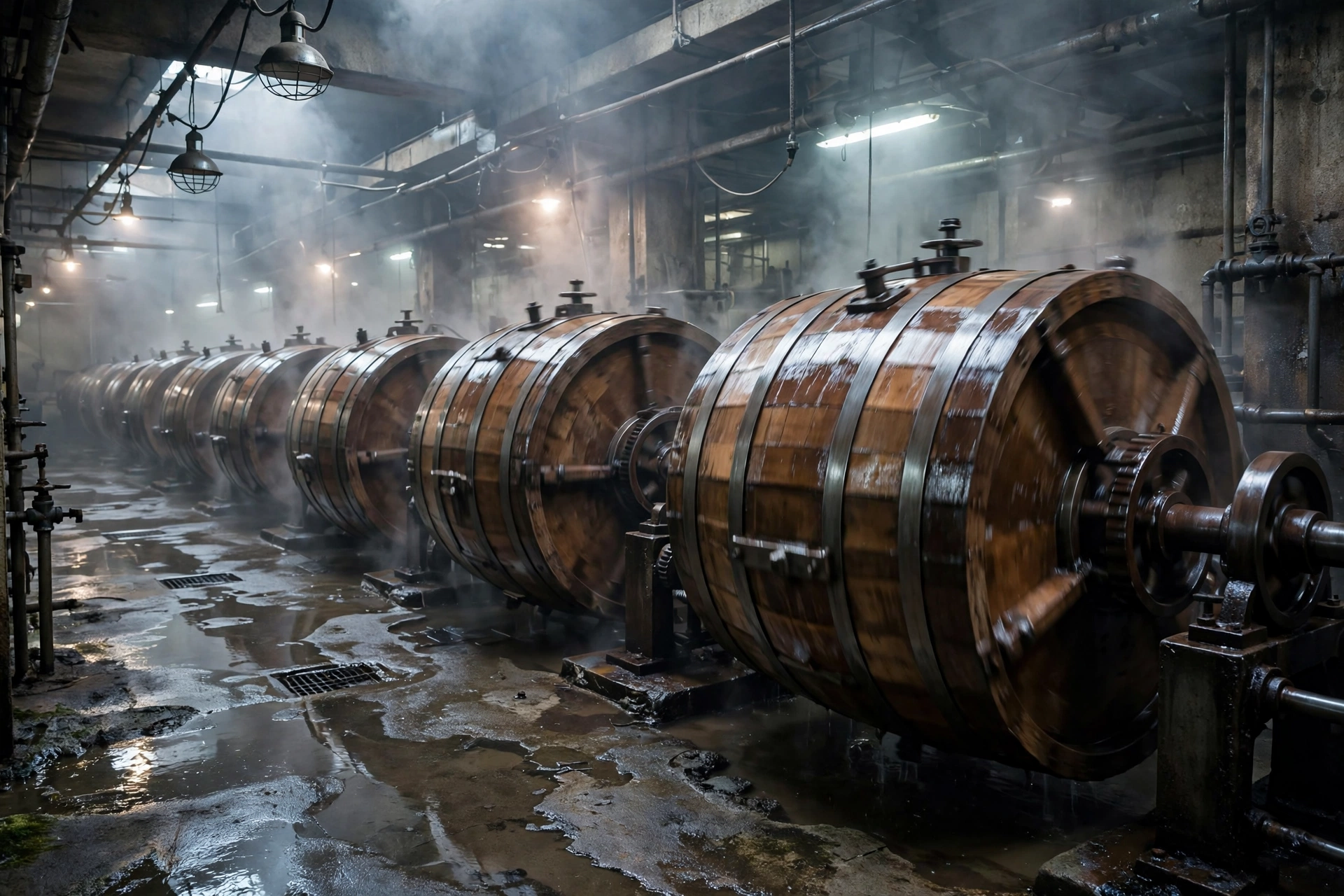
A tannery turns raw animal hides into leather, and almost everything in that transformation is time-critical. Raw hide is a perishable material. Left untreated it rots. The beamhouse — soaking, liming, unhairing, fleshing, deliming and bating — opens the collagen fibre structure so that tanning chemicals can enter. Chrome tanning then fixes chromium into the collagen and makes the hide stable against heat, water and bacteria. About 80–85% of garment leather worldwide is chrome-tanned, and the chrome step runs in a rotating wooden drum for 8–24 hours at a liquor temperature of about 30–40 °C. The drum does not stop for the night, and it does not stop for a blackout.
The scale of the industry is easy to underestimate. India alone has hundreds of tanneries clustered in Kanpur, Chennai, Ambur, Kolkata and Unnao, most of them small: in Kanpur’s Jajmau cluster, 250 tanneries operate side by side, and 85% of them are small-scale units. Bangladesh moved its Hazaribagh cluster to Savar outside Dhaka. Ethiopia, Pakistan, Vietnam and Brazil all run tannery clusters where the grid is unreliable and the outage is a normal working condition, not an exception. A tannery in any of those clusters buys a generator for the same reason a hospital buys one: the process cannot be paused and restarted without damage.
That damage is not theoretical. It is measured in hides, and hides are the tannery’s working capital. A cow hide entering the drum is worth far more than the chemicals around it. Once the drum stops turning, the hides inside settle to the bottom of the liquor, the chrome stops reaching them evenly, and the batch starts to drift out of specification. The longer the stop, the worse the drift. A tannery that loses power for two hours does not lose two hours of production. It loses the batch that was in the drum, the batch that was in the dryer, and the day’s effluent compliance — three losses from one outage.
The energy numbers explain why the generator question is smaller than buyers expect, and larger than they fear. The European Commission’s tanning reference document puts about 85% of a tannery’s energy as heat and 15% as electricity. Drying takes 32–34% of total energy, hot water about the same, and machinery and process vessels only 9–12%. Total energy runs 9.3–42 GJ per tonne of raw hide. The boiler, not the generator, carries the thermal load: a boiler burns fuel oil or gas to make steam for drying and hot water, and a power cut does not stop a boiler that is already fired. What the generator must carry is the electrical slice — drums, pumps, fans, compressors, aerators and controls — and that slice is a few hundred kVA in most tanneries. That is the good news. The bad news is that the electrical slice is also the slice that decides whether the hides survive.
The drum clock
The drum clock starts the second the power fails. A chrome tanning drum is a wooden cylinder, typically 2.5–3.5 metres in diameter, turning slowly — a few revolutions per minute — on a motor of 5.5–15 kW. Inside it, hides tumble in a liquor of chromium(III) sulphate at pH 3.0–3.5. The chrome has to cross the full thickness of the hide, and it does so only while the drum keeps the hides moving through the liquor. The standard chrome step takes 8–24 hours, and the basification that fixes the chrome — raising the pH to 3.8–4.0 at about 40 °C — takes a further 2–4 hours of rotation.
Stop the drum for an hour and the hides at the bottom of the pile sit in liquor that is no longer being refreshed, while the hides at the top dry out in the air. Chrome uptake becomes uneven across the batch. The result is not a batch that needs a little more time. It is a batch with stained, patchy grain, loose areas where the chrome never penetrated, and tight areas where it over-fixed. The trade calls the finished stage “wet blue” for its pale blue-grey colour; uneven chrome shows up as uneven blue, and a buyer grading wet blue by hand rejects it on sight. A drum holding 500 kg of hides — roughly 20–25 cow hides — carries several thousand dollars of raw material. One stalled drum can write off a day’s tanning.
The drum motor itself is not the problem. A 11 kW drum motor draws about 14 kVA running and six to seven times that for a few seconds on a direct-on-line start. The problem is the load the motor carries when it restarts: a drum full of wet hides and liquor is a heavy, unbalanced load, and a generator that dips below 20% voltage on the restart will trip the drum drive or stall it halfway up to speed. The sizing answer is therefore not the running kW of the drums. It is the starting kVA of the largest drum, plus the base load already running.
The drying clock
The drying clock runs faster and costs more. After tanning, retanning, dyeing and fatliquoring, the leather is dried — on a vacuum dryer at 60–80 °C, in a toggle dryer, or in a drying tunnel with forced air. Drying is the single largest energy consumer in the tannery at 32–34% of total energy, and it is also the stage where a stop does the most visible damage. Leather left half-dry in a vacuum dryer cools and re-wets unevenly. Leather left in a hot tunnel with the fans stopped cooks on one side and stays damp on the other. The result is case hardening — a dry, hard surface over a damp core — and leather that cracks when it is staked and finished.
A vacuum dryer is the worst case for a power cut. The dryer holds the leather against a heated plate under vacuum, and the vacuum pump and the hot-water circulation pump both need power. Lose the pumps and the vacuum breaks, the plate cools, and the batch has to be re-dried from the start — if it can be saved at all. A toggle dryer is more forgiving: the leather is clipped to a frame and air-dried, so a stop costs time rather than the batch. But a tannery with a vacuum dryer and no generator on its drying board is gambling a full day’s finished leather on every outage.
The Tannery Process, Load by Load
A tannery has five electrical stages. None of them draws the megawatts of a smelter or a cement kiln, but all five must be understood before a generator can be sized, because the loads that look small on paper are the ones that decide whether the batch survives. The table below shows the split for a typical tannery processing 500 hides a day, then each stage is examined in turn.
| Stage | Typical electrical load | Generator carries? | Tolerable gap |
|---|---|---|---|
| Beamhouse (soak, lime, fleshing) | 40–80 kW | Yes — drums, pumps, fleshing machines | Hours for soaking, minutes for fleshing |
| Tanning drums (chrome, retan, dye) | 60–120 kW | Yes — all drums | Minutes — hides settle and stain |
| Drying (vacuum, toggle, tunnel) | 50–90 kW | Yes — vacuum pumps, fans, circulation | Minutes — case hardening, re-dry |
| Finishing (staking, spraying, plating) | 30–60 kW | Partial — staking and plating first | Hours — mostly time, not batch loss |
| Effluent treatment (ETP/CETP feed) | 40–70 kW | Yes — aeration, pumps, dosing | Hours — then discharge breach |
The beamhouse is the least time-critical stage and the easiest to protect. Soaking takes 8–24 hours and liming 1–3 days; a hide sitting in a lime pit for an extra two hours is not damaged. What the beamhouse needs from a generator is the fleshing machine and the drum drives. A fleshing machine strips flesh and fat from the hide on a rotating cylinder with a spiral blade, and a hide half-through the fleshing machine when the power fails has to be pulled out by hand before the blade marks it. The beamhouse also runs the largest water pumps in the plant: a tannery uses about 50 m³ of water and 300 kg of chemicals per tonne of processed hides, and that water has to be moved, heated and drained on schedule.
The tanning drums are the heart of the plant and the first load on the critical board. A medium tannery runs 6–10 drums, each driven by a 5.5–15 kW motor, and the drums run in rotation around the clock: one batch soaking, one liming, one chrome-tanning, one retanning and dyeing. The chrome drum is the load that cannot wait. The retanning and dyeing drums are almost as sensitive: dye that stops circulating settles, and a batch that comes out of a stopped dye drum has a shade that no buyer will accept. Dyeing is the stage where a power cut is visible in the finished leather, because colour is the first thing a buyer checks.
Drying is the largest electrical load after the drums, and the most expensive to get wrong. A vacuum dryer draws 20–40 kW for its vacuum pump and circulation, a drying tunnel draws 15–30 kW for fans and conveyors, and a toggle dryer draws less — 5–10 kW — because it relies on air movement rather than heat and vacuum. The thermal energy for drying comes from the boiler, so the generator is not carrying the heat. It is carrying the machines that move the heat and the leather. That distinction matters for sizing: a buyer who sizes the generator for the boiler’s thermal load will buy a set three times too big, and a buyer who forgets the vacuum pump will lose a day’s leather to a 200 kVA set that was almost big enough.
Finishing is the most forgiving stage. Staking softens the leather, spraying applies the finish coat, and plating presses the grain. A stop in finishing costs time, not material: the leather sits, the operators wait, and the line restarts. Finishing is therefore the first load to shed when the generator is running close to its limit, and the last load to restore when the grid returns.
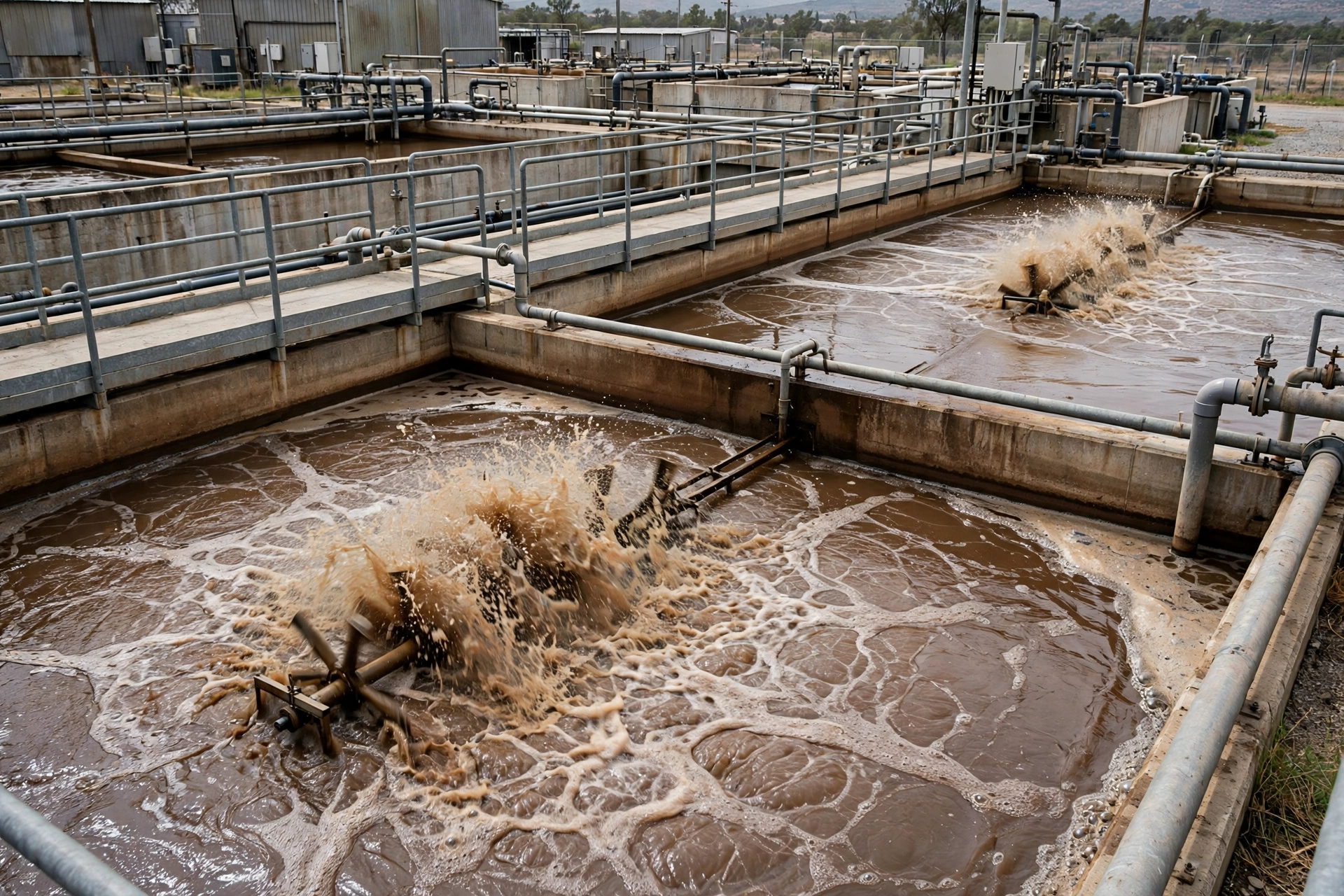
Effluent treatment is the stage buyers most often leave off the critical board, and the one that costs the most when it stops. A tannery’s effluent is among the most polluting industrial wastewaters in existence: high chemical oxygen demand, high dissolved solids, sulphide from liming, and chromium from tanning. The effluent treatment plant — the ETP inside the tannery, or the feed to a common effluent treatment plant, the CETP, in a cluster — runs aeration blowers, transfer pumps, dosing pumps and mixers around the clock. Stop the aeration and the biology in the activated-sludge basin starts to die within hours. Stop the pumps and untreated effluent backs up into the plant. The ETP is not a production load. It is a compliance load, and in a cluster like Kanpur it is the load that decides whether the tannery is allowed to open tomorrow.
What Size Generator Does a Tannery Need?
The answer depends on hides per day, because hides per day decides how many drums run at once, how much leather is in the dryers, and how much effluent the ETP has to treat. The table below gives planning bands for the critical board — the loads the generator must carry — for three sizes of tannery. These are planning figures for a chrome-tanning plant running one shift of beamhouse and tanning with drying through the day; a tannery running two shifts or a vegetable-tanning line will sit higher.
| Tannery size | Hides per day | Critical board | Recommended set |
|---|---|---|---|
| Small, jobbing tannery | 50–150 | 60–120 kVA | 150 kVA standby / 135 kVA prime |
| Medium, export tannery | 150–400 | 150–300 kVA | 350 kVA standby / 320 kVA prime |
| Large, integrated tannery | 400–1,000 | 300–500 kVA | 500 kVA standby / 455 kVA prime |
| Very large, cluster anchor | 1,000+ | 500–800 kVA | 750–1000 kVA standby |
The pattern in the table is worth reading carefully. A tannery processing ten times as many hides does not need ten times the generator. The critical board grows more slowly than throughput, because the drum count grows in steps and the ETP load grows with effluent volume rather than with hides. A 100-hide tannery needs about 100 kVA on its critical board. A 500-hide tannery needs about 350–400 kVA. A 1,000-hide tannery needs about 600 kVA. The generator is sized by the machines, not by the hides, and the machines are counted one by one.
The worked example below is for a medium-to-large export tannery in a cluster, processing 500 cow hides a day into wet blue and crust leather for shoe uppers. It is the size of plant most often asking PAVO for a quotation, and the numbers are the ones that should appear on the load list the buyer sends with the enquiry.
The worked example: 500 hides a day
The plant runs eight drums: three in the beamhouse, two chrome-tanning, two retanning and dyeing, one in reserve. Drum motors are 11 kW each, six running at any time. Fleshing and splitting take 30 kW between them. Drying runs one vacuum dryer at 35 kW and one tunnel at 20 kW. The ETP runs aeration blowers at 37 kW and transfer and dosing pumps at 18 kW. Air compressors for the spray booths and pneumatic tools take 22 kW. Lighting, controls, the boiler feed pump and the water pumps take 25 kW. The running total is 290 kW, or about 363 kVA at 0.8 power factor.
Starting surge is what moves the answer from 363 kVA to 500 kVA. The largest single motor is the 11 kW drum motor on a direct-on-line start, drawing about 70 kVA for a few seconds. The aeration blower at 37 kW draws about 200 kVA on a direct-on-line start, and it is the motor that decides the frame size if it is started while the drums are already running. The honest sizing sequence is the one the generator sizing guide sets out: locked-rotor kVA of the largest motor with its starter factored in, plus the base load already running, checked against the voltage dip the plant can survive. With the blower on a soft starter — the right choice on a generator-fed board — its starting draw falls to about 90 kVA, and a 500 kVA standby / 455 kVA prime set carries the board with margin for one more drum.
That set is the Cummins C500D5 class: 500 kVA standby, 455 kVA prime, on a QSZ13-G5 engine. It is worth noting what the set is not carrying. It is not carrying the boiler, which burns its own fuel. It is not carrying the steam load, which is thermal. And it is not carrying the whole plant: finishing, the spray booths and the second drying tunnel are shed on generator power, and they wait for the grid. A buyer who insists on backing up everything will be quoted a 1,000 kVA set and will pay for it. A buyer who backs up the critical board will be quoted 500 kVA and will keep the hides.
Two details decide whether the set works in practice. The first is the rating. A tannery in a cluster with an unreliable grid runs its generator for hundreds of hours a year, and that is prime duty, not standby duty. The standby and prime ratings are not a marketing choice: a standby-rated set is designed for up to 200 hours a year, and a tannery that runs it for 600 hours a year will wear it out early and lose the warranty argument when it does. The prime rating on the same frame is 455 kVA, about 9% lower, and it is the figure the load list should be checked against. The second detail is the transfer switch. The automatic transfer switch must move the critical board to the generator in under 10 seconds, and it must do so on a board where the drum drives are already loaded. A transfer switch that is slow, or that drops the board and re-energises it in one step, will stall the drums it was bought to protect.
What the set costs to run
A 500 kVA set at 75% load burns about 69.9 litres per hour on prime rating, and 93.2 litres per hour at full load. At a diesel price of $1.00–1.20 per litre in most tannery markets, that is $70–84 per hour at three-quarter load, or about $840–1,000 for a 12-hour outage day. Against that, a single drum of 500 kg of hides written off by a stalled chrome batch costs several thousand dollars in raw material alone, before the lost dye batch, the re-drying and the missed shipment are counted. The generator pays for its fuel on the first outage that would otherwise have stopped a drum. The question is never whether the fuel is expensive. It is whether the hides are worth more than the fuel, and they always are.
What Happens When the Power Fails Mid-Shift
Three cases, from three tannery clusters, show what a power cut actually does inside a tannery. None of them is a story about a generator failing. All three are stories about a tannery that had no generator on the right board, or had one and never tested it under load.
Case 1: Kanpur — a drum of hides left standing
Jajmau, Kanpur, is one of the largest tannery clusters in the world: 250 tanneries in a single industrial estate on the bank of the Ganges, most of them small, most of them chrome-tanning cow and buffalo hides for export. Power supply in the cluster has always been unreliable, and the tanneries that survive are the ones that treat the generator as production equipment rather than as a compliance purchase.
A medium tannery in the cluster runs six drums and processes about 300 hides a day. One afternoon the grid failed at 14:20, in the middle of a chrome batch that had been running since 08:00. The tannery had a generator, but it was wired only to the lighting and the office, and the drums were on the unprotected board. The drum stopped with 450 kg of hides in chrome liquor at pH 3.2. The operators could not turn the drum by hand — a loaded drum weighs over a tonne — and the grid did not return for four hours.
When the drum restarted, the batch was visibly uneven. The hides that had sat at the bottom of the drum were darker and stiffer than the hides that had sat at the top, and the grain showed the patchy staining that comes from chrome settling in a still liquor. The batch was downgraded from shoe-upper grade to lining grade, a price drop of roughly 40%, and the tannery lost about $2,500 on that one drum. The generator that would have kept the drum turning cost less than the loss on two such batches. The tannery rewired the drums onto the generator board the following week, and the next outage — three weeks later — passed without a single hide lost.
Case 2: Ambur — the effluent plant that stopped first
Ambur, in Tamil Nadu, is a leather cluster of a different kind: a dense concentration of tanneries feeding a common effluent treatment plant, with discharge into the Palar river basin under close regulatory watch. The tanneries there live or die by their effluent compliance, and the CETP is the cluster’s most important shared asset.
A tannery in Ambur processing 400 hides a day had its generator sized for the drums and the dryers, and sized well: a 350 kVA set that carried the production board without complaint. What it did not carry was the tannery’s own primary effluent treatment plant — the screens, the equalisation tank, the chemical dosing and the transfer pumps that feed the CETP. When the grid failed for six hours during a monsoon storm, the drums kept turning and the dryers kept drying. The ETP stopped.
The equalisation tank filled in two hours. After that, untreated effluent — chrome liquor, sulphide-bearing lime liquor and dye bath — had nowhere to go. The tannery held what it could in the drums and the pits, and discharged the rest to the CETP feed line untreated, at a chromium concentration far above the 2 mg/L limit the pollution control board enforces. The board’s inspectors sampled the CETP inlet the following morning, traced the spike to the tannery, and issued a closure notice. The tannery was shut for 11 days while it proved its ETP was back in compliance. Eleven days of lost production, against a 55 kW aeration and pumping load that a 75 kVA addition to the generator board would have carried. The drums survived the outage. The business did not, for a fortnight.
Case 3: Dhaka — wet blue that could not wait
The Savar leather estate outside Dhaka houses the tanneries relocated from Hazaribagh, and it runs on a grid that fails often enough that every tannery there owns a generator. The question in Savar is not whether to own a set. It is whether the set is tested under load, and whether the loads on it are the loads that matter.
A tannery in Savar producing wet blue for export had a 500 kVA set and a monthly test routine — but the test was a no-load run. The set started, ran for 30 minutes with no load, and was logged as healthy. One evening the grid failed while a batch of 600 kg of hides was in the dye drum and a second batch was in the vacuum dryer. The set started, the automatic transfer switch closed, and the board took the load. Then the set stalled. The dye drum motor, the vacuum pump and the aeration blower all started within seconds of each other, the voltage dipped below the under-voltage trip, and the set shut down on overload.
The dye drum sat for three hours while the electrician found the fault and restarted the set on a staged load. The batch in the dye drum came out with a shade variation the buyer rejected, and the batch in the vacuum dryer had to be re-dried — a full day of drying capacity lost. The post-mortem was simple: the set had never been load-bank tested, the starting sequence had never been rehearsed, and the three largest motors had never been started together. A motor starting study would have shown that the blower needed a soft starter and the drum needed to start first, alone, before the dryer and the ETP were added. The tannery now tests under load every month, with the same starting order it uses in a real outage, and the set has carried four outages since without a trip.
How Long Can a Tannery Run on a Generator?
The answer is a fuel calculation, and it is the calculation buyers most often get wrong — because they size the tank for the outage they expect, and the outage they get is longer. A 500 kVA set at 75% load burns 69.9 litres per hour. A 1,000-litre day tank therefore gives about 14 hours. A 2,000-litre tank gives about 28 hours. A tannery that wants 72 hours of autonomy needs about 5,000 litres of usable fuel, and a bulk tank to hold it.
| Autonomy | Fuel needed (500 kVA at 75%) | Tank | What it covers |
|---|---|---|---|
| 8 hours | ~560 L | Day tank, 1,000 L | One shift, one drum cycle |
| 24 hours | ~1,680 L | Day tank + 2,000 L bulk | A full day, all drums and dryers |
| 72 hours | ~5,030 L | 5,000–6,000 L bulk tank | A long outage, full production |
| 7 days | ~11,700 L | 12,000 L bulk + delivery contract | A grid failure, not a blip |
The fuel calculation has a second half that tanneries forget: diesel fuel ageing. A bulk tank that sits full for six months between outages grows water in the bottom, and water grows microbes, and microbes grow sludge that blocks filters exactly when the set is needed most. Fuel in a standby tank should be tested every six months and polished or replaced when it fails. A tannery that buys 5,000 litres of fuel and forgets it for a year has bought a filter blockage, not autonomy. The generator maintenance schedule is the document that keeps the fuel honest: filters, coolant, batteries and fuel testing on a calendar, not on a memory. A remote monitoring controller that reports fuel level, run hours and faults to the manager’s phone turns a weekly check into a continuous one, and it is the cheapest way to know the set is ready before the outage rather than after it.
Fuel theft is a smaller risk in a tannery than at a telecom tower, but it is not zero. A bulk tank in an unfenced yard in a cluster is an easy target, and a tannery that discovers its 5,000-litre tank is half empty during an outage has the same problem as a tannery with no tank at all. A lockable filler, a level gauge that the manager reads weekly, and a delivery ledger are cheap insurance.
Where the set sits: wet floors, salt and hydrogen sulphide
A tannery is a hard place for a generator to live. The floors are wet, the air carries salt from the pickling baths and hydrogen sulphide from the liming pits, and the drum house is humid enough to condense on any cold surface. A generator installed in the open next to the drum house will corrode faster than the same set installed in a dry warehouse, and the corrosion shows up first where it matters most: the alternator windings, the control panel contacts, and the battery terminals.
Three placement rules follow. First, the set goes in a ventilated enclosure or a canopy with a roof, on a raised plinth above the wet floor, and never in the drum house itself. Second, the alternator needs the anti-condensation heater wired and working, because a set that sits cold and damp between outages will fail its insulation test when it is needed. Third, the control panel needs to be in a dry room, or at least under a cover, because hydrogen sulphide attacks silver contacts and a contact that fails open is a set that will not start. A silent canopy set is the right choice for most tanneries: it keeps the rain off, it keeps the noise down for the neighbouring units in the cluster, and it keeps the set’s own heat inside the enclosure where the ventilation can manage it. The ventilation calculation — how much air the room needs — is the same one the generator room article sets out, and it applies in full to a tannery: a 500 kVA set needs roughly 30–40 m³/min of cooling and combustion air, and a room that cannot supply it will cook the set on a hot day.
Effluent, Chrome and the Law: Why the ETP Is on the Critical Board
A tannery’s effluent is the reason the generator question is also a legal question. Tannery wastewater carries chromium, sulphide, chloride, dissolved solids and organic load at concentrations no other common industry matches. A single tonne of raw hides produces about 50 m³ of wastewater, and that wastewater, untreated, will kill a river. The regulators know it, and they enforce it with closure notices rather than warnings.
The numbers are not ambiguous. In Kanpur, the pollution control board’s limits for the primary effluent treatment plant discharge are 600 mg/L total suspended solids and 2 mg/L total chromium. The common effluent treatment plant at Jajmau is rated at 20 million litres a day for 250 tanneries, and it has been overloaded for years: in October 2019, 122 tanneries were closed for discharging untreated effluent after the CETP could not take their flow. The closure lasted until the tanneries could prove their own treatment was working. A tannery that loses its ETP in a power cut is not just losing production. It is losing its licence to operate.
The discharge limits are the sizing constraint
The ETP load is small — 40–70 kW for a medium tannery — and it is the load most often left off the generator board because it does not make leather. That is the wrong way to think about it. The ETP is the only load in the plant whose failure can close the tannery for a fortnight. The drums make the product. The ETP keeps the factory open. The aeration blowers are the largest single ETP load, and they are also the load with the least tolerance for a stop: the biology in an activated-sludge basin starts to lose dissolved oxygen within 1–2 hours of the blowers stopping, and a basin that goes anaerobic takes days to recover, not hours. The transfer pumps are the second load: without them, the equalisation tank fills and the plant has nowhere to put its effluent. The dosing pumps are the third: without chrome precipitation chemicals, the chromium passes straight through to the discharge.
The US Environmental Protection Agency’s reliability criteria for wastewater facilities make the same point in regulatory language: a Class I facility — one whose discharge could permanently damage the receiving water — must provide backup power for all vital process components at peak flow. A tannery ETP in a cluster on a river is a Class I facility in everything but name. The generator board should treat it as one.
Chrome recovery pays for part of the generator
There is a commercial argument for the ETP load as well. Only 70–80% of the chrome in a tanning bath is taken up by the hides. The rest stays in the spent liquor, and a tannery that recovers it — by precipitating the chromium, re-dissolving it and reusing it in the next batch — saves 20–30% of its chrome chemical cost and cuts the chromium load on the ETP at the same time. Chrome recovery needs power: the precipitation tank mixer, the filter press and the transfer pumps. A generator that keeps the recovery plant running through an outage is not just protecting compliance. It is protecting a chemical saving worth thousands of dollars a year. The water and wastewater treatment article sets out the pumping and treatment sizing in detail; the tannery version of the same argument is simpler — the ETP is a production asset, and it belongs on the generator board with the drums.
Frequently Asked Questions
What size generator does a tannery need?
A tannery processing 500 hides a day needs 400–500 kVA on its critical board — drums, drying, effluent treatment and utilities. A small 100-hide tannery needs about 100–150 kVA, and a large 1,000-hide plant needs 600–800 kVA. Size from a load list of the machines that must not stop, then add the starting surge of the largest motor.
Do tanneries need a backup generator?
Yes, in any cluster where the grid is unreliable — which is most tannery clusters. The chrome drum cannot wait, the vacuum dryer cannot wait, and the effluent plant cannot wait. A tannery without a generator on its critical board loses batches, not just hours, and a single stalled drum can cost more than a day of generator fuel.
How long can a tannery run on a generator?
As long as the fuel lasts. A 500 kVA set at 75% load burns about 70 litres per hour, so a 1,000-litre day tank gives about 14 hours and a 5,000-litre bulk tank gives about 72 hours. The practical limit is fuel storage and delivery, not the engine: a prime-rated set is designed for unlimited annual hours.
What happens to a tannery during a power outage?
The drums stop and the hides inside settle, so chrome uptake becomes uneven and the batch is stained or downgraded. The vacuum dryer loses its pumps and the leather case-hardens or has to be re-dried. The effluent plant stops aerating, the biology dies back, and untreated effluent backs up — which can breach discharge limits and trigger a closure notice.
Can a diesel generator power a tannery?
Yes — the critical board, not the whole plant. A diesel set carries the drums, the drying machines, the effluent treatment and the utilities, which total a few hundred kVA in most tanneries. It does not carry the boiler’s thermal load, which burns its own fuel, and it does not need to carry finishing and the second drying line, which can wait for the grid.
Specification Checklist: Ten Lines Before the Deposit
- Which rating is quoted — ESP, PRP or COP? A tannery running hundreds of generator hours a year needs prime power. Check the prime figure, not the standby figure.
- Is the load list the critical board or the whole plant? Drums, drying, ETP and utilities on the generator; finishing and the second dryer shed. The quotation should say so.
- What is the largest motor, and how does it start? The aeration blower and the largest drum motor decide the frame size. A soft starter on the blower is worth more than a bigger set.
- What is the starting order? Drums first, alone, then dryers, then ETP. The order should be written down and rehearsed under load.
- Has the set been load-bank tested? A no-load monthly run proves the engine starts. It proves nothing about carrying the board. Demand a load-bank test before acceptance.
- How many hours of fuel are on site? Day tank plus bulk tank, with a delivery contract. A 72-hour autonomy target needs about 5,000 litres for a 500 kVA set.
- Is the fuel tested? Fuel in a standby tank should be tested every six months. A blocked filter in an outage is a failed generator.
- Where does the set sit? Raised plinth, ventilated canopy, dry control panel, anti-condensation heater wired. A tannery’s wet, salty, sulphide air corrodes a set that is left in the open.
- Is the ETP on the generator board? Aeration, transfer pumps and dosing. If the answer is no, the quotation is incomplete.
- Will the warranty stand at the stated duty? Ask in writing, with the annual hours and the site conditions attached. A direct answer is worth more than a discount.
A tannery’s generator is not a piece of insurance. It is production equipment, in the same sense as a drum or a dryer, and it should be specified with the same care. The drum that keeps turning through an outage is a batch that ships on time. The dryer that keeps its vacuum is a day’s leather that does not need re-drying. The effluent plant that keeps aerating is a factory that opens tomorrow. Size the set for the loads that must not stop, test it under those loads, and keep fuel in the tank. The hides cannot wait, and neither can the river.
For a sizing quotation on your tannery’s critical board — drum count, dryer type, ETP load and hides per day — contact PAVO with those four lines, and the right set will be priced from them, not from a guess.