

What Size Generator Does a Shipyard Need? Guide | PAVO
A shipyard is the one industrial site where the load list reads like a port, a steelworks and a welding school at the same time. A single gantry crane can draw more power than a small town, and the vessel sitting in the dock has nowhere to go when the lights go out.
What size generator does a shipyard need? A small repair yard typically needs 250–500 kVA; a mid-size newbuild yard 1,000–2,000 kVA; and a large yard with a 1,000-tonne gantry crane 2,000–3,750 kVA or more, because the crane, dry-dock pumps and welding load decide the rating, not the yard’s total connected load.
Contents – What a Shipyard Actually Runs on Power – The Damage Window: What Stops First When the Power Goes – How Big: Sizing Bands by Yard Type – The Crane Problem: Starting Surge and Regenerative Braking – Dry Docks and Flooding: The Pumps That Must Not Stop – Fuel Autonomy and Salt Air: Running for Days on a Coastal Yard – Frequently Asked Questions – Shipyard Generator Specification Checklist
What a Shipyard Actually Runs on Power
A shipyard’s load list looks nothing like a factory’s. A factory runs the same machines every day. A yard runs a different combination every week, depending on which hull is in the dock, which blocks are being welded and whether a crane is lifting a 400-tonne engine at the same time. The first job in sizing a yard generator is to stop thinking in connected load and start thinking in what actually runs together.
The dry dock and its pumps
The dry dock is the heart of a repair yard and the first load that cannot wait. A graving dock is a concrete basin the size of a football field, flooded to float a ship in, then pumped dry so the hull sits on blocks. The dewatering pumps are the largest steady load in the dock: typically two to four pumps of 250–500 kW each, running for 4–8 hours to empty a large dock, then holding the dock dry against seepage for the whole docking period. Lose power while the dock is being pumped down and the water level rises again, the hull settles back onto blocks that are not yet taking the load evenly, and a docking that was scheduled for three days becomes a week of re-work.
A floating dock is worse in one respect: it has no concrete walls. It stays afloat by pumping ballast water in and out of its tanks, and the pumps, the valve controls and the stability monitoring all need power continuously. A floating dock that loses power does not just stop working. It starts to lose trim. The PD-50 case in the next section is what happens when that goes wrong.
The fabrication halls
Away from the dock, the fabrication halls are where the steel is cut, bent and welded into blocks. A single manual metal-arc welding station draws 10–20 kVA; a MIG station 15–30 kVA; a plasma cutter 20–40 kVA. One hall with 30 welders at work does not draw 30 times the station rating, because welders strike arcs in bursts and rest between passes. The diversity factor for welding is typically 0.4–0.6, so 30 welders at 20 kVA each is a 240–360 kVA load, not 600 kVA. Get the diversity wrong in either direction and the set is either oversized and wet-stacking at 30% load, or tripping out the moment the morning shift strikes its first arcs.
Panel lines, plate-cutting machines and press brakes add steady base load. A CNC plasma or laser cutting table draws 60–120 kW while cutting. Air compressors for blasting and pneumatic tools run 75–200 kW each, and they cycle on and off all day, which is exactly the kind of load that punishes an undersized alternator with repeated starting surges.
Cranes, the largest single load
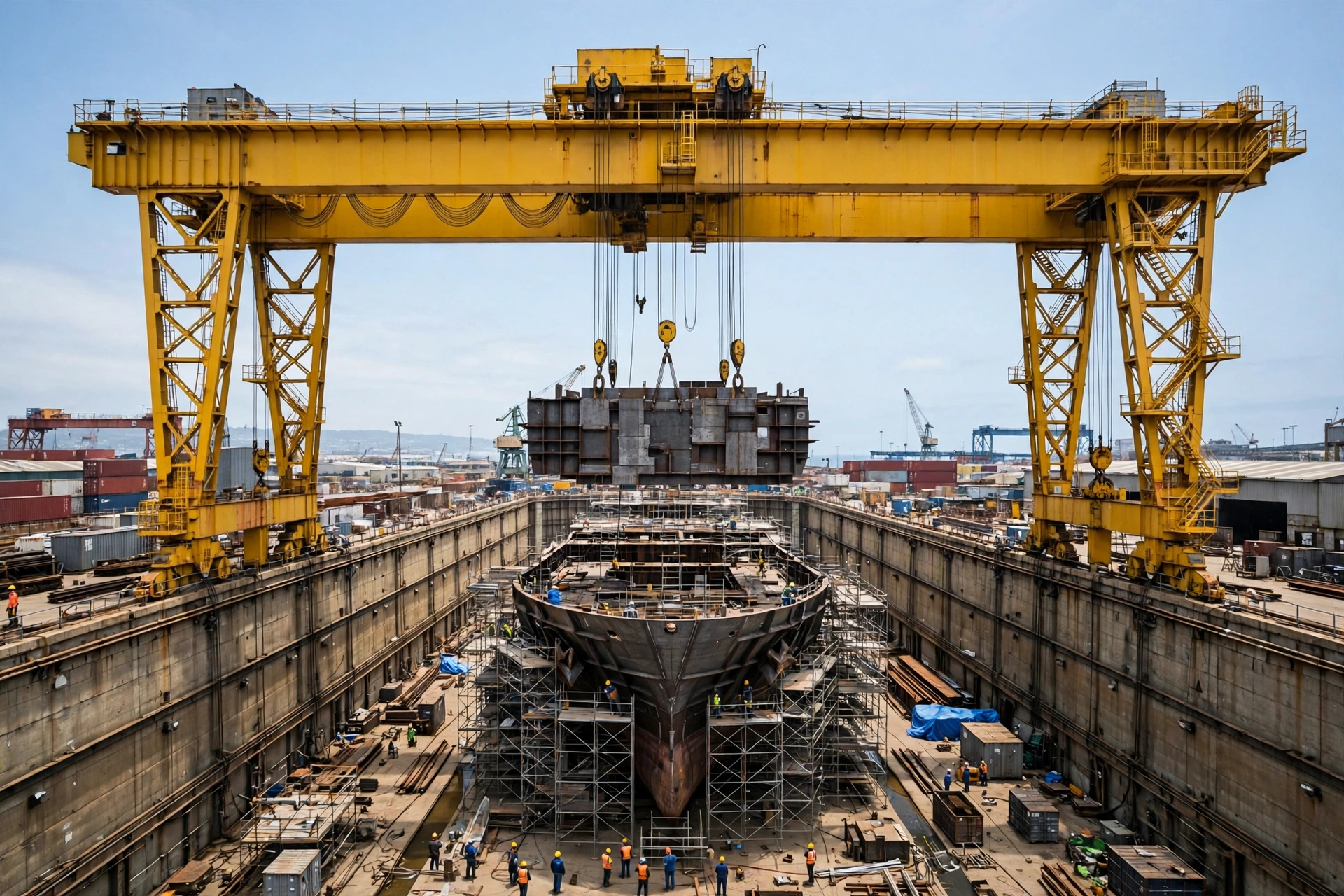
The gantry crane — the Goliath — is the load that decides whether the yard needs a 1,000 kVA set or a 3,750 kVA set. These are not the 10-tonne overhead cranes of a warehouse. Mitsubishi Heavy Industries’ Koyagi plant in Nagasaki runs a 1,200-tonne Goliath crane, 95.5 m high and 185 m wide, lifting hull blocks of up to 1,500 tonnes. Konecranes’ largest Goliath at Hyundai Samho in South Korea lifts 1,650 tonnes, stands 142 m tall with a 165 m span, and runs on 42 electric motors carried on 96 wheels. Meyer Turku’s 1,200-tonne crane in Finland is 120 m high with a 154 m rail span and a 90 m lifting height.
A crane of this size does not draw a steady load. It draws almost nothing while it travels empty, then a sharp peak when the hoist lifts a block, then it feeds power back when the load is lowered. The peak is what the generator must survive. The CRIST shipyard in Gdynia, Poland, published the numbers for its 1,000-tonne crane: more than 100 electric motors rated from 11 kW to 350 kW, fed by two 2 MW rectifiers on a 4 MW DC bus. That is one crane drawing up to 4 MW at peak — more than the entire fabrication hall behind it. No yard backs up a 4 MW crane peak with diesel alone. The question is which parts of the crane load the generator must carry, and which parts can wait.
Outfitting, offices and the docked vessel
The fourth tier is the load most buyers forget until the first outage: the vessel itself. A ship in dry dock is not dead. Its crew — or the yard’s outfitting team — needs lighting, ventilation, fire detection, bilge alarms, hotel services and, for a cruise ship or ferry, refrigeration and air conditioning for the spaces still in use. A large cruise ship on shore power in dock draws 500 kW to 2 MW. A cargo vessel draws less, typically 100–400 kW, but it still needs it. Add the yard’s own offices, the design department’s servers, the stores, the security lighting and the perimeter, and the “small” loads add up to 150–300 kVA that must be on the essential board from the first second.
The Damage Window: What Stops First When the Power Goes
A shipyard outage is not one failure. It is a sequence, and the sequence runs fast. The first ten seconds decide whether the yard has a bad day or a bad month, because that is the window in which a crane is holding a load in the air and a dock is holding a ship out of the water.
A weld stops in seconds; a crane stops mid-lift
Welding is the most forgiving load in the yard and the most expensive to restart. An arc stops the instant the power goes. The weld pool freezes mid-bead, and the joint has to be ground back and re-welded. On a single joint that costs an hour. On a hull block with forty welders working, it costs a shift. The steel is not damaged — the schedule is. A yard that loses power at 10 a.m. does not lose an hour of welding. It loses the day’s block-erection sequence, because the block that was due on the dock at 2 p.m. is not ready, and the crane that was booked for it is now idle.
The crane is the sharper problem. A Goliath crane holding a 400-tonne block in the air has spring-applied, fail-safe brakes that engage the moment power is lost. The load does not fall. But it hangs, and it hangs where it is, possibly over the dock, possibly over a half-finished hull, in wind. The crane cannot be moved until power returns, and the block cannot be set down safely until the crane can travel. A 20-minute outage with a block in the air is a 20-minute delay. A 6-hour outage with a block in the air is a rigging inspection, a re-plan and a lost docking slot.
The docked vessel loses its hotel load
The vessel in the dock loses its shore supply the moment the yard’s incomer trips. Its own emergency generator — if it has one running — picks up fire pumps, emergency lighting and steering gear, but not the hotel load, not the ventilation and not the refrigeration. On a cruise ship in refit, that means cabins without air conditioning, galleys without refrigeration and a thousand workers in a steel box that heats up fast. On a cargo vessel, it means the ballast and bilge monitoring goes dark, and the yard’s own fire watch has to take over with portable equipment.
The vessel’s owner charges for the dock by the day. A cruise line that loses a dry-dock slot because the yard’s power failed does not absorb the cost quietly. The Grand Bahama Shipyard case, below, shows what a lost dock costs when the yard cannot deliver: $52 million in lost earnings from one dock going out of service, three cancelled cruises and a second vessel diverted to Europe.
The floating dock lesson from Murmansk
The clearest warning in the industry comes from Murmansk, Russia, in October 2018. The floating dry dock PD-50, servicing the aircraft carrier Admiral Kuznetsov, lost its power supply. Without power, the dock’s ballast control stopped working. The dock began to sink and tilted as it went down. One of its cranes fell onto the carrier’s deck. The official commission identified 52 instances of damage, with repairs estimated at about 70 million rubles — roughly $1 million — and the carrier’s refit was delayed by months.
The lesson is not that floating docks are fragile. It is that a floating dock’s power supply is a safety system, not a convenience. The pumps, the ballast valves and the stability monitoring are the only things keeping several thousand tonnes of steel and a warship afloat in the right attitude. A yard that runs a floating dock on a single grid incomer with no standby generation is betting the dock on the utility’s reliability. The PD-50 sinking is the price of losing that bet.
How Big: Sizing Bands by Yard Type
The sizing question has no single answer, because a “shipyard” covers everything from a two-slip repair yard to a yard that builds LNG carriers. The bands below are the starting point. The worked example after the table shows how a real yard lands inside its band.
| Yard type | Typical essential load | Generator band | Notes |
|---|---|---|---|
| Small repair yard, 1 graving dock, no Goliath crane | 150–350 kW | 250–500 kVA | Dock pumps, welding hall, offices, vessel hotel load |
| Mid-size repair yard, 1–2 docks, 100–300 t crane | 400–900 kW | 500–1,250 kVA | Add crane hoist peak and compressor cycling |
| Newbuild yard, panel line, 300–600 t Goliath | 800–1,600 kW | 1,000–2,000 kVA | Crane peak is the deciding load; VFD cranes reduce it |
| Large newbuild yard, 1,000 t+ Goliath, 2+ docks | 1,600–3,000 kW | 2,000–3,750 kVA | Usually 2 sets in parallel; 11 kV distribution |
| Offshore / heavy-lift yard, 1,650 t crane | 3,000 kW and up | 3,750 kVA+ | Paralleled sets; crane peak often excluded from backup |
The band is not the connected load. It is the essential load — the loads that must run during an outage, after the non-essential loads are shed. A yard’s total connected load is typically 2–3 times its essential load, because the panel line, the second dock and the full welding complement do not all run at once, and they do not all need to run during a power cut. The generator sizing guide explains the step-by-step method: list the loads, apply diversity, add the largest motor start, then check the voltage dip.
Worked example: a mid-size repair yard at 1,250 kVA
Take a repair yard in Southeast Asia — one graving dock, one 200-tonne gantry crane, a fabrication hall with 25 welders, and a 3,000-tonne cargo vessel in dock. The essential load list, with diversity applied, looks like this:
– Dock dewatering and holding pumps: 2 × 160 kW = 320 kW, running together – Welding hall, 25 welders at 20 kVA, diversity 0.5: 250 kVA – Gantry crane, hoist and travel, one lift at a time: 300 kW peak, 150 kW average – Air compressors, one of two running: 110 kW – Vessel hotel load and yard offices: 180 kW – Lighting, fire systems, IT: 60 kW
Running load totals roughly 1,020 kW. Add the largest motor start — a 160 kW dewatering pump on direct-on-line start, drawing 6–7 times running current for a few seconds — and the transient peak reaches about 1,500 kVA. A 1,250 kVA set rated at 1,000 kW prime, running at 80% load factor with a 10% overload allowance for one hour in twelve, carries this load with margin. A 1,000 kVA set would run at 100% or more during the pump start and would trip on overload the first time the crane hoist and a pump start together. That is the difference between a specification and a guess: the pump start, not the welding load, decides the size.
Why diversity factor matters more than the total
The most common sizing mistake in shipyards is adding up every rating plate in the yard. A yard with 4,000 kVA of connected load does not need a 4,000 kVA generator, because the panel line, both docks and every welder never run at the same time, and during an outage the yard sheds the non-essential loads anyway. The second most common mistake is the opposite: sizing to the average load and forgetting the peaks. A crane hoist and a pump start landing in the same second can double the instantaneous demand. The standby and prime power ratings matter here too — a set bought on its standby rating for a yard that runs it for days at a time during a long outage is being run outside its design duty, and its engine life shortens accordingly. Size to prime, not standby, if the yard expects multi-day running.
The Crane Problem: Starting Surge and Regenerative Braking
Every other load in a shipyard is straightforward. The crane is not. It is the largest load, the most variable load, and the only load that can feed power back into the generator. Get the crane wrong and the set either trips on overload or overspeeds on regeneration.
One crane, 100 motors
The CRIST shipyard in Gdynia gives the clearest published picture of what a large gantry crane actually draws. Its 1,000-tonne crane carries more than 100 electric motors, rated from 11 kW to 350 kW, for hoisting, trolley travel, gantry travel, and auxiliaries. The crane is fed by two 2 MW rectifiers on a 4 MW DC bus. That is the peak electrical demand of one machine — 4 MW — and it is why no yard tries to back up a large Goliath crane at full duty with diesel. The generator’s job is narrower: carry the crane’s essential functions — lowering a load safely, travelling empty to a safe position, and holding the brakes — while the full lifting duty waits for grid power.
A 200-tonne crane is a different machine. Its hoist motors are typically 2 × 110–160 kW, with travel motors of 4 × 30–55 kW, and a peak draw of 400–600 kW. That is a load a 1,000–1,250 kVA set can carry, provided the starting method is right. The rule is simple: a crane on direct-on-line starting needs a generator 2.5–3 times the motor rating; on a soft starter, 1.5–2 times; on a variable frequency drive, barely more than the running load, because the drive ramps the motor up instead of slamming it on. The starting method, not the motor size, decides the generator size — the full arithmetic is in our guide to motor starting.
Regenerative braking and the DC bus
Lowering a 400-tonne block is the opposite of lifting it. The hoist motor becomes a generator, and the energy of the descending load has to go somewhere. On a modern crane with a DC bus and regenerative drives, that energy goes back into the supply — which is fine when the supply is the grid, and a problem when the supply is a diesel generator. A generator set has no way to absorb regenerated power. The alternator’s voltage rises, the engine is driven faster than its governed speed, and the protection trips the set on overspeed or overvoltage. The block is left hanging, which is exactly the situation the backup power was supposed to prevent.
The fix is a braking resistor — a load bank, in effect — fitted to the crane’s DC bus, sized to absorb the regeneration peak. On the CRIST crane, the 4 MW DC bus exists precisely because the crane’s drives share a common bus and the braking energy is managed centrally. For a yard generator, the specification line is: crane drives must be fitted with dynamic braking resistors, or the generator must be sized with a load bank that can absorb the regeneration. A yard that omits this line buys a generator that trips the first time a crane lowers a block. The same crane-power problem appears on the quayside — our article on ports and container terminals works through the reefer and ship-to-shore crane loads that decide a terminal’s generator size.
VFDs, soft starters and the voltage dip rule
The voltage dip rule is the one number that decides whether the crane and the generator can work together. When a large motor starts, the generator’s terminal voltage dips — typically 15–25% on a correctly sized set, and 30%+ on an undersized one. Crane controls, PLC systems and VFDs drop out at around 20–25% dip. A set that dips 30% when the hoist starts does not just run badly; it resets the crane’s control system mid-lift.
The practical answer is to put the crane’s hoist motors on VFDs, which limit the starting current to 1.2–1.5 times running current, and to sequence the starts: pumps first, then compressors, then the crane, never two large motors in the same second. A Deep Sea or Smartgen controller with staged load shedding does this automatically — the generator picks up the essential board in stages, and the crane is the last load added, not the first. The automatic transfer switch is what makes the whole sequence happen without an operator standing at the panel: it senses the mains failure, starts the set, and transfers the load in under 10 seconds, which is the NFPA 110 Level 1 requirement for life-safety loads.
Dry Docks and Flooding: The Pumps That Must Not Stop
If the crane is the largest load, the pumps are the most urgent one. A crane can wait with its brakes on. A dock cannot wait, because water does not negotiate.
Graving dock dewatering
A graving dock is emptied by pumps that move thousands of cubic metres of water. A large dock — 300 m long, 50 m wide, 12 m deep — holds roughly 180,000 m³ of water. Pumping that out in 6 hours needs a combined pumping rate of about 8 m³/s, which is typically four pumps of 400–500 kW each. Once the dock is dry, the holding pumps keep it dry against groundwater seepage and rain. Lose power during the pump-down and the water level rises at 1–2 m per hour. A hull that has settled onto its blocks unevenly, with water rising around it, is a hull at risk of shifting — and a shifted hull in a dock is a dry-dock incident, not a delay.
The specification answer is redundancy: N+1 pumps, with the standby pump on the generator-backed board, and the pump control on an uninterruptible supply so a transfer does not lose the control logic. The generator does not need to run all four dewatering pumps at once during an outage. It needs to run enough of them to hold the dock dry, and it needs to start them one at a time, because four 400 kW pumps starting together would need a generator twice the size of the one the yard actually needs.
Floating dock ballast control
A floating dock is a steel pontoon with ballast tanks. It submerges by flooding the tanks, floats a ship in, then pumps the tanks dry to lift the ship clear of the water. Every step depends on the ballast pumps and the valves, and the dock’s stability depends on keeping the tanks balanced. A power failure mid-operation leaves the dock at whatever trim it had when the power went — and if the tanks were uneven, the dock starts to list. The PD-50 sinking is the extreme case, but smaller incidents are common enough that classification societies — Lloyd’s Register, DNV, ABS — require floating docks to have independent emergency power for ballast control, separate from the yard’s main supply.
For a yard buying a generator, the floating dock’s ballast system belongs on the essential board, with its own dedicated circuit, and the dock’s control system needs a UPS so the valve positions and tank levels survive a transfer. The generator’s load for a floating dock is modest — typically 100–250 kW of pumps and controls — but its priority is absolute. It is the first load on the essential board, not the last.
The docked vessel’s own systems
The vessel in the dock has its own generators, and on a well-run docking they are shut down and the vessel runs on shore power from the yard. That means the vessel’s fire detection, bilge alarms, ventilation and emergency lighting all depend on the yard’s supply. A yard generator that covers the vessel’s hotel load is not a luxury. It is the difference between a vessel that stays safe in dock during a grid outage and a vessel whose crew has to be evacuated to the quayside at 2 a.m. because the ventilation stopped and the fire detection went dark. For a cruise ship in refit, the hotel load alone can be 1–2 MW — which is why large repair yards size their sets with the vessel’s load on the essential board, and why small yards agree in advance with the vessel’s master which systems the yard will keep alive and which the vessel’s own emergency generator will cover. The vessel’s own auxiliary power is a separate subject — marine diesel generators covers the sets that keep a ship alive at sea.
Fuel Autonomy and Salt Air: Running for Days on a Coastal Yard
A shipyard outage is rarely a one-hour event. Yards sit on the coast, and the events that take the grid down — typhoons, cyclones, storm surges, earthquakes — take it down for days. A generator that runs out of fuel after 12 hours is a generator that was specified for the wrong outage.
How long the set can hold
Fuel autonomy is a multiplication, not a guess: tank capacity divided by consumption at the actual load. The table below uses typical consumption figures for prime-rated sets at 75% load, which is where a yard set usually runs during an outage.
| Generator size | Fuel use at 75% load | 24 hours | 72 hours | 7 days |
|---|---|---|---|---|
| 250 kVA | ~38 L/h | ~900 L | ~2,700 L | ~6,400 L |
| 500 kVA | ~70 L/h | ~1,700 L | ~5,000 L | ~11,800 L |
| 1,000 kVA | ~140 L/h | ~3,400 L | ~10,000 L | ~23,500 L |
| 2,000 kVA | ~275 L/h | ~6,600 L | ~19,800 L | ~46,200 L |
| 3,750 kVA | ~510 L/h | ~12,200 L | ~36,700 L | ~85,700 L |
A 1,250 kVA set at 75% load burns roughly 175 L/h, or about 4,200 litres a day. A 10,000-litre bulk tank — a standard size for a yard — gives it 2.4 days. A yard that wants 72 hours of autonomy needs a 13,000-litre tank or a refuelling contract that actually works during a storm. The Cummins C500D5, a common yard size at 500 kVA standby / 455 kVA prime, burns 93.2 L/h at full prime load — a number worth checking against any supplier’s datasheet, because a set that burns 20% more than its datasheet says will run out of fuel 20% sooner than the plan assumes.
Refuelling during an outage is the part of the plan that fails most often. The fuel supplier’s depot may be without power too, the roads to the yard may be flooded, and the yard’s own transfer pump needs electricity. A yard that plans for 72 hours should store 72 hours on site, in a bunded bulk tank, and treat the refuelling contract as a bonus. Fuel that has sat in a bulk tank for a year without polishing and testing is fuel that will clog filters exactly when the set is needed most — diesel fuel ageing explains why.

Salt air and corrosion
A shipyard is a C5 corrosive environment under ISO 12944 — the highest category for atmospheric corrosion, the same as an offshore platform. Salt spray, humidity and industrial pollutants attack every unprotected surface. A standard canopy set, painted for a factory yard, will show rust on its doors and louvres within two years on a coastal site. The specification answer is a marine-grade paint system — typically 320 microns of epoxy and polyurethane over a blasted substrate — stainless steel fasteners, a canopy with no untreated edges, and an alternator with anti-condensation heaters, because a winding that has absorbed moisture overnight will fail its insulation test in the morning.
The engine’s air intake needs attention too. Salt-laden air drawn straight into a turbocharger erodes compressor blades and fouls the aftercooler. A yard set should have its intake positioned away from the prevailing sea wind, with a filter housing that can be cleaned without dismantling the canopy. The radiator is the other casualty: salt deposits on the fins cut cooling capacity, and a set that runs at 50°C ambient in a tropical yard needs its radiator cleaned on a schedule, not when it overheats.
Placement, noise and the neighbours
A shipyard is rarely alone on the coast. Fishing villages, housing and hotels often sit within a few hundred metres of the yard boundary, and a 2,000 kVA open set at full load produces 105–110 dB(A) at one metre — enough to draw complaints from a kilometre away at night. A silent canopy brings that down to 75 dB(A) at 7 metres, which is the figure most yards quote, and a containerised set with an acoustic package can reach 70 dB(A) at 7 metres. The set should sit on the yard side of the fabrication halls, which act as a noise barrier, and never beside the boundary fence facing the village.
Placement has a second rule: above the flood line. A yard that floods in a storm surge loses its generator at the same moment it loses the grid, which is the one moment it needs it. The set’s plinth should sit at least 500 mm above the highest recorded flood level on the site, with the fuel tank bunded and the cable runs in ducts that drain. The diesel generator maintenance schedule covers the rest — weekly test runs, monthly load tests, quarterly fuel sampling — because a set that has not been tested under load in six months is a set that will not start when the storm arrives.
Frequently Asked Questions
What size generator does a shipyard need?
A small repair yard with one graving dock and no large crane typically needs 250–500 kVA. A mid-size repair yard with a 200-tonne crane needs 500–1,250 kVA. A newbuild yard with a 300–600-tonne Goliath crane needs 1,000–2,000 kVA, and a large yard with a 1,000-tonne crane needs 2,000–3,750 kVA or more, usually as two sets in parallel. The crane’s hoist peak and the dry-dock pump starts decide the rating, not the yard’s total connected load.
Do shipyards need a backup generator?
Yes, and for a floating dock it is closer to a safety requirement than a business decision. A yard’s grid supply is its single point of failure for dry-dock pumps, crane brakes, welding and the docked vessel’s hotel load. Classification societies require independent emergency power for floating-dock ballast control. A yard without standby generation is betting its dock, its vessels and its order book on the utility’s reliability.
How long can a shipyard run on a generator?
As long as the fuel lasts. A 1,250 kVA set at 75% load burns about 175 L/h, so a 10,000-litre tank gives roughly 2.4 days and a 13,000-litre tank gives 72 hours. Yards in cyclone and typhoon regions plan for 72 hours of on-site fuel as a minimum, because refuelling during a storm is unreliable. The set itself can run indefinitely on its prime rating, provided it is serviced on schedule and the load stays within the 70–80% band.
What happens to a shipyard during a power outage?
Welding stops instantly and every open weld has to be ground back and re-done. A crane holding a load in the air stops with its fail-safe brakes on and cannot move until power returns. Dry-dock pumps stop, and in a graving dock the water level starts rising at 1–2 m per hour. A floating dock loses ballast control and can list or sink — the PD-50 sinking in Murmansk in 2018, which damaged the aircraft carrier Admiral Kuznetsov, was caused by a power supply failure. The docked vessel loses its shore supply and its hotel load.
Can a diesel generator power a shipyard?
It can power the essential loads of a shipyard, which is what matters. No practical number of diesel sets backs up a 4 MW gantry crane at full duty or a 2 MW cruise-ship hotel load at the same time as everything else. A correctly sized set — or two sets in parallel — covers the dry-dock pumps, the crane’s safe-lowering and travel functions, the welding hall at reduced load, the vessel’s essential systems and the yard’s offices. The non-essential loads, including full crane lifting duty and the panel line, wait for the grid.
Shipyard Generator Specification Checklist
- List the essential loads first. Dry-dock pumps, ballast control, crane safe-lowering, welding at reduced load, vessel hotel load, offices and fire systems. Shed the panel line, the second dock and full crane lifting duty.
- Size to the peaks, not the average. Add the largest motor start — usually a dewatering pump at 6–7 times running current — to the running load, and check the voltage dip stays under 20–25%.
- Put the crane on VFDs. Direct-on-line crane starting needs a generator 2.5–3 times the motor rating. A VFD cuts that to 1.2–1.5 times and removes the voltage-dip problem.
- Fit dynamic braking resistors. A crane lowering a load feeds power back. Without braking resistors the generator trips on overspeed or overvoltage the first time a block is lowered.
- Specify the rating for the duty. If the yard expects multi-day running during storm outages, buy on the prime rating, not the standby rating. Standby sets are designed for roughly 200 hours a year.
- Plan 72 hours of fuel on site. A 1,250 kVA set needs about 13,000 litres for three days at 75% load. Treat the refuelling contract as a bonus, not the plan.
- Specify a marine-grade paint system. C5 environment, 320 microns epoxy and polyurethane, stainless fasteners, anti-condensation heaters in the alternator, and a radiator cleaning schedule.
- Put the set above the flood line. Plinth at least 500 mm above the highest recorded flood level, bunded fuel tank, draining cable ducts.
- Test it under load, monthly. A weekly no-load run proves the engine starts. A monthly load-bank test at 70–80% proves it carries the yard. Keep the test log with the set’s service record.
- Agree the vessel’s essential load in advance. Write down which of the docked vessel’s systems the yard will keep alive and which the vessel’s own emergency generator covers, before the vessel enters the dock.
A shipyard’s generator is not bought for the days the grid works. It is bought for the one night the grid fails with a vessel in the dock, a block in the air and a storm coming in off the sea. Size it for that night, place it above the flood line, and test it under load every month. For a yard-specific sizing assessment, load list and quotation, contact PAVO — send the dock dimensions, crane rating and welding complement, and the set will be specified against the loads the yard actually runs.