

What Size Generator Does a Container Terminal Need? | PAVO
A container terminal is the one site where a power cut does not just stop work. It stops a ship, and a ship that cannot work costs money by the hour, not by the day.
A container terminal needs a generator sized to its crane peaks and reefer racks, not its average load. The question — what size generator does a container terminal need — has no single answer: a small feeder terminal runs on 500–750 kVA, a regional terminal needs 1,000–2,000 kVA, and a hub terminal needs 2,000–3,750 kVA or more in parallel sets.
Contents
- The Port Does Not Stop for a Blackout
- What a Container Terminal Actually Consumes
- Sizing the Set by Terminal Type
- Crane Surge and Regenerative Braking
- The Reefer Problem: Hundreds of Loads That Never Sleep
- Fuel Autonomy, Salt Air and Placement
- Frequently Asked Questions
- Specification Checklist: Before You Sign
The Port Does Not Stop for a Blackout
A container terminal runs on a schedule set by somebody else. The vessel arrives on a tidal window, the berth is booked for a fixed number of hours, and the next ship is already waiting at anchorage. When the grid fails at 02:00, the terminal cannot call the shipping line and ask for a later slot. The cranes stop mid-lift, the reefer racks lose power, the terminal operating system keeps running on UPS for twenty minutes and then goes dark, and the gate queue backs up onto the public road.
The cost of that stop is measured in vessel time. A mid-size container ship on charter costs tens of thousands of dollars a day, and a delayed departure ripples into the next port of call, where the berth window is already sold. Demurrage and detention charges on containers that miss their connection run at $100–$300 per box per day after free time expires. A terminal that handles 2,000 TEU a day and loses a full shift to a blackout is not losing a day of electricity. It is losing a day of throughput, and the cargo owners will send the next booking to the terminal across the bay that kept working.
That is why port backup power is specified differently from warehouse or hotel backup power. A hotel generator protects comfort and safety. A port generator protects the berth schedule. The set has to start in seconds, pick up the loads that keep the terminal working, and run for as long as the outage lasts — which, in a port at the end of a long distribution line, in a storm, or in a region with an unstable grid, can be 24 to 72 hours. Shanghai handled more than 49 million TEU in 2023, and the world’s busiest terminals each move 30–50 million TEU a year. At that scale, even a two-hour outage is a measurable event in the port’s annual statistics.
The loads themselves make the job harder than it looks. A terminal is not one load but four systems that happen to share a fence: the cranes, the reefer racks, the yard and gate systems, and the terminal operating system. The cranes are the largest single loads and the most violent. The reefers are the quietest and the most relentless. The operating system is the smallest load and the one that must never go down. A generator specification that treats the terminal as a single kVA number — terminal area multiplied by watts per square metre — gets all four systems wrong at once.
This article sizes port generators the way terminal engineers size them: load by load, tier by tier, with the starting surge of the cranes and the steady draw of the reefers counted separately, and with fuel autonomy and salt-air corrosion treated as part of the specification, not as afterthoughts.
What a Container Terminal Actually Consumes
The first step is an honest load list. Every asset on the terminal draws power, but the assets do not draw it in the same way. A ship-to-shore crane draws almost nothing while it waits, then peaks violently for the thirty seconds of a hoist. A reefer rack draws the same power at 03:00 as it does at 15:00. The terminal operating system draws 30 kVA all day, every day, and a five-minute interruption costs more than a five-hour interruption to the workshop. The table below gives typical figures for the assets that dominate a terminal load list.
| Asset | Typical load | Duty | Generator priority |
|---|---|---|---|
| Ship-to-shore (STS) crane | 1,000–1,500 kVA peak | Intermittent, hoist surge | Grid only, or dedicated set |
| Rubber-tyred gantry (RTG) crane | 300–500 kVA peak | Intermittent, travel + hoist | Tier 2, load-shed on transfer |
| Rail-mounted gantry (RMG) crane | 400–600 kVA peak | Intermittent | Tier 2 |
| Reefer rack (100 plugs) | 400–550 kVA steady | Continuous, 24 hours | Tier 1, never shed |
| Terminal operating system (TOS) | 20–30 kVA | Continuous | Tier 1, UPS + generator |
| Gate, weighbridge and OCR | 40–60 kVA | Continuous during operations | Tier 1 |
| Yard lighting towers | 80–120 kVA | Night, continuous | Tier 1 at night |
| Workshop and maintenance | 100–150 kVA | Daytime, deferrable | Tier 3 |
| Security, CCTV and comms | 15–25 kVA | Continuous | Tier 1, UPS + generator |
The figures come from published terminal power guidance and from the load lists terminal engineers actually use. A single STS crane can peak at around 1,500 kVA while hoisting a 40-tonne box at full speed. The same crane draws a fraction of that while travelling empty. That gap between peak and average is the whole problem: a generator sized to the average cannot start the hoist, and a generator sized to the peak costs three times as much and runs at 30% load for most of its life.
The honest method is the same one used in the generator sizing guide: sort every load into tiers before any kVA figure is discussed. Tier 1 must stay on through any outage: reefer racks, the terminal operating system, gate and weighbridge, yard lighting, security and communications. Tier 2 keeps the terminal working at reduced speed: one or two yard cranes, the straddle carriers’ charging points, the container handling equipment that moves boxes between the stack and the gate. Tier 3 can wait: the workshop, the offices, the canteen, the reefer pre-trip inspection bays and any non-essential lighting. Most terminals that buy a generator protect Tier 1 in full and Tier 2 in part, and shed Tier 3 automatically on transfer. The standby and prime power ratings article explains why the rating matters as much as the size: a set that runs 2,000 hours a year on a port with an unreliable grid is a prime-duty set, not a standby set.
Ship-to-Shore Cranes
The STS crane is the largest electrical load on any container terminal and the hardest to put on a generator. A modern post-Panamax crane carries a hoist motor of 400–700 kW, plus trolley and gantry motors, and the regenerative braking system that returns energy to the grid when the load is lowered. The hoist accelerates a 40-tonne container from rest to full speed in seconds, and the current draw follows the acceleration curve: a short, steep peak, then a plateau, then a sharp drop as the load is lowered and the drives regenerate.
That peak is what breaks generator sizing. A 1,500 kVA crane peak, even for thirty seconds, demands a generator with enough alternator subtransient reactance margin to hold voltage within the crane drive’s tolerance. Most variable-frequency drives trip on undervoltage below about 85% of nominal, and a generator that dips to 75% on a hoist start will drop the crane — and the load — mid-lift. For that reason, most terminals do not put STS cranes on the standby generator at all. The generator protects the reefers, the operating system and the yard. The cranes wait for the grid, and the berth plan is built around that fact. Where a terminal does need crane backup — a river port with a single crane and no alternative berth — the answer is a dedicated set per crane, sized to the crane alone, and the cost is accepted as the price of a working berth.
Reefer Racks
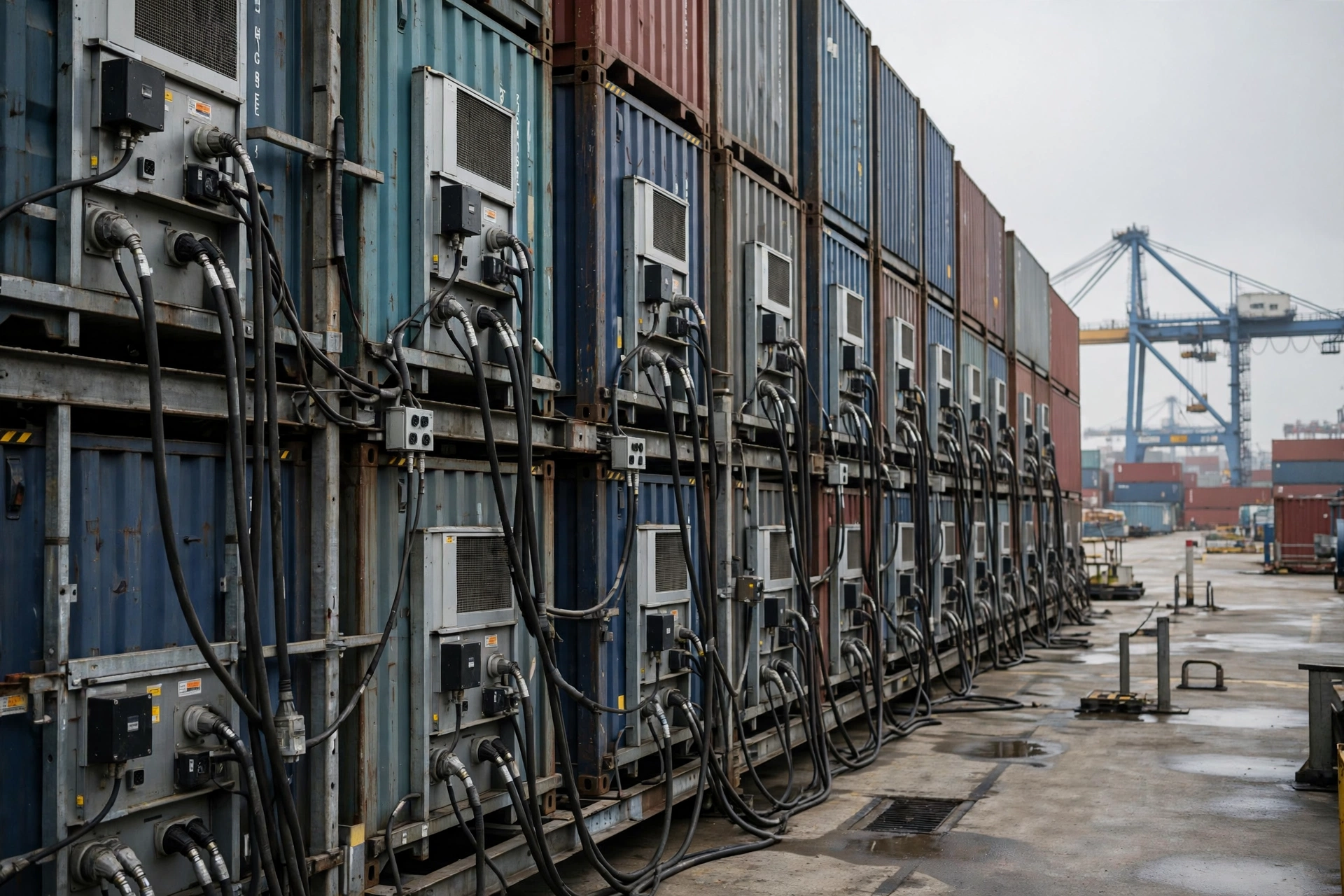
Reefer racks are the opposite problem: small loads, in large numbers, that never stop. A single refrigerated container draws 5.8–11 kW depending on size, ambient temperature and temperature setpoint, and published guidance puts the average at 4–5 kW per container, with pull-down — the period after a warm box is plugged in — materially higher. One hundred plugs therefore draw 400–550 kVA continuously, day and night, in every season. A terminal with 400 reefer plugs carries a steady 1,600–2,200 kVA of reefer load alone, before a single crane moves.
The reefer load also grows with the trade. A terminal that handled 200 reefer plugs five years ago handles 400 today, because chilled and frozen cargo is the fastest-growing segment of container trade. The generator that was sized for the old rack count is already undersized, and the rack count is the one figure in the load list that never goes down. Reefer plugs run on 380 V three-phase at 50 Hz or 440 V three-phase at 60 Hz, and the plugs themselves are 32 A four-pin connectors. The cold storage backup power article covers the same problem from the warehouse side; at a port, the same physics applies at ten times the scale, with the added complication that the cargo belongs to somebody else and the claim for a spoiled load arrives by email before the power comes back.
Gates, TOS and Lighting
The smallest loads on the list are the ones that cause the most damage when they fail. The terminal operating system — the software that knows where every container is — draws only 20–30 kVA, but it runs the gate, the yard plan, the vessel stowage and the customs interface. Lose the TOS and the terminal does not slow down; it stops, because nobody knows which box to move next. The TOS sits on UPS, and the UPS battery gives the generator ten minutes to start and take load. That ten-minute window is the real specification for the automatic transfer switch: the switch must transfer inside the UPS autonomy, and the generator must be at rated voltage and frequency before the battery runs out.
Gate and weighbridge systems draw 40–60 kVA and matter for a different reason: the gate is the terminal’s boundary with the public road. When the gate system fails, trucks queue onto the highway, the port authority fines the terminal, and the queue takes hours to clear after power returns. Yard lighting towers draw 80–120 kVA and are a Tier 1 load at night for a simple reason: a terminal that cannot see its yard cannot work it, and a crane operator will not lift a 40-tonne box over a dark stack. Lighting is also the load most often forgotten in the load list, because it is spread across twenty towers and nobody owns it as a single line item.
Sizing the Set by Terminal Type
There is no standard port generator. There are three kinds of terminal, and each one sizes its backup power differently. The table below gives the sizing bands that terminal engineers work to, and the three cases that follow show how the numbers are reached in practice. The bands assume Tier 1 loads in full, Tier 2 in part, and the STS cranes on the grid — the configuration that covers the great majority of real terminals.
| Terminal type | Throughput | Generator size | Typical configuration | Fuel autonomy |
|---|---|---|---|---|
| Small feeder terminal | Under 200,000 TEU/year | 500–750 kVA | 1 set, standby rated | 24 hours |
| Medium regional terminal | 200,000–1,000,000 TEU/year | 1,000–2,000 kVA | 1–2 sets, prime rated | 48 hours |
| Large hub terminal | Over 1,000,000 TEU/year | 2,000–3,750 kVA | 2–3 sets in parallel | 72 hours |
| Dedicated reefer terminal | Reefer-heavy, any size | 1,000–2,500 kVA | 2 sets, N+1 on reefer racks | 72 hours |
The band is a starting point, not a specification. Two terminals with the same throughput can need sets a factor of two apart, because one handles mostly dry boxes and the other is reefer-heavy. The load list decides the size; the throughput band only tells the buyer which catalogue page to open first. Motor starting is the step most often skipped in port specifications, and it is the step that decides whether the set actually picks up the load or trips on its first transfer.
Case 1: A Feeder Terminal in West Africa
A feeder terminal at a West African river port handles about 120,000 TEU a year with one mobile harbour crane and 120 reefer plugs. The grid fails two or three times a week, for two to six hours at a time, and the terminal’s own records show 340 hours of outage in the previous year. That is a prime-duty site by any definition, and the specification says so in the first paragraph.
The load list came to 380 kVA of Tier 1 load: 120 reefer plugs at 5 kVA each, or 600 kVA at the plug rating — the terminal’s own metered data showed a steady 480 kVA on the racks, because not every plug runs at pull-down at the same time. The TOS, gate and lighting added 90 kVA. The mobile harbour crane, at 450 kVA peak, was left on the grid. Total Tier 1: 570 kVA running, with a starting allowance of 20% for the reefer compressors that cycle on together after a transfer. The set specified was a 750 kVA prime-rated unit with a 1,500-litre sub-base tank and a 10,000-litre bulk tank, giving 48 hours at 75% load. The set runs on a Cummins QSK19-class engine frame, and the fuel log after the first year showed 61 L/h average consumption — close to the 65 L/h the specification predicted. The terminal’s berth utilisation rose by 11% in the first year, because the one cost the old arrangement carried — the lost shift after every outage — disappeared.
Case 2: A Regional Terminal in Southeast Asia
A regional terminal in Southeast Asia handles 600,000 TEU a year with two STS cranes, four RTGs and 300 reefer plugs. The grid is reliable but the terminal sits at the end of a 30 km distribution line that floods every monsoon season, and the 2023 flood took the terminal down for 31 hours. The specification called for 48 hours of autonomy and for the terminal to keep working at reduced speed through any outage.
The load list split the terminal in two. The reefer racks, TOS, gate and lighting — 1,450 kVA steady — went on the generator. The STS cranes stayed on the grid. Two of the four RTGs went on the generator through a load-shed panel, adding 700 kVA of intermittent load. The total came to 2,150 kVA of running load with a crane-starting allowance, and the terminal specified 2 × 1,250 kVA sets in parallel, giving 2,500 kVA with N+1 redundancy on the reefer racks. Each set carries a 2,000-litre day tank fed from a 25,000-litre bulk tank, and the fuel contract guarantees a tanker within 12 hours of a call. The two sets were load-bank tested at 100% for four hours each before handover, and the parallel switchgear was tested with a simulated failure of one set while the other carried the full reefer load. The test found a fault in the load-shed relay that would have dropped the RTGs on transfer — found in the test bay, not during the first real outage.
Case 3: A Hub Terminal in the Gulf
A hub terminal in the Gulf handles more than 2 million TEU a year, with six STS cranes, twelve RTGs and 800 reefer plugs. The reefer load alone is 3,200–4,400 kVA at steady state, and the terminal’s own data shows the racks peaking at 4,100 kVA on a summer afternoon when every plug is in pull-down. The specification called for 72 hours of autonomy, N+1 redundancy on every Tier 1 load, and a salt-air corrosion specification to ISO 12944 C5-M.
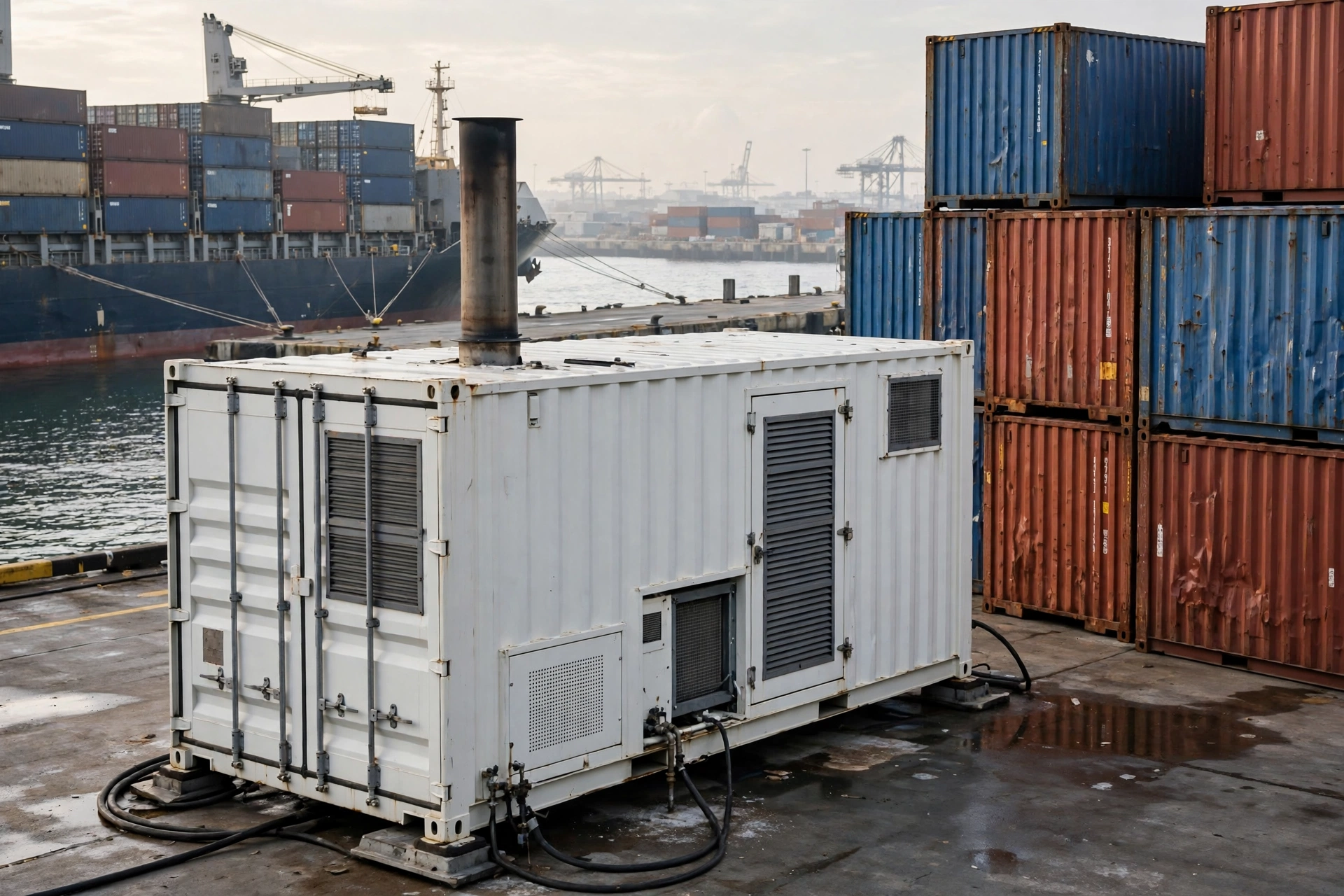
The terminal specified 3 × 1,500 kVA containerised sets in parallel — 4,500 kVA installed, 3,000 kVA with one set down — with the STS cranes on the grid and the RTGs load-shed in pairs. The sets are 3,750 kVA-class containerised units from the PAVO range, each with its own 3,000-litre day tank and a shared 60,000-litre bulk tank, giving 72 hours at 75% load on the full Tier 1 load. The fuel contract is a standing order: a tanker every 48 hours during any outage, with the terminal’s own fuel gauge reporting to the control room by remote monitoring. The sets run a weekly 30-minute test at 50% load on a load bank, and the full parallel test — all three sets, full reefer load, one set tripped — runs every six months. The specification also required the alternators to be sized for the reefer compressor starting current, not just the running load: the high-voltage generator article explains why alternator sizing, not engine sizing, decides whether a set holds voltage on a motor start.
Crane Surge and Regenerative Braking
Crane loads break generator sizing in two ways: the surge on starting, and the energy that comes back when the load is lowered. Both are electrical problems, and both are solved in the specification, not on site.
A crane hoist motor draws five to seven times its running current for the first seconds of a lift. That is the same locked-rotor current that the motor starting article works through for industrial motors, but on a crane the motor is larger, the load is heavier, and the consequence of a failed start is a 40-tonne box hanging over a ship. A 400 kW hoist motor draws roughly 2,000–2,800 kVA for the first second of a lift if started direct-on-line. No standby generator in the terminal’s size range can supply that without a voltage dip that trips the crane’s own drives. The answer is never a bigger generator. The answer is a starting method that limits the inrush, and a generator sized to the limited inrush, not the locked-rotor current.
Hoist Inrush
Modern STS and RTG cranes use variable-frequency drives, which limit the starting current to about 150–200% of running current — a 400 kW hoist draws 600–800 kVA on start instead of 2,000–2,800 kVA. That is the figure the generator must carry, and it is a figure the crane manufacturer will state in the electrical data sheet. The specification must ask for it. A specification that says “crane load 500 kVA” without saying whether that is running load, starting load or peak load is not a specification. It is a guess, and the generator supplier will guess differently from the crane supplier, and the terminal will discover the difference during commissioning.
Older cranes without VFDs use soft starters or rotor resistance, and the starting current is higher — 250–350% of running current. A terminal with older cranes that wants generator backup for them must either budget for a larger set or budget for a drive retrofit. The retrofit is usually cheaper: a VFD on a 400 kW hoist costs a fraction of the extra 500 kVA of generator capacity it saves, and it pays for itself in reduced mechanical wear as well.
Regenerative Braking
Lowering a load returns energy to the supply. A crane lowering a 40-tonne container from 40 metres returns several hundred kilowatts for ten to twenty seconds, and on the grid that energy is absorbed by the network without a second thought. On a generator, it has nowhere to go. The generator’s engine cannot absorb power, the alternator’s voltage rises, and the crane’s drive trips on overvoltage — or worse, the generator’s own protection trips and the whole terminal goes dark.
The specification handles regeneration in one of three ways. The simplest is a braking resistor on the crane drive, which burns the regenerated energy as heat. The second is a load bank on the generator bus, switched in automatically when the generator exports power. The third, and the one most terminals now choose, is to keep the STS cranes off the generator entirely and let the grid absorb the regeneration. The RTGs, which are smaller and often diesel-electric themselves, are the cranes that go on the generator, and their regeneration is handled by their own braking resistors. Whichever route the specification takes, the words “regenerative braking” must appear in it. A specification that does not mention regeneration will be answered by a supplier who has not allowed for it.
VFDs, Soft Starters and Voltage Dip
The voltage dip on a motor start is the number that decides whether the set works. ISO 8528 defines performance classes G1, G2 and G3, and a crane drive that trips below 85% voltage needs a set that holds above 85% on the largest single motor start. That is an alternator specification, not an engine specification: the alternator’s subtransient reactance, the excitation system and the automatic voltage regulator decide the dip, and a set with a generously sized alternator — the high-voltage generator article covers alternator sizing in detail — will hold voltage where a set with a marginal alternator will not.
The test for this is not a datasheet. It is a step-load test at handover: start the largest motor on the generator and record the voltage dip and the recovery time. A set that dips to 82% and recovers in 1.5 seconds is a set that will drop a crane drive. A set that dips to 90% and recovers in under a second is a set that will work. The factory acceptance test must include this step, with the actual crane drive connected, and the result must be written into the handover report. A generator that passes a resistive load-bank test and fails a motor-starting test has passed the wrong test.
The Reefer Problem: Hundreds of Loads That Never Sleep
Reefers are the load that terminal managers underestimate most, because each one is small and the total is large. A reefer is a refrigeration machine bolted to the end wall of a container, and it draws power continuously from the moment it is plugged in until the moment it is unplugged. There is no duty cycle, no rest period, no night-time reduction. A rack of 200 plugs draws the same power at 03:00 on a Sunday as it does at 15:00 on a Tuesday, and it draws it in a hot climate at a higher rate than in a cold one, because the refrigeration machine works harder against the ambient temperature.
The cargo inside makes the stakes higher than the kilowatts suggest. A reefer carrying frozen meat holds −25°C to −18°C. A reefer carrying pharmaceuticals holds 2–8°C. A reefer carrying fresh fruit holds 0–4°C and breathes — the fruit generates heat as it ripens, and the refrigeration machine must remove that heat continuously. Lose power for four hours and the temperature inside a frozen reefer rises by several degrees. Lose it for twelve hours and the cargo is a claim, not a shipment. The cold storage backup power article covers the same temperature problem from the warehouse side; at a port, the difference is that the cargo belongs to a dozen different owners, the claim arrives from a dozen different insurers, and the terminal’s reputation for reefer handling is the reason the cargo came to that terminal in the first place.
Per-Plug Demand
The number to use in the load list is 5 kVA per plug for planning, and 11 kW for the worst case. Published reefer power data puts consumption at 5.8–11 kW per unit depending on container size, ambient temperature and temperature setpoint, and published guidance puts the average at 4–5 kW per container. The planning figure of 5 kVA per plug is conservative for a mixed rack in a temperate climate and optimistic for a rack of frozen cargo in a Gulf summer, where every unit runs at high load simultaneously. The specification should state the ambient temperature the figure is based on, and the buyer should ask the reefer rack supplier for the metered demand of the existing racks rather than the catalogue figure. Metered data from a terminal’s own racks is worth more than any catalogue: it shows the real peak, the real diversity and the real growth rate.
A study of a 13,154 TEU container ship carrying 1,200 FEU of refrigerated containers measured a maximum reefer load of approximately 7,440 kW — about 6.2 kW per reefer at the ship’s peak. That is the ship’s figure, not the terminal’s, but it shows the scale: a single large vessel can carry more reefer load than a small terminal’s entire generator. The terminal’s rack is smaller, but the same arithmetic applies, and the rack count is the figure that grows every year.
Pull-Down vs Steady State
Pull-down is the period after a warm container is plugged in, when the refrigeration machine runs continuously to bring the cargo to temperature. A reefer in pull-down draws 50–100% more than the same reefer at steady state, and a rack of containers plugged in together after a vessel discharge can draw double its steady-state load for two to four hours. The terminal’s operating pattern makes this worse: a vessel discharges 300 reefers in eight hours, the yard plugs them in as fast as they arrive, and every one of them is in pull-down at the same time.
The specification must allow for it. The usual method is a diversity factor: the rack is sized at 100% of the plugs at steady state, plus 50% of the plugs at pull-down load, on the assumption that not every plug is in pull-down at once. A terminal that sizes its generator to steady state alone will find the set overloaded on the afternoon a large reefer vessel discharges, and the overload will arrive on the hottest day of the year, when the grid is most likely to fail. The factory acceptance test should include a simulated pull-down: load the generator to the specified reefer load plus the pull-down allowance, and hold it for two hours.
Rack Design and Diversity
The rack itself matters as much as the load. Reefer plugs are grouped in racks of 24, 48 or 96 plugs, each rack fed from its own distribution board, and the generator feeds the racks through the same board. A single fault in a rack board can take 96 plugs off power, and a single generator feeding all the racks through one board is a single point of failure for the whole reefer operation. The specification should split the reefer load across at least two generator feeds, so that a fault in one feed leaves half the racks running. The terminal in the Gulf case above feeds its 800 plugs from four rack boards, each on its own generator feed, and a fault in any one board costs the terminal 200 plugs, not 800.
The other design decision is the socket standard. Reefer plugs run on 380 V three-phase at 50 Hz or 440 V three-phase at 60 Hz, and the plugs are 32 A four-pin connectors. A terminal that buys a generator with a 400 V output and a rack wired for 440 V has bought a problem, not a set. The voltage, frequency and plug standard must be stated in the specification, and the factory test must run the set at the rack’s actual voltage and frequency, not at the factory’s standard test voltage.
Fuel Autonomy, Salt Air and Placement
A port generator that runs out of fuel during an outage is worse than no generator at all, because the terminal planned around it. Fuel autonomy is the number of hours the set can run on the fuel stored on site, and it is the specification line that terminal buyers get wrong most often, because they count the tank and forget the load.
The arithmetic is simple. A diesel generator burns roughly 0.21 litres per kVA per hour at full load — the Cummins C500D5 burns 107.1 L/h at its 500 kVA standby rating, and the figure scales linearly across the range. At 75% load, consumption falls to about 75% of the full-load figure. The table below gives the fuel burn and the tank size needed for 24, 48 and 72 hours at 75% load, which is the load a terminal generator typically carries in an outage.
| Set size | Fuel at 75% load | 24 hours | 48 hours | 72 hours |
|---|---|---|---|---|
| 500 kVA | 79 L/h | 1,900 L | 3,800 L | 5,700 L |
| 1,000 kVA | 158 L/h | 3,800 L | 7,600 L | 11,400 L |
| 1,500 kVA | 236 L/h | 5,700 L | 11,300 L | 17,000 L |
| 2,000 kVA | 315 L/h | 7,600 L | 15,100 L | 22,700 L |
| 3,750 kVA | 591 L/h | 14,200 L | 28,400 L | 42,600 L |
A 1,500 kVA set running for 72 hours burns 17,000 litres — a bulk tank the size of a shipping container, not a sub-base tank. The sub-base tank under the set, typically 500–1,000 litres, gives two to four hours. The bulk tank gives the rest. The specification must state the autonomy in hours and the load at which it is measured, and the tank must be sized to it. diesel fuel ageing matters here too: a bulk tank that sits for six months between outages grows water and microbes, and the fuel that the terminal counts on must be tested and polished on a schedule, not on the day the outage arrives.
Fuel Autonomy in Hours
The autonomy figure comes from the terminal’s own outage history, not from a catalogue. A terminal with a reliable grid and a 30-minute outage record can specify 8 hours and be generous. A terminal with a history of 24-hour outages specifies 48 hours. A terminal at the end of a long distribution line, in a cyclone region, or in a country where fuel delivery stops during a storm, specifies 72 hours and a fuel contract that guarantees delivery within 12 hours of a call. The Gulf hub terminal above specifies 72 hours and a tanker every 48 hours during an outage, because the fuel supplier’s own depot is 40 km away and the road floods in the same storm that takes the grid down.
The contract matters as much as the tank. A bulk tank gives the terminal its first 72 hours. The fuel contract gives it the next 72. A specification that states the tank size and not the delivery arrangement has specified half a fuel system. The contract should state the delivery time, the minimum delivery quantity, the supplier’s own outage arrangements, and the price — because the price of diesel delivered during a regional outage is not the price of diesel on a normal Tuesday.
Corrosion and the C5 Marine Environment
A port is the most corrosive environment a generator will ever work in. Salt spray, high humidity and diesel exhaust combine into an atmosphere classified as C5-M — very high corrosivity, marine — under ISO 12944, and a standard industrial enclosure will show rust within a year and structural corrosion within five. The specification must call for a C5-M coating system, stainless-steel fasteners, and a canopy designed for a marine environment, not a standard industrial one. The cost difference is 10–15% of the enclosure price. The cost of repainting a corroded canopy on a working terminal, with the set out of service, is several times that.
The engine itself needs protection too. Salt air drawn into the combustion air intake deposits salt on the turbocharger compressor wheel and the aftercooler, and the deposit grows with every hour the set runs. The specification should call for a marine-grade air filter with a salt-spray rating, and the maintenance schedule should include an aftercooler inspection every 500 hours — twice as often as an inland set. The alternator needs the same attention: salt deposits on the windings reduce insulation resistance, and the maintenance schedule should include a megger test of the alternator windings every 1,000 hours, with the result recorded and trended. A winding that drops from 100 MΩ to 10 MΩ over a year is a winding that will fail in the next outage.
Placement, Noise and Access
Where the set stands decides how well it works. The set must be above the flood level — a terminal that floods every monsoon season and puts its generator at ground level has built a very expensive anchor. It must be close to the load it serves, because every metre of cable between the set and the reefer racks is voltage drop and cost. It must be accessible to a fuel tanker and a service crane, because a set that cannot be refuelled or lifted out for overhaul is a set that will be abandoned in place. And it must be far enough from the reefer racks that its own exhaust does not heat the containers it is trying to keep cold.
Noise is the constraint that surprises most buyers. A port is a working industrial site, and the 85–90 dB(A) eight-hour exposure limits for port workers are far above the 75 dB(A) at 7 metres that a silent canopy delivers. But the terminal’s neighbours are not port workers. A terminal next to a residential area, a hotel or a fishing village will face a noise complaint the first time the set runs at night, and the complaint will arrive with a regulator. The specification should state the noise limit at the site boundary, not at the set, and the canopy should be chosen to meet it. A silent canopy costs 15–25% more than an open set. A noise enforcement order costs more.
Frequently Asked Questions
What size generator does a container terminal need?
A small feeder terminal needs 500–750 kVA, a regional terminal needs 1,000–2,000 kVA, and a large hub terminal needs 2,000–3,750 kVA or more in parallel sets. The size is set by the reefer rack load and the crane starting surge, not by the terminal’s average demand. A load list that counts every reefer plug, the terminal operating system and the yard lighting, then adds a starting allowance for the largest motor, gives the figure; a throughput band alone does not.
Do ports need a backup generator?
Yes. A port loses money by the hour when the grid fails, because a delayed vessel costs tens of thousands of dollars a day in charter and demurrage, and reefer cargo spoils within hours. The generator protects the reefer racks, the terminal operating system and the gate — the loads that keep the terminal working and the cargo safe. A port without backup power is a port that closes every time the grid does, and shipping lines notice.
How long can a port run on a generator?
As long as its fuel lasts. A set with a 1,500-litre sub-base tank runs for two to four hours; a set with a bulk tank and a fuel delivery contract runs for 72 hours or more. Most terminals specify 48–72 hours of autonomy, because the outages that matter — storms, floods, grid failures — last days, not minutes. The autonomy figure must be stated in the specification with the load it is measured at, and the fuel contract must guarantee delivery inside the autonomy window.
Can a diesel generator power a reefer container?
Yes. A reefer container draws 5.8–11 kW depending on size, ambient temperature and setpoint, and a generator sized to the rack — 5 kVA per plug for planning — powers the whole rack. The generator must be sized for pull-down as well as steady state, because a rack of containers plugged in together after a vessel discharge draws double its steady load for two to four hours. The rack must also be split across at least two generator feeds, so a single fault does not take every plug off power at once.
What should a port generator power during an outage?
Tier 1 loads first: reefer racks, the terminal operating system, gate and weighbridge, yard lighting, and security and communications. Tier 2 next: one or two yard cranes and the container handling equipment that keeps boxes moving at reduced speed. Tier 3 — workshop, offices, canteen — can wait, and should be shed automatically on transfer. Ship-to-shore cranes usually stay on the grid, because their starting surge and regenerative braking need a supply a standby generator cannot provide.
Specification Checklist: Before You Sign
Rating and Duty
The specification must state the rating in ISO 8528 terms — ESP, PRP or COP — and the annual hours the set is expected to run. A terminal with 340 hours of outage a year needs a prime-rated set, not a standby set, and the price difference is the price of a set that survives its first year. The specification must also state the voltage dip limit on the largest motor start, the alternator size that delivers it, and the step-load test that proves it at handover. The standby and prime power ratings article explains the three ratings in full, and the quotation that states only “kVA” without a rating code should be returned for clarification before any deposit is paid.
Fuel and Delivery
The specification must state the autonomy in hours, the load it is measured at, the bulk tank size that delivers it, and the fuel delivery contract that extends it. A 72-hour autonomy on a 1,500 kVA set needs a 17,000-litre bulk tank and a tanker within 12 hours of a call. The specification must also state the fuel testing schedule — water and microbe testing every six months, fuel polishing when the test fails — because the fuel in the tank on the day of the outage is the fuel that was delivered six months ago, and diesel fuel ageing does not wait for an outage to begin.
Testing and Handover
The specification must state the factory acceptance test and the site acceptance test, and both must test the loads the set will actually carry. The factory test must include a step-load test with the largest motor, a pull-down simulation on the reefer load, and a parallel failure test with one set tripped. The site test must include a full transfer under load, a load-shed test, and a fuel-system test from bulk tank to day tank. The results must be written into the handover report, with the voltage dip, the recovery time and the fuel consumption recorded. A set that has not been tested under its real load has not been tested. The remote monitoring article covers the monitoring that keeps the set honest after handover: fuel level, battery voltage, running hours and alarms reported to the control room, so the terminal knows the set is ready before the grid fails, not after.
A container terminal buys a generator once and lives with it for twenty years. The specification is the document that decides whether those twenty years are quiet or expensive. Size it to the load list, not the throughput band. Test it under the real load, not the load bank alone. And keep the fuel contract as current as the set itself — because the outage that matters will arrive on the hottest day of the year, with a ship at the berth and a full reefer rack, and the set will either work or it will not. There is no middle outcome.
For a port generator specification, a load-list review or a quotation on a containerised set sized to your terminal’s reefer racks and crane loads, contact PAVO — the PAVO technical team sizes port and terminal sets from the load list up, with the fuel autonomy, corrosion specification and parallel switchgear the berth schedule demands.