

What Size Generator for a Vaccine Refrigerator? | PAVO
A vaccine is not a box on a shelf. It is a living product that dies quietly when it gets warm — and the generator is the only thing standing between the dose and the bin.
What size generator do I need for a vaccine refrigerator? A single vaccine refrigerator needs a 1–3 kVA set, a district store with several fridges and a cold room needs 10–30 kVA, and a national depot with walk-in cold rooms needs 50–150 kVA. The figure comes from the compressor starting surge, not the running watts.
- What a Vaccine Cold Chain Actually Needs Power For
- Sizing Bands by Depot Size
- The 2–8°C Window: What an Outage Really Costs
- Holdover Time: How Long Vaccines Stay Cold Without Power
- NFPA 110 and the 10-Second Rule for Health Facilities
- Fuel Autonomy: How Long a Depot Can Really Run
- Frequently Asked Questions
- Specification Checklist
What a Vaccine Cold Chain Actually Needs Power For
Most routine vaccines must stay between 2°C and 8°C from the factory to the child’s arm. That range is the whole job. Heat above 8°C degrades the active components. Freezing below 0°C permanently damages the freeze-sensitive vaccines that carry aluminium adjuvants — diphtheria, tetanus, hepatitis B, HPV. The damage is invisible, irreversible and undetectable by looking at the vial. A dose that has been frozen looks exactly like a dose that has not, which is why the cold chain is policed by temperature loggers and not by eyesight.
The scale of the loss is the reason the generator matters. The World Health Organization estimates that more than 50% of vaccines may be wasted globally every year because of temperature control, logistics and shipment problems. In 2011, cold-chain failures in five countries alone accounted for the loss of 2.8 million doses. UNICEF reported $1.5 million of vaccines lost in five months in one programme, largely because the cold chain could not be maintained to remote locations. The Global Alliance for Vaccines and Immunization estimates that only 10% of health care facilities in the world’s poorest countries have a reliable electricity supply. The cold chain is, for much of the world, a power problem first and a logistics problem second.
The loads fall into three tiers, and the tiers decide the specification. The first tier is the national depot: walk-in cold rooms holding 1–10 million doses, with compressors, air handling, monitoring servers and a packing area. The second tier is the district store: several vaccine refrigerators, a cold room or two, ice-pack freezers and a dispatch desk. The third tier is the last mile: a single refrigerator in a health centre, a vaccine carrier on a motorbike, and a solar direct-drive fridge in a clinic that has no grid at all. A set that covers the first tier protects the national stock. A set that covers the third tier protects the child who walked three hours to the clinic. The budget has to state which one it is buying, because the difference between them is roughly fifty times the kVA figure.
National Depots and Cold Rooms
A national vaccine store is a warehouse with a pharmaceutical licence. A typical national depot holds 1–5 million doses in walk-in cold rooms of 20–100 cubic metres, each room cooled by a 3–7.5 kW compressor, with a second compressor on standby. The rooms run 24 hours a day, 365 days a year, because the stock never leaves. The depot also runs ice-pack freezers at −20°C or colder, a packing hall where cold boxes are loaded for dispatch, and a monitoring room where the temperature loggers from every district in the country are watched on a screen.
The load is large and it is continuous. A national depot with two 40-cubic-metre cold rooms, four −20°C freezers and a packing hall draws 40–120 kW running, and the compressors start together when power returns, which is when the starting surge arrives. The depot also carries the country’s buffer stock — typically 25% above the monthly requirement — so a failure does not just lose today’s doses. It loses the reserve that covers the next campaign. The general rules for sizing a cold room and its compressors are set out in the cold storage backup power guide; the vaccine depot adds one constraint that a food cold store does not have, which is that the temperature record is a regulatory document, and a gap in the record is a compliance failure even if the vaccines survive.
District Stores and Health Centres
A district vaccine store is the middle of the chain, and it is where most generators are bought. A typical district store holds 20,000–100,000 doses in four to eight vaccine refrigerators and one walk-in cold room, with two or three ice-pack freezers beside them. The running load is 5–15 kW. The store dispatches to 20–50 health centres, and it does so on a fixed schedule — once a week, or once a fortnight — which means the stock is at its highest the day before dispatch and at its lowest the day after. An outage the day before dispatch puts the whole district’s next two weeks of immunisation at risk.
The health centre at the end of the chain is smaller and more fragile. A single vaccine refrigerator, a 200-litre ice-lined unit, holds 2,000–10,000 doses and draws 100–200 W running. The load is tiny. The consequence of losing it is not tiny: the centre serves 5,000–20,000 people, and the next delivery is a week away. India runs more than 27,000 cold chain points under its universal immunisation programme, and the programme plans for roughly 25% vaccine wastage across the system — a figure that includes the doses lost when a centre’s fridge warms up and nobody notices until the morning. A study of health facilities in Morogoro, Tanzania found that 84% had functional refrigerators, powered by a mix of grid electricity (34%), solar (36%) and LPG (30%) — and that temperature excursions above 8°C, some lasting 281 hours, were still being recorded. The refrigerator is the easy part. The power behind it is the hard part.
Last-Mile Carriers and Outreach
The last mile is where the cold chain is thinnest. A vaccine carrier — an insulated box with conditioned ice packs — holds 2–8°C for 24–48 hours, and it is carried on a motorbike, in a boat, or on foot to a village that has no refrigerator at all. The carrier is charged at the health centre, which means the centre’s freezer has to be working, which means the centre has to have power. An outreach session vaccinates 50–200 children in a day, and the doses in the carrier are the day’s work. Lose the carrier’s temperature and the session is cancelled, and the children who walked to the session do not come back next week.
The outreach load is not a generator load in the usual sense. It is a freezer load: the ice-pack freezer at the health centre, running at −20°C, freezing 2–3 kg of ice packs per day, so that the carriers can be charged for the next session. A freezer that is off for three days has no ice packs, and a health centre with no ice packs has no outreach. The hospital backup power article covers the hospital end of this chain; the vaccine end is the district store and the health centre, and the specification has to cover both, because the hospital’s generator does not keep the district’s fridges cold.
Sizing Bands by Depot Size
Sizing a vaccine cold-chain generator starts with the load list, not with the number of doses. Two depots holding the same number of doses can need sets that differ by a factor of three, because one of them has walk-in cold rooms and the other has refrigerators. The step-by-step load-list method is set out in the generator sizing guide, and the table below is the starting point — every depot has to be measured at its own distribution board, because the load depends on the compressors, not on the stock.
| Depot type | Vaccine stock | Essential load | Recommended sets | Typical cost installed |
|---|---|---|---|---|
| Health centre, 1–2 fridges | 2,000–10,000 doses | 0.5–3 kW | 1–3 kVA, one set | $2,000–$5,000 |
| District store, fridges + cold room | 20,000–100,000 doses | 5–15 kW | 10–30 kVA, one set | $10,000–$25,000 |
| Regional depot, 2 cold rooms | 100,000–500,000 doses | 15–40 kW | 20–50 kVA, one set | $25,000–$60,000 |
| National store, walk-in cold rooms | 1–10 million doses | 40–120 kW | 50–150 kVA, 1–2 sets | $60,000–$150,000 |
The table is a starting point, not a specification. The measurement has to be done fridge by fridge, with a clamp meter, over a full week — because the load at 3 a.m. is the compressors cycling, and the load at 10 a.m. is the compressors cycling plus the ice-pack freezers, the packing hall and the monitoring room. A set sized for the night load is undersized from the first morning of the campaign.
A District Store: 10–30 kVA
A district store — 20,000–100,000 doses, four to eight vaccine refrigerators, one walk-in cold room, two ice-pack freezers — typically needs a single 10–30 kVA set. The worked example is worth doing, because it shows where the kVA goes. Six vaccine refrigerators at 150 W running each are 0.9 kW. One walk-in cold room compressor at 5 kW running is 5 kW. Two ice-pack freezers at 300 W each are 0.6 kW. Lighting, monitoring and the dispatch desk add 1 kW. The running load is 7.5 kW, or about 9.4 kVA at a power factor of 0.8.
The running load is not the set size. The cold room compressor starts at five to seven times its running current, and the refrigerators start together when power returns. What sizes the set is motor starting, not the running load: a 5 kW compressor can demand 25–35 kVA of starting apparent power for a second. A 20 kVA set covers the district store with room for the compressor restart surge, and it burns about 5 L/h at 75% load. A Cummins C20D5, rated 20 kVA standby and 18 kVA prime, covers most district stores, and it costs $8,000–$15,000 installed with a sub-base tank.
The mistake district stores make is buying the set for the refrigerators and forgetting the cold room. A store with six fridges and no cold room needs 3–5 kVA. A store with six fridges and one cold room needs 20 kVA. The cold room is the load, and the specification has to name it, because a set bought for the fridges will trip the first time the cold room compressor restarts after an outage — and the outage is the one moment the compressor has to restart.
A Regional Depot: 20–50 kVA
A regional depot — 100,000–500,000 doses, two walk-in cold rooms, eight to twelve refrigerators, four freezers — typically needs a single 20–50 kVA set. The load is 15–40 kW, and the sizing decision is not the total. It is the split: the cold rooms are the load that cannot wait, and the packing hall is the load that can. A 40 kVA set covers the cold rooms, the fridges and the freezers, and the packing hall goes on a separate circuit that is shed when the generator takes the load. The set costs $25,000–$60,000 installed, and it burns about 11 L/h at 75% load.
The regional depot is also the size where the standby and prime ratings start to matter. A set that runs for 72 hours on a long outage is running on its prime rating, not its standby rating, and the difference is 10% of the kVA figure. A 50 kVA standby set is a 45 kVA prime set, and a depot that sizes for the standby figure and then runs for three days has overloaded its set by 10% for three days. The rating on the nameplate is the number that counts, not the number on the quotation.
A National Store: 50–150 kVA
A national store — 1–10 million doses, four or more walk-in cold rooms, a freezer hall, a packing hall and a monitoring room — typically needs 50–150 kVA, as one or two sets. The load is 40–120 kW, and the largest single set is usually 100 kVA, serving one cold-room block. The total cost is $60,000–$150,000, and the lead time is 10–16 weeks, because the sets are ordered against a national immunisation plan, not a single building’s specification.
The national store is also the size where the set is specified as two smaller sets rather than one large one, because a single set is a single point of failure for the country’s entire vaccine stock. Two 75 kVA sets cost roughly 30% more than one 150 kVA set, and the depot buys them anyway, because a national store that loses its only generator during a storm loses the stock for the next campaign. The automatic transfer switch staggers the cold-room restarts across the two sets, a few seconds apart, so that the combined starting surge never hits either set at once — and the sequencing has to be designed, programmed and tested, because a set that is sized for the running load and never tested under a full restart will trip on its first real outage.
The 2–8°C Window: What an Outage Really Costs
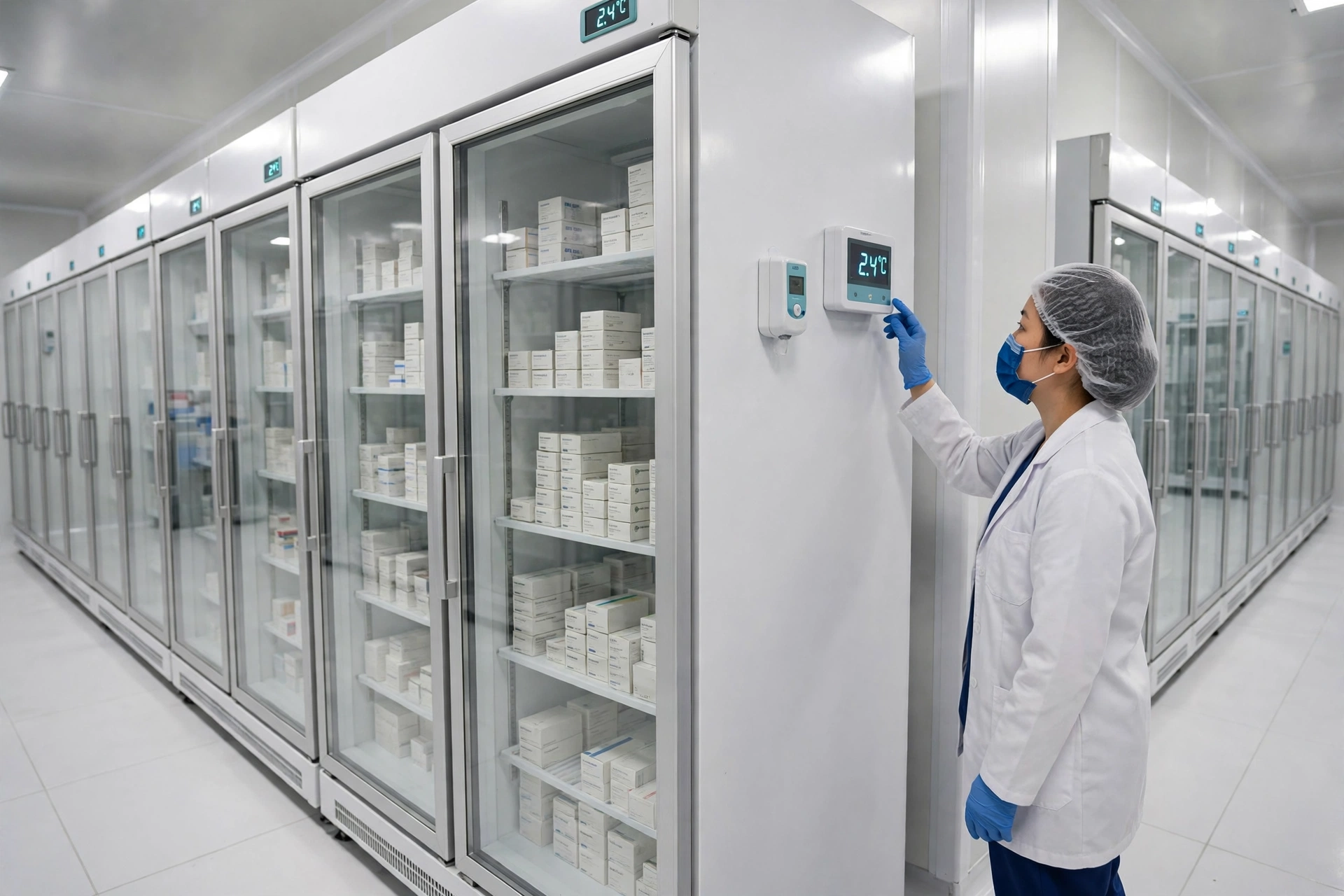
A vaccine cold chain measures an outage in doses and in degrees, not in kilowatt-hours. The grid fails, the automatic transfer switch moves the essential bus to the generator, and if everything works, the refrigerators never notice and the temperature loggers never show a blip. If anything in that chain fails, the depot starts losing its stock within hours, and it starts losing its immunisation sessions within a day. The arithmetic is worth doing before the outage, because it is the arithmetic that justifies the generator.
The window is the number that decides everything. A vaccine refrigerator that has lost power warms past 8°C within 4–8 hours in a hot climate, and a walk-in cold room warms past 8°C within 2–4 hours once the compressor stops, because the room’s thermal mass is the air and the stock, and the stock is mostly water in small vials. A dose that has been above 8°C is not necessarily destroyed — the vaccine vial monitor on the label shows whether the heat exposure has crossed the discard point — but a dose that has been frozen is destroyed outright, and the only test that finds it is the shake test, which compares the frozen vial against a control. The temperature window buys hours, not days, and the hours are the reason the generator has to start in seconds, not in the morning.
Case 1: Harris County and the Generator That Failed
In February 2021, Winter Storm Uri cut power to about 4.4 million customers in Texas, and Harris County — the most populous county in the state — was in the middle of it. The building that stored the county’s supply of Moderna vaccine lost power at about 2 a.m. on Monday 15 February. Then its backup generator failed, and the refrigerator storing the vaccines did not send out a warning that its temperature had risen above the level required to keep the doses viable. By the time the county realised what had happened, there were about six hours to get the vaccine distributed. There were 8,430 doses that needed to go out.
The county distributed 5,410 doses in those six hours — 3,000 to the Harris County Jail, 1,000 to Houston Methodist Hospital, 810 to Rice University, and 600 split between Lyndon B. Johnson and Ben Taub hospitals. The rest were saved only because Moderna advised the county that the remaining doses could be re-refrigerated and distributed as usual. Not a single dose was lost, but the margin was six hours, a phone call to the manufacturer, and a county judge’s decision to send vaccines to a jail because that was where the people and the nurses already were.
The case is the one that cold-chain managers quote, because it is the failure that looks like nothing. The generator failed, and the alarm failed, and the two failures together turned a routine outage into a race against the thaw. A $200 temperature logger with an SMS alarm would have caught the rise hours earlier. A generator that was tested under load the month before would have started. The county’s vaccine programme was saved by improvisation, and improvisation is not a specification. The same storm delayed 400,000 doses destined for Texas, and vaccination sites across the state closed for days.
Case 2: Hurricane Maria and 80% of Puerto Rico’s Vaccines
In September 2017, Hurricane Maria caused the largest blackout in US history across Puerto Rico. Health facilities lost power for weeks or months, and more than 80% of the island’s vaccines and other medicines requiring refrigeration were destroyed as a result of the power outage, according to the CDC. Only 5% of clinics were fully operational ten days after the disaster. Adolescent HPV vaccination initiation fell from almost 90% in July 2017 to 75% in September, and the island’s immunisation programme took months to recover.
The scale is the point. Maria did not destroy one depot. It destroyed the cold chain for an island of 3.2 million people, because the grid was down for months and the facilities that had generators ran out of fuel, and the facilities that had no generators lost their stock in the first days. Two years later, Direct Relief equipped 89 health facilities across Puerto Rico with 164 FDA-compliant pharmaceutical-grade refrigeration units, expanding the island’s capacity to store temperature-sensitive vaccines and medicines by roughly 6 million vials. Of the 89 facilities, 88 have backup power in the form of either a diesel generator or a solar and battery system — a ratio that the island’s Department of Health now treats as the minimum, not the target.
The Maria case is the one that shows the national arithmetic for vaccine cold chain. The outage hit the storage, because the refrigerators stopped. And it hit the programme itself, because the clinics were dark, the staff could not be contacted, and the children who missed their vaccinations did not come back on schedule. A depot generator protects the stock. Nothing protects the programme except a grid that stays up, which is why the facilities that recovered fastest were the ones whose generators kept their fridges running, so that the first health workers back through the door could restart their sessions the same day.
Case 3: Fort Worth and the 800 Doses That Almost Thawed
The third case is smaller and closer to a district store. In February 2021, during the same Winter Storm Uri, staff at JPS Health Network’s Diamond Hill Clinic in Fort Worth arrived on the Monday morning after the weekend storm to find the electricity had been out for hours and the alarms had failed. About 800 doses of vaccine were thawing in the freezer. The team deployed in the ice and snow and administered about 500 vaccines to people from across the community in a matter of hours, then organised a pop-up clinic the next day that vaccinated 1,000 people — more than had been anticipated, in the harshest conditions.
The Fort Worth case is the one that shows the arithmetic at the scale of a single clinic. Eight hundred doses is a small number against a national stock, and it is the entire week’s work for a clinic. The doses were saved because the staff arrived, noticed, and acted — and because the vaccines were mRNA doses with a thawed window of hours, not minutes. A clinic that loses its 800 doses loses its week, and a district that loses its clinics loses its campaign. The generator that protects a clinic’s single refrigerator is protecting the district’s immunisation schedule, not its electricity bill.
The three cases share one detail. In none of them did a vaccine programme lose its doses because a generator failed mechanically in a way that could not have been foreseen. In all three, the loss came from the chain around the generator — a generator that was never tested under load, an alarm that never sounded, a clinic with no backup power at all. The generator is the only part of that chain that the depot controls, and it is the part that has to work the first time, because there is no second chance to keep a dose cold.
Holdover Time: How Long Vaccines Stay Cold Without Power
Holdover time is the number of hours a refrigerator keeps its vaccines between 2°C and 8°C after the power fails, and it is the number that decides how much time the generator has. A standard mains-powered compression refrigerator stays below 8°C for at least four hours in a hot-zone climate. An ice-lined refrigerator holds below 8°C for at least 20 hours, because the ice lining around the storage compartment keeps the vaccines cool after the compressor stops. A solar direct-drive refrigerator holds for 77–137 hours, because it is built around a thermal store that is charged by the sun. The refrigerator buys the time. The generator buys the rest.
The World Health Organization’s Performance, Quality and Safety (PQS) programme prequalifies every refrigerator that is bought with immunisation money, and the PQS data sheets are the numbers that matter. A domestic refrigerator must never be used to store vaccines — the WHO warning is explicit, because a domestic appliance cannot hold 2–8°C, cannot protect against freezing, and cannot prove its temperature record. A PQS-prequalified refrigerator can, and the data sheet says how long it can do it for.
| Refrigerator | Type | Vaccine capacity | Holdover without power |
|---|---|---|---|
| Vestfrost VLS 094A SDD | Solar direct drive | 92 L | 77 h 41 min |
| Dulas VC155SSD | Solar direct drive | 102 L | 83 h 42 min at 43°C |
| Haier HTCD 90 SDD | Solar direct drive | 37.5 L | 137 h |
| Ice-lined refrigerator (typical) | Mains, ice-lined | 50–150 L | 20 h minimum |
| Standard compression fridge | Mains | 50–150 L | 4 h minimum in hot zone |
The table is the reason the specification starts with the refrigerator, not with the generator. A district store with ice-lined refrigerators has 20 hours before the vaccines are at risk, and a 10 kVA set that starts within ten seconds has 20 hours of margin. A district store with standard compression fridges has four hours, and the same set has four hours of margin. The refrigerator decides the urgency, and the generator decides whether the urgency is met.
Ice-Lined Refrigerators
The ice-lined refrigerator is the workhorse of the vaccine cold chain, and it is the appliance that makes the generator’s job survivable. Most ice-lined refrigerators can maintain acceptable temperatures below 8°C on as little as eight hours of electricity per 24 hours, day after day, because the ice lining refreezes while the power is on and keeps the vaccines cool while it is off. The lining is made up of ice or cold-water compartments or frozen ice packs around the storage compartment, and when the electricity fails, the store keeps the vaccine cool for at least 20 hours. When the power is restored, the compressor runs until the lining is refrozen.
The ice-lined refrigerator is also the appliance that protects against the other half of the damage: freezing. A vaccine that freezes is destroyed, and a refrigerator that over-cools is as dangerous as a refrigerator that under-cools. WHO PQS Grade A freeze protection — “user-independent freeze protection” — means the refrigerator cannot freeze the vaccines no matter what the user does with the thermostat. A Vestfrost VLS 094A SDD, for example, carries Grade A protection, holds 92 litres of vaccines, and uses 0.24 kWh per day in continuous running. The refrigerator’s power draw is 40–60 W — a load that a 1 kVA set could carry, if the starting surge did not exist.
Solar Direct Drive
The solar direct-drive refrigerator is the appliance that changes the generator calculation entirely, because it does not need a generator at all on a sunny day. A solar direct-drive unit runs its compressor directly from a photovoltaic array — typically 600 Wp of panels — with no battery in between, and it stores its energy as ice, not as charge. The Dulas VC155SSD holds 102 litres of vaccines and 12 kg of ice packs, uses 0.72 kWh per day at 32°C, and holds its vaccines between 2°C and 8°C for 83 hours 42 minutes at 43°C with no sun at all. The Haier HTCD 90 SDD holds for 137 hours.
The solar direct-drive refrigerator is the right answer for a clinic with no grid, and it is the wrong answer for a national depot, because a depot’s cold rooms draw 40–120 kW and no solar array covers that. The specification has to say which tier the site is on. A clinic with a solar direct-drive fridge and a 3 kVA generator for the lights, the monitoring and the ice-pack freezer is a clinic that survives a storm. A clinic with a mains refrigerator, no generator and no solar is a clinic that loses its stock in four hours.
Ultra-Low Freezers and mRNA Vaccines
The mRNA vaccines added a fourth tier to the cold chain, and it is the tier that most depots were not built for. The Pfizer-BioNTech vaccine ships and stores at −90°C to −60°C. The Moderna vaccine ships frozen at −25°C to −15°C and, once thawed, keeps for 30 days at 2–8°C. An ultra-low freezer draws 700–1,000 W running, and a depot with ten of them draws 7–10 kW continuously, day and night. The Harris County case turned on exactly this: the Moderna doses were in a freezer that needed its temperature held, the generator failed, and the doses had six hours before they were lost.
The ultra-low freezer is also the load with the worst failure mode. A vaccine refrigerator that warms past 8°C loses its doses over hours. An ultra-low freezer that warms past −60°C loses its mRNA doses over hours too, but the doses are worth more per vial, and the freezer’s thermal mass is smaller, because the temperature difference to ambient is 80 degrees, not 30. A depot that stores mRNA vaccines needs its ultra-low freezers on the essential bus, on the generator, and on the temperature alarm — and the alarm has to reach a person who can act, because a freezer that warms at 2 a.m. is a freezer that loses its stock by breakfast.
Solar Direct Drive vs Diesel
The remote clinic is where the solar-versus-diesel decision is made, and it is made on the power mix, not on the ideology. A clinic with a reliable grid buys a 3–10 kVA diesel set, because the set is cheap, the fuel is available, and the outage lasts hours. A clinic with no grid buys a solar direct-drive refrigerator, because the refrigerator runs on the sun and holds for 77–137 hours without it, and a diesel set that never gets fuel is a sculpture. A clinic with an unreliable grid buys both: the solar fridge for the vaccines, and a 3–5 kVA set for the lights, the monitoring, the ice-pack freezer and the phone charging that keeps the clinic in contact with the district.
The Morogoro study shows the mix as it actually exists: 34% of facilities on grid electricity, 36% on solar, 30% on LPG. No single source covers the chain, and the facilities that keep their vaccines cold are the ones with two sources, not one. A solar direct-drive refrigerator costs $3,000–$6,000 installed with its panels. A 5 kVA diesel set costs $4,000–$8,000 installed. A clinic that buys both spends $7,000–$14,000 and has a cold chain that survives a storm, a fuel shortage and a cloudy week. A clinic that buys one spends half as much and has a cold chain that survives two of the three.
The honest limit matters here too. A solar direct-drive refrigerator protects the vaccines in the refrigerator. It does not protect the walk-in cold room, the ultra-low freezer, or the packing hall, because those loads draw 5–120 kW and no solar array on a clinic roof covers them. The depot’s answer is diesel. The clinic’s answer is solar plus diesel. The specification has to say which tier the site is on, because the answer changes at every tier.
NFPA 110 and the 10-Second Rule for Health Facilities
The ten-second rule is not a target. It is a standard, and it is the standard that decides whether a health facility’s generator is compliant or not. NFPA 110 requires Level 1 emergency power systems — the classification that covers hospitals, vaccine depots and any facility where the loss of power threatens life or public health — to start and accept load within 10 seconds. A set that takes 15 seconds is not a slow set. It is a set that does not meet the standard, and the facility’s insurer and its health ministry both know it.
The rule matters for a vaccine depot because the depot has both classifications in the same building. The temperature monitoring and the alarms are Level 1: a temperature excursion that nobody sees is a stock loss, and the alarm has to work within ten seconds. The walk-in cold rooms are Level 2: the rooms have two to four hours of thermal margin, and the set has 60 seconds to start. The packing hall is Level 2. The specification has to classify every load, because the classification decides the start time, and the start time decides the set.
Level 1 vs Level 2
Level 1 covers the loads where the loss of power threatens life or public health: temperature monitoring, alarms, emergency lighting, fire alarms and the ultra-low freezers. The set must start and accept load within 10 seconds, and the fuel autonomy is typically 48–72 hours. Level 2 covers the loads where the loss of power threatens property or operations: walk-in cold rooms, ice-pack freezers, packing halls and water pumping. The set must start within 60 seconds, and the fuel autonomy is typically 24–48 hours. Most depots carry both levels, and the sets are classified by the highest level of load they carry — a set that carries a single Level 1 load is a Level 1 set, with a 10-second start and a 72-hour fuel tank.
The classification also decides the testing. A Level 1 set is tested under load every month, for 30 minutes, with the start time recorded. A Level 2 set is tested every three months. The testing is the part of the standard that depots most often fail, because the test has to be run during the working week, when the cold rooms are full, and the test is noisy, and the test interrupts the very loads it is protecting. A depot that tests its Level 1 sets quarterly instead of monthly has a set that is compliant on paper and untested in practice, and the first real outage is when the depot finds out which one it has.
What the Code Actually Requires
NFPA 110 defines the system by three letters: type, class and level. The type is the start time — Type 10 is 10 seconds, Type 60 is 60 seconds. The class is the fuel autonomy — Class 48 is 48 hours, Class 72 is 72 hours. The level is the consequence — Level 1 is life safety, Level 2 is everything else. A depot specification that says “NFPA 110, Level 1, Type 10, Class 72” has said everything: the set starts in ten seconds, runs for 72 hours, and protects public health. A specification that says “generator to NFPA 110” has said nothing, and the supplier will supply the cheapest set that meets the words.
The CDC’s Vaccine Storage and Handling Toolkit sets the same expectation from the health side: every facility that stores vaccines must have a written contingency plan for power failure, a backup storage location identified in advance, and a temperature monitoring system that alarms when the temperature leaves the 2–8°C range. The toolkit does not say “buy a generator”. It says “have a plan”, and a plan that depends on moving the vaccines to another facility in the middle of a storm is a plan that fails when the roads are closed. The generator is the plan that works when the roads do not.
Testing That Proves It
The monthly load test is the cheapest item on a depot’s maintenance schedule and the most skipped. A 30-minute test under load, once a month, costs roughly $100–$300 in fuel and labour per set, and it proves three things: the set starts, the set takes the load, and the set holds its voltage and frequency under that load. A set that is tested without load proves nothing — an engine that idles happily for 30 minutes can still trip the moment the cold-room compressors come on, because the fault is in the alternator or the governor, and the alternator and the governor only work under load.
The test record is also the document the health ministry asks for after a loss. A depot that can show twelve monthly test records, each with a start time of ten seconds or less, has a claim that is paid. A depot that can show four, or none, has a claim that is argued. The maintenance schedule for a depot set is the same for a 10 kVA set and a 150 kVA set: weekly inspection, monthly load test, annual full-load test, and a starting battery replaced on a two-year schedule regardless of condition. The Harris County generator failed because it was not tested under load. The battery terminal is the component that decides whether the set starts, and the battery is tested under cranking load, not by looking at it.
Fuel Autonomy: How Long a Depot Can Really Run
A depot generator runs as long as it has fuel, and the fuel calculation is the one most depots get wrong by a factor of two. The calculation starts with the load, and the load is not the set’s rating. A 50 kVA set does not burn fuel for 50 kVA. It burns fuel for the load it is actually carrying, which in a depot is typically 60–75% of the rating — the compressors cycle, and the packing hall is shed. The fuel use at 75% load is the number that sizes the tank.
| Set size | Fuel use at 75% load | Fuel for 24 hours | Fuel for 48 hours | Fuel for 72 hours |
|---|---|---|---|---|
| 10 kVA | 2.5 L/h | 60 L | 120 L | 180 L |
| 20 kVA | 5 L/h | 120 L | 240 L | 360 L |
| 50 kVA | 11 L/h | 264 L | 528 L | 792 L |
| 100 kVA | 20 L/h | 480 L | 960 L | 1,440 L |
| 150 kVA | 30 L/h | 720 L | 1,440 L | 2,160 L |
The table assumes the set runs at 75% load, which is the realistic figure for a depot on generator power. A 50 kVA set needs a 800-litre bulk tank for 72 hours, and a 100 kVA set needs a 1,500-litre tank. The tank has to be sized for the autonomy the depot specifies, not for the tank the supplier happens to have in stock. A national store with two 100 kVA sets needs 2,880 litres of diesel on site for 72 hours, and that is a fuel store, not a tank.
The 72-Hour Question
NFPA 110 defines classes by how long the set must run: Class 48 is 48 hours, Class 72 is 72 hours. Most national depots specify Class 72, because a depot that runs out of fuel on the third day of an outage loses its stock on the third day — and the third day is when the vaccines are already at the edge of their holdover window. The Maria case is the reason: Puerto Rico was without power for months, and the facilities that survived were the ones whose fuel lasted past the first week, when the fuel suppliers could finally reach them.
The 72-hour question is also a budget question. A 50 kVA set with a 72-hour tank costs roughly $2,000–$4,000 more than the same set with a 24-hour tank, because the tank is larger, the bund is larger, and the fuel itself costs $1.00–$1.50 per litre — 792 litres is $800–$1,200 of diesel sitting in a tank, waiting for an outage that may not come for five years. The depot that buys the 72-hour tank is buying insurance, and the insurance costs roughly $3,000 per set. The depot that buys the 24-hour tank is buying 24 hours, and after 24 hours it has nothing.
Delivery During a Regional Outage
The third half of the fuel calculation is the delivery. A depot that specifies 72 hours of fuel autonomy and has no fuel-delivery contract has specified 72 hours and bought 72 hours — and after 72 hours, it has nothing. The contract has to guarantee delivery within 24 hours, and it has to be tested, because a fuel supplier that cannot reach the depot during a storm is a supplier that does not exist. The Maria case is the evidence: seven-hour lines at petrol stations, and hospitals waiting for fuel that did not arrive.
Fuel quality is the second half of the calculation. Diesel stored in a bulk tank degrades, grows water and breeds microbes, and a depot generator is the worst case for fuel quality: it sits for months without running, then has to run for three days without stopping. The fuel has to be tested, polished and turned over on a schedule because of diesel fuel ageing, and the tank has to be kept full — a half-empty tank breathes moist air, and moist air grows water, and water grows microbes. A generator that fails on bad fuel fails at the same moment as the grid, which is the one moment it is needed.
Where the Set Goes
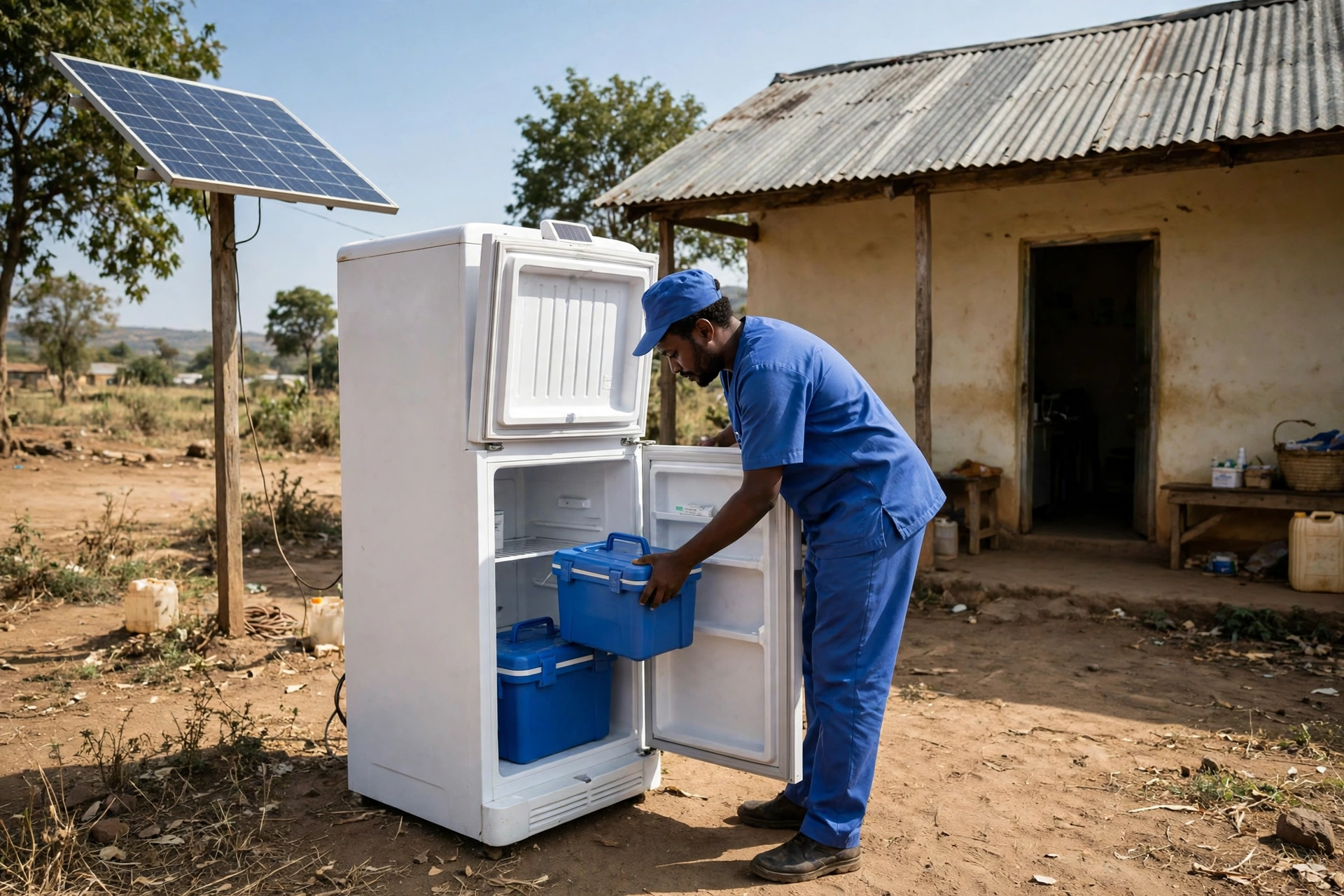
A vaccine depot generator is a placement problem before it is an engineering problem. It sits next to a health facility where patients wait, next to houses where the depot’s neighbours live, and next to the cold rooms it is protecting. It has to run without disturbing any of them, and it has to be tested without disturbing any of them either. The noise calculation and the placement decision are as important as the kVA calculation, and they are the two calculations most often left until after the set is ordered.
A silent-canopy set produces 65–75 dB(A) at 7 metres, which is the level of a loud conversation. The night-time limit at a residential boundary is typically 45–55 dB(A), which is the level of a quiet room. The difference is 20 dB(A), and 20 dB(A) is a factor of ten in sound energy — which means the set has to be 20–30 metres from the nearest bedroom window, or behind an acoustic barrier, or both. Sound falls by 6 dB(A) for every doubling of distance, so a set that measures 70 dB(A) at 7 metres measures about 58 dB(A) at 28 metres and about 52 dB(A) at 56 metres.
Placement has a second rule, and it is the one the Hurricane Sandy case proves for every health facility. A generator in a flood zone is a generator that fails at the same time as the grid, which is the one moment it is needed. NYU Langone Medical Center put its emergency generators in the basement, and Hurricane Sandy flooded the basement, and the hospital evacuated 215 patients down dark stairwells. A vaccine depot that puts its generator in the basement because the space is free is making the same bet, and the odds are the same. The set goes above the flood line, on a plinth, with the fuel tank protected — and the cold rooms go above the flood line too.
The third rule is access. A depot generator needs a fuel delivery lorry to reach it, a crane to lift it in, and a service engineer to reach it at 2 a.m. in a storm. A set buried behind the depot, down a lane that a lorry cannot turn in, is a set that cannot be fuelled during the outage it was bought for. The location has to be chosen with the fuel lorry in mind, not with the spare land in mind, and the access road has to be on the depot’s emergency plan, so that the security gate opens for the fuel lorry at 3 a.m. without a phone call.
The fourth rule is the one the Harris County case proves: the alarm has to reach a person. A temperature logger that records the excursion and tells nobody is a historian, not a warning system. Every refrigerator and cold room needs a logger with an SMS alarm, and the alarm needs remote monitoring, so that a temperature excursion at 2 a.m. reaches a person who can act — and the monitoring needs its own power, a small UPS that holds longer than the generator’s start time, because a monitoring system that dies with the grid is a monitoring system that never reports the outage.
Frequently Asked Questions
What size generator do I need for a vaccine refrigerator?
A single vaccine refrigerator needs a 1–3 kVA set, because the refrigerator draws only 100–200 W running but its compressor starts at three to five times that figure. A district store with several fridges and a cold room needs 10–30 kVA, and a national depot with walk-in cold rooms needs 50–150 kVA. Size from the compressor starting surge, not the running watts, and measure the load at the distribution board before ordering.
How long can vaccines stay cold without power?
A standard mains-powered vaccine refrigerator stays below 8°C for at least four hours in a hot climate. An ice-lined refrigerator holds for at least 20 hours. A WHO-prequalified solar direct-drive refrigerator holds for 77–137 hours — the Vestfrost VLS 094A SDD holds 77 hours 41 minutes, and the Haier HTCD 90 SDD holds 137 hours. The holdover time is the margin the generator has, and a depot with standard fridges has four hours of margin, not four days.
Do vaccine cold rooms need a backup generator?
Yes. A walk-in cold room warms past 8°C within 2–4 hours once its compressor stops, and a national depot holds 1–10 million doses behind those rooms. The World Health Organization estimates that more than 50% of vaccines are wasted globally every year because of temperature control and logistics failures, and a cold room with no backup power is the most common cause. NFPA 110 classifies vaccine depots as Level 1 emergency power systems, which means the generator must start and accept load within 10 seconds.
What happens to vaccines during a power outage?
The refrigerators start warming within hours, and the doses are lost when the temperature leaves the 2–8°C range — or when it drops below 0°C and freezes the aluminium-adjuvanted vaccines, which destroys them outright. In Hurricane Maria, more than 80% of Puerto Rico’s vaccines were destroyed after the island lost power for weeks. In Winter Storm Uri, Harris County had six hours to distribute 8,430 Moderna doses after its generator failed. A dose outside its range must be discarded, and the discard is recorded against the programme.
Can a diesel generator power a vaccine cold chain?
Yes — and it is the standard answer for every tier above a single clinic. A 1–3 kVA set powers a health centre’s refrigerator, a 10–30 kVA set powers a district store, and a 50–150 kVA set powers a national depot’s walk-in cold rooms. A clinic with no grid at all is the exception: it uses a solar direct-drive refrigerator, which holds for 77–137 hours without power, with a small 3–5 kVA diesel set behind it for the lights, the monitoring and the ice-pack freezer.
Specification Checklist
1. Zone the cold chain before sizing anything. Split the depot into national store, district store and health centre, and size each tier separately. A single set at the national depot cannot keep a district’s fridges cold.
2. Load list by refrigerator and compressor. Count every vaccine refrigerator, cold-room compressor, ice-pack freezer and ultra-low freezer, with running watts, starting watts and power factor. Measure at the distribution board over a full week. No load list, no quotation.
3. Set size with starting surge. Size for the simultaneous compressor restart — five to seven times the running load for a cold-room compressor — or programme a staggered restart sequence in the automatic transfer switch. State which one the quotation uses.
4. Rating matched to duty. A set that runs for 72 hours on a long outage is running on its prime rating, not its standby rating. Check the rating on the nameplate, not on the quotation.
5. Start time of 10 seconds or less. Specify NFPA 110 Level 1, Type 10 in the contract, and test the start time under load every month. A set that takes 15 seconds does not meet the standard.
6. Fuel autonomy of 72 hours. Size the bulk tank for 72 hours at 75% load — 360 litres for a 20 kVA set, 1,440 litres for a 100 kVA set — and hold a fuel-delivery contract that guarantees delivery within 24 hours. Test the fuel, polish it and turn it over on a schedule.
7. Temperature alarms with remote monitoring. A temperature logger with an SMS alarm on every refrigerator and cold room, with remote monitoring so that an excursion at 2 a.m. reaches a person who can act. A logger that records the excursion and tells nobody is a historian, not a warning system.
8. Monthly load test and battery discipline. Test every set under load for 30 minutes every month, with the starting battery tested under cranking load and replaced on a two-year schedule. The generator that was never tested under load is the generator that fails on the first real outage.
A vaccine depot that loses power loses more than electricity — it loses the doses its programme spent months procuring, the sessions its clinics spent weeks planning, and the trust of the parents who brought their children to be vaccinated. If the sizing, the holdover time or the fuel autonomy is still an open question, contact PAVO for a load schedule and a quotation built around the depot’s actual refrigerators and cold rooms.