

What Size Generator Does a University Need? | PAVO
A university is a small city that never sleeps — lecture halls by day, residence halls by night, and freezers that hold ten years of research at minus eighty degrees.
What size generator does a university need? A small college typically needs a 100–250 kVA set, a mid-size university 250–1,000 kVA, and a large research university 1,000–3,000 kVA, usually as several sets across campus. The figure comes from the load list — research freezers, housing, dining and the central plant — not from student numbers alone.
- What a Campus Actually Needs Power For
- Sizing Bands by Campus Size
- The Research Freezer and the Exam Hall: What an Outage Really Costs
- NFPA 110 and the 10-Second Rule on Campus
- Fuel Autonomy: How Long a Campus Can Really Run
- Noise, Placement and the Neighbours
- Frequently Asked Questions
- Specification Checklist
What a Campus Actually Needs Power For
A university campus is several facilities behind one name, and each of them needs power for a different reason. A lecture hall needs light and projection for three hours. A research laboratory needs power for ten years of samples that cannot be re-created. A residence hall needs power at 2 a.m., when 800 students are asleep inside it. A dining hall needs power for the cold rooms that hold the week’s food. Treating the campus as one connected load with one interruption tolerance is the planning error that produces either a single oversized set at the main substation, or a set that cannot reach the buildings that matter.
The loads fall into four tiers, and the tiers decide the specification. The first tier is life safety: emergency lighting, fire alarms, lift recall, exit signage and the fire pumps. The second tier is research and data: ultra-low freezers, incubators, analytical instruments, the campus data centre and the network that runs the whole institution. The third tier is student welfare: residence halls, dining, water pumping, security and the health centre. The fourth tier is teaching and administration: lecture halls, libraries, offices and sports facilities. A set that covers the first two tiers protects life and research. A set that covers all four keeps the university open. The budget has to state which one the university is buying, because the difference between them is roughly half the kVA figure.
The scale is visible in the student numbers. A mid-size university of 10,000 students typically occupies 30–50 buildings across 100–200 hectares, with a connected electrical load of 5–15 MW. A large research university of 30,000–50,000 students draws 20–60 MW at peak. No diesel generator covers that. The campus generator does not power the university. It powers the slice of the university that cannot afford to stop — and the specification is the list of what sits in that slice.
Teaching and Administration
Teaching loads are the most forgiving on a campus, and the easiest to oversize for. A lecture hall of 400 seats draws 15–25 kW for lighting, projection, sound and ventilation — a load that stops the moment the lecture stops. A library draws 30–60 kW for lighting, computers and air handling, and it closes at night. An office block draws 10–20 kW per floor. None of these loads kills anyone when they stop, and none of them destroys anything that cannot be re-done the next day. They are the loads that go off the essential bus first.
The exception is the examination hall, and it is the exception that catches universities out. A 400-seat hall running online examinations draws 40–60 kW — 400 laptops or desktops, the network switches, the proctoring system and the cooling that keeps 400 people and 400 machines from overheating. The load is not large. The consequence of losing it is: an examination interrupted mid-way is invalidated, and 400 students have to be re-examined. Teaching loads are forgiving in every case except the one where the university is testing its students, and the specification has to treat the examination hall as a research load, not a teaching load, for the weeks when examinations run.
Research Laboratories
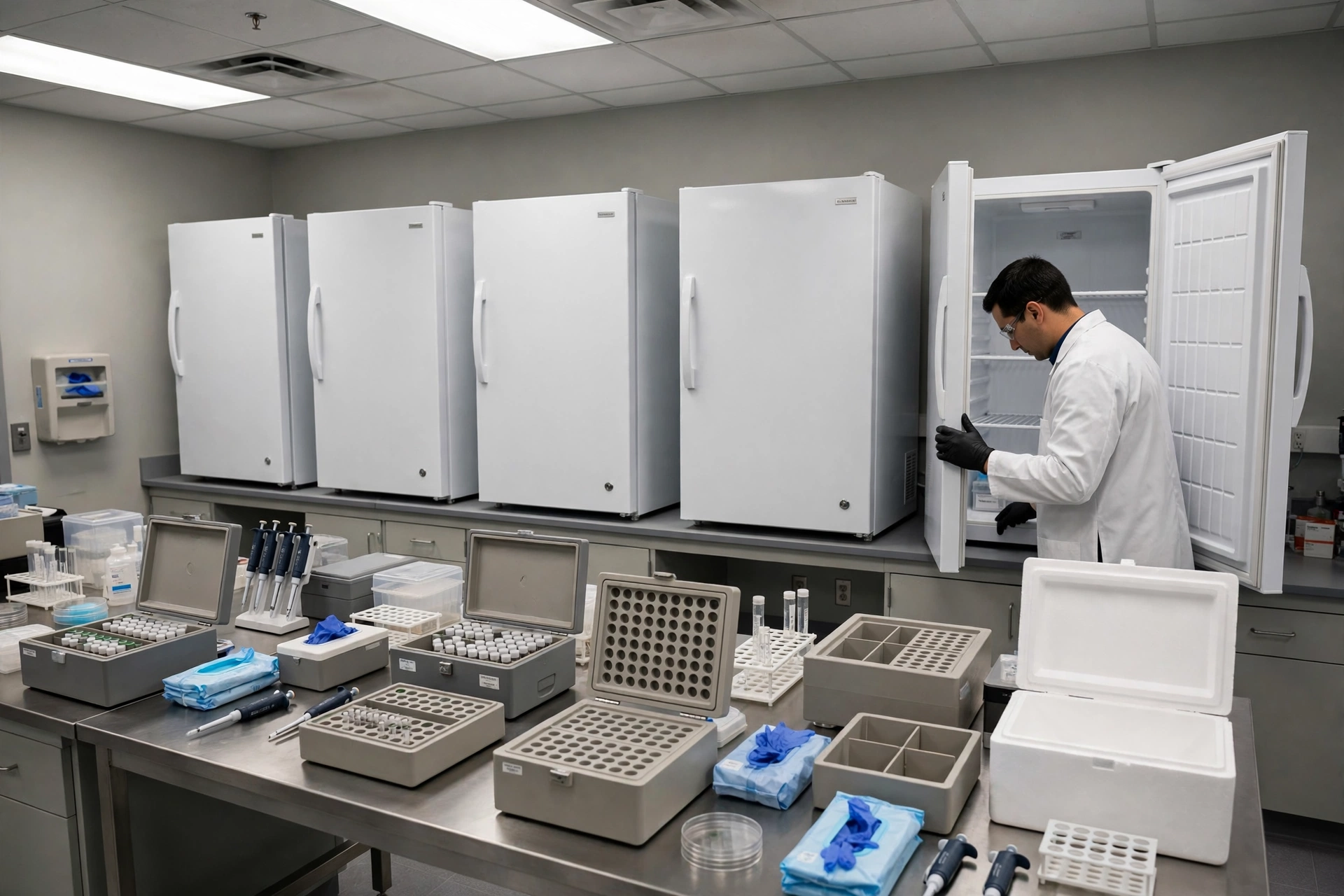
Research loads are the reason a university buys a generator at all. A single −80°C ultra-low freezer draws 700–1,000 W running, and a research building with 40 freezers draws 28–40 kW continuously, day and night, weekends included. The load never drops, because the freezers never switch off. A university with 300 freezers across its science buildings carries 210–300 kW of freezer load alone — and each freezer holds samples worth $50,000–$500,000 in research time, reagents and, in the case of clinical samples, material that cannot be collected again.
The laboratory load is also the load with the worst power-quality requirement. A nuclear magnetic resonance spectrometer draws 15–30 kW and takes days to restabilise after a power cut, because the superconducting magnet has to be re-cooled and re-shimmed. A confocal microscope draws 2–5 kW and loses a live-cell experiment that took six months to grow. A fume hood is a safety system: lose the extract fan and the laboratory fills with the vapours the hood was removing. The laboratory article sets out the freezer and fume-hood side of this calculation in detail. The point for the campus specification is that the research building gets its own generator, sized for its own freezers, before the teaching block gets anything.
Student Housing
Residence halls are the load that makes a university different from a school. A K-12 school empties at 4 p.m. A residence hall is occupied 24 hours a day, and a power failure at 2 a.m. is an occupied-building emergency, not an empty-building inconvenience. A 500-bed hall draws 80–150 kW at night for lighting, water pumping, security, fire systems and the lifts, and 150–250 kW in the evening when students cook, shower and charge their devices. The schools article covers the daytime school case; the university case is the night case, and it is governed by the same rule that governs hospitals: people sleeping in a building need the lights, the lifts and the alarms to work.
The housing load is also the load that produces the most complaints when it is not covered. Students who lose heating in winter, water on the upper floors, or the Wi-Fi that runs their coursework, complain to the university, and they complain on social media, and the complaint is about the university, not about the grid. A university that covers its research freezers and leaves its residence halls dark has protected its science and damaged its reputation. The specification has to rank the halls alongside the laboratories, not below them.
Central Plant and Utilities
The central plant is the largest generator load on most campuses, and the least visible. A campus chilled-water plant draws 500 kW–3 MW for its chillers, pumps and cooling towers. A heating plant draws 200 kW–1 MW for its boilers, pumps and fans. The water treatment plant, the sewage lift stations and the campus-wide street lighting add another 100–300 kW. These are the loads that keep the campus habitable, and they are the loads that no single generator covers. A central plant of 2 MW needs a 2,500–3,000 kVA set, and most universities do not buy one — they buy a 500–1,000 kVA set for the life-safety and research loads, and they accept that the central plant stops during an outage.
The honest answer is that the central plant is the load the university plans around, not the load it powers. The specification has to say which central-plant loads are on the essential bus — the sewage lift station, the domestic water pumps, the fire water pumps — and which are not — the chillers, the main heating plant, the air handling. The difference between the two lists is the difference between a 500 kVA set and a 2,000 kVA set, and the facilities director has to sign the list, because it is a budget decision, not an engineering one.
Sizing Bands by Campus Size
Sizing a campus generator starts with the zones, not with the student numbers. Two universities with 10,000 students can need sets that differ by a factor of three, because one of them has a medical school and the other does not. The sizing bands below are starting points, and every campus has to be measured at its own distribution boards, because the load depends on the buildings, not on the enrolment. The step-by-step load-list method is set out in the generator sizing guide.
| Campus type | Students | Essential load | Recommended sets | Typical cost installed |
|---|---|---|---|---|
| Small college, teaching only | 1,000–3,000 | 80–200 kW | 100–250 kVA, one set | $25,000–$45,000 |
| Mid-size university, some research | 5,000–15,000 | 200–800 kW | 250–1,000 kVA, one to three sets | $60,000–$180,000 |
| Large research university | 20,000–50,000 | 800–2,500 kW | 1,000–3,000 kVA, several sets | $200,000–$600,000 |
| Central plant, whole campus | Any | 2–5 MW | 2,500–6,000 kVA, paralleled | $500,000–$1,200,000 |
The table is a starting point, not a specification. The measurement has to be done building by building, with a clamp meter, over a full term — because the load at 3 a.m. in the summer vacation is the freezer load, and the load at 2 p.m. in the examination week is the freezer load plus the examination halls, the dining halls and the data centre at full tilt. A set sized for the vacation load is undersized from the first week of term.
A Small College: 100–250 kVA
A small teaching college — 1,000–3,000 students, a handful of buildings, no medical school — typically needs a single 100–250 kVA set. The load is 80–200 kW: life safety across the buildings, the IT room, the dining hall cold rooms and the residence hall that holds the overnight students. The set sits in a silent canopy outside the main building, with a sub-base tank that holds 8–12 hours of fuel, and the cost is $25,000–$45,000 installed. A Cummins C200D5, rated 200 kVA standby and 182 kVA prime, covers most small colleges with room for the compressor restart surge, and it burns about 37 L/h at 75% load.
The mistake small colleges make is buying the set for the teaching load and forgetting the residence hall. A college with 400 residential students has 400 people sleeping in its buildings, and the fire alarm, the emergency lighting and the water pumps are life-safety loads, not teaching loads. The specification has to include the halls, because the students are the load that cannot be sent home when the grid fails — and a college that sends 400 students home in the middle of a storm has a transport problem, not a power problem.
A Mid-Size University: 250–1,000 kVA
A mid-size university — 5,000–15,000 students, a science faculty, a data centre, a teaching hospital affiliation — typically needs 250–1,000 kVA, usually as two or three sets in different buildings. The load is 200–800 kW, and the sizing decision is not the total. It is the split: one 250 kVA set for the research building, one 200 kVA set for the residence halls and dining, one 150 kVA set for the data centre and administration. Three smaller sets cost roughly 30% more than one large set, and the university buys them anyway, because a single set at the main substation cannot reach the buildings that matter, and a single point of failure takes the whole campus down.
The mid-size university is also the size where the standby and prime ratings start to matter. A set that runs for 72 hours on a long outage is running on its prime rating, not its standby rating, and the difference is 10% of the kVA figure. A 500 kVA standby set is a 450 kVA prime set, and a university that sizes for the standby figure and then runs for three days has overloaded its set by 10% for three days. The rating on the nameplate is the number that counts, not the number on the quotation.
A Large Research University: 1,000–3,000 kVA
A large research university — 20,000–50,000 students, a medical school, a supercomputing centre, a campus of 100 or more buildings — typically needs 1,000–3,000 kVA, as five to ten sets across the campus. The load is 800–2,500 kW, and the largest single set is usually 500–1,000 kVA, serving one research building or one cluster of buildings. The total cost is $200,000–$600,000, and the lead time is 12–20 weeks, because the sets are ordered against a campus-wide resilience plan, not a single building’s specification.
The large university is also the size where motor starting decides the set size, not the running load. A research building’s chillers, air-handling fans and fume-hood extract fans all start at once when the generator takes the load, and the combined starting surge is three to five times the running load. A building drawing 300 kW running can demand 900–1,500 kVA of starting apparent power for a second. The answer is load sequencing — the automatic transfer switch staggers the starts, a few seconds apart — and the sequencing has to be designed, programmed and tested, because a set that is sized for the running load and never tested under a full restart will trip on its first real outage.
The Research Freezer and the Exam Hall: What an Outage Really Costs
A university measures an outage in samples and in students, not in kilowatt-hours. The grid fails, the automatic transfer switch moves the essential bus to the generator, and if everything works, the freezers never notice and the examination hall never notices. If anything in that chain fails, the university starts losing its research within hours, and it starts losing its examinations within minutes. The arithmetic is worth doing before the outage, because it is the arithmetic that justifies the generator.
The freezer window is the number that decides everything. An unpowered −80°C freezer typically warms past −60°C within 4–8 hours, and past −40°C within 8–12 hours. A sample stored at −80°C that warms to −40°C is not necessarily destroyed, but it has to be re-validated, and a sample that has been thawed and re-frozen is a sample that no reviewer trusts. The freezer’s thermal mass buys hours, not days, and the mass is the samples themselves — a full freezer holds its temperature twice as long as a half-empty one, which is why the laboratories that keep their freezers full lose less than the laboratories that keep them half empty.
Case 1: The North Carolina Ice Storm and the Battery Terminal
A 28,000-student research university in North Carolina lost backup power to its biomedical research building during a February ice storm — not because the generator failed mechanically, but because a corroded battery terminal prevented the engine from cranking. The generator was maintained, tested and fuelled. The starting battery was not. The engine never turned, the automatic transfer switch never transferred, and the building’s freezers started warming.
The case is the one that maintenance engineers quote, because it is the failure that looks like nothing. A corroded terminal costs $15 to replace and ten minutes to clean. A freezer full of clinical samples costs $200,000 to replace, and the samples in it cannot be replaced at any price, because they came from patients who cannot be re-sampled. The university’s own maintenance guide puts it plainly: whether a campus runs three generators or thirty, the battery is the component that decides whether the set starts, and the battery is tested under cranking load, not by looking at it. A battery that reads 12.6 volts on a meter and collapses to 8 volts under cranking is a battery that has already failed, and the only test that finds it is the cranking test.
Case 2: Winter Storm Uri and the Texas Freezers
In February 2021, Winter Storm Uri cut power to about 4.5 million customers in Texas, and the state’s universities were in the middle of it. The University of Texas at Austin, with more than 50,000 students, lost power across much of its campus, and its researchers spent the storm moving samples from warming freezers to the few that still had power, and from freezers that had lost power to dry ice bought from the few shops that were open. The storm lasted a week. The freezers that were not moved, and not protected, lost samples that had taken years to collect.
The Uri case is the one that shows the national arithmetic for universities. The outage hit the storage, because the freezers stopped. And it hit the research itself, because the laboratories were dark, the instruments were down, and the experiments that were running when the power failed were lost — cell cultures that had been growing for six months, animal studies that had been running for a year, field samples that had been collected on a grant that had already ended. A university’s generator protects the storage. Nothing protects the experiment except a grid that stays up, which is why the universities that recovered fastest were the ones whose generators kept their research buildings running, so that the first researchers back through the door could restart their work the same day.
The cost of missing the window is not the cost of the freezer. A −80°C freezer costs $10,000–$18,000. The samples inside it are worth far more: a single freezer in a cancer research laboratory can hold tissue from 500 patients, collected over five years under a protocol that cannot be repeated. A university that loses a freezer room loses the research, the publications, the grant renewals and the PhD theses that depended on those samples. The generator that protects the freezer room is protecting the university’s research output, not its electricity bill.
Case 3: The 400-Seat Exam Hall
The examination hall is the case that has no freezer and no drama, and it still costs the university real money. A 400-seat hall running online examinations draws 40–60 kW, and the examination lasts 90 minutes. The grid fails 40 minutes in. The automatic transfer switch takes ten seconds. The computers reboot. The examination platform reconnects. The students have lost five minutes, and the examination board has a decision to make: the examination is either re-run, or it is not, and the decision is made by people who were not in the hall.
A re-run examination for 400 students costs roughly $15,000–$30,000 — room hire, invigilation, question setting, marking, and the administrative time to reschedule 400 students who have already started their holidays. A university that runs 2,000 students through online examinations in a single week, across five halls, has $75,000–$150,000 of re-run exposure in that week alone. The generator that covers the examination halls for two weeks a year is the cheapest insurance the university buys, and it is the insurance that the facilities budget usually cuts first, because the examination halls are quiet for the other 50 weeks.
The three cases share one detail. In none of them did the university lose its research or its examinations because a generator failed mechanically. In all three, the loss came from the chain around the generator — a battery terminal, a fuel delivery, a hall that was never put on the essential bus. The generator is the only part of that chain that the university controls, and it is the part that has to work the first time, because there is no second chance to keep a sample frozen or an examination valid.
NFPA 110 and the 10-Second Rule on Campus
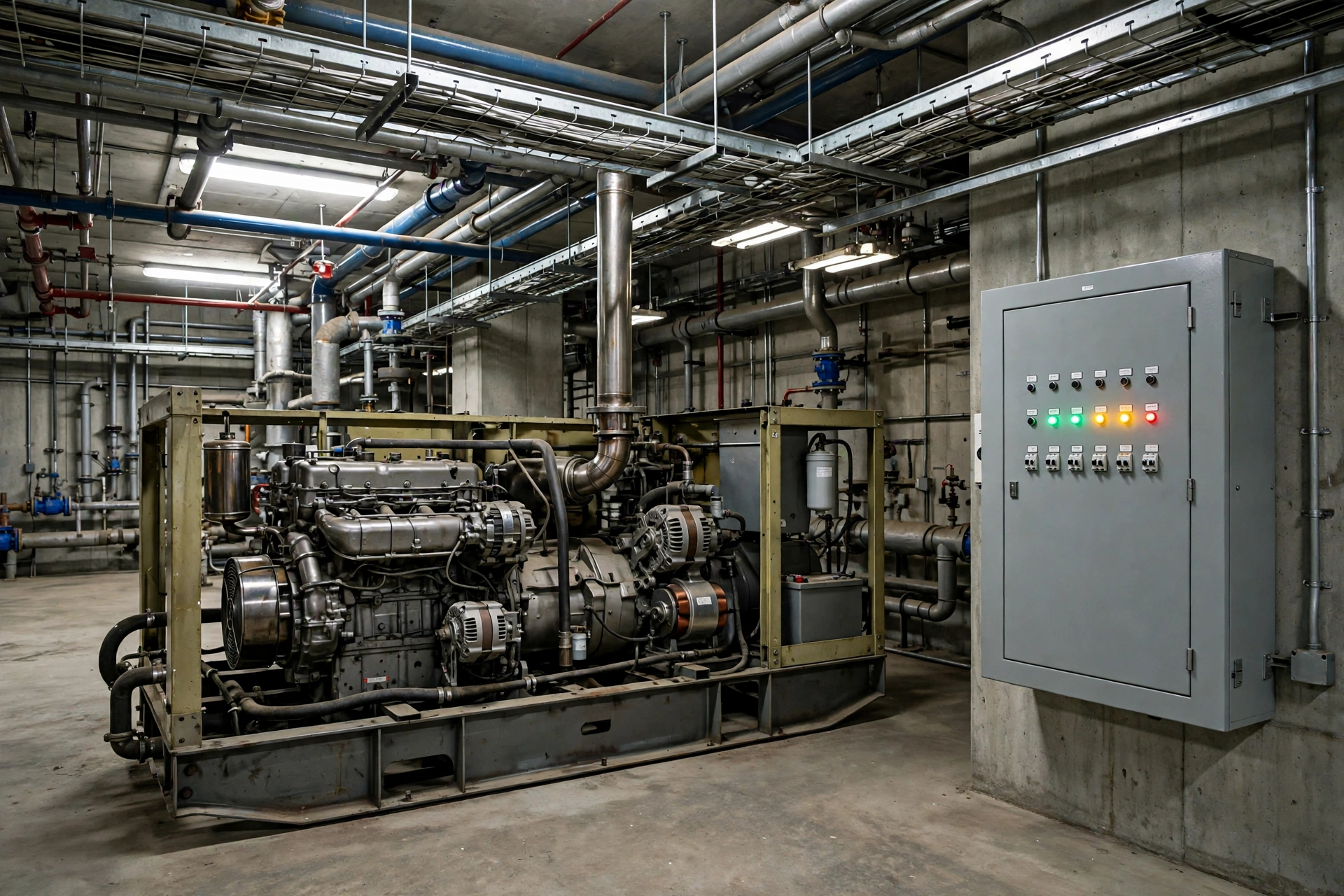
The ten-second rule is not a target. It is a standard, and it is the standard that decides whether a campus generator is compliant or not. NFPA 110 requires Level 1 emergency power systems — the classification that covers universities, hospitals and any facility where the loss of power threatens life — to start and accept load within 10 seconds. A set that takes 15 seconds is not a slow set. It is a set that does not meet the standard, and the university’s insurer and its accreditation body both know it.
The rule matters on a campus because the campus has both classifications in the same buildings. The residence hall is Level 1: people sleep there, and the emergency lighting, the fire alarm and the lift recall have to work within ten seconds. The dining hall cold rooms are Level 2: the food can wait 60 seconds, and the set has 60 seconds to start. The research building is Level 1 for its fume hoods and its alarms, and Level 2 for its freezers, which have hours of thermal margin. The specification has to classify every load, because the classification decides the start time, and the start time decides the set.
Level 1 vs Level 2
Level 1 covers the loads where the loss of power threatens life: emergency lighting, fire alarms, lift recall, exit signage, fume hoods and the fire pumps. The set must start and accept load within 10 seconds, and the fuel autonomy is typically 48–72 hours. Level 2 covers the loads where the loss of power threatens property or operations: dining cold rooms, data-centre cooling, water pumping and the freezers. The set must start within 60 seconds, and the fuel autonomy is typically 24–48 hours. Most campuses carry both levels, and the sets are classified by the highest level of load they carry — a set that carries a single Level 1 load is a Level 1 set, with a 10-second start and a 72-hour fuel tank.
The classification also decides the testing. A Level 1 set is tested under load every month, for 30 minutes, with the start time recorded. A Level 2 set is tested every three months. The testing is the part of the standard that universities most often fail, because the test has to be run during term time, when the buildings are occupied, and the test is noisy, and the test interrupts the very loads it is protecting. A university that tests its Level 1 sets quarterly instead of monthly has a set that is compliant on paper and untested in practice, and the first real outage is when the university finds out which one it has.
What the Code Actually Requires
NFPA 110 defines the system by three letters: type, class and level. The type is the start time — Type 10 is 10 seconds, Type 60 is 60 seconds. The class is the fuel autonomy — Class 48 is 48 hours, Class 72 is 72 hours. The level is the consequence — Level 1 is life safety, Level 2 is everything else. A university specification that says “NFPA 110, Level 1, Type 10, Class 72” has said everything: the set starts in ten seconds, runs for 72 hours, and protects life. A specification that says “generator to NFPA 110” has said nothing, and the supplier will supply the cheapest set that meets the words.
The UK’s HTM 06-01 sets the same expectation for healthcare electrical systems, and most universities write the 10-second requirement into their own specifications regardless of jurisdiction, because the insurer asks for it. The insurer’s question is simple: how long does the campus take to get power back, and how do you prove it. The answer is the monthly test record, with the start time written down, and the answer has to be ten seconds or less.
Testing That Proves It
The monthly load test is the cheapest item on the campus maintenance schedule and the most skipped. A 30-minute test under load, once a month, costs roughly $200–$400 in fuel and labour per set, and it proves three things: the set starts, the set takes the load, and the set holds its voltage and frequency under that load. A set that is tested without load proves nothing — an engine that idles happily for 30 minutes can still trip the moment the freezers and the fans come on, because the fault is in the alternator or the governor, and the alternator and the governor only work under load.
The test record is also the document the insurer asks for after an outage. A university that can show twelve monthly test records, each with a start time of ten seconds or less, has a claim that is paid. A university that can show four, or none, has a claim that is argued. The maintenance schedule for a campus set is the same for a 100 kVA set and a 1,000 kVA set: weekly inspection, monthly load test, annual full-load test, and a starting battery replaced on a two-year schedule regardless of condition.
Fuel Autonomy: How Long a Campus Can Really Run
A campus generator runs as long as it has fuel, and the fuel calculation is the one most universities get wrong by a factor of two. The calculation starts with the load, and the load is not the set’s rating. A 500 kVA set does not burn fuel for 500 kVA. It burns fuel for the load it is actually carrying, which on a campus is typically 60–75% of the rating — the freezers and the fans run continuously, and the teaching loads cycle. The fuel use at 75% load is the number that sizes the tank.
| Set size | Fuel use at 75% load | Fuel for 24 hours | Fuel for 48 hours | Fuel for 72 hours |
|---|---|---|---|---|
| 100 kVA | 20 L/h | 480 L | 960 L | 1,440 L |
| 250 kVA | 55 L/h | 1,320 L | 2,640 L | 3,960 L |
| 500 kVA | 105 L/h | 2,520 L | 5,040 L | 7,560 L |
| 1,000 kVA | 200 L/h | 4,800 L | 9,600 L | 14,400 L |
| 2,000 kVA | 400 L/h | 9,600 L | 19,200 L | 28,800 L |
The table assumes the set runs at 75% load, which is the realistic figure for a campus on generator power. A 500 kVA set needs a 8,000-litre bulk tank for 72 hours, and a 1,000 kVA set needs a 15,000-litre tank. The tank has to be sized for the autonomy the university specifies, not for the tank the supplier happens to have in stock. A university with five 500 kVA sets needs 38,000 litres of diesel on site for 72 hours, and that is a fuel farm, not a tank.
The 72-Hour Question
NFPA 110 defines classes by how long the set must run: Class 48 is 48 hours, Class 72 is 72 hours. Most large universities specify Class 72, because a campus that runs out of fuel on the third day of an outage loses its freezers on the third day — and the third day is when the research is already at the edge of its window. The Uri case is the reason: Texas was without power for a week, and the universities that survived were the ones whose fuel lasted past the third day, when the fuel suppliers could finally reach them.
The 72-hour question is also a budget question. A 500 kVA set with a 72-hour tank costs roughly $8,000–$12,000 more than the same set with a 24-hour tank, because the tank is larger, the bund is larger, and the fuel itself costs $1.20–$1.50 per litre — 7,560 litres is $9,000–$11,000 of diesel sitting in a tank, waiting for an outage that may not come for five years. The university that buys the 72-hour tank is buying insurance, and the insurance costs roughly $10,000 per set. The university that buys the 24-hour tank is buying 24 hours, and after 24 hours it has nothing.
Delivery During a Regional Outage
The third half of the fuel calculation is the delivery. A university that specifies 72 hours of fuel autonomy and has no fuel-delivery contract has specified 72 hours and bought 72 hours — and after 72 hours, it has nothing. The contract has to guarantee delivery within 24 hours, and it has to be tested, because a fuel supplier that cannot reach the campus during a storm is a supplier that does not exist. The Maria case is the evidence: seven-hour lines at petrol stations, and hospitals waiting for fuel that did not arrive.
Fuel quality is the second half of the calculation. Diesel stored in a bulk tank degrades, grows water and breeds microbes, and a campus generator is the worst case for fuel quality: it sits for months without running, then has to run for three days without stopping. The fuel has to be tested, polished and turned over on a schedule because of diesel fuel ageing, and the tank has to be kept full — a half-empty tank breathes moist air, and moist air grows water, and water grows microbes. A generator that fails on bad fuel fails at the same moment as the grid, which is the one moment it is needed.
Noise, Placement and the Neighbours
A campus generator is a neighbourhood problem before it is an engineering problem. It sits next to residence halls where students sleep, next to lecture halls where students listen, and next to houses where the university’s neighbours live. It has to run without disturbing any of them, and it has to be tested without disturbing any of them either. The noise calculation and the placement decision are as important as the kVA calculation, and they are the two calculations most often left until after the set is ordered.
A silent-canopy set produces 65–75 dB(A) at 7 metres, which is the level of a loud conversation. The night-time limit at a residential boundary is typically 45–55 dB(A), which is the level of a quiet room. The difference is 20 dB(A), and 20 dB(A) is a factor of ten in sound energy — which means the set has to be 20–30 metres from the nearest bedroom window, or behind an acoustic barrier, or both. Sound falls by 6 dB(A) for every doubling of distance, so a set that measures 70 dB(A) at 7 metres measures about 58 dB(A) at 28 metres and about 52 dB(A) at 56 metres.
Night Noise and the 45 dB(A) Line
The night limit is the number that decides the location. A residence hall is a bedroom, and the World Health Organization’s guideline for a classroom is 35 dB(A) — the figure the schools article uses for its own noise calculation, and the figure that applies to a lecture hall as well. A generator that measures 70 dB(A) at 7 metres has to be 112 metres from a classroom window to reach 35 dB(A), which is further than most campuses can manage. The answer is not distance. It is the enclosure: an acoustic canopy, a louvred plant room, or a below-grade enclosure that takes 20 dB(A) off the source before distance does the rest.
The noise calculation is the reason the set’s location is a planning decision, not a facilities decision. A set placed next to the residence hall because the space is free will be the subject of a complaint on its first test run, and a complaint on the first test run becomes a restriction on testing — and a restriction on testing becomes a generator that is never tested under load. The set has to be far enough from the halls to be tested monthly, under load, for 30 minutes, without disturbing a student. If it cannot be tested, it cannot be trusted.
Where the Set Goes
Placement has a second rule, and it is the one the Hurricane Sandy case proves. A generator in a flood zone is a generator that fails at the same time as the grid, which is the one moment it is needed. NYU Langone Medical Center put its emergency generators in the basement, and Hurricane Sandy flooded the basement, and the hospital evacuated 215 patients down dark stairwells. A university that puts its generator in the basement because the space is free is making the same bet, and the odds are the same. The set goes above the flood line, on a plinth, with the fuel tank protected — and the research freezers go above the flood line too.
The third rule is access. A campus generator needs a fuel delivery lorry to reach it, a crane to lift it in, and a service engineer to reach it at 2 a.m. in a storm. A set buried behind the sports hall, down a lane that a lorry cannot turn in, is a set that cannot be fuelled during the outage it was bought for. The location has to be chosen with the fuel lorry in mind, not with the spare land in mind, and the access road has to be on the campus emergency plan, so that the security gate opens for the fuel lorry at 3 a.m. without a phone call.
Emissions and Permits
A campus generator is also a permit problem. A 500 kVA diesel set emits roughly 2.6 kg of CO2 per litre of diesel burned, which is 275 kg of CO2 per hour at 75% load, and 6.6 tonnes over a 24-hour outage. Most universities have a carbon-reduction target, and the generator is the line item that the sustainability office asks about first. The answer is that the generator runs for hours a year, not thousands of hours, and its annual emissions are a rounding error against the campus total — but the answer has to be written down, because the permit application asks for it.
The permit also asks about the exhaust. A set in a plant room needs a stack that clears the roofline, a silencer that takes the exhaust noise below the boundary limit, and a rain cap that keeps water out of the turbocharger. A set outside needs a bund for its fuel tank, a spill kit, and a drainage plan that keeps a fuel spill out of the campus storm drains. The permit is not the hard part. The hard part is that the permit has to be applied for before the set is ordered, because the stack height and the bund size are part of the quotation, and a quotation written without them is a quotation that will be revised.
Frequently Asked Questions
What size generator does a university need?
A small college typically needs a 100–250 kVA set, a mid-size university 250–1,000 kVA, and a large research university 1,000–3,000 kVA, usually as several sets across campus. The figure comes from the load list — research freezers, housing, dining and the central plant — not from student numbers alone. A set sized from the load list up is a set that works; a set sized from the enrolment down is either too large or too small.
Do universities need a backup generator?
Yes. A university is an occupied building 24 hours a day — residence halls, research freezers, data centres and dining cold rooms — and NFPA 110 classifies most campus buildings as Level 1 emergency power systems, which means the generator must start and accept load within 10 seconds. A campus without a generator loses its research within hours, its examinations within minutes, and its students’ confidence within a day.
How long can a university run on a generator?
As long as it has fuel. Most large universities specify 72 hours of fuel autonomy — a 500 kVA set needs about 7,560 litres of diesel for 72 hours at 75% load, and a campus with five such sets needs 38,000 litres on site. The practical limit is not the engine, which can run for weeks with oil top-ups, but the fuel delivery: a university with a 72-hour tank and no delivery contract has 72 hours and nothing after it.
What happens to a university during a power outage?
The research freezers start warming within 4–8 hours, the examination halls lose their online tests immediately, and the residence halls lose lighting, water and lifts. During Winter Storm Uri, the University of Texas at Austin lost power across much of its campus, and researchers spent the storm moving samples from warming freezers to the few that still had power. A campus generator protects the storage and the examinations; nothing protects the research except a grid that stays up.
Can a diesel generator power a university campus?
Yes, in part — and the honest limit matters. A diesel generator cannot power a whole university: a large campus draws 20–60 MW, and no generator set covers that. What a generator powers is the critical slice — life safety, research freezers, the data centre, residence halls and dining — typically 1,000–3,000 kVA across several sets. A university that asks for a single set to power the whole campus is asking for the wrong thing, and the right answer is a zone-by-zone plan.
Specification Checklist
1. Zone the campus before sizing anything. Split the campus into teaching, research, housing, dining and central plant, and size each zone separately. A single set at the main substation cannot reach the buildings that matter.
2. Load list by building. Count every freezer, fume hood, analyser, server and compressor, with running watts, starting watts and power factor. Measure at the distribution board over a full term. No load list, no quotation.
3. Set size with starting surge. Size for the simultaneous restart — three to five times the running load — or programme a staggered restart sequence in the automatic transfer switch. State which one the quotation uses.
4. Rating matched to duty. A set that runs for 72 hours on a long outage is running on its prime rating, not its standby rating. Check the rating on the nameplate, not on the quotation.
5. Start time of 10 seconds or less. Specify NFPA 110 Level 1, Type 10 in the contract, and test the start time under load every month. A set that takes 15 seconds does not meet the standard.
6. Fuel autonomy of 72 hours. Size the bulk tank for 72 hours at 75% load — 7,560 litres for a 500 kVA set, 14,400 litres for a 1,000 kVA set — and hold a fuel-delivery contract that guarantees delivery within 24 hours. Test the fuel, polish it and turn it over on a schedule.
7. UPS for the electronic loads. A 10–40 kVA UPS for the data centre, temperature monitoring, alarms and examination platforms, with a battery that holds longer than the generator’s actual start time. The UPS must sit on the essential bus so it recharges on generator power.
8. Remote monitoring and monthly load test. Temperature alarms on every freezer, with SMS and remote monitoring, so that a temperature excursion at 2 a.m. reaches a person who can act. Test every set under load for 30 minutes every month, with the starting battery tested under cranking load and replaced on a two-year schedule.
A university that loses power loses more than electricity — it loses the research its students spent years on, the examinations its students spent a term preparing for, and the trust of the students who sleep in its halls. If the sizing, the fuel autonomy or the restart sequence is still an open question, contact PAVO for a load schedule and a quotation built around the campus’s actual buildings.