

What Size Generator Does a Palm Oil Mill Need? | PAVO
A palm oil mill is not a factory with a generator. It is a race against a biological clock, and the generator is the only thing that keeps the race from being lost the day the power fails.
What size generator does a palm oil mill need? A 10 t FFB/h mill needs a 250–400 kVA set, a 30 t FFB/h mill needs 750–800 kVA, and a 60 t FFB/h mill needs around 1,500 kVA. The sterilizer, press and thresher decide the figure, because a mill’s electrical load runs 17–21 kWh per tonne of fresh fruit bunches.
This article works through the load list of a real palm oil mill, the sizing table by mill capacity, the starting surge that catches most buyers out, the 24-hour clock that turns a power failure into spoiled fruit, and the relationship between the diesel set, the biomass boiler and the POME biogas engine. The loads resemble a food processing plant more than any other industrial site: a continuous process line where the raw material spoils while it waits. It covers small Nigerian mills and large Malaysian estates, sterilizers and screw presses, and the fuel and placement decisions that follow the sizing decision.
Contents
- What a Palm Oil Mill Actually Draws: The Load List
- Sizing by Mill Capacity: The kVA Table
- The Starting Surge: Why the Press and the Thresher Decide the Set
- The 24-Hour Clock: What Happens When Power Fails Mid-Shift
- Three Mills, Three Outages
- Diesel, Biogas or Both: Where the Generator Fits
- Frequently Asked Questions
- Specification Checklist
What a Palm Oil Mill Actually Draws: The Load List
A palm oil mill looks simple from the road: a loading ramp, a boiler house, a tall stack, a few sheds. The electrical load list tells a different story. A 45 t/h mill measured in a published Indonesian study drew 502.4 kW across its stations, and the general planning figure for a mill is 17–21 kWh of electricity per tonne of fresh fruit bunches (FFB). At 30 t/h that is 510–630 kW of continuous electrical load — roughly the demand of a small town — and it is spread across a dozen drives that start, stop and surge on their own schedules.
Sizing a generator for a palm oil mill means understanding which loads run together, which loads start together, and which loads cannot be allowed to stop. The mill is a chain of stations, and the chain is only as strong as the station that fails first.
The sterilizer station: steam’s customer, electricity’s small load
Sterilization is the first and most time-critical station. Whole fresh fruit bunches go into horizontal vessels and are cooked in saturated steam at 130–145 °C and 2.5–3.0 bar for 60–90 minutes, usually in a triple-peak cycle — 1.2 bar, then 2.0 bar, then 3.0 bar — with condensate drained between peaks. The steam does the work; electricity only runs the doors, the hydraulic loading ramp, the scraper conveyors and the condensate valves. In the Bandar Pulau study the sterilizer station carried 41 kW of installed motors and drew 31.6 kW in operation.
The electrical load is small. The consequence of losing it is not. A sterilizer cycle interrupted halfway leaves a vessel full of half-cooked bunches at 130 °C with no steam to finish the job and no power to open the door. The fruit inside keeps cooking in its own heat, the oil oxidises, and the batch is written off. Sterilization exists to deactivate the lipase enzymes that produce free fatty acids (FFA). An incomplete cycle leaves those enzymes partly active, and the FFA keeps rising after discharge.
Threshing and digestion: the motor-heavy middle
After sterilization the bunches go to the thresher, where a rotating drum strips the fruit from the stalk, and then to the digester, where steam-heated paddles mash the fruit at 90–95 °C for 10–20 minutes to break the oil cells. This is where the motor load concentrates. The Bandar Pulau measurements put the thresher station at 52 kW installed and 40.8 kW running, with the thresher drum itself at 18.5 kW and a stripping efficiency that depends on the drum running at full speed.
The digester is a lower-speed, high-torque machine. Its motor is smaller than the thresher’s, but it runs continuously for the whole shift and it starts under a full load of hot, mashed fruit. A digester that stops mid-batch leaves a vessel of cooling mash that sets into a solid plug. Clearing it is a half-day job with steam lances and hand tools, and the mill loses the shift.
Pressing: the largest single motor on the floor
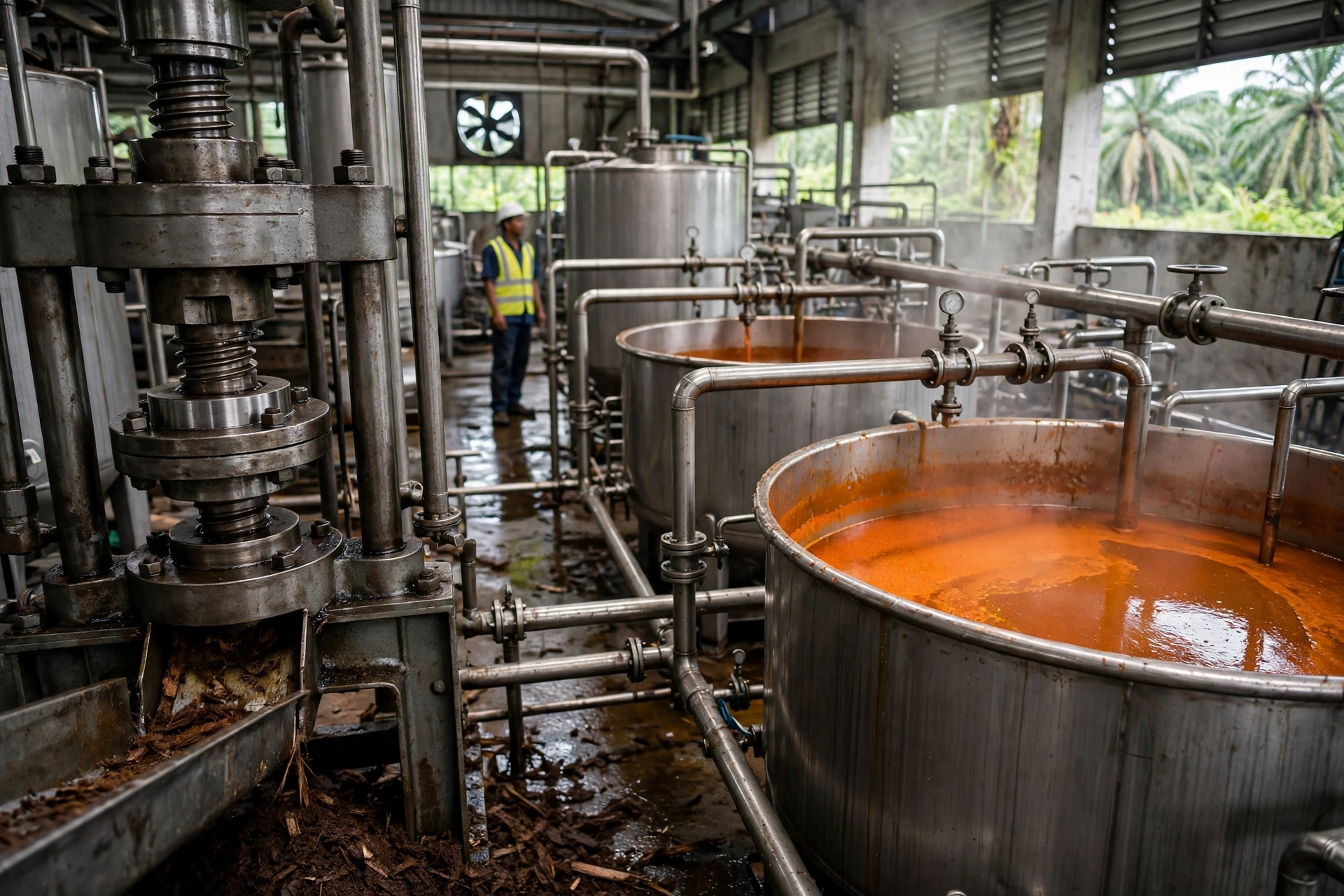
The screw press is the largest single motor in most mills and the one that decides the generator size. A press on a 30 t/h mill typically carries a 55–75 kW motor, and on a 45–60 t/h mill the press motor reaches 90–110 kW. The press runs continuously, it runs loaded, and it stops badly: fruit left inside a stopped press cools, stiffens and has to be dug out before the press can restart. The Nigerian operating-risks guide for small mills names this as one of the five biggest operating risks in the business, and it is the reason the press motor — not the average load — sets the generator’s starting capability.
Clarification, kernel recovery and the boiler house
After the press, crude palm oil goes to clarification: vibrating screens, settling tanks, centrifuges and vacuum dryers that separate oil, water and sludge. The kernel line — nut cracking, winnowing, kernel drying — runs in parallel. Together these stations add 60–120 kW on a 30 t/h mill, mostly in small motors that cycle on and off.
The boiler house is the mill’s own power station. Fibre and kernel shell feed a biomass boiler that makes 350–500 kg of process steam per tonne of FFB, and a back-pressure turbine turns part of that steam into electricity. The boiler’s own electrical load — feed pumps, forced-draught and induced-draught fans, fuel conveyors — runs 40–80 kW, and it is the most important load in the building: without the feed pumps and fans there is no steam, and without steam there is no mill. Any backup plan that forgets the boiler house has planned for a mill that cannot restart.
Utilities, effluent and the loads nobody counts
The remaining loads are small individually and large in total: the effluent treatment plant (POME) with its aerators and pumps, the water treatment plant, the workshop, the laboratory, staff housing and the weighbridge. A mill that runs 140 staff, as the Indonesian 30 t/h mill in the RECP study does, carries a housing and services load of 30–50 kW that runs around the clock whether the mill is processing or not. These loads are the reason a mill’s generator cannot simply be sized for the process line and switched off at night.
Sizing by Mill Capacity: The kVA Table
The planning rule for a palm oil mill is 17–21 kWh of electricity per tonne of FFB, with 14.5 kWh/t at the efficient end and 25 kWh/t at the old or poorly maintained end. Multiply by the mill’s throughput and the full-process load follows. The table below gives the full-process load, the essential load — the stations that must keep running through an outage — and the diesel set for each, at a 0.8 power factor and with the usual 25% margin for motor starting already folded into the full-process figure.
| Mill capacity (t FFB/h) | Full-process load (kW) | Essential load (kW) | Diesel set, essential load only | Diesel set, full process |
|---|---|---|---|---|
| 5 | 85–105 | 40–50 | 75 kVA | 150 kVA |
| 10 | 170–210 | 75–95 | 150 kVA | 250–400 kVA |
| 20 | 340–420 | 150–190 | 250 kVA | 500–550 kVA |
| 30 | 510–630 | 220–280 | 350 kVA | 750–800 kVA |
| 45 | 765–945 | 330–420 | 500 kVA | 1,000–1,250 kVA |
| 60 | 1,020–1,260 | 440–560 | 625 kVA | 1,500 kVA |
Two things in this table deserve attention. First, the 10 t/h row matches the published reference range for small Nigerian mills — 250–400 kVA for a 10 t/h mill — which is a useful cross-check that the planning rule lands where real mills land. Second, the gap between the essential-load column and the full-process column is the decision the buyer actually makes. A set sized for essential load keeps the sterilizer controls, the boiler feed pumps, the clarification line and the effluent plant alive, and the mill restarts cleanly when power returns. A set sized for full process keeps the mill running through the outage at full rate. The first costs roughly half the second. The choice depends on how often the power fails and how much a lost shift costs — and in a mill, a lost shift is measured in tonnes of fruit that cannot wait.
The essential load is not a fixed fraction of the full load. It depends on what the mill chooses to protect. The sterilizer station’s electrical load is small, but the boiler feed pumps and the clarification centrifuges are not, and a mill that protects the press as well as the sterilizer will find its essential load closer to 50% of full load than 40%. The table uses 40–45% as the planning figure. Measure the real load list before ordering the set; the generator sizing guide gives the method, and a mill that skips the measurement usually buys the wrong set.
The Starting Surge: Why the Press and the Thresher Decide the Set
A mill’s average load is a misleading number. The generator does not fail on the average. It fails on the largest motor starting under load while the rest of the mill is already running, and in a palm oil mill that motor is the screw press, with the thresher drum a close second.
The screw press: 5–7 times rated current, under a full load of fruit
A screw press motor draws five to seven times its rated current at start, and it starts under load — the press is full of hot, mashed fruit that has to move the moment the motor turns. A 75 kW press motor on a 30 t/h mill therefore asks the generator for 375–525 kVA of starting capacity in the first second, on top of the 400–500 kW the rest of the mill is already drawing. A set sized on average load alone will dip, the voltage will fall, the press motor will stall, and the protection will trip the whole board.
The practical answer is a set with enough transient capacity, or a soft starter or variable-frequency drive (VFD) on the press. A soft starter cuts the starting current to two to three times rated; a VFD cuts it to little more than rated current and adds speed control that the press actually benefits from, because press throughput tracks fruit condition through the day. The motor starting guide covers the methods in full — the point here is that the press, not the nameplate total, is what the generator must be able to start.
The thresher drum: high inertia, high starting torque
The thresher drum is a different problem. It is a large, heavy, rotating mass, and it needs high starting torque to break away from rest. Two 18.5 kW drum motors on the Bandar Pulau mill drew 17.7 kW each in operation — near their full rating — and the starting transient is correspondingly large. If the thresher and the press start together after a transfer, the combined surge can exceed the set’s transient rating even when the running load is comfortable. The fix is sequencing: start the thresher first, let it reach speed, then start the press. A Deep Sea or Smartgen controller with staged start outputs does this automatically, and it costs a fraction of the next size up in generator.
Soft starters, VFDs and the 25% rule
The rule of thumb in mill sizing is to add 25% to the running kVA for motor starting, then check the largest motor’s starting kVA against the generator’s transient rating. On a 30 t/h mill the running load is roughly 630 kW (787 kVA), the 25% margin takes it to 984 kVA, and the press starting transient is what pushes the recommendation to 750–800 kVA for the essential-plus-press case and 1,000 kVA and above for full process. Mills that fit soft starters or VFDs on the press and thresher routinely buy one frame size smaller and run it harder — which is cheaper to buy and cheaper to fuel, provided the starting equipment is maintained. A VFD that fails in a hot, humid mill house is worse than no VFD at all.
The 24-Hour Clock: What Happens When Power Fails Mid-Shift
A palm oil mill’s raw material rots. That single fact is what separates mill backup power from every other industrial application, and it is what makes the generator a production decision rather than a facilities decision.
Fruit on the ramp: the 24-hour window
Fresh fruit bunches should enter the sterilizer within 24 hours of harvest. The absolute maximum is 48 hours. In the tropical heat of Sumatra, Kalimantan, Sabah or southern Nigeria, the lipase enzymes in damaged or over-ripe fruit activate within hours of cutting, and the free fatty acid (FFA) content of the oil rises continuously while the fruit waits. Oil with FFA above 5% draws a price penalty from the refinery. Oil with FFA above 7% is no longer food grade at all — it sells for industrial use at a discount that wipes out the mill’s margin.
A mill that processes 30 t/h takes in 720 tonnes of fruit a day. A 24-hour power failure does not just stop the mill for a day. It strands 720 tonnes of fruit on the ramp and in the yard, and by the time the power returns, a large part of it is worth materially less than it was when it was cut. The fruit cannot be stored and processed later. It can only be processed now, or written down.
Fruit in the sterilizer: a cycle that cannot pause
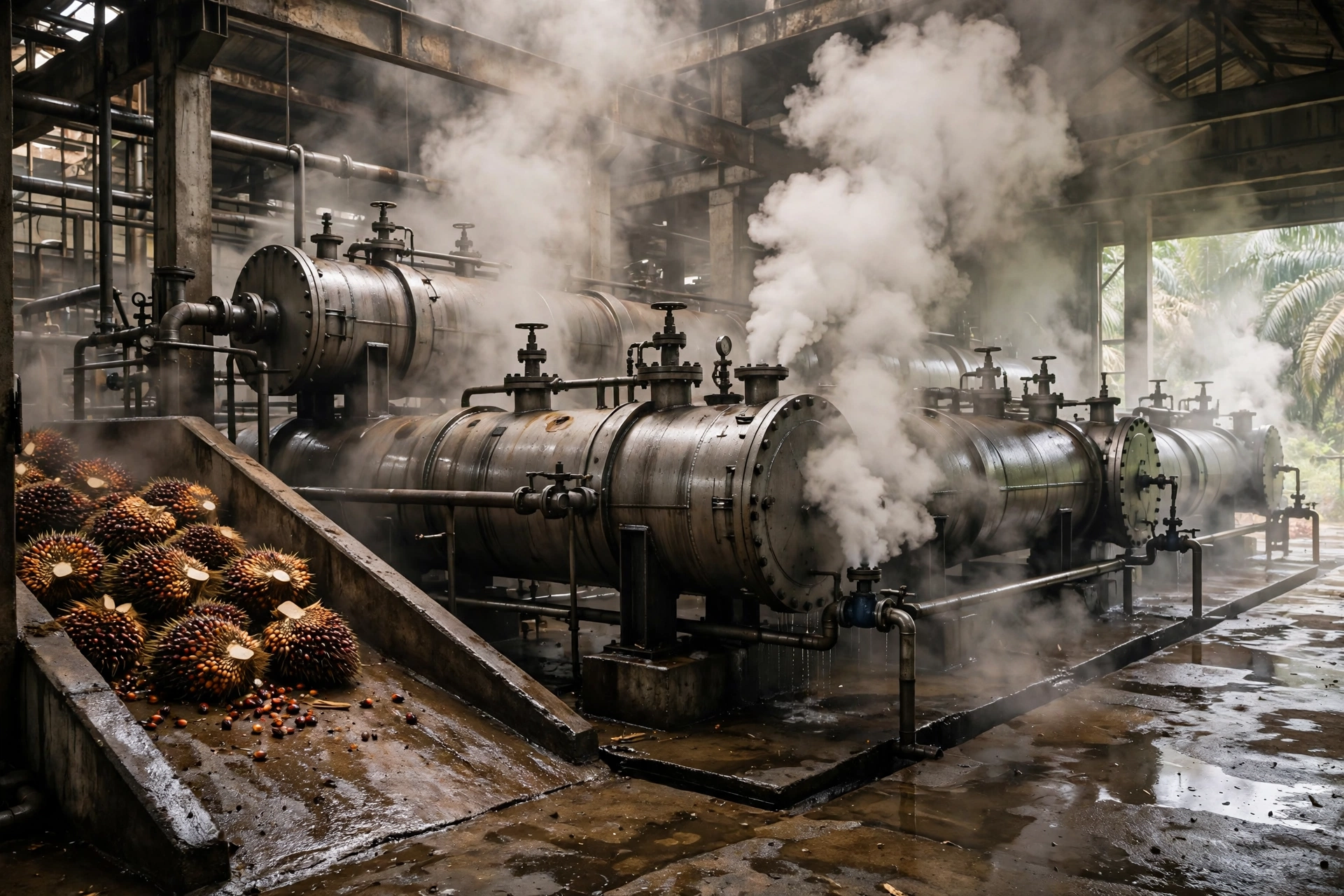
A sterilizer cycle runs 60–90 minutes at 130–145 °C. The published optimum for a triple-peak cycle is 87.4 minutes, at which the oil loss to condensate stays inside the 1.2% standard. Shorter than that, the fruit is under-cooked and the enzymes survive. Longer, the oil oxidises and the loss to condensate rises past the standard.
A power failure in the middle of a cycle breaks the cycle. The steam supply stops, the temperature falls, the condensate valves close, and the vessel sits full of half-sterilized bunches. If the outage is short — ten minutes, the length of a typical automatic transfer switch sequence — the cycle can sometimes be recovered by extending the hold. If the outage runs to an hour, the batch is lost: the fruit has to be discharged, re-sorted, and either re-sterilized at a loss or downgraded. Three sterilizers in a 30 t/h mill hold roughly 90 tonnes of fruit between them. One interrupted cycle is 90 tonnes of fruit at risk, and at a 20% oil extraction rate that is 18 tonnes of crude palm oil — about US$18,800 at the November 2026 price of US$1,043 per tonne.
Oil in the press and the clarifier: the mess that stops the next shift
A press that stops mid-cycle leaves hot fruit inside the screw. It cools, stiffens and sets. Restarting means opening the press, digging out the plug, cleaning the cage and re-feeding — a job that takes hours and a crew that would otherwise be running the mill. A clarifier that stops mid-batch leaves oil, water and sludge mixed in the settling tanks, and the separation has to be re-established from scratch. None of this is catastrophic on its own. Together, after a four-hour outage, it is a lost shift and a mill that restarts dirty, behind schedule, and with a yard full of fruit that is already past its best.
The money at stake: US$6,258 an hour
The arithmetic is blunt. A 30 t/h mill at a 20% oil extraction rate produces 6 tonnes of crude palm oil an hour. At US$1,043 a tonne, that is US$6,258 of oil an hour. A 24-hour outage strands 720 tonnes of fruit and roughly 144 tonnes of oil — about US$150,000 of product — before counting the downgrade penalty on the fruit that survives, the labour cost of clearing the press and sterilizers, and the lost processing fees if the mill is a toll mill working for smallholders. Against that, a 750 kVA prime set costs a fraction of one bad week. The generator is not an insurance policy. It is the difference between a mill that processes its fruit and a mill that watches it rot.
Three Mills, Three Outages
A 10 t/h mill in southern Nigeria: the set that runs the whole mill
The first mill is a small one in southern Nigeria, processing about 10 t/h of fruit from surrounding smallholders. The national grid peaks at about 7,000 MW for a country of more than 200 million people, and power rationing is routine. The mill’s answer, documented in a published study of medium-scale Nigerian agroindustries, is two diesel sets — 275 kVA and 250 kVA — that carry the mill between them. Diesel accounts for only 1.25–1.78% of the mill’s total energy; the rest is biomass, mostly forest wood mixed with empty fruit bunches burned for process heat. The digestion stage alone uses 0.6–0.8 litres of diesel per tonne of FFB.
The lesson is the sizing. The mill did not buy one large set. It bought two medium ones, so that one set can carry the essential load while the other is serviced, and so that a single failure does not stop the mill. The published operating-risks guide for small Nigerian mills puts the reference range for a 10 t/h mill at 250–400 kVA, and it adds a detail that larger mills often miss: a separate UPS or battery backup for the PLC control cabinet, so the control system shuts down safely when the power fails rather than dropping its program mid-cycle.
Four FELDA mills in Malaysia: biogas engines and the diesel set behind them
The second case is at the other end of the scale. Concord Green Energy, working with the Federal Land Development Authority (FELDA), installed six GE Jenbacher Type 4 gas engines across four FELDA palm oil mills in Malaysia, generating 5.6 MW from palm oil mill effluent (POME) biogas under a 16-year build-operate-own agreement. The biogas engines run on the methane captured from the effluent ponds, and the excess electricity is sold to the national grid.
The diesel set is still there. A biogas engine cannot black-start a mill: it needs power to run its own gas blowers, cooling pumps and controls before it can generate. The biomass boiler cannot start without its feed pumps and fans. When the grid fails and the boiler is cold, the only thing that can bring the mill back is a diesel set. The FELDA project is a reminder that biogas and biomass do not replace the diesel generator — they change its job, from carrying the whole mill to starting the systems that carry the mill. The set gets smaller, but it does not go away.
A 30 t/h mill in Indonesia: the audit that found 3.56 kWh per tonne
The third mill is a 30 t/h government-owned mill in Indonesia, built in 1995 and originally designed for 60 t/h, running with 140 staff. A resource-efficiency audit measured its electricity intensity at 20.56 kWh per tonne of FFB and identified measures to bring it to 17 kWh per tonne — a saving of 3.56 kWh on every tonne, or about 107 kW on a 30 t/h mill. The mill’s annual electricity use was 2,573,040 kWh.
The audit matters for generator sizing because a mill that wastes 3.56 kWh on every tonne is a mill that buys a generator one frame size larger than it needs. At 30 t/h, the difference between 20.56 and 17 kWh/t is the difference between a 750 kVA set and a 625 kVA set. The audit also measured the mill’s total material use at 125,145 tonnes and its water use at 313,197 cubic metres a year — numbers that show how much of a mill’s operating cost is tied to throughput, and how directly a power failure hits it.
Diesel, Biogas or Both: Where the Generator Fits
A palm oil mill is unusual among industrial sites because it already generates most of its own energy. The biomass boiler burns fibre and shell, the turbine makes electricity, and the POME biogas engine adds more. The diesel set has to fit into that system, not replace it — and the fit is where most specifications go wrong.
The biomass boiler and the turbine: the mill’s real power station
A large mill’s boiler makes 450–600 kg of steam per tonne of FFB, of which 350–500 kg goes to process use — mostly the sterilizers, which need only about 3 bar(g). The turbine sits between the boiler and the process: steam at 21 bar(g) and 250 °C drops through the turbine to 3 bar(g) exhaust, and the enthalpy drop yields a theoretical ceiling of 32–45 kWh per tonne of FFB. Against a mill load of about 21 kWh per tonne, a 21-bar boiler covers the mill with margin. A 31-bar boiler at 330 °C yields 42–60 kWh per tonne.
The point for the generator buyer is that the turbine only generates when the boiler is steaming, and the boiler only steams when the mill is processing. At night, during maintenance, at start-up, and during the low season when fruit is scarce, the mill’s own generation falls away — and the loads that remain, the effluent plant, the housing, the workshop, the security lighting, still need power. That is the diesel set’s first job: covering the hours when the mill is not its own power station.
POME biogas engines: real power, with a start-up problem
POME biogas is the mill’s second own-generation source. A published Thai study measured a biogas engine plant running at 1,000 kW and 94% load, generating 6,681,962 kWh a year over 6,682 operating hours at 38.46% electrical efficiency. The gas has to be conditioned — hydrogen sulphide, moisture and particles removed — and the engine needs a minimum load to run efficiently. A large engine running below its suitable load range delivers less value than a smaller unit with more operating hours.
Biogas has a start-up problem that diesel does not. The digester produces gas continuously, but the engine needs electricity to start, and the gas storage has finite capacity. If the engine trips and the grid is down, the gas is flared and the power is gone until the diesel set restores the auxiliaries. The diesel set is the biogas plant’s starter motor, and it has to be sized for the engine’s auxiliaries — blowers, cooling pumps, gas treatment — as well as the mill’s essential load.
The diesel set’s real job: black start, essential load, and the boiler outage
In a mill with a boiler and a biogas engine, the diesel set has three jobs, and they are not the same size. The first is black start: restoring the boiler feed pumps, the fans and the biogas auxiliaries so the mill’s own generation can come back. The second is essential load: carrying the sterilizer controls, the clarification line, the effluent plant and the housing through an outage. The third is the boiler outage: carrying the full process load when the boiler is down for maintenance or repair, which is when the mill needs the generator most and has it least.
A set sized for the first two jobs is the 350 kVA figure in the table for a 30 t/h mill. A set sized for the third is the 750–800 kVA figure. Mills that buy the smaller set and then discover the boiler needs a two-week retube learn the difference the expensive way. The standby and prime ratings article explains the rating distinction that decides whether the set survives that fortnight: a standby-rated set running a mill 24 hours a day for two weeks will not last the fortnight.
Fuel use, tank sizing and the running cost
A diesel set in a mill burns fuel in proportion to load, and the numbers are straightforward. A 500 kVA prime set burns 93.2 litres an hour at full prime load (Cummins C500D5 datasheet), roughly 70 litres an hour at 75% load and 47 litres an hour at 50%. A 750 kVA set on a 30 t/h mill’s essential load — about 250 kW, or 40% of its prime rating — burns roughly 75–80 litres an hour. Over 24 hours that is 1,800–1,900 litres. Over 72 hours, 5,400–5,700 litres.
The tank follows from the autonomy the mill needs. A mill that loses grid power for a day at a time and refuels by road tanker needs a 5,000-litre day tank and a 10,000-litre bulk tank to hold 72 hours of essential-load running with a margin for delivery delays. A mill in a remote estate, a day’s drive from the nearest fuel depot, needs more — and the fuel in that tank needs the same care as any standby set’s fuel. Diesel fuel ageing is a real problem in a hot, humid mill store, and a tank of stale fuel is a generator that will not start when the boiler trips.
| Generator set | Duty on a 30 t/h mill | Fuel use (L/h) | Fuel for 24 h | Fuel for 72 h |
|---|---|---|---|---|
| 350 kVA prime | Essential load, 220–280 kW | ~60 | ~1,450 L | ~4,300 L |
| 500 kVA prime | Essential load plus press | ~70 | ~1,700 L | ~5,000 L |
| 750 kVA prime | Essential load, 250 kW | 75–80 | 1,800–1,900 L | 5,400–5,700 L |
The running cost is the number that decides whether the mill runs the generator or waits for the grid. At a diesel price of US$1.00 a litre, the 750 kVA set on essential load costs about US$78 an hour to run. Against US$6,258 an hour of oil at stake in a 30 t/h mill, the fuel cost is not a decision factor. It is a rounding error. The decision factor is whether the set starts, and whether it is big enough.
Placement in heat, humidity and dust
A palm oil mill is one of the hardest environments a generator can live in. Ambient temperatures run 32–38 °C, humidity sits above 80% for most of the year, and the air carries fibre dust, ash from the boiler house and the corrosive vapour from the effluent ponds. A set rated at 27 °C loses roughly 1% of its output for every 5 °C above its rating temperature, so a 750 kVA set in a 38 °C mill house is a 730 kVA set before anything else is considered — and the derating is worse if the radiator is breathing hot air from the boiler house next door.
The enclosure matters more here than in almost any other application. An open set in a mill house will ingest fibre dust into its alternator windings and its radiator core. A soundproof canopy keeps the dust out and the noise in, and it is worth the premium on a site where the set sits metres from the sterilizer operators. The canopy needs its own ventilation, sized for the radiator air plus the combustion air plus the heat the set rejects into the enclosure, and the louvres need to face away from the boiler house. The ventilation article gives the calculation; the short version is that a mill that puts its generator in a hot, dusty corner without ventilation will buy a second generator sooner than it planned.
Frequently Asked Questions
What size generator does a palm oil mill need?
A 10 t FFB/h mill needs a 250–400 kVA set, a 30 t FFB/h mill needs 750–800 kVA for full-process backup or 350 kVA for essential load only, and a 60 t FFB/h mill needs around 1,500 kVA. The planning rule is 17–21 kWh of electricity per tonne of FFB, and the screw press motor — not the average load — decides the starting capability the set must have.
Do palm oil mills need a backup generator?
Yes. A mill’s raw material rots: fruit should be sterilized within 24 hours of harvest, and oil with free fatty acids above 5% draws a price penalty while oil above 7% is no longer food grade. A mill with its own biomass boiler and turbine still needs a diesel set for black start, for the hours when the boiler is not steaming, and for the boiler outage.
How long can a palm oil mill run on a generator?
As long as the fuel lasts and the set is prime-rated. A 750 kVA set carrying a 30 t/h mill’s essential load burns roughly 75–80 litres an hour, so a 10,000-litre bulk tank gives about 72 hours. A standby-rated set should not be run continuously for days; a mill that needs multi-day running must buy a prime-rated set, as the standby and prime ratings article explains.
What happens to a palm oil mill during a power outage?
The sterilizer cycle breaks, the press stops with hot fruit inside it, the clarifier loses separation, and the fruit on the ramp keeps ageing. A 30 t/h mill strands 720 tonnes of fruit a day and about US$150,000 of crude palm oil in a 24-hour outage, before counting downgrade penalties and the labour cost of clearing the press and sterilizers.
Can a diesel generator power a palm oil mill?
Yes, and it is the standard backup on mills from 5 t/h to 60 t/h and above. A diesel set powers the full process load on small mills and the essential load — sterilizer controls, boiler feed pumps, clarification, effluent treatment — on large mills, and it is the only source that can black-start a mill whose boiler and biogas engine are both cold.
Specification Checklist
- Measure the load list first. Walk the mill station by station — sterilizer, thresher, digester, press, clarification, kernel, boiler house, effluent, housing — and record running kW, motor sizes and starting method. The table in this article is a planning guide, not a substitute for the mill’s own numbers.
- Size for the press, not the average. Check the largest motor’s starting kVA against the generator’s transient rating. Fit a soft starter or VFD on the press and thresher if the starting surge pushes the set a frame size larger.
- Decide essential load versus full process before ordering. A 30 t/h mill needs 350 kVA for essential load and 750–800 kVA for full process. The difference is the cost of a lost shift measured against the cost of the larger set.
- Buy a prime rating for multi-day running. A standby-rated set will not survive a fortnight carrying a mill while the boiler is retubed. Check the rating on the nameplate, not the quotation.
- Plan 72 hours of fuel. A 10,000-litre bulk tank plus a 5,000-litre day tank covers a 30 t/h mill’s essential load for three days, with a margin for a late tanker. Test and polish the fuel; stale diesel in a hot store is a set that will not start.
- Protect the controls. A UPS on the PLC cabinet and the instrumentation lets the control system shut down safely instead of dropping its program mid-cycle. It costs less than one interrupted sterilizer batch.
- Place the set for the climate. Canopy the set, ventilate the enclosure for radiator air plus combustion air plus rejected heat, keep the intake away from the boiler house, and derate for 35 °C-plus ambient and high humidity.
- Test under load, on schedule. A monthly no-load run proves the set starts. It does not prove it carries the press. Follow the generator maintenance schedule and load-bank the set at least once a year, and remote monitoring pays for itself on a mill a day’s drive from the nearest technician.
Talk to PAVO about a generator set sized for your mill — capacity, press motor, boiler arrangement and fuel autonomy included. Contact PAVO with your mill’s throughput and load list, and the factory will size the set and quote it against the mill’s real numbers.