

What Size Generator Does a Paper Mill Need? | PAVO
A paper machine running at 1,500 metres a minute does not stop politely. When the power goes, the web breaks, the dryers cool, and the restart takes hours. The generator is what stands between a ten-second outage and a lost shift.
What size generator does a paper mill need? A 300-tonne-a-day containerboard mill needs 1,250–2,000 kVA for its critical loads, a tissue mill needs 800–1,250 kVA, and an integrated pulp and paper mill needs 2,000–3,750 kVA in paralleled sets. The set never powers the whole mill. It powers the machine, the steam and the drives that cannot stop.
Contents
1. Why a Paper Mill Is Not Just Another Factory Load
2. What Size Generator Does a Paper Mill Need?
3. The Paper Machine Damage Window: What Ten Seconds Does to a Running Web
4. The Loads That Decide the Set: Refiners, Dryers and Steam
5. Fuel Autonomy: How Long a Mill Can Actually Run
6. Three Mills, Three Outages
7. Frequently Asked Questions
8. Specification Checklist: Five Questions Before the Deposit
Why a Paper Mill Is Not Just Another Factory Load
A paper mill is a continuous process that happens to be housed in a factory. That distinction decides everything about its backup power. Most factories lose an hour of production when the grid fails. A paper mill loses the hour, the web, the steam balance, and often the next four hours to a restart that produces nothing but broke — the industry’s name for paper that goes straight back to the pulper.
The numbers explain why. A paper and pulp mill typically consumes 700–1,200 kWh of electricity per tonne of paper produced, and it consumes it around the clock. A 300-tonne-per-day containerboard mill therefore draws roughly 9–15 MW at full production, day and night, 340 days a year. That is the load of a small town, and it is spread across hundreds of drives, pumps, refiners and fans that must stay in step with each other to the second.
No diesel generator set powers a whole mill of that size. A buyer who asks for one has misunderstood the job, in the same way a steel buyer misunderstands it when he asks a generator to run an arc furnace. The generator’s job in a paper mill is narrower and more valuable: keep the paper machine under control through a controlled stop or a reduced-speed run, keep the steam and condensate system safe, keep the stock preparation from setting solid in the pipes, and keep the effluent plant running so the mill does not breach its discharge permit while the machine is down.
The load profile in numbers
Electricity is only part of the mill’s energy. Heat dominates. Drying the sheet from about 50% dryness after the press section to 92–95% dryness at the reel consumes roughly 60% of the mill’s total energy, almost all of it as steam. A modern containerboard machine evaporates 1.2–1.5 tonnes of water per tonne of paper. The dryer section alone — 40 to 60 steam-heated cylinders, each 1.5–1.8 metres in diameter, running at 3–5 bar — accounts for most of the mill’s steam demand.
That split shapes the electrical specification. The largest electrical loads are not the dryer cylinders themselves, which are steam-heated, but the drives that turn them, the refiners that prepare the fibre, the vacuum pumps that pull water from the sheet, and the fans that move air through the dryer hoods. Each of those loads behaves differently in an outage, and the generator specification must treat them separately.
Why the mill cannot simply stop
A paper machine is a single web of wet fibre, 4–8 metres wide, travelling at 1,200–2,000 metres per minute on a modern containerboard or newsprint machine, and 1,800–2,200 metres per minute on a tissue machine. At those speeds the sheet covers 20–35 metres every second. When the drives lose power, the web does not slow down gracefully. It breaks, wraps around rolls, and fills the machine with wet broke that must be cleared by hand before the machine can restart.
The restart is where the money goes. A controlled restart after a planned stop takes 30–60 minutes on a well-run machine. A restart after an uncontrolled outage takes 2–4 hours, because the steam system must be rebalanced, the dryer temperatures must be brought back up in sequence, the stock must be re-established at the right consistency, and the first 10–20 minutes of production are off-specification and go straight to broke. Industry data puts a single hour of paper-machine downtime at $12,000–$35,000, with some mills reporting $15,000–$80,000 per hour depending on grade and machine size. A four-hour restart after a ten-second outage is a $50,000–$140,000 event — and that is before the cost of the broke, the overtime and the missed delivery.
What Size Generator Does a Paper Mill Need?
The honest answer starts with a load list divided into three tiers, not with a nameplate total. Mills that skip this step end up with a set that is either twice the size it needs to be, because it tries to carry everything, or half the size it needs to be, because it was sized from a total that nobody triaged.
Tier 1 — must stay on. Paper machine drives and controls, dryer-section steam and condensate, vacuum system, stock pumps that keep fibre moving, boiler feedwater, effluent treatment, emergency lighting and the control room. Without these, the machine cannot be stopped safely.
Tier 2 — should stay on. Stock preparation at reduced rate, refiners at minimum load, compressed air, water treatment, the winder and the reel handling. These keep the mill ready to restart quickly and keep product moving.
Tier 3 — can wait. The full stock preparation line, the complete pulping plant, non-essential HVAC, offices, the warehouse and the full-speed winder. These return when the grid returns.
Integrated pulp and paper mill
An integrated mill — pulp and paper on one site, 500–1,500 tonnes a day — draws 15–40 MW in total. The critical board alone, the Tier 1 and Tier 2 loads, runs 2,000–3,750 kVA, and it is almost always supplied by two or three paralleled sets rather than one large unit. Paralleling buys two things: the ability to add capacity as the mill grows, and the ability to keep half the critical load alive if one set fails to start. A single 3,750 kVA set is cheaper per kVA. Two 2,000 kVA sets are cheaper per outage.
Recycled containerboard mill
A recycled containerboard mill running 150–300 tonnes a day draws 6–12 MW. Its critical board runs 1,000–2,000 kVA. The paper machine itself, at 300 tonnes a day, typically needs 800–1,200 kVA for its drives, vacuum and controls at reduced speed, plus 300–500 kVA for stock preparation at minimum rate and 150–250 kVA for the boiler house and effluent plant. The 1,250 kVA frame is the workhorse here: a Cummins C1250D5-class set, or a Weichai equivalent, covers the critical board of most mid-size containerboard mills with room for one large motor start.
Tissue mill
A tissue mill running 100–200 tonnes a day draws 5–9 MW. Its critical board runs 800–1,250 kVA. The Yankee dryer — a single steam-heated cylinder 3–5 metres in diameter — dominates the steam side, but its electrical load is modest: the Yankee drive, the hood fans and the vacuum system. What tissue adds is speed. At 1,800–2,200 metres a minute, a tissue machine’s web is thinner and faster than any other grade, and a break at full speed fills the machine with light, dusty broke that takes longer to clear than containerboard broke.
Specialty and small mills
A specialty mill — security paper, filter paper, décor paper — running 20–50 tonnes a day draws 1–3 MW. Its critical board runs 250–500 kVA. These mills are often the best candidates for a single set, because the whole critical board fits on one 500 kVA frame with a 10% overload allowance for the largest motor start. The specification is simpler, but the stakes are the same: a specialty grade can be worth $3,000–$8,000 a tonne, so an hour of lost production on a 30-tonne-a-day machine is $4,000–$10,000 of product, plus the cost of re-establishing a grade that may take a full shift to bring back into specification.
| Mill type | Production | Total mill load | Critical-board generator size |
|---|---|---|---|
| Specialty / small mill | 20–50 tpd | 1–3 MW | 250–500 kVA |
| Tissue mill | 100–200 tpd | 5–9 MW | 800–1,250 kVA |
| Recycled containerboard | 150–300 tpd | 6–12 MW | 1,000–2,000 kVA |
| Integrated pulp and paper | 500–1,500 tpd | 15–40 MW | 2,000–3,750 kVA (paralleled) |
These bands are starting points, not quotations. The correct figure comes from the load list, the largest single motor and its starting method, and the site conditions — altitude, maximum ambient temperature and duty. That is the same discipline the generator sizing guide applies to every industrial site, and it matters more in a paper mill than in most, because the gap between the total mill load and the critical board is so large. A quotation that sizes the set from the mill’s total demand is either a quotation for a power station or a misunderstanding.
The rating matters as much as the size. A mill that loses grid power 40–60 hours a year, plus monthly testing, sits comfortably inside the 200-hour annual limit for a standby rating under ISO 8528-1. A mill in a region with an unreliable grid — 300 hours a year or more — needs a prime rating, because the set will run long enough each year to wear like a prime set. The difference between the standby and prime power ratings is about 9% in kVA on the same frame, and the wrong choice shows up as early wear, not as a fault code.
The Paper Machine Damage Window: What Ten Seconds Does to a Running Web
Ten seconds is the standard answer for how long a standby system takes to restore power. Ten seconds is also long enough to break a web, stall a dryer section and cost a mill a shift. The damage window in a paper mill is not measured in seconds of darkness. It is measured in what the machine does in those seconds, and in how long the restart takes afterwards.
A well set up standby system restores power in about 10 seconds: 1–3 seconds for the automatic transfer switch to confirm the outage, 5–8 seconds for the engine to crank and stabilise, and under a second to move the load. The timers set most of that time. What matters for the mill is not the 10 seconds themselves but whether the loads that protect the process survive them.
The wet end: ten seconds to a web break
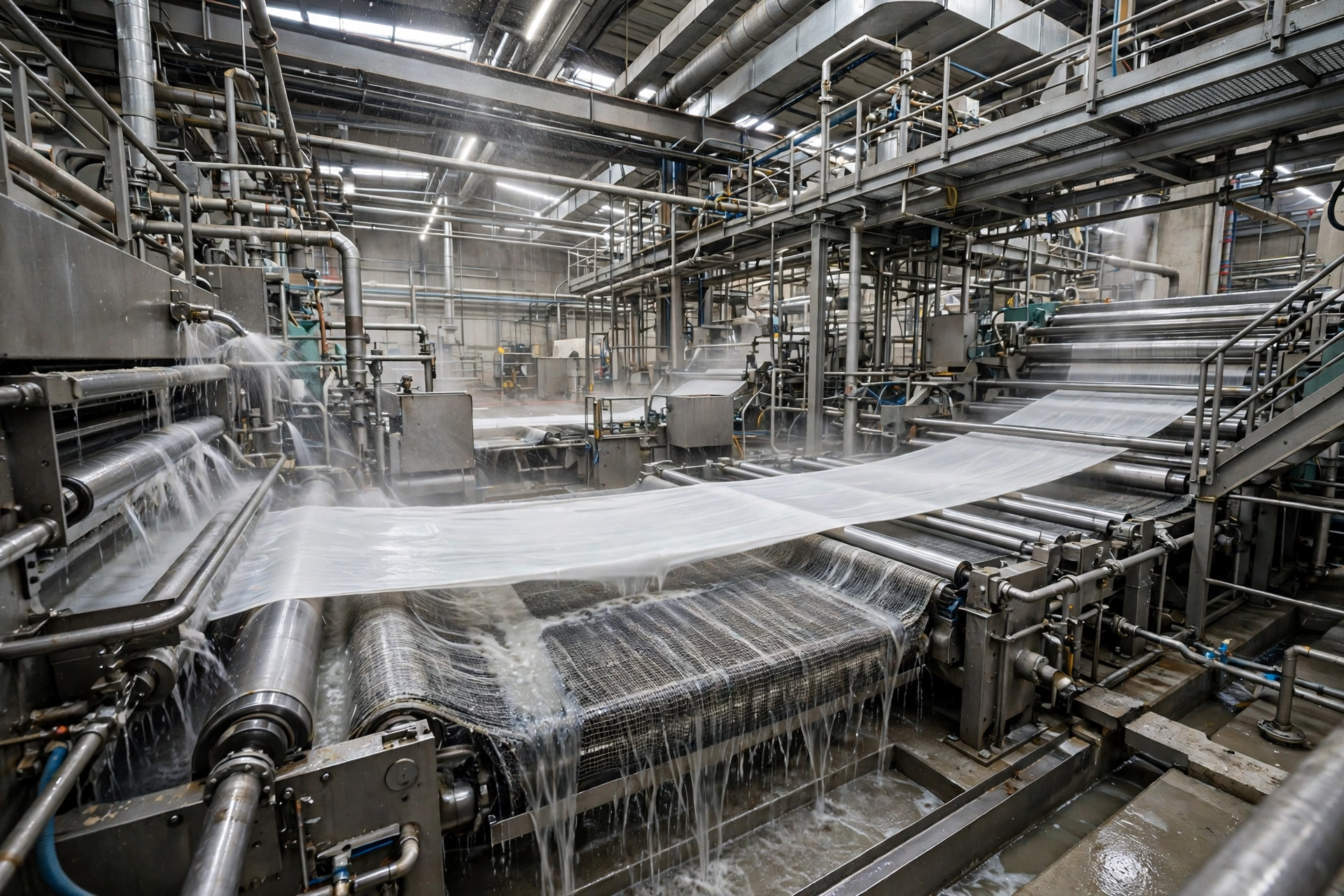
The wet end is where the sheet is formed, at 0.5–1% consistency — essentially water with a little fibre in it. The headbox, the forming fabric and the first press rolls all run on drives that must stay in speed ratio with each other to within a fraction of a percent. When power fails, the drives stop together, but not identically. The sheet, still 99% water, has no strength. It breaks at the first point of tension, and the stock that was on its way to the forming section keeps coming for a few seconds until the stock pumps stop.
A web break at full speed is not a small event. The sheet wraps around the nearest roll, and the operator must stop the machine, clear the wrap, re-thread the sheet through the press and dryer sections, and re-establish the stock flow. On a containerboard machine that takes 30–60 minutes if the steam system is still hot. If the steam system has also gone cold, it takes twice that.
The press and dryer sections: heat that cannot be switched off
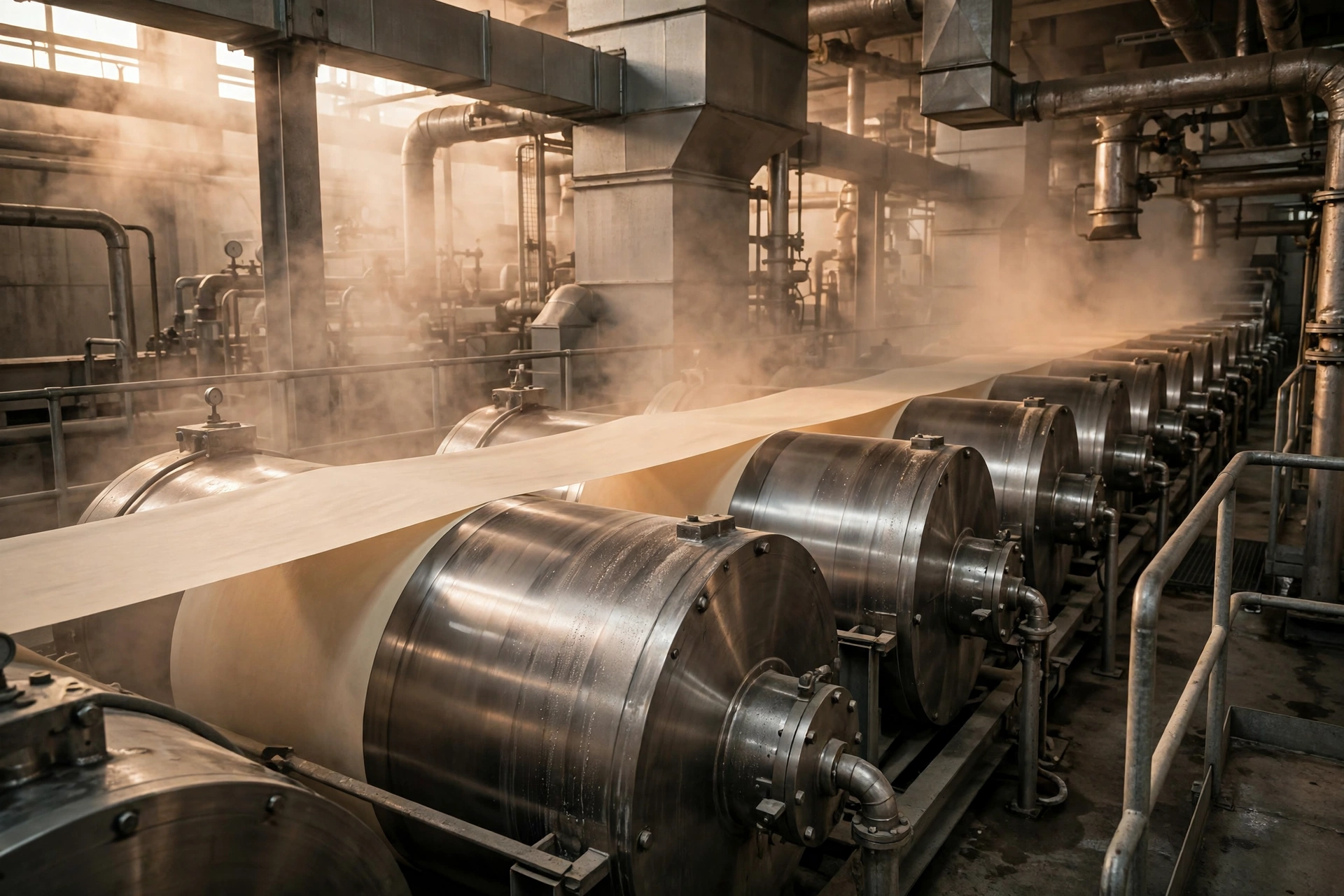
The dryer section holds the mill’s largest thermal risk. Forty to sixty steam-heated cylinders, each holding tonnes of steel at 120–180°C, do not cool in ten seconds. They keep radiating heat into a sheet that is no longer moving. A sheet that stops inside the dryer section dries where it sits, sticks to the cylinder surfaces, and can scorch. Worse, the condensate inside the cylinders stops being evacuated when the steam and condensate system loses power. Condensate pools, the cylinders go out of balance, and on restart the machine vibrates until the condensate is cleared.
The protection is not complicated, but it must be on the critical board: the condensate pumps, the steam supply valves and the dryer-section drive motors that allow the machine to be turned slowly — “crawled” — during an outage so the sheet does not sit in one place. A machine that can crawl at 5–10 metres a minute during a grid failure comes back in an hour. A machine that stops dead comes back in four.
The reel and the restart
The reel is where the finished sheet is wound into a parent roll weighing 10–40 tonnes. A parent roll that is mid-wind when the power fails must be handled carefully: the reel drum stops, the roll sits on the drum, and the tension control is lost. If the roll is not secured, it can telescope — the layers sliding sideways — and a telescoped roll is scrap, however good the paper was before the outage.
The restart sequence is the most expensive part of the outage, and the least understood by buyers who have never watched one. The steam system must be rebalanced section by section, because the dryer cylinders do not reheat evenly. The stock must be re-established at the right consistency and freeness, which takes 15–30 minutes of running broke through the machine before saleable paper appears. The first reel after a restart is almost always downgraded. Industry data from a mid-sized mill running 850 tonnes a day across two machines puts the average cost of a single production break at $17,000, with 23 breaks a month and 1,711 hours of lost production a year — $4.7 million a year, before the cost of the restart waste is counted.
The Loads That Decide the Set: Refiners, Dryers and Steam
A paper mill specification is decided by four loads. Get those four right and the rest of the board follows. Get one wrong and the set either trips on the first motor start or runs at half load for its whole life.
Refiners: the biggest single motor on site
The refiner is the largest single motor in most paper mills. A disc refiner in a stock preparation line draws 300–1,500 kW, and it starts under load — the plates are already in contact with the stock when the motor is energised. That makes motor starting the single most important calculation in the specification. A 750 kW refiner motor started direct-on-line draws five to seven times its running current for a few seconds, and the voltage dip on a 1,250 kVA set can reach 20–25% if the alternator is not sized for it.
The practical answer is usually a soft starter or a variable-frequency drive on the refiner, which cuts the starting current to two to three times running current and keeps the dip under 15%. The alternative — sizing the whole set for a direct-on-line refiner start — adds 300–500 kVA to the specification and buys nothing in normal operation. The refiner is also the load most often dropped to Tier 3 in a well-written specification: the mill can run for hours on stock already prepared, and the refiner can restart when the grid returns.
Dryer-section drives and steam
The dryer section is the opposite of the refiner: many small drives, no single large start, but a strict requirement that they stay in speed ratio. A 50-cylinder dryer section has 50 drive motors, each 7.5–30 kW, plus the felt and rope systems. The total is 400–800 kW, and it must start in sequence, section by section, so the sheet tension is maintained as each section comes up to speed.
The steam side needs almost no electricity — a few pumps and valves — but it needs that electricity without interruption. The condensate pumps, the thermocompressors and the steam pressure-reducing valves are small loads, 10–50 kW in total, and they are the cheapest insurance in the whole specification. A mill that puts the dryer drives on the critical board but leaves the condensate pumps on the grid side has bought a generator that protects the machine’s speed and destroys its dryers.
Boiler house, CHP and the imported-power slice
Many large mills already generate much of their own electricity. A recovery boiler burning black liquor, or a biomass boiler burning bark and sludge, drives a back-pressure turbine that covers 60–80% of the mill’s electrical load. That is co-generation, and it changes the generator specification in a useful way: the set does not need to replace the mill’s whole supply, only the imported-power slice and the critical loads that the turbine cannot carry when the grid connection is lost.
The interaction needs care. When the grid fails, a co-generation turbine that was exporting power must island — disconnect from the grid and carry the mill’s internal load alone — or trip. The diesel set’s job in that moment is to carry the loads the turbine cannot pick up fast enough, and to provide the stable frequency reference the turbine’s governor needs to re-synchronise. Mills that treat the diesel set and the turbine as separate systems, specified by separate engineers, are the mills that discover in the first real outage that neither system was sized for the other.
Placing the set in a humid, corrosive mill
A paper mill is a hard environment for a diesel set. The machine hall runs at 30–45°C with relative humidity of 70–90%, and the air carries paper dust, starch vapour and, in a kraft mill, traces of sulphur compounds that corrode unprotected steel. A set installed in the open in the machine hall will age faster than the same set in a clean warehouse, and its control electronics will fail first.
Three decisions protect it. First, the set goes in its own room or a weatherproof canopy, with generator room ventilation sized for the full radiator airflow plus combustion air — a 1,250 kVA set needs roughly 2,500–3,000 m³/min of cooling air at full load, and a room that cannot supply it will derate the set by 10–15% on a hot day. Second, the enclosure and the alternator windings get a tropical or marine-grade coating, and the control panel gets a heater that runs whenever the set is idle, to keep condensation off the electronics. Third, the set gets remote monitoring — a Deep Sea or Smartgen controller with Modbus or GSM reporting — because a mill’s maintenance team is busy keeping the paper machine running, and the generator is the asset most likely to be forgotten until the day it is needed. A set that is not tested under load every month is a set that will not start when the grid fails.
Fuel Autonomy: How Long a Mill Can Actually Run
The question every mill manager asks after the sizing question is how long the set will run. The answer is arithmetic, and it is the arithmetic most often got wrong, because it is done from the set’s rated consumption at full load rather than from the load the set will actually carry.
A mill’s critical board does not run at 100% load. It runs at 50–75% of the set’s rating, because the critical board is sized with a margin for motor starting and the Tier 2 loads are shed or added as the outage develops. Fuel consumption follows the load, not the rating. The Cummins C500D5 — 500 kVA standby, 455 kVA prime — burns 29.2 L/h at 25% load, 49.0 L/h at 50%, 69.9 L/h at 75% and 93.2 L/h at 100% on prime rating. A 1,250 kVA set carrying a 700 kVA critical board burns roughly 130–150 L/h. A 2,000 kVA set carrying a 1,400 kVA board burns roughly 230–260 L/h.
Fuel use by set size
| Set size | Critical load carried | Fuel at that load (approx.) | 24 hours | 72 hours |
|---|---|---|---|---|
| 500 kVA | 300 kVA | 55 L/h | 1,320 L | 3,960 L |
| 1,250 kVA | 700 kVA | 140 L/h | 3,360 L | 10,080 L |
| 2,000 kVA | 1,400 kVA | 240 L/h | 5,760 L | 17,280 L |
| 2 × 2,000 kVA | 2,800 kVA | 480 L/h | 11,520 L | 34,560 L |
The 72-hour column is the one that matters. A mill that plans for a 24-hour outage and gets a 72-hour one — a storm, a flood, a grid failure that takes days to repair — runs out of fuel on the second day, and the restart after a fuel starvation is worse than the restart after a grid failure, because the set must be bled, reprimed and retested before it will run again. A 10,000-litre bulk tank is not an extravagance for a 1,250 kVA set. It is 72 hours of critical-board operation, and it costs less than one hour of paper-machine downtime.
Seventy-two hours: the tank and the delivery contract
Fuel autonomy is not a tank size. It is a tank size plus a delivery contract plus a fuel-quality regime. Diesel fuel ageing is a real failure mode in standby sets: diesel stored for 12–18 months without treatment grows microbes at the fuel-water interface, and the first time the set runs under load after a long idle period, the filters clog and the set trips. A mill’s fuel plan needs three lines: a bulk tank sized for 72 hours at the real critical load, a contracted delivery that can refill it within 24 hours of the outage starting, and a fuel-polishing and testing schedule that runs whether or not the set has been used.
The delivery contract is the line most often missing. A mill 40 kilometres from the nearest fuel depot, on roads that flood in the rainy season, cannot assume a tanker will arrive in four hours. The mills that run through long outages are the ones that called their fuel supplier before the storm, not during it.
Three Mills, Three Outages
Case 1: Recycled containerboard, Morbi, Gujarat — the monsoon outage that proved the board
A recycled containerboard mill outside Morbi runs 300 tonnes a day on a single Fourdrinier machine, 5.2 metres wide, at 1,100 metres a minute. Its critical board is a 1,250 kVA standby set, a Cummins-powered silent unit, installed in 2023 after a monsoon outage in 2022 cost the mill a full shift and $60,000 in lost production and broke.
In July 2025 the grid failed at 02:40 during a monsoon storm. The automatic transfer switch confirmed the outage in 2 seconds, the set reached rated speed in 7 seconds, and the load transferred at 10 seconds. The paper machine was on the critical board at reduced speed — 400 metres a minute — and the dryer section kept its steam and condensate. The stock preparation line was shed. The mill ran on the generator for 11 hours, burning 1,540 litres of diesel, and produced 120 tonnes of saleable board at reduced speed instead of losing the shift. The restart to full speed took 45 minutes. The mill’s own calculation put the saving at $48,000 against the 2022 outage — roughly four times the annual cost of the set’s maintenance contract.
Case 2: Tissue mill, Gaziantep, Türkiye — the Yankee dryer that could not wait
A tissue mill in Gaziantep runs 120 tonnes a day on a single crescent-former machine with a 4.5-metre Yankee dryer, at 1,900 metres a minute. Its critical board is an 800 kVA standby set, installed beside the machine hall in a sound-attenuated canopy because the mill sits 200 metres from housing and the night noise limit is 45 dB(A) at the boundary.
In January 2026 a winter storm took the grid down at 19:20, in the middle of the night shift. The set started in 9 seconds. The critical loads were the Yankee drive, the hood fans, the vacuum system and the condensate pumps — 520 kVA in total. The mill’s operators kept the machine crawling at 150 metres a minute for 6 hours, long enough for the storm to pass and the grid to return, and the Yankee never went cold. The alternative, which the mill had experienced twice before the set was installed, was a full stop: the Yankee cooling from 150°C to ambient, the condensate pooling, and a 5-hour restart with the first two parent rolls downgraded. The mill’s production manager put the avoided loss at $22,000 for the night, against a set that cost $58,000 installed.
Case 3: Integrated pulp and paper, Riau, Indonesia — two sets and a recovery boiler
An integrated mill in Riau runs 1,500 tonnes a day of printing and writing paper, with a recovery boiler and a 25 MW back-pressure turbine that covers most of the mill’s load. Its critical board is two 2,000 kVA sets in parallel, installed in 2024 after a grid disturbance tripped the turbine and the mill lost a full day.
In September 2026 the grid failed during a thunderstorm. The turbine islanded, carrying the mill’s internal load, but the frequency dipped to 48.2 Hz before the governor recovered. The two diesel sets started, synchronised with each other in 12 seconds, and picked up the paper machine drives, the stock pumps and the effluent plant — 2,600 kVA between them — while the turbine stabilised. The mill ran on the combination for 9 hours, the paper machine never stopped, and the only lost production was a 20-minute grade change that was already scheduled. The mill’s engineering manager credits the paralleling: one set alone could not have carried the starting current of the machine drives, and the second set’s job was not capacity but the starting transient.
Frequently Asked Questions
What size generator does a paper mill need?
A recycled containerboard mill running 300 tonnes a day needs 1,250–2,000 kVA for its critical loads, a tissue mill needs 800–1,250 kVA, and an integrated pulp and paper mill needs 2,000–3,750 kVA in paralleled sets. The figure comes from the critical load list — machine drives, steam and condensate, stock pumps and effluent treatment — not from the mill’s total demand, which can be ten times larger.
Do paper mills need a backup generator?
Yes, unless the mill can accept losing a shift every time the grid fails. A paper machine that stops uncontrolled costs $12,000–$35,000 per hour in lost production, and the restart takes 2–4 hours. A generator that keeps the machine crawling, or stops it under control, turns a lost shift into a reduced-speed run and a 45-minute restart.
How long can a paper mill run on a generator?
As long as the fuel lasts. A 1,250 kVA set carrying a 700 kVA critical board burns roughly 140 litres an hour, so a 10,000-litre bulk tank gives about 72 hours. The limit is almost always fuel logistics, not the engine: a prime-rated set can run indefinitely with fuel, oil top-ups and a contracted delivery.
What happens to a paper machine during a power outage?
The web breaks within seconds, the sheet wraps around the nearest roll, and the dryer section keeps radiating heat into a sheet that is no longer moving. Condensate pools in the dryer cylinders, the stock in the pipes begins to set, and the restart takes 2–4 hours of rebalancing steam, re-establishing stock and running broke before saleable paper appears.
Can a diesel generator power a paper mill?
It can power the critical loads of a paper mill, not the whole mill. A 300-tonne-a-day mill draws 9–15 MW in total, and no practical generator set carries that. The set carries the 1,250–2,000 kVA critical board — the machine, the steam system and the drives that cannot stop — while the rest of the mill waits for the grid.
Specification Checklist: Five Questions Before the Deposit
1. Which loads are on the critical board, and which are not? The load list must be divided into three tiers — must stay on, should stay on, can wait — with the kVA of each tier stated. A quotation that sizes from the mill’s total demand is a quotation for a power station.
2. Which rating is quoted — ESP, PRP or COP? A mill that loses the grid 40–60 hours a year fits a standby rating. A mill in a region with an unreliable grid needs prime. The rating letters must appear on the datasheet and the contract, and the maintenance schedule must match the duty.
3. How does the largest motor start? The refiner is usually the biggest single motor, at 300–1,500 kW, and it starts under load. The quotation must state the starting method — soft starter, variable-frequency drive or direct-on-line — and the voltage dip at the alternator terminals. A dip above 15% will trip the machine drives.
4. What is the fuel autonomy, and who delivers the fuel? The tank must hold 72 hours at the real critical load, and the delivery contract must be able to refill it within 24 hours. Ask for the fuel consumption at 50% and 75% load, not just at full load, because the critical board runs at 50–75%.
5. Where does the set sit, and who watches it? The set needs its own ventilated room or canopy, tropical-grade coatings, a panel heater, and remote monitoring. A set that is not tested under load every month is a set that will not start when the grid fails.
A paper mill buys a generator for the same reason it buys a spare dryer felt: not because it expects to use it every day, but because the day it is needed, nothing else will do. The specification is not complicated. It is a load list, a damage window, a fuel plan and a test regime, written down before the deposit is paid. Mills that write those four things down get a set that saves a shift. Mills that do not get a quotation that looks cheap and a restart that costs $50,000.
contact PAVO — send PAVO the mill type, the daily tonnage, the largest motor and the site conditions, and the quotation will come back with the rating, the critical-board size, the fuel autonomy and the test regime stated in writing.