

What Size Generator Does a Gypsum Board Plant Need? | PAVO
A gypsum board line is a chain, and the chain has no pause button. When the power fails, the board in the machine does not wait — it sets, it sticks, and it has to come out by hand.
What size generator does a gypsum board plant need? A 2 million m² line needs a 350–500 kVA set, a 3 million m² line needs 500–750 kVA, and a 10 million m² line needs 1,250–1,750 kVA. The set powers the calciner, forming line and dryer fans — never the burners’ heat — and starts within 10 seconds.
- What a Gypsum Board Plant Actually Needs Power For
- Sizing Bands by Plant Output
- The Wet-Board Window: What Happens in the First Minutes
- Three Gypsum Board Plants That Lost Power — and What They Teach
- Calciner Restart: The Hour Nobody Budgets For
- Fuel Autonomy and Running Cost: How Long It Runs and What It Burns
- Frequently Asked Questions
- Specification Checklist
What a Gypsum Board Plant Actually Needs Power For
A gypsum board plant looks like a building-materials factory. In electrical terms it is a continuous-process plant, and continuous-process plants are the hardest loads a standby generator ever meets. The line never stops by design. Raw gypsum goes in at one end, finished board comes out at the other, and every section in between depends on the section before it. A board line is a chain: slurry feeds forming, forming feeds the dryer, and the dryer feeds the stacker. Break the chain anywhere and the whole line stops — and the material already in the chain is lost.
The market behind that chain is large. Research firms put the global gypsum board market at roughly $29–62 billion in 2024, depending on what counts as board — DataString Consulting puts plasterboard at $28.8 billion, Research and Markets puts gypsum board at $62 billion. The names on the lines are familiar: Saint-Gobain, Knauf, USG, National Gypsum, Georgia-Pacific, Etex and, in China, Taishan Gypsum under BNBM. Most of the world’s board now comes from lines that run two shifts a day, 300 days a year, at speeds their owners would have called impossible twenty years ago.
The electrical load falls into three tiers, and the generator has to carry all three. The split matters because the largest energy user in the plant — the dryer — burns gas, not electricity. A buyer who sizes the generator for the plant’s total energy bill buys a set several times too large. A buyer who sizes it only for the motors buys a set that trips the first time the dryer fans start together.
| Load tier | Systems | Share of plant electrical load | On the generator? |
|---|---|---|---|
| Calciner and stucco preparation | Calciner kettle or flash calciner, mills, conveyors, stucco silo, dust collection | 25–35% | Yes — always |
| Forming line and setting belt | Pin mixer, forming station, paper unwind, setting belt, rotary knife, wet-end transfer | 20–30% | Yes — always |
| Dryer and dry end | Dryer fans and roller drives, burner controls, trimming, stacking, packaging, compressors | 35–45% | Yes — always |
| Offices and utilities | Offices, laboratory, workshop, yard lighting, water pumps | 5–10% | No — shed on transfer |
The reference numbers behind the table come from a published 3,000,000 m² a year line, 12 mm board: installed power 600–800 kW, electricity use 0.5–0.6 kWh per m², natural gas 0.5–0.7 m³ per m². The gas is the thermal load — calcination and drying. The electricity is the mechanical load — every motor, fan and drive on the line. The generator carries the mechanical load. The gas burners need electricity too, for their fans and controls, but their heat comes from the gas main, and a gas supply that depends on electric valves is a separate failure the generator cannot fix.
Calciner and Stucco Preparation
Calcination is where board making starts, and it is the most energy-intensive step in the plant. Raw gypsum is calcium sulfate dihydrate, CaSO₄·2H₂O. Heated to about 120–150°C, it gives up three-quarters of its chemically bound water and becomes stucco, calcium sulfate hemihydrate, CaSO₄·½H₂O. The US EPA’s AP-42 process description puts the conversion at about 0.85 tonnes of stucco per tonne of gypsum. The stucco is the product the rest of the line consumes, and the calciner is the machine that makes it.
The calciner is usually a kettle — a large heated vessel with a stirrer — or a flash calciner, where ground gypsum is carried through a hot gas stream. Either way, the electrical load is motors: the kettle stirrer, the feed conveyors, the mills that grind the rock, the fans that move hot air, and the dust collectors that keep the building breathable. A small electric calciner section can carry a connected load of 350 kW on its own. The load is steady, not spiky, which is good news for the generator. The bad news is that the calciner cannot be switched off and on like a light. A kettle full of stucco at 140°C that cools to ambient takes hours to bring back to temperature, and the stucco inside it has to be checked before the line restarts. That restart is a section of its own in this article.
Dust collection belongs in this tier, not in the shed list. Gypsum dust is not combustible the way wood dust is, but fine dust in a board plant is a constant housekeeping and respiratory problem, and the paper dust from the forming end is combustible. The US EPA’s 1977 industry profile recorded dust emissions below 3 kg per tonne of gypsum with dust control operating, against about 20 kg per tonne without it. The collectors run whenever the line runs, and they run on the generator during an outage. Switch them off to save load and the plant fills with dust in minutes.
Forming Line and Setting Belt
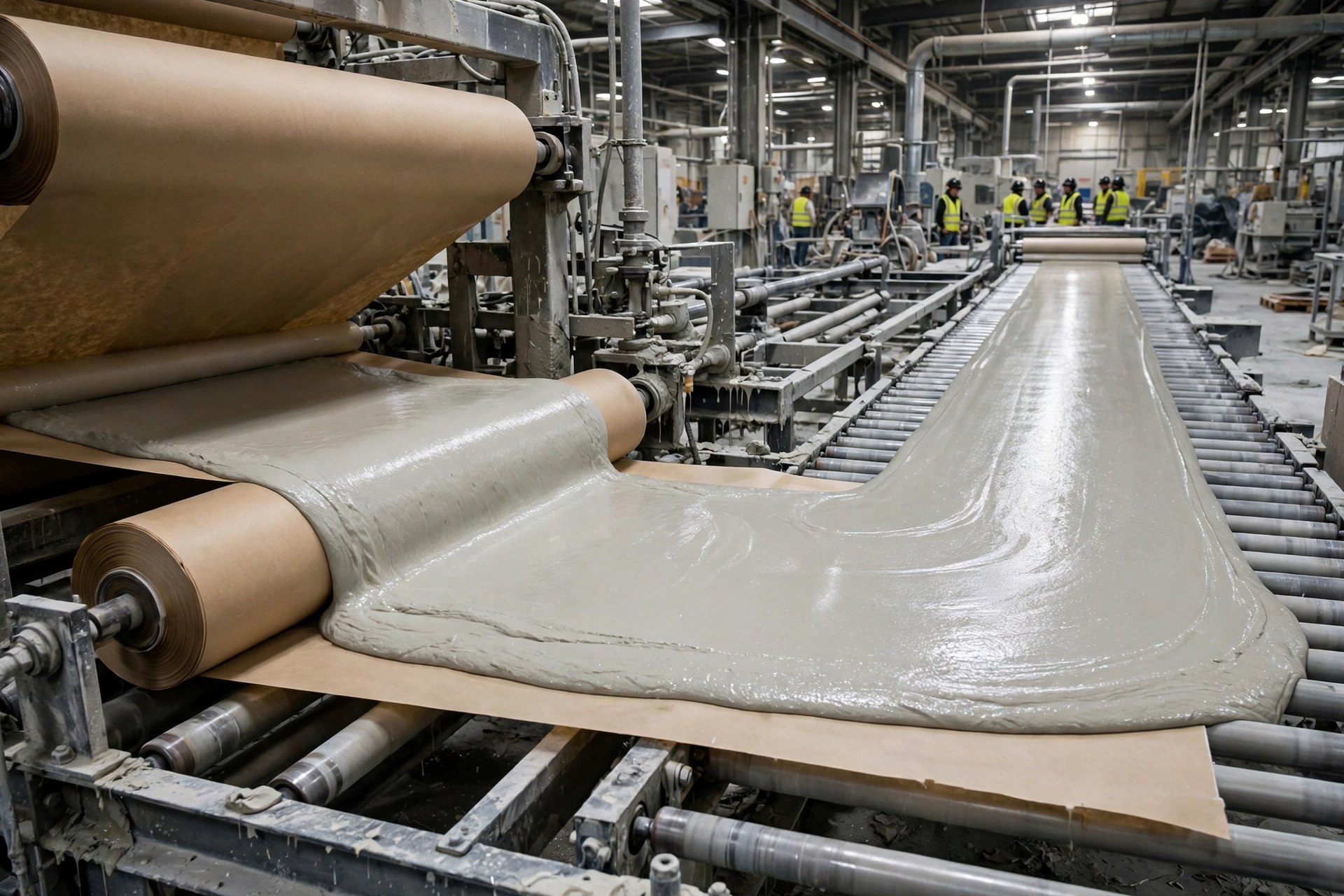
The forming station is where the board takes its shape. Stucco and dry additives are combined with water in a pin mixer at the head of the line. The slurry is spread between two paper sheets that serve as a mould, the edges are scored and folded, and the wet board travels down a forming belt while the hemihydrate takes up water and turns back into gypsum. The chemistry is the reverse of calcination: CaSO₄·½H₂O + 1½H₂O → CaSO₄·2H₂O. Only about 18.6% of the stucco’s weight in water is needed for the reaction. The slurry carries far more than that — a water-to-stucco ratio of 0.75–0.90 is the benchmark — because the slurry has to flow and spread at line speed. Everything above the 0.19 the reaction needs must leave through the dryer.
The forming line’s electrical load is a collection of medium motors: the pin mixer, the paper unwind stands, the belt and roller drives, the rotary knife that cuts the continuous web into boards. None of them is large alone. Together they are a fifth to a third of the plant’s electrical load, and they all start together after a transfer. The motor starting behaviour of the line is the sizing problem: a dozen motors across the belt, the knife and the wet-end transfer, each drawing five to seven times its running current for a few seconds at start. The motor-starting article covers the general method — locked-rotor kVA, starting sequence, voltage dip — and the board line is the textbook case for staggering starts instead of starting everything at once.
The setting belt deserves a sentence of its own, because it is the part of the line most people forget when they size a generator. After forming, the board is still a soft slurry between two sheets of paper. The belt carries it while the stucco hydrates. The length of belt needed before the knife is simple arithmetic: length ≈ line speed × time needed to reach cutting strength. At 15 m/min, every minute of setting time needs 15 m of belt. A faster line, or a slower-setting formulation, needs a longer setting section or more accelerator. Set time is not fixed by the machine. USG’s patent literature notes that it depends on the age and impurities of the calcined gypsum, surface area, pH, particle size and mixing temperature. A line that ran well on one stucco can run badly on another, and a generator that cannot keep the belt moving while the set completes turns a chemistry problem into a cleanup problem.
Dryer and Dry End
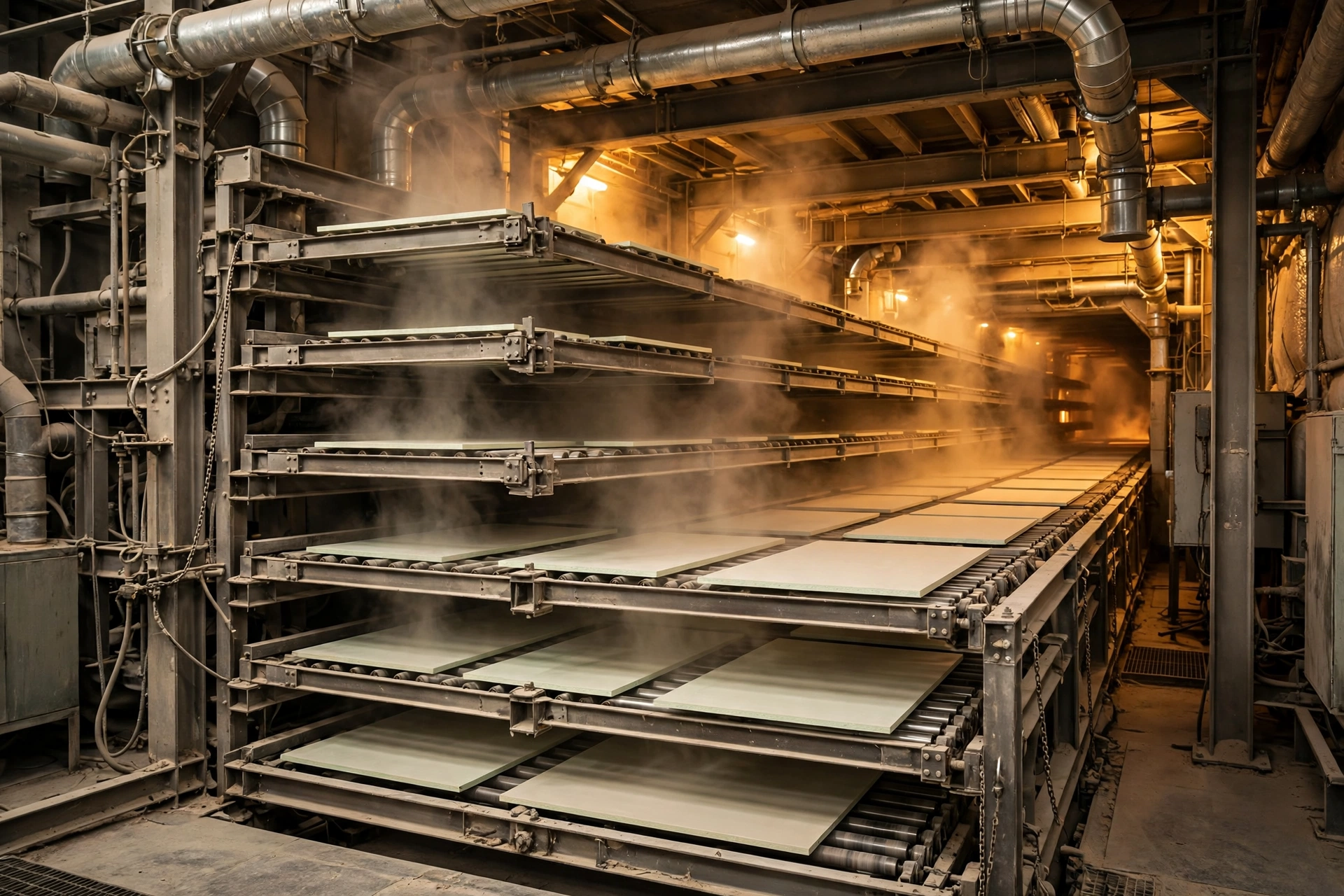
The dryer is the longest machine in the plant and the reason the generator’s fuel bill is what it is. After cutting, wet boards are spread over the stacked roller decks of a multi-deck dryer and carried through heated zones, hottest at the entry and cooler toward the exit, for roughly 20–60 minutes. The aim is to drive off the free water without heating the gypsum crystals enough to lose their chemically bound water. Over-dry the board and the core calcines again — weak, crumbly, unsaleable. Under-dry it and the board goes to stacking wet — heavy, weak and prone to mould in the warehouse.
The numbers explain why the dryer dominates the plant’s energy. Eurogypsum, the European gypsum industry association, puts the figures for standard plasterboard at about 1.4 litres of water per m² taken up by stucco hydration and about 4 litres per m² that has to be evaporated in the dryer. The dryer removes roughly three times more water than the board keeps. On a 1.2 m wide line running at 30 m/min, that is more than 11,000 kg of water an hour to evaporate, according to a US patent describing a typical plant. Best-in-class dryers burn 0.9–1.1 MMBTU per thousand square feet of ½-inch board; typical lines run 1.3–1.6, and inefficient dryers exceed 1.8. The gap is thermal efficiency: world-class dryers recover heat and hold 68–72%, while poorly sealed dryers leak down to 55%.
The dryer’s electrical load is fans and roller drives, not burners. A reference line’s dryer has 6–7 decks and runs 30–40 m long; large high-speed lines have ten to twelve decks and drying sections of 100 m or more. Each zone has its own fan, heater and air temperature, and the fans are the load the generator must carry — dozens of fan motors, each small, all running continuously. The dry end adds trimming saws, the stacker, strapping and packaging, plus the air compressors that drive the pneumatic controls across the whole line. The compressor is the load buyers most often forget: a 30–50 kW compressor that starts direct-on-line can draw 200 kW for a few seconds, and if it is not on the generator’s load list, it is the load that trips the set.
Sizing Bands by Plant Output
Gypsum board plants do not size by floor area or by headcount. They size by the line — its output in square metres a year, its speed, and its installed power. The table below gives the bands that cover most plants. The generator figure is the standby-rated set for the essential tiers, with a 20% margin for starting transients and load growth — not the full installed load, and not the thermal load, which stays on gas.
| Plant output | Line speed | Installed power | Essential electrical load | Generator size |
|---|---|---|---|---|
| 2 million m²/year | 12–15 m/min | 400–500 kW | 250–350 kW | 350–500 kVA |
| 3 million m²/year | 12–15 m/min | 600–800 kW | 400–550 kW | 500–750 kVA |
| 10 million m²/year | 30–60 m/min | 1,500–2,000 kW | 1,000–1,400 kW | 1,250–1,750 kVA |
| 30 million m²/year | 100–150 m/min | 3,000–4,000 kW | 2,400–3,200 kW | 2,500–3,750 kVA |
The pattern is consistent: the generator is roughly 0.8–1.2 kVA per thousand m² of annual output for a single-line plant. A buyer who quotes the generator from the plant’s total energy bill — gas included — buys a set three or four times too large, which will run at a quarter load, wet-stack, and cost four times as much to fuel and maintain. A buyer who quotes from the forming line alone buys a set that trips the first time the dryer fans and the compressor start together. The generator sizing guide covers the general method — load list, starting surge, margin — and the bands above are the gypsum-board application of it. Board plants are not the only continuous-process factories with this problem: cement plants face the same kiln-restart arithmetic when the power fails, and textile mills lose a full loom’s work to a ten-second outage.
The Small Line: 2 Million m² a Year
Two million square metres a year is the smallest line that makes sense for most investors. Below that, the plant still needs every section of a continuous line — calciner, stucco storage, dosing and mixing, forming station, setting belt, knife, wet-end transfer, dryer and dry end — plus a minimum crew and a laboratory, so the cost per square metre rises steeply. The published figures for a 2 million m² a year plant, scaled from the 3 million m² reference line, are about 14,000 tonnes of stucco, 16,700 tonnes of gypsum, 900 tonnes of facing paper, 1.0–1.4 million m³ of gas and 1.0–1.2 million kWh of electricity a year.
The essential electrical load on the generator is 250–350 kW, and a 350–500 kVA standby set covers it with margin. The load list is short enough to write on one page: calciner stirrer and feed, mills, pin mixer, forming belt and knife, dryer fans, dust collectors, compressor, controls and lighting. The critical decision on a small line is the rating, not the size. A 500 kVA set bought on its standby figure and run as a prime set through a long outage will follow the pattern in the standby and prime ratings article: acceptable for months, then early wear, then a rebuild far from a workshop. A plant that loses grid power for 300 hours a year needs a prime-rated set, or it needs to accept that the standby set’s 200-hour annual limit is a warranty line, not a suggestion.
The Reference Line: 3 Million m² a Year
The 3 million m² a year line is the reference the industry’s published figures are built on: 12 mm board, 1.2 m wide, forming at 12–15 m/min, two 8-hour shifts, 300 days a year. Annual consumption is about 21,000 tonnes of stucco, 25,000 tonnes of gypsum, 1,350 tonnes of facing paper, 1.5–2.1 million m³ of natural gas and 1.5–1.8 million kWh of electricity. Installed power is 600–800 kW, and the crew is 30–50 people on two shifts.
The generator for this line is a 500–750 kVA standby set. The Cummins C500D5, a frame PAVO builds regularly, is rated 500 kVA standby / 455 kVA prime and burns 93.2 L/h at full prime load, 69.9 L/h at 75%, 49.0 L/h at 50% and 29.2 L/h at 25%. At the reference line’s essential load of 400–550 kW, the set runs at 65–85% of its prime rating — the band where a diesel engine is happiest, hot enough to avoid wet stacking and loaded enough to be efficient. A 750 kVA set on the same line runs at 50–65%, which is acceptable but wastes capital and fuel; a 500 kVA set on a line whose essential load has crept to 600 kW runs at 95% and trips on the first compressor start. The honest load list, measured with a clamp meter during a full production run, is worth more than any catalogue figure.
The High-Speed Line: 10–30 Million m² a Year
High-speed lines change the problem from sizing to starting. A competitive line runs at 400–450 ft/min (122–137 m/min); world-class ½-inch production reaches 500–600 ft/min (152–183 m/min). A Yoshino Gypsum patent describes production at 60 m/min or more, with examples at 150 m/min. At those speeds the annual output per line is 150–250 million ft², and world-class lines reach 250–400 million ft² — roughly 14–37 million m².
The generator for a 10 million m² a year line is 1,250–1,750 kVA; a 30 million m² a year line needs 2,500–3,750 kVA, which is the top of PAVO’s range and usually means two sets in parallel rather than one. The reason is not the running load. It is the starting sequence. At 150 m/min, the forming belt, the dryer roller drives, the dust collectors and the compressors cannot all start at once without a voltage dip that drops the control system. The sequence has to be staged — calciner first, then mixer and forming, then dryer fans zone by zone, then the dry end — and the automatic transfer switch has to be programmed for it. A 10-second start is the standard; a 10-second start followed by a 90-second staged load acceptance is the reality on a high-speed line. The plant’s UPS bridges the control system through the transfer, not the production load, and the UPS article’s warning applies here too: a UPS that keeps switching to battery on generator power is usually a frequency problem, not a battery problem.
The Wet-Board Window: What Happens in the First Minutes
The first minutes of an outage decide how much of the plant’s work-in-progress survives. A gypsum board line holds a surprising amount of material in the machine at any moment, and every metre of it is on a clock. The board on the setting belt is setting. The board in the dryer is drying. The stucco in the calciner is hot. Stop the line and all three clocks keep running — just not in the plant’s favour.
The window is short because the process is fast. At 15 m/min on a reference line, the board travels 15 metres every minute. The setting belt is tens of metres long, the dryer is 30–40 m long with six or seven decks, and the distance from the pin mixer to the stacker is well over 100 m. At any instant the line holds several hundred square metres of board in various stages of setting and drying. None of it can be left where it is.
The Board in the Dryer
The dryer is the worst place for board to stop. A reference line’s dryer holds roughly 240–290 m² of board at any moment — six or seven decks, each carrying a 30–40 m length of 1.2 m wide board. Wet board weighs about 12 kg/m² against 8 kg/m² dry, so the dryer holds roughly 3–3.5 tonnes of wet board. The zones are hottest at the entry and cooler at the exit, and the board inside is at every stage of drying from wet to nearly dry.
When the fans stop, the heat does not. The burner controls shut down, but the dryer housing, the decks and the hot air inside stay hot for a long time. The board nearest the entry keeps drying without air movement, which means it dries unevenly — edges over-dry, centres stay wet. Over-dried edges go soft and cupped at the tapers, the defect a National Gypsum patent describes for edges dried out of balance. The board in the middle of the dryer sets in place on the rollers, and if it sits long enough it bonds to the roller surface with dried gypsum. Pulling it out means stopping the line, cooling the dryer, and sending a crew inside with scrapers. On a 40 m dryer that is half a shift of manual work before the line can even be re-threaded.
The dryer also has a thermal problem the generator cannot solve. The burners need gas, and the gas valves need electricity to stay open. A plant whose gas supply is interrupted by the same outage — a common arrangement where the gas train is electrically interlocked — loses the dryer’s heat as well as its fans. The generator keeps the fans turning, but a dryer with fans and no heat is a very expensive conveyor. The gas interlock belongs on the generator’s essential list, and the fuel supply for the burners belongs in the same conversation as the fuel supply for the generator.
The Calciner Kettle
The calciner kettle is the second-worst place for material to stop. A kettle holds several tonnes of stucco at 120–150°C, stirred continuously. Stop the stirrer and the stucco at the bottom of the kettle keeps cooking against the hot wall while the stucco at the top cools. The result is uneven calcination — part of the batch over-calcined, part under-calcined — and stucco whose set time no longer matches the formulation the line is tuned for. The line then runs badly on a stucco it was running well on an hour earlier, because set time depends on the stucco’s age, impurities, surface area and temperature, and all four have just changed.
A flash calciner is more forgiving than a kettle, because it holds less material at any moment — the gypsum is carried through a hot gas stream rather than sitting in a vessel. But it is not forgiving for long. Stop the feed and the hot gas stream keeps heating an empty duct; restart the feed and the first stucco through is over-calcined until the temperatures stabilise. Either way, the calciner is the section that decides how long the restart takes, and the restart is a section of its own below.
The Setting Belt
The setting belt is the most visible casualty, because it is the longest single piece of material in the plant. At 15 m/min with a two-minute set time, the belt holds 30 m of wet board — a continuous sheet, 1.2 m wide, setting as it travels. Stop the belt and the sheet sets where it lies. The leading edge, which was nearly ready for the knife, sets hard. The trailing edge, fresh from the forming station, is still slurry. The sheet cannot be cut, cannot be lifted, and cannot be restarted. It has to be cut out by hand, in sections, and carried away.
On a high-speed line the arithmetic is worse. At 150 m/min, a two-minute set time needs 300 m of belt and conveyor before the knife. The belt holds 360 m² of board, and a single minute of outage at full speed puts 180 m² of board on the floor — a minute’s production, scrapped, plus the time to clear it. The board itself is cheap per square metre. The time to clear it is not. A crew of six clearing 300 m of set board by hand, cutting it into sections and carrying it to a skip, takes the better part of an hour, and the line cannot restart until the belt is clean.
Three Gypsum Board Plants That Lost Power — and What They Teach
Case 1: The 10 Million m² Line in Gujarat
A 10 million m² a year line in Gujarat runs at 30–60 m/min on a single 1.2 m wide web, two shifts a day, six days a week. Installed power is about 1,700 kW; the essential load on the generator is 1,100 kW. The plant bought a 1,250 kVA standby set with an automatic transfer switch, and the set started within 10 seconds on every monthly test. On paper, the plant was covered.
The outage came at 14:20 on a summer afternoon, when the grid feeder tripped and stayed down for six hours. The set started in 9 seconds and took the calciner, the mixer and the forming line. It tripped 40 seconds later. The cause was the dryer fans. The transfer sequence started the dryer fans in two groups, but the second group’s starting current, added to the forming line already at load, pulled the voltage down far enough to drop the control system, and the control system dropped the contactors. The set was running. The plant was dark.
The crew restarted the line in manual, zone by zone, and got the board moving again after 55 minutes. The cost was the board in the dryer — about 290 m², three tonnes of wet board that had to be pulled out by hand — plus the stucco in the kettle, which had to be discharged and re-tested, plus the board on the setting belt, cut out in sections. Total lost production was about 4,000 m², roughly an hour and a half of output at 30 m/min, and the line did not reach full speed again until the next shift. The set was not too small. The starting sequence was wrong, and no one had ever tested the transfer at full production load. The monthly test ran the set at 30% load with the line stopped. The lesson is the one the maintenance schedule article states plainly: a test that never sees the real load proves the set starts. It proves nothing about the plant.
Case 2: The 3 Million m² Plant in Shandong
A 3 million m² a year plant in Shandong runs the reference line: 12 mm board, 1.2 m wide, 12–15 m/min, two shifts, 300 days a year. The essential load is 450 kW and the set is a 500 kVA standby unit — the C500D5 frame. The plant’s grid supply is reliable, with two or three short outages a year, and the set had never run for more than an hour at a time.
The outage lasted 11 hours, overnight, when a substation fault took down the industrial park. The set started, took the load, and ran. The problem was fuel. The set’s base tank held 645 litres, which at the line’s 75% load — about 70 L/h — gave roughly nine hours. At hour nine the set stopped on low fuel, and the line stopped with it. The dryer, which had been running on generator power for nine hours, now sat full of board with no fans and no heat. The board inside set in place. The kettle cooled with a full charge of stucco inside.
The plant had a bulk tank, but the transfer pump that moved fuel from the bulk tank to the day tank was wired to the mains board, not the essential board. The pump had no power during the outage, and no one had ever tested the transfer under outage conditions. The fuel was 20 metres away, in a tank the generator could not reach. The restart took the whole next day: the dryer had to be cooled and cleared by hand, the kettle had to be emptied and reheated, and the first stucco through the line was out of specification until the temperatures stabilised. The fuel bill for the outage would have been about 770 litres for 11 hours. The lost production was a full day. The lesson is not about tank size. It is about the fuel system as a system: the day tank, the transfer pump, the bulk tank and the wiring that connects them all belong on the essential board, and the diesel fuel ageing article’s warning about fuel in storage applies to the bulk tank too — fuel that sits for a year without testing is a second failure waiting for the first.
Case 3: The High-Speed Line at 150 m/min
A high-speed line in the American Midwest runs at 150 m/min on a 1.2 m web, producing ½-inch board for the residential market. Annual output is about 25 million m². The plant’s essential load is 2,800 kW and the backup is two 1,500 kVA sets in parallel, with a synchronising panel and a staged load-acceptance sequence. The plant had invested in the right hardware. The outage tested the right procedure.
The grid failed at 03:40, during the night shift, when the line was running at full speed. Both sets started within 10 seconds and synchronised. The load acceptance ran in stages: calciner and dust collection first, then the mixer and forming line, then the dryer fans zone by zone, then the dry end. The whole sequence took just under two minutes. The line lost about 90 seconds of production — 270 m² of board at 150 m/min — and the board on the setting belt was cut out in four minutes by the night crew, who had rehearsed the procedure.
The plant ran on the generators for 14 hours while the utility repaired a transmission fault. Fuel consumption at the line’s load was about 440 L/h across the two sets, and the bulk tank held 10,000 litres — enough for 22 hours with margin. The line returned to full speed within 20 minutes of the grid coming back, because the board in the dryer had kept moving and the kettle had stayed at temperature. Total lost production was under 500 m², and the plant shipped its full order book that week. The difference from the first two cases was not the size of the set. It was the sequence, the fuel system and the rehearsal. The plant’s operations manager keeps a one-page card at the control desk: the load-acceptance order, the fuel-transfer procedure, and the phone number of the fuel supplier. The card is laminated. The card is the backup plan.
Calciner Restart: The Hour Nobody Budgets For
Every board plant’s backup plan has a gap, and the gap is the calciner restart. The generator restarts the line in minutes. The calciner restarts the line in hours. A plan that counts only the generator’s start time is a plan that stops at the easy part.
The kettle has to come back to 120–150°C and stay there, evenly, before the stucco it produces is usable. A kettle that has cooled to ambient takes 2–4 hours to reheat, depending on its size and the burner capacity, and the first stucco through the line after a restart is out of specification until the temperatures stabilise. The stucco that was in the kettle when the power failed has to be discharged and tested, because part of it cooked and part of it cooled. A kettle that holds 5 tonnes of stucco loses the whole charge — not because the stucco is ruined, but because no one can prove which part of it is still in specification.
Reheating the Kettle
The reheat is a thermal problem, not an electrical one, and the generator does not help it. The kettle’s burner runs on gas, and the gas supply has to be restored before the reheat can start. If the outage also interrupted the gas supply — an electrically interlocked gas train, or a gas supply that depends on a compressor on the mains board — the reheat waits for the gas as well as the power. The plant’s backup plan has to cover the gas train, the burner controls and the kettle stirrer as one system, not three separate items on three separate boards.
The reheat rate matters. Heat a kettle too fast and the stucco nearest the wall over-calcines while the centre is still cold. The temperature profile has to be even, and even takes time. A plant that rushes the reheat gets stucco with a set time that wanders from batch to batch, and a forming line whose set time wanders is a line that produces board with soft edges, wet centres and cupped tapers. The USG patent literature is blunt about the cause: set time depends on the stucco’s age, impurities, surface area, pH, particle size and mixing temperature. A restart changes all of them at once.
Re-threading Paper and Re-setting the Mixer
While the kettle reheats, the forming line has its own restart. The paper has to be re-threaded through the forming station, the pin mixer has to be flushed and re-primed, and the slurry formulation has to be checked against the stucco that is now coming through. The paper is a real cost in the restart: facing paper runs at 0.45 kg/m², and a roll weighs a tonne or more. A re-thread that wastes half a roll is a tonne of paper and twenty minutes of labour. The mixer flush wastes stucco and water, and the first board off the line after a restart is almost always scrap — the formulation is right, but the line temperatures and the set time have not settled.
The honest restart time for a 3 million m² a year line after a cold calciner is 4–6 hours from power restoration to saleable board. A plant that plans for a 10-second generator start and a 4-hour calciner restart is a plant that understands its own process. A plant that plans only for the 10 seconds is a plant that will discover the other four hours in the middle of an outage, with a full order book and no board to ship.
Fuel Autonomy and Running Cost: How Long It Runs and What It Burns
A board plant’s generator is a fuel problem before it is a power problem. The set runs for as long as the outage lasts, and the outage lasts as long as the utility says it lasts. The plant’s fuel autonomy is the number of hours the set can run without a delivery, and the delivery is the part of the plan that depends on someone else’s truck.
The table below uses the C500D5’s published consumption figures and scales them to the sizing bands. The figures are at 75% load, which is where a well-sized set runs during an outage.
| Generator size | Essential load | Fuel at 75% load | 8 hours | 24 hours | 72 hours |
|---|---|---|---|---|---|
| 500 kVA | 400–550 kW | 70 L/h | 560 L | 1,680 L | 5,040 L |
| 750 kVA | 550–750 kW | 105 L/h | 840 L | 2,520 L | 7,560 L |
| 1,500 kVA | 1,100–1,400 kW | 210 L/h | 1,680 L | 5,040 L | 15,120 L |
| 2 × 1,500 kVA | 2,400–3,200 kW | 440 L/h | 3,520 L | 10,560 L | 31,680 L |
Fuel Use by Set Size
The fuel cost is the smallest part of the outage bill, and it is the part buyers argue about most. At a delivered diesel price of $0.80–1.20 per litre, typical in many export markets, a 500 kVA set burns $56–84 an hour at 75% load. Over 24 hours that is $1,340–2,020. Over 72 hours it is $4,030–6,050. The board the line produces in 24 hours is worth far more than the fuel — a 3 million m² a year line produces about 10,000 m² a day, and a day’s lost production costs the plant a day’s margin on 10,000 m², plus the restart, plus the scrap. The fuel is cheap. The stopped line is expensive.
The fuel system has to be sized for the autonomy the plant actually needs, not the autonomy the catalogue promises. A 645-litre base tank on a 500 kVA set gives about nine hours at 75% load. Nine hours covers a short outage. It does not cover an overnight substation fault, and it does not cover a 72-hour grid failure after a storm. A plant that needs 72 hours of autonomy needs a 5,000-litre bulk tank for a 500 kVA set, a 7,500-litre tank for a 750 kVA set, and a 15,000-litre tank for a 1,500 kVA set — and a transfer pump on the essential board, a fuel contract with a supplier who delivers during outages, and a testing regime for fuel that sits in the tank for months. Fuel that has gone bad in the tank is the subject of the fuel-ageing article, and a bulk tank that has not been tested in a year is a second failure waiting for the first.
The 72-Hour Tank
Seventy-two hours is the autonomy figure most industrial buyers ask for, and it is the figure that separates a fuel plan from a fuel hope. Three days covers a storm, a substation rebuild and a utility’s worst-case restoration estimate. It also covers the restart: the set has to keep running while the calciner reheats and the line comes back to temperature, and the restart takes hours after the grid returns if the calciner has gone cold. A plant that sizes its tank for the outage and forgets the restart runs out of fuel during the recovery.
The tank itself needs a bund. A 5,000-litre tank that leaks into the ground is an environmental incident, a fine and a shutdown. Secondary containment sized to 110% of the tank’s capacity is the standard, and the bunding article covers the numbers — the bund volume, the rainwater allowance, the drain valve that must stay shut. The tank, the bund, the transfer pump and the delivery contract are one system, and the generator is the only part of it that gets tested monthly. The rest of it gets tested when it is needed, which is the worst possible time to find out it does not work.
Frequently Asked Questions
What size generator does a gypsum board plant need?
A 2 million m² a year line needs 350–500 kVA, a 3 million m² a year line needs 500–750 kVA, a 10 million m² a year line needs 1,250–1,750 kVA, and a 30 million m² a year line needs 2,500–3,750 kVA, usually as two sets in parallel. The figure is the standby-rated set for the essential electrical load — calciner, forming line, dryer fans and dry end — with a 20% margin for starting transients. The dryer’s heat stays on gas and is not part of the generator’s load.
Do gypsum board plants need a backup generator?
Yes, and the reason is the material in the machine, not the building. A board line holds several hundred square metres of board in the dryer and on the setting belt at any moment, and a calciner kettle holds tonnes of stucco at 120–150°C. When the power fails, that material sets, sticks and has to come out by hand. A plant without a generator loses the board in the machine, the stucco in the kettle, and four to six hours of restart time — on top of the outage itself.
How long can a gypsum board plant run on a generator?
As long as the fuel lasts. A 500 kVA set at 75% load burns about 70 L/h, so a 645-litre base tank gives roughly nine hours and a 5,000-litre bulk tank gives about 72 hours. The limit is the fuel system, not the engine: a prime-rated set can run indefinitely with fuel, oil and service, while a standby-rated set is limited to about 200 hours a year under ISO 8528-1. A plant that loses power for 300 hours a year needs a prime-rated set or a different backup plan.
What happens to gypsum board during a power outage?
The board on the setting belt sets where it lies and has to be cut out by hand. The board in the dryer keeps drying unevenly without air movement — edges over-dry and cup — and can bond to the rollers if it sits long enough. The stucco in the calciner kettle cooks unevenly and has to be discharged and tested. The first board off the line after a restart is almost always scrap, and a cold calciner takes 4–6 hours to come back to saleable board.
Can a diesel generator power a gypsum board plant?
Yes, for the essential electrical load. A diesel set powers the calciner drives, the pin mixer, the forming line, the dryer fans and roller drives, the dust collectors, the compressors and the controls. It does not power the dryer’s heat, which comes from gas burners, and it does not power the full installed load — offices and non-essential utilities are shed on transfer. The set must start within 10 seconds and accept load in stages, because the dryer fans and compressors cannot all start at once without dropping the voltage.
Specification Checklist
1. Which rating is quoted — ESP or PRP, and for how many hours a year? The letters must appear on the datasheet and the contract. A plant that loses grid power for 300 hours a year needs a prime-rated set; a standby-rated set’s 200-hour limit is a warranty line, not a suggestion.
2. Is the load list measured, not estimated? The essential load must be measured with a clamp meter during a full production run — calciner, mixer, forming line, dryer fans, dust collectors, compressor, controls. A catalogue figure is a starting point, not a load list.
3. Is the starting sequence staged? The calciner starts first, then the mixer and forming line, then the dryer fans zone by zone, then the dry end. The automatic transfer switch must be programmed for the sequence, and the sequence must be tested at full production load, not at 30% with the line stopped.
4. Is the fuel system on the essential board? The day tank, the bulk tank, the transfer pump and the fuel-level alarms all belong on the generator’s board. A transfer pump wired to the mains board is a fuel system that stops working exactly when it is needed.
5. Is the gas train covered? The dryer’s burners need gas, and the gas valves need electricity to stay open. If the gas train is electrically interlocked, it belongs on the essential board with the generator, or the dryer has fans and no heat.
6. Is the calciner restart in the plan? A cold kettle takes 2–4 hours to reheat, and a cold calciner takes 4–6 hours to come back to saleable board. The restart time belongs in the backup plan next to the generator’s 10-second start.
7. Is the fuel tested and the tank bunded? Fuel in a bulk tank goes bad — water, microbes and ageing — and a tank that has not been tested in a year is a second failure waiting for the first. The bund must hold 110% of the tank’s capacity, and the drain valve must stay shut.
8. Is the set tested under load every month? A monthly test at 30% load proves the set starts. It proves nothing about the plant. The maintenance schedule for a board-plant set includes a monthly loaded test, a quarterly transfer test at full production load, and an annual fuel-system test — transfer pump, bulk tank and alarms included.
9. Is the set sized for the next line, not just this one? A plant that adds a second line, a faster forming station or a bigger dryer will outgrow its generator. A 500 kVA set on a line that grows to 600 kW of essential load runs at 95% and trips on the first compressor start. Buy the margin now, or buy a second set later.
A gypsum board plant is a chain, and the chain has no pause button. The generator is the part of the plant that keeps the chain moving when the grid stops, and the calciner restart is the part of the plan that keeps the chain moving after the grid comes back. A buyer who sizes the set from a measured load list, stages the starting sequence, puts the fuel system on the essential board, and budgets four to six hours for the calciner restart has a backup plan. A buyer who buys a set from a catalogue figure has a generator. The two are not the same, and the difference shows up in the first real outage — in the dryer, on the setting belt, and in the kettle.
For a quotation on a set sized for a board line, send the load list, the annual output, the line speed and the fuel autonomy required, and contact PAVO — PAVO builds sets from 9 to 3750 kVA in open, silent and containerised configurations, powered by Cummins, Weichai, Yuchai and Shanghai Diesel, and will price the correct rating from those four lines.