

What Size Generator Does an Asphalt Plant Need? | PAVO
An asphalt plant is not a factory with a generator. It is a continuous thermal process, and the generator is the only thing standing between a full day of paving and a drum full of cold, set mix.
What size generator does an asphalt plant need? An 80 t/h batch plant needs a 300–400 kVA set, a 160 t/h plant needs 600–750 kVA, and a 240 t/h plant needs 800–1,000 kVA. The induced-draft fan decides the figure, because a plant’s electrical load runs 150–750 kW and its largest motors draw four to seven times rated current at start.
This article works through the load list of a real asphalt plant, the sizing table by plant capacity, the starting surge that catches most buyers out, the 160 °C clock that turns a power failure into a ruined batch, and the choice between grid, diesel and twin-power. The loads resemble a concrete batching plant more than any other industrial site — conveyors, elevators, a mixer that cannot stop mid-cycle — except that the product here leaves the plant at 160 °C and cannot wait. It covers small mobile plants and 320 t/h stationary plants, batch mixers and drum mixers, and the fuel and placement decisions that follow the sizing decision.
Contents
- What an Asphalt Plant Actually Draws: The Load List
- Sizing by Plant Capacity: The kVA Table
- The Starting Surge: Why the Induced-Draft Fan Decides the Set
- The 160°C Clock: What Happens When Power Fails Mid-Batch
- Three Plants, Three Outages
- Diesel, Grid or Twin-Power: Where the Generator Fits
- Frequently Asked Questions
- Specification Checklist
What an Asphalt Plant Actually Draws: The Load List
An asphalt plant looks simple from the road: a tall dryer drum, a mixing tower, a few silos, a stack. The electrical load list tells a different story. A 240 t/h batch plant carries 600–720 kW of installed electrical power across a dozen drives, and a 320 t/h plant carries 745–750 kW. The load is not one big motor. It is a chain of stations — cold feed, drying, screening, mixing, storage — and every station has to run at the same time for the plant to make a single tonne of mix.
Sizing a generator for an asphalt plant means understanding which loads run together, which loads start together, and which loads cannot be allowed to stop. The plant is a chain, and the chain is only as strong as the station that fails first.
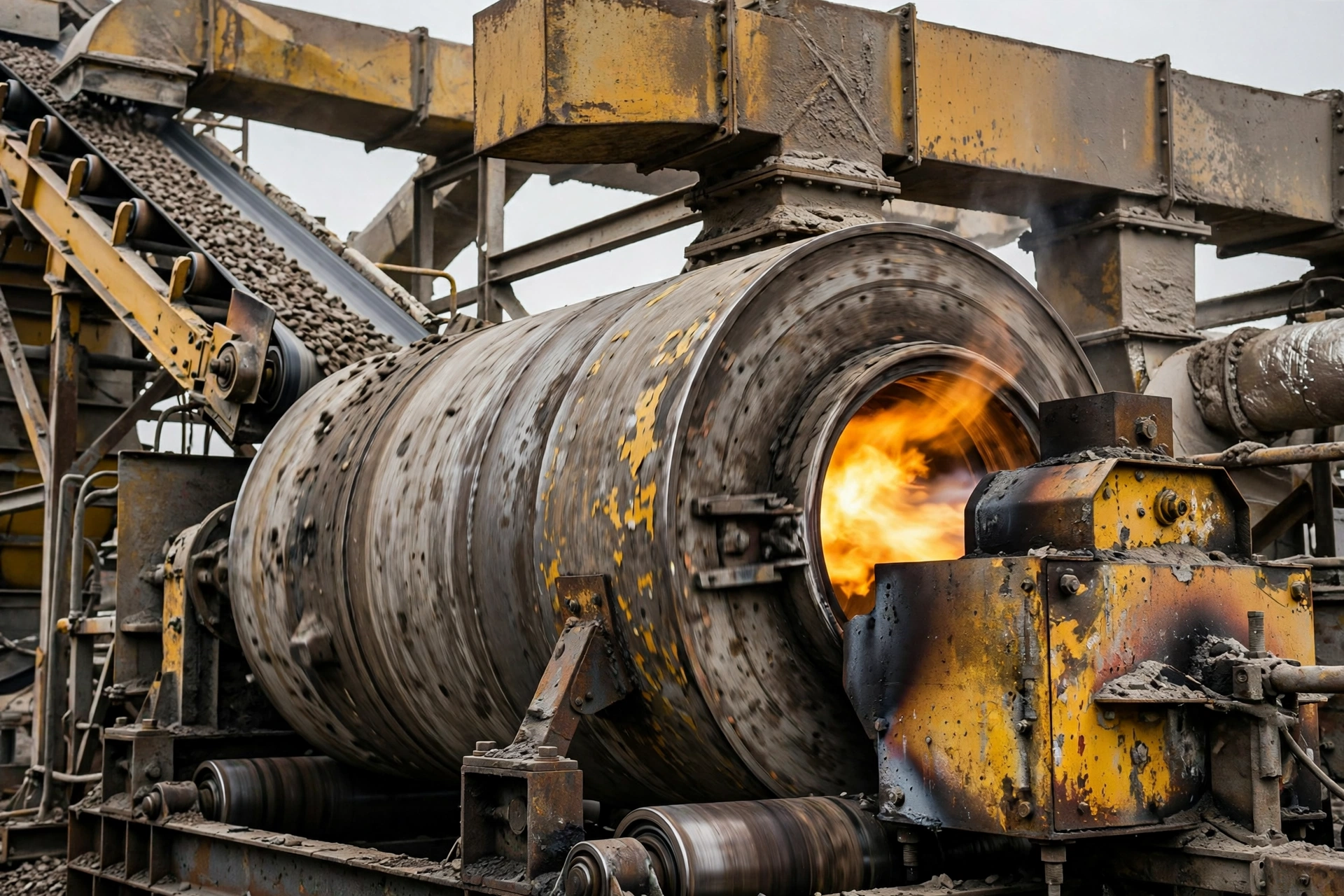
The dryer drum and burner: heat’s customer, electricity’s biggest load
Drying is the first and most energy-hungry station. Cold aggregate at 3–8% moisture enters a rotating drum 2–2.8 m in diameter and 8–12 m long, where a burner firing diesel, heavy oil, gas or coal drives the moisture out and heats the stone to 160–180 °C. The burner does the thermal work — 5.5–7 kg of diesel per tonne of mix on a batch plant, 4–6 litres per tonne on a counter-flow drum plant at low moisture — but the electricity runs everything around it: the drum drive, the burner fan, the fuel pumps and the combustion-air blower.
The drum itself is a modest motor, typically 30–90 kW depending on drum size. The induced-draft fan is the problem. It pulls the combustion gases and the dust through the drum and into the baghouse, and on a 160–240 t/h plant it is a 90–160 kW motor that starts against a cold, heavy drum full of aggregate. It is the largest single motor on most plants, and it is the motor that decides the generator size. The burner guide from Dingbo Power puts the starting current of the induced-draft fan and the bucket elevator at four to seven times rated current, and that single figure is the reason a plant sized on running load alone trips its own generator on the first start of the shift.
Cold feed and aggregate handling: many small motors, one big total
Before the drum, the cold-feed system moves aggregate from four to six hoppers onto a collecting conveyor and into the drum. Each hopper has its own feeder motor, and the conveyors add more. Individually they are 5.5–15 kW motors. Together, on a 240 t/h plant, the cold-feed system draws 60–90 kW, and it runs continuously for the whole shift.
The load is unremarkable. The consequence of losing it is not. A cold-feed system that stops mid-shift starves the drum, and a drum that runs empty overheats its flights and its shell. The plant cannot simply restart the feed and carry on: the drum has to be brought back to temperature, the aggregate flow has to be re-established, and the first 10–15 minutes of production after a restart are usually out of specification. The cold feed is the reason a backup plan has to cover the whole plant, not just the mixer.
Hot elevator, screen and mixer: the tower that cannot pause
After the drum, hot aggregate at 160–180 °C goes up the hot elevator — a vertical chain conveyor of 15–37 kW — into a vibrating screen of 11–22 kW that splits it into four to six fractions, and then into hot bins. From the bins, weighed aggregate, filler and bitumen drop into the mixer: a twin-shaft pugmill of 2 × 37–55 kW on a 2,000–4,000 kg batch, running a 45-second mixing cycle.
The mixer is the heart of the plant, and it is the load that punishes a power failure hardest. A batch of 2,000 kg takes 45 seconds to mix. If power fails 30 seconds into the cycle, the mixer stops with two tonnes of 160 °C asphalt inside it. The mix cools, stiffens and sets. Clearing a set mixer is a half-day job with jackhammers and cutting torches, and the mixer gearbox and shafts take the damage. The mixer motor is not the largest on the plant, but it is the one whose failure costs the most per minute.
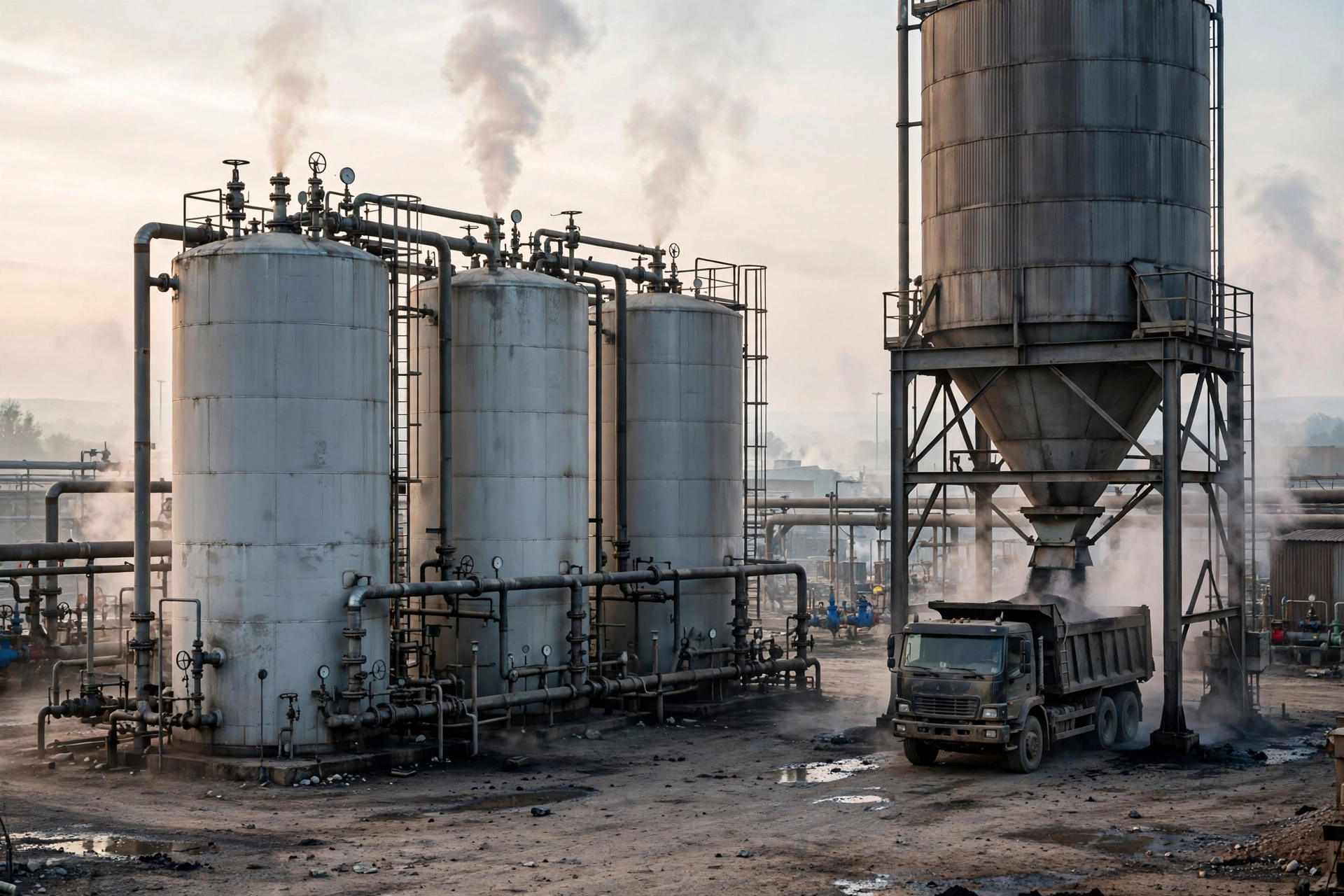
Bitumen heating, storage and the thermal-oil heater
Bitumen arrives by tanker and is stored at about 160 °C in insulated tanks of 25–200 t, heated by a thermal-oil system running at 200–240 °C. The electrical load is small — circulation pumps of 7.5–15 kW, the thermal-oil heater’s own pumps and fans — but the thermal logic is unforgiving. Bitumen that cools below about 140 °C will not pump. Bitumen that cools to ambient temperature is a solid block that has to be re-melted from the outside, a process measured in days, not hours.
A plant that loses power for two hours does not lose its bitumen. A plant that loses power for two days does. The thermal-oil heater is the load that decides whether a weekend outage becomes a week-long shutdown, and it is the load most often forgotten in a sizing exercise because its motor is small.
Dust collection, controls and the loads nobody counts
The remaining loads are small individually and large in total: the baghouse with its pulse-jet cleaning and screw conveyors, the filler elevator and silo, the finished-mix silo and its discharge gates, the control room with its PLC and SCADA, the weighbridge, the laboratory and the water sprays for dust suppression. On a 240 t/h plant these add 40–70 kW, and they run for the whole shift whether the plant is producing or not.
The control system deserves a line of its own. A modern plant runs on a PLC that holds the mix recipe, the weighing calibration and the production log. A control room without power is a plant without a recipe, and a PLC that loses power mid-batch loses the batch data that proves the mix met specification. A small UPS for the control cabinet — 3–5 kVA — is the cheapest insurance on the site, and it belongs in every backup plan.
Sizing by Plant Capacity: The kVA Table
The fastest way to size a generator for an asphalt plant is to start from the plant’s main power — the total installed electrical power published in the manufacturer’s specification — and work from there. The table below pulls together the published figures from three manufacturers, SDCAD, Metong and Suniverse, and adds the generator size that matches each plant in practice.
| Plant model | Capacity (t/h) | Main power (kW) | Operating power (kW) | Recommended generator |
|---|---|---|---|---|
| LB500 / mobile 40 t/h | 40 | 150 | 110–130 | 250–300 kVA |
| LB800 | 64 | 185 | 140–160 | 300–350 kVA |
| LB1000 | 80 | 245 | 180–210 | 300–400 kVA |
| LB1500 | 120 | 350 | 260–300 | 450–500 kVA |
| LB2000 | 160 | 450–490 | 340–400 | 600–750 kVA |
| LB3000 | 240 | 600–720 | 480–580 | 800–1,000 kVA |
| LB4000 | 320 | 745–750 | 600–650 | 1,000–1,250 kVA |
The table is a starting point, not a quotation. Two plants with the same model number can differ by 100 kVA once the options are added: a RAP (reclaimed asphalt pavement) feed system, a warm-mix foaming unit, a second bitumen tank, a baghouse upgrade. The sizing exercise has to start from the actual load list of the plant being bought, not from the brochure figure.
Why installed power and operating power differ
Installed power is the sum of every motor nameplate on the plant. Operating power is what the plant actually draws while it is producing, and it is always lower — typically 75–85% of installed power. Dingbo Power’s figures make the gap concrete: a VB320 plant carries 640–680 kW installed and draws 560–600 kW in operation, while a UN400 with a RAP system carries 960–1,120 kW installed and draws 830–970 kW.
The gap exists because not every motor runs at full load at the same time. The cold-feed conveyors cycle on and off with the hopper levels. The filler elevator runs in bursts. The baghouse cleaning cycle is intermittent. A generator sized for installed power is oversized by 15–25%, and an oversized diesel set runs at 40–50% load, where it wets stacks, glazes bores and burns fuel badly. A generator sized for operating power, with a margin for starting, is the right answer — provided the starting margin is real.
The 0.9 rule and the prime rating
Two rules govern the conversion from plant power to generator size. The first is the 0.9 rule from Dingbo Power: the continuous output of a diesel generator is generally 0.9 times its rated power. A 500 kVA set rated at 400 kW continuous will deliver about 360 kW hour after hour. A plant drawing 400 kW needs a set rated above 500 kVA, not a set rated at 500 kVA.
The second rule is the rating itself. An asphalt plant runs 10–14 hours a day, five or six days a week, for a paving season of 120–180 days. That is prime power duty, not standby duty: 1,500–2,500 operating hours a year, with the set carrying 70–90% load for most of that time. A standby-rated set is built for 200 hours a year and a 10% overload for one hour in twelve. Running it as a prime set voids the warranty and shortens its life by years. The difference between standby and prime ratings is the first thing to settle in any quotation, before the kVA figure is even discussed.
The worked example is straightforward. A 160 t/h LB2000 plant draws 340–400 kW in operation. Divide by 0.9 and the set needs a continuous rating of 380–445 kW, which is a 475–550 kVA prime set. Add the starting margin for the induced-draft fan — a 110 kW fan drawing 4–7 times rated current at start — and the practical choice lands at 600–750 kVA. The table above already includes that margin, which is why its figures look larger than a simple division would suggest. The full method — running load, starting surge, diversity and growth margin — is set out in the generator sizing guide.
The Starting Surge: Why the Induced-Draft Fan Decides the Set
Every asphalt plant has one motor that decides the generator size, and it is rarely the biggest motor on the nameplate list. It is the motor that starts against the heaviest load, with the worst power factor, at the moment when the rest of the plant is already drawing current. On an asphalt plant that motor is the induced-draft fan.
The induced-draft fan: four to seven times rated current
The induced-draft fan pulls combustion gases and dust through the dryer drum and into the baghouse. On a 160 t/h plant it is a 90–110 kW motor; on a 240 t/h plant it reaches 132–160 kW. At start it draws four to seven times its rated current — 500–800 A on a 400 V system for a 110 kW motor — and it draws that current for 8–15 seconds while the fan and the drum come up to speed.
A generator sized for running load alone cannot supply that surge. Voltage dips 25–35%, the contactors on the smaller motors drop out, the PLC sees a brownout and trips the plant, and the fan never reaches speed. The plant is left with a drum full of aggregate, a burner that cannot light, and a generator that is running perfectly well at 30% load. The failure is not in the generator. It is in the sizing.
The fix is in the motor starting method. A soft starter or a variable-frequency drive on the induced-draft fan cuts the starting current to 2–3 times rated, and the generator size falls by 100–150 kVA on a 160 t/h plant. A VFD on the fan costs US$8,000–15,000. The generator capacity it saves costs more than that. The VFD is the cheapest kVA on the site, and it should be specified before the generator, not after it.
Staged starting: largest motor first
The second fix costs nothing. Start the plant in stages, largest motor first, and wait for each motor to reach full speed before starting the next. The sequence is the induced-draft fan first, then the dryer drum, then the hot elevator, then the mixer, then the cold feed. Dingbo Power and Zoomline both state the rule the same way: start the largest rated-power motor first, wait until it runs stably, then start the other components in sequence.
The rule matters because the generator’s voltage dip is cumulative. Two motors starting together draw twice the surge current, and the dip doubles. A plant that starts its fan, drum and elevator in one push needs a generator 30–40% larger than a plant that starts them one at a time. The staged sequence is written into the PLC on a well-built plant. On a plant where it is not, the operator has to do it by hand, and the first week of the season is when the mistakes happen.
Voltage dip and the mixer that will not restart
The third problem is the restart. A mixer that stops mid-batch and is restarted against a full load of hot mix draws a starting current far above its normal start, because the pugmill shafts have to break the mix loose before they can turn. A 2 × 37 kW mixer that normally starts at 2–3 times rated current can draw 5–6 times rated when it restarts against a set batch — and if the mix has already cooled for 20 minutes, it may not start at all.
This is the reason the generator’s transient response matters as much as its steady-state rating. A set with a slow governor and a small alternator will dip below 300 V on a heavy restart and drop the contactors. A set with a fast electronic governor and a PMG (permanent magnet generator) excitation system recovers in under a second. The alternator’s subtransient reactance — the X”d figure on the datasheet — is the number that predicts it, and it is worth asking for in the quotation. A generator bought on kVA alone, without the transient figures, is a generator bought blind.
The 160°C Clock: What Happens When Power Fails Mid-Batch
An asphalt plant does not have the luxury of a graceful shutdown. The product leaves the mixer at 130–165 °C, the aggregate in the drum sits at 160–180 °C, and the bitumen in the tanks is held at about 160 °C. Every one of those temperatures falls the moment power fails, and each one falls at a different speed. The damage window is measured in minutes for the mixer, hours for the drum, and days for the bitumen tanks.
Mix in the drum: fifteen minutes to a set load
The worst place for power to fail is the mixer. A 2,000 kg batch at 160 °C begins to cool the moment the pugmill stops, and it cools fast: the steel mixer body is a large heat sink, and the mix loses 3–5 °C per minute in the first ten minutes. At 120 °C the mix is still workable but out of specification. At 100 °C it will not compact. At 80 °C it is a solid block bonded to the mixer walls and shafts.
The practical window is about fifteen minutes. Inside fifteen minutes, the generator can be started, the mixer can be restarted, and the batch can be discharged into the silo or a truck. Beyond fifteen minutes, the batch is written off and the mixer has to be cleared by hand. On a 160 t/h plant running a 45-second cycle, fifteen minutes of stopped production is 40 tonnes of mix — roughly US$2,000–3,000 of material at typical hot-mix prices — plus the clearing time. The automatic transfer switch is the device that decides whether the outage lasts 10 seconds or 15 minutes, and on an asphalt plant it is worth more than on almost any other industrial site.
Bitumen that cools and will not pump
The bitumen system fails more slowly and more expensively. Bitumen is pumped at 150–170 °C through lines heated by thermal oil at 200–240 °C. When power fails, the circulation pumps stop, the thermal-oil heater stops, and the bitumen in the lines begins to cool. In an insulated line the temperature falls 5–10 °C per hour. In an exposed line, or in winter, it falls faster.
Bitumen below 140 °C will not pump reliably. Below 120 °C it will not pump at all. A plant that loses power overnight in winter can find its bitumen lines solid in the morning, and clearing a solid bitumen line means heating it from the outside with steam or hot oil, section by section, over one to three days. The tanks are worse: a 50-tonne bitumen tank that cools to ambient temperature takes a week to re-melt, because the heat has to work its way in from the heating coils at the bottom. The thermal-oil heater’s 7.5–15 kW pump is a small load with a large consequence, and it is the first load that should go onto the generator’s essential circuit.
The silo, the trucks and the paving crew waiting
The third clock is the one the plant manager feels first: the paving crew. A 160 t/h plant feeds a paving operation laying 1,000–1,500 tonnes a day, with 20–25 trucks a day cycling between the plant and the site. When the plant stops, the trucks queue at the silo, the paver runs out of mix within 30–45 minutes, and the paving crew — 15–25 people, a paver, three rollers and a milling machine — stands idle at US$3,000–5,000 an hour.
The finished-mix silo buys time. A 100–200 t silo holds 40–75 minutes of production at 160 t/h, and a plant that fails with a full silo can keep the trucks moving while the generator starts. A plant that fails with an empty silo has nothing to send. The silo level at the moment of failure is luck, not planning — which is why the generator’s start time matters more than the silo’s size. Ten seconds of transfer time costs nothing. Fifteen minutes costs a shift.
Three Plants, Three Outages
The sizing table and the temperature windows are theory. Three real plants show what they mean in practice: a 240 t/h stationary plant in Saudi Arabia, a 1,000 kVA twin-power set in Australia, and a 300 kVA set on a mobile plant in Greece.
A 240 t/h plant in Saudi Arabia: 720 kW of installed power
Suniverse’s SY-LB-3000 is a 180–240 t/h stationary batch plant with 720 kW of total installed power: a 2.5 m diameter dryer drum 9.5 m long, a 3,000 kg mixer, five cold-feed hoppers, a 260 t/h hot elevator and a 260 t/h vibrating screen. It is the size of plant that supplies a highway project laying 2,000–3,000 tonnes a day.
A plant of this size does not run on a single small set. The practical choice is a 1,000–1,250 kVA prime set, or two 500–630 kVA sets in parallel with a load-sharing controller. The parallel option costs more in switchgear — typically US$25,000–40,000 for the paralleling panel — but it buys two things a single set cannot: the plant can run at 400–500 kVA overnight on one set while the bitumen tanks stay hot, and a set can be serviced without stopping the plant. On a highway job where a day of lost production costs US$30,000–50,000 in idle paving crews and liquidated damages, the second set pays for itself the first time it is needed.
A 1,000 kVA TwinPower in Australia: 800 kVA by day, 400 kVA by night
Stanley Road Construction, one of Australia’s leading independent road builders, runs its asphalt plant on an Atlas Copco QAC1100 TwinPower — a 20-foot containerised set with two 500 kVA Scania engines inside, coupled to deliver 1,000 kVA together or 500 kVA each. The plant draws about 800 kVA during the day, when the dryer, the mixer and the full cold-feed system are running, and about 400 kVA at night, when only the bitumen heating, the silo and the control room need power.
The twin-engine design solved a problem that a single 1,000 kVA set could not: a single set running at 400 kVA overnight is running at 40% load, where it wet stacks and wastes fuel. Two engines let the plant run one engine at 80% load at night and both at 80% load during the day. The result, reported by Atlas CEA, was a 60% reduction in diesel consumption compared with the previous generator, and 100% production uptime. The set also runs in parallel with the mains when the site has grid power, and in island mode when it does not — the same two engines, the same controller, either way.
The lesson is not that every plant needs a TwinPower. It is that a plant with a large day-night load swing — and almost every asphalt plant has one — should not be sized as if the load were flat. The night load decides the low-load problem. The day load decides the peak. A set that handles both without wet stacking is worth more than a set that only handles the peak.
A 300 kVA set for a Greek mobile plant: the 240 kW answer
The third case is the small end of the market. In May 2026, Zoomline delivered an AGG 240 kW (300 kVA) diesel set to a Greek road-construction supplier, for use with asphalt mixing plants on island and remote sites where there is no grid at all. The customer rents and sells asphalt plants for highway work, and the generator had to move with the plant, run continuously under full load for extended periods, and serve as a standard power module in future rental packages.
The plant in question is an LB1000-type batch plant of 80 t/h or below, with about 240 kW of installed power. The 300 kVA set matches it with a small margin: 240 kW of installed power draws roughly 180–210 kW in operation, which is 70–80% of the set’s 300 kVA (240 kW) prime rating. That is the sweet spot for a diesel set — loaded hard enough to stay hot and clean, with enough headroom for the induced-draft fan’s starting surge.
Zoomline’s engineers made two points that apply to every plant of this size. First, the starting sequence: the induced-draft fan starts first, then the drum, then the rest, because the fan’s 4–7 times starting current is the event the generator has to survive. Second, the fuel: a set that runs out of diesel mid-shift stops the plant exactly as surely as a grid failure, and a fuel interruption under load can damage the excitation system. The 300 kVA set burns about 55–60 litres an hour at full load. A 1,000-litre sub-base tank gives about 17 hours — two full shifts. A 500-litre tank gives one. The tank is part of the sizing, not an afterthought.
Diesel, Grid or Twin-Power: Where the Generator Fits
An asphalt plant needs power in one of three ways: from the grid, from a diesel set, or from both. The right answer depends on where the plant sits, how long it stays there, and how much a lost day costs. The wrong answer is the one chosen on the price of the generator alone.
When the grid is the right answer
A stationary plant on a permanent site with a reliable grid should take grid power as its main supply and keep a diesel set for backup. The economics are clear: grid electricity at US$0.08–0.15 per kWh is cheaper than diesel generation at US$0.25–0.35 per kWh, and a 240 t/h plant drawing 500 kW for 12 hours a day burns 6,000 kWh a day — US$480–900 from the grid against US$1,500–2,100 from diesel. Over a 150-day season the difference is US$150,000–180,000.
The backup set for a grid-connected plant does not need to carry the full load. It needs to carry the loads that cannot stop: the mixer, the bitumen heating, the control system and the silo discharge — typically 40–60% of the plant’s operating power. A 240 t/h plant with 600 kW installed can be kept alive on a 400–500 kVA backup set, provided the plant can shed the cold feed and the dust collection during the outage. The load-shedding scheme has to be designed into the control system before the plant is commissioned, not improvised during the first outage.
When a single prime set is enough
A mobile plant, or a stationary plant on a site with no grid, runs on diesel as its main supply. The set is a prime set, it runs 1,500–2,500 hours a year, and it is sized from the table above with the starting margin included. The practical range is 300 kVA for an 80 t/h plant and 1,000–1,250 kVA for a 320 t/h plant.
The fuel bill for the generator is small next to the burner’s. A 300 kVA set burns about 55–60 litres an hour at full load; a 1,000 kVA prime set burns about 170–190 litres an hour. A 160 t/h plant’s burner, by comparison, burns 5.5–7 kg of diesel per tonne of mix — 880–1,120 kg an hour, or roughly 1,030–1,320 litres an hour. The generator’s fuel is about 5% of the burner’s. The table below puts the two together for a 10-hour shift.
| Plant size | Burner diesel (L/shift) | Generator diesel (L/shift) | Generator share of fuel |
|---|---|---|---|
| 80 t/h, 300 kVA set | 4,400–5,600 | 450–600 | ~10% |
| 160 t/h, 600 kVA set | 8,800–11,200 | 900–1,100 | ~9% |
| 240 t/h, 1,000 kVA set | 13,200–16,800 | 1,700–1,900 | ~11% |
The numbers carry a warning. A plant that saves 10% on generator fuel by running a smaller set has saved almost nothing — and has bought itself a voltage dip, a tripped contactor and a set mixer. The generator is not where the fuel money is. The burner is. Fuel saving on an asphalt plant comes from aggregate moisture control, drum insulation and burner tuning, where a 1% rise in aggregate moisture adds 1.5–2% to fuel use, and where a well-tuned counter-flow drum burns 4–6 litres per tonne against 8–10 for a parallel-flow drum at the same moisture.
When twin-power pays for itself
The third option is two sets in parallel, and it pays for itself on plants with a large day-night swing, on plants where a lost day costs more than US$30,000, and on plants that run 2,000+ hours a year. The Australian case above is the model: two 500 kVA engines, one at night, both by day, with a 60% fuel saving and no low-load running.
The parallel option also changes the maintenance picture. A single set on a 2,000-hour season needs its 500-hour service under the generator maintenance schedule — oil, filters, coolant check — four times a season, and each service stops the plant for half a day unless it is done at night. Two sets in parallel let one set be serviced while the other carries the night load. The maintenance cost is the same. The lost production is not.
The decision rule is simple. If the plant runs on grid power with a backup set, one set is enough. If the plant runs on diesel alone and the load is flat, one prime set is enough. If the plant runs on diesel alone and the load swings by more than 2:1 between day and night, or if a lost day costs more than the paralleling panel, two sets are the right answer. A cement plant faces the same arithmetic on its kiln auxiliaries, and the same rule applies there.
Frequently Asked Questions
What size generator does an asphalt plant need?
An 80 t/h batch plant needs a 300–400 kVA set, a 160 t/h plant needs 600–750 kVA, and a 240 t/h plant needs 800–1,000 kVA. The induced-draft fan decides the figure, because its starting current runs four to seven times rated current. Size from the plant’s operating power, not its installed power, and confirm the prime rating with the supplier.
Do asphalt plants need a backup generator?
Yes, unless the plant is willing to lose a batch and a shift every time the grid fails. A power failure mid-batch leaves two tonnes of 160 °C mix setting in the mixer, and a failure overnight can solidify the bitumen lines. A backup set carrying 40–60% of the plant’s load — mixer, bitumen heating and controls — is the minimum that keeps an outage from becoming a shutdown.
How long can an asphalt plant run on a generator?
As long as the fuel lasts. A 300 kVA set at full load burns 55–60 litres an hour, so a 1,000-litre tank gives about 17 hours. A 1,000 kVA set burns 170–190 litres an hour, so the same tank gives about five hours. Most plants size the generator tank for two full shifts and keep a bulk tank of 5,000–10,000 litres on site for the season. The burner, not the generator, is the fuel that runs out first.
What happens to asphalt during a power outage in a mixing plant?
Mix in the mixer cools 3–5 °C per minute and sets solid below about 80 °C, which gives the operator roughly fifteen minutes to restart and discharge the batch. Aggregate in the drum cools more slowly, but a drum that runs empty overheats. Bitumen in the lines cools 5–10 °C per hour and will not pump below 140 °C. A plant with a full 100–200 t silo can keep trucks moving for 40–75 minutes while the generator starts.
Can a diesel generator power an asphalt plant?
Yes, and on mobile and remote plants it is the normal power source. An LB1000-type plant of 80 t/h runs on a 300 kVA set, and a 320 t/h plant runs on a 1,000–1,250 kVA set. The set must be prime-rated for 1,500–2,500 hours a year, started in stages with the induced-draft fan first, and fitted with a soft starter or VFD on the fan if the starting surge would otherwise force a larger set.
Specification Checklist
Before ordering a generator for an asphalt plant, confirm these ten points in writing. Each one has cost a plant a shift when it was missed.
- Plant capacity and model. LB1000, LB2000 or LB3000, batch or drum mix, and the manufacturer’s main-power figure in kW — not the brochure headline.
- Operating power, not installed power. The load list with running currents for every motor, measured or taken from the plant’s electrical drawings.
- Prime rating, not standby. 1,500–2,500 hours a year at 70–90% load. A standby rating voids the warranty on this duty.
- Starting surge. The induced-draft fan’s starting current in multiples of rated current, and whether a soft starter or VFD is fitted.
- Voltage dip limit. Maximum 15–20% dip on the largest motor start, with the alternator’s subtransient reactance (X”d) stated in the quotation.
- Starting sequence. Largest motor first, staged through the PLC, with the sequence tested at commissioning.
- Fuel autonomy. Generator tank sized for two full shifts, plus a bulk tank for the season. Confirm the burner’s separate fuel supply is not counted as generator fuel.
- Essential loads on the backup circuit. Mixer, bitumen heating, thermal-oil pumps, control system and silo discharge — with load shedding for cold feed and dust collection.
- Control-system UPS. A 3–5 kVA UPS for the PLC cabinet, so a transfer does not lose the recipe or the batch data.
- Service access and placement. The set sited clear of the dryer exhaust and bitumen fumes, with room for a 500-hour service without stopping the plant, and diesel fuel ageing checked on any fuel stored longer than three months.
An asphalt plant’s generator is not an accessory. It is the device that decides whether a power failure costs ten seconds or a week. Size it from the load list, start it in stages, keep the bitumen hot, and the plant will survive the outage that would otherwise have ended the season.
For a generator sized to your plant — model, capacity and site conditions — contact PAVO with your plant specification and daily output, and the engineering team will return a matched set, starting sequence and fuel plan.