

What Size Generator for a Food Processing Plant | PAVO
A food processing plant does not lose money when the lights go out. It loses money when the cold chain breaks, the batch is condemned and the recall starts.
What size generator for a food processing plant depends on the cold chain first and the production lines second. Most plants need 250 kVA to 2,000 kVA: a bakery or small dairy at the lower end, a meat or frozen-food plant at the upper end. The correct figure comes from a load list, not a rule of thumb.
Contents
- What a Food Processing Plant Runs on Backup Power
- Sizing the Set: Load Bands by Plant Type
- Cold Chain: The Four Hours That Decide the Batch
- Three Plants, Three Outages
- Fuel Autonomy: How Long the Plant Can Actually Run
- Hygiene, Noise and Placement: Where the Generator Goes
- Frequently Asked Questions
- Specification Checklist Before You Order
What a Food Processing Plant Runs on Backup Power
A food plant is not one load. It is four loads that fail at different speeds, and the generator has to carry the ones that cannot wait. Refrigeration fails in hours. A production line fails in minutes. Traceability data fails in seconds. The load list has to be built in that order, because a set sized for lighting and offices will watch a cold store warm up while the lights stay on.
Cold chain and refrigeration first
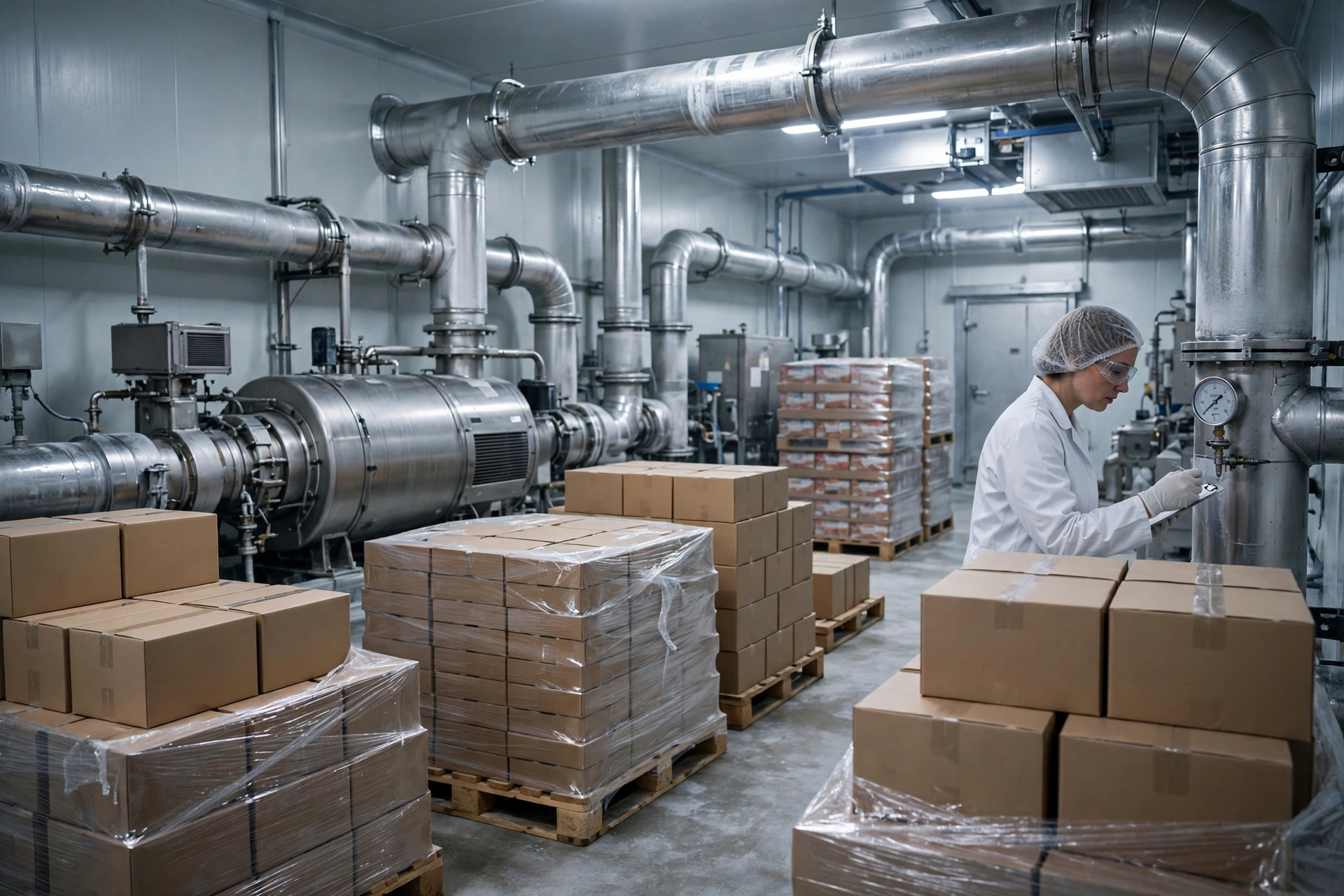
Refrigeration is the largest single backup load in most food plants, typically 40–60% of the total. Compressors, condensers, evaporator fans, blast freezers and chilled-water pumps run around the clock, and they restart hard. A refrigeration compressor draws four to seven times its running current at start-up, and a cold store that has been without power for an hour needs every compressor back at once, not one at a time.
The cold chain also never sleeps. A dairy silo, a meat chiller and a frozen-food store all hold product overnight, at weekends and through holidays. The generator is not protecting a working day. It is protecting stock that is worth more than the building it sits in.
Production lines and process equipment
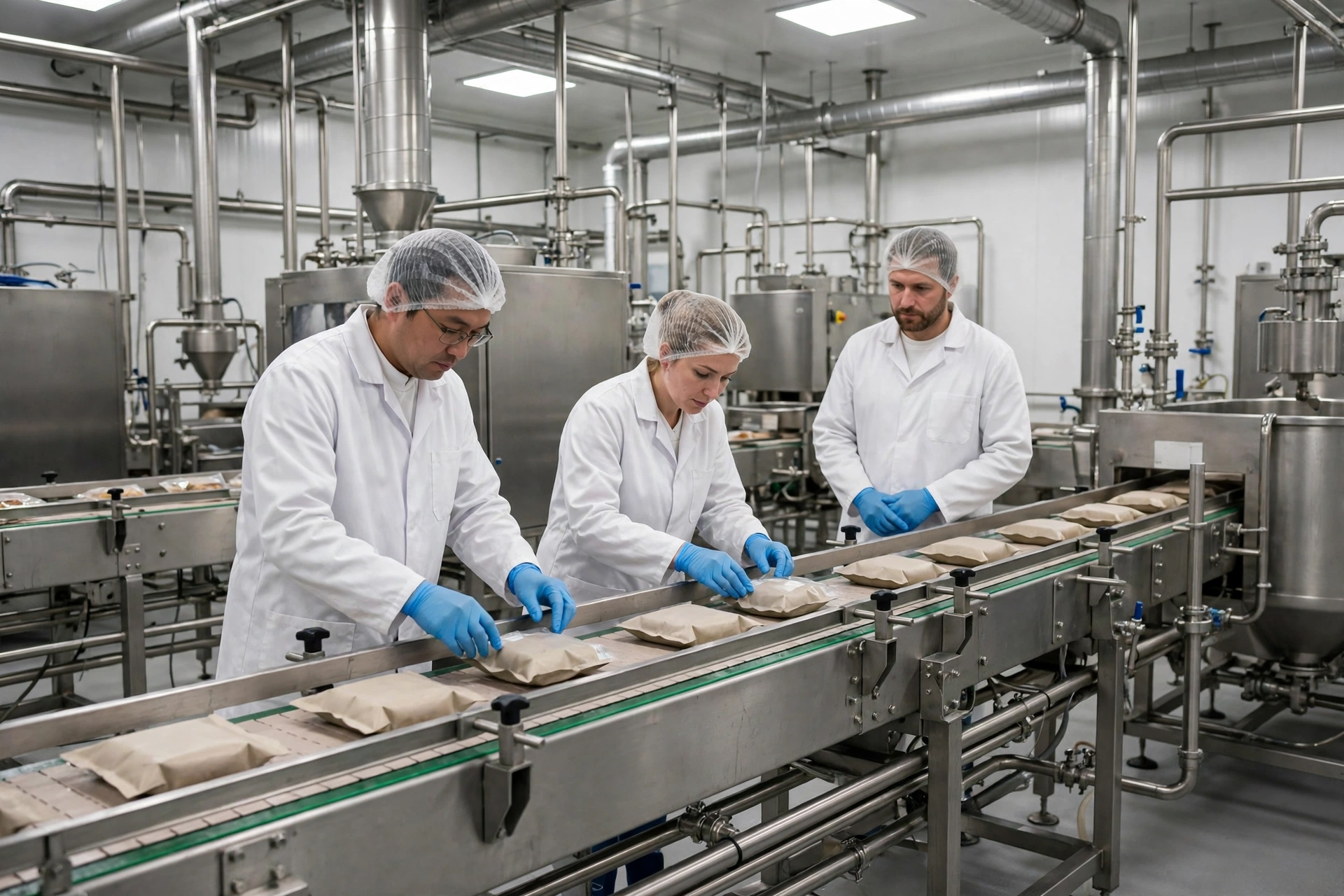
Mixers, conveyors, slicers, fillers, ovens, pasteurisers and packaging machines make up the second tier. A line stopped mid-batch does not pause. Dough over-proofs, a pasteuriser loses its temperature profile, a filler leaves half-sealed packs on the belt. The batch is scrapped, the line is cleaned, and the shift is lost.
Some process loads cannot be dropped at all. A spray dryer in a milk-powder plant, a retort in a canning line and a continuous oven in a bakery all need controlled shutdown, not a sudden stop. The generator has to carry them long enough for the batch to finish or for the line to shut down in sequence.
Steam, compressed air and water
Boilers, air compressors and water pumps are easy to forget and expensive to lose. A gas or oil boiler still needs electricity for its fans, feed pumps and controls. Pneumatic valves, carton erectors and bag sealers stop the moment compressed air drops. Washdown water, clean-in-place (CIP) systems and effluent pumps all need power, and a plant that cannot clean cannot restart.
Traceability, IT and offices
Programmable logic controllers, SCADA servers, label printers, temperature loggers and the enterprise resource planning system are small loads with outsized consequences. If the plant loses power and the system cannot record a critical tracking event — raw milk transferred into a pasteurisation vessel, milk powder moved from a spray dryer to a silo — the product may have to be discarded, even if it is physically fine. The traceability record is part of the product.
These loads are also the reason the transfer gap matters. An automatic transfer switch typically restores generator power within 10 seconds, but a PLC and a server cannot ride through even that gap. A small UPS holds the controls and the loggers while the generator starts, and the generator takes over from there.
Sizing the Set: Load Bands by Plant Type
Sizing starts with a load list, not a floor area. Every motor on the essential board is listed with its running kW, its starting current and its duty. The list is then reduced by a demand factor, because not every load runs at once, and converted from kW to kVA at the site power factor, usually 0.8.
| Plant type | Typical backup load | Generator frame |
|---|---|---|
| Artisan bakery | 60–120 kW | 100–250 kVA |
| Dairy processing, pasteurising and bottling | 150–400 kW | 250–500 kVA |
| Meat and poultry processing | 300–800 kW | 400–1,250 kVA |
| Frozen foods and ice cream | 400–1,200 kW | 500–2,000 kVA |
| Beverages and bottling | 200–600 kW | 300–1,000 kVA |
| Ready meals, sauces and canning | 150–500 kW | 250–800 kVA |
The worked example shows the arithmetic. A chilled-food plant lists 800 kW of connected load. A demand factor of 0.8 brings the working load to 640 kW. At a power factor of 0.8, the apparent load is 800 kVA, so an 800 kVA frame fits with no margin to spare. Add 10–25% for future load and derating, and the order becomes a 1,000 kVA or 1,250 kVA frame. The same load list also sizes the transfer switch and the cables, so one calculation feeds the whole installation.
The generator sizing guide covers the full method, including demand factors and power factor correction. Two rules from it apply to every food plant. First, never size from the headline kVA alone. Second, never size from the connected load without a demand factor, or the set will be oversized, run below 30% load for long periods, and develop wet stacking.
Motor starting: the surge that sizes the alternator
Refrigeration compressors and large mixers set the alternator size, not the running load. A 75 kW compressor starting direct-on-line can demand 300–525 kVA for a few seconds. Two compressors starting together double that figure. The alternator has to hold voltage through the surge, or the contactors drop out and the compressors trip in sequence.
Three measures keep the surge manageable. Staggered restart brings compressors back one at a time, with a 10–30 second delay between starts. Soft starters and variable-speed drives cut locked-rotor current to 2–3 times running current. And the alternator is specified with enough subtransient reactance margin to hold voltage dip inside the ISO 8528 G2 limits the plant’s controls can tolerate. The motor starting guide covers the methods and the maths in detail.
Rating matters as much as size. Most food plants with a reliable grid buy a standby-rated set, limited to 200 hours a year under ISO 8528. A plant in a region with an unreliable grid, running the set 8–12 hours a day, is on prime duty, and a standby-rated set will wear out early. The standby and prime power ratings article explains the difference and the cost of getting it wrong.
Cold Chain: The Four Hours That Decide the Batch
The cold chain has a clock, and the US Food and Drug Administration has published it. A refrigerator keeps food cold for about 4 hours if the door stays closed. A full freezer holds temperature for about 48 hours, a half-full freezer for about 24 hours. Perishable food held above 40°F (4°C) for 2 hours or more should be discarded. The danger zone for bacterial growth runs from 40°F to 140°F (4°C to 60°C), and bacteria in that range can double in as little as 20 minutes.
Those are household figures. A plant cold store behaves worse in the ways that matter and better in the ways that do not. Doors open for forklifts, warm product arrives from the production floor, and a 10,000 m³ cold store holds far more thermal mass than a domestic fridge — but it also has far more air exchange. The four-hour window is the planning figure. A plant that cannot restore refrigeration within four hours should assume the batch is lost.
| Storage | Safe window without power | Discard rule |
|---|---|---|
| Refrigerator, door closed | About 4 hours | Perishables above 40°F / 4°C for 2 hours or more |
| Freezer, full, door closed | About 48 hours | Food above 40°F / 4°C or without ice crystals |
| Freezer, half full, door closed | About 24 hours | Same 2-hour rule once thawed |
| Blast freezer, −25°C | 6–12 hours to reach −18°C limit | Product above −18°C is out of specification |
The cost of missing the window is the reason cold storage backup power exists. ABB puts the cost of a power interruption in a food and beverage plant at $100,000 to $1 million per hour. A 2022 industry analysis put annual US cold-chain losses from temperature spoilage above $50 billion, with $12 billion attributable to power interruption. A single temperature excursion in a mid-sized freezer typically destroys $50,000–$500,000 of inventory.
What a temperature excursion costs
| Cost item | Typical figure |
|---|---|
| Direct product loss, 120 pallets at $4,200 each | $504,000 |
| Emergency disposal | $18,000 |
| Cleanup labour | $6,000 |
| Mandatory recall, if product entered commerce | Above $2,000,000 |
| Audit finding, HACCP / FSMA / SQF | Corrective action, possible loss of certification |
| Insurance claim | Paid only with documented backup-power readiness |
The last two rows are the ones plant managers underestimate. A temperature excursion is not only a product loss. It is a documented break in the food-safety system. HACCP, FSMA and SQF auditors demand evidence that backup power was ready and that temperature was logged continuously. Cargo insurers increasingly require proof of NFPA 110 compliance before paying a spoilage claim. A generator that was never tested under load is not evidence. A load-bank test record is.
The downstream risk is visible in the supermarket cold chain, where the same four-hour rule applies to retail chillers and freezers. A plant that ships warm product does not only lose its own stock. It puts its customer’s stock at risk, and the recall follows the shipment, not the outage.
Three Plants, Three Outages
Case 1: Dairy plant, Nakuru, Kenya — 600 kVA, nine hours, 22,000 litres of milk
A dairy processor outside Nakuru takes in 90,000 litres of raw milk a day from 400 smallholder farmers, pasteurises 10,000 litres an hour and holds raw milk in three 30,000-litre silos at 4°C. The grid in the region fails several times a month, usually for two to four hours. The plant runs a 600 kVA standby set with a 1,200-litre sub-base tank and a 5,000-litre bulk tank.
One evening the grid failed at 19:40, during intake. The set started in 9 seconds and took the silo cooling, the pasteuriser controls and the CIP pumps in three steps. It ran for nine hours at an average of 62% load, burning about 85 litres an hour — 765 litres in total. The milk never rose above 4°C. At the farm-gate price of roughly $0.55 a litre, the 22,000 litres in the silos represented about $12,100 of raw material, before processing value. Without the set, the milk would have crossed 4°C within two hours and the whole intake would have been condemned.
The plant’s lesson was about fuel, not the engine. The bulk tank held enough for 58 hours at that load, and the supplier delivers within 12 hours of a call. The set itself had never failed a monthly load test. The only incident in three years was a flat starting battery, found during a test, not during an outage.
Case 2: Meat processing plant, Cavite, Philippines — 1,250 kVA, thirty-one hours, one typhoon
A meat processor in Cavite runs a slaughter line, a cutting floor and a −25°C blast freezer, with 18 tonnes of pork in chillers on a normal day. The site’s 1,250 kVA set is prime-rated, because the grid in the industrial park is unreliable enough that the plant runs it 400–600 hours a year. The bulk tank holds 5,000 litres.
A typhoon took the grid out for 31 hours. The set carried the full load at 72% average, burning about 165 litres an hour. At hour 20 the tank was down to 1,700 litres, and the plant called its fuel supplier. A 3,000-litre tanker arrived at hour 24, while roads were still passable, and the set ran through the night without stopping. Total fuel burned: 5,115 litres.
The plant lost nothing. The two details that saved it were a fuel contract signed before the storm season and a delivery arranged while roads were open, not after they closed. A second detail mattered: the set had been load-bank tested to 100% for two hours in May, six weeks before the typhoon, so the maintenance team knew it would hold full load.
Case 3: Frozen-food plant, Łódź, Poland — 2,000 kVA, a heatwave, 120 pallets at risk
A frozen-food plant near Łódź runs an 8,000 m² cold store at −22°C and a packaging hall with six lines. Its 2,000 kVA set backs up the refrigeration plant, the packaging hall and the dispatch dock. A summer heatwave pushed ambient temperature to 36°C and the grid failed at 14:10, at the peak of the afternoon shift.
The set started in 8 seconds and took load in three steps: refrigeration first, then the packaging hall, then the dock. It ran at 68% load, burning about 265 litres an hour from a 10,000-litre bulk tank. The cold store never rose above −20°C. The 120 pallets in the store, valued at about $4,200 each, represented $504,000 of stock. The outage lasted 11 hours.
The plant’s engineers noted two things afterwards. First, the set’s radiator had to work against 36°C ambient air, and the alternator was derated by about 6% — the margin built into the 2,000 kVA frame absorbed it. Second, the temperature loggers recorded the whole event, minute by minute, so the next SQF audit had a complete record. The generator did not only save the product. It produced the evidence that the product was safe.
Fuel Autonomy: How Long the Plant Can Actually Run
A generator runs for as long as its fuel lasts. The tank, not the engine, sets the limit, and the table below shows what the numbers look like at 75% load, the point most food plants actually run at.
| Generator frame | Fuel use at 75% load | 8 hours | 24 hours | 72 hours |
|---|---|---|---|---|
| 250 kVA | About 35 L/h | 280 L | 840 L | 2,520 L |
| 500 kVA | About 70 L/h | 560 L | 1,680 L | 5,040 L |
| 800 kVA | About 105 L/h | 840 L | 2,520 L | 7,560 L |
| 1,250 kVA | About 165 L/h | 1,320 L | 3,960 L | 11,880 L |
| 2,000 kVA | About 265 L/h | 2,120 L | 6,360 L | 19,080 L |
The Cummins C500D5 illustrates the same point from the datasheet: 500 kVA standby, 455 kVA prime, burning 93.2 L/h at full prime load. At 75% load that falls to about 70 L/h. A 645-litre sub-base tank gives about nine hours at that load. A plant that wants 72 hours of autonomy needs a bulk tank of about 5,000 litres for a 500 kVA set, and about 12,000 litres for a 1,250 kVA set.
Three rules govern the fuel side. First, size the tank for the longest outage the plant has actually seen, then add a margin — 72 hours is the common standard for food plants, because a storm or a grid failure rarely respects a 24-hour plan. Second, hold a delivery contract with a supplier who can reach the site during the same event that caused the outage. Third, keep the fuel clean. About 38% of generator failures in standby service trace back to fuel degradation, not to mechanical faults, and diesel fuel ageing — water, microbes and sludge in a tank that sits for months — is the usual cause. Fuel polishing and a six-monthly test are cheaper than a failed start.
The generator maintenance schedule covers service intervals by hours and calendar, including fuel testing. A standby set that runs 40 hours a year still needs its fuel tested, its batteries checked and its coolant changed on the calendar, not on the hour meter.
Hygiene, Noise and Placement: Where the Generator Goes
A generator at a food plant sits outside the hygiene zones, and it has to stay there. The set is normally installed on a concrete plinth at the service yard, at least 5 metres from the building, with the exhaust stack and the radiator discharge pointed away from air intakes, open doors and loading docks. Exhaust fumes near a fresh-air intake are a contamination risk and an audit finding, not a cosmetic issue.
Drainage matters more than it looks. Washdown water, rain and a fuel spill all end up in the same yard. The plinth needs a fall to a drain, and the fuel tank needs secondary containment — a bund holding 110% of the tank volume. A 5,000-litre bulk tank needs a 5,500-litre bund. Delivery tankers need access to the tank without crossing pedestrian routes or blocking the dispatch dock.
Noise is a planning condition, not an afterthought. A silent-canopy set typically measures 70–75 dB(A) at 7 metres. That is acceptable in an industrial yard in the daytime and often not acceptable at night near housing. Local limits vary, and a plant that runs its set at 02:00 during a long outage needs to know the night limit before the outage, not after a complaint. An acoustic enclosure, a longer exhaust silencer and a barrier wall each buy a few decibels, and the cheapest time to add them is at installation.
Vibration and access complete the list. Anti-vibration mounts and a flexible exhaust connector keep vibration out of the building slab. Service access needs a clear 1 metre around the set, and the canopy doors must open fully — a set that cannot be serviced without a forklift will not be serviced.
Frequently Asked Questions
What size generator for a food processing plant?
Most food processing plants need 250 kVA to 2,000 kVA. A bakery or small dairy sits at the lower end, a meat or frozen-food plant at the upper end. The correct figure comes from a load list with starting currents, reduced by a demand factor and converted at a 0.8 power factor — refrigeration compressors, not lighting, set the size.
Do food processing plants need a backup generator?
Yes, unless the plant can afford to lose its cold chain and its batch. A power interruption in a food and beverage plant costs an estimated $100,000 to $1 million per hour, and a single temperature excursion typically destroys $50,000–$500,000 of stock. HACCP, FSMA and SQF audits also expect documented backup-power readiness.
How long can a food processing plant run on a generator?
As long as its fuel lasts, within the set’s rating. A standby-rated set is limited to 200 hours a year under ISO 8528, while a prime-rated set has no annual hour limit. Most food plants plan for 72 hours of fuel autonomy — about 5,000 litres for a 500 kVA set at 75% load — and hold a delivery contract for longer outages.
What happens to food in a processing plant during a power outage?
Refrigerated food stays safe for about 4 hours if the cold store stays closed, and a full freezer holds for about 48 hours. Perishable food held above 40°F (4°C) for 2 hours or more must be discarded, and any batch without a continuous temperature record may have to be condemned even if it looks and smells fine. The recall follows the shipment, not the outage.
Can a diesel generator power a food processing plant?
Yes. Diesel sets from 250 kVA to 2,000 kVA cover the full range of food plants, from artisan bakeries to frozen-food factories. The set needs an automatic transfer switch for a 10-second transfer, staggered compressor restart to manage the starting surge, and a fuel tank sized for the longest outage the plant expects.
Specification Checklist Before You Order
- Load list with running kW and starting current for every motor on the essential board, including refrigeration compressors
- Demand factor applied, power factor 0.8 assumed, frame selected with 10–25% growth margin
- Rating stated on the quotation: standby (ESP, 200 hours/year) or prime (PRP, unlimited hours)
- Automatic transfer switch specified for a 10-second transfer, with a UPS for PLCs, servers and temperature loggers
- Staggered restart or soft starters for refrigeration compressors, voltage dip inside ISO 8528 G2 limits
- Fuel autonomy 72 hours at 75% load, bunded bulk tank at 110% of tank volume, delivery contract signed
- Fuel polishing and six-monthly fuel testing in the maintenance plan
- Noise limit confirmed for day and night, exhaust and radiator discharge away from air intakes and loading docks
- Remote monitoring — Deep Sea or Smartgen controller with alerts — so the set can be watched from anywhere
- Factory acceptance test on a load bank to 100% for at least two hours, with the report filed before the balance is paid
- Service contract and critical spares — filters, belts, battery, AVR — held on site or within 24 hours
- Warranty terms in writing, including what voids a claim and what the service interval is in hours and months
A food processing plant buys a generator once and depends on it for a decade. The set that saves the batch is the one that was sized from a load list, tested under load, fuelled for three days and started on the first attempt. To size a set for a specific plant, with the load list and the fuel autonomy the site needs, contact PAVO — the engineering team will work from the plant’s own loads, not from a catalogue page.