

What Size Generator Does a Car Factory Need? | PAVO
A car plant does not stop the way other factories stop. A line running at one car a minute cannot be paused and resumed. When the power fails, the robots freeze mid-weld, the bodies sit half-painted in the ovens, and the press line stops with a tonne of steel halfway through a die. The generator is what decides whether that is a ten-second interruption or a week of scrapped cars.
What size generator does a car factory need? A tier-1 supplier plant needs 500–1,000 kVA for its essential board, a mid-size assembly plant needs 1,500–2,500 kVA, and a full assembly plant with its own paint shop needs 3,000–5,000 kVA or several sets in parallel. The set powers the essential board, not the whole plant.
Contents
- Why a Car Plant Is Not Like Any Other Load
- What the Generator Actually Has to Carry
- Sizing the Set: What Size Generator Does a Car Factory Need?
- The First 10 Seconds and the Next 10 Minutes
- The Paint Shop and the Robot Line: Where an Outage Does Its Damage
- Three Plants That Learned the Hard Way
- Frequently Asked Questions
- Specification Checklist: Before You Sign the Order
Why a Car Plant Is Not Like Any Other Load
Most factories lose an hour of production when the grid fails. A car plant loses the cars that were on the line, the shift’s production plan, and — if the outage hits the paint shop — a batch of bodies that can never be finished to specification. The difference is that a car plant is a continuous, timed process running at one vehicle a minute, with almost no buffer stock anywhere in the building. There is no warehouse of half-finished cars to draw on while the line restarts. There is no way to finish a weld that was interrupted halfway through, or to cure a coat of paint that dried at the wrong temperature. The work in progress at the moment of failure is, in most cases, scrap.
The money explains why the sector treats backup power as a production system rather than a facilities afterthought. A 2006 survey of 101 automotive manufacturing executives by Advanced Technology Services put the average cost of a minute of downtime at $22,000, with some plants reporting $50,000 a minute. Siemens and Senseye’s *True Cost of Downtime 2024*, based on 181 interviews with maintenance, engineering and IT professionals, put the cost of an hour’s downtime in automotive at $2.3 million — more than $600 a second — and the annual cost of downtime at a large automotive plant at $695 million. Those figures count lost production. They do not count the bodies scrapped in the paint shop, the robots that have to be recalibrated, the supplier penalties for missed just-in-time deliveries, or the overtime needed to recover a lost shift. In a car plant, the cost curve is not linear. The first ten seconds are free. The first ten minutes are expensive. The first day is a different order of magnitude, because by then the plant is not restarting — it is recovering.
The second fact is that a car plant’s electrical load is not one load. It is four loads that happen to share a switchboard. There is the safety load, which must never stop. There is the process load — the paint shop, the robots, the presses — which decides whether the plant rides through or shuts down in an orderly way. There is the utilities load — compressed air, chilled water, ventilation — without which nothing restarts. And there is the general load — offices, workshops, non-essential lighting — which can be dropped without consequence. A generator sized for the whole plant is a generator nobody can afford and nobody needs. A generator sized for the essential board is a generator that earns its keep in the first outage.
The third fact is the power quality problem. A modern car plant is full of loads that a diesel generator finds difficult: hundreds of robot servo drives, variable-speed drives on fans and pumps, resistance welding transformers that draw enormous current in short bursts, and DC rectifiers for the electro-coat line. These loads distort the waveform, pull the voltage around and demand current in spikes. A generator that is sized only on running kilowatts will look adequate on paper and fail on the day it matters, because the voltage dip on the first robot start trips the drives, and the drives drop the line. The sizing work for a car plant is a power-quality exercise as much as a capacity exercise.
The fourth fact is the timing. A car plant runs on just-in-time delivery. Parts arrive hours before they are fitted, not days. A line stop of four hours does not just cost four hours of production — it stops the supplier’s trucks, fills the supplier’s yard, and forces the plant to reschedule a production programme that was set weeks in advance. Recovery is slow. Siemens and Senseye found that the average time to get production back up after an unplanned stop has risen from 49 minutes five years ago to 81 minutes today, as plants have become more automated and more interdependent. The generator’s job is not to keep the whole plant running. Its job is to keep the stop short, controlled and recoverable.
What the Generator Actually Has to Carry
The essential board of a car plant is built in tiers, and the tiers decide the generator size, the transfer scheme and the fuel autonomy. A tier that is left off the board is a tier that fails in the first outage. The tiers below are the ones used in practice on supplier plants and assembly plants from 500 kVA to 5,000 kVA.
Tier 1 — Safety and controlled stop: the loads that must never fail
Emergency lighting, the fire alarm and detection system, the paint shop fire suppression system, the control room UPS, the safety instrumented system on the paint ovens and the emergency ventilation all sit in Tier 1. These loads are small — typically 50–200 kW on a mid-size plant — but they are non-negotiable. The paint shop is the reason. A paint oven running at 180°C with a body inside it, solvent vapour in the booths and a ventilation system that has just stopped is a fire risk within minutes. The suppression system, the gas detection and the emergency ventilation must have power while the oven cools, and they must have it from the first second. A generator that takes 30 seconds to accept load is a generator that has already failed Tier 1, even if it starts perfectly. The standard for these systems under NFPA 110 Level 1 is a 10-second start, and the UPS bridges that gap.
Tier 2 — Process continuity: the paint shop, the robots and the presses
The paint shop ovens and booths, the body shop robots and welding equipment, the press line drives, the electro-coat rectifiers and the chilled water plant sit in Tier 2. These are the loads that decide whether the plant rides through the outage or shuts down in a controlled way — and whether the work in progress survives. A modern body shop runs 500–1,000 robots, each drawing 5–15 kW through its servo drives. A resistance spot-welding gun draws 100–200 kVA in a burst of a few hundred milliseconds, and a body shop fires dozens of guns in sequence. A transfer press line runs a main motor of 200–500 kW. The paint shop is the single largest energy consumer in most car plants, typically a third or more of total site energy, and its ovens, booths, air handling and e-coat rectifiers are the largest single block of load on the essential board.
Tier 2 is where the sizing work happens, and it is also where most sizing mistakes happen. The loads are large, they start with a surge, and they are sensitive to voltage and frequency in a way that a pump or a fan is not. A robot servo drive that sees a voltage dip below its threshold trips offline, and a tripped robot stops the line even if the generator is running perfectly. The motor starting guide covers the starting methods in detail; the rule for a car plant is simple — the generator is sized for the largest motor start plus the running load already on the board, and then checked against the voltage dip the drives will tolerate, never against running load alone.
Tier 3 — Restart and utilities: the loads that decide how fast the plant comes back
Compressed air, chilled water, cooling towers, the water treatment plant, the paint shop air handling units, the IT and manufacturing execution system servers and the lighting over the line sit in Tier 3. None of these loads is dramatic on its own. Together they decide the restart. A press line cannot restart without compressed air. A paint shop cannot restart without chilled water and air handling. The robots cannot restart without the servers that hold their programmes and the network that coordinates them. A plant that protects Tier 1 and Tier 2 but leaves Tier 3 off the essential board will restart slowly, in the wrong order, with the line waiting on air and water while the generator runs at quarter load. Tier 3 is usually 200–800 kW on a mid-size plant, and it is the cheapest capacity on the board — which is why leaving it off is the most expensive mistake in the specification.
Sizing the Set: What Size Generator Does a Car Factory Need?
Sizing starts with a load list, not a catalogue. The load list records every load on the essential board, its running kW, its starting method and its starting kVA. The generator is then sized for the running load plus the largest single starting transient, with a 15–20% margin for load growth and for the voltage dip limit. The generator sizing guide covers the full method; the table below gives the bands that experienced buyers use as a first check.
| Plant type | Total site load | Essential board | Typical set | Fuel at 75% load |
|---|---|---|---|---|
| Tier-1 stamping / welding supplier, 200 staff | 2–4 MVA | 500–800 kVA | 1 × 1,000 kVA | ~126 L/h |
| Engine / transmission plant, 800 staff | 10–20 MVA | 1,000–2,000 kVA | 2 × 1,000 kVA | ~252 L/h |
| Mid-size assembly plant, 1,500 staff | 15–25 MVA | 1,500–2,500 kVA | 2 × 1,250 kVA | ~315 L/h |
| Full assembly with paint shop, 3,000+ staff | 30–50 MVA | 3,000–5,000 kVA | 2–3 × 2,000 kVA, 11 kV | ~630 L/h |
Fuel figures use the standard rule of thumb of 0.21 litres per kWh generated. A 1,000 kVA set (800 kW) at 75% load produces 600 kW and burns about 126 L/h. A 2,500 kVA set (2,000 kW) at 75% load burns about 315 L/h. A 5,000 kVA set (4,000 kW) at 75% load burns about 630 L/h. The Cummins C500D5 datasheet gives a measured figure for the same frame: 500 kVA standby / 455 kVA prime, 93.2 L/h at prime full load. Real consumption is always lower than the catalogue figure at part load, and always higher than the buyer hoped at full load. Size the tank on the measured figure, not the brochure figure.
The rating matters as much as the size. A car plant’s generator is a standby set in the strict sense of the standby and prime power ratings — it runs for hours a year, not hundreds, and it is rated to ISO 8528 for a standby duty of 200 hours a year on average. The trap is the buyer who sizes on the standby rating and then runs the set for a three-day outage at full standby load. The standby rating allows a 10% overload for one hour in twelve; it does not allow continuous running at nameplate. A plant that expects multi-day outages should size on the prime rating, or buy a larger standby set and run it at 70–80% of nameplate. The difference is a set that lasts twenty years and a set that needs a rebuild after its first real outage.
A worked example makes the method concrete. A tier-1 stamping and welding supplier in Thailand runs a 3 MVA total load across two press lines and a body welding shop. Its essential board carries one 160 kW press main motor, four 37 kW press feed motors, 120 kW of robot servo drives, 90 kW of welding transformers on a diversified basis, 75 kW of compressed air, 60 kW of chilled water and 40 kW of safety systems and lighting — 640 kW of running load, or about 800 kVA at 0.8 power factor. The largest single start is the 160 kW press main motor, started direct-on-line at six times running current, about 1,200 kVA of starting demand for two seconds. Running load minus that motor plus the starting transient gives 800 − 200 + 1,200 = 1,800 kVA of transient demand. A 2,000 kVA set handles it with margin. A 1,000 kVA set does not — the voltage dip would trip the robot drives and drop the load it was bought to protect. The plant ordered the 2,000 kVA set. That is the arithmetic that decides whether a generator works on the day it matters.
How long the set can run
Fuel autonomy is the second half of the sizing question, and it is the half most buyers get wrong. A 1,000 kVA set at 75% load burns 126 L/h, so 8 hours needs 1,000 litres, 24 hours needs 3,000 litres and 72 hours needs 9,000 litres. A 2,500 kVA set at 75% load burns 315 L/h, so 72 hours needs 22,700 litres — a bulk tank, a transfer pump and a refuelling plan that works when the roads are closed. The sub-base tank under the set holds 8–12 hours at most. Everything beyond that is a bulk tank, and a bulk tank is a separate project with its own bund, its own permits and its own diesel fuel ageing problem: fuel that sits for a year grows water and microbes, and a generator that starts perfectly on bad fuel stops within the hour. A plant that buys a 72-hour tank and never polishes the fuel has bought a 72-hour tank of liability.
The honest answer to the autonomy question is that a car plant does not need to run for 72 hours on generator power. It needs to run long enough to shut down in a controlled way, protect the paint shop, and restart when the grid returns. For most plants that is 8–24 hours of fuel, with a refuelling contract for anything longer. The plants that genuinely need 72 hours are the ones in regions where the grid fails for days — and those plants buy prime-rated sets, bulk tanks and fuel contracts, not a bigger sub-base tank.
The First 10 Seconds and the Next 10 Minutes
The first ten seconds decide everything. The grid fails. The automatic transfer switch senses the loss, waits out its programmed delay — typically 3–5 seconds, long enough to ride through a voltage sag that is not a real outage — and then signals the generator to start. The engine cranks, reaches speed, builds voltage and frequency, and the transfer switch moves the essential board onto generator power. The whole sequence, on a well-maintained set, takes 8–10 seconds from grid failure to load acceptance. NFPA 110 Level 1 demands it within 10 seconds, and a car plant’s safety systems are built around that number.
The ten seconds are bridged by the UPS. The control systems, the PLCs, the robot controllers and the servers run on UPS power for those seconds, and the UPS is sized in minutes, not hours — typically 10–15 minutes at full load. The UPS is not there to keep the plant running. It is there to keep the control systems alive while the generator starts, and to give the plant a controlled shutdown if the generator fails to start. A plant whose UPS batteries are five years old and never load-tested will discover the fact in the first outage, when the PLCs drop before the generator has cranked.
The next ten minutes are about sequencing. A generator that takes the whole essential board in one step will see every motor start at once, and the voltage will collapse. The transfer scheme has to bring loads on in steps: Tier 1 first, then the air and water, then the paint shop, then the robots and presses, with a delay of 5–10 seconds between steps. The sequencing is programmed into the transfer switch or the plant’s load-shedding controller, and it is tested on the monthly test run — or it is not tested at all, and the first real outage is the first test. The monthly test is the difference between a transfer scheme and a hope. The maintenance schedule for a car plant set includes a monthly load test, an annual full-load test and a battery replacement programme, and the test is run on load, not on no-load, because a no-load test proves the engine starts and nothing else.
The robot problem is the reason the ten minutes matter more than the ten seconds. A robot that loses control power does not just stop. It loses its position, drops whatever it was holding, and has to be re-taught and recalibrated before it can run again. At Tesla’s Fremont plant, Active Power’s flywheel UPS installation — 2 × 2.4 MW of kinetic energy storage, giving 20 seconds of ride-through at full load — was justified on exactly this arithmetic: without ride-through, resetting and recalibrating the robots after a loss of control power took 26–28 hours. With 20 seconds of flywheel power, the robots ride through 99.9% of recorded outages and production resumes in hours instead of a day. A diesel generator cannot do that job on its own, because it needs ten seconds to start. The flywheel or the battery UPS covers the seconds; the generator covers the hours. A car plant that buys a generator without a ride-through system for its robots has bought half a solution.
The Paint Shop and the Robot Line: Where an Outage Does Its Damage
A car plant’s outage damage is not spread evenly across the building. It concentrates in two places: the paint shop and the robot line. Every other department loses time. These two lose product, and in the paint shop’s case, they lose product that cannot be remade.
| Process | Safe window after power loss | What happens when the window closes |
|---|---|---|
| E-coat dip tank | Minutes | Bodies soaking in the bath over-dip; coating thickness goes out of specification |
| Paint oven, body inside | 10–15 minutes | Oven cools below cure temperature; coating cures soft or not at all |
| Spray booth, body half-coated | Minutes | Flash-off interrupted; basecoat dries unevenly and will not take clearcoat |
| Robot welding, joint half-made | Seconds | Spot weld incomplete; joint must be cut out and remade, or the body is scrapped |
| Press line, steel in the die | Minutes | Coil strip stops mid-feed; die must be cleared by hand before restart |
| Compressed air system | 15–30 minutes | Receiver pressure falls; every pneumatic tool and clamp on the line stops |
| Chilled water / cooling | 30–60 minutes | Paint booth temperature drifts; robot servo drives overheat and trip |
The paint shop: the ten minutes that decide the batch
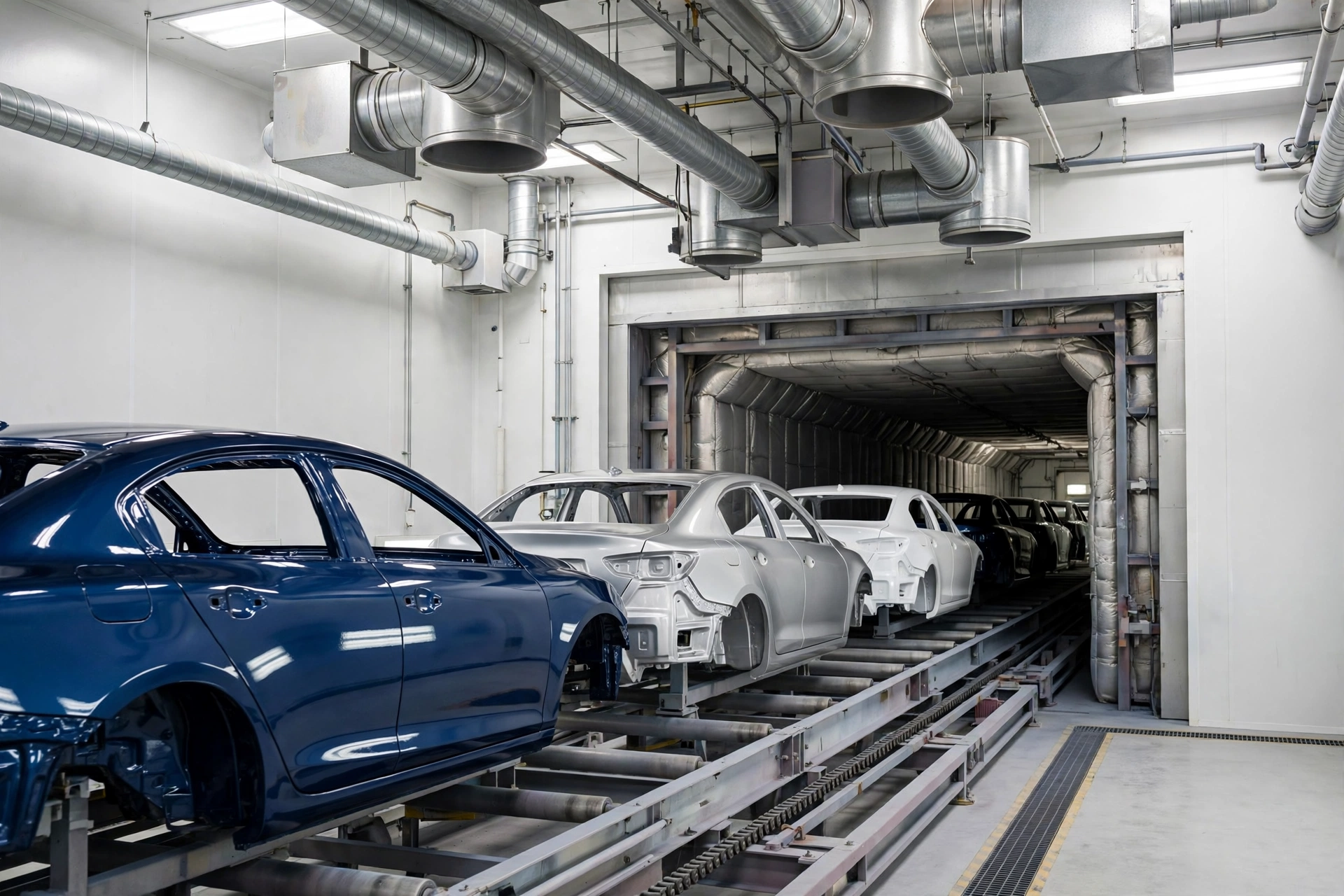
The paint shop is a timed chemical process, not a production line that happens to use paint. A body moves through pretreatment dips, an electro-coat bath, a primer oven, a basecoat booth and a clearcoat oven, with the temperature and humidity at each stage controlled to within a few degrees. The e-coat oven cures at around 180°C; the topcoat ovens run at 140–160°C. The process is closely timed, and the paint only adheres to the metal if the temperature profile is right from start to finish. A power cut in the middle of that profile does not delay the cure. It ruins it.
The damage happens in three ways. First, bodies left in the ovens cool below cure temperature, and the coating cures soft, with poor adhesion and poor gloss. The body has to be stripped and repainted, or scrapped. Second, bodies left soaking in the e-coat bath or the pretreatment chemicals over-dip, and the coating thickness goes out of specification — the metal is damaged by the chemicals it was only supposed to touch for minutes. Third, bodies left half-sprayed in the booths dry unevenly, and the basecoat will not take a clearcoat. The August 2003 blackout showed all three at once: bodies left half-painted, parts soaking in chemicals that damaged the metal, and paint shops taking the biggest hit of any department in the plant.
The generator’s job in the paint shop is not to keep the shop running. It is to keep the shop safe and to save what can be saved. That means power for the oven ventilation and the fire suppression system while the ovens cool, power for the booth air handling so solvent vapour does not accumulate, and power for the e-coat rectifiers and the tank circulation pumps so the bath does not settle and stratify. A paint shop that loses power with no generator at all is a paint shop that needs days to clean, re-qualify and restart. A paint shop with a generator sized for its essential board is a paint shop that restarts in hours.
The robot line: position, power quality and the restart
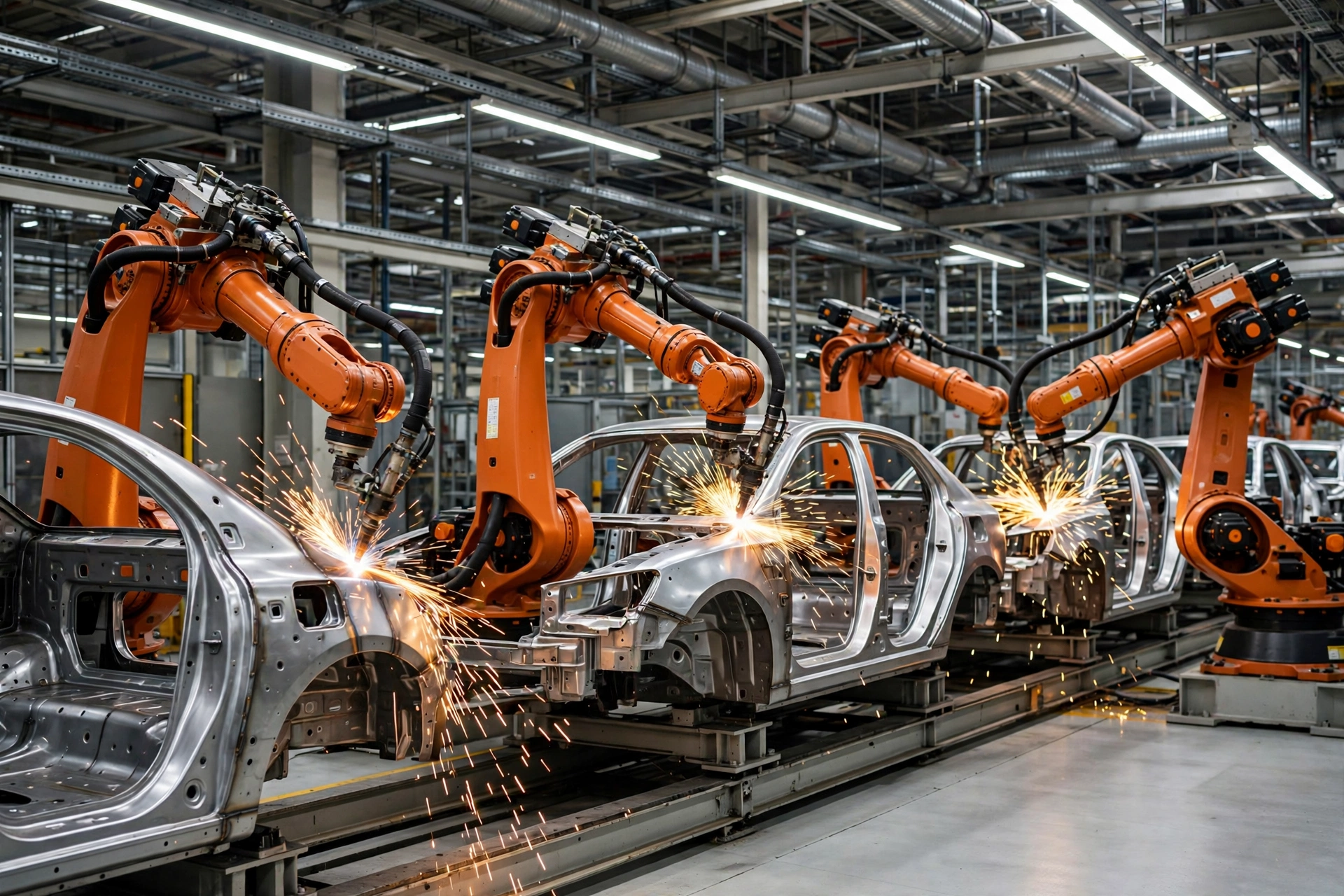
A modern body shop is a robot shop. Hundreds of six-axis robots weld, handle and seal, coordinated by a network of PLCs and a manufacturing execution system that tracks every body. Each robot draws 5–15 kW through its servo drives, and the drives are the sensitive point. A servo drive that sees a voltage dip below its threshold trips offline. A tripped drive drops the robot, and a dropped robot stops the line — even if the generator is running and the lights are on.
The power quality problem has three parts. The first is voltage dip on motor starting: a press motor or a large fan starting direct-on-line pulls the voltage down for a second or two, and the drives trip. The second is harmonics and power quality: the servo drives, the variable-speed drives and the e-coat rectifiers are non-linear loads that distort the generator’s waveform, and a distorted waveform overheats alternator windings and confuses the voltage regulator. The third is frequency: a generator that is loaded suddenly slows down, the frequency dips, and the drives and the PLCs see a frequency they were not designed for. ISO 8528 classes G2 and G3 exist for exactly this reason — G2 for loads that tolerate moderate voltage and frequency variation, G3 for loads that need tight control. Robot lines and paint shop controls belong on G2 as a minimum, and G3 where the drives are sensitive. A set bought to G1 — the class for general-purpose loads like lighting and heating — will run a car plant’s essential board and trip its robots.
The practical fixes are the same ones that work in every industrial plant, and they are cheaper than a bigger generator. Sequence the motor starts so the largest start never coincides with the robot load. Fit soft starters or variable-speed drives to the large fans and pumps. Oversize the alternator relative to the engine — a 2.5–3x alternator is the standard answer to a non-linear load — so the waveform stays clean when the drives pull current in spikes. And put the robot controllers and the PLCs on a UPS with enough runtime to ride through the transfer, so the drives never see the ten-second gap at all.
The press shop: tonnes of steel, seconds of warning
The press shop is the loudest and most honest department in the plant. A transfer press line runs a main motor of 200–500 kW, a flywheel the size of a small car, and a coil feed that moves steel through the dies at one stroke every few seconds. A power cut stops the press with steel in the die, and the die has to be cleared by hand before the line can restart — a job that takes 30–60 minutes even when nothing is damaged. A press that stops mid-stroke with a misfeed can damage the die, and a damaged die is a $50,000–$200,000 repair and a week of lost production.
The press shop’s generator load is the press motor start, and it is the largest single transient on the essential board. The motor is started direct-on-line in most plants, which means six times running current for two seconds, and the starting kVA is the number that sizes the generator. A plant that sizes its generator on the press shop’s running load and forgets the starting transient will find out in the first outage, when the voltage collapses and the transfer switch drops the board it was supposed to protect.
Three Plants That Learned the Hard Way
The 2003 Northeast blackout — 50 plants, 1,000 cars scrapped
The August 2003 blackout across the north-eastern United States and Canada hit more than 50 North American car plants in a single afternoon. Over 1,000 new vehicles and parts moving down production lines when the power went out were scrapped for quality reasons. Cars and trucks were left half-painted, in some cases soaking in chemicals. Robotic welding arms left joints only partially joined. Engines being shaped by precision laser tools were left incomplete. Parts were dropped on the floor when the vacuum-powered suction arms that lift and move them lost their hold.
Chrysler estimated it lost production of 10,000 vehicles during the outage, and an undisclosed part of that was cars, trucks and parts that had to be discarded. Ford and General Motors reported similar situations without releasing numbers. The plants could not simply flip a switch and finish the work when power returned. As Chrysler’s senior vice president of advanced manufacturing put it at the time, the post-blackout rule was: if you are in doubt, throw it away. The paint shops took the biggest hit, because the process is closely timed and the temperature and humidity tightly controlled — and a body that spent an hour in a cold oven or a chemical bath could not be trusted.
The lesson is not that every plant needs a generator big enough to run the whole line. No plant does. The lesson is that the plants with generators sized for their essential boards — the paint shop ventilation and suppression, the robot controllers on UPS, the compressed air — restarted in hours, and the plants without them restarted in days, after scrapping the work in progress and re-qualifying the paint shop.
Tesla Fremont — 20 seconds that saved 28 hours
Tesla’s Fremont plant in California runs one of the most automated body shops in the industry, with hundreds of robots on a production line that cannot tolerate an uncontrolled stop. A sudden loss of control power does not just stop the robots. It costs 26–28 hours to reset and recalibrate them — a full day of lost production for an outage that might last seconds.
The answer was not a bigger generator. It was a flywheel. Active Power installed 2 × 2.4 MW of CleanSource PLUS kinetic energy storage UPS, giving 20 seconds of runtime at full load. Twenty seconds is enough to ride through 99.9% of the unplanned outages recorded at the site, and it is enough for the robots to complete a controlled stop when the outage is longer. The flywheel covers the seconds; the generator, where one is installed, covers the hours. The case is the clearest proof in the industry that a generator and a ride-through system are two halves of one solution, and that the expensive part of an outage in a robot plant is not the power — it is the restart.
The Texas freeze, February 2021 — the grid that failed a whole state
In February 2021, Winter Storm Uri took ~34 GW of generation offline in Texas and left millions of homes and businesses without power for days. The car plants were not spared. Toyota’s San Antonio truck plant and General Motors’ Arlington assembly plant shut down for days, along with supplier plants across the state. The outage was not a ten-second transfer problem. It was a multi-day grid failure in freezing weather, with roads closed, fuel deliveries stopped and staff unable to reach the plant.
The plants that fared best were the ones whose generators were sized for multi-day running and whose fuel plans assumed the roads would be closed. A sub-base tank holds 8–12 hours. A plant that needs three days needs a bulk tank, a transfer pump and a fuel contract with a supplier that can deliver in a storm — or it needs to accept that the generator’s job is a controlled shutdown, not continued production. The Texas freeze is the case that separates the two philosophies: the plants that bought generators to keep running, and the plants that bought generators to shut down safely and restart fast. Both are legitimate. Only one of them needs 72 hours of fuel.
Frequently Asked Questions
What size generator does a car factory need?
A tier-1 supplier plant needs 500–1,000 kVA for its essential board, a mid-size assembly plant needs 1,500–2,500 kVA, and a full assembly plant with its own paint shop needs 3,000–5,000 kVA or several sets in parallel. The exact size comes from a load list — running load plus the largest motor start — not from the plant’s total connected load, which is 10–20 times larger.
Do car factories need a backup generator?
Yes, and the case is financial rather than regulatory. Automotive downtime costs an average of $22,000 a minute and $2.3 million an hour at a large plant, and a single outage can scrap more than 1,000 vehicles in the paint shop alone. A generator sized for the essential board — paint shop safety systems, robot controllers, compressed air and chilled water — typically pays for itself in the first serious outage.
How long can a car plant run on a generator?
On the sub-base tank under the set, 8–12 hours. On a bulk tank, 24–72 hours, depending on tank size — a 2,500 kVA set at 75% load burns about 315 L/h, so 72 hours needs 22,700 litres. In practice most plants plan for 8–24 hours of generator running, long enough for a controlled shutdown and a fast restart, with a fuel contract for anything longer.
What happens to a car factory during a power outage?
The robots freeze mid-weld and lose their position, the press line stops with steel in the die, and the paint shop takes the worst of it — bodies left half-painted or soaking in chemicals have to be stripped or scrapped. The plant then needs 81 minutes on average just to get production back up, and a full day if the robots need recalibration. A generator with a sequenced transfer and UPS ride-through turns that into a controlled stop of minutes.
Can a diesel generator power an automotive plant?
It can power the essential board — the safety systems, the paint shop ventilation and suppression, the robot controllers, the compressed air and the chilled water — but it cannot power a whole assembly plant, which draws 20–50 MW. The set is sized for the loads that keep a line from becoming scrap, not for full production. For the largest plants that means several sets in parallel at 11 kV, with a load-shedding scheme that protects the essential board first.
Specification Checklist: Before You Sign the Order
- A load list, signed off by the plant engineer. Every load on the essential board, its running kW, its starting method and its starting kVA. No load list, no order.
- The largest motor start, stated in kVA. The press main motor or the largest fan, started direct-on-line at six times running current. The generator is sized for this transient plus the running load, with a 15–20% margin.
- The voltage dip limit for the robot drives. Stated in writing by the robot supplier. The generator and alternator are then checked against that limit, not against the catalogue.
- An alternator oversized for the non-linear load. A 2.5–3x alternator relative to the engine is the standard answer to servo drives, variable-speed drives and e-coat rectifiers. A standard alternator will overheat and distort.
- ISO 8528 G2 as a minimum, G3 where the drives are sensitive. G1 is for general-purpose loads. A robot line on a G1 set will trip its drives on the first voltage dip.
- A sequenced transfer scheme, tested on load. Tier 1 first, then air and water, then the paint shop, then the robots and presses, with 5–10 seconds between steps. Tested monthly, on load, not on no-load.
- Ride-through for the robot controllers. A UPS or flywheel system with 20 seconds or more of runtime at full load, so the robots never see the ten-second transfer gap. The generator covers the hours; the ride-through covers the seconds.
- Fuel for the outage plus the restart. 8–24 hours in the tank as a minimum for most plants, with a bulk tank and a refuelling contract where the grid fails for days. Fuel polished and tested, because a generator that starts on bad fuel stops within the hour.
- A generator room that can breathe and stay cool. Radiator air, combustion air and radiant heat all need a path out of the building. The generator room ventilation numbers decide the louvre size, not the architect’s guess — and a set that overheats in its first summer is a set that was installed, not engineered.
- A maintenance contract with a response time. A generator that is not tested is a generator that has already failed. Monthly test on load, annual full-load test, battery replacement programme, and a service engineer who can reach the site in four hours.
A car plant buys a generator for the worst day in its life, not for the average day. The worst day is a grid failure in the middle of a shift, with a hundred bodies in the paint shop, five hundred robots mid-weld and a press line running at one car a minute. The set that handles that day is the set that was sized from a load list, checked against the robot drives’ voltage dip limit, sequenced by tier, fuelled for a full day and tested every month. Everything else is paperwork.
Need a set specified for a car plant? Contact PAVO with the load list and the plant layout, and the engineering team will size the set, the fuel system and the transfer scheme for the plant — not for the catalogue.