

Why Your UPS Switches to Battery on Generator Power | PAVO
The generator is running. The load is on the UPS. And the UPS is on battery anyway — draining the one thing it was bought to protect.
Why does my UPS keep switching to battery on generator power? Because the UPS watches voltage, frequency and waveform, and a diesel generator under load lets all three wander outside the UPS input window — so the UPS protects its load by going to battery, draining the batteries it was meant to save.
This article explains why a UPS rejects generator power, how the three UPS designs differ in tolerance, how much generator a UPS load actually needs, and what three real sites did to make the two machines agree.
Contents
- The Four-Second Loop: What the UPS Actually Sees
- Three UPS Designs, Three Different Answers
- Harmonics: The Rectifier Is the Problem, Not the Generator
- Sizing the Generator for a UPS Load
- Three Sites Where the UPS Said No
- Making Them Agree: Settings, Filters, Batteries and the Witnessed Test
- Frequently Asked Questions
- Specification Checklist: Seven Lines Before the Order
The Four-Second Loop: What the UPS Actually Sees
A UPS that refuses generator power is not broken. It is doing exactly what it was designed to do: protecting its load from power it judges unacceptable. The failure is in the system design, not in either machine.
The cycle, step by step
Schneider Electric documents the pattern precisely in its support FAQ for Back-UPS and Smart-UPS units. The generator starts and the transfer switch moves the load. The UPS looks at the generator output and finds the voltage waveform distorted — the normal result of a generator feeding non-linear loads such as computers. It transfers to battery. With the UPS load removed, the distortion on the generator falls away. The UPS sees clean power again and transfers back to line. The load returns, the distortion returns, and the UPS transfers to battery again. The cycle repeats indefinitely, at intervals of about 4 seconds.
Four seconds on battery, a fraction of a second on generator, four seconds on battery. The batteries drain at full load while a perfectly good generator runs a few metres away. On a site with a 15-minute battery, the protected load goes dark in roughly 12–15 minutes — not because the generator failed, but because the UPS never accepted it.
Why the UPS is right to refuse
A UPS input stage is a measuring instrument with a hair trigger. It continuously checks three things: voltage within its window (typically ±10% of nominal for a double-conversion unit, wider for line-interactive), frequency within its window (typically ±3 Hz for line-interactive, ±5% or tighter for double-conversion), and waveform shape. A diesel generator under a step load fails all three at once, briefly: voltage dips as the alternator takes the hit, frequency sags as the governor opens the fuel rack, and the waveform distorts as the UPS rectifier draws current in pulses.
None of this means the generator is faulty. A utility supply has a short-circuit capacity hundreds of times its load; a generator’s subtransient reactance X”d is roughly 10–12%, against 3–4% for a transformer of the same rating. The generator is simply a much softer source. The same load that barely registers on the grid bends a generator’s waveform visibly. The UPS, built to distrust anything that is not grid-clean, distrusts it.
The correct response is not to blame the UPS or to buy a bigger generator blindly. It is to understand which of the three measurements is failing, and to fix that one. The pattern is not unique to hospitals: airport backup power systems fail the same way when the tower UPS and the generator meet for the first time during an actual outage.
Three UPS Designs, Three Different Answers
Not every UPS reacts to generator power the same way. The design decides the tolerance, and the tolerance decides whether the site survives its first real outage.
Offline / standby UPS (IEC 62040-3 class VFD)
The cheapest design passes mains power straight through to the load and switches to battery only when the mains fails. It offers almost no conditioning. On generator power it is the most likely to cycle: any voltage or frequency excursion outside its window is read as a mains failure. It suits a single PC or a router. It has no place protecting a server room fed by a generator, and it should never be specified for a site where the generator is the plan rather than the backup to the plan.
Line-interactive UPS (class VI)
A line-interactive unit adds an automatic voltage regulator that corrects low or high voltage without going to battery. That buys tolerance — typically 10–25% on voltage and about 3 Hz on frequency — and it is the most common UPS in small offices and branch sites. But it still passes the generator’s waveform through to the load, and it still switches to battery when frequency wanders beyond its window. On a well-regulated diesel set with a stable governor, a line-interactive UPS usually works. On an open-frame petrol generator whose frequency swings with every load change, it clicks to battery and stays there.
Online double-conversion UPS (class VFI)
A double-conversion UPS converts AC to DC and back to AC continuously. The load never sees the generator at all — it sees the UPS inverter’s output, which is a clean sine wave at exactly the right voltage and frequency. This is the design that belongs on generator-fed sites: servers, server rooms, medical devices, and any load that cannot tolerate a transfer gap.
The catch is the input stage. The rectifier that feeds the inverter draws current from the generator, and that current is where the harmonics live. A modern double-conversion UPS with an IGBT or active power-factor-correction rectifier draws nearly sinusoidal current, with total harmonic current distortion (THDI) under 3%. An older unit with a thyristor (SCR) rectifier draws current in pulses, with THDI around 30%. Same UPS topology, same load, completely different generator. The rectifier type, not the UPS badge, decides the generator size.
| UPS design | IEC class | Generator tolerance | Best use |
|---|---|---|---|
| Offline / standby | VFD | Lowest — cycles on any excursion | Single PC, router |
| Line-interactive | VI | Medium — AVR helps, frequency window ~±3 Hz | Small office, branch site |
| Online double-conversion | VFI | Highest for the load, rectifier decides the generator | Servers, medical, generator sites |
Harmonics: The Rectifier Is the Problem, Not the Generator
Harmonic distortion is the most misunderstood part of UPS–generator compatibility, because the symptom looks like a generator problem and the cause sits inside the UPS.
Six-pulse, twelve-pulse, and IGBT rectifiers
A six-pulse thyristor rectifier — the standard input stage of older three-phase UPS units — draws current in six pulses per cycle. The result is harmonic current distortion of roughly 30%, dominated by the 5th and 7th harmonics. A twelve-pulse rectifier, which uses two six-pulse bridges fed through a phase-shifting transformer, roughly halves that figure. A modern IGBT rectifier with active power-factor correction draws current that follows the voltage waveform, with THDI under 3% and a power factor close to unity.
The difference is not academic. Harmonic currents flowing through the generator’s reactance distort the terminal voltage. The distortion the UPS then measures is, in a real sense, distortion the UPS itself created — but the UPS does not know that, and it reacts to it the same way it would react to a bad grid. The IEEE white paper on sizing alternators for UPS loads makes the point directly: loads drawing harmonic currents cause distortion from the source; the source does not produce distortion. Fix the load’s current waveform and the generator’s voltage cleans up.
Input filters help. A passive filter on a six-pulse rectifier brings THDI from about 30% down to under 5%. An active PFC rectifier needs no filter at all. Both approaches meet the IEC 61000-3-4 limits for low-voltage equipment: THDI under 5% at the UPS input, total harmonic voltage distortion under 5% on the upstream busbar, and no individual harmonic above 5%. A UPS bought in the last ten years usually meets those limits. A UPS bought in 2012 probably does not, and no generator setting will fix that.
What distortion does to the generator
The generator parameter that controls voltage transients is the subtransient reactance, X”d. A lower X”d means smaller transient voltage swings for the same harmonic current — which is why alternator manufacturers publish a maximum motor starting kVA and a maximum UPS kVA for each frame, and why a permanent-magnet excitation system (PMG) or an oversized alternator buys margin the engine alone cannot. When voltage dips during a load step, the automatic voltage regulator needs its own independent power source to force the field back up; a shunt-excited alternator, fed from its own distorted output, cannot.
The practical consequence is a sizing rule that surprises buyers: the alternator, not the engine, often decides the generator size for a UPS load. A 200 kVA set with a small alternator can be a worse UPS partner than a 150 kVA set with a large, low-reactance alternator and PMG excitation. The datasheet line that matters is the alternator’s harmonic and step-load capability, not the headline kVA.
Sizing the Generator for a UPS Load
The most common sizing error in UPS–generator systems is sizing the generator for the UPS output and forgetting everything else the UPS draws. A UPS is not a passive load. It draws its output load, plus battery recharge current, plus its own losses — and it draws them as harmonic current that the generator must absorb without distorting.
The four-step method, worked
Caterpillar’s published procedure for sizing generator sets with static UPS loads runs in four steps, and it is the clearest method in general use:
Step 1 — Establish UPS input kW. Input kW equals output kW plus battery recharge kW, divided by UPS efficiency. Use 0.85 efficiency for a UPS under 100 kW, 0.875 for 100–500 kW, and 0.90 above 500 kW. Battery recharge is typically 10–25% of UPS output kW, depending on how fast the batteries must recover.
Step 2 — Set the minimum generator size for waveform distortion. For a six-pulse rectifier, multiply UPS input kW by 1.6. For a twelve-pulse rectifier, multiply by 1.4. For a modern IGBT/PFC rectifier, the multiplier falls to roughly 1.25.
Step 3 — Add the other loads. Size the set for the other loads on the generator as well: UPS input kW × 1.15 for a twelve-pulse system, plus the other loads in kW.
Step 4 — Take the larger result. Round up to the nearest available standby-rated set.
Caterpillar’s own worked example: a UPS rated 200 kVA / 180 kW, with other loads totalling 100 kW. UPS input kW is 255 kW (180 kW output plus recharge, divided by efficiency). Six-pulse rectifier: 255 × 1.6 = 408 kW minimum standby set. Other-loads check: (255 × 1.15) + 100 = 393 kW. The larger figure wins: a standby set of at least 408 kW — more than double the UPS output rating. That is the arithmetic most sites never do, and it is why a generator sized “to the UPS” trips on its first real outage.
Quick ratios, by UPS type
When the rectifier type is known, the industry rules of thumb converge:
| UPS input type | Generator size vs UPS kVA | Notes |
|---|---|---|
| Modern IGBT / PFC rectifier, filtered | 1.25–1.5× | THDI <3%; the smallest premium |
| 12-pulse thyristor, filtered | 1.4–1.6× | THDI ~10–15% after filtering |
| 6-pulse thyristor, unfiltered | 2× (and up to 3–5× per Schneider) | THDI ~30%; Schneider advises 3–5× total load |
| Line-interactive / passive, multiple units | Limit UPS load to 15–20% of generator kVA | Generac guide; small units add up |
| Double-conversion, single-phase, unfiltered | 4× (limit UPS to 25% of generator) | Generac guide |
| Double-conversion, three-phase, filtered | 1.25× (limit UPS to 80% of generator) | Generac guide; filter changes everything |
Two rules sit underneath the table. First, the recharge load is real: a UPS recharging a depleted battery string after an outage draws 10–25% of its rated output on top of the protected load, for one to four hours. A generator sized exactly to the IT load, with no margin for recharge, will take the load and then trip on overload — exactly the failure the data centre article describes for data centre generators sized without a recharge allowance. Second, the rating that matters is the standby and prime power rating at site conditions, not the brochure figure. A set sold as 500 kVA standby is roughly 455 kVA prime, and less again at altitude or in 45°C heat.
Three Sites Where the UPS Said No
Case 1: Hospital imaging suite, Lagos — the 4-second loop
A private hospital in Lagos runs a 120 kVA double-conversion UPS protecting its imaging suite — CT scanner controls, PACS servers, and the radiology workstations. The UPS is a 2013 three-phase unit with a six-pulse thyristor rectifier and no input filter. The generator is a 250 kVA standby set, correctly sized for the building’s running load and correctly rated for the hospital’s roughly 60 hours of annual outage time.
During a two-hour grid outage in the rainy season, the UPS cycled to battery every four seconds, exactly as Schneider documents. The batteries — a 15-minute string — were flat in 38 minutes. The imaging suite rebooted mid-scan. The generator ran the whole time, never faulted, and never carried the UPS load for more than a second at a stretch.
The fix cost less than the battery string it destroyed. A passive harmonic filter on the UPS input, about $3,500 installed, cut THDI from roughly 30% to under 5%. The UPS has accepted generator power on every outage since, including a 3-hour outage the following month. The alternative — replacing the UPS with a modern IGBT-rectifier unit — was quoted at $28,000 and was not needed. The hospital’s facilities log now records the filter as a line item, and the replacement battery string, $8,000, as the cost of the lesson. Hospitals face the same arithmetic under a harder deadline — NFPA 110 Type 10 requires life-safety loads to be carried within 10 seconds — as covered in the guide to hospital backup power.
Case 2: Server room, Nairobi — the recharge overload
A financial services firm in Nairobi runs an 80 kVA UPS on a 100 kVA generator. The arithmetic looked right: 80 kVA of UPS, 100 kVA of generator, 25% margin. What the arithmetic missed was recharge. After a 40-minute outage, the UPS batteries were at 60% charge. On transfer back to generator power, the UPS drew its 80 kVA of protected load plus 20 kW of recharge current — and the generator, already carrying the room’s cooling load, hit 105% and tripped on overload at 11 minutes into the outage.
The firm resized to a 150 kVA set with the recharge load written into the sizing sheet, and added a UPS setting that limits recharge current to 10% of rated output during generator operation, extending recharge time from 2 hours to 4 but keeping the generator inside its rating. Total cost of the resize, including the larger set and a new breaker: about $14,000. Cost of the outage that forced it: one trading morning, unquantified by the firm and not forgotten by it.
Case 3: Clinic, Accra — the $0 fix
A small clinic in Accra runs a 3 kVA line-interactive UPS on a 5.5 kVA open-frame petrol generator. During outages the UPS clicked to battery within seconds of transfer and drained its 9-minute battery before the generator had warmed up. The generator’s frequency wandered between 47 and 53 Hz as the load changed — far outside the UPS input window of ±3 Hz.
The fix cost nothing. The UPS sensitivity setting, buried in its management software, was changed from “high” to “medium”, widening the acceptable frequency window. The UPS now rides through the generator’s wander and stays on line for the full outage. The clinic still plans to replace the open-frame set with an inverter generator — about $1,200 — because a line-interactive UPS on a wandering source is a compromise, not a design. But the $0 setting change bought them the year they needed to budget for it.
The three cases share one lesson: the UPS and the generator are bought as separate items, installed by separate contractors, and they meet for the first time during an actual outage. That first meeting should happen during commissioning, under load, with someone watching the UPS display.
Making Them Agree: Settings, Filters, Batteries and the Witnessed Test
Widen the input window
Most UPS units let the input window be adjusted. Sensitivity settings, frequency slew-rate limits, and voltage transfer points are all configurable on any UPS with management software or an LCD panel — and the default is almost always the tightest setting, because the manufacturer assumes grid power. On a generator-fed site, widening the frequency window from ±0.5 Hz to ±2 Hz, and the voltage window by a few percent, is often enough to stop the cycling. The trade-off is real: a wider window means the UPS tolerates worse power before protecting the load. For a double-conversion UPS, that trade-off barely matters, because the load never sees the input anyway. For a line-interactive UPS, it matters more, and the setting should be chosen deliberately, not left at default.
Turn off ECO or high-efficiency mode on any UPS fed by a generator. ECO mode bypasses the double-conversion stage and passes generator power straight to the load — which removes exactly the protection the UPS was bought for, and reintroduces the transfer gap the site was trying to close.
Battery runtime: the bridge has a length

A UPS battery is a countdown timer, and its length is the single most expensive line item in the whole scheme, per minute. The arithmetic is unforgiving: a UPS that carries 10 kVA for 15 minutes at full load carries the same load for roughly 30 minutes at half load, because battery discharge is non-linear — the Peukert effect means a battery gives back less total energy the faster it is drained. Sizing a battery for “15 minutes” at a load that turns out to be 90% of rating instead of 70% can cut the real runtime to 9 minutes.
Ageing shortens the bridge further. A valve-regulated lead-acid (VRLA) string in a warm room loses capacity every year, and a five-year-old string is a promise, not a battery. Replacement every 3–5 years is a schedule, not a suggestion — and the replacement should be tested under load, because a battery that reads full voltage at rest can still collapse under load. The correct specification is battery hold-up time measured against the measured transfer-plus-settle time from the last witnessed test, plus 20% margin, because the next test will be worse. In semiconductor fab backup power, the same three-layer sandwich — generator, static UPS, flywheel — protects tools that trip on a 0.4-second sag, and the battery time is the most expensive line item in the whole scheme, per minute.
How long will a UPS last during a power outage? As long as its batteries last at the actual load — typically 10–30 minutes for a server-room UPS at full load, and far less than the brochure figure once the batteries are three years old and the load is heavier than planned. The battery, not the generator, is the deadline. If the generator cannot start and stabilise inside the battery’s real runtime, the site goes dark with fuel in the tank.
Filters and alternator choices
When the UPS cannot be replaced and the generator cannot be upsized, two hardware fixes remain. A passive harmonic filter on the UPS input cuts THDI from about 30% to under 5% and is the cheapest fix in the book — a few thousand dollars against a generator resize. An oversized alternator with low subtransient reactance, or a PMG excitation system, gives the generator the stiffness to absorb harmonic current without distorting. Both fixes address the same physics: the generator must be stiff enough, or the UPS current clean enough, that the voltage at the UPS terminals stays inside the window the UPS accepts.
The witnessed transfer test
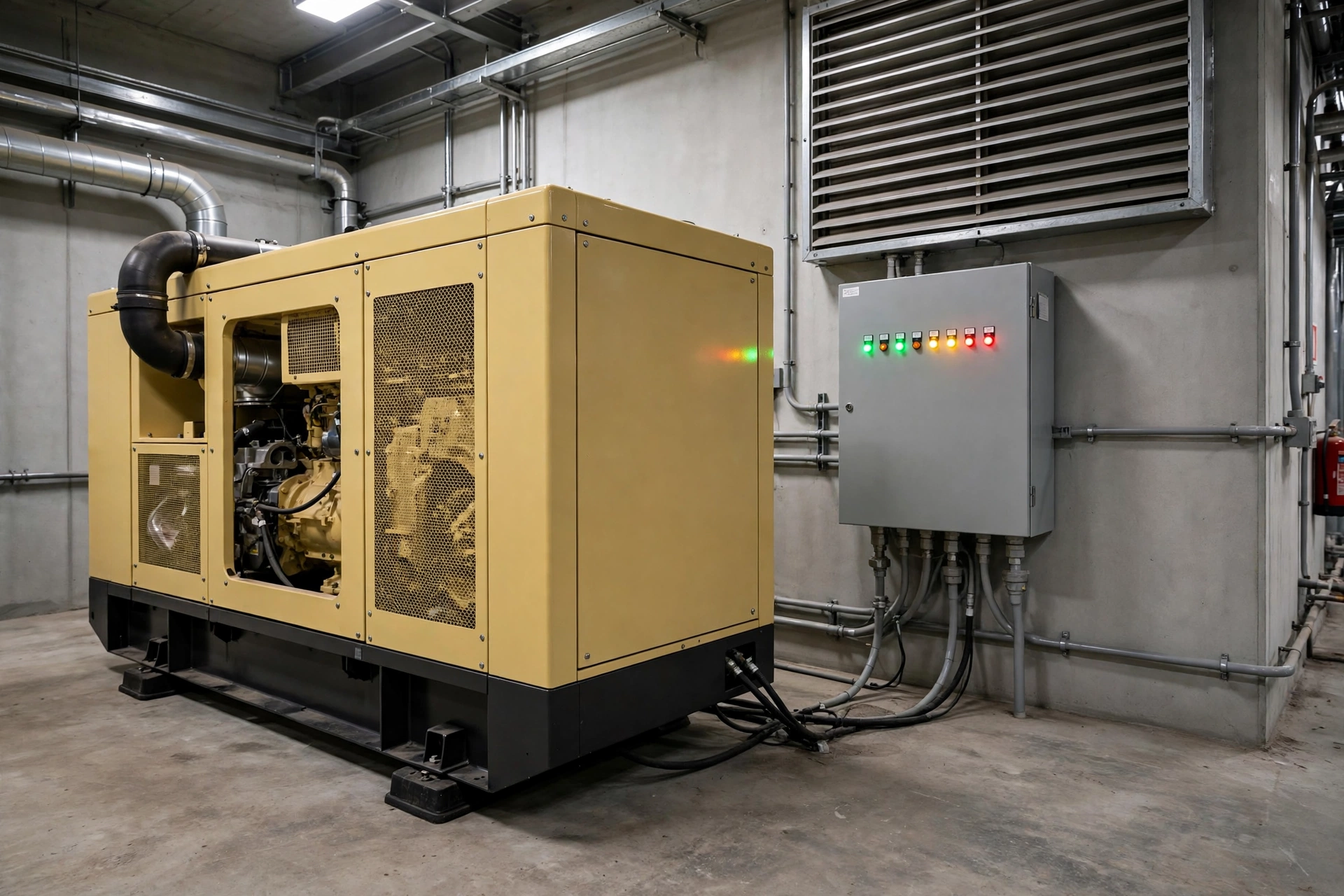
None of the above matters if it is never tested. The test that counts is a witnessed transfer with the actual UPS online, under the actual load, watching three things: whether the UPS accepts generator power without cycling, how deep the voltage dips when the largest motor starts, and how long the batteries actually last. A monthly no-load generator run proves the engine turns over. It proves nothing about whether the UPS will accept the output, whether the ATS contacts that have not carried current in three years will hold, or whether the battery charger has been quietly dying. That test belongs in the commissioning file, repeated annually, with the transfer time, the dip, and the battery runtime written down — because the next outage will use those numbers, whether or not anyone measured them.
Frequently Asked Questions
Why does my UPS keep switching to battery on generator power?
Because the UPS measures voltage, frequency and waveform, and the generator lets one or more of them wander outside the UPS input window — usually harmonic distortion from the UPS rectifier itself, or frequency wander under load. The UPS transfers to battery to protect its load, the distortion falls, it transfers back, and the cycle repeats about every 4 seconds until the batteries drain.
What size generator do I need for a UPS?
It depends on the UPS rectifier. A modern IGBT or PFC-rectifier UPS needs a generator of about 1.25–1.5× the UPS kVA. A twelve-pulse thyristor UPS needs about 1.4–1.6×. A six-pulse unfiltered UPS needs 2×, and Schneider advises 3–5× the total load. Always add the battery recharge load — typically 10–25% of UPS output — and confirm the ratio with both manufacturers before ordering.
Can you plug a UPS into a generator?
Yes, and on any site that needs more than a few minutes of backup it is the correct design — the UPS bridges the 10-second gap while the generator starts, and the generator carries the site for hours. The UPS must sit on the load side of the transfer switch, after the ATS, so that generator power can actually reach it. A double-conversion UPS is the safest partner for a generator; a line-interactive UPS works if the generator output is stable and the sensitivity setting is widened.
How long will a UPS last during a power outage?
As long as its batteries last at the actual load — typically 10–30 minutes for a server-room UPS at full load, longer at part load, and less than the brochure figure once the batteries are past three years old. A UPS is a bridge, not a power station. If the generator cannot start and take load inside the battery’s real runtime, the protected equipment goes dark with fuel still in the tank.
How do I stop my UPS switching to battery on generator power?
Start with the free fixes: widen the UPS input sensitivity and frequency window, turn off ECO mode, and limit battery recharge current during generator operation. If the UPS still cycles, add a harmonic filter to the UPS input or replace an old thyristor-rectifier UPS with a modern IGBT/PFC unit. Then run a witnessed transfer test with the actual UPS online — and size the generator at 1.25–2× the UPS kVA, depending on rectifier type, with recharge included.
Specification Checklist: Seven Lines Before the Order
1. What rectifier does the UPS have? IGBT/PFC, twelve-pulse, or six-pulse thyristor — the answer sets the generator multiplier, from 1.25× to 3× or more. Get it in writing from the UPS manufacturer.
2. Is the recharge load in the sizing? UPS input kW equals output kW plus recharge kW, divided by efficiency. A generator sized to the UPS output alone will trip on its first real outage.
3. Is the UPS double-conversion? On any generator-fed site protecting servers or medical equipment, the answer should be yes. Line-interactive belongs on stable utility power, not on a wandering generator.
4. What is the alternator’s step-load capability? Ask for the subtransient reactance X”d and the maximum UPS kVA for the frame. A large, low-reactance alternator with PMG excitation is worth more than extra engine kW.
5. What is the battery’s real runtime? Measured at the actual load, on the actual batteries, from the last witnessed test — plus 20% margin. A brochure runtime on new batteries is not a specification.
6. Has a witnessed transfer test been run? With the actual UPS online, under the actual load, watching for the 4-second cycle. If the answer is no, the system is unproven, however good the paperwork looks.
7. Where does the UPS sit? On the load side of the ATS, after the transfer switch — never on the mains side, where generator power cannot reach it. And the generator’s fuel consumption must cover the whole outage, because a UPS that outlasts the fuel is no help either.
A UPS and a generator are two halves of one system, and they are almost always bought as if they were two separate systems. The generator protects the building for hours. The UPS protects the load for minutes. Neither works without the other, and the place they meet — the UPS input terminals, in the first ten seconds of an outage — is where the whole design is decided. Size for the rectifier, allow for the recharge, widen the window, and test it under load with the actual UPS online. The alternative is learning, at 3 a.m., that the batteries were the deadline all along.
Before requesting a price, a buyer should provide four lines: the UPS make, model and rectifier type; the protected load in kW and the required battery runtime in minutes; the largest single motor on the generator and its starting method; and the site altitude, maximum temperature and enclosure type. Any manufacturer that knows its business — PAVO included, with a range of 9 to 3750 kVA in open, silent and containerised configurations, powered by Cummins, Weichai, Yuchai and Shanghai Diesel — will size the correct set from those four lines. A supplier that sizes from UPS kVA alone is not doing the buyer a favour.
The UPS is the cheapest part of a backup power system and the easiest to get wrong. It costs a few thousand dollars, it decides whether the generator ever carries the load, and it is the only component that can drain itself to death while the generator runs perfectly. Check the rectifier, do the recharge arithmetic, and run the witnessed test. Then contact PAVO — the generator, the sizing, and the test protocol are one conversation, not three.