

What Size Backup Generator Does an Aquarium Need? | PAVO
An aquarium does not go dark like a shop. It suffocates — slowly, invisibly, and on a clock measured in dissolved oxygen, not in lost ticket sales.
What size generator does an aquarium need? A small regional aquarium needs a 100–250 kVA set for life support, a large public aquarium needs 500–2,000 kVA, and a mega-aquarium protects only its critical slice — the full building load runs into megawatts that no diesel set can carry. The generator protects the animals, not the whole building.
- What an Aquarium Actually Needs Power For
- Sizing Bands by Aquarium Size
- The Oxygen Clock: What Happens in the First Hours
- Two Aquariums That Lost Power — and What They Teach
- Pumps, Chillers and Ozone: The Loads That Decide the Set
- Fuel Autonomy and Placement: How Long It Runs and Where It Sits
- Frequently Asked Questions
- Specification Checklist
What an Aquarium Actually Needs Power For
An aquarium is a building full of water that must never stop moving. Georgia Aquarium in Atlanta holds more than 11 million gallons of water across its galleries, and its Ocean Voyager exhibit alone holds 6.3 million gallons — a single tank larger than the entire Shedd Aquarium in Chicago. That water is not poured in once and left alone. About 98% of it is recirculated through mechanical filtration, protein skimming and ozone treatment around the clock. Stop the pumps and the water in every tank starts to change within minutes. Stop them for hours and animals start to die.
The loads fall into four tiers, and only the first two are non-negotiable. Getting the tiers right is what keeps the generator affordable. An aquarium that tries to back up everything — restaurants, gift shops, the full lighting rig — ends up with a set so large it never gets approved. An aquarium that backs up only the life support keeps its animals alive on a set a fraction of the size. Most coastal aquariums also run their own intake water treatment — the filters and sterilisers that turn raw seawater into exhibit water — and that plant sits on the same life-support loop as the pumps.
| Load tier | Systems | Share of building load | On the generator? |
|---|---|---|---|
| Life support | Circulation pumps, filtration, oxygenation, ozone, UV sterilisers | 25–40% | Yes — always |
| Temperature control | Chillers, heat exchangers, heaters, HVAC for animal areas | 20–35% | Yes — staged |
| Safety and operations | Emergency lighting, alarms, quarantine, veterinary, water-quality monitoring | 5–10% | Yes — always |
| Visitor systems | Exhibit lighting, restaurants, shops, offices, lifts | 25–40% | No — shed on transfer |
Life support is the tier that decides everything. The circulation pumps move water from each exhibit through the filtration plant and back, several times an hour. A typical large exhibit turns its full volume over every 60–90 minutes; a reef tank with delicate corals turns over faster. The filters strip out solid waste. Protein skimmers pull dissolved organic matter out of the water before it decays. Ozone oxidises what is left and keeps the water clear enough for visitors to see through 30 feet of it. Ultraviolet sterilisers kill pathogens in the water stream. Every one of those steps needs power, and they need it continuously. There is no battery big enough to run a 75 kW circulation pump for a day.
Temperature control is the second tier, and it is the largest single electrical load in most aquariums. Tropical reef tanks sit at 24–27°C. Cold-water exhibits sit at 7–12°C. Penguin habitats hold air at 2–7°C with water chilled colder still. The chillers that hold those temperatures draw far more power than the pumps, and they start hard — a chiller compressor can pull five to six times its running current at start-up. The generator has to be sized for that starting surge, not for the steady running load. Chillers are also the load that can be staged: on transfer, the generator starts the pumps first and brings the chillers in one at a time, minutes apart, so the set never sees the full starting load at once.
Safety and operations is the smallest tier and the easiest to forget. The veterinary hospital needs power for its holding tanks. The quarantine area needs power for the animals in it, some of which are more valuable than anything on public display. The water-quality laboratory needs its analysers. The alarm system needs to tell the duty manager that dissolved oxygen is falling in the shark tank — and the automatic transfer switch has to make that call itself, within 10 seconds, because nobody is standing in the plant room at 3 a.m. waiting for the grid to fail.
Visitor systems are the load that gets shed. Exhibit lighting, restaurants, the gift shop, the offices and the lifts all go dark on transfer, and nobody apologises for it. An aquarium that loses its grid supply closes to the public. The animals do not know the building is closed. Their water still has to move.
The distinction matters because the numbers are so different. A large public aquarium can draw 2–4 MW in normal operation. Its life-support and temperature-control loads — the part that keeps animals alive — are typically 500–1,500 kW. That is the size of the problem the generator has to solve. The rest of the building is a separate problem, and on the day the grid fails it is a problem that can wait.
Sizing Bands by Aquarium Size
Aquariums do not size by floor area. They size by water volume, by the number of separate life-support systems, and by how much of the building is cold water. A 500,000-gallon aquarium with one big ocean tank and a dozen small reef tanks has a very different load profile from a 500,000-gallon aquarium with forty small exhibits, because each exhibit has its own pumps, its own filtration loop and its own control panel. The table below gives the bands that cover most public aquariums. The generator figure is the standby-rated set for life support plus staged temperature control — not the full building load.
| Aquarium type | Water volume | Life-support load | Generator size | Fuel at 75% load |
|---|---|---|---|---|
| Small regional aquarium | Under 100,000 gal | 40–90 kW | 100–150 kVA | 20–30 L/h |
| Regional aquarium | 100,000–500,000 gal | 90–200 kW | 150–400 kVA | 30–75 L/h |
| Large public aquarium | 500,000–2,000,000 gal | 200–500 kW | 400–1,000 kVA | 75–150 L/h |
| Mega-aquarium | Over 2,000,000 gal | 500–1,500 kW | 1,000–2,500 kVA | 150–300 L/h |
A worked example shows how the numbers add up, using the same method as the generator sizing guide: running load first, then the largest starting surge on top. Take a regional aquarium holding 400,000 gallons across twenty exhibits. Its circulation pumps draw 45 kW running. Its chillers draw 60 kW. Ozone generators and UV sterilisers draw 12 kW. Controls, monitoring, emergency lighting and the veterinary holding tanks draw 20 kW. The running total is 137 kW, about 170 kVA at 0.8 power factor. But the chillers start at five times their running current, and the largest circulation pump starts at six times. If everything started at once, the set would need to absorb a starting surge of more than 400 kVA. The answer is not a 500 kVA set. The answer is a 250 kVA set with a sequenced start: pumps first, then the first chiller, then the second, each a minute apart, with the ozone and UV units coming in last. The set never sees more than 200 kVA at any moment, and the animals never notice the sequence.
The rating matters as much as the size. An aquarium generator is a standby-rated set under ISO 8528-1, and the difference between standby and prime ratings decides how long the set can run when the outage stretches into days. A standby-rated set is designed for up to 200 hours a year at variable load with an average load factor of about 70%. That covers monthly testing and a handful of real outages. An aquarium in a hurricane zone that expects to run its set for a week at a time should be looking at a prime-rated set, or at least at a standby set derated to prime duty — a 500 kVA standby set that becomes a 455 kVA prime set, the same 9% margin the Cummins C500D5 carries between its two ratings. Buy the standby number and run it at prime duty, and the set will fail on its third long outage, not its first.
Fuel is the other half of the sizing decision, and it is the half most often missed. A 250 kVA set at 75% load burns about 45 litres an hour. Over 72 hours that is 3,240 litres — more than a standard 2,000-litre sub-base tank holds. The aquarium that sizes its tank for 24 hours and assumes a fuel delivery will arrive during a hurricane is planning to lose its animals on day two. The fuel section later in this article works through the numbers in full.
One more sizing rule, learned the hard way: size for the aquarium as it will be in five years, not as it is today. Aquariums grow. A new shark tank, a new penguin habitat, a new quarantine wing — each one adds a life-support loop. The aquarium that buys a 400 kVA set for a 350 kVA load has no room for the next exhibit. The aquarium that buys a 500 kVA set for the same load has room for one more loop and a margin for a hot summer day when the chillers work hardest. The extra 100 kVA costs a few thousand dollars at purchase. Adding a second set later costs ten times that.
The Oxygen Clock: What Happens in the First Hours
When the pumps stop, the first thing that changes is not the temperature. It is the dissolved oxygen. Fish breathe oxygen dissolved in water, and a tank full of fish consumes it steadily. In a healthy reef tank the dissolved oxygen sits at 6–8 mg/L. Fish start to show stress below 5 mg/L. Most species die below 2–3 mg/L. The clock starts the moment the circulation pumps stop, and how fast it runs depends on the stocking density, the water temperature and the size of the tank.
Warm water holds less oxygen than cold water, and warm fish use more of it. A tropical reef tank at 26°C holds about 8 mg/L of oxygen at saturation. The same tank at 30°C holds about 7.4 mg/L — and the fish in it are burning oxygen faster because their metabolism has risen with the temperature. The margin shrinks from both sides at once. That is why a reef tank is the first exhibit to suffer in an outage, and why the reef tank is the first load the generator must pick up. Production fish farms face the same oxygen clock, and the same dissolved-oxygen limits decide how fast their stock dies when the aerators stop.
The reef tank goes first
A coral reef exhibit is the most demanding life-support load in the building. The corals themselves are sensitive to temperature — sustained water above 30°C triggers bleaching, and a bleached coral that does not recover within weeks dies. The reef fish are stocked densely because a reef looks empty without them, and dense stocking means the oxygen clock runs fast. The lighting over a reef tank is intense, and when the lights go out the photosynthetic organisms in the tank stop producing oxygen and start consuming it instead. A reef tank that loses power at noon on a summer day is in trouble within 2–4 hours. The same tank at night, with the lights already off and the water a degree cooler, has a few hours more. The difference is measured in hours, not days.
Sharks and rays run out of oxygen first
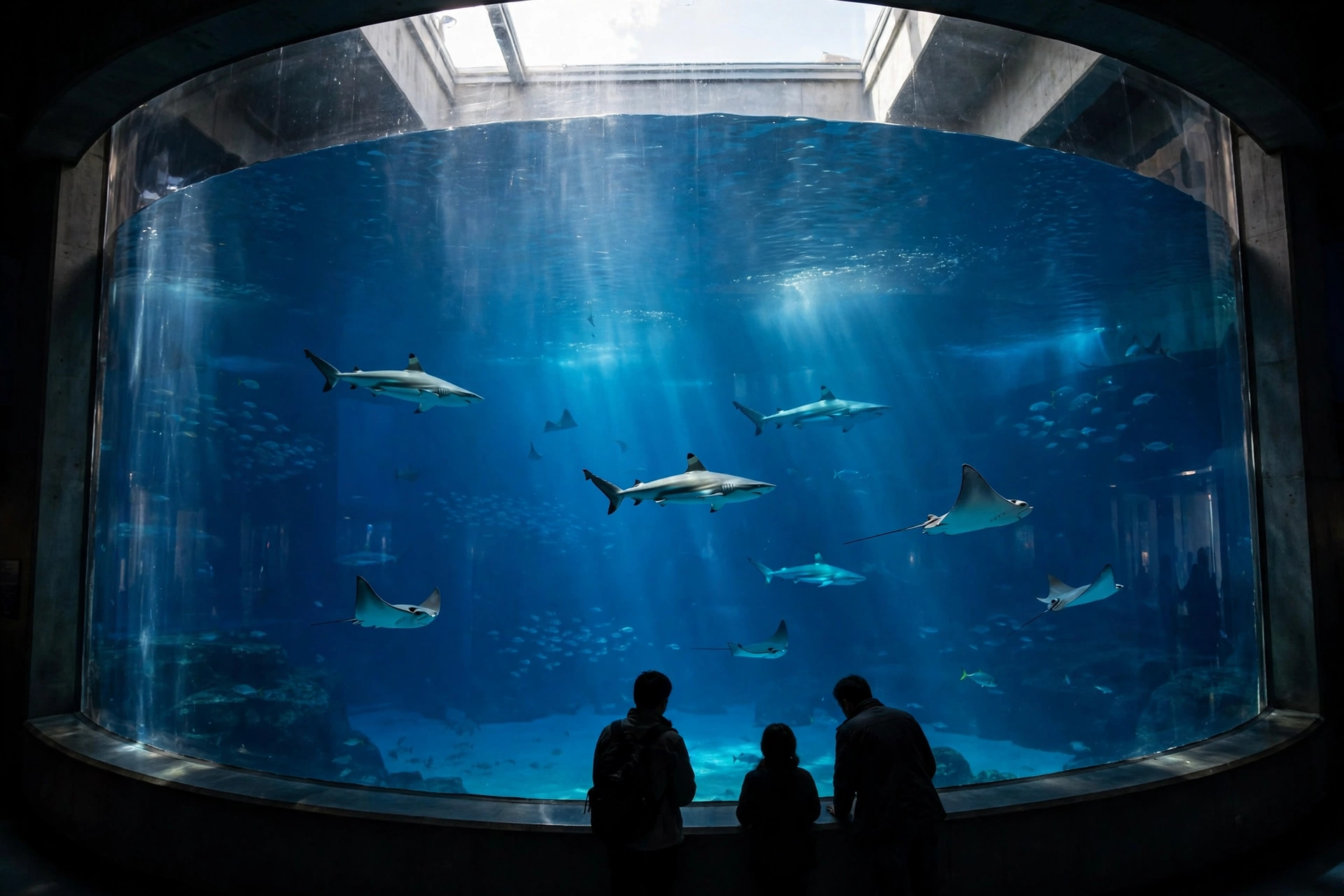
Sharks and rays are the animals visitors come to see, and they are the animals with the least tolerance for still water. Most sharks must keep swimming to push water over their gills — a behaviour called ram ventilation — and in a tank with no circulation the water they swim through is the same water, getting poorer in oxygen with every pass. A large shark tank holds a lot of water, which helps, but it also holds a lot of biomass, which does not. The practical rule used by aquarists is that a shark exhibit without circulation has 1–3 hours before dissolved oxygen falls into the danger zone. That is the window the generator has to start, transfer and pick up the circulation pumps. Ten seconds of transfer time is nothing. Three hours without a generator is everything.
Big water buys time
The one factor that works in the aquarium’s favour is thermal mass. A 6.3-million-gallon tank changes temperature slowly — a degree or two a day, even with the chillers off, because there is simply so much water to warm. A 500-litre quarantine tank changes temperature in hours. A 50-litre hospital tank changes in minutes. The big exhibits are the most forgiving part of the building. The small ones are the most fragile, and they are often the ones holding the most valuable animals: the sick shark in the veterinary hospital, the rare seahorses in the breeding programme, the coral fragments in the nursery.
Ammonia is the second clock, and it runs slower but lasts longer. When filtration stops, the waste the fish produce has nowhere to go. Ammonia rises. At the same time, the bacteria in the biofilter — the living colony that converts ammonia to nitrite and then to nitrate — begin to die without oxygenated water flowing over them. A biofilter that has been starved of flow for 24 hours loses a large part of its bacterial colony. When power returns, the pumps restart, but the filter does not work properly for days while the colony regrows. The aquarium that survives a three-day outage on generator power and then loses fish a week later has usually lost them to the biofilter, not to the outage itself. The recovery plan matters as much as the generator: test the water daily for a week after any outage, feed lightly until the ammonia readings are back to zero, and keep a bottle of commercial nitrifying bacteria in the store room for exactly this day.
| Species group | Stress below | Lethal below | Window without circulation |
|---|---|---|---|
| Tropical reef fish | 5 mg/L | 2–3 mg/L | 2–4 hours |
| Sharks and rays | 5.5 mg/L | 3–3.5 mg/L | 1–3 hours |
| Corals | 30°C water | 32°C sustained | 24–48 hours to bleach |
| Cold-water fish | 6 mg/L | 3 mg/L | 4–8 hours |
| Penguins (air temperature) | 10°C air | 20°C air sustained | Days, with chilled water |
The table is a guide, not a guarantee. A heavily stocked tank runs faster than a lightly stocked one. A tank with a lot of live rock and coral runs faster still, because the rock itself consumes oxygen at night. The only number that matters on the day is the reading on the dissolved-oxygen meter in the tank that is worst off — and that is why the monitoring system, with its battery-backed sensors and its alarms, is on the generator too.
Two Aquariums That Lost Power — and What They Teach
No specification sheet teaches what two real storms taught. Both aquariums below had backup generators. Both lost power anyway. The reasons are the reason this article exists.
Case 1: New York Aquarium, Hurricane Sandy, 29 October 2012
At 7:50 p.m. on Monday 29 October 2012, the Atlantic Ocean surged over the Coney Island boardwalk and into the New York Aquarium. Within three minutes the water was rushing through sandbagged flood doors and through air-intake vents. The basements of the aquarium’s buildings filled with up to 15 feet of salt water. The ground floors flooded to three feet. Electrical transformers were destroyed. The emergency generators failed — not because the engines were damaged, but because the switchgear and distribution equipment they fed power through had been fried by salt water. A generator that cannot distribute its power is a very expensive piece of sculpture.
Eighteen staff stayed in the building through the storm. The aquarium held nearly 12,000 animals. The only working generator was the one in the second-floor veterinary health centre, above the flood line, and the staff ran the recovery from there. They pumped water out of the basements and mechanical areas around the clock, put animals on temporary life support, and waited. Power was not fully restored to all exhibits until Friday evening — four days later. In the end, more than 80% of the collection survived, but several hundred fish died, most of them in one exhibit that staff could not reach for days. About 150 koi carp in outdoor holding pools died when the salt-water surge knocked their pools over. The damage was estimated at $65 million, and the aquarium stayed closed for months.
The lesson is not that the aquarium had too small a generator. The lesson is that the generator and its switchgear sat below the flood line, and the distribution system was the single point of failure. A set in a basement is a set that drowns. The aquarium rebuilt with its electrical equipment raised, its flood doors strengthened and its life-support systems given a second, independent power path. Any aquarium within a mile of the sea should be asking where its switchgear sits relative to the highest water the site has ever seen — and then adding a margin.
Case 2: Moody Gardens, Hurricane Ike, 13 September 2008
Four years earlier, on the same Gulf Coast that would freeze in 2021, Hurricane Ike came ashore at Galveston as a Category 2 storm with 110 mph sustained winds and a storm surge that reached 22 feet at Sabine Pass. At Moody Gardens, floodwater rose 14 feet. The diesel generator and its electrical switches were submerged. At 3:51 a.m. the staff made the call to shut the emergency generator down themselves, before the rising water shorted out the transformers. The generator was not destroyed by the storm. It was switched off to save it — and the aquarium went dark anyway.
What saved the animals was not a machine. It was bottled oxygen. Staff placed large metal oxygen tanks throughout the Aquarium Pyramid and aerated the water by hand. Of the 8,400 fish in the pyramid, only 36 died, and one chronically sick shark died of stress. The Rainforest Pyramid fared worse: salt water flooded a third of the rainforest floor and seeped into a freshwater tank, killing 80% of its fish. The penguins were kept alive by chilling their water to 44°F — ten degrees colder than normal — so the cold water kept the air in their area cool. Over three days without power the air temperature in the penguin area rose from 34°F to 58°F, still not enough to stress the birds. The kelp exhibit was kept alive by emptying frozen fish from a six-foot deep-freeze into the tank to hold the temperature down.
And then there was the fuel tank. Moody Gardens had done the right thing: it had its diesel fuel in place and its generators ready. But the 18,000-gallon diesel fuel tank floated. “I would not have thought that a big 18,000-gallon tank of diesel fuel would float,” the president said afterwards. A full tank of diesel weighs less than the water it displaces, and in fourteen feet of floodwater it lifts off its pad and drifts. The fuel was there. The generators were there. They could not be used together.
The two cases share a pattern that should be printed on the wall of every aquarium plant room. The engine is rarely the part that fails. The distribution fails. The fuel fails. The transfer fails. The generator that is tested every month under load, with its switchgear above the flood line, its fuel tank anchored against buoyancy, and its oxygen cylinders checked and full, is the generator that saves the animals. The generator that is only ever started and left idling is the one that fails on the night it matters.
Winter Storm Uri in February 2021 adds the scale of the problem. The freeze knocked out power to about 4.5 million customers across Texas, and the Texas Parks and Wildlife Department estimated that at least 3.8 million fish died along the Texas coast — 61 species, in bays that had never frozen in living memory. Wild fish cannot be saved by a generator. Aquarium fish can. But only if the generator is where the water is not, and the fuel is where the water cannot take it.
Pumps, Chillers and Ozone: The Loads That Decide the Set
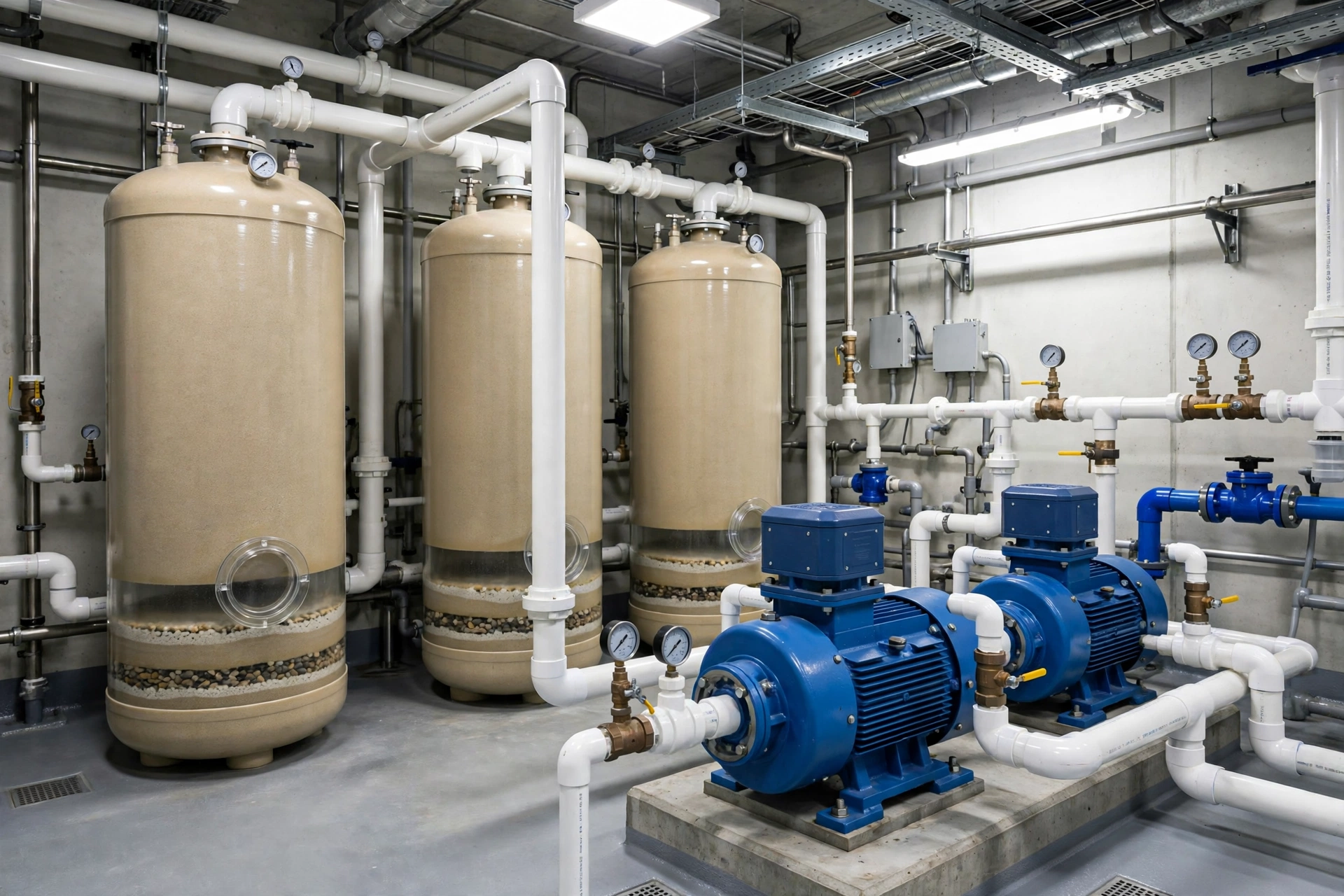
Three loads decide the size of an aquarium generator, and none of them is the lighting. They are the circulation pumps, the chillers and the ozone system — and each one punishes a badly sized set in a different way.
Circulation pumps and starting surge
A circulation pump is a centrifugal pump, and a centrifugal pump is a motor. A motor at start-up draws locked-rotor current of five to seven times its running current for a few seconds. A 30 kW pump that draws 45 amps running will draw 270 amps starting. Put four of those pumps on one set and start them together, and the set sees a surge it cannot supply. The voltage dips. The frequency dips. The pumps stall, the breakers trip, and the aquarium is back where it started — except now the generator is running and nothing is.
The fix is motor starting discipline, and it has three parts. First, variable-frequency drives on the largest pumps, so the pump ramps up over ten seconds instead of slamming on. A VFD turns a 6x starting surge into a 1.5x ramp, and it pays for itself in energy savings within two years on a pump that runs 24 hours a day. Second, sequenced starting: the control system starts one pump, waits for the generator to stabilise, and then starts the next. Third, never size the set on running load alone. The set must carry the largest single starting surge plus the running load of everything already on line. A 250 kVA set that can start a 30 kW pump while carrying 120 kVA of running load is correctly sized. A 250 kVA set that trips when the second chiller starts is not.
Chillers and heat pumps
Chillers are the largest single load in most aquariums, and they are also the most sensitive to power quality. A chiller compressor is a hermetic or semi-hermetic machine with tight tolerances. A voltage dip of more than 15% during start-up can trip its internal protection. A frequency dip below 47 Hz on a 50 Hz system will do the same. The generator has to hold its voltage and frequency while the chiller starts, which means the set needs a low subtransient reactance alternator — the same specification that matters for UPS compatibility and for any load with a large starting surge.
Chillers also have a restart problem that pumps do not. A chiller that has just stopped cannot restart immediately. The refrigerant pressures have to equalise, which takes 3–5 minutes. A generator that transfers, starts the chillers, trips on overload and then tries to restart them immediately will fail twice: once on the overload, and once on the short-cycle protection. The transfer sequence has to account for it. Pumps first. Wait. First chiller. Wait. Second chiller. The aquarium that writes this sequence into its controller and tests it under load every month never discovers the problem at 3 a.m.
Heat is the other side of the chiller equation. A chiller that cools a million gallons of water rejects that heat somewhere, and in most aquariums it rejects it through a cooling tower or a dry cooler on the roof. The cooling tower needs its fans and its own pumps, and those are on the generator too. Forget the tower fans and the chiller trips on high head pressure ten minutes after it starts. The load list has to include everything the chiller needs to run, not just the chiller itself.
Ozone, UV and power quality
Ozone is what keeps aquarium water clear. An ozone generator takes oxygen, passes it through a corona discharge, and produces ozone gas that is injected into the water stream. The ozone oxidises organic matter, kills pathogens and breaks down the compounds that make water look yellow. It is also the load most likely to be damaged by bad power. An ozone generator is a piece of precision electronics. It wants clean voltage, stable frequency and no harmonics. A generator with a high harmonic distortion output — the kind produced by an undersized alternator working hard — will shorten the life of the ozone cells and the UV lamp ballasts, and it will do it silently, over months, until the water starts to look cloudy and nobody knows why.
The answer is the same as it is for any sensitive load: an alternator sized generously for the load, a voltage regulator that holds ±1%, and a UPS bridging the ten-second gap between grid failure and generator power for the control electronics. The ozone generator itself can wait ten seconds. Its control board, which holds the settings and the safety interlocks, cannot lose power without a fault. The UPS that protects it is a small one — a few hundred watts — and it is the cheapest insurance in the building.
There is also a safety point that belongs in any discussion of ozone. Ozone is toxic, and an ozone system that loses power mid-cycle can leave residual ozone in the water or in the plant room air. The system needs its destruct unit — the carbon bed that removes residual ozone — on the generator, and it needs its gas detectors on the UPS. An aquarium that backs up the ozone generator but not the destruct unit has backed up the hazard and not the safety system.
Fuel Autonomy and Placement: How Long It Runs and Where It Sits
A generator without fuel is a sculpture. An aquarium without a fuel plan is an aquarium with a countdown that starts the moment the grid fails.
The fuel maths
The table below is calculated at 75% load, which is the realistic running load for a life-support set with staged chillers. A set that runs at 100% load burns about 25% more fuel and wears faster. Size the tank for the load the set will actually carry.
| Generator size | Consumption at 75% | 24 hours | 48 hours | 72 hours |
|---|---|---|---|---|
| 150 kVA | 28 L/h | 672 L | 1,344 L | 2,016 L |
| 250 kVA | 45 L/h | 1,080 L | 2,160 L | 3,240 L |
| 500 kVA | 75 L/h | 1,800 L | 3,600 L | 5,400 L |
| 1,000 kVA | 150 L/h | 3,600 L | 7,200 L | 10,800 L |
| 2,000 kVA | 300 L/h | 7,200 L | 14,400 L | 21,600 L |
The 72-hour figure is the one that matters. Seventy-two hours is the standard that most aquarium emergency plans are built around, because it is the longest most grids take to restore after a major storm — and because it is the point at which fuel delivery becomes a problem rather than a solution. A fuel tanker cannot reach an aquarium when the roads are flooded, and a fuel supplier cannot promise a delivery when its own depot has no power. The aquarium that holds 72 hours of fuel on site is self-sufficient for the outage it is most likely to face. The aquarium that holds 24 hours is betting that the roads open on day two.
The reason the 72-hour tank has to be managed, not just filled, is diesel fuel ageing. Diesel in a standby tank degrades. Water condenses in the tank, microbes grow at the fuel-water interface, and the fuel that was perfectly good when it was delivered is a filter-clogging sludge eighteen months later. The aquarium that fills its 10,000-litre tank and forgets it for two years will discover the problem when the generator stops after four hours with a blocked fuel filter. The fuel has to be tested every six months, polished when the water content rises, and turned over — burned in a monthly load test and replaced — so that no fuel in the tank is older than 12 months. A fuel polishing system on the bulk tank costs less than one day of lost ticket sales. It is the cheapest part of the whole installation.
Above the flood line
The New York Aquarium and Moody Gardens both teach the same lesson, and it is the most important paragraph in this article. Put the generator above the flood line. Put the switchgear above the flood line. Put the fuel tank above the flood line, or anchor it so it cannot float. A generator in a basement is a generator that drowns, and a fuel tank that is not anchored is a fuel tank that drifts away when it is needed most.
The practical standard is to place the generator and its switchgear above the highest water level the site has ever recorded, plus a margin of 500 mm. In a coastal city that means checking the storm-surge maps, not the last ten years of local memory — Hurricane Sandy put 15 feet of water in basements that had never flooded before. In a river city it means checking the 100-year flood level. The generator room should have its own drainage, its own sump pump on the UPS, and a door that can be sealed. The fuel tank should be anchored against buoyancy with the same care that a bridge pier is anchored against scour. An 18,000-gallon tank that floats is a story that should never need to be told twice.
Salt air eats generators
Most aquariums are near the sea, and the sea eats steel. Salt-laden air corrodes a generator enclosure, a radiator and an exhaust system faster than any inland site. The specification has to reflect it: a marine-grade coating on the canopy, stainless-steel fasteners, a radiator with a corrosion-resistant finish, and an air intake that does not draw salt spray directly into the alternator. The generator should be inspected for corrosion every six months, not every year, and the air filter should be checked monthly — salt crystals in an air filter are a failure waiting for a humid day.
Noise the visitors never hear
A public aquarium is a public venue, and a public venue has neighbours. A 500 kVA set in an open enclosure produces 85–90 dB(A) at one metre. In a silent canopy it produces 68–75 dB(A) at seven metres. That is the difference between a generator the neighbours complain about and a generator they never notice. The canopy costs more, and it costs a little in cooling — a canopied set derates by about 3–5% in hot weather — but for an aquarium in a city centre it is not optional. The generator should also be placed where its exhaust does not drift over the visitor entrance or the outdoor penguin habitat, and where its vibration does not travel through the building structure into the exhibit halls. Fish feel vibration through water far better than humans feel it through air.
Watching it from abroad
An aquarium’s generator is useless if nobody knows it has started. Remote monitoring — a Deep Sea controller with a GSM modem, or a Modbus link into the building management system — sends the duty manager a message the moment the set starts, and another the moment it stops. It reports fuel level, coolant temperature, battery voltage and dissolved oxygen in the worst tank, all on one screen. The aquarium that monitors its generator remotely knows within a minute that the grid has failed. The aquarium that does not knows when the morning shift arrives and finds the shark tank cloudy.
Frequently Asked Questions
What size generator does an aquarium need?
A small regional aquarium needs a 100–250 kVA set for life support, a large public aquarium needs 500–2,000 kVA, and a mega-aquarium such as Georgia Aquarium protects only its critical life-support slice on diesel power. The set is sized on the circulation pumps, chillers and ozone system — not on the full building load, which runs into megawatts. A sequenced start keeps the set a size smaller than the starting surge would suggest.
Do aquariums need a backup generator?
Yes. An aquarium without a generator is an aquarium with a countdown measured in hours. Circulation pumps, filtration, oxygenation and temperature control all stop when the grid fails, and dissolved oxygen in a stocked reef tank falls into the danger zone within 2–4 hours. Accreditation standards for zoos and aquariums treat life-support backup power as a core requirement, not an optional extra.
How long can an aquarium run on a generator?
As long as it has fuel. A 500 kVA set at 75% load burns about 75 litres an hour, so a 5,400-litre tank gives 72 hours of running. Most aquarium emergency plans are built around 72 hours of on-site fuel, because that is the longest most grids take to restore after a major storm. The generator itself can run indefinitely if it is maintained, refuelled and given a rest for oil checks — the limit is the fuel in the tank.
What happens to an aquarium during a power outage?
The pumps stop first, then the dissolved oxygen falls, then the temperature drifts. Reef tanks suffer first, within 2–4 hours; sharks and rays follow within 1–3 hours without circulation. If the outage lasts more than a day, the biofilter bacteria die and the water chemistry collapses even after power returns. The New York Aquarium lost several hundred fish in Hurricane Sandy in 2012, and Moody Gardens lost 80% of its Rainforest Pyramid fish in Hurricane Ike in 2008 — both because their generators could not deliver power, not because they had none.
Can a diesel generator power an aquarium?
Yes, and it is the standard answer. A diesel set provides the sustained, high-power output that life-support pumps and chillers need, and it runs for days on a fuel tank the aquarium controls. Battery systems and UPS units bridge the ten-second gap while the generator starts, but no battery bank can run a 75 kW circulation pump for a day. For the critical loads, diesel is the only practical answer.
Specification Checklist
- Size the set on life support plus staged temperature control, never on the full building load — the full load is two to four times larger and does not need to run.
- Use the standby rating for occasional outages and the prime rating for hurricane-zone sites that expect multi-day running.
- Sequence the start: circulation pumps first, then chillers one at a time, then ozone and UV — never everything at once.
- Fit variable-frequency drives on the largest pumps to cut the starting surge from six times running current to one and a half times.
- Hold 72 hours of fuel on site, test it every six months, polish it when the water content rises, and never let fuel sit longer than 12 months.
- Place the generator, the switchgear and the fuel tank above the highest water the site has ever seen, plus 500 mm — and anchor the fuel tank against buoyancy.
- Specify a marine-grade canopy and corrosion-resistant finishes for any site within a mile of the sea, and inspect for salt corrosion every six months.
- Put the ozone destruct unit, the gas detectors and the water-quality monitoring on the generator or the UPS — never the ozone generator alone.
- Install remote monitoring with fuel level, coolant temperature, battery voltage and dissolved-oxygen alarms, so the duty manager knows within a minute that the set has started.
- Test the whole system under load every month, including the transfer sequence, and test it at the load the aquarium will actually carry — not at idle.
An aquarium is a promise to thousands of animals that their water will keep moving, whatever the grid does. That promise is kept by a generator that is sized on the right loads, placed above the water, fuelled for three days and tested every month. The two aquariums in this article had generators. What they did not have, on the night it mattered, was a generator that could deliver power. If your aquarium is planning its backup power, or reviewing a system that has not been tested under load in months, contact PAVO — the team can size the set, specify the transfer sequence and build the fuel plan that keeps the tanks alive.