

What Size Generator Does a Printing Plant Need? | PAVO
A printing plant does not stop the way other factories stop. A press running at 15 metres of paper a second cannot be paused and resumed. When the power fails, the web breaks in every unit, the ink dries on the rollers, and the dryer flames out with a half-printed job inside it. The generator is what decides whether that is a ten-second interruption or a lost edition.
What size generator does a printing plant need? A small commercial sheetfed shop needs 150–300 kVA for its essential board, a mid-size heatset web plant needs 1,000–1,250 kVA, and a newspaper plant with two web presses needs 2,000–2,500 kVA in parallel sets. The set powers the essential board, not the whole plant.
Contents
- Why a Printing Plant Is Not Like Any Other Load
- What the Generator Actually Has to Carry
- Sizing the Set: What Size Generator Does a Printing Plant Need?
- The First 10 Seconds and the Next 10 Minutes
- The Press and the Dryer: Where an Outage Does Its Damage
- Three Plants That Learned the Hard Way
- Frequently Asked Questions
- Specification Checklist: Before You Sign the Order
Why a Printing Plant Is Not Like Any Other Load
Most factories lose an hour of production when the grid fails. A printing plant loses the job that was on the press, the edition that was due at the distribution trucks, and — if the outage hits a heatset web press — a run that cannot be restarted where it stopped. The difference is that a printing plant is a continuous, timed process with almost no buffer stock anywhere in the building. Paper moves through the press as a single web at 10 to 15 metres a second. There is no warehouse of half-printed copies to draw on while the press restarts. There is no way to finish a copy that was halfway through the dryer, or to re-register a web that broke in four places at once. The work in progress at the moment of failure is, in most cases, waste.
The second fact is the deadline. A newspaper has a distribution time, not a delivery window. Copies that miss the first trucks miss the newsagents, and a late edition is a lost edition — the news in it is already old by the time it arrives. A magazine has a binding date and a postal slot. A packaging plant feeds a filling line that runs on its own schedule, and a missed delivery stops a line that belongs to someone else. In printing, the cost of an outage is not measured in lost hours. It is measured in missed deadlines, and missed deadlines carry penalties, reprint costs and lost clients. A press that stops for an hour does not lose an hour of production. It loses the job, the re-make-ready, the spoiled paper and the slot in the schedule that the job was supposed to occupy.
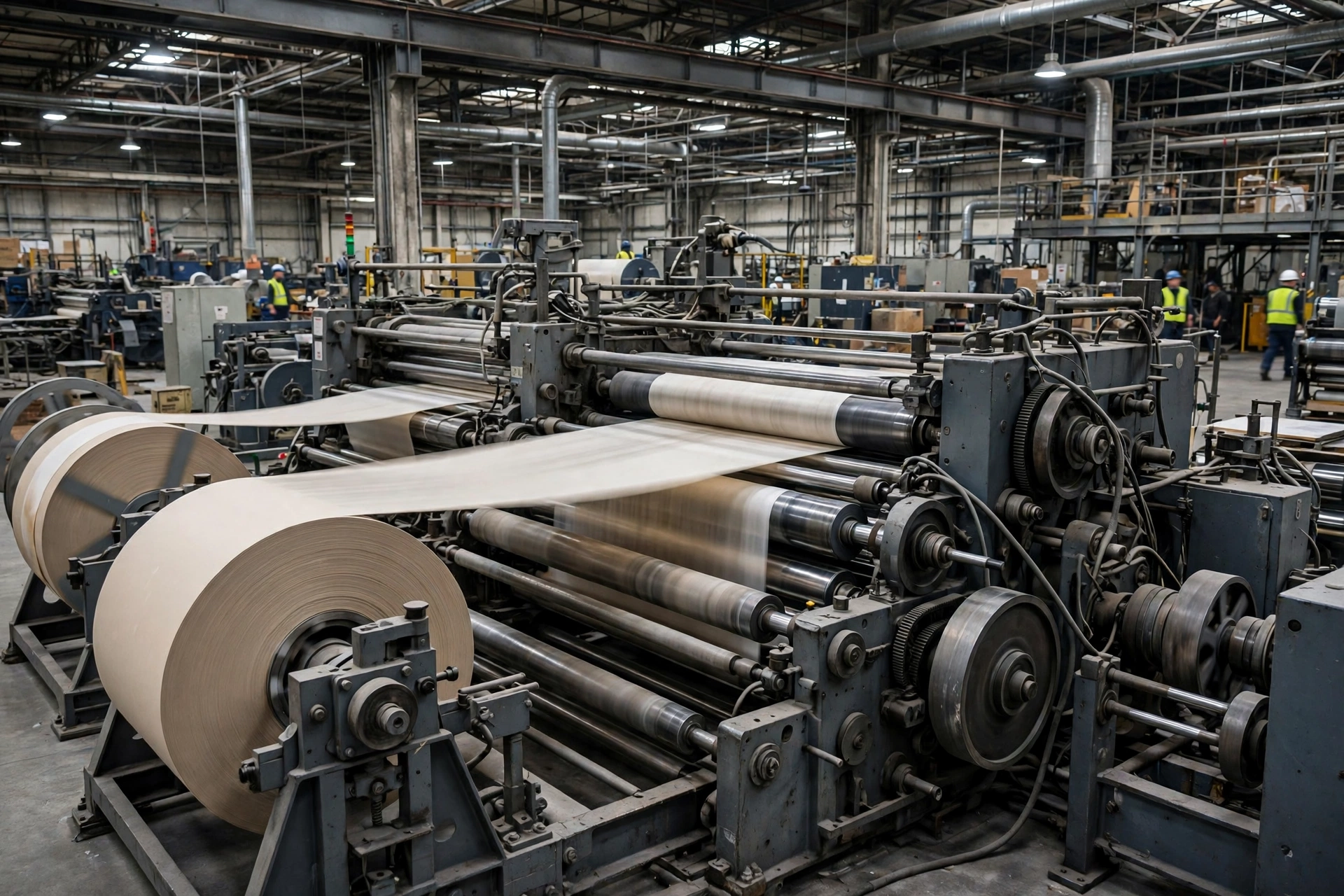
The third fact is what happens inside the press when the power goes. A modern web offset press is a shaftless machine: each printing unit, the folder and the reel stands are driven by their own servo motors, synchronised electrically rather than by a common shaft. That gives precise register control at full speed — modern high-speed offset presses run cylinders of about 300 mm diameter at nearly 35,000 revolutions an hour. It also means that when power fails, every driven component keeps rotating on inertia, and each one decelerates at a different rate. The web tension varies from section to section, and the web breaks. A patent filed specifically for this problem states it plainly: on power failure, web breaks occur in all reel stands and printing units, the broken web wraps around the printing cylinders, and removing the web clinging to the cylinders takes roughly 15 to 30 minutes, with about another 30 minutes to thread the web again from the reel stands to the folder. One outage costs 45 to 60 minutes before the press prints a single saleable copy — and that is before the wash-up, the re-registration and the make-ready that follow.
The fourth fact is the energy profile. A printing plant’s largest single energy consumer is usually the heatset dryer, not the press itself. A Finnish study of five heatset offset presses measured annual energy consumption of 2.5 to 13.7 GWh per press, with electricity at about 40%, oil or district heating at about 50% and propane at about 10% — and more than half of the dryer energy went simply to warming the heating air. On a sheetfed press the figures are smaller but the pattern is the same: HEIDELBERG’s figures for the Speedmaster XL 106-6+L with DryStar give a connected load of 242 kW and an effective consumption of 151 kW at 18,000 sheets an hour, with energy per 1,000 sheets down from 13.8 kWh on the 1990 CD 102-6+L to 8 kWh — a reduction of about 40%. A press is most efficient at full speed, which is the opposite of most machines, and it is also the reason a press cannot be throttled down gently through an outage. It runs at speed, or it stops.
The fifth fact is power quality. A printing plant is full of loads that a diesel generator finds difficult: dozens of servo drives on a shaftless press, variable-speed drives on fans and pumps, resistance heaters and chillers, and the control systems that hold register to a fraction of a millimetre. These loads distort the waveform, pull the voltage around and demand current in spikes. A generator sized only on running kilowatts will look adequate on paper and fail on the day it matters, because the voltage dip on the first large motor start trips the drives, the drives lose register, and the press drops the job it was bought to protect. Sizing for a printing plant is a power-quality exercise as much as a capacity exercise.
What the Generator Actually Has to Carry
The essential board of a printing plant is built in tiers, and the tiers decide the generator size, the transfer scheme and the fuel autonomy. A tier that is left off the board is a tier that fails in the first outage. The tiers below are the ones used in practice on plants from 300 kVA to 2,500 kVA.
Tier 1 — Safety and controlled stop: the loads that must never fail
Emergency lighting, the fire alarm and detection system, the heatset dryer gas safety system, the control-room UPS, the solvent-vapour extraction and the emergency ventilation all sit in Tier 1. These loads are small — typically 25–75 kW on a mid-size plant — but they are non-negotiable. The dryer is the reason. A heatset dryer running on gas at 150–180°C, with a web inside it and solvent vapour in the exhaust, is a fire risk within minutes if the fans and the gas safety system lose power together. The flame supervision, the gas shut-off valves and the purge fans must have power while the dryer cools, and they must have it from the first second. A generator that takes 30 seconds to accept load is a generator that has already failed Tier 1, even if it starts perfectly. The standard for these systems under NFPA 110 Level 1 is a 10-second start, and the UPS bridges that gap.
Tier 2 — Presses and dryers: the loads that decide whether the job survives
The press main drives, the dryer fans and burners, the chill rolls and chiller, the folder and the reel stands sit in Tier 2. These are the loads that decide whether the plant rides through the outage, stops in a controlled way, or loses the job entirely. A sheetfed press such as the Speedmaster XL 106 draws 151 kW effectively at full speed on a 242 kW connected load. A heatset web press draws more, and its dryer is the single largest block of load on the board — a gas-fired dryer still needs electric fans, burners and exhaust, and an electric dryer needs the full heating load. The folder, which cuts and folds the web into copies, draws less but is the most time-critical load on the press: if the folder stops while the web is still moving, the web piles up and breaks.
Tier 2 is where the sizing work happens, and it is also where most sizing mistakes happen. The loads are large, they start with a surge, and they are sensitive to voltage and frequency in a way that a pump or a fan is not. A servo drive that sees a voltage dip below its threshold trips offline, and a tripped drive loses register across the whole press. The motor starting guide covers the starting methods in detail; the rule for a printing plant is simple — the generator is sized for the largest motor start plus the running load already on the board, and then checked against the voltage dip the drives will tolerate, never against running load alone.
Tier 3 — Bindery, finishing and pre-press: the loads that decide whether the job ships
Stitchers, trimmers, perfect binders, folders, guillotines, the computer-to-plate (CTP) system, the RIP servers and the plate processor sit in Tier 3. None of these loads is dramatic on its own. Together they decide whether a printed job becomes a finished, shippable product. A perfect binder that stops mid-cycle leaves a book block glued halfway through its cover. A CTP platesetter that loses power mid-exposure ruins a plate and the chemistry in the processor. The RIP servers hold the queued jobs, the colour profiles and the imposition data; if they go down without a clean shutdown, the queue has to be rebuilt by hand. Tier 3 is usually 60–200 kW on a mid-size plant, and it is the cheapest capacity on the board — which is why leaving it off is the most expensive mistake in the specification.
Tier 4 — Restart and utilities: the loads that decide how fast the plant comes back
Compressed air, chilled water, cooling towers, the dampening-water treatment plant, the press-hall air handling, the IT and management-information servers and the lighting over the line sit in Tier 4. A press cannot restart without compressed air: pneumatic clutches, ink keys, blanket washers and web guides all run on air. A heatset press cannot restart without chilled water for the chill rolls, which set the ink on the web as it leaves the dryer. The servers cannot restart without the network that holds the job tickets. A plant that protects Tier 1 and Tier 2 but leaves Tier 4 off the essential board will restart slowly, in the wrong order, with the press waiting on air and water while the generator runs at quarter load. Tier 4 is usually 75–250 kW on a mid-size plant. The general load — offices, workshops, non-essential lighting — is dropped without consequence, and dropping it is what keeps the generator affordable.
Sizing the Set: What Size Generator Does a Printing Plant Need?
Sizing starts with a load list, not a catalogue. The load list records every load on the essential board, its running kW, its starting method and its starting kVA. The generator is then sized for the running load plus the largest single starting transient, with a 15–20% margin for load growth and for the voltage dip limit. The generator sizing guide covers the full method; the table below gives the bands that experienced buyers use as a first check.
| Plant type | Total site load | Essential board | Typical set | Fuel at 75% load |
|---|---|---|---|---|
| Commercial sheetfed shop, 30 staff | 300–500 kVA | 150–250 kVA | 1 × 300 kVA | ~38 L/h |
| Mid-size heatset web plant, 120 staff | 1–2 MVA | 600–1,000 kVA | 1 × 1,250 kVA | ~158 L/h |
| Newspaper plant, 2 web presses, 200 staff | 2–4 MVA | 1,200–2,000 kVA | 2 × 1,250 kVA | ~315 L/h |
| Packaging flexo plant, 150 staff | 1.5–3 MVA | 800–1,500 kVA | 2 × 1,000 kVA | ~252 L/h |
Fuel figures use the standard rule of thumb of 0.21 litres per kWh generated. A 300 kVA set (240 kW) at 75% load produces 180 kW and burns about 38 L/h. A 1,250 kVA set (1,000 kW) at 75% load burns about 158 L/h. A 2,500 kVA set (2,000 kW) at 75% load burns about 315 L/h. The Cummins C500D5 datasheet gives a measured figure for the same frame: 500 kVA standby / 455 kVA prime, 93.2 L/h at prime full load. Real consumption is always lower than the catalogue figure at part load, and always higher than the buyer hoped at full load. Size the tank on the measured figure, not the brochure figure.
The rating matters as much as the size. A printing plant’s generator is a standby set in the strict sense of the standby and prime power ratings — it runs for hours a year, not hundreds, and it is rated to ISO 8528 for a standby duty of 200 hours a year on average. The trap is the buyer who sizes on the standby rating and then runs the set for a three-day outage at full standby load. The standby rating allows no sustained overload; it does not allow continuous running at nameplate. A plant that expects multi-day outages should size on the prime rating, or buy a larger standby set and run it at 70–80% of nameplate. The difference is a set that lasts twenty years and a set that needs a rebuild after its first real outage.
A worked example makes the method concrete. A commercial heatset web plant runs one web press line, a folder and a small bindery. Its essential board carries press drives 180 kW, dryer fans and burners 60 kW, chill rolls and chiller 90 kW, folder 45 kW, compressed air 75 kW, bindery 60 kW, pre-press and IT 40 kW, and safety systems and lighting 25 kW — 575 kW of running load, or about 719 kVA at 0.8 power factor. The largest single start is the 75 kW air compressor, started direct-on-line at six times running current, about 450 kVA of starting demand for two seconds. Running load minus that motor plus the starting transient gives 719 − 94 + 450 = 1,075 kVA of transient demand. A 1,250 kVA set handles it with margin. A 1,000 kVA set does not — the voltage dip would trip the press servo drives and drop the job it was bought to protect. The plant ordered the 1,250 kVA set. That is the arithmetic that decides whether a generator works on the day it matters.
How long the set can run
Fuel autonomy is the second half of the sizing question, and it is the half most buyers get wrong. A 300 kVA set at 75% load burns 38 L/h, so 8 hours needs 300 litres, 24 hours needs 900 litres and 72 hours needs 2,700 litres. A 1,250 kVA set at 75% load burns 158 L/h, so 8 hours needs 1,260 litres and 24 hours needs 3,800 litres. A 2,500 kVA newspaper installation at 75% load burns 315 L/h, so 24 hours needs 7,600 litres — a bulk tank, a transfer pump and a refuelling plan that works when the roads are closed. The sub-base tank under the set holds 8–12 hours at most. Everything beyond that is a bulk tank, and a bulk tank is a separate project with its own bund, its own permits and its own diesel fuel ageing problem: fuel that sits for a year grows water and microbes, and a generator that starts perfectly on bad fuel stops within the hour. A plant that buys a 72-hour tank and never polishes the fuel has bought a 72-hour tank of liability.
The honest answer to the autonomy question is that a printing plant does not need to run for 72 hours on generator power. It needs to run long enough to finish the job on the press, protect the dryer, and shut down in a controlled way — or to keep printing until the grid returns. For most plants that is 8–24 hours of fuel, with a refuelling contract for anything longer. The plants that genuinely need 72 hours are the newspaper plants in regions where the grid fails for days — and those plants buy prime-rated sets, bulk tanks and fuel contracts, not a bigger sub-base tank. Some newspaper plants go further: because a power failure breaks the web in every unit and costs 45 to 60 minutes of recovery, they run their presses on generators as the primary power source and treat the grid as the backup. It is expensive power, but it is cheaper than a lost edition.
The First 10 Seconds and the Next 10 Minutes
The first ten seconds decide everything. The grid fails. The automatic transfer switch senses the loss, waits out its programmed delay — typically 3–5 seconds, long enough to ride through a voltage sag that is not a real outage — and then signals the generator to start. The engine cranks, reaches speed, builds voltage and frequency, and the transfer switch moves the essential board onto generator power. The whole sequence, on a well-maintained set, takes 8–10 seconds from grid failure to load acceptance. NFPA 110 Level 1 demands it within 10 seconds, and a printing plant’s safety systems are built around that number.
The ten seconds are bridged by the UPS. The press control systems, the register control, the RIP servers and the plate processor run on UPS power for those seconds, and the UPS is sized in minutes, not hours — typically 10–15 minutes at full load. The UPS is not there to keep the press running. It is there to keep the control systems alive while the generator starts, and to give the plant a controlled shutdown if the generator fails to start. A plant whose UPS batteries are five years old and never load-tested will discover the fact in the first outage, when the register control drops before the generator has cranked.
The next ten minutes are about sequencing. A generator that takes the whole essential board in one step will see every motor start at once, and the voltage will collapse. The transfer scheme has to bring loads on in steps: Tier 1 first, then the air and water, then the dryer fans, then the press drives, with a delay of 5–10 seconds between steps. The sequencing is programmed into the transfer switch or the plant’s load-shedding controller, and it is tested on the monthly test run — or it is not tested at all, and the first real outage is the first test. The monthly test is the difference between a transfer scheme and a hope. The maintenance schedule for a printing plant set includes a monthly load test, an annual full-load test and a battery replacement programme, and the test is run on load, not on no-load, because a no-load test proves the engine starts and nothing else. A Deep Sea controller with remote monitoring lets the plant engineer watch the test from another site and receive the alarm the moment a test fails, instead of discovering it in the next outage.
The press problem is the reason the ten minutes matter more than the ten seconds. A press that loses power mid-run does not coast down evenly. Its driven components decelerate at different rates, the web tension varies from section to section, and the web breaks in every unit. The broken web wraps around the printing cylinders. Clearing it takes 15 to 30 minutes, re-threading takes about another 30, and only then can the wash-up and re-registration begin. A generator cannot prevent that sequence once the grid has failed — no generator starts fast enough to keep a running web press in register. What the generator can do is restart the press quickly, in the right order, with air and water already available, so that the recovery is measured in one hour instead of three. A plant that buys a generator without a sequenced transfer scheme has bought half a solution: the power returns, but the press still waits on air, on water and on a control system that dropped during the gap.
The Press and the Dryer: Where an Outage Does Its Damage
A printing plant’s outage damage is not spread evenly across the building. It concentrates in two places: the press and the dryer. Every other department loses time. These two lose product, and in the dryer’s case, they lose product that cannot be remade.
| Process | Safe window after power loss | What happens when the window closes |
|---|---|---|
| Web offset press running | Seconds | Web breaks in every unit, wraps around cylinders; 15–30 min to clear, ~30 min to re-web |
| Heatset dryer | Minutes | Flameout, ink stays wet or dries on rollers, wash-up and re-register, 2–3 h restart |
| Sheetfed press mid-run | Minutes | Ink skins on rollers, sheets jam in delivery, 1–2 h wash-up and re-make-ready |
| Folder and stitcher | Seconds | Signatures jam, mis-feeds, re-feed and re-fold of the whole section |
| CTP and pre-press servers | 10–15 min on UPS | Plates in processor ruined, RIP queues lost, jobs rebuilt by hand |
| Ink, dampening and chill rolls | Hours | Temperature drift, emulsification, colour shift on restart |
The dryer deserves a closer look, because it is the one place where an outage can become a safety incident rather than a production loss. A heatset dryer runs on gas at 150–180°C, drying the ink on the web as it passes through at full speed. When the power fails, the burner flames out and the fans stop. The web stops inside a hot dryer. Solvent vapour accumulates in the exhaust duct. On restart, the dryer must be purged before the burner relights, and the purge cycle takes minutes that feel like hours when a deadline is waiting. A dryer that is relit without a full purge is a dryer that can flash. The gas safety system, the purge fans and the flame supervision are Tier 1 loads for exactly this reason — they are the difference between a slow restart and a fire.
Ink is the second slow poison. Offset ink does not dry by evaporation alone; it sets by absorption into the paper and by oxidation on the rollers. When a press stops mid-run, the ink on the rollers begins to skin within minutes. On a sheetfed press, the sheets in the delivery pile stick together. On a web press, the ink on the blankets dries and has to be washed off before the press can print again. The wash-up takes 30 to 60 minutes, and it consumes wash-up solution, blankets and operator time. A press that stops twice in one shift loses more time to wash-ups than to the outages themselves.
Register is the third loss. A shaftless press holds register — the alignment of the four colour plates — to a fraction of a millimetre, using servo drives that are synchronised electrically. When power fails, the drives lose their position reference. On restart, the press has to re-register, which takes 15 to 30 minutes and consumes several hundred sheets of make-ready paper before the colour is right. The paper is the cheapest part of that loss. The time is not: a commercial printer that runs three shifts a day cannot absorb a 30-minute re-registration in the middle of a 4,000-copy run without pushing every job behind it.
Compressed air is the quiet failure that most specifications miss. A press runs on air: pneumatic clutches engage the drives, ink keys meter the ink, blanket washers spray and wipe, and web guides steer the paper. When the air compressor stops and the receiver drains, the press cannot restart even if the generator is running perfectly. The compressor is a Tier 4 load, but it is the first Tier 4 load that has to come back, and it is the one most often left off the essential board because it sits in a different room from the press. The same applies to chilled water: a heatset press cannot print without its chill rolls, and the chill rolls cannot work without the chiller. Air and water are not glamorous loads. They are the loads that decide whether the restart takes twelve minutes or two hours.
Placement matters too. A printing plant is a dusty, solvent-laden environment: paper dust from the reel stands and the folder, lint from the bindery, solvent vapour from the wash-up and the dryer exhaust. A generator installed inside the press hall breathes that air, and its radiator clogs, its air filter loads up and its windings collect conductive dust. The set belongs in its own room or outside, with clean combustion air and a radiator that can be cleaned without stopping the press. The paper mills that supply the plant face the same dust problem, and they solve it the same way — separation, filtration and a cleaning schedule that is written down, not remembered.
Three Plants That Learned the Hard Way
Case 1: Regional newspaper — the edition that missed its trucks
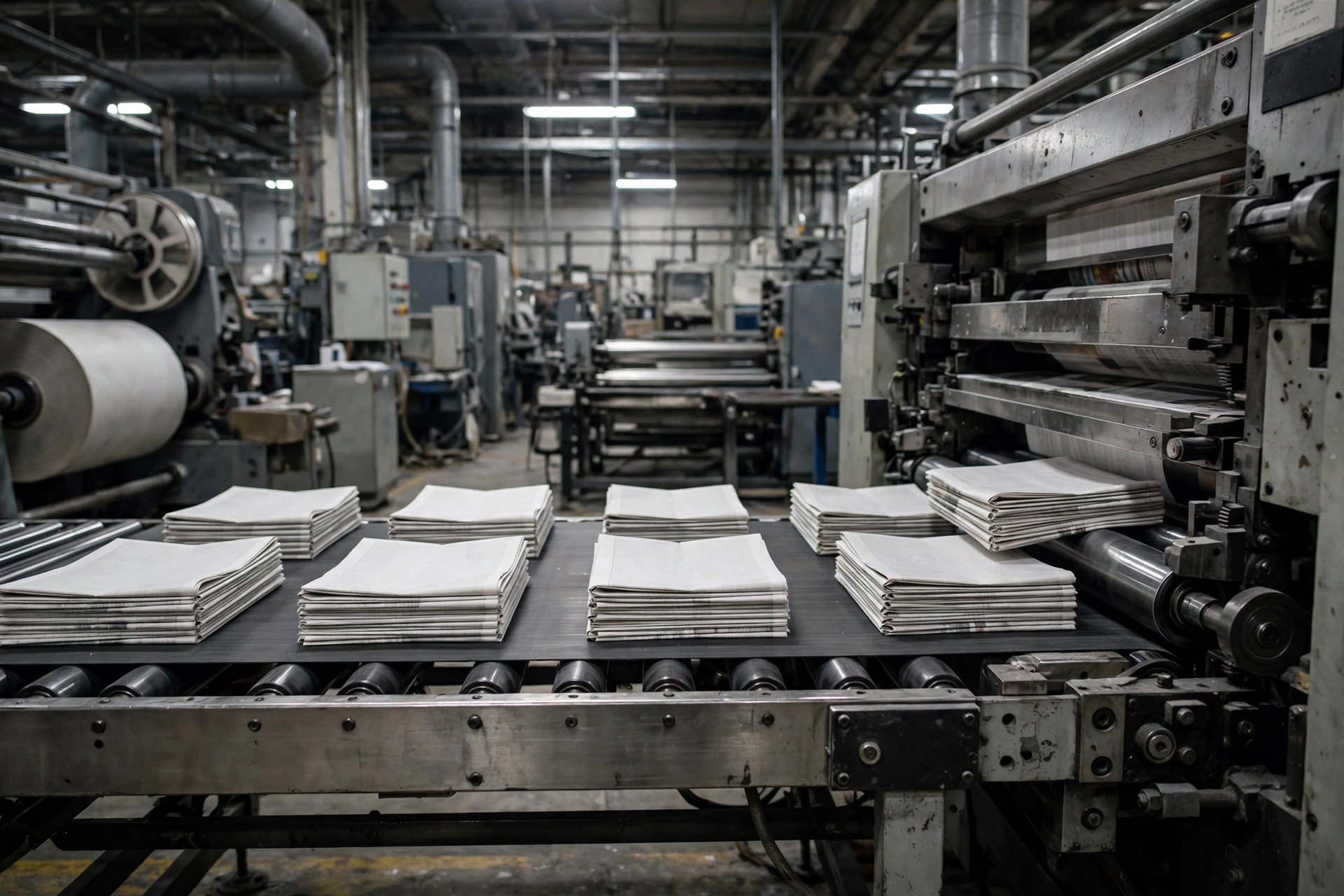
A regional daily newspaper prints 120,000 copies a night on two web offset presses, with a distribution deadline of 23:30. The first trucks leave at 23:45. At 22:40, forty minutes before the deadline, the grid failed. Both presses were running at full speed. The webs broke in every unit on both presses, exactly as the patent literature describes, and the broken web wrapped around the printing cylinders.
The crew needed 55 minutes to clear the wrapped web and re-thread both presses. Wash-up and re-registration took another 25 minutes. The presses restarted at 00:00, and the edition finished 70 minutes late. Twelve thousand copies missed the first distribution trucks, and the newsagents in the outer districts received their papers after the morning peak. The plant paid a penalty to its largest advertiser, whose insert missed the edition, and it paid overtime to a crew that had already worked a full shift.
The plant’s generator was a 500 kVA set that covered the offices, the lighting and the pre-press servers. It did not cover the presses. The board had been sized on the assumption that a newspaper plant needs its generator for lighting and safety, and that the presses could wait for the grid. The outage proved the opposite: the presses were the load that mattered, and the generator that could not run them was a generator that had protected everything except the business. The plant now runs two 1,250 kVA sets in parallel, and the presses are on the essential board. The generator cost less than one lost edition a month would have cost.
Case 2: Magazine heatset plant — the dryer that flamed out
A commercial magazine printer runs a heatset web press on a three-shift pattern, printing 64-page magazines in runs of 40,000 to 80,000 copies. At 14:00 on a Tuesday, the grid failed during a 60,000-copy run. The press stopped. The dryer flamed out with a half-printed web inside it, and the ink on the rollers began to skin within minutes.
The grid returned after 35 minutes. The restart took three hours. The dryer had to be purged before relighting. The press needed a full wash-up, the blankets had to be cleaned, and the press had to re-register across four colour units, consuming several hundred sheets of make-ready paper. Twelve thousand sheets were spoiled. The 64-page job was reprinted the next day at the plant’s cost, and the binding slot it had occupied was lost — the bindery ran a different job, and the magazine shipped a day late.
The plant did have a generator: a 750 kVA set that covered the press drives. It did not cover the chiller, the compressed air or the bindery. The press restarted, but the chill rolls had no chilled water, the pneumatic clutches had no air, and the folder could not run. The restart waited on the grid for the utilities it needed, and the generator ran at quarter load while the clock ran. The plant’s next specification put the chiller, the compressor and the folder on the essential board, and the set grew from 750 kVA to 1,250 kVA. The extra 500 kVA cost less than the single reprint it would have prevented.
Case 3: Packaging flexo plant — the twelve-minute restart
A packaging printer runs a flexo press and a die-cutter on a two-shift pattern, supplying printed cartons to a food manufacturer whose filling line runs on a just-in-time schedule. A missed delivery stops the filling line, and the filling line’s penalty clause is written into the contract. The plant specified a 750 kVA set with a sequenced transfer scheme: Tier 1 first, then compressed air and chilled water, then the dryer fans, then the press drives, with a 10-second delay between steps.
At 11:20 on a Thursday, the grid failed during a 25,000-carton run. The press stopped in a controlled sequence on UPS ride-through: the web was cut, the drives ramped down together, and the web did not break. The generator started in 9 seconds. Air and water came back in the first minute. The press restarted 12 minutes after the failure, with zero web breaks and 400 metres of waste paper — one reel change, not a reprint. The run finished 40 minutes late, inside the delivery window, and the filling line never stopped.
The difference between this plant and the first two was not the size of the generator. The flexo plant’s set was smaller than the newspaper plant’s replacement sets and the same size as the magazine plant’s set. The difference was the transfer scheme, the tiering and the monthly load test that had proved the sequence worked. The plant tests its transfer on load every month, and the test includes the full sequence — air, water, dryer, press — not just the engine start. The generator is the cheapest part of that system. The sequencing is the part that earns its keep.
Frequently Asked Questions
What size generator does a printing plant need?
A small commercial sheetfed shop needs 150–300 kVA for its essential board, a mid-size heatset web plant needs 1,000–1,250 kVA, and a newspaper plant with two web presses needs 2,000–2,500 kVA in parallel sets. Size the set on the essential board — presses, dryer, folder, air, water and pre-press — plus the largest single motor start, with a 15–20% margin. Never size on the whole plant load.
Do printing plants need a backup generator?
Yes, if the plant runs a web press, a heatset dryer or a time-critical edition. A power failure breaks the web in every unit, flames out the dryer and costs 45 to 60 minutes of recovery before the press prints a saleable copy. A sheetfed shop with no deadline can wait for the grid; a newspaper plant, a magazine printer or a packaging supplier to a filling line cannot.
How long can a printing plant run on a generator?
As long as the fuel lasts. A 300 kVA set at 75% load burns about 38 L/h, so a 1,000-litre tank gives roughly 24 hours. A 1,250 kVA set burns about 158 L/h, so 24 hours needs about 3,800 litres. Most plants hold 8–24 hours of fuel and keep a refuelling contract for longer outages. The limit is usually fuel logistics, not the engine.
What happens to a printing press during a power outage?
The press stops, and the web breaks. On a shaftless web press, the driven components decelerate at different rates on inertia, the web tension varies from section to section, and the web breaks in every unit and wraps around the printing cylinders. Clearing the wrapped web takes 15 to 30 minutes and re-threading takes about another 30. Ink skins on the rollers, the dryer flames out, and the press needs a wash-up and re-registration before it prints again.
Can a diesel generator power a printing plant?
Yes. A diesel generator powers the essential board — presses, dryer, folder, compressed air, chilled water and pre-press — through an automatic transfer switch, with a UPS bridging the 8–10 seconds the generator needs to start and accept load. The set must be sized for the largest motor start and checked against the voltage dip the press servo drives will tolerate. Some newspaper plants run their presses on generators as the primary power source because a web break costs more than the fuel.
Specification Checklist: Before You Sign the Order
1. Which loads are on the essential board — in writing? The contract should list every load by tier: safety, presses and dryer, bindery and pre-press, air and water. A board that does not include the air compressor and the chiller is a board that cannot restart the press.
2. Which rating is quoted — ESP, PRP, COP or LTP? The letters must appear on the datasheet and the contract. A sheet that will not name its rating is a warning. Size on the prime rating if the plant expects multi-day outages.
3. What is the largest single motor start, and what voltage dip does it cause? The generator must handle the largest direct-on-line start plus the running load already on the board, without dipping the voltage below what the press servo drives tolerate. Ask for the dip figure in writing.
4. Is the transfer sequenced, and has it been tested on load? The scheme must bring loads on in steps — safety first, then air and water, then dryer, then press — with a 5–10 second delay between steps. A monthly load test that proves the sequence is part of the specification, not an afterthought.
5. How many hours of fuel, and what is the refuelling plan? The sub-base tank holds 8–12 hours. Everything beyond that is a bulk tank with its own bund and permits, and a fuel-polishing and testing programme. A 72-hour tank of untested fuel is a liability.
6. Where does the set live, and what does it breathe? A printing plant is full of paper dust, lint and solvent vapour. The set belongs in its own room or outside, with clean combustion air, a radiator that can be cleaned without stopping the press, and separation from ink and solvent storage.
7. Will the warranty stand at the stated duty? Ask in writing: “If this set runs at the stated duty, for the stated annual hours, at the stated site conditions, will the warranty remain valid?” A direct answer, with the rating letters attached, is worth more than a 5% discount. A vague answer is a warning.
A printing plant buys a generator for one reason: the run that cannot be reprinted. The press, the dryer and the folder are the loads that decide whether an outage is a ten-second interruption or a lost edition, and they are the loads that have to be on the essential board. Size the set for the largest motor start, sequence the transfer, test it on load every month, and keep enough fuel to finish the job. The rest is detail.
For a set sized to a printing plant’s essential board — from a 300 kVA sheetfed shop to a 2,500 kVA newspaper installation — contact PAVO with the load list, the largest motor and its starting method, and the site conditions. A manufacturer that knows its business will price the correct rating from those lines, in open, silent and containerised configurations from 9 to 3750 kVA.