

What Size Generator Does a Prison Need? | PAVO
A prison is the one building where a power cut does not just stop work. It stops the locks, the cameras and the lights — and nobody inside can leave.
What size generator does a prison need? A prison needs a 250–2,500 kVA generator, sized to its bed count, security systems and kitchen — roughly 3.1–4.6 kVA of connected load per bed, with a demand factor near 0.35. A 200-bed county jail typically needs a 250 kVA set; a 1,000-bed state prison needs about 1,250 kVA.
Contents
- What a Prison Actually Needs When the Grid Fails
- How Big: Sizing a Prison Generator by Beds
- The Ten Seconds That Decide Everything
- Fail-Safe, Fail-Secure and the Lock That Cannot Fail
- Three Prisons, Three Outages
- Fuel, Placement and Testing
- Frequently Asked Questions
- Specification Checklist: Nine Questions Before the Contract
What a Prison Actually Needs When the Grid Fails
A prison differs from every other building on a backup-power list in one respect: its occupants cannot leave. A hotel can evacuate its guests. A factory can send its workers home. A prison holds hundreds or thousands of people behind locked doors, and the doors, the cameras, the lights and the air all run on electricity. When the grid fails, the question is not how much revenue is lost. It is whether the building stays secure, habitable and under control.
That is why the load list for a prison is drawn up in tiers, and why the tiers are argued over before any kVA figure is written down. The first tier is life safety: emergency lighting in cell blocks and corridors, fire alarm and detection, exit signs, and the ventilation that keeps air moving through cells. Georgia’s Department of Corrections design standard calls for at least 15 cubic feet per minute of outside or recirculated filtered air per occupant in cells, officer stations and dining areas. Stop the air in a sealed cell block and the temperature and the carbon dioxide rise together.
The second tier is security, and it is the tier that makes a prison unlike a hospital or a school. CCTV cameras and their recording servers, the access-control system, the intercoms, the perimeter fence detection, the control-room consoles and the radio chargers all have to keep running without a gap. A camera that stops recording for ten minutes creates a ten-minute hole in the record of everything that happened in that time. A perimeter sensor that goes dark is an invitation. Virginia’s correctional construction code, 6VAC15-81-1300, states the minimum plainly: standby power must sustain life safety operations, security systems, refrigerators and freezers.
The third tier is operations: the kitchen that feeds the population three times a day, the laundry, the water pumps and sewage lift stations, the medical unit, and the heating and cooling that keeps cell temperatures inside the 65–85°F band that Texas, for example, requires by regulation. The fourth tier is everything else — administrative offices, workshops, classrooms, the chapel — and it is the tier that gets shed first when the generator is loaded.
The mistake most often made in prison backup power is treating the second tier as optional. It is not. A generator that powers the lights but not the security system has kept the building visible and made it blind at the same time.
Life safety comes first, security comes second, everything else waits
The order matters because the generator is never sized for the whole building. It is sized for the loads that must run, in the order they must run. Emergency lighting and fire alarm take power within 10 seconds. Security systems ride on UPS batteries through that same gap and then transfer to the generator. Kitchen and laundry start later, once the set has accepted its first load and stabilised. A load-shedding sequence that is written down, tested and understood by the control room is worth more than an extra 100 kVA of capacity that nobody knows how to use.
A prison is a Level 1 load under NFPA 110
NFPA 110, the Standard for Emergency and Standby Power Systems, classifies emergency power supply systems by Level. Level 1 covers systems where failure could result in loss of human life or serious injury. Prisons are named in the standard’s own guidance as a Level 1 application, alongside hospitals, fire pumps and egress lighting. Hospitals face the same Level 1 classification, and the hospital backup power article covers the three-branch essential electrical system in detail. That classification carries consequences: stricter testing, stricter fuel storage, and a 2-hour fire-rated separation for the Level 1 generator room. A prison generator is not a convenience. It is a life-safety system, and it is specified, tested and inspected as one.
How Big: Sizing a Prison Generator by Beds
Prison sizing starts from a figure that looks crude until the arithmetic behind it is understood: kVA per bed. A 1997 load calculation for the Larimer County Detention Facility in Colorado analysed four correctional facilities and found NEC calculated loads of 3.1 to 4.6 kVA per bed — Sterling Correctional Facility at 4.4, Limon at 3.1, the Denver Reception and Diagnostic Center at 4.6, and Larimer itself at 3.7. Those figures are connected load, not demand. The same study applied a demand factor of 0.295 to 0.387, taken from historic operating data at Colorado Department of Corrections facilities. The projected demand for the expanded Larimer facility came to 721 kVA against an existing 850 kVA set — adequate for the entire building, existing plus new, on generator power alone.
The spread of 3.1 to 4.6 kVA per bed is wide because prisons differ. A minimum-security dormitory with open bays and natural ventilation sits at the low end. A maximum-security facility with individual cells, electronic locks on every door, a full CCTV network, a commercial kitchen and a medical unit sits at the high end. The per-bed figure is a starting point for the load inventory, not a substitute for one. The inventory is where the sizing is actually decided, and the generator sizing guide sets out the method: list every load, record running and starting demand, apply a demand factor, and add a margin for growth.
A worked example: a 1,000-bed state prison
The table below is a load inventory for a 1,000-bed medium-security state prison, built from the load categories that appear in correctional design standards. Running loads are shown at normal operation; starting demand for the largest motors is handled separately, in the motor starting section of the design.
| Load | Running load (kW) | Notes |
|---|---|---|
| Cell block lighting and receptacles | 120 | Emergency and general lighting, cell outlets |
| Security systems (CCTV, access control, intercom, perimeter) | 45 | Continuous load, UPS-backed through transfer |
| Kitchen (cook line, refrigeration, dishwashers) | 150 | Largest single non-HVAC load |
| Laundry (washers, dryers, ironers) | 80 | Gas-heated dryers reduce this sharply |
| Water pumps and sewage lift stations | 60 | Sewage lift is life safety in a sealed building |
| HVAC (partial — cell blocks and control room) | 200 | Full HVAC roughly doubles this figure |
| Medical unit | 40 | Examination rooms, refrigeration, dialysis |
| Administration and communications | 25 | Control room, radio, telephones, servers |
| UPS recharge | 30 | Recharges the security UPS after transfer |
| Total running load | 750 |
750 kW at 0.8 power factor is 938 kVA. Add a 20% margin for growth and for motor starting, and the requirement is about 1,125 kVA. The next standard frame up is a 1,250 kVA set — or two 625 kVA sets in parallel, which gives the prison N+1 redundancy: one set can be down for service and the building still has full emergency power. For a prison, that redundancy is usually worth the extra switchgear cost, because there is no such thing as a convenient time to take a prison’s only generator offline.
Sizing bands by facility size
The bands below use the same method — connected load at 3.1 to 4.6 kVA per bed, a demand factor near 0.35, and the essential-load slice that the generator actually carries. They are planning bands, not quotations. The load inventory for the specific building always has the last word.
| Facility | Beds | Connected load | Essential demand | Typical set |
|---|---|---|---|---|
| Small county jail | 100–300 | 310–1,380 kVA | 150–300 kVA | 250 kVA |
| Medium county jail | 300–800 | 930–3,680 kVA | 300–600 kVA | 500 kVA |
| State prison | 800–1,500 | 2,480–6,900 kVA | 700–1,200 kVA | 1,000–1,250 kVA |
| Large prison complex | 1,500–3,000 | 4,650–13,800 kVA | 1,500–2,500 kVA | 2 × 1,250 kVA |
The most common sizing error in this sector is the opposite of the usual one. Buyers do not normally undersize a prison generator — the stakes are too visible. They oversize it, and then run it at 15–20% load for the rest of its life. A diesel set that never reaches 30% load wets stacks, glazes cylinders and fails its monthly test in the slow, quiet way that only shows up when the grid actually fails. The standby and prime ratings article explains why the rating and the load factor matter as much as the kVA figure: a standby-rated set is designed for up to 200 hours a year at variable load, and a set that idles at light load for years is being misapplied even if its nameplate is generous.
The Ten Seconds That Decide Everything
NFPA 110 Type 10 requires the emergency power source to be available within 10 seconds of a utility failure. Ten seconds covers detection, engine start and transfer. It is the same 10-second rule that governs hospitals and fire pumps, and it exists for the same reason: in a prison, ten seconds of darkness in a cell block is ten seconds in which nobody can see what is happening and nobody can prove what happened afterwards.
The sequence is mechanical and unforgiving. The automatic transfer switch senses the loss of utility voltage, usually after a delay of one to three seconds to ride through momentary dips. It signals the generator to start. The engine cranks, reaches rated speed and voltage, and the switch transfers the emergency bus to the generator. A well-maintained set does this in seven to nine seconds. A set with a weak starting battery, a cold engine or a sticky fuel solenoid does it in twelve — and twelve seconds is a failed test. The same 10-second rule shapes backup power for police stations and fire stations, where dispatch and bay doors cannot wait either.
The UPS bridges the gap. Security systems — CCTV, access control, intercoms, the control-room consoles — sit on uninterruptible power supplies that carry them through the start and transfer. The St. Louis City Justice Center policy states this explicitly: a UPS provides short-term power to essential electronic security systems, elevator lighting, data systems, the telephone system and the fire safety system while the generator starts. The UPS is sized for minutes, not hours. If the generator does not start, the UPS buys the control room perhaps fifteen minutes to recognise the failure and act. After that, the security system is dark.
Class 48 and Class 72: how long the set must run
NFPA 110 Class is the duration, in hours, that the system must be able to run at full rated load. Class 48 means 48 hours of fuel on site. Class 72 means 72 hours. Virginia’s correctional code requires a minimum of 72 hours of fuel without refuelling, and the St. Louis policy matches it: an 8,000-gallon tank that delivers about 72 hours at full capacity. Seventy-two hours is the floor for a prison, not the target. A hurricane or an ice storm that takes the grid down for a week does not respect a 72-hour fuel plan, and the fuel-delivery contract — a named supplier, a named phone number, a priority delivery clause — is part of the generator specification, not an afterthought.
Testing is where the ten seconds are proven
NFPA 110 Chapter 8 requires a monthly exercise of at least 30 minutes at not less than 30% of nameplate kW, or at a load that keeps the manufacturer’s minimum exhaust gas temperature. Every 36 months, a Level 1 system takes a 4-hour test. The St. Louis policy goes further: a quarterly test under full building load, or a simulated power outage, for 30 minutes, with refuelling after every test. The quarterly full-load test is the one that finds the problems a monthly no-load run never will — the transfer switch that hesitates, the set that sags when the kitchen load lands, the battery that cranks slowly on a cold morning. A prison that tests only at no load is testing its engine. A prison that tests at full load is testing its power system.
Fail-Safe, Fail-Secure and the Lock That Cannot Fail
Every door in a prison is either fail-safe or fail-secure, and the difference is decided at the design stage, not during an outage. A fail-safe lock unlocks when power is lost. A fail-secure lock stays locked when power is lost. The choice is a deliberate trade between two risks: the risk of people being trapped in a fire, and the risk of people walking out of a cell block during a blackout.
Cell doors on the means of egress are fail-safe, because fire codes require it. A prisoner must be able to get out of a burning cell block, and the door that will not open in a fire is a death trap. Cell doors inside a housing unit, and the doors to segregation units, control rooms and armouries, are fail-secure, because a blackout must not open every cell in the building at once. The perimeter gates are fail-secure. The sally port — the double-gated airlock through which vehicles enter — is designed so that one gate cannot open until the other has closed, and that interlock has to hold on emergency power, not just on grid power.
The complication is that the locks themselves are only half the system. The other half is the control system that operates them. Modern cell doors are opened from the control room, in groups, by an officer at a console. The console, the door controllers, the wiring and the intercom all need power. When the power goes, the manual override has to work — and the manual override in many facilities is a pneumatic or mechanical release that itself needs compressed air or a charged battery. Virginia’s code requires emergency release provisions for unlocking or group release of cell doors in case of fire, power failure or other emergencies. The requirement is written in those words because the alternative has already happened: prisoners locked in cells, in the dark, with no air, while the water rises.
The CCTV blind window
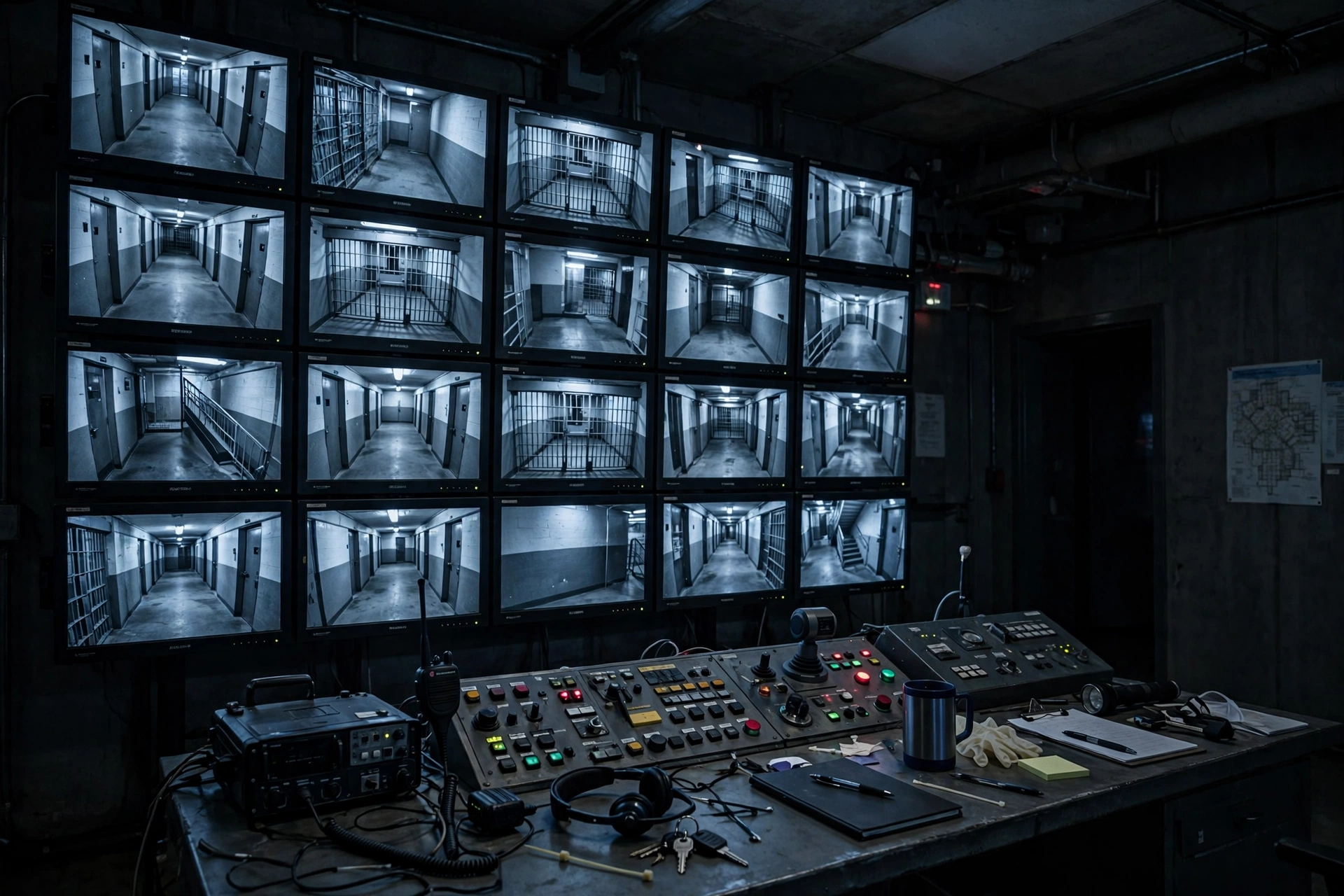
The camera system fails differently from the locks. Cameras do not unlock or lock. They stop recording. A CCTV network that loses power for ten seconds loses ten seconds of footage from every camera, and the recording server that restarts after an unplanned shutdown may take minutes to come back online and re-synchronise its cameras. During those minutes, the control room sees frozen frames or black screens. The UPS that bridges the generator start is therefore sized for the cameras and the servers first, and for the office computers last. A camera network that rides through on UPS and transfers cleanly to generator power has no blind window at all. One that does not has a gap in the record that cannot be filled afterwards, and in a prison, the record is evidence.
Group release and the fire plan
The fire plan for a prison assumes that power may be gone and that smoke may be present. Group release — opening a whole tier of cell doors from the control room with one action — is the mechanism that makes evacuation possible without an officer walking the tier with a key. It needs power at the control console and at the door operators. If the generator does not start, group release does not work, and the evacuation becomes a manual operation, tier by tier, key by key, in the dark. That is the scenario the monthly full-load test exists to prevent. The test is not a formality. It is the only proof, short of a real outage, that the doors will open when they have to.
Three Prisons, Three Outages
Case 1: Orleans Parish Prison, Hurricane Katrina, 2005
Orleans Parish Prison in New Orleans held 6,375 prisoners on 29 August 2005, the day Hurricane Katrina made landfall. The jail’s generators failed that day. Without power there were no lights, no air circulation and no working toilets. The next day the jail ran out of food. Deputies walked off their posts. Prisoners broke windows to get fresh air and set fires to signal to those outside that they were trapped inside.
In Templeman III, one of several buildings in the compound, more than 600 inmates were held with no correctional officers in the building at all. Floodwater on the ground floor rose to chest level. Prisoners who could force their cell doors open did so; those who could not waited in locked cells while bodily waste flowed from non-functioning toilets. They had no food or water from their last meal on the weekend of 27–28 August until they were evacuated on Thursday 1 September. The evacuation of the whole prison was not completed until Friday 2 September — four days after the generators died.
The failure was not a single broken part. The ACLU’s 2006 report records a sergeant and a corporal attempting to fill a generator with diesel fuel, neither of them knowing how to make the generator work, and the set eventually failing. The sheriff had declined the state Department of Corrections’ offer to help evacuate the prison before the storm. The emergency operations plan the sheriff said the prison was operating under did not, in the aftermath, appear to exist in any usable form. Six hundred people in one building, no power, no staff, no plan, and water rising to chest height: that is what a failed generator means in a prison. It does not mean a dark building. It means an uncontrolled one.
Case 2: Texas, Winter Storm Uri, 2021
Winter Storm Uri reached Texas in February 2021 and took the state’s electric grid down with it. Thirty-two of the state’s nearly 100 prisons were running on backup generator power at the worst of the outages, and 33 had no water or low water pressure. The generators, for the most part, started. The problem was what they were connected to.
Texas jails are required to keep temperatures between 65 and 85 degrees. During Uri, many facilities’ heating systems were not connected to emergency power at all. Inmates at a Harris County jail reported that when the power went out, the generators restored very little power: most lights did not come on, electrical outlets were unusable, and the heat stopped working. The air blowing through the vents was too cold to provide any relief. Toilets filled and stayed filled for four days. Staff handed out cardboard to cover them. In Bastrop County Jail, a 60-year-old inmate spent a day without any water to drink after the heater broke and the jail lost running water. Bottled water was rationed to 16-ounce bottles, and the same bottle was meant to cover drinking, washing hands and brushing teeth.
The lesson of Uri is about the load list, not about the generator. A set that starts and runs is not enough. If the heating system, the water pumps and the cell-block lighting were never put on the emergency panel, the generator can run perfectly for a week while the building becomes uninhabitable. The load tiers in the first section of this article are drawn up precisely so that this mistake is caught on paper, before the outage, instead of being discovered by the people locked inside.
Case 3: St. Louis City Justice Center — the set that worked
The St. Louis City Justice Center shows the other side of the same coin. Its emergency generator sits on the sixth floor, fuelled from an internal 8,000-gallon tank, and at full capacity it produces power for approximately 72 hours. On loss of utility power it delivers power to emergency lighting, doors, elevators, fire alarms, communication telephones, data systems, air circulation, cameras and essential jail operations. A UPS carries the security systems, elevator lighting, data systems, telephones and fire safety system through the start and transfer.
What distinguishes the St. Louis policy is not the hardware. It is the routine around it. Maintenance staff inspect the generator weekly. They test it quarterly, under a full building load or a simulated power outage, for 30 minutes, and refuel it after every test. When a test problem occurs, they identify it, call the service representative, supervise the repair and re-test. The generator checklist is completed, the original kept on file. Nothing in that routine is expensive. All of it is the difference between a generator that starts when the grid fails and a generator that somebody tries to fill with diesel, by hand, in the dark, during a hurricane.
Fuel, Placement and Testing
Fuel autonomy for a prison is arithmetic, and the arithmetic is unforgiving. The Cummins C500D5, a 500 kVA standby / 455 kVA prime set that appears in many institutional specifications, burns 93.2 litres per hour at full prime load, 69.9 at 75%, 49.0 at 50% and 29.2 at 25%. A prison generator does not run at full load; it runs at the essential load, which is typically 50–75% of its rating. The table below shows what 72 hours — the Virginia minimum — actually requires at three common sizes, and what a 7-day outage would require. The fuel in those tanks has to be tested and polished, because diesel fuel ageing turns stored diesel into water, microbes and sludge, and a generator that starts on bad fuel stops on bad fuel.
| Set size | Load | Fuel use (L/h) | 72 hours | 7 days |
|---|---|---|---|---|
| 250 kVA | 75% | ~35 | ~2,500 L | ~5,900 L |
| 500 kVA | 75% | 69.9 | ~5,000 L | ~11,700 L |
| 1,250 kVA | 75% | ~175 | ~12,600 L | ~29,400 L |
A 1,250 kVA set needs roughly 12,600 litres — about 3,300 US gallons — for 72 hours, and about 29,400 litres for a week. The St. Louis 8,000-gallon tank, about 30,300 litres, is sized for a 500 kVA-class set running a full week, not for a 1,250 kVA set running three days. The tank and the set are specified together, and the fuel-delivery contract is specified with them. A prison that cannot get a fuel truck through a flooded road or a snow-blocked gate needs the fuel already on site. That is what the 72-hour rule is for.
Placement: inside the fence, out of reach, out of the flood
A prison generator is placed under three constraints that rarely apply together anywhere else. It must be inside the secure perimeter, because a set outside the fence is a set that can be reached, tampered with or stolen from. It must be above the flood line, because a generator in a basement that floods is a generator that drowns — and the Orleans Parish Prison case shows what happens when the power system and the floodwater occupy the same level. And it must be separated from the rest of the building by 2-hour fire-rated construction, because NFPA 110 requires it for Level 1 systems.
The practical answer is usually a purpose-built generator house or a weatherproof enclosure on a raised plinth inside the secure yard, with the fuel tank bunded, the exhaust routed clear of air intakes, and the whole installation visible from the control room’s cameras. Ventilation matters here as it does everywhere: a 1,250 kVA set rejects roughly 900 kW of heat into its room at full load, and a generator house that cannot move that heat will trip its own set on high temperature. The enclosure also has to be quiet enough not to breach the noise limits that apply at the perimeter — a silent canopy at 65–75 dB(A) at 7 metres is the normal choice, and the same acoustic treatment that keeps the neighbours quiet keeps the cell blocks habitable.
Security of the installation itself is a design input, not an afterthought. Fuel filler caps are locked and caged. The generator house door is on the access-control system. The fuel level is telemetered to the control room, so a falling level is noticed in minutes rather than discovered at the next weekly inspection. A prison that has had fuel stolen from its own tank — and the telecom-tower experience shows how common fuel theft is at remote sites — has lost its 72 hours without knowing it.
Testing that proves the system, not the engine
The monthly 30-minute test at 30% of nameplate is the minimum. For a prison it is not enough on its own, and the facilities that get this right test further. The quarterly full-load test, under the real building load or a simulated outage, is the test that proves the transfer switch, the load-shedding sequence and the door-release system all work together. The annual test should include the fire plan: a simulated evacuation of one tier on generator power, with the control room releasing the doors and the officers moving the prisoners. The 36-month 4-hour test runs the set long enough to find the faults that only appear with heat — the fuel line that vapour-locks, the radiator that cannot hold temperature, the battery charger that cannot keep up.
Records matter as much as the tests. NFPA 110 requires the test records to be kept, and a prison’s records are the evidence that the system was maintained. When a generator fails during a real outage, the first question asked afterwards is when it was last tested, under what load, and what the result was. A prison that can answer that question with a file of dated, signed test sheets is in a different position from one that cannot.
Frequently Asked Questions
What size generator does a prison need?
A prison needs a 250–2,500 kVA generator, depending on bed count. A 200-bed county jail typically needs a 250 kVA set, a 1,000-bed state prison about 1,250 kVA, and a 3,000-bed complex about 2,500 kVA in two parallel sets. Connected load runs 3.1–4.6 kVA per bed, with a demand factor near 0.35. The load inventory for the specific building always has the last word.
Do prisons need a backup generator?
Yes. Prisons are a Level 1 application under NFPA 110, which means failure of the emergency power system could result in loss of life. Virginia’s correctional code requires standby power for life safety, security systems and refrigeration, with a minimum of 72 hours of fuel. Without a generator, a power cut stops the locks, the cameras, the lights and the air in a building whose occupants cannot leave.
How long can a prison run on a generator?
A prison can run on a generator for as long as its fuel lasts — 72 hours is the usual minimum, set by state codes such as Virginia’s 6VAC15-81-1300. A 500 kVA set at 75% load burns about 70 litres per hour, so 72 hours needs roughly 5,000 litres. Longer outages need a larger tank or a contracted fuel delivery, and the delivery contract should be in place before the storm, not negotiated during it.
What happens to a prison during a power outage?
The emergency systems transfer to generator power within 10 seconds under NFPA 110 Type 10, and security systems ride through on UPS. If the generator fails, the building goes dark: cell doors stay locked or release only manually, CCTV stops recording, ventilation stops, toilets back up, and food and water run out. At Orleans Parish Prison in 2005, generators failed and 6,375 prisoners spent four days without power, food or water.
Can a diesel generator power a prison?
Yes. A diesel generator can power a prison’s essential loads — emergency lighting, security systems, kitchen, laundry, water pumps, medical unit and partial HVAC — for days, provided it is sized to the load inventory, fuelled for at least 72 hours and tested under full load. It cannot normally power the entire building at full load; non-essential loads are shed, and the set is sized for the essential slice, not the connected total.
Specification Checklist: Nine Questions Before the Contract
1. Which loads are on the emergency panel, and in what order do they transfer? The list must name life safety, security, kitchen, laundry, water, medical and HVAC separately, with the transfer sequence written down. If heating is not on the emergency panel, the generator can run perfectly while the building freezes.
2. What is the kVA-per-bed figure, and what demand factor was applied? Expect 3.1–4.6 kVA per bed connected and a demand factor near 0.35. A quotation that states only a kVA figure, without the load inventory behind it, should be returned for clarification.
3. Is the set Level 1, Type 10, Class 48 or better? Ten seconds to restore power, 48 to 72 hours of fuel on site. The classification should appear on the datasheet and the contract.
4. Are the locks fail-safe where the fire code requires it, and fail-secure everywhere else? The door schedule must state the behaviour of every door on loss of power, and the group-release system must work on generator power.
5. How long does the UPS carry the security systems? Long enough to bridge the generator start and transfer, with margin. CCTV, access control and the control-room consoles are the first loads on the UPS, not the last.
6. What is the fuel capacity, and who delivers the next load? Seventy-two hours on site is the minimum. The delivery contract — named supplier, priority clause, phone number — is part of the specification.
7. Where does the set sit, and can it be reached or flooded? Inside the secure perimeter, above the flood line, in a 2-hour fire-rated enclosure, with locked fuel fillers and a telemetered fuel level.
8. What does the test regime look like? Monthly 30 minutes at 30% of nameplate as the minimum, quarterly full-load or simulated-outage tests, a 4-hour test every 36 months, and written records of every test. The quarterly full-load test is the one that finds real faults.
9. Will the warranty stand at the stated duty and site conditions? Ask in writing, with the rating, the annual hours and the site conditions attached. A direct answer is worth more than a discount.
A prison generator is bought once and relied on for twenty years. The specification that matters is not the headline kVA figure. It is the load list, the ten-second transfer, the locks that behave correctly in the dark, the fuel that is already on site, and the test record that proves the system works. Get those five things right and the building stays secure, habitable and under control through the longest outage the grid can deliver. Get any one of them wrong and the generator becomes the most expensive decoration in the yard.
To specify a set for a correctional facility, or to check an existing installation against the nine questions above, contact PAVO — PAVO builds open, silent and containerised diesel generator sets from 9 to 3750 kVA, powered by Cummins, Weichai, Yuchai and Shanghai Diesel, and supplies correctional, hospital and institutional backup power in more than 20 countries.