

What Size Generator Does a Laboratory Need? | PAVO
A laboratory sells nothing but results, and every result depends on a freezer holding minus 80, a fume hood holding its face velocity, and an instrument holding its calibration.
What size generator does a laboratory need? A small teaching laboratory typically needs a 30–60 kVA set, a university research laboratory 100–250 kVA, and a pharmaceutical quality-control laboratory or biobank 250–500 kVA. The figure covers ultra-low freezers, fume hoods and instruments, plus the cooling that keeps them running — and the compressor restart surge most quotations forget.
- What a Laboratory Actually Needs Power For
- The Minus-80 Window: What an Outage Actually Costs
- Sizing the Set: Three Laboratory Sizes
- The First Ten Seconds: ATS, UPS and the Restart Surge
- Fume Hoods, Gas and the Safety Case
- Fuel, Noise and the Urban Problem
- Frequently Asked Questions
- Specification Checklist
What a Laboratory Actually Needs Power For
A laboratory’s electrical load looks modest on a schedule and behaves unlike any other commercial load. There are no production lines, no furnaces, no large process motors. The load is dozens of small, always-on loads — freezers, incubators, instruments — plus a small number of safety loads that cannot tolerate a single second without power. That combination is what makes the sizing easy to get wrong in both directions: a set sized from the building’s total demand is far too large, and a set sized from the benches alone is far too small.
The loads fall into four tiers. The first tier is cold storage: ultra-low freezers, minus-20 freezers, refrigerators and liquid-nitrogen backup systems. The second tier is safety: fume hoods, exhaust fans, gas detection and emergency lighting. The third tier is instruments: chromatographs, spectrometers, sequencers, centrifuges and the computers that control them. The fourth tier is the building: HVAC, water, lifts and the rooms the people work in. A set that covers the first three tiers keeps the laboratory’s work alive. A set that covers all four keeps the laboratory comfortable. The specification has to state which one the buyer is paying for, because the difference between them is roughly half the set size.
The scale of what is at stake is visible in the numbers. A single 600-litre ultra-low freezer holds 40,000–50,000 sample vials. A university biobank with 40 such freezers holds two million vials. A pharmaceutical quality-control laboratory holds reference standards and stability samples that cannot be remade: a stability programme runs for five years, and a sample lost in year four has no replacement. The generator is not protecting a building. It is protecting work that took years to accumulate and cannot be repeated.
Ultra-Low Freezers: The Load That Never Sleeps
An ultra-low temperature freezer is the most demanding load in a laboratory, and the easiest to underestimate. A modern 600–700 litre ULT freezer draws 700–1,000 W running, with a compressor start that pulls 2,000–3,000 W for a fraction of a second. A laboratory with 20 freezers draws 14–20 kW continuously, day and night, weekends included. The load never drops, because the freezers never switch off. A set sized for a laboratory’s daytime load and not its 24-hour load is undersized from the first night.
The freezer load is also almost perfectly flat, which is good news for the engine. A diesel set likes a steady load, and a freezer room gives it one: the compressors cycle, but the room total stays within a few percent of its average for weeks at a time. The problem is the restart. When the power returns after an outage, every compressor in the room tries to start at once, and the combined starting surge is three to four times the running load. A 20-freezer room drawing 18 kW running can demand 55–70 kVA of starting apparent power for a second. The motor starting sequence has to stagger the restarts, or the set has to be sized for the surge. Most quotations do neither, and the first real outage is when the buyer finds out.
Fume Hoods and Exhaust: Safety, Not Comfort
A fume hood is a safety system, not a piece of bench equipment. It holds a face velocity of 0.5 m/s — about 100 feet per minute — across its open sash, and it does that by exhausting 700–900 m³/h of air for a standard 1.8-metre hood. The exhaust fan motor is 1.1–2.2 kW, and a laboratory with 12 hoods draws 15–25 kW of fan power. When the power fails, the hoods stop, the face velocity falls to zero, and any volatile chemical on the bench is no longer contained. The laboratory’s own safety rules then require evacuation, and the work stops whether the freezers survive or not.
The exhaust load is also the load with the worst diversity. Hoods are not all open at once, and variable-air-volume systems turn the fans down when the sashes close. A VAV laboratory’s exhaust load at 3 a.m. can be a third of its midday load. The sizing has to use the worst case — all sashes open, all fans at full speed — because the outage that matters is the one that happens at 2 p.m. on a working day, not the one that happens at night.
Instruments, Incubators and the Calibration Problem
The third tier is small, expensive and unforgiving. A single LC-MS system draws 2–3 kW and takes four to six hours to restabilise after a power cut: the vacuum has to be re-established, the source has to be re-tuned, and the calibration has to be repeated before a single sample can run. A DNA sequencer draws 1–2 kW and a run in progress is lost when the power fails — a run that took three days to prepare and costs $5,000–10,000 in reagents alone. A CO₂ incubator draws 200–400 W, but the cell cultures inside it die if the temperature rises by more than a few degrees for more than an hour.
Two details matter here. The first is power quality. Analytical instruments need clean, stable power, and a generator that hunts in frequency or sags in voltage will trip the instrument’s own protection, or worse, corrupt a run without tripping anything. The set has to hold ±1% frequency and ±2% voltage under a step load, which means a properly sized alternator and a fast governor, not the cheapest set that meets the kVA figure.
The second detail is the restart. Instruments do not come back on their own. A mass spectrometer that loses vacuum needs a trained operator to restart it, and the restart takes hours. The laboratory’s outage plan has to list every instrument, who restarts it, and in what order — because the generator can only protect the instruments that are on its essential bus, and the instruments on the non-essential bus are lost the moment the grid fails.
The Minus-80 Window: What an Outage Actually Costs
A laboratory measures an outage in samples, not in kilowatt-hours. The grid fails, the automatic transfer switch moves the essential bus to the generator, and if everything works, the freezers never notice. If anything in that chain fails, the laboratory starts losing its work within hours, and the cost of that work is measured in years, not in electricity. The arithmetic is worth doing before the outage, because it is the arithmetic that justifies the generator.
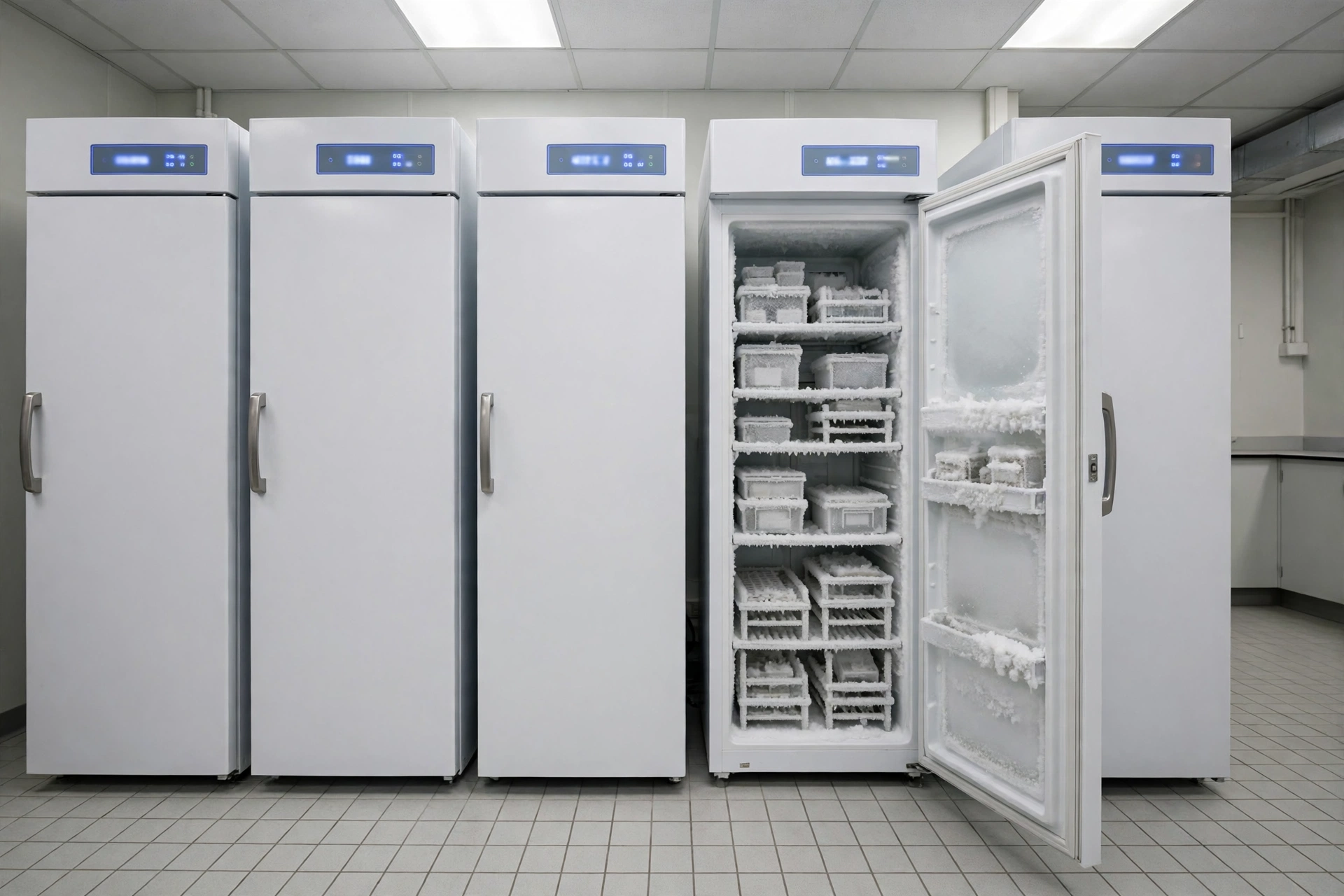
The thaw window is the number that decides everything. A well-insulated ultra-low freezer, full of samples and never opened, warms from minus 80°C at roughly 1°C per hour in the first hours after power loss. It reaches minus 70°C — the alarm threshold most biobanks set — in about 8–12 hours, and minus 50°C in 18–30 hours, depending on how full it is and how often the door is opened. RNA and enzymes degrade above minus 60°C. Cell lines thaw and die above minus 40°C. A freezer that is opened once during an outage, to check on the samples, warms twice as fast. The generator has to be running within the first hour, or the laboratory is working against a clock it cannot stop.
The cost of missing the window is not the cost of the freezer. A ULT freezer costs $10,000–$20,000. The samples inside it are worth far more: a single freezer in a cancer biobank can hold tissue from 2,000 patients, collected over ten years under an ethics approval that cannot be re-issued for the same patients. A pharmaceutical stability laboratory holds samples worth $50,000–$200,000 per batch in reference standards alone. The generator that protects them costs less than one freezer’s contents.
Case 1: The North Carolina Ice Storm
In February 2026, an ice storm cut power to a research university in North Carolina with 28,000 students. The biomedical research building lost its backup power — not because the generator failed mechanically, but because a corroded battery terminal prevented the engine from cranking. The generator sat silent for 11 hours while $2.3 million in tissue samples, cell cultures and reagents reached ambient temperature in freezers rated for 72 hours of backup power that never arrived.
The failure was not the engine. It was the starting battery, a component that costs $300 and takes 20 minutes to inspect. The university’s own maintenance guide, published after the event, puts it plainly: a structured preventive maintenance programme is the difference between power resilience and catastrophic loss. The generator had been tested monthly — on no load, for 30 minutes, with the battery never tested under cranking load. The test proved the engine could run. It never proved the engine could start.
Case 2: Hurricane Sandy and NYU Langone
In October 2012, Hurricane Sandy flooded the basement of NYU Langone Medical Center in New York. The hospital’s emergency generators were in the basement. They flooded, and the hospital evacuated 215 patients down dark stairwells. The research floors lost power for days. Thousands of research mice died. Years of samples in ultra-low freezers were lost, including work on cancer and stem cells that had taken a decade to accumulate.
The lesson is not about the storm. It is about placement. A generator in a flood zone is a generator that fails at the same time as the grid, which is the one moment it is needed. The hospital rebuilt its emergency power plant on higher ground, with the generators above the flood line and the fuel tanks protected. A laboratory that puts its generator in the basement because the space is free is making the same bet NYU Langone made, and the odds are the same.
Case 3: The Contract Laboratory in Pune
In June 2024, a monsoon storm cut power to a contract testing laboratory in Pune, India, for six hours. The laboratory ran pharmaceutical quality-control testing for export clients, and its 40 ultra-low freezers held stability samples for 12 products. The laboratory had a 125 kVA set, installed two years earlier, and it started on the first crank. The freezers never rose above minus 78°C.
The laboratory’s director put the cost of the outage at $180,000 — the value of the samples that would have been lost, the re-testing that would have been required, and the client audits that would have followed. The generator cost $28,000 installed. It paid for itself in one afternoon, and it has been tested under load every month since, with the starting battery replaced on a two-year schedule regardless of condition. The laboratory’s rule is simple: the battery is a consumable, not a component.
Sizing the Set: Three Laboratory Sizes
Sizing a laboratory generator starts with the load list, and the load list starts with the freezers. Everything else — hoods, instruments, HVAC — is added after the freezers are counted, because the freezers are the load that never switches off and the load that cannot be shed. A set sized from the freezers up is a set that works. A set sized from the building’s total demand down is a set that is either too large or too small, and the buyer only finds out which on the first real outage. The step-by-step load-list method is set out in the generator sizing guide.
| Laboratory type | Running load | Starting surge | Recommended set | Typical fuel use at 75% load |
|---|---|---|---|---|
| Small teaching laboratory, 6–10 freezers, 4 hoods | 25–40 kW | 60–80 kVA | 30–60 kVA | 8–12 L/h |
| University research laboratory, 20–40 freezers, 12 hoods, instruments | 60–120 kW | 180–260 kVA | 100–250 kVA | 20–45 L/h |
| Pharmaceutical QC laboratory or biobank, 60+ freezers, cleanrooms | 150–300 kW | 400–700 kVA | 250–500 kVA | 50–100 L/h |
The table is a starting point, not a specification. Every laboratory has to be measured, because the load depends on the equipment schedule, not on the floor area. A 500-square-metre laboratory with 40 freezers draws more power than a 1,000-square-metre laboratory with 10. The measurement has to be done at the distribution board, with a clamp meter, over a full week — because the load at 3 a.m. on a Sunday is the freezer load, and the load at 2 p.m. on a Tuesday is the freezer load plus everything else.
The Small Teaching Laboratory
A small teaching laboratory — a university department, a school science block, a private testing laboratory with a handful of freezers — typically needs a 30–60 kVA set. The load is 25–40 kW running, and the set is small enough to sit in a canopy outside the building, with a sub-base tank that holds 8 hours of fuel. The cost is $8,000–$15,000 installed, and the set can be delivered, installed and commissioned in a week.
The mistake small laboratories make is buying a portable set. A portable generator has no automatic transfer switch, no automatic start, and no fuel autonomy. It has to be wheeled out, fuelled, started by hand, and connected by cable — in the dark, in the rain, by whoever happens to be on site. A teaching laboratory that loses power at 2 a.m. has nobody on site to do any of that. The set has to start itself, and it has to start within 10 seconds, because the freezers do not wait for a technician to arrive.
The University Research Laboratory
A university research laboratory — 20–40 freezers, 12 fume hoods, a mass spectrometry suite and a cell-culture room — typically needs a 100–250 kVA set. The load is 60–120 kW running, and the set is large enough to need a dedicated plant room or a containerised enclosure, with a bulk fuel tank that holds 24–72 hours of fuel. The cost is $35,000–$90,000 installed, and the lead time is 8–12 weeks.
The sizing decision for a research laboratory is not the kVA figure. It is the tier decision: which loads go on the essential bus, and which do not. The freezers, the fume hoods and the instruments go on the essential bus. The general lighting, the offices and the non-essential HVAC do not. The difference between the two lists is roughly half the set size, and the laboratory’s safety officer has to sign the essential-bus list, because it is a safety decision, not an engineering one. The standby and prime ratings of the set have to match the duty: a set that runs for 72 hours on a long outage is running on its prime rating, not its standby rating, and the difference is 10% of the kVA figure.
The Pharmaceutical Laboratory and the Biobank
A pharmaceutical quality-control laboratory or a biobank — 60 or more freezers, cleanrooms, stability chambers and a validated environment — typically needs a 250–500 kVA set, and often two sets in parallel. The load is 150–300 kW running, and the set has to hold its voltage and frequency within the limits the instruments demand. The cost is $120,000–$250,000 installed, and the commissioning includes a full load-bank test, a witnessed factory acceptance test, and a validation file that the quality department signs off.
The biobank’s sizing decision is redundancy, not capacity. A single set is a single point of failure, and a biobank that holds two million vials cannot accept a single point of failure. Two 250 kVA sets in parallel, each able to carry the essential load alone, cost roughly 60% more than one 500 kVA set — and the biobank buys them anyway, because the cost of losing the samples is a hundred times the cost of the second set. The parallel configuration also lets one set be serviced while the other carries the load, which is the only way a biobank can do maintenance without taking its freezers off backup power.
The First Ten Seconds: ATS, UPS and the Restart Surge
The first ten seconds of an outage decide whether a laboratory keeps its work or loses it. The grid fails, the automatic transfer switch senses the loss, the generator cranks, the engine reaches speed, the alternator builds voltage, and the switch transfers the essential bus to the generator. The whole sequence takes 8–10 seconds on a properly maintained set, and it is the longest ten seconds in the laboratory’s year — because every load on the essential bus is without power for that time, and every load without a UPS is off.
The ten-second rule is not a target. It is a standard. NFPA 110 requires Level 1 emergency power systems — the classification that covers laboratories holding irreplaceable samples and handling hazardous chemicals — to start and accept load within 10 seconds. A set that takes 15 seconds is not a slow set. It is a set that does not meet the standard, and the laboratory’s insurer and its safety officer both know it.
The UPS Bridge
The UPS is the bridge across the ten seconds, and it has to be sized for the loads that cannot tolerate a break. The instruments — the LC-MS, the sequencer, the centrifuge controller — sit on the UPS, and the UPS holds them for the ten seconds it takes the generator to start, plus the margin for a failed first crank. A 10 kVA UPS with 10 minutes of battery holds a 6 kW instrument load through two failed cranks and a successful third. A UPS with 5 minutes of battery does not.
The UPS is also the load that decides the generator’s behaviour in the first minute. When the generator comes on line, the UPS starts recharging its batteries, and the recharge load is 20–30% of the UPS rating — a 60 kVA UPS draws 12–18 kW of recharge load on top of the load it is already carrying. A generator sized without the recharge load will sag in voltage when the UPS starts charging, and the sag will trip the UPS back to battery, which will then try to recharge again, in a cycle that can go on for an hour. The recharge load has to be in the sizing calculation, and the UPS has to be set to a soft recharge rate, or the generator and the UPS will fight each other for the first hour of every outage.
The Compressor Restart Surge
The restart surge is the load that most quotations leave out. When the power returns, every freezer compressor in the room tries to start at once, and the combined starting current is three to four times the running current. A 20-freezer room drawing 18 kW running can demand 55–70 kVA for a second. A set sized for the running load and not the surge will stall on the restart, and the freezers will stay off.
The fix is sequencing. A freezer controller, or a simple time-delay relay on each freezer circuit, staggers the restarts over 30–60 seconds, so that no more than three or four compressors start at once. The cost is a few hundred dollars of relays. The alternative is a set one size larger, which costs $8,000–$15,000 more. The relays are the cheaper answer, and they are the answer most laboratories never hear about, because the quotation that leaves out the surge also leaves out the relays.
Why Voltage Quality Matters
Analytical instruments are the most sensitive loads in a laboratory, and they are the loads most often damaged by a poor generator. A GC-MS needs a stable 230 V ±5% and 50 Hz ±1%. A generator with a slow governor will dip in frequency when a freezer compressor starts, and the dip will trip the instrument’s protection — or worse, it will not trip anything, and the instrument will run on unstable power and produce data that looks valid and is not. A laboratory that discovers, three weeks later, that a batch of results is invalid has lost more than the outage cost. It has lost the work.
The answer is alternator sizing. An alternator with a subtransient reactance below 0.12 and a properly matched engine governor will hold its voltage through a compressor start. A cheap set with a high-reactance alternator will not. The alternator specification has to be in the quotation, and the buyer has to ask for it, because the kVA figure alone says nothing about voltage quality. The motor starting capability of the set — its ability to start a motor without the voltage dipping below 80% — is the number that matters, and it is the number that is never in the brochure.

Fume Hoods, Gas and the Safety Case
A fume hood is the one laboratory load where a power failure is a safety event, not a financial one. The hood holds a face velocity of 0.5 m/s across its sash, and it does that by exhausting air continuously. When the power fails, the fan stops, the face velocity falls to zero, and the chemicals on the bench are no longer contained. The laboratory’s own safety rules then require evacuation, and the work stops whether the freezers survive or not. A generator that does not cover the exhaust fans is a generator that does not protect the laboratory’s people.
The exhaust system has to be on the essential bus, and it has to be on the first tier of the essential bus — the loads that are restored first, within seconds, not minutes. A laboratory with 12 hoods draws 15–25 kW of fan power, and the fans have to start in sequence, because 12 fan motors starting together can demand 60–80 kVA of starting apparent power. The sequencing has to be in the design, not improvised on the day.
Fume Hoods Are Life Safety
The classification matters. Under NFPA 110, fume hoods in a laboratory handling hazardous chemicals are a Level 1 load: life safety, not convenience. The generator that serves them has to meet the Level 1 standard — start within 10 seconds, run for the full duration of the outage, and be tested monthly under load. A set that is tested on no load, for 30 minutes, once a month, has not been tested to the standard, and the laboratory’s safety file will show it on the first audit.
The hood also has to be tested as a system, not as a fan. The test has to prove that the face velocity returns to 0.5 m/s within 60 seconds of the generator coming on line, and that the alarm sounds if it does not. A fan that runs but does not reach its design speed is worse than a fan that does not run at all, because the laboratory keeps working in the belief that it is protected. The test has to measure the velocity, not just listen for the fan.
Gas Detection and Alarms
A laboratory that uses flammable or toxic gases has a second safety load: the gas detection system. The detectors, the alarms and the automatic shut-off valves all need power, and they need it continuously. A gas detection panel draws less than 500 W, but it is the load that warns the laboratory of a leak, and a leak during an outage — when the ventilation is off and the gas is still flowing — is the most dangerous moment in the laboratory’s year.
The gas system has to fail safe. When the power fails, the solenoid valves on the gas lines have to close, and they have to close on the UPS, not on the generator, because the generator takes ten seconds to start and the gas has to be shut off in one. The valves are normally closed, so they close when the power fails — but only if the design is right. A laboratory that has never tested its gas shut-off on a real outage has not tested it at all.
The Restart Checklist
The restart is where laboratories lose their work, not the outage. The power returns, the generator transfers back to the grid, and the laboratory comes back to life — but the instruments need recalibrating, the incubators need re-stabilising, and the freezers need their temperatures checked and logged. The restart checklist has to list every load, who restarts it, and in what order, because the generator can only protect the loads that are on its essential bus, and the loads on the non-essential bus are lost the moment the grid fails.
The checklist has to be tested. A laboratory that has never run a full restart drill — grid off, generator on, grid back, everything checked — has a plan on paper and no plan in practice. The drill takes half a day, and it has to be done once a year, because the staff changes, the equipment changes, and the checklist that was right last year is wrong this year. The maintenance schedule for the generator has to include the drill, or the drill never happens.
Fuel, Noise and the Urban Problem
A laboratory generator has to run for as long as the outage lasts, and the outage that matters is not the 30-minute one. It is the 72-hour one — the ice storm, the flood, the grid failure that takes days to repair. The fuel calculation has to be done for 72 hours, not for 8, because the laboratory that runs out of fuel on the second day loses its samples on the second day, and the generator that stops for fuel is a generator that has failed.
| Set size | Fuel use at 75% load | 24 hours | 72 hours | Tank size for 72 hours |
|---|---|---|---|---|
| 60 kVA | 12 L/h | 290 L | 865 L | 1,000 L |
| 150 kVA | 30 L/h | 720 L | 2,160 L | 2,500 L |
| 250 kVA | 50 L/h | 1,200 L | 3,600 L | 4,000 L |
| 500 kVA | 100 L/h | 2,400 L | 7,200 L | 8,000 L |
The table assumes the set runs at 75% load, which is the load a laboratory set typically carries — the freezers and the hoods, but not the full building. A set that runs at 50% load uses roughly two-thirds of the fuel in the table, and a set that runs at full load uses roughly a third more. The tank has to be sized for the 72-hour figure, plus a 10% margin for the fuel that is already in the tank when the outage starts, because the tank is never full on the day the grid fails.
Fuel Autonomy and the Delivery Problem
The fuel problem is not the tank. It is the delivery. A laboratory that needs 2,160 litres for 72 hours has to have that fuel on site before the outage, because the fuel supplier cannot deliver during a storm, a flood or a grid failure — the supplier’s own trucks need fuel, and the roads are closed. The laboratory’s fuel contract has to guarantee a delivery within 24 hours of a call, and the contract has to be tested, because a contract that has never been used is a contract that has never been proven.
The fuel also has to be managed, because diesel fuel ageing is a real problem in a standby set: fuel that sits in a tank for a year absorbs water, grows microbes, and forms sludge that blocks the filters. A laboratory that tests its fuel every six months, polishes it once a year, and replaces it every two years will start on the first crank. A laboratory that does not will find out, on the first real outage, that its fuel is the reason the engine will not run. The fuel test costs $50. The failure costs the samples.
Noise Limits and the Neighbours
A laboratory is usually in a built-up area — a university campus, a science park, a hospital site — and the generator has to meet the noise limits for that area. A 150 kVA set in a standard canopy produces 75 dB(A) at 7 metres, which is too loud for a residential boundary at night, where the limit is often 45 dB(A). A super-silent canopy, an acoustic enclosure, or a generator room with attenuators can bring the level down to 65 dB(A) at 7 metres, and a properly designed room can bring it below 55 dB(A).
The noise has to be measured, not assumed. The manufacturer’s figure is measured in a test cell, at full load, at 7 metres, in open air. The laboratory’s generator sits in a courtyard, between two buildings, with the sound reflecting off the walls — and the level at the nearest bedroom window is higher than the brochure says. The acoustic survey has to be done before the set is ordered, because the attenuators that fix the noise cost $5,000–$15,000, and they cost twice as much when they are retrofitted.
Placement: Heat, Vibration and the Cleanroom Next Door
A laboratory generator has to be placed with the same care as the laboratory itself. The set produces heat — a 150 kVA set rejects 60–80 kW of heat through its radiator and its exhaust — and the heat has to go somewhere that does not warm the laboratory. The set produces vibration, and the vibration has to be isolated from the building, because a mass spectrometer on the floor above a vibrating generator will not hold its calibration. The set produces exhaust, and the exhaust has to be routed away from the laboratory’s air intakes, because the fume hoods that exhaust the laboratory’s air also draw in the generator’s exhaust if the stack is in the wrong place.
The cleanroom next door is the hardest constraint. A pharmaceutical laboratory with a cleanroom has to keep the particle count below 3,520 particles per cubic metre at 0.5 microns — the ISO 14644-1 Class 7 limit — and the generator’s exhaust, its dust and its vibration all threaten that limit. The generator room has to be sealed, the air intakes have to be filtered, and the exhaust stack has to be above the roofline and downwind of the intakes. The pharmaceutical cleanroom classification is not a detail. It is the reason the generator room has to be designed by someone who has built one before.
Frequently Asked Questions
What size generator does a laboratory need?
A small teaching laboratory typically needs a 30–60 kVA set, a university research laboratory 100–250 kVA, and a pharmaceutical quality-control laboratory or biobank 250–500 kVA. The figure depends on the number of ultra-low freezers, the fume-hood count, and the instrument load — a laboratory with 40 freezers draws 28–40 kW on freezers alone, before a single hood or instrument is counted.
Do laboratories need a backup generator?
Yes, if the laboratory holds samples, cultures or reference standards that cannot be remade. A hospital laboratory, a biobank, a pharmaceutical quality-control laboratory and a university research laboratory all hold work that is lost when the freezers warm past minus 60°C. A teaching laboratory that holds only consumables and student work can accept a shorter outage, but it still needs a generator if its fume hoods handle hazardous chemicals, because the hoods are a safety system.
How long can a laboratory run on a generator?
As long as it has fuel. A 150 kVA set at 75% load uses about 30 litres per hour, so a 2,500-litre tank gives 72 hours of running. The practical limit is fuel delivery: during a storm or a flood, a supplier may not be able to deliver for days, so the tank has to be sized for the longest outage the laboratory is willing to survive without a delivery — usually 72 hours, and 7 days for a biobank.
What happens to a laboratory during a power outage?
The freezers start warming at about 1°C per hour, the fume hoods stop and the laboratory has to be evacuated, and the instruments in progress lose their runs. The automatic transfer switch restores the essential bus within 10 seconds if the generator starts, and the laboratory keeps working. If the generator does not start — a dead battery, bad fuel, a failed test — the freezers reach minus 70°C in 8–12 hours and minus 50°C in 18–30 hours, and the samples are lost.
Can a diesel generator power a laboratory?
Yes, and it is the standard answer. A diesel set provides the standby and prime ratings a laboratory needs, starts within 10 seconds under NFPA 110, and runs for 72 hours on a bulk tank. The set has to be sized for the compressor restart surge, the UPS recharge load and the fume-hood fans — not just the running load — and the instruments need a UPS to bridge the ten seconds it takes the generator to start.
Specification Checklist
1. Count the freezers first. List every ultra-low freezer, minus-20 freezer and refrigerator, with its running watts and its starting surge. The freezers are the load that never switches off and the load that cannot be shed.
2. List the fume hoods as life safety. Count every hood, its exhaust fan motor and its face-velocity requirement. The hoods go on the first tier of the essential bus, and they are tested as a system, not as a fan.
3. Size for the restart surge, not the running load. A 20-freezer room drawing 18 kW running can demand 55–70 kVA on restart. Stagger the restarts with time-delay relays, or size the set for the surge.
4. Put the UPS recharge load in the calculation. A 60 kVA UPS draws 12–18 kW of recharge load when the generator comes on line. Size the set for it, and set the UPS to a soft recharge rate.
5. Demand the alternator specification. The subtransient reactance must be below 0.12, and the set must hold ±1% frequency and ±2% voltage under a step load. The kVA figure alone says nothing about voltage quality.
6. Size the fuel for 72 hours. A 150 kVA set at 75% load uses 30 L/h, so 72 hours needs 2,160 litres. Add a 10% margin, test the fuel every six months, and hold a delivery contract that guarantees 24-hour supply.
7. Test the set under load, every month. A no-load test proves the engine can run. It does not prove the engine can start, or that it can carry the load. Test under load, test the starting battery under cranking load, and replace the battery every two years regardless of condition.
8. Run a full restart drill once a year. Grid off, generator on, grid back, every instrument checked and recalibrated. The drill takes half a day, and it is the only test that proves the laboratory’s outage plan works.
For a laboratory generator sized to the freezers, the fume hoods and the instruments it has to protect, contact PAVO with the equipment schedule — the freezers, the hoods and the instrument list — and the team will size the set, the fuel and the transfer gear to the laboratory, not to the building.