

What Size Generator Does a Broadcast Station Need? | PAVO
When the grid fails at a broadcast station, the silence is immediate. The transmitter drops, the studio goes dark, and a whole region loses the one channel that tells it what is happening.
What size generator does a broadcast station need? A community FM station with a 10 kW transmitter typically needs a 60–100 kVA set, a regional TV station needs 500–1,000 kVA, and a national broadcast centre needs 1,250–2,500 kVA. The transmitter’s power draw, not the studio, decides the size.
- What a Broadcast Station Actually Runs On
- Sizing the Set: Four Station Types, Four Answers
- The Ten Seconds That Decide Whether You Stay On Air
- Three Stations, Three Outages
- Fuel Autonomy: How Long the Signal Lasts
- Where the Generator Sits: Lightning, RF and Noise
- Frequently Asked Questions
- Specification Checklist
What a Broadcast Station Actually Runs On
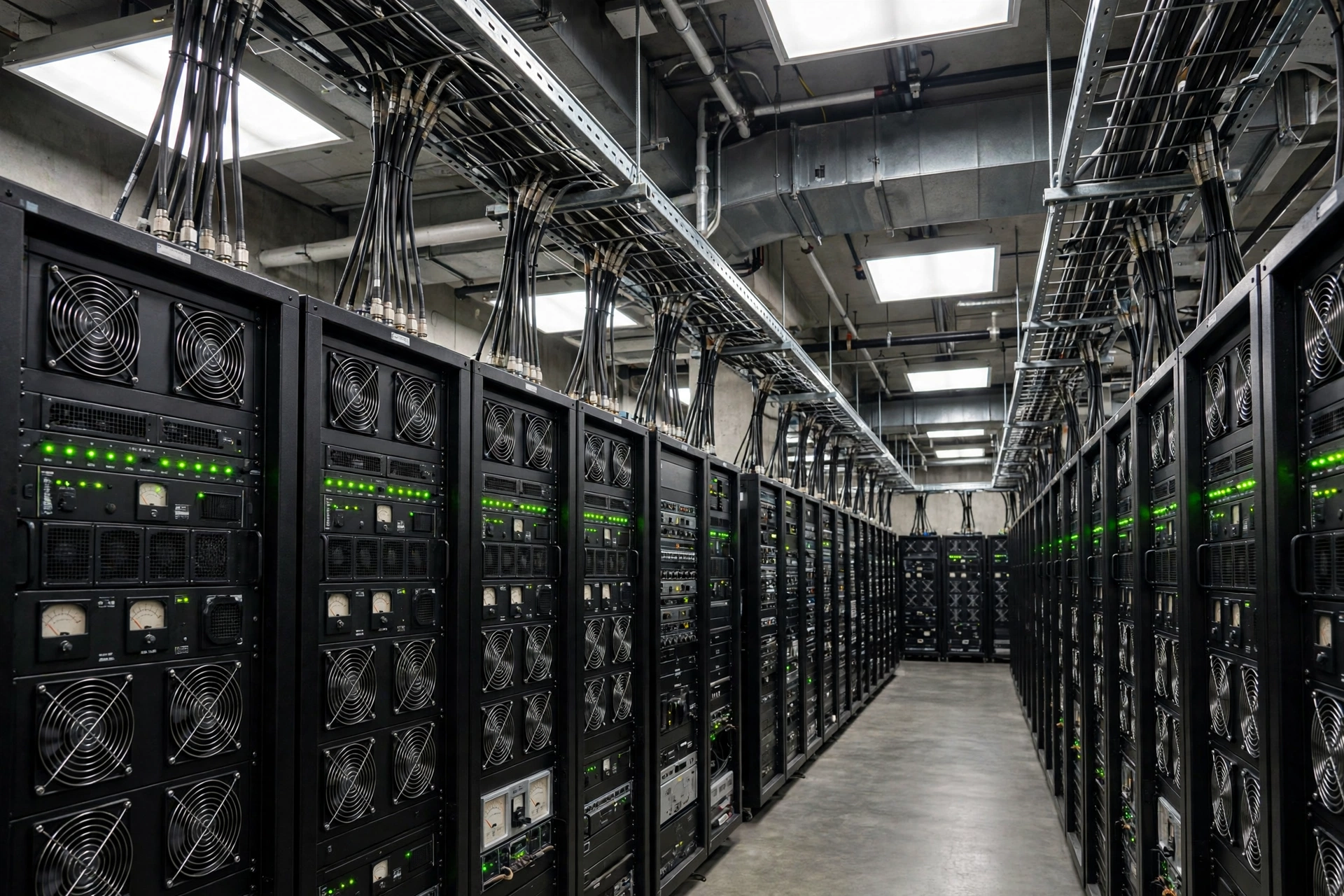
A broadcast station is two facilities sharing one roof and one electricity bill, and they behave nothing alike. The transmitter is a continuous industrial load: it draws the same power at 3 a.m. as it does at 8 p.m., it converts most of that power into heat rather than signal, and it stops the moment its supply stops. The studio is an office with a UPS: consoles, playout servers, microphones and LED lighting, drawing a fraction of the transmitter’s power but carrying the content that the transmitter sends. A generator sized for the studio alone leaves the transmitter dead. A generator sized for the transmitter alone leaves the studio dark. The set has to carry both, plus the cooling that keeps the transmitter alive, plus the link that carries the programme from the studio to the transmitter.
The scale of the problem runs from a village FM station to a national network. Spain’s public broadcaster RTVE runs its television and radio services on two mtu 16V 2000 gensets, each delivering 1,250 kVA, configured so the broadcaster can run on them for extended periods as a main source of power, not just as an emergency standby. At the other end of the scale, a community FM station runs on a set a tenth of that size. The practice in China, published by the generator industry there, gives the same shape in different numbers: a provincial broadcast station is specified at 800 kW of standby power, a municipal station at 300–400 kW, and a town or county station at 120 kW or below, usually as prime power because the grid there is unreliable enough that the set is the station’s real supply for much of the year. The numbers change with the country. The structure does not.
FM radio: ERP is not the power bill
The first mistake in sizing a generator for a radio station is reading the station’s ERP — its effective radiated power — as its electrical load. ERP is not the power the transmitter draws. It is the power the transmitter puts into the antenna, multiplied by the antenna’s gain. A 50 kW ERP FM station, the standard regional size in much of the world, typically runs a transmitter of about 10 kW: the antenna, mounted high on a tower or a hill, multiplies that 10 kW by a gain of roughly five. A community station licensed at 1 kW ERP runs a transmitter of about 250 W. The generator does not see the ERP. It sees the transmitter’s mains draw, and the mains draw is the transmitter power divided by the transmitter’s efficiency.
A modern solid-state FM transmitter is about 70–75% efficient at converting mains power into radio-frequency power. A 10 kW transmitter therefore draws about 14 kW from the mains, and the 4 kW difference leaves as heat in the transmitter hall. A 1 kW transmitter draws about 1.4 kW. The exciter, the control and monitoring circuits and the transmission-line pressurisation add another 0.5–1 kW. The FM transmitter’s load is therefore small in absolute terms and almost perfectly steady: it does not surge, it does not cycle, and it draws the same current in the middle of the night as it does in the evening drive-time peak. That steadiness is a gift to a generator. A steady load is the easiest load a set can carry, and a set that carries a steady load at 60–70% of its rating will run for decades with little more than oil, filters and a monthly test.
Television: the hungry transmitter
Television is a different animal, and it is the transmitter that makes it so. A UHF television transmitter is far less efficient than an FM transmitter: a modern solid-state UHF transmitter converts only about 30–35% of its mains power into radio-frequency power. A regional UHF station licensed at 500 kW ERP typically runs a transmitter of about 20 kW, which draws about 63 kW from the mains and turns about 43 kW of it into heat. A national UHF station at 1 MW ERP runs a transmitter of about 35 kW, drawing about 110 kW and rejecting about 75 kW of heat — roughly the heat output of twenty domestic kettles, running continuously, in a room that has to be kept at 20–25°C. VHF television is kinder, at around 45–50% efficiency, but VHF is a minority of modern television, and a station that is sizing a generator for a UHF transmitter has to size the cooling first and the transmitter second, because the cooling load is nearly as large as the transmitter load itself.
The studio side of a television station is heavier than a radio studio, and it is getting lighter. A television studio’s lighting was once its biggest load: a tungsten-lit studio drew 150–250 kW of lighting alone. LED lighting has cut that to 30–80 kW for a comparable studio, and the cameras, switchers, graphics systems and playout servers add another 20–40 kW. The master control room, which runs twenty-four hours a day, draws 10–20 kW on its own. A regional television station’s studio and master control therefore draw 60–140 kW — a serious load, but still less than the transmitter and its cooling, which is why the transmitter decides the generator size and the studio decides the UPS size.
AM radio: the tube’s appetite
AM radio is the oldest broadcast technology still in daily service, and its transmitters are the least efficient. A 50 kW AM station — the maximum licensed power in the United States, and a common size for national services in Africa, Asia and Latin America — transmits 50 kW of radio-frequency power, not ERP: AM stations are licensed by transmitter power, and their antennas have no meaningful gain. A tube AM transmitter is about 50–60% efficient, so a 50 kW AM transmitter draws 90–100 kW from the mains and rejects 40–50 kW as heat. A modern solid-state AM transmitter does better, at around 70%, drawing about 71 kW for the same 50 kW of output, but a large part of the world’s AM fleet is still tube equipment, some of it forty years old, and a generator sized for a solid-state transmitter will be undersized for the tube transmitter it replaces.
AM has two loads that FM and television do not have. The first is the antenna tuning unit and the phasor, the network of coils and capacitors that matches the transmitter to the tower and, for a directional station, splits the power between two or more towers. The phasor draws little power itself, but it is tuned by hand, and a station that loses power and restarts without checking the phasor can put a mistuned load on the transmitter and trip it. The second is the ground system: 120 buried radials, each a quarter-wavelength long, spreading out from the base of the tower. The radials carry no power, but they are the reason the tower radiates efficiently, and a station whose ground system has corroded — a common problem at coastal sites — radiates less signal for the same transmitter power, which is a slow way of wasting the generator’s fuel.
The studio and production chain
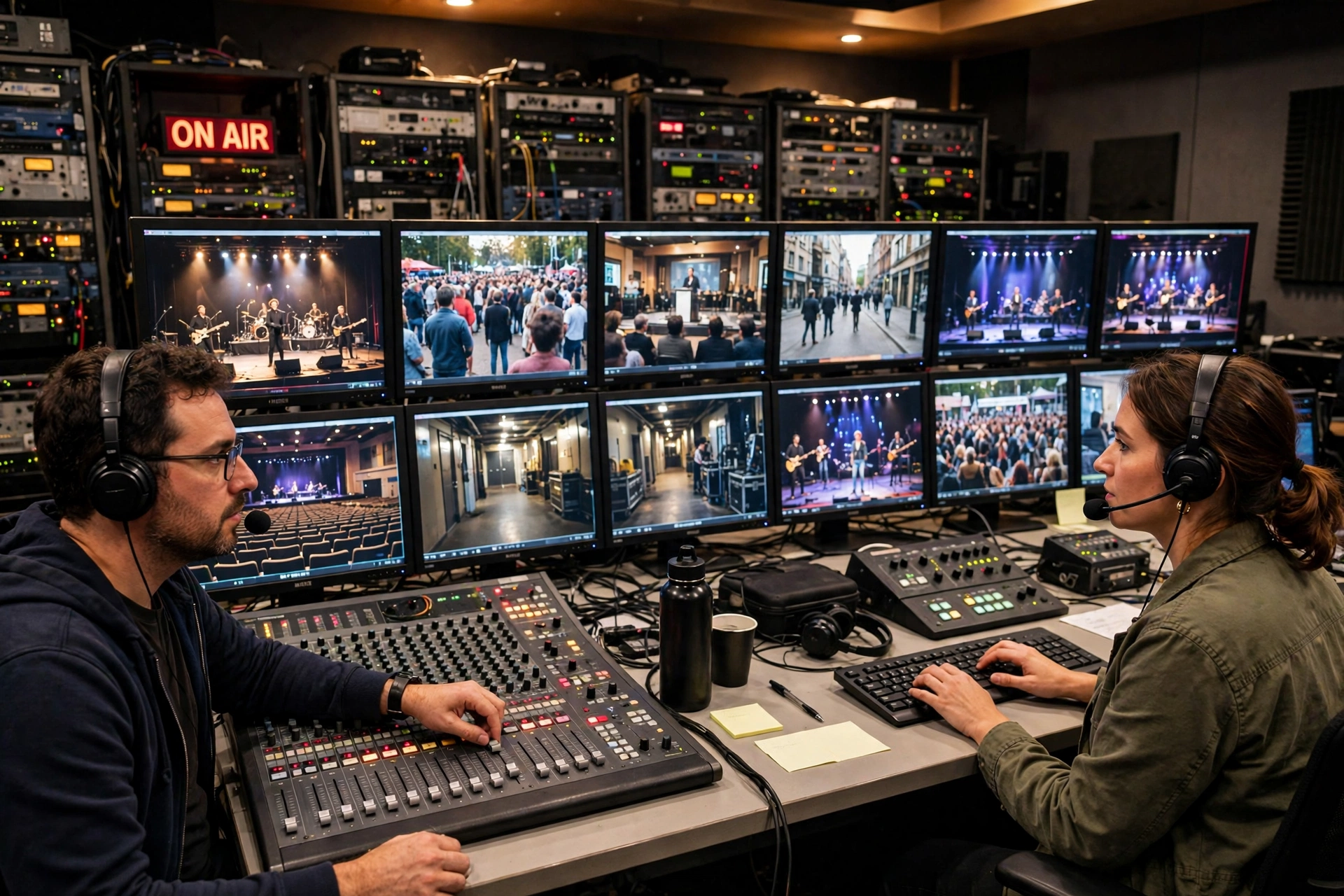
The studio is the part of the station that the audience never sees and the generator must never let blink. A radio studio draws 5–10 kW: the mixing console, the microphones and their processing, the playout servers that hold the music and the commercials, the newsroom computers, the LED lighting and the air conditioning that keeps the presenters and the equipment at a working temperature. A television studio draws more, as above, but the principle is the same: the studio’s load is small, it is almost entirely electronic, and it cannot tolerate a break in supply. A playout server that loses power mid-programme takes 5–10 minutes to reboot and reload its schedule, and a station that is off air for ten minutes in prime time has lost its audience to a competitor and its advertisers to a make-good.
The studio’s load is also the load that the UPS carries, and the UPS is the bridge between the grid failing and the generator starting. The studio, the playout servers, the master control and the studio-to-transmitter link sit on the UPS. The transmitter, the cooling and the building services sit on the generator. That split is the whole design: the UPS protects the seconds, the generator protects the hours, and the two meet at the automatic transfer switch.
Cooling, STL and the rest
Cooling is the load that first-time buyers forget, and it is the load that kills transmitters. A UHF transmitter rejecting 43–75 kW of heat needs 12–21 tons of refrigeration — roughly 4–8 kW of compressor power for every 10 kW of heat, depending on the system — and a transmitter hall without cooling trips on overtemperature within 10–15 minutes of the cooling stopping. The cooling compressors are also the largest motors on the site, drawing 5–7 times their running current on start, which is why the generator has to be sized for their starting surge and not just for their running load. A transmitter with power and no cooling is a transmitter that will shut itself down to protect itself, and a station that sizes its generator for the transmitter and forgets the cooling has bought a set that keeps the transmitter running for fifteen minutes.
The studio-to-transmitter link — the STL — is the smallest load on the site and the one with the most leverage. An STL is a microwave link, usually at 7 GHz or 13 GHz, carrying the programme from the studio to the transmitter site, which may be 10–50 km away on a hilltop. The STL transmitter and receiver draw 50–200 W between them, less than a light bulb, but if the STL loses power, the transmitter has nothing to transmit. The STL sits on the UPS at both ends, and the transmitter site’s STL receiver sits on the generator’s essential bus with the transmitter itself. A station that powers the transmitter and forgets the STL is broadcasting a carrier with no programme on it — which is, for the audience, the same as being off air.
The rest of the site is small but real. Aviation obstruction lights on the tower draw 0.5–2 kW and are a legal requirement, not a convenience: a tower without its lights is a hazard to aircraft and a violation of the station’s licence conditions. The transmission-line dehydrator, which keeps dry air in the coaxial cable or waveguide between the transmitter and the antenna, draws a few hundred watts. The building’s security, the fire detection and the offices draw 5–15 kW. Together the small loads add 10–20 kW to a regional station’s essential load, and they are the loads most often left off the first draft of a load list.
| Service | ERP | Transmitter power | Efficiency | AC draw | Heat to remove |
|---|---|---|---|---|---|
| Community FM | 1 kW | 0.25 kW | 70% | 0.4 kW | 0.15 kW |
| Regional FM | 50 kW | 10 kW | 72% | 14 kW | 4 kW |
| Regional TV (UHF) | 500 kW | 20 kW | 32% | 63 kW | 43 kW |
| National TV (UHF) | 1 MW | 35 kW | 32% | 110 kW | 75 kW |
| AM (50 kW) | 50 kW | 50 kW | 55% | 91 kW | 41 kW |
Sizing the Set: Four Station Types, Four Answers
Sizing a generator for a broadcast station starts with a decision that has nothing to do with kilowatts. It starts with deciding what the generator has to keep on air. A station that sizes its generator for the lights and the offices will discover, on the first outage, that the transmitter stopped, the cooling stopped, and the audience went elsewhere. A station that sizes its generator for the transmitter, the cooling, the STL and the studio will discover, on the first outage, that nothing changed except the sound of the engine outside. The difference between those two outcomes is the difference between a generator that was sized for the building and a generator that was sized for the broadcast.
The table below gives the sizing bands that work in practice. The running load is the load the station draws at full operation. The recommended set is the standby rating that covers that load with the cooling compressors’ starting surge and the 10% overload rule kept in reserve. The full method for adding up a site’s loads is covered in the generator sizing guide, and the starting rules for the cooling compressors and pumps are the same motor starting rules that govern any large motor start. The bands are for a station running at 50 Hz, 400 V, which is the standard for most of the world outside North America.
| Station type | Typical running load | Recommended standby set | What decides it |
|---|---|---|---|
| Community FM (1–5 kW ERP) | 15–30 kW | 30–60 kVA | Studio + STL + small transmitter |
| Regional FM (50 kW ERP) + studio | 40–80 kW | 100–150 kVA | Transmitter + cooling + studio |
| Regional TV (UHF) + studio | 150–300 kW | 250–500 kVA | UHF transmitter + cooling |
| National broadcast centre | 800–1,500 kW | 1,250–2,500 kVA | Multiple transmitters + studios + N+1 |
| Hilltop transmitter-only site | 10–40 kW | 30–60 kVA | Transmitter + cooling, fuel autonomy |
Community FM: the 30 kVA answer
A community FM station — a 1–5 kW ERP transmitter, a two-room studio, a playout server and an STL link — draws 15–30 kW at full operation. The transmitter itself draws 1–7 kW. The studio draws 5–10 kW. The cooling, the STL, the tower lights and the offices draw the rest. A 30–60 kVA standby set covers that load with room for the cooling compressor’s starting surge, and a 30 kVA set is the size most community stations actually buy: a Weichai-powered silent set at that rating is a common export configuration for radio broadcasting stations, and it leaves the station with a set that can run the whole site, not just the studio. The community station’s sizing mistake is usually the cooling. A station that sizes its generator for the transmitter and the studio forgets the air conditioning, and a transmitter hall without cooling trips in fifteen minutes. The cooling has to be on the essential bus, and it has to start with the transmitter, not after it.
Regional FM and regional TV
A regional FM station with a 50 kW ERP transmitter draws 40–80 kW at full operation: 14 kW for the transmitter, 4–8 kW for its cooling, 10–20 kW for the studio and master control, and 10–20 kW for the building. A 100–150 kVA standby set covers it, and a 125 kVA set is the size most regional FM stations actually buy. A regional television station is a step up: the UHF transmitter alone draws 63 kW, its cooling draws 20–30 kW, and the studio and master control draw 60–140 kW, for a total of 150–300 kW. A 250–500 kVA standby set covers it, and a 500 kVA set — a Cummins C500D5 at 500 kVA standby / 455 kVA prime — is the size most regional television stations actually buy. A 500 kVA Huadong set is the configuration most often quoted for radio broadcasting stations at this scale, and it leaves the station with a set that can carry the transmitter, the cooling and the studio together.
The regional station’s sizing mistake is usually the starting sequence. A regional station does not start all at once. The transmitter, the cooling compressors and the studio air conditioning start in sequence, and each compressor draws 5–7 times its running current for the first few seconds. A 15 kW cooling compressor draws 75–105 kVA on start if it is started direct-on-line. A set that is sized for the running load alone will stall on the first compressor start, and the transmitter will never get its cooling. The set has to be sized for the starting sequence, not the running load, and the starting sequence has to be written down and tested — not assumed. Soft starters or variable-frequency drives on the cooling compressors cut the starting surge to 2–3 times running current, and a station that fits them can buy a smaller set — but the set still has to be sized for the surge that remains.
National broadcast centre
A national broadcast centre is a different machine altogether. It runs several transmitters — FM, television, sometimes AM — several studios, a master control room, a newsroom and a playout farm, and it draws 800–1,500 kW at full operation. A 1,250–2,500 kVA standby set is the size that covers it, and at this size the set is usually a pair of paralleled sets in N+1 configuration, so that one set can be serviced while the other carries the station. RTVE’s answer — two 1,250 kVA mtu 16V 2000 sets — is the shape of it: two sets, each able to carry the critical load alone, tested regularly, and configured to run for extended periods as a main source of power. At this size the station’s electrical design has to include load shedding — a controlled sequence that starts the transmitters and the cooling first, and brings the studios and the offices up in stages as the load allows.
The honest limit has to be stated. A broadcast centre that draws 1,500 kW at full operation cannot be backed up by a single small set, and a centre that tries will discover the limit on the first outage. The generator is sized for the essential load — the transmitters, the cooling, the STL and the studio UPS — not for the whole centre at full operation. The rest of the centre is shed, and it is shed by design, not by accident. A centre that writes its load-shedding sequence into the generator’s control system restarts in a controlled order. A centre that does not writes its load-shedding sequence into the outage itself, and the outage is not a good place to make that decision.
Hilltop transmitter-only site
A hilltop transmitter site is the simplest station and the hardest to keep on air. There is no studio: the programme arrives by STL or by satellite, the transmitter sends it out, and the site is unmanned for weeks at a time. The load is small — 10–40 kW for a 10 kW FM transmitter, its cooling, the STL receiver and the tower lights — and a 30–60 kVA set covers it. What decides the set at a hilltop site is not the kVA. It is the fuel. A hilltop site’s generator is the site’s only power supply when the grid fails, and the grid at a hilltop site fails more often and for longer than the grid in a city, because the overhead line to the hilltop is the first thing a storm takes down. A hilltop site shares its mast with telecom towers more often than not, and the two loads together — the broadcast transmitter and the cellular radios — are what the set has to carry, which is why the set is sized for both and the fuel is sized for a week, not a day. The fuel section below covers the numbers; the point here is that a hilltop site’s generator is bought for autonomy, and a set that is sized for the load but not for the fuel is a set that stops on the third day of a five-day outage.
The Ten Seconds That Decide Whether You Stay On Air
A broadcast station’s generator is judged on one number before any other: how fast it takes load. The transmitter drops the instant the grid fails. The studio’s UPS carries the studio for minutes. The generator has to start, reach speed, close its breaker and take the load before the UPS runs out — and for a broadcast station, the standard that matters is the same one that governs hospitals and emergency services. NFPA 110, the American standard for emergency and standby power systems, defines Level 1 systems — those where failure could result in loss of human life or serious injury — and Class 10, which requires the set to take load within 10 seconds of the grid failing. A broadcast station is not a hospital, but during a disaster it is the channel that tells a population where to go and what to do, and most broadcasters specify their generators to the same 10-second rule.
The UPS bridge
The UPS is the bridge between the grid failing and the generator starting, and it has to be sized for the bridge, not for the station. A studio UPS that carries the studio, the playout servers, the master control and the STL for 10–15 minutes is a 10–20 kVA UPS for a radio station and a 30–60 kVA UPS for a television station. The UPS carries the load for ten seconds while the generator starts, and it carries the load for ten minutes if the generator fails to start, which is long enough for an engineer to start the set by hand or to switch the station to a backup feed. The rule of thumb for sizing the generator against the UPS is that the generator should be 1.5–2 times the UPS rating: a UPS draws a large charging current when it recharges its batteries after an outage, and a generator that is sized for the UPS’s running load alone will be overloaded by the recharge current and will trip. UPS compatibility is the point to confirm in writing before the set is ordered: a UPS that refuses generator power because the generator’s frequency wanders outside the UPS’s window is a UPS that does not help, and the generator’s governor has to hold the frequency within that window under the full studio load.
The ATS and the 10-second rule
The automatic transfer switch is the device that watches the grid, starts the generator and moves the load from the grid to the generator, and it is the device that decides whether the station stays on air. An open-transition ATS — the standard type — breaks the grid connection before it makes the generator connection, which means the load sees a break of a few hundred milliseconds while the switch moves. The transmitter does not notice a break that short: it restarts in seconds and is back on air. The studio does not notice it either, because the UPS carries the studio through the break. A closed-transition ATS makes the generator connection before it breaks the grid connection, so the load sees no break at all, but it requires the generator to synchronise with the grid and it requires the utility’s permission, because for a fraction of a second the generator and the grid are connected together. Most broadcast stations use an open-transition ATS, test it monthly under load, and accept the fraction of a second. The test is the point: an ATS that is never tested is an ATS that fails on the first real outage, and a station that tests its ATS monthly under load knows, before the outage, that the switch will move.
What trips first
The question that decides whether a station stays on air is not whether the generator starts. It is what trips first when the generator takes the load. The answer, in most stations, is one of three things. The first is the cooling: a transmitter without cooling trips on overtemperature within 10–15 minutes, and a station that puts the transmitter on the essential bus and forgets the cooling has bought fifteen minutes of broadcast. The second is the STL: a transmitter with power and no programme is broadcasting a carrier with nothing on it, and a station that powers the transmitter and forgets the STL receiver has bought a silent carrier. The third is the generator’s own breaker: a set that is sized for the running load alone will trip on the cooling compressor’s starting surge, and the transmitter will never get its cooling. The fix for all three is the same: put the transmitter, the cooling, the STL and the studio UPS on the essential bus together, write the starting sequence down, and test it under load every month. A station that tests its starting sequence knows what trips first. A station that does not finds out during the outage.
Three Stations, Three Outages
The sizing bands above are not theory. They are what three stations learned the expensive way, and each one learned a different lesson. The first learned that a national broadcaster buys redundancy, not just capacity. The second learned that the outage that matters can last for weeks, not hours. The third learned that a hilltop site’s fuel tank is the station’s real generator.
RTVE, Madrid: the 1,250 kVA answer
Spain’s public broadcaster, RTVE, runs the country’s television and radio services from its headquarters in Madrid, and it does not leave its power supply to chance. The broadcaster runs two mtu 16V 2000 diesel gensets, each delivering 1,250 kVA, to keep its television and radio services on air through a power outage. The sets are configured so the broadcaster can deploy them at any time and over a longer period as a main source of power for its TV and radio services — not as a ten-minute emergency measure, but as a working power supply that can carry the broadcaster for as long as the outage lasts. The lesson is direct: a national broadcaster does not buy one set of the right size. It buys two sets, each able to carry the critical load, so that one can be serviced while the other runs, and it tests them as a system, not as two machines that happen to share a building. A station that buys one set and never tests it under load has bought a hope, not a backup. A station that buys two sets and tests them monthly has bought a broadcast that continues.
Puerto Rico after Hurricane Maria: the outage that lasted weeks
The second lesson is not about one station. It is about a whole island, and it is the reason a broadcast station’s generator protects the station but cannot protect the grid. On 20 September 2017, Hurricane Maria made landfall in Puerto Rico as a Category 4 hurricane, and it destroyed the island’s electricity grid. The entire island — 3.4 million people — lost power, and most of it stayed without power for months: the grid was not substantially restored for 11 months, and some areas waited longer. In the first days after the storm, only a handful of the island’s roughly 100 radio stations stayed on air. WAPA Radio, 680 AM, became the island’s information lifeline, broadcasting news, shelter locations and the names of the missing to an audience that had no television, no internet and no mobile signal. The stations that stayed on air ran on generators and rationed their diesel by the hour, because the fuel trucks could not reach them through the blocked roads. The stations that went silent went silent for weeks: their generators ran out of fuel, their antennas were damaged, or their studios were flooded.
The numbers show what that cost. The Federal Communications Commission’s post-storm review found that broadcasters were the primary source of emergency information for most of the island’s population in the first week, and that the stations that stayed on air did so because they had generators, fuel and engineers who could reach the site. The stations that did not have all three went silent, and a station that is silent during a disaster is a station that has failed at the one moment its licence exists for. The FCC’s rules make the point in legal form: a station that is off air for more than 10 days must notify the Commission, and a station that stays silent for 12 months loses its licence automatically under Section 312(g) of the Communications Act. The lesson for a broadcast station is direct: a generator keeps the station’s own signal on air, but the station also needs fuel for a week, a second fuel supplier and an antenna that can survive the storm. The station that holds a week of fuel and a generator that runs for 72 hours without refuelling survives an outage that closes a station that holds neither.
A hilltop FM site in the Scottish Highlands: the fuel ran out on day four
A community FM station in the Scottish Highlands runs a 5 kW transmitter from a hilltop site at 600 metres, serving a valley of scattered villages that have no other local radio. The site’s load is small — the transmitter, its cooling, the STL receiver and the tower lights draw about 12 kW — and the station’s 60 kVA set covers it easily. The set was bought for the load, and it was bought well: a silent-canopy set, an automatic transfer switch, a monthly test. What was not bought well was the fuel. The site’s tank held 1,000 litres, which at the set’s 8 L/h burn at 75% load was 125 hours — five days. In January, a storm took the overhead line to the hilltop down, and the snow closed the single-track road to the site for six days. The set ran for four days and stopped on the fifth, with a day of snow still to go. The station was off air for two days, and the valley lost its only local station in the middle of a storm warning.
The fix cost less than the outage. The tank was replaced with a 3,000-litre bunded tank — 15 days of autonomy at the same burn rate — a fuel delivery contract was signed with a supplier that runs a four-wheel-drive tanker in winter, and remote monitoring was fitted to the set, so the station’s engineer can see the fuel level, the running hours and the alarms from the studio, 40 km away, instead of driving to the hilltop to find out that the tank is empty. The station has not been off air for fuel since. The lesson is the one every hilltop site learns eventually: the generator is not the backup. The fuel is the backup, and the fuel has to be sized for the road, not for the set.
Fuel Autonomy: How Long the Signal Lasts
Fuel is the part of the sizing exercise that most station owners get wrong, because they size the tank for the set and not for the outage. A 500 kVA set with a 1,000-litre day tank runs for about 14 hours at 75% load — and then it stops, whether the grid is back or not. A station that needs 72 hours of autonomy needs a bulk tank, a transfer pump and a fuel delivery contract, and it needs them before the outage, not during it.
The table below uses the published datasheet figures for a Cummins C500D5 — 500 kVA standby / 455 kVA prime, burning 93.2 L/h at full prime load, 69.9 L/h at 75% and 49.0 L/h at 50% — and the standard rule of thumb of roughly 0.21 litres per kWh at 75% load for the other sizes. The 72-hour column is the number that decides the tank.
| Set size | 50% load (L/h) | 75% load (L/h) | 100% prime (L/h) | 24 h at 75% (L) | 72 h at 75% (L) |
|---|---|---|---|---|---|
| 60 kVA | 5 | 8 | 10 | 192 | 576 |
| 100 kVA | 8 | 13 | 17 | 312 | 936 |
| 250 kVA | 21 | 32 | 42 | 768 | 2,304 |
| 500 kVA | 49 | 70 | 93 | 1,680 | 5,040 |
| 1,000 kVA | 84 | 126 | 168 | 3,024 | 9,072 |
| 1,250 kVA | 105 | 158 | 210 | 3,792 | 11,376 |
Fuel burn by set size
The numbers scale in a straight line, and that is the point. A community FM station on a 60 kVA set burns about 8 L/h at 75% load, which is 192 litres a day — a drum and a half. A regional television station on a 500 kVA set burns about 70 L/h, which is 1,680 litres a day. A national broadcast centre on a 1,250 kVA set burns about 158 L/h, which is 3,792 litres a day — a road tanker every two days, not a jerry can. The station that sizes its tank for a day and then faces a three-day outage discovers the error at the worst possible moment, when the fuel supplier is also without power and the roads are closed.
The cost is easy to count. Diesel at $1.00–$1.20 per litre in most markets means a 500 kVA set costs $70–$84 per hour to run at 75% load, or $1,680–$2,016 per day. A 72-hour outage on that set costs $5,040–$6,048 in fuel alone. That is the price of keeping the station on air, and it is a small price next to the cost of going silent — a regional commercial station’s advertising is sold by the spot, and an hour off air in prime time is thousands of dollars of make-goods, the free spots the station owes its advertisers for the ones it failed to transmit, before the audience that moved to a competitor and did not come back. The fuel bill is not the problem. The problem is running out of fuel on the second day of a three-day outage, and the solution is a tank that is sized for the outage, not for the set.
The hilltop delivery problem
A hilltop transmitter site’s fuel problem is not the tank. It is the road. A bulk tank at a hilltop site is filled by a tanker that has to climb a single-track road in all weathers, and in winter that road closes. The station that sizes its tank for 72 hours and then faces a five-day road closure discovers the error on the fourth day, when the set stops and the site goes silent. The answer is to size the tank for the road, not for the outage: a hilltop site that can be cut off for a week needs a week’s fuel, which for a 60 kVA set is 1,344 litres — a 2,000-litre bunded tank — and for a 250 kVA set is 5,376 litres — a 6,000-litre bunded tank. Both tanks need a bund — a secondary containment that holds 110% of the tank’s volume — and both need a fuel-polishing cycle, because diesel fuel ageing turns stored diesel into water, microbes and sludge, and a generator that is fed bad fuel is a generator that does not start. The fuel in the tank is not a consumable. It is the station’s insurance, and it has to be maintained like insurance.
Where the Generator Sits: Lightning, RF and Noise
A broadcast station is a forgiving load for a generator in one respect and a demanding one in another. The transmitter is a steady, mostly resistive load, which tolerates a generator’s voltage and frequency variations without complaint. The station’s tower, its radio-frequency field and its studios are not forgiving at all, and the generator has to be placed, wired and protected with all three in mind.
Lightning and earthing
A broadcast tower is the tallest structure for miles around, and it is struck by lightning regularly — a tall tower in a storm-prone area can be struck dozens of times a year. The tower’s lightning protection system, built to NFPA 780, carries the strike to earth through down-conductors and a ground ring, and every cable that enters the transmitter building — power, STL, control, monitoring — has to be protected against the surge that a strike induces. The generator’s own earthing must bond to the site’s single-point earth: a generator with its own separate earth rod creates a potential difference between the set and the building, and a lightning strike will drive current through that difference, through the control cables, and into the generator’s controller. The fix is one earth, one bond, and surge protection on every cable entry. A station that bonds its generator to the site earth and protects its cable entries survives the strike. A station that does not replaces a controller, an ATS and a transmitter exciter after the first storm of the season.
RF interference — both directions
A transmitter site’s radio-frequency field is the second placement question, and it works in both directions. The transmitter’s field — tens of kilowatts at the antenna, and a strong field near the tower base and the transmission line — can get into the generator’s electronic governor, its automatic voltage regulator and its Deep Sea or Smartgen controller through unshielded cables, and a controller that is picking up RF will report faults that do not exist, or worse, will not report faults that do. The fix is shielded cables, ferrite chokes on the control wiring, metal conduit for the cable runs, and a controller that is earthed to the site’s single-point earth. The generator’s own emissions work the other way: the alternator and the switching in the ATS produce electrical noise, and a generator that feeds a broadcast station has to keep its total harmonic distortion below 5% — the figure that broadcast equipment suppliers specify for signal integrity — or the distortion will show up as noise in the audio, as hum in the video, and as overheating in the alternator’s windings. A set that is tested at the factory on a resistive load bank and never tested at the site, at full transmitter load, with the cooling drives running, has not been tested at all. The test that matters is the one at the site, on the real load.
Noise and the studio
Noise is the third placement question, and at a broadcast station it is a professional question, not a neighbourly one. A radio or television studio needs a background noise level of NC-25 to NC-30 — quiet enough that a microphone does not hear the room. A silent-canopy generator at 75 dB(A) at 7 metres is quiet enough for a plant in an industrial estate, but it is not quiet enough outside a studio wall: the low-frequency rumble of a diesel engine passes through a standard wall and into a microphone, and a station that puts its generator outside the studio wall will hear it in every recording. The noise falls by 6 dB every time the distance doubles, so a set at 75 dB(A) at 7 metres is 69 dB(A) at 14 metres and 63 dB(A) at 28 metres — and the station that measures the noise inside the studio, with the microphone live, is the station that does not get a ruined take. The set goes as far from the studios as the cable run allows, behind an acoustic screen or inside a purpose-built room with acoustic louvres, and the exhaust is routed away from the building’s air intakes, so that the fumes do not reach the studio’s ventilation. The neighbours matter too: a studio in a residential area has to meet the local noise limit at the boundary, often 45–55 dB(A) at night, and a station that measures the noise at the boundary, not at the set, is the station that does not get a complaint.
Frequently Asked Questions
What size generator does a broadcast station need?
A community FM station with a 10 kW transmitter typically needs a 60–100 kVA set, a regional TV station needs 500–1,000 kVA, and a national broadcast centre needs 1,250–2,500 kVA. The transmitter’s power draw decides the size, not the studio. Size the set for the starting sequence, and test it under load before the first real outage.
Do broadcast stations need a backup generator?
Yes, if the station transmits to the public and the grid is unreliable. A broadcast station is the channel that carries emergency alerts during a disaster, and a station that goes silent during a disaster has failed at the one moment its licence exists for. A station that is off air for more than 10 days must notify the regulator, and a station that stays silent for 12 months loses its licence. A station that runs only on grid power is a station that has outsourced its broadcast to the distribution network.
How long can a broadcast station run on a generator?
As long as the fuel lasts. A 500 kVA set at 75% load burns about 70 L/h, so a 1,000-litre day tank lasts about 14 hours and a 5,040-litre bulk tank lasts 72 hours. A hilltop site that can be cut off by weather should size its tank for a week, not a day. The generator itself will run for as long as it is fuelled, serviced and cooled — the limit is the tank, the road and the fuel delivery contract, not the engine.
What happens to a TV station during a power outage?
The transmitter drops immediately, and the station goes off air. The studio’s UPS carries the studio, the playout servers and the STL for 10–15 minutes, and if the generator starts within 10 seconds the station is back on air with only a brief interruption. Without a generator, the station stays dark until the grid returns, loses its advertising for every hour it is silent, and must notify the regulator if the outage lasts more than 10 days. The transmitter’s cooling is the part that decides the damage: a transmitter that restarts without cooling trips on overtemperature within minutes.
Can a diesel generator power a radio transmitter?
Yes. A radio transmitter is a steady, mostly resistive load that suits a generator well — it does not surge, it does not cycle, and it draws the same current at 3 a.m. as it does at 8 p.m. Size the set for the transmitter’s mains draw, which is the transmitter power divided by its efficiency — about 14 kW for a 10 kW FM transmitter and about 91 kW for a 50 kW AM transmitter — plus the cooling, the STL and the studio, and keep the total harmonic distortion below 5% so the generator’s power does not put noise into the signal.
Specification Checklist
- Size the set from the transmitter’s mains draw — transmitter power divided by efficiency — not from the ERP: a 50 kW ERP FM station needs about 14 kW of transmitter power, and a 1 MW ERP UHF station needs about 110 kW.
- Rate the set on the right duty: the standby and prime ratings on the nameplate decide how many hours a year it can run — a hilltop site that runs on prime duty is a different machine from a studio set that runs on standby.
- Put the transmitter, the cooling, the STL link and the studio UPS on the essential bus — a transmitter with power and no cooling trips on overtemperature within fifteen minutes.
- Fit an automatic transfer switch rated for the full set output, NFPA 110 Level 1, 10-second transfer, and test it monthly under load.
- Pair the generator with a UPS sized for the studio and playout, and confirm UPS compatibility — the generator must hold frequency inside the UPS’s window, at 1.5–2 times the UPS rating.
- Size the fuel tank for 72 hours at 75% load — 5,040 litres for a 500 kVA set — and longer for hilltop sites; bund it to 110% of the tank’s volume.
- Keep the set away from the studios, behind an acoustic screen or in a purpose-built room, and measure the noise inside the studio with a microphone live, not at the set.
- Bond the set to the site’s single-point earth, fit surge protection on every cable entry, and shield the control wiring against the transmitter’s RF field.
- Test the set at the site, at full transmitter load, with the cooling drives running, and confirm the THD stays below 5%.
- Keep a spare set of fuel filters, air filters and a spare AVR on the shelf, test the set at 100% load for four hours at least once a year, and keep a fuel delivery contract and a fuel-polishing cycle in place.
Talk to PAVO about a generator sized for your station’s transmitter, studio and cooling — a set that keeps the signal on air through the outage, not just the lights on. To size a set for your station, contact PAVO with your transmitter power, your ERP and your longest outage in the last two years.