

What Size Generator Does a Steel Mill Need? | PAVO
An arc furnace draws more power than a small town. No diesel generator will ever melt steel — but the right set decides whether a ten-minute outage costs a shift or a caster.
What size generator does a steel mill need? A re-rolling mill needs 150–500 kVA, an EAF mini-mill needs 1,000–2,500 kVA for its critical board, and a large integrated plant needs 2,000–3,750 kVA in paralleled sets. The set never powers the furnace itself; it powers the cooling water, cranes, extraction and drives that keep molten steel safe when the grid fails.
Contents
- Why a Steel Mill Cannot Buy Its Way Out of an Outage
- The Three Load Tiers: What Must Stay On, What Should Stay On, What Can Wait
- Sizing Bands by Mill Type
- The Damage Window: What Happens in the First Minutes
- Starting the Big Motors: Rolling Mill Drives and Crane Hoists
- Fuel Autonomy, Heat and Dust: Running the Set in a Steel Plant
- Frequently Asked Questions
- Specification Checklist: Eight Lines Before the Deposit
Why a Steel Mill Cannot Buy Its Way Out of an Outage
World crude steel production reached 1,892 million tonnes in 2023, and almost every tonne of it passed through a process that cannot tolerate a sudden loss of power. A steel mill is not a factory with a few machines that stop politely. It is a continuous flow of liquid metal at 1,600°C, and when the power goes, the metal does not wait for the electrician.
The first fact any mill buyer must accept is the limit of the technology. A modern electric arc furnace (EAF) runs on a transformer rated 60–120 MVA for a 100–150 tonne furnace. A large hot strip mill draws 50–100 MW across its stands. No diesel generator set, and no practical number of paralleled sets, will carry that load. A buyer who asks for a generator to “keep the melt shop running” has misunderstood what a generator is for.
What a generator can do, and what it is bought for in every steel plant that specifies one properly, is narrower and more valuable: keep the cooling water moving, keep the cranes able to lift, keep the gas extraction running, keep the drives under control, and keep the controls alive long enough for a controlled shutdown — or, on a smaller mill, for a controlled continuation at reduced load. The difference between those two jobs is the difference between a specification that works and a quotation that wastes six figures.
The distinction matters because the cost of getting it wrong is measured in hours of lost production and in damaged equipment, not in the price of the set. A strand that freezes in a caster mould, a ladle that solidifies before it can be emptied, a strip that cobbles through a finishing stand — each of these is a five- or six-figure event, and each of them is caused not by the outage itself but by the seconds and minutes after it, when the loads that protect the process have no power. The same damage-window logic applies in a cement plant, where a kiln that stops mid-cycle faces its own version of the problem.
The Three Load Tiers: What Must Stay On, What Should Stay On, What Can Wait
Every steel mill specification should start with a load list divided into three tiers. Mills that skip this step end up with a set that is either twice the size it needs to be, because it tries to carry everything, or half the size it needs to be, because it was sized from a nameplate total that nobody triaged.
Tier 1 — Life safety and controlled shutdown
Tier 1 is the load that must be on generator power within 10 seconds, under NFPA 110 Level 1, and must stay on until the process is safe. It is dominated by cooling water: mould cooling pumps on the caster, furnace panel cooling, ladle furnace cooling, and the cooling tower and scale-pit pumps that keep that water moving. A billet caster typically runs mould cooling pumps of 110–250 kW per strand line, and a four-strand caster carries two or three such pumps plus a standby pump. Lose them, and the mould loses its water jacket while it still holds liquid steel.
Tier 1 also includes gas extraction fans on the furnace and the BOF shop, because carbon monoxide does not stop being produced when the power stops; emergency lighting in the melt shop and caster bay; fire pumps; and the control systems — PLC cabinets, the caster control pulpit, and the level-2 process computer — which need only a few kilowatts but decide whether the operators can see what is happening. A 100-tonne ladle crane’s hoist brake release and slow-speed lowering also belong here: a ladle hanging 12 metres above the shop floor with no power to lower it is a safety case, not a production problem.
Tier 2 — Production continuity
Tier 2 is the load that keeps the mill earning while the grid is down, or that lets it restart without a full reheat. On a re-rolling mill this is the rolling stands themselves — a 12-stand mill with 200–500 kW drives per stand — plus the reheating or induction furnace auxiliaries, the descaling pumps, the coil handling and the compressed air system that drives every pneumatic valve in the plant. On an EAF mini-mill, Tier 2 is the ladle furnace auxiliaries, the continuous caster drives and withdrawal units, and the cranes that move billets to the cooling bed.
Tier 2 is where the sizing decision is made. A mill that puts Tier 2 on the generator buys continuity; a mill that leaves it off buys a safe shutdown and a restart. Both are legitimate. The mistake is to buy one and expect the other.
Tier 3 — What can wait
Tier 3 is everything that stops without consequence: the oxygen plant (multi-megawatt, never a generator load — its shutdown sequence is automatic), the water treatment plant beyond the emergency reserve, the workshops, the offices, the yard lighting beyond the emergency circuits, and the furnace charging system. Shedding Tier 3 is how a 2,500 kVA critical board becomes a 1,500 kVA generator instead of a 4,000 kVA one. The load-shedding scheme should be written into the ATS logic, not decided by whoever happens to be standing in the electrical room during the outage.
| Tier | Typical loads | Transfer requirement |
|---|---|---|
| Tier 1 — must stay on | Caster mould cooling pumps, furnace cooling, gas extraction, emergency lighting, fire pumps, PLC/control, ladle crane lowering | Within 10 s, no shedding |
| Tier 2 — production continuity | Rolling mill drives, caster drives, cranes, descaling pumps, compressed air, ladle furnace auxiliaries | Within 10 s, or staged start |
| Tier 3 — can wait | Oxygen plant, workshops, offices, yard lighting, furnace charging | Shed on transfer |
Sizing Bands by Mill Type
There is no single “steel mill generator size”. A re-rolling mill in Bangladesh and an integrated plant in South Africa have almost nothing in common electrically, except that both buy their sets by the same method: list the Tier 1 and Tier 2 loads, add the largest single motor start, apply derating for altitude and temperature, and add 20–25% margin. The full method is covered in the guide on how to size a diesel generator, and the bands below are the result of applying it to the three mill types PAVO quotes most often.
Re-rolling mills — 150–500 kVA
A re-rolling mill takes billets, reheats them in a pusher or induction furnace, and rolls them into bars and sections. The furnace itself is gas or induction and is not a generator load. The critical board is the mill: 8–14 stands, drives of 75–200 kW each, plus descaling pumps, cooling-bed drives and compressed air. A 150-tonne-per-day mill typically lands at 150–250 kVA for Tier 1 plus the first stands; a 300-tonne-per-day mill with a full 12-stand line lands at 300–500 kVA. The common PAVO specification here is a 150 kVA Weichai set (WP4D152E200) for the smaller mills, and a 500 kVA Cummins C500D5 for the larger ones — the same frame that carries 500 kVA standby / 455 kVA prime, burning 93.2 L/h at full prime load.
EAF mini-mills — 1,000–2,500 kVA
An EAF mini-mill melts scrap in a 60–150 tonne furnace, casts billets or slabs, and rolls them. The furnace and the rolling mill’s main stands are grid loads and stay off the generator. The critical board — caster cooling, furnace cooling, gas extraction, cranes, caster drives, ladle furnace auxiliaries and controls — typically totals 800–1,800 kW, which after starting allowance and margin becomes a 1,000–2,500 kVA set, usually a single containerised unit or two paralleled 1,250 kVA sets. A single 2,063 kVA standby / 1,875 kVA prime containerised set, such as the Cummins C2000D5-PB class, covers the middle of this band in one box.
Integrated BOF plants — 2,000–3,750 kVA
An integrated plant — blast furnace, basic oxygen furnace, continuous caster, hot strip mill — has the largest critical board and the highest stakes. The BOF shop’s gas extraction and cooling, the caster’s full cooling system, the strip mill’s auxiliary drives and the plant’s crane fleet push the Tier 1 + Tier 2 total to 1,500–3,000 kW. The specification here is almost always two or three paralleled sets totalling 2,000–3,750 kVA, the top of PAVO’s range, with N+1 redundancy on the cooling-water board so that the loss of one set during an outage does not take the caster with it. At this size the sets are usually high-voltage generator units at 11 kV, which keeps cable sizes and switchgear practical across a plant that can be a kilometre long.
| Mill type | Critical board (Tier 1 + 2) | Typical generator | Fuel at 75% load |
|---|---|---|---|
| Re-rolling mill, 150 t/day | 120–200 kW | 150–250 kVA | 21–35 L/h |
| Re-rolling mill, 300 t/day | 250–400 kW | 300–500 kVA | 42–70 L/h |
| EAF mini-mill | 800–1,800 kW | 1,000–2,500 kVA | 140–350 L/h |
| Integrated BOF plant | 1,500–3,000 kW | 2,000–3,750 kVA, paralleled | 280–520 L/h |
The Damage Window: What Happens in the First Minutes
The reason a steel mill buys a generator is not the outage. It is the damage window — the minutes after the outage in which liquid steel, hot equipment and cooling systems interact without power. Three failures dominate that window, and each of them has a time limit measured in minutes, not hours.
Case 1 — The strand that freezes in the mould
A mini-mill in Iskenderun, Turkey, runs a 120-tonne EAF and a four-strand billet caster. The caster’s mould cooling pumps draw 2 × 160 kW, with a third pump on standby. During a grid outage in 2024 the 1,500 kVA standby set started in 9 seconds through the automatic transfer switch, and the cooling pumps transferred without a dip. The cast continued, the heat was completed, and the mill lost nothing but the furnace’s melting time.
The counterfactual is the reason the set exists. A billet strand carries roughly 8–12 tonnes of steel per hour per strand through a water-cooled copper mould. If the mould water stops while the strand is in the mould, the solidified shell thins within 2–3 minutes, and a breakout — liquid steel breaking through the shell — follows. A breakout on one strand damages the mould, the foot rolls and the spray chamber, costs $150,000–$500,000 in repairs and lost production, and stops the caster for 8–24 hours. The generator’s job in that mill is not to make steel. It is to keep water moving for nine seconds’ worth of starting time.
Case 2 — The ladle that cannot be emptied
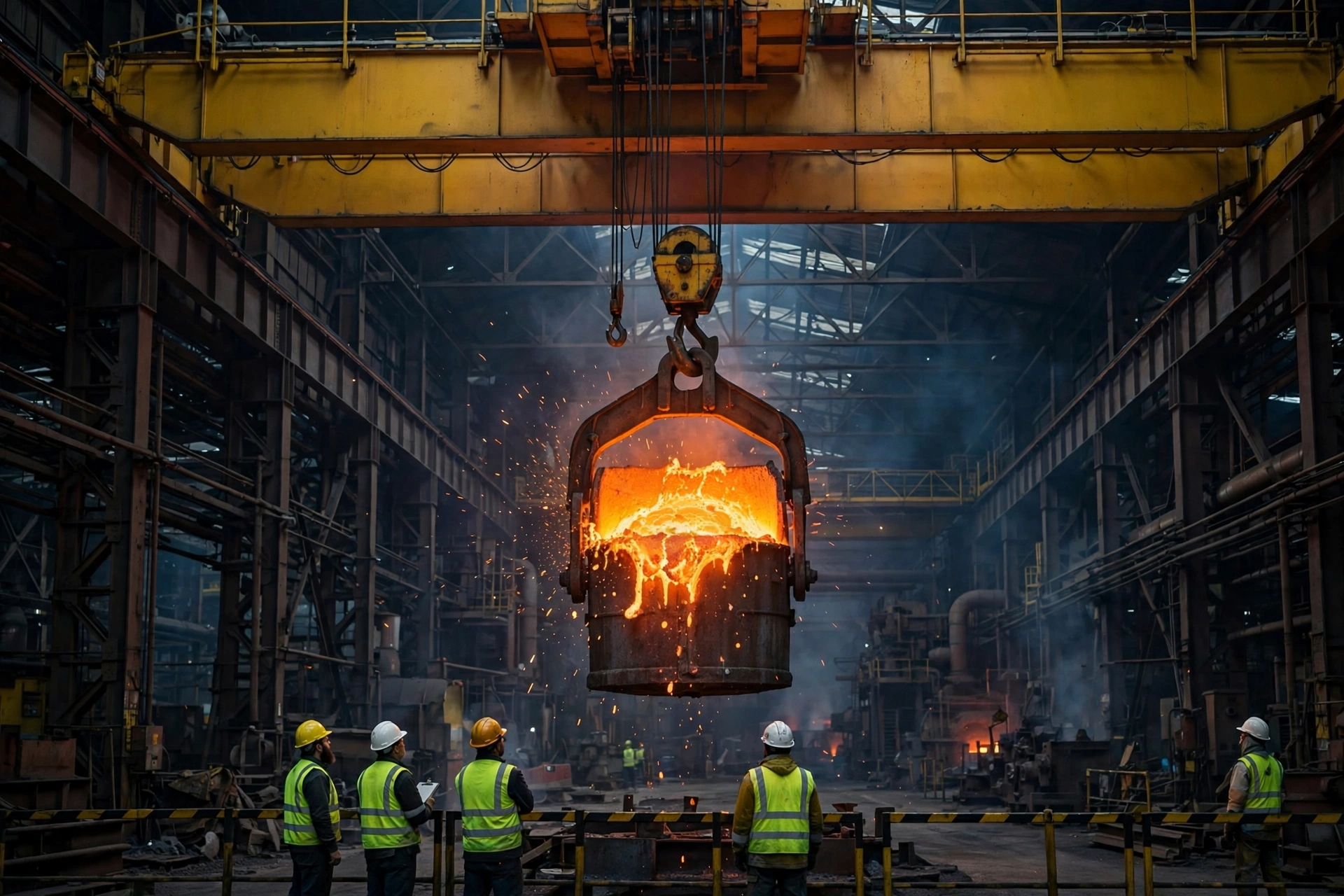
A re-rolling mill in Chattogram, Bangladesh, runs a 12-stand mill fed by an induction furnace. An outage in the middle of a rolling sequence left a billet in the furnace and a full ladle — in this case a 60-tonne transfer ladle — hanging on the crane. The mill’s 500 kVA set carried the crane, the cooling water and the mill auxiliaries. The ladle was lowered, the billet was discharged to the cooling bed, and the mill restarted on the grid two hours later with no damage.
Without the set, the ladle would have hung until the grid returned. A ladle of steel at 1,600°C loses roughly 1–2°C per minute standing still, and once the steel freezes in the ladle the vessel is effectively destroyed: the skull has to be cut out, the lining is lost, and the relining alone costs $20,000–$50,000 before the lost production is counted. A crane that cannot lower its load is not an inconvenience. It is a ladle-shaped liability hanging over the shop floor.
Case 3 — The gas that has nowhere to go
An integrated plant in Vanderbijlpark, South Africa, runs a BOF shop where the off-gas system handles carbon monoxide at concentrations that are lethal in minutes. On a grid failure the 2,500 kVA paralleled sets picked up the gas extraction fans, the BOF cooling and the caster water within 10 seconds. The furnace was idled safely, the gas holder was isolated, and the shop was ventilated throughout the outage.
The alternative is the one safety case every BOF plant writes into its operating procedures: extraction fans stop, CO accumulates in the shop, and the evacuation that follows is the best available outcome. The generator in a BOF shop is therefore not a production asset. It is a life-safety asset, and it should be specified, tested and maintained to the same standard as the fire pumps. A set that is allowed to fail its monthly test in a BOF shop is a set that will fail when the gas needs it.
Starting the Big Motors: Rolling Mill Drives and Crane Hoists
Steel mill loads are motor loads, and motor loads are starting loads. A direct-on-line motor draws 5–7 times its running current for a few seconds at start, and a generator that cannot supply that inrush will dip in voltage, trip on overload, or stall the motor — which on a rolling mill means a cobble, and on a crane means a load that stops halfway up.
The three starting methods, and where each belongs in a mill, are the subject of the guide on motor starting, and the short version is this: direct-on-line suits small motors under 30 kW where the generator has margin; star-delta or soft starters cut the inrush to 2–3 times running current and suit mill stand drives and large pumps; variable-frequency drives give full control of acceleration and suit the largest drives, the caster withdrawal units and the crane hoists — but a VFD also injects harmonics, and the alternator must be sized for them, typically 2.5–3 times the VFD load in kVA.
Two mill-specific rules follow. First, sequence the starts. A generator that can start any one motor in the mill cannot start all of them at once. The ATS and the plant PLC should start the cooling pumps first, then the extraction fans, then the cranes, then the mill drives, with 5–10 seconds between groups. Second, test under load. A monthly no-load run proves the engine starts. It proves nothing about whether the set will accept a 200 kW mill drive. The load-bank test, run quarterly at 70–80% of rating, is the only test that answers the question the mill actually needs answered — and it is the test most often skipped, because it takes a morning and a load bank, while a no-load run takes ten minutes.
Fuel Autonomy, Heat and Dust: Running the Set in a Steel Plant
A generator that starts is not a generator that keeps running. In a steel plant the three things that stop a running set are fuel, heat and dust, in that order.
Fuel. Consumption follows the same curve as every other diesel set: a 500 kVA prime set burns about 70 L/h at 75% load, a 1,000 kVA set about 140 L/h, a 2,000 kVA set about 280 L/h, and a 3,750 kVA installation about 520 L/h. At those rates, 24 hours of autonomy needs 1,700 L, 3,400 L, 6,700 L and 12,500 L respectively — and 72 hours needs three times as much. The bulk tank, the transfer pump and the fuel delivery contract are part of the specification, not an afterthought. Diesel fuel ageing in a standby tank is a real failure mode in a mill, where a set can sit for months between outages: water condenses, microbes grow, and the fuel that the set needs on the worst day of the year is the fuel that has been degrading in the tank since the last test. Test it, polish it, and turn it over.
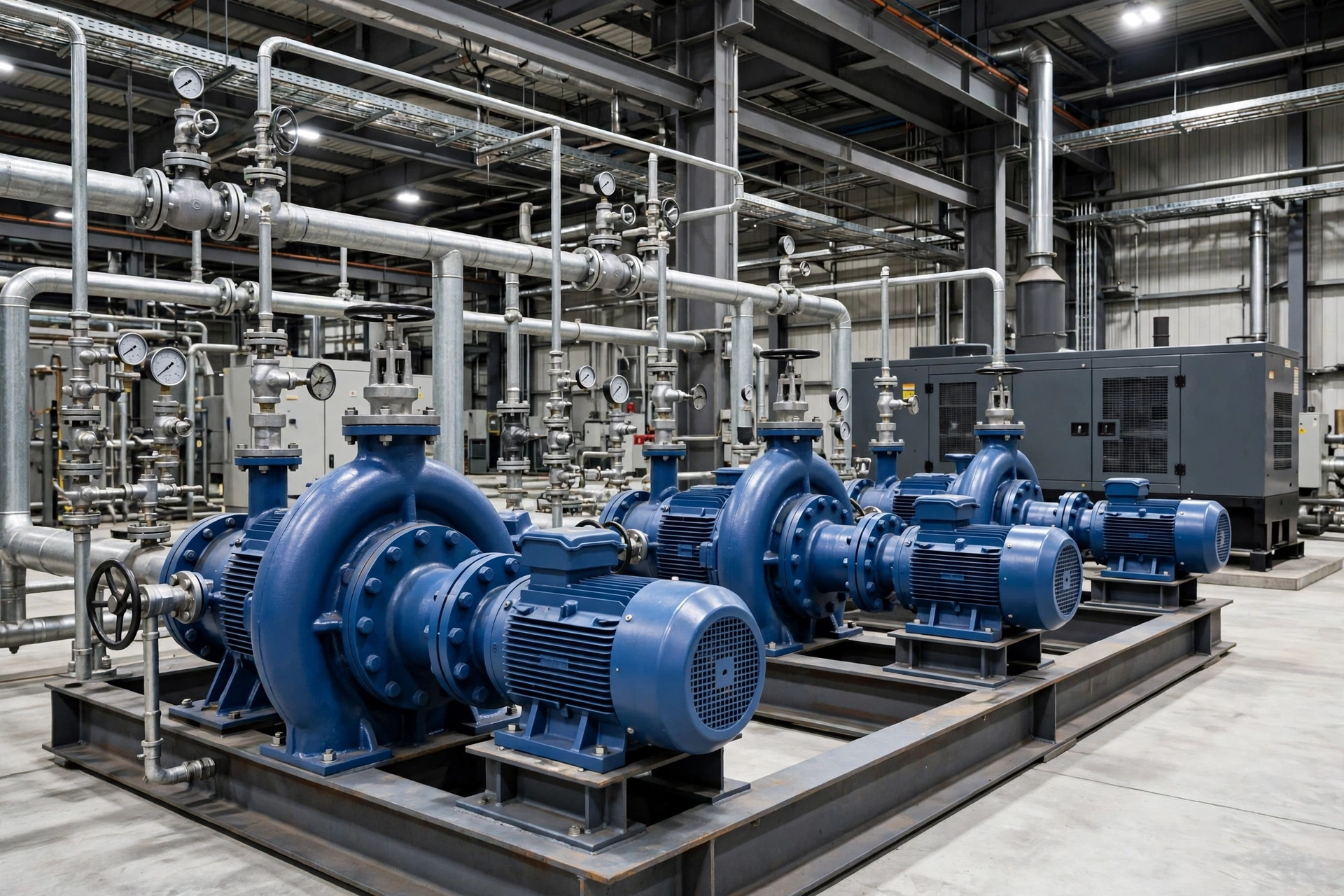
Heat. A melt shop runs at 45–55°C ambient near the furnace, with radiant heat that pushes the generator room well above the 25°C catalogue rating. The derating is unforgiving: above 1,000 m altitude, output falls by about 1% per 100 m, and above 40°C the alternator loses about 3% per 10°C. A set rated 1,000 kVA at 25°C delivers roughly 920 kVA at 50°C. Size the set for the hottest day of the year, not the day the quotation was written, and put the generator room upwind of the melt shop, not beside it.
Dust. Iron oxide dust is abrasive, conductive when damp, and everywhere in a mill. It fouls radiators — a fouled radiator can raise coolant temperature by 5–10°C, which is enough to trip a set on high temperature on a hot day — and it coats alternator windings. The enclosure should be specified with IP54 or better protection on the control panel, the radiator should be cleaned on the same schedule as the mill’s own equipment, and the air intake should be ducted from outside the melt shop. A set that breathes melt-shop air will not live as long as a set that breathes clean air.
Frequently Asked Questions
What size generator does a steel mill need?
A re-rolling mill needs 150–500 kVA, an EAF mini-mill needs 1,000–2,500 kVA for its critical board, and an integrated BOF plant needs 2,000–3,750 kVA in paralleled sets. The size comes from the Tier 1 and Tier 2 load list plus the largest motor start, derated for site temperature and altitude — never from the furnace rating, which no generator can carry.
Do steel mills need a backup generator?
Yes — not to keep melting steel, but to keep the process safe when the grid fails. The generator powers caster and furnace cooling water, gas extraction, cranes and controls, so that a ten-minute outage ends in a controlled shutdown or a restart instead of a breakout, a frozen ladle or a gas incident.
How long can a steel mill run on a generator?
On Tier 1 and Tier 2 loads, as long as the fuel lasts: a 1,000 kVA set at 75% load burns about 140 L/h, so a 10,000 L bulk tank gives roughly 72 hours. The practical limit is usually fuel logistics and the 200-hour annual limit on a standby rating, not the engine. Mills that expect regular long outages should specify a prime rating.
What happens to a steel furnace during a power outage?
An electric arc furnace simply stops: the arc extinguishes, the melt cools, and the heat is delayed, not destroyed. The danger is not the furnace but what surrounds it — the caster mould that loses cooling water, the ladle that cannot be moved, and the gas extraction that stops. Those are the loads the generator exists to protect.
Can a diesel generator power a steel mill?
It can power the critical parts of a steel mill — cooling, cranes, extraction, drives and controls — but it cannot power the furnace or the main rolling stands of a hot strip mill, which draw tens of megawatts. Any quotation that promises full mill production from diesel generators should be rejected; the honest specification names the tiers it covers.
Specification Checklist: Eight Lines Before the Deposit
1. Which loads are Tier 1, Tier 2 and Tier 3? The list should be written, signed and wired into the ATS load-shedding logic — not decided during the outage.
2. Which rating — ESP, PRP or COP? The standby and prime power ratings decide how many hours the set is warranted for. A standby set on a mill with 300 outage hours a year will fail early, and the warranty claim will be refused.
3. What is the largest single motor start? The set must accept it with voltage dip inside the limit the drives tolerate — typically 15–20% — with the starting method stated.
4. At what site temperature and altitude? Ask for the derated figure at the hottest day and the real altitude, not the catalogue figure at 25°C and sea level.
5. What is the fuel autonomy? State the hours at 75% load, the bulk tank size, and who delivers fuel on day two of an outage.
6. Is the set medium voltage? Above 2,000 kVA, an 11 kV set usually saves more in cable and switchgear than it costs in the alternator.
7. What does the test regime include? Monthly start, quarterly load-bank test at 70–80%, annual full-load test with the actual Tier 1 and Tier 2 loads transferred. A set that has never been tested under load has never been tested.
8. Who maintains it, and on what schedule? The maintenance schedule should be written into the contract with service intervals in hours and calendar months, a spares list, and a named technician who can reach the site within the outage window.
A steel mill does not buy a generator to make steel. It buys one to make sure that the steel it has already made — in the ladle, in the caster, in the furnace — does not become a liability when the grid fails. The set that does that job is sized from the load list, tested under load, fuelled for the longest outage the mill can imagine, and maintained as if the next outage were tomorrow. Because in a mill, sooner or later, it is.
contact PAVO — send PAVO the load list, the largest motor and the site conditions, and the quotation will come back with the rating, the fuel autonomy and the test regime stated in writing.