

What Size Generator Does a Paint Plant Need? | PAVO
In a paint plant, the grid does not fail at a convenient hour. It fails in the middle of a batch, with pigment half-dispersed in the tank and a filling line full of open cans.
What size generator does a paint plant need? A small decorative paint plant making 2,000–5,000 tonnes a year typically needs a 150–250 kVA set, a mid-size plant making 10,000–20,000 tonnes needs 400–750 kVA, and a large coatings plant needs 1,000–2,000 kVA. The dispersers and bead mills, not the filling lines, decide the size.
- What a Paint Plant Actually Loads
- The Batch Window: Why the First Minutes Decide the Paint
- Sizing by Plant Size
- Three Plants That Lost Power — and What It Cost
- Fuel Autonomy: How Long a Paint Plant Can Run on a Generator
- Power Quality, Solvent Vapour and Placement
- Frequently Asked Questions
- Specification Checklist
What a Paint Plant Actually Loads
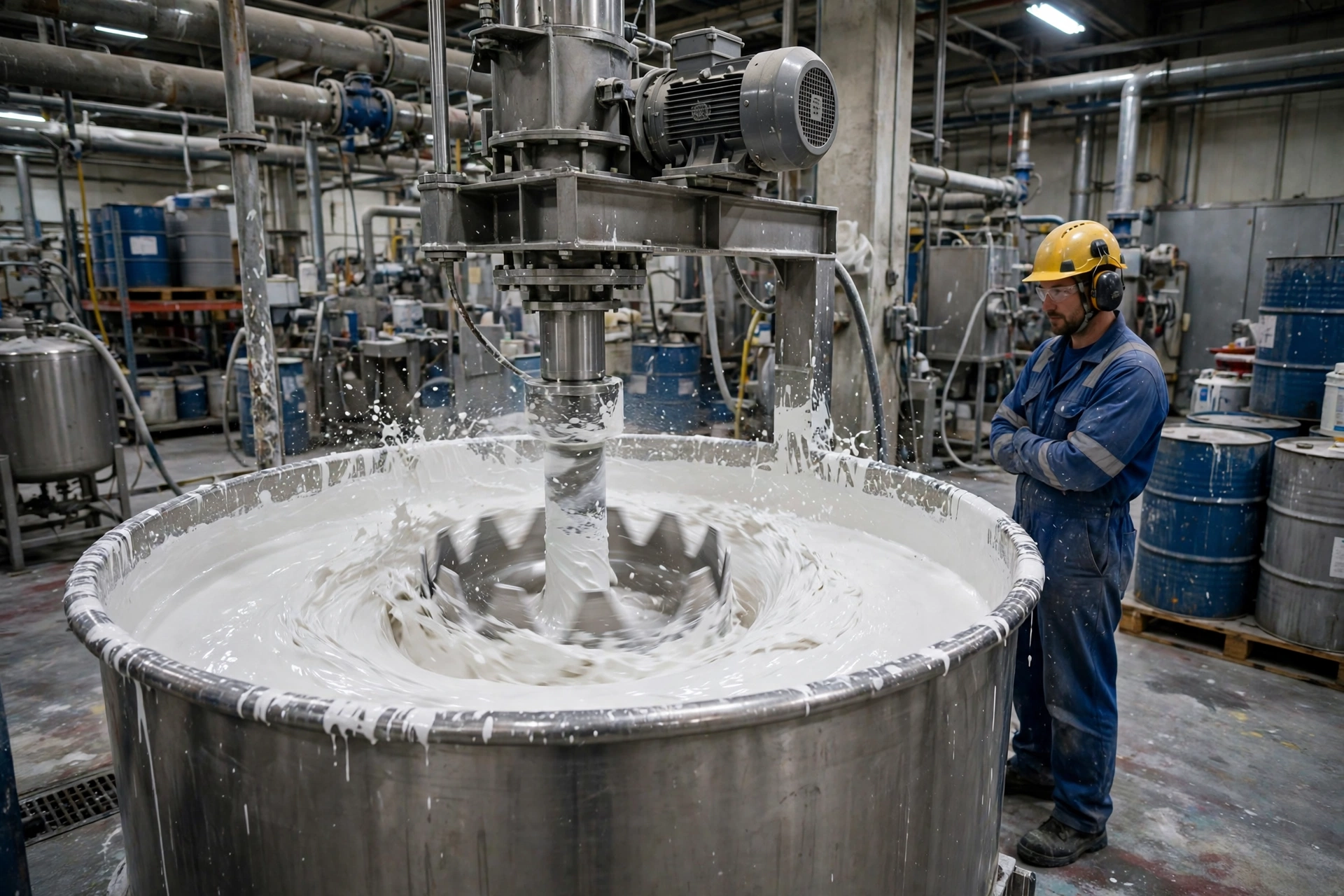
A paint plant’s electrical load looks nothing like a warehouse’s and nothing like a continuous chemical plant’s. The world produced about 48.9 billion litres of paint and coatings in 2024, worth roughly $202 billion, and China alone made 35.34 million tonnes — so the load profile below is not a corner case. It is the daily reality of an industry that makes its product one batch at a time, in tanks that hold 500 to 5,000 litres, and loses the batch if the power stops halfway through it.
The load is also unusual in a way that matters for generator sizing: most of it is motors and drives, not heat. The disperser is a motor. The bead mill is a motor. The filling line is a row of small motors and pneumatic cylinders. The plant’s thermal load is small — a little steam or hot water for resin kettles and wash water — and the sensitive load is small too: the tinting computer, the laboratory instruments and the batch records. That mix is forgiving on a generator in one respect — there is little delicate electronics to protect — and demanding in another: the load is dominated by motor starts, and the process is dominated by a batch that cannot be paused. A voltage dip that a computer would ride through without noticing can stall a disperser disc in a tank of thick paste, and a stalled disperser is a batch that has to be reworked or thrown away. Car-body paint shops, with their curing ovens and spray booths, are a different load again and are covered in the automotive plants article.
Dispersing and milling
Dispersing is where paint is made, and it is where the plant’s biggest motors live. A high-speed disperser — a Cowles disperser — uses a toothed disc on a vertical shaft, spun at a tip speed of 24–26 metres per second, to wet pigment and filler into the liquid vehicle and break up agglomerates. Production models run from 1.5 kW for a 50-litre trial batch to 55–90 kW for a 5,000-litre production batch, and the standard rule for sizing one is 1 HP for every 10 US gallons of product: a 1,000-litre batch is about 264 gallons, or about 26 HP (19.7 kW). A double-shaft disperser for heavy pastes runs 11–75 kW for batches of 500–3,000 litres, with explosion-proof versions available for solvent plants. A typical dispersion run takes about 20 minutes once all the ingredients are in the tank.
Milling is the second step, and it is where the fineness comes from. A basket bead mill circulates the premix through a basket of zirconia beads to grind the pigment down to the fineness the film can carry. Production basket mills run from 2.2 kW for a 10-litre handling capacity to 45–55 kW for 1,000–1,500 litres, and a large horizontal bead mill for a 6,000-litre batch draws 55 kW on the grinding motor alone. A plant running two dispersers and two bead mills carries 100–250 kW of milling load, and every one of those machines is a motor that draws 5–7 times its running current on start. A disperser that is started under a full tank of thick paste draws more than its nameplate, and a set that is sized for the running load alone will stall on the first motor start.
The dispersing floor is also where the plant’s product is most exposed. A disperser running at 1,200–1,450 rpm keeps a vortex in the tank that pulls powder down into the disc. If the power fails, the disc stops, the vortex collapses, and the pigment that was half-wetted settles to the bottom of the tank. The batch does not wait. It starts to separate the moment the disc stops, and the longer it sits, the harder it is to bring back.
Let-down, tinting and thinning
Let-down is where the dispersed mill base becomes finished paint, and it is where the plant’s quality is decided. The mill base is pumped to a let-down tank, where resin, solvent or water, driers and additives are stirred in at low speed. The mixers here are small — 5–15 kW — but they run for a long time, and they run on every batch. A plant with four let-down tanks carries 20–60 kW of mixing load, and the tanks are the ones that hold the batch while the laboratory checks it. The laboratory checks viscosity, fineness, colour and solids on every batch, and a batch that fails any one of those checks goes back for adjustment or down the drain.
Tinting is the step that decides whether the batch ships. A tinting machine adds colourant to a white base in measured doses, and the shade is checked against a standard with a spectrophotometer. A tinting station draws only 0.5–2 kW, but it is the step that cannot be repeated by hand: a batch that was tinted to the wrong shade because the tinting computer lost power mid-dose has to be corrected by adding more colourant, and a batch that is corrected twice is a batch that is out of specification. The tinting computer, the spectrophotometer and the batch-record server are the plant’s most sensitive loads, and they are the loads that need a UPS even when the rest of the plant is on the generator.
Thinning and solvent handling are the quiet loads that carry the safety risk. Solvent-based paints are thinned with toluene, xylene, white spirit or methyl ethyl ketone, and the solvent is pumped from a bulk store to the production floor through pipes and pumps that draw 2–5 kW. The pumps are small. The vapour they handle is not. A solvent pump that stops mid-transfer leaves a line full of solvent and a tank that is half full, and a plant that restarts without checking the line is a plant that is pumping solvent into a tank that nobody is watching. The transfer pumps have to be on the essential bus with the dispersers, and they have to be interlocked with the ventilation, so that a pump cannot run when the extraction fans are stopped.
Filling and packaging
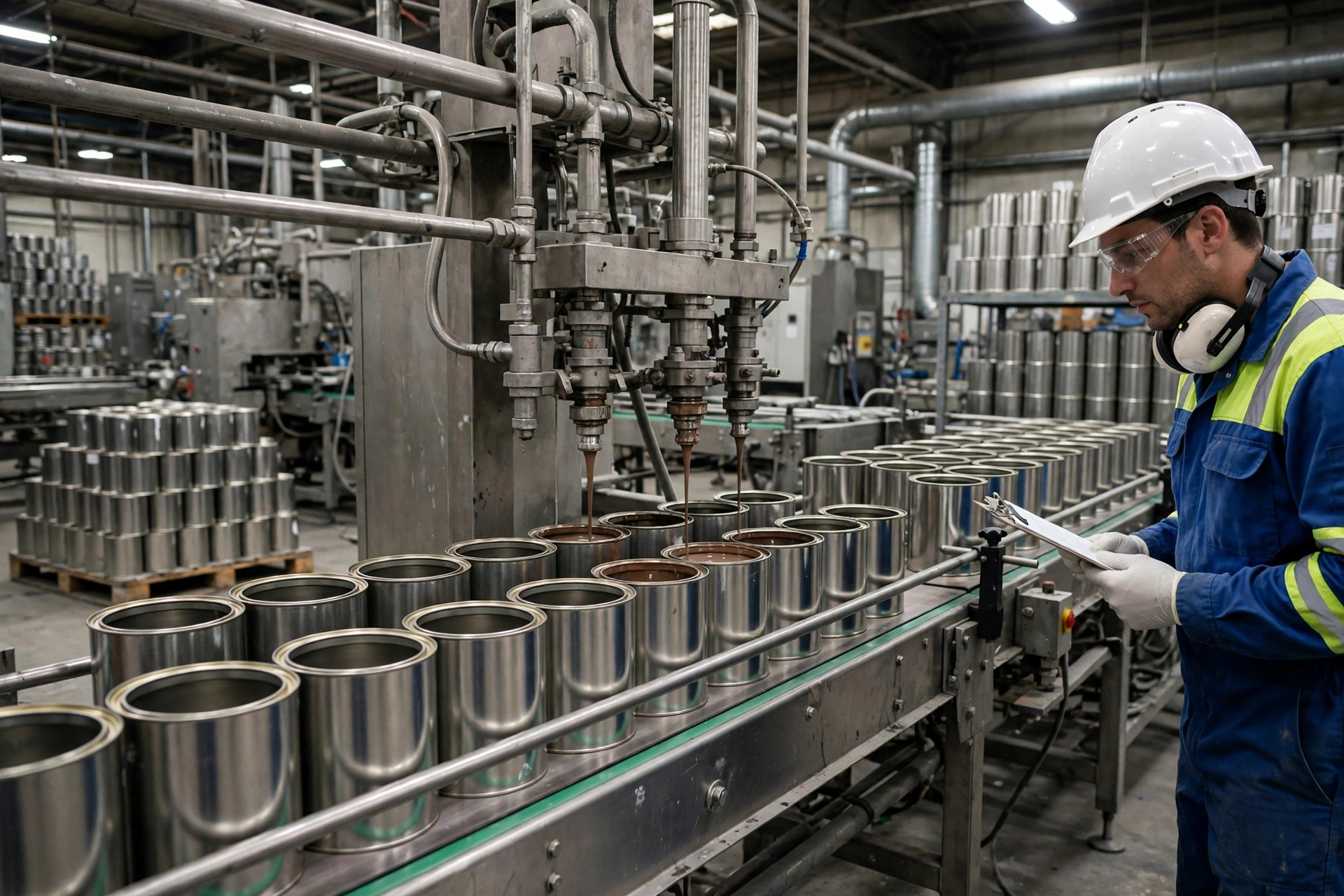
Filling is where the paint leaves the plant, and it is where most of the plant’s machines live. A fully automatic emulsion paint filling machine fills 60 cans a minute in 1–5 litre sizes, draws 1.5 kW, and runs on compressed air at 0.6–0.8 MPa. A semi-automatic filler-capper for 10–30 kg pails fills 120–360 containers an hour. A filling line is not one machine. It is a chain — filler, lid press, labeller, palletiser — and every link in the chain has to run for the line to run. A line that stops mid-fill leaves open cans on the conveyor, and open cans of solvent-based paint give off vapour while they wait.
The filling floor is also where the plant’s money is most exposed in a different way from the dispersing floor. A filling line that stops for an hour loses an hour of cans, and the cans are the plant’s finished stock. A plant filling 60 cans a minute loses 3,600 cans in an hour, and a 4-litre can of decorative emulsion is worth $8–15 at the factory gate. The arithmetic is simple: an hour of lost filling is $29,000–$54,000 of finished product that did not leave the building, and the order that was supposed to ship that day ships late. The filling line’s electrical load is small — 10–30 kW for the whole line — but the load it protects is the plant’s revenue, and it has to be on the essential bus with the dispersers.
Compressed air, HVAC and the rest
The load that surprises first-time buyers is not on the production floor at all. It is in the plant room. A paint plant runs on compressed air, and compressed air is electric. The filling machines, the lid presses, the pneumatic valves on the let-down tanks and the air-operated pumps all run on air at 0.5–0.8 MPa. A mid-size plant’s screw compressor draws 22–37 kW, and a larger plant’s compressor draws 55–75 kW. A filling line with power but no compressed air is as idle as a line with no power at all, so the compressor has to be on the essential bus with the machines it serves, and it has to be started before the filling line, because the lid press needs air before the first can can be closed.
Ventilation is the second utility load, and it is the one with a safety dimension. A paint plant’s production floor has to be ventilated to keep solvent vapour below its lower explosive limit, and the extraction fans that do that draw 15–30 kW. The load is not comfort. Solvent vapour is flammable, and a plant that loses its extraction while the machines are still running is accumulating the fuel for a fire. The fans have to run whenever the machines run, and on a generator they have to start with the machines, not after them. A plant that sizes its generator for the dispersers and forgets the extraction has bought a set that can make paint and cannot make it safely.
The rest of the plant is small by comparison but still matters. The resin kettles and the wash-water heating draw 10–25 kW. The laboratory, the offices and the quality-control instruments draw 5–10 kW. The raw-material handling — the forklifts are usually diesel or battery, but the drum pumps, the powder handling and the warehousing conveyors draw 10–25 kW. Together the utilities add 80–150 kW to a mid-size plant’s essential load, and they are the loads most often forgotten when a plant owner sizes a generator by adding up the nameplates on the production floor.
The Batch Window: Why the First Minutes Decide the Paint
A paint plant is a batch process, and that is what makes a power cut in a paint plant different from a power cut anywhere else. When the power fails in a warehouse, the lights go out and the work stops. When the power fails in a paint plant during a batch, the paint does not stop being half-made. The pigment keeps settling, the resin keeps separating, and the batch keeps changing while nobody can do anything about it.
The numbers are unforgiving. A dispersion run takes about 20 minutes once all the ingredients are in the tank. A bead mill pass takes 30–60 minutes. A tinted batch takes 1–2 hours from the first pigment to the final shade check. If the power fails at any point in that sequence, the batch is not paused. It is damaged, and the damage is measured in the batch’s value — a 3,000-litre batch of decorative emulsion is worth $9,000–$12,000 in materials alone, and a 3,000-litre batch of industrial coating is worth $15,000–$30,000. The generator is not bought to keep the lights on. It is bought to keep the batch moving, and the batch moves only if the generator starts in seconds and carries the whole floor, not just the lights.
What dispersion actually is
Dispersion is the breaking apart of pigment agglomerates — clusters of pigment particles stuck together — into single particles that are evenly spread through the liquid. A pigment as it arrives from the supplier is not a powder of single particles. It is a powder of clusters, and a cluster that is not broken apart shows up in the finished film as a speck, a streak or a weak colour. The disperser’s toothed disc breaks the clusters apart by shear: the disc spins at a tip speed of 24–26 metres per second, and the liquid is pulled down into the disc and thrown out again, thousands of times a minute, until the clusters are gone.
That process has a sequence, and the sequence matters. The powder has to be wetted first — pulled down into the liquid without dusting — and then dispersed, and then the batch has to be held at speed until the fineness is right. The laboratory checks the fineness with a Hegman gauge, and a batch that has not reached its fineness target goes back on the disperser for another pass. If the power fails during the dispersion, the sequence breaks. The disc stops, the vortex collapses, and the powder that was half-wetted sits on the surface of the liquid while the pigment that was half-dispersed settles to the bottom. The batch that was 10 minutes from its fineness target is now a tank of separated liquid and settled pigment, and bringing it back takes longer than starting it did.
What happens to a batch in a stopped disperser
The damage window is measured in minutes, and the plant has no control over it once the power is gone. The pigment in a stopped tank settles fast: titanium dioxide, the white pigment that carries most decorative paints, has a density of about 4.2 g/cm³, and a settled layer of pigment at the bottom of a 3,000-litre tank is a hard cake within 30–60 minutes. A disperser that restarts after an hour has to break up a cake that was not there when it stopped, and a disc that is started in a settled tank draws more current than it did when the batch was fluid — enough to trip the motor protection if the set is not sized for it.
Solvent-based batches have a second problem. The solvent evaporates from the surface of a stopped tank, and the surface of the paint skins over — a thin film of dried resin that forms on the top of the batch. A skinned batch has to be strained before it can be filled, and a batch that is strained badly carries lumps of skin into the cans. Water-based batches have the opposite problem: the water does not evaporate, but the emulsion can break if the batch sits without agitation and the temperature falls. A broken emulsion is a batch that has separated into water and resin, and it cannot be fixed by stirring. It is waste.
The bead mill has its own failure mode. A bead mill that stops mid-pass leaves product in the milling chamber with the beads, and the beads settle into the product. A mill that is restarted without being purged first grinds its own beads, and a bead that is ground down contaminates the batch with zirconia dust. The mill has to be purged and cleaned before it can run again, and a purge takes 30–60 minutes and wastes 50–100 litres of product. A plant that loses power three times in a week loses three purges, three batches of waste and a day of production — and the generator that would have prevented all three costs less than one of the batches.
| Batch stage | Time in stage | What happens if power fails here |
|---|---|---|
| Powder wetting | 5–10 minutes | Powder sits on the surface, dusts into the air, batch has to be re-wetted |
| Dispersion | 15–25 minutes | Vortex collapses, pigment settles, fineness target lost, re-dispersion needed |
| Bead milling | 30–60 minutes | Beads settle in the chamber, mill needs purging, 50–100 L wasted |
| Let-down and tinting | 30–90 minutes | Shade check lost, tinting computer loses the dose, batch needs re-tinting |
| Filling | Continuous | Open cans on the conveyor, solvent vapour builds up, cans have to be emptied |
The restart that costs more than the stop
The restart is where the money goes. A paint plant that has stopped mid-batch does not restart at full speed. The disperser has to be restarted in a settled tank, the bead mill has to be purged, the let-down tank has to be re-checked by the laboratory, and the tinting has to be re-done from the last good shade check. A typical restart takes 1–2 hours and wastes 100–300 litres of product, and that is for a clean stop with an experienced crew and a generator that started on time. A stop that also took out the ventilation, the compressed air and the tinting computer takes longer, because each of those systems has its own restart sequence and its own checks.
The cost of a restart is easy to count and hard to accept. A mid-size plant making 10,000–20,000 tonnes a year runs 8–12 batches a day, and a single lost batch is $9,000–$30,000 of material plus 1–2 hours of lost production. A plant that loses a batch a week to power cuts loses $470,000–$1,560,000 a year in materials alone, before the late orders, the rework and the customers who move to a supplier whose plant does not stop. The generator is not bought to save the electricity bill. It is bought to save the batch, and the batch is the plant’s product.
Sizing by Plant Size
Sizing a generator for a paint plant starts with a decision that has nothing to do with kilowatts. It starts with deciding what the generator has to keep running. A plant that sizes its generator for the lights and the offices will discover, on the first outage, that the dispersers stopped, the bead mill needs purging and the batch in the tank is waste. A plant that sizes its generator for the whole production floor will discover, on the first outage, that the batch kept moving and the order shipped on time. The difference between those two outcomes is the difference between a generator that was sized for the building and a generator that was sized for the business.
The table below gives the sizing bands that work in practice. The running load is the load the plant draws at full production. The recommended set is the standby rating that covers that load with the motor starts and the ventilation included, and with the 10% overload rule kept in reserve for the dispersers’ starting surge. The full method for adding up a plant’s loads is covered in the generator sizing guide, and the motor starting rules for the dispersers’ drives are the same rules that govern any large motor start. The bands are for a plant running at 50 Hz, 400 V, which is the standard for most of the world outside North America.
| Plant type | Typical output | Running load | Recommended standby set |
|---|---|---|---|
| Small decorative plant | 2,000–5,000 t/year | 80–150 kW | 150–250 kVA |
| Mid-size paint plant | 10,000–20,000 t/year | 250–500 kW | 400–750 kVA |
| Large coatings plant | 30,000–60,000 t/year | 600–1,200 kW | 1,000–2,000 kVA |
| Industrial coatings plant | 60,000–150,000 t/year | 1,200–2,000 kW | 2,000–3,000 kVA |
Small plants
A small decorative paint plant makes emulsion and enamel for the local market, runs one or two dispersers and a single filling line, and draws 80–150 kW at full production. The load is two dispersers at 30–45 kW each, a basket mill at 15–30 kW, a filling line at 10–15 kW, a compressor at 22 kW and the ventilation at 15 kW. A 150–250 kVA standby set covers that load with room for the motor starts, and a 200 kVA set is the size most small plants actually buy — a Weichai-powered silent set at that rating is a common export configuration, and it leaves the plant with a set that can run the whole floor, not just the lights.
The small plant’s sizing mistake is usually the ventilation. A small plant that sizes its generator for the dispersers alone forgets the extraction fans, and a solvent-based plant with power but no extraction is a plant that is accumulating flammable vapour while it makes paint. The extraction has to be on the essential bus, and it has to be started before the dispersers, because the disperser cannot run safely in a room that is not ventilated. A small plant that sizes its generator for the whole floor, ventilation included, restarts in minutes. A small plant that sizes it for the machines alone restarts in hours — or does not restart at all, because the safety interlock will not let it.
Mid-size plants
A mid-size plant makes 10,000–20,000 tonnes a year across decorative, industrial and wood coatings, runs three or four dispersers and two bead mills, and draws 250–500 kW at full production. The load is four dispersers at 45–75 kW each, two bead mills at 37–55 kW each, two filling lines at 15–30 kW between them, a compressor at 37 kW, the ventilation at 30 kW and the let-down and tinting at 20–40 kW. A 400–750 kVA standby set covers it, and a 500 kVA set — a Cummins C500D5 at 500 kVA standby / 455 kVA prime — is the size most mid-size plants actually buy.
The mid-size plant’s sizing mistake is usually the starting sequence. A mid-size plant does not start all at once. The dispersers, the bead mills and the compressor start in sequence, and each one draws 5–7 times its running current for the first few seconds. A 75 kW disperser draws 375–525 kVA on start if it is started direct-on-line, and a 55 kW bead mill draws 275–385 kVA. A set that is sized for the running load alone will stall on the first motor start, and the disperser will never get to speed. The set has to be sized for the starting sequence, not the running load, and the starting sequence has to be written down and tested — not assumed. Soft starters or VFDs on the dispersers cut the starting surge to 2–3 times running current, and a plant that fits them can buy a smaller set — but the set still has to be sized for the surge that remains.
Large plants
A large coatings plant making 30,000–60,000 tonnes a year is a different machine altogether. The dispersing floor runs six or eight dispersers at 55–90 kW each, the bead mills run at 55 kW each, and the filling hall runs three or four lines at 60 cans a minute. A plant of this size draws 600–1,200 kW at full production, and a 1,000–2,000 kVA standby set is the size that covers it. At this size the set is usually a containerised unit or a pair of paralleled sets, and the plant’s electrical design has to include load shedding — a controlled sequence that starts the dispersers and the ventilation first, and brings the filling lines up in stages as the load allows.
The honest limit has to be stated. A plant that draws 2,000 kW at full production cannot be backed up by a single small set, and a plant that tries will discover the limit on the first outage. The generator is sized for the essential load — the dispersers, the bead mills, the ventilation, the compressed air and one filling line — not for the whole plant at full production. The rest of the plant is shed, and it is shed by design, not by accident. A plant that writes its load-shedding sequence into the generator’s control system restarts in a controlled order. A plant that does not writes its load-shedding sequence into the outage itself, and the outage is not a good place to make that decision.
Three Plants That Lost Power — and What It Cost
The sizing bands above are not theory. They are what three plants learned the expensive way, and each one learned a different lesson. The first learned that a generator sized for the lights does not save the batch. The second learned that the outage that matters can be at the supplier, not at the plant. The third learned that a generator that is never tested is a generator that does not start.
A decorative paint plant outside Mumbai
A decorative paint plant outside Mumbai makes emulsion and enamel for the western Indian market, runs two dispersers and a single filling line, and produces about 4,000 tonnes a year. The plant’s grid supply is unreliable in the summer, when the local distribution network is loaded to its limit, and the plant had a 200 kVA set that was sized, on paper, for the whole floor. The set was bought for the lights and the offices, and the dispersers were added to the essential bus later, without anyone re-checking the load.
The outage came on a Tuesday afternoon, in the middle of a tinted batch of 3,000 litres of exterior emulsion for a housing project with a deadline at the end of the week. The grid failed, the set started, and the dispersers came up — but the compressor did not, because it had never been put on the essential bus. The dispersers had power and no air. The pneumatic valves on the let-down tank could not open, the filling line could not close a can, and the batch sat in the disperser while the pigment settled. The plant lost the batch — $9,000 of material — and it lost the order, because the housing project moved to a competitor for the next quarter. The fix cost nothing: the compressor was moved onto the essential bus, the load was re-checked, and the set was re-rated from 200 kVA to 250 kVA to cover the compressor’s starting surge. The plant has not lost a batch to a power cut since.
The Texas freeze that stopped the whole chain
The second lesson is not about one plant. It is about the whole coatings chain, and it is the reason a paint plant’s generator protects the plant but cannot protect the supply of resin. In February 2021, Winter Storm Uri froze Texas, and the freeze sidelined the chemical industry on the US Gulf Coast. The resin plants that supply the world’s paint makers lost power, lost steam and lost feedstock, and they were slow to recover. Seven months later, some suppliers were still not back to their previous operating levels.
The numbers show what that cost the paint makers. PPG Industries said its third-quarter 2021 sales would be $225–275 million lower than expected, because it could not get resin. Sherwin-Williams said raw material shortages crimped its second-quarter sales by 3.5% and would cut third-quarter sales by a high-single-digit percentage, and it put surcharges on its products because the resin it could get was expensive. AkzoNobel, the largest paint maker in Europe, ran out of the tint needed for some shades of blue and could not fulfil deliveries of exterior wall paints. Paint prices rose 6% in 2021, and Hurricane Ida, which hit the Gulf Coast in August, made the shortage worse. The lesson for a paint plant is direct: a generator keeps the plant’s own batches moving, but the plant also needs resin stock, a second resin supplier and a filling schedule that does not depend on a single delivery. The plant that holds two weeks of resin and a generator that runs for 72 hours survives an outage that closes a plant that holds neither.
A coatings plant in Lagos
A coatings plant in Lagos makes industrial and marine coatings for the construction and shipping companies of south-west Nigeria. The plant’s grid supply fails several times a week, and the plant’s 400 kVA set is the plant’s real power supply for much of the year — it runs on prime duty, not standby, and it is the machine the plant’s production depends on. The set was bought second-hand, and it had never been load-tested since it was installed.
The outage that mattered came during a run of 5,000 litres of marine coating for a shipyard, with a truck waiting at the dock. The grid failed, the set started, and the disperser came up — and then the set stalled. The fuel filters were blocked, the injectors were fouled, and the set had been running at 30–40% load for months, which had glazed the cylinder bores and left the engine unable to take a step load. The plant lost the batch, the truck left empty, and the shipyard moved the order to a competitor. The set was rebuilt — filters, injectors, a load-bank test at 100% load for four hours — and the plant’s maintenance schedule was rewritten to include a monthly load-bank test, a fuel-polishing cycle and remote monitoring of the set’s running hours, fuel level and alarms. The plant’s generator now runs 2,000 hours a year on prime duty, and it is tested under load every month. The plant has not lost a batch to a generator failure since.
Fuel Autonomy: How Long a Paint Plant Can Run on a Generator
Fuel is the part of the sizing exercise that most plant owners get wrong, because they size the tank for the set and not for the outage. A 500 kVA set with a 1,000-litre day tank runs for about 14 hours at 75% load — and then it stops, whether the grid is back or not. A plant that needs 72 hours of autonomy needs a bulk tank, a transfer pump and a fuel delivery contract, and it needs them before the outage, not during it.
The table below uses the published datasheet figures for a Cummins C500D5 — 500 kVA standby / 455 kVA prime, burning 93.2 L/h at full prime load, 69.9 L/h at 75% and 49.0 L/h at 50% — and the standard rule of thumb of roughly 0.21 litres per kWh at 75% load for the other sizes. The 72-hour column is the number that decides the tank.
| Set size | 50% load (L/h) | 75% load (L/h) | 100% prime (L/h) | 24 h at 75% (L) | 72 h at 75% (L) |
|---|---|---|---|---|---|
| 250 kVA | 26 | 39 | 52 | 936 | 2,808 |
| 400 kVA | 42 | 63 | 84 | 1,512 | 4,536 |
| 500 kVA | 49 | 70 | 93 | 1,680 | 5,040 |
| 750 kVA | 74 | 105 | 140 | 2,520 | 7,560 |
| 1,000 kVA | 98 | 140 | 186 | 3,360 | 10,080 |
| 1,500 kVA | 147 | 210 | 280 | 5,040 | 15,120 |
Fuel use by set size
The numbers scale in a straight line, and that is the point. A small plant on a 200 kVA set burns about 31 L/h at 75% load, which is 744 litres a day. A mid-size plant on a 500 kVA set burns about 70 L/h, which is 1,680 litres a day. A large plant on a 1,500 kVA set burns about 210 L/h, which is 5,040 litres a day — a road tanker every three days, not a jerry can. The plant that sizes its tank for a day and then faces a three-day outage discovers the error at the worst possible moment, when the fuel supplier is also without power and the roads are closed.
The cost is easy to count. Diesel at $1.00–$1.20 per litre in most markets means a 500 kVA set costs $70–$84 per hour to run at 75% load, or $1,680–$2,016 per day. A 72-hour outage on that set costs $5,040–$6,048 in fuel alone. That is the price of keeping the plant running, and it is a small price next to the cost of not running — a single lost batch is $9,000–$30,000 of material, and a week of lost batches is $47,000–$210,000. The fuel bill is not the problem. The problem is running out of fuel on the second day of a three-day outage, and the solution is a tank that is sized for the outage, not for the set.
The 72-hour question
Seventy-two hours is the autonomy figure that most plant owners settle on, and it is the right figure for most plants. A grid outage that lasts 72 hours is rare but not unheard of — a storm, a substation fire, a transformer failure — and a plant that can run for 72 hours can ride out almost any outage that does not also close the roads. A plant that can run for 24 hours can ride out a normal outage and nothing more. The difference between the two is a bulk tank, and a bulk tank is cheap next to the set that feeds from it.
The 72-hour tank for a 500 kVA set is 5,040 litres, which is a 6,000-litre bulk tank with room for the fuel to expand and for the transfer pump to work. The 72-hour tank for a 1,500 kVA set is 15,120 litres, which is a 20,000-litre bulk tank. Both tanks need a bund — a secondary containment that holds 110% of the tank’s volume — and both need a fuel-polishing cycle, because diesel fuel ageing turns stored diesel into water, microbes and sludge, and a generator that is fed bad fuel is a generator that does not start. The fuel in the tank is not a consumable. It is the plant’s insurance, and it has to be maintained like insurance.
Fuel storage next to solvents
A paint plant’s fuel store has a neighbour that other plants do not have: the solvent store. Diesel is the least flammable liquid on a paint plant’s site — its flash point is around 52–60°C, against −18°C for acetone and 4°C for toluene — but it is still a fuel, and it has to be stored as one. The diesel bulk tank and the solvent store must be separated by the distance the plant’s area classification drawing requires, or by a fire-rated wall, and the two must never share a bund. A bund that holds diesel and solvent together holds a mixture that is more flammable than either liquid on its own, and a spill that runs from one store to the other is a fire that starts in two places at once.
The transfer pump and the fuel lines need the same discipline. A diesel transfer pump that leaks into a solvent bund is a pump that has to be stopped and cleaned before it can run again, and a fuel line that runs past a solvent store has to be routed outside the classified area. The generator’s own day tank is the smallest store on the site, and it is the one that sits closest to the set — which is why the set itself must sit outside the classified area, a point the next section covers in full.
Power Quality, Solvent Vapour and Placement
A paint plant is a forgiving load for a generator in one respect and a demanding one in another. The load is mostly motors and heaters, which tolerate a generator’s voltage and frequency variations without complaint. The plant’s controls, its tinting computer and its solvent vapour are not forgiving at all, and the plant’s vapour is a fire risk that a generator’s exhaust can ignite. The set has to be placed, wired and protected with all three in mind. The continuous-process side of this industry — resin kettles run around the clock — is covered in the chemical plants article; this article covers the batch plant, where the hazard is a tank of solvent that stops being stirred.
Harmonics from the drives
The dispersing floor and the filling hall are full of variable-frequency drives, and variable-frequency drives are non-linear loads. A VFD draws current in pulses, not in a sine wave, and those pulses distort the voltage waveform that the generator produces. The distortion is measured as total harmonic distortion (THD), and a generator that is feeding a floor full of VFDs will see a THD of 15–25% if the alternator is not sized for it — enough to overheat the alternator’s windings, trip the protection and, in the worst case, damage the drives themselves.
The fix is an alternator that is oversized for the load. A generator that is feeding a VFD-heavy load needs an alternator rated at 2–2.5 times the kVA of the drives it feeds, and the alternator’s subtransient reactance has to be low enough to hold the voltage waveform within limits. A 500 kVA set feeding a dispersing floor with 200 kW of VFD load needs an alternator in the 500–625 kVA class, not a 400 kVA alternator that happens to be bolted to a 500 kVA engine. The alternator is the part of the set that the harmonics attack, and it is the part that has to be specified for the load, not for the engine.
The tinting computer and the laboratory instruments are the most sensitive loads in the plant. A spectrophotometer that loses power mid-reading loses the shade check, and a batch-record server that loses power mid-write corrupts the record of the batch. A UPS on the tinting computer, the laboratory and the batch-record server, fed from the generator, is the standard answer, and it is a small load — 5–10 kVA — that protects a large one. The UPS also has to be compatible with the generator: a UPS that refuses generator power because the frequency wanders is a UPS that does not help, and the generator’s governor has to hold the frequency within the UPS’s window.
ATEX zones and where the set can go
Solvent vapour is the paint plant’s fire risk, and it is a risk that a generator can make worse. The solvents a paint plant uses flash at temperatures below a normal working day. Acetone flashes at −18°C, methyl ethyl ketone at −7°C, ethyl acetate at −4°C, toluene at 4°C, methanol at 10°C, ethanol at 13°C, n-butyl acetate at 24°C and m-xylene at 25°C. A liquid that flashes below room temperature gives off enough vapour to form an explosive mixture with air on an ordinary day, and the lower explosive limit for most of these solvents is only 1–3% of vapour in air. A potentially explosive atmosphere is present above about 40 grams of solvent per cubic metre of air, a concentration a spilled drum reaches in minutes in a closed room.
The areas where that atmosphere can occur are classified under ATEX — the European explosion-protection rules, implemented as the ATEX 114 equipment directive (2014/34/EU) and the ATEX 153 workplace directive (1999/92/EC), with the same zone system in IEC 60079 used around the world. The hazardous-area rules are the same ones used at petrol stations, where the fuel store and the ignition sources are kept apart by classification rather than by hope. Zone 0 is where an explosive atmosphere is present continuously or for long periods — inside a solvent tank or a closed vessel. Zone 1 is where it is likely to occur in normal operation — directly around an open filling nozzle, at a transfer point, or where a disperser is charged with solvent. Zone 2 is where it is unlikely and, if it appears, persists only briefly — in a paint store, in a mixing room, or anywhere the ventilation has failed. The generator is an ignition source: its exhaust leaves the engine at 400–500°C, its electrical switching makes sparks, and its hot surfaces stay hot after it stops. A generator must not sit inside a classified area, and it must not sit where its exhaust can reach one. In practice the set goes outside the zoned area, on the far side of a fire-rated wall from the solvent store, with the exhaust routed outside the building and the cable run kept clear of the classified zone.
The reason for that rule is written in incident reports. On 8 April 2021, at the Yenkin-Majestic Paint plant in Columbus, Ohio, a mixture of flammable naphtha solvent vapour and resin escaped through the seal of a closed manway on an operating resin kettle — Kettle 3 — after the kettle’s agitator was switched on when it had not been running while the solvent was added. The vapour cloud spread through the facility, found an ignition source, and exploded. The fire burned for roughly 11 hours, more than 100 firefighters responded, one worker was killed and eight were injured, and the damage was estimated at over $90 million. The US Chemical Safety Board’s final report, published in November 2023, found that the manway had not been designed, constructed or pressure-tested to a suitable design pressure, and that the plant had no engineering control to prevent solvent being added while the agitator was off. OSHA cited the company for two willful and 33 serious violations and proposed $709,960 in penalties. In February 2024, seven workers were killed in a fire at a paint factory in Alipur, Delhi, in a building with a single gate and no emergency exit. In Salto, Brazil, twelve people were injured in a fire at a paint and industrial-solvent factory where nearly 100,000 litres of flammable solvents were stored. None of these fires was caused by a generator. All of them show what solvent vapour does when it meets an ignition source, and a generator is an ignition source that the plant itself installs.
Where the set goes
The set’s placement is decided by four things: the cable run to the switchboard, the air it needs to breathe, the noise it makes, and the vapour and dust it has to live with. A generator needs 6–8 cubic metres of air per second for every 1,000 kVA of rating, split between combustion air and cooling air, and a set that is starved of air derates itself — a 500 kVA set in a room with too little ventilation will deliver 400 kVA on a hot day and trip on high coolant temperature on a hotter one. The room needs louvres sized for the airflow, and the louvres need to be on the opposite wall from the exhaust, so that the air flows across the set and not around it.
Noise is the second placement question. A silent-canopy set at 75 dB(A) at 7 metres is quiet enough for a plant in an industrial estate, but a plant next to houses or a school needs a set that is quieter, or a set that is further away, or a set that is inside a purpose-built room. The noise falls by 6 dB every time the distance doubles, so a set at 75 dB(A) at 7 metres is 69 dB(A) at 14 metres and 63 dB(A) at 28 metres — and the plant that measures the noise at the boundary, not at the set, is the plant that does not get a complaint.
Vapour and dust are the third placement question. A generator’s air filter clogs with pigment dust — titanium dioxide, calcium carbonate, talc — faster than it clogs with road dust, and a set that is placed downwind of the powder handling will need its filters changed twice as often as a set that is placed upwind. The set should be placed where the air is cleanest, outside the classified area and upwind of the powder store, and the filters should be checked weekly, not monthly. A set that is starved of air because its filters are clogged with pigment dust derates itself in exactly the same way as a set in a room with too little ventilation, and the fix is the same in both cases: more air, and cleaner air.
Frequently Asked Questions
What size generator does a paint plant need?
A small decorative paint plant making 2,000–5,000 tonnes a year typically needs a 150–250 kVA set, a mid-size plant making 10,000–20,000 tonnes needs 400–750 kVA, and a large coatings plant needs 1,000–2,000 kVA. The dispersers and bead mills decide the size, not the filling lines. Size the set for the starting sequence, and test it under load before the first real outage.
Do paint factories need a backup generator?
Yes, if the plant runs dispersers or bead mills and the grid is unreliable. A single lost batch is $9,000–$30,000 of material, a stopped filling line loses 3,600 cans an hour, and a plant that ships to a housing project or a shipyard on a fixed date cannot afford to miss a delivery window because the grid failed. A plant that runs only on grid power is a plant that has outsourced its production schedule to the distribution network.
Can a diesel generator be installed in a paint factory?
Yes, but not inside the classified area. A diesel generator is an ignition source — its exhaust runs at 400–500°C and its switching makes sparks — so it must sit outside the ATEX zones, on the far side of a fire-rated wall from the solvent store, with the exhaust routed outside the building. The dispersers, the ventilation and the compressed air sit on the essential bus inside the plant; the set itself sits outside it.
What happens to paint during a power outage in a factory?
The batch stops being made and starts being damaged. The disperser’s vortex collapses and the pigment settles, the bead mill needs purging, the tinting computer loses the shade check, and the filling line stops with open cans on the conveyor. A 3,000-litre batch left standing for an hour has a settled cake of pigment at the bottom and a skinned surface on top, and the restart takes 1–2 hours even with an experienced crew.
Is a diesel generator safe near flammable paint solvents?
It is safe when it is placed and protected correctly, and it is not safe when it is not. Diesel itself is the least flammable liquid on a paint plant’s site, with a flash point around 52–60°C against −18°C for acetone and 4°C for toluene. The risk is not the diesel. It is the set’s hot exhaust and electrical switching meeting solvent vapour, which is why the set sits outside the ATEX zones, the fuel store is separated from the solvent store, and the two never share a bund.
Specification Checklist
- Size the set from the starting sequence, not the running load — a 75 kW disperser and a 55 kW bead mill draw 5–7 times running current on start.
- Rate the set on the right duty: the standby and prime ratings on the nameplate decide how many hours a year it can run — a set that runs on prime duty in Lagos is a different machine from a set that runs on standby in Mumbai.
- Put the dispersers, the bead mills, the ventilation, the compressed air and one filling line on the essential bus — a floor with power but no air and no extraction is a floor that is not producing paint safely.
- Fit an automatic transfer switch rated for the full set output, with a 10-second transfer time or better, and test it monthly under load.
- Size the fuel tank for 72 hours at 75% load — 5,040 litres for a 500 kVA set, 15,120 litres for a 1,500 kVA set — and bund it to 110% of the tank’s volume.
- Pair the generator with a UPS on the tinting computer, the laboratory instruments and the batch-record server, so a voltage dip does not lose the shade check or corrupt the batch record.
- Check the alternator is oversized 2–2.5 times the VFD load it feeds, and confirm the THD stays below 15% under full dispersing load.
- Keep the set outside the ATEX zones, separate the diesel store from the solvent store, and never share a bund between the two.
- Keep a spare set of fuel filters, air filters and a spare AVR on the shelf, and test the set at 100% load for four hours at least once a year.
- Keep a fuel delivery contract and a fuel-polishing cycle in place, test the fuel for water and microbes every six months, and hold two weeks of resin stock so a supplier outage does not stop the plant the way the Texas freeze stopped the industry.
Talk to PAVO about a generator sized for your plant’s dispersers, bead mills and filling lines — a set that keeps the batch moving through the outage, not just the lights on. To size a set for your plant, contact PAVO with your annual tonnage, your largest disperser and bead mill, and your longest outage in the last two years.