

What Size Generator Does a Fire Station Need? | PAVO
A fire station is the one building in a town that is not allowed to go dark. When the grid fails, the crew still has to get out of the bay, the radios still have to work, and the air compressor still has to fill the cylinders they will breathe from.
What size generator does a fire station need? A single-bay volunteer station typically needs a 25–50 kVA set, a two-bay suburban station needs 60–125 kVA, and a city headquarters station needs 150–300 kVA. The bay doors, the dispatch radios and the breathing-air compressor decide the size — not the lights, and not the square footage of the building.
- What a Fire Station Actually Runs On
- Sizing the Set: Four Station Types, Four Answers
- The Ten Seconds That Decide Whether the Crew Gets Out
- Three Stations, Three Outages
- Fuel Autonomy: How Long the Station Lasts
- Where the Generator Sits: Exhaust, Noise and the Neighbours
- Frequently Asked Questions
- Specification Checklist
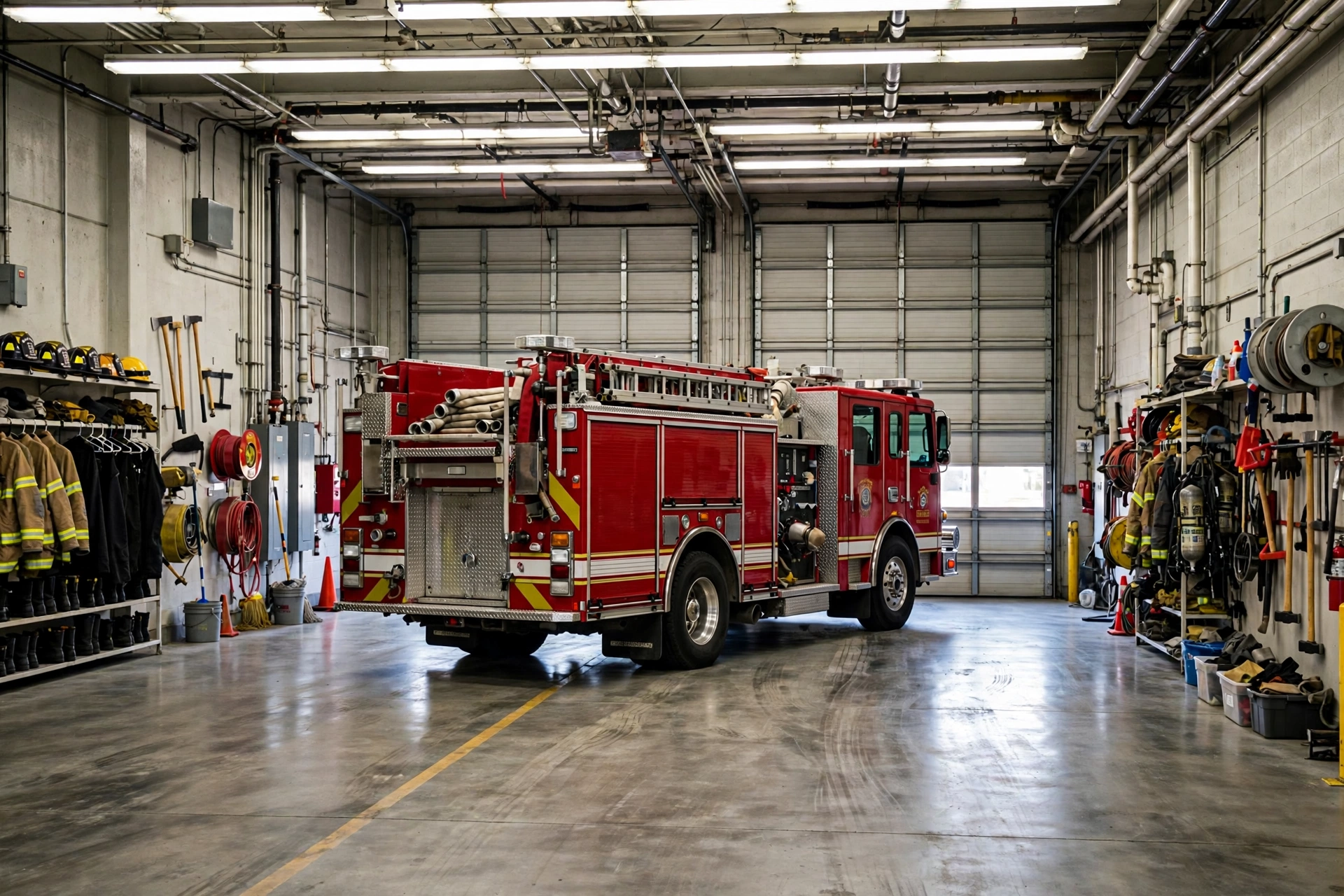
What a Fire Station Actually Runs On
A fire station is three buildings sharing one roof and one electricity bill, and they behave nothing alike. The apparatus bay is a garage with heavy doors and heavy vehicles. The dispatch and watch room is a communications centre that cannot blink. The living quarters are a small house where a crew eats, sleeps and waits. A generator sized for the living quarters alone leaves the engines trapped behind dead doors. A generator sized for the bay alone leaves the radios dead. The set has to carry all three, plus the compressor that fills the breathing-air cylinders, plus the gear dryers that decide whether the crew can enter the next fire. The load list is the whole job, and it is shorter than most buyers expect — which is exactly why it gets done badly.
The scale runs from a volunteer station with one engine and a dozen members to a city headquarters with four bays, a training tower and a fleet of twenty vehicles. The smallest stations run on a set the size of a large home standby unit. The largest run on a set the size of a small factory’s. Between those two ends, the same four loads decide the size every time: the bay doors, the dispatch radios, the breathing-air compressor and the heating and cooling that keeps the crew and the equipment at working temperature. Everything else is negotiable. Those four are not.
The bay doors: the load that strands the crew
The bay door is the single most dangerous load in a fire station, because it is the only load that can physically trap the crew inside the building. A sectional overhead door on an apparatus bay is driven by an electric operator of 0.5–1 hp per door. A four-bay station has four operators, and on a call all four can be asked to open at once. Each operator draws 5–6 times its running current for the first second of the start, so four doors opening together present a starting surge several times their modest running load — the classic motor-starting problem in miniature, and the reason a station’s generator is sized on starting kVA rather than on the sum of the nameplates.
Every bay door has a manual override, usually a chain hoist. The override works, and it is slow. A crew that has to haul a 4-metre door open by hand loses a minute or more of its response time, and the chain can jam. Memphis found that out on the night of 27 November 2013, when Station 23 lost grid power at 22:01 and the crew, trying to answer a medical call at 22:43, began opening the door by hand — and the chain fell off the pulley and blocked the exit entirely. The engines sat behind a door that would not move. A fatal house fire was burning less than a mile away. The station’s firefighters did not reach it. Three surrounding stations answered instead, and the department met its response-time target anyway, but only because the city had redundancy to spare. The lesson was not about the chain. It was about a station whose doors depended on a grid that had already failed.
A generator that carries the bay doors changes the whole calculation. The doors open on the first press, the engines roll, and the crew’s turnout time — 80 seconds under NFPA 1710, from alarm to wheels rolling — stays achievable. The doors belong on the generator’s essential bus, on the first transfer switch, with no load-shedding relay in front of them. A door that waits for a second-stage transfer is a door that has already cost the crew its response time.
Dispatch and radio: the load that cannot blink
The dispatch and watch room is the smallest load in the station and the one with the least tolerance for interruption. Radios, the station alerting system, the computer-aided dispatch terminal, the repeater and the antenna system together draw 2–5 kW — less than a domestic kettle. But a radio that drops for ten seconds drops the call that came in during those ten seconds, and a station alerting system that misses a tone leaves a crew asleep while a house burns. These loads sit on a UPS, and the UPS battery carries them for 15–30 minutes while the generator starts. The generator’s job is to take over before the battery runs out, and then to keep the UPS charged for the rest of the outage.
The radio load is almost entirely electronic, which makes it sensitive to the generator’s power quality in a way the bay doors are not. A set that hunts — its frequency wandering as the governor chases a step load — will make the UPS switch back to battery, and a UPS that keeps switching to battery will drain itself and then drop the load it was protecting. This is the same failure that shows up in offices and data centres, and it is why the generator’s voltage and frequency regulation matter as much as its kilowatt rating. A station that buys on kVA alone and ignores regulation buys a set that can run the doors and starve the radios.
The breathing-air compressor
The breathing-air compressor is the load most first-time buyers leave off the list, and it is the load that decides whether the station is still in service after the first fire. A self-contained breathing apparatus cylinder holds about 30 minutes of air. A crew that works a structure fire empties several cylinders per firefighter, and the station refills them from its own compressor, a machine that fills cylinders to 300 bar (4,500 psi) and draws 3–7.5 kW from a motor that starts hard and runs for 20–40 minutes per fill cycle. The air it produces must meet NFPA 1989 breathing-air quality — oil-free, dry, and tested — which is why the compressor is a fixed installation with its own filtration and testing regime, not a portable unit borrowed from a dive shop.
A station whose compressor has no power after a fire is a station that cannot send its crew to the next fire. The cylinders are empty, the neighbouring station’s compressor is a drive away, and the crew is standing in wet gear waiting for air. The compressor belongs on the essential bus, and it belongs in the sizing calculation with its starting kVA counted, not its running kW. A 5.5 kW compressor motor starting across the line can demand 30 kVA for its first second. A generator sized without that number in it will trip its breaker the first time the compressor starts under load.
Living quarters, gear drying and the rest
The living quarters are the largest load in the station and the easiest to shed. Kitchen, bunk-room heating and cooling, lighting, showers and laundry add 10–20 kW to a station’s total, and most of it can wait. A station that sheds the kitchen and the bunk-room air conditioning on generator power loses comfort, not capability. The mistake is the opposite one: sizing the generator for the whole building, quarters included, and then discovering the set is twice the size it needed to be and running at 30% load for its entire life, wet stacking, glazing its bores and failing its monthly test.
Two smaller loads deserve a line each. The vehicle exhaust extraction system — the hose or rail system that captures diesel exhaust at the tailpipe as the engine starts in the bay — draws 2–4 kW and runs every time an engine leaves, which is exactly when the generator is carrying the doors and the radios. Diesel exhaust is a carcinogen, and the extraction system is a health measure, not a convenience; it stays on the essential bus. The turnout-gear dryers draw 2–3 kW each and run for hours after a fire, because NFPA 1851 requires contaminated gear to be cleaned and dried before it is worn again — wet gear is heavy, it loses its thermal protection, and a crew in wet gear cannot enter a structure. The dryers are not urgent in the first ten minutes of an outage. They are urgent by the next morning.
| Load | Running load | Starting demand | On essential bus? |
|---|---|---|---|
| Bay door operators (4 doors) | 1.5–3 kW | 8–18 kVA | Yes — first transfer |
| Dispatch, radios, alerting | 2–5 kW | Negligible (UPS) | Yes — via UPS |
| Breathing-air compressor | 3–7.5 kW | 18–45 kVA | Yes |
| Vehicle exhaust extraction | 2–4 kW | 6–12 kVA | Yes |
| Turnout-gear dryers (2 units) | 4–6 kW | 5–7 kVA | Shed after 24 h |
| Living quarters, kitchen, HVAC | 10–20 kW | 15–30 kVA | Shed on generator |
| Apparatus battery chargers, block heaters | 2–4 kW | Negligible | Yes |
| Lighting, security, IT | 3–5 kW | Negligible | Yes |
Sizing the Set: Four Station Types, Four Answers
Sizing a generator for a fire station starts with a decision that has nothing to do with kilowatts. It starts with deciding what the generator has to keep working. A station that sizes its generator for the lights and the offices will discover, on the first outage, that the doors would not open and the compressor would not start. A station that sizes its generator for the doors, the dispatch, the compressor and the extraction system will discover, on the first outage, that nothing changed except the sound of the engine outside. The difference between those two outcomes is the difference between a generator sized for the building and a generator sized for the response.
The method is the same one in any sizing guide: list every load, separate the essential loads from the sheddable ones, add the running loads, then add the starting kVA of the largest motor that will start while the others are running. A fire station’s largest motor is usually the breathing-air compressor or the HVAC compressor, and the rule of thumb from municipal sizing work is to allow two to three times the running draw for startup. The generator is then chosen so that it carries the essential load at 50–80% of its rating after the inrush has passed. A set that runs at 90% of its rating on a hot night has no margin for the next motor to start. A set that runs at 30% of its rating for its whole life wet stacks.
The rating matters as much as the size. A fire station’s set is a standby set: it waits for months, then runs for hours. The correct rating is the standby rating, and the standby and prime ratings of a set are not interchangeable — a standby set is rated for the duration of a utility outage, typically up to 200 hours a year, and running it as if it were a prime set shortens its life and voids its warranty. A station that expects its generator to run for a week after a hurricane needs to know that its standby rating covers that week, and that the fuel and the maintenance schedule are sized for it too.
| Station type | Typical set | Essential load | Fuel at 75% load | Notes |
|---|---|---|---|---|
| Volunteer, single bay, 1 engine | 25–50 kVA | 15–30 kW | 3.3–6.6 L/h | Often unmanned between calls; remote monitoring essential |
| Suburban, two bays, 2 engines | 60–125 kVA | 40–80 kW | 8–13 L/h | The common size; SCBA compressor usually the largest motor |
| Urban, three to four bays | 125–200 kVA | 80–130 kW | 13–20 L/h | Multiple compressors, training rooms, larger HVAC |
| City HQ, four-plus bays, training centre | 150–300 kVA | 100–200 kW | 20–40 L/h | May need a second set or a paralleled pair |
The table’s numbers track the municipal market. Turnkey Industries, which supplies municipal generators across the United States, puts a satellite fire station at 65–125 kW — a 65 kW set carries a small station’s traffic-signal-scale loads, lighting, basic operations and communications, while larger stations serving bigger populations need 125 kW and up, with concurrent high-draw systems pushing the requirement towards 250 kW. PAVO’s own catalogue follows the same shape: the 50 kVA Weichai silent set is the one most often quoted for fire stations, a size that carries a two-bay station’s essential loads with room for the compressor’s starting surge, while a city headquarters steps up to a 300 kVA class set such as the Cummins-powered C500D5 — 500 kVA standby, 455 kVA prime, burning 93.2 L/h at full prime load and 69.9 L/h at 75%.
One honest limit belongs in this section. A generator cannot power a whole city fire service. It powers one station, and a city with fifty stations needs fifty sets, each sized for its own building, each tested on its own schedule. The stations that fail in a disaster are the ones that were never given a set, not the ones whose set was a size too small. Memphis learned that in 2013: nearly half of the city’s 56 stations had no backup generator at all, including the station whose crew was trapped behind its own bay door.
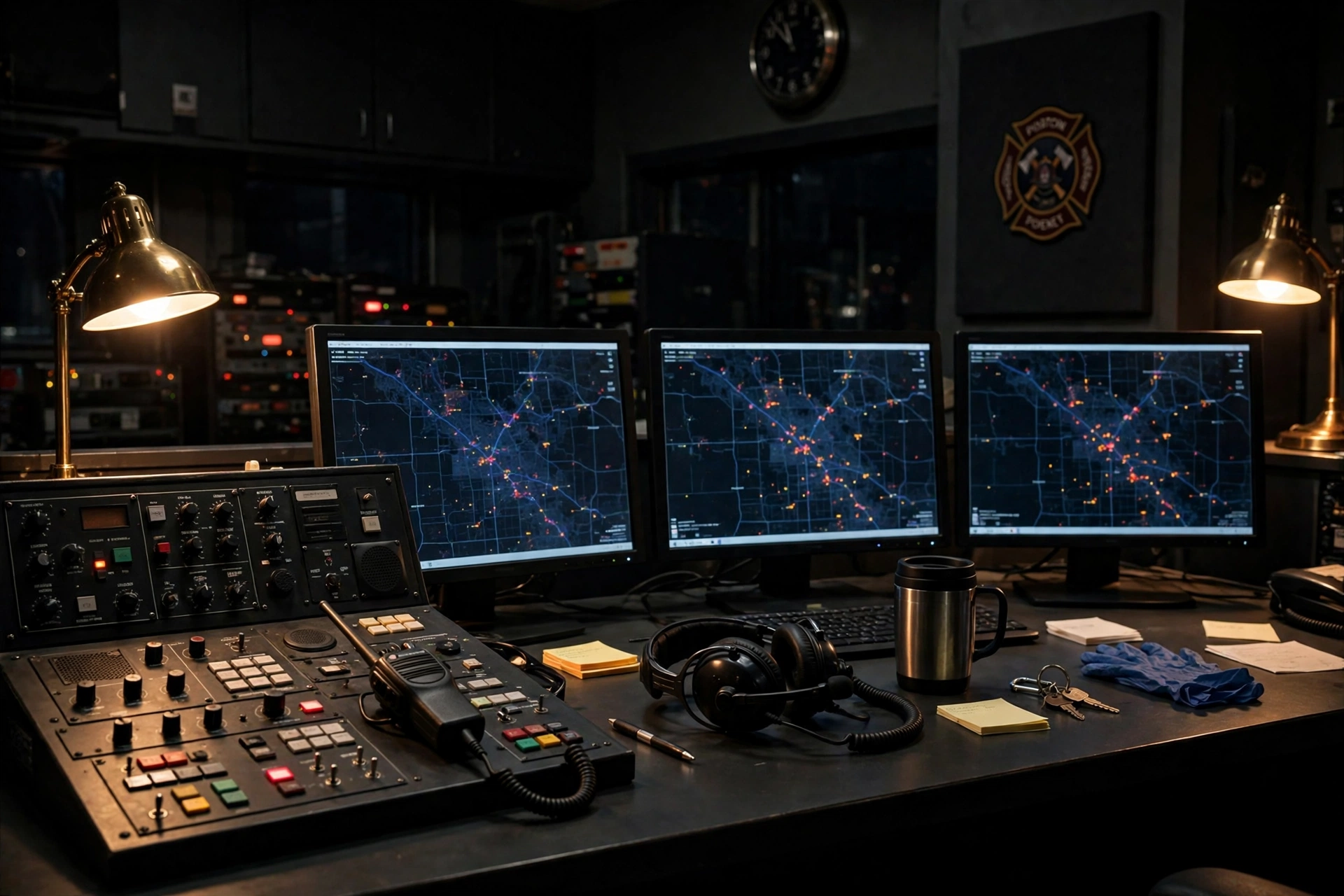
The Ten Seconds That Decide Whether the Crew Gets Out
NFPA 110, the Standard for Emergency and Standby Power Systems, is the document that decides what a fire station’s generator must do, and it decides it in three words: Level, Class and Type. A fire station is a Level 1 application — failure of the backup power could result in loss of human life or serious injury — which is the strictest of the two levels. Type 10 means the system must provide power within 10 seconds of the utility failing. Class 48 means the system must run for 48 hours on stored fuel without refuelling. A station specified as Type 10, Class 48, Level 1 has a generator that is running and carrying load ten seconds after the grid fails, and enough fuel on site to keep it running for two days. Anything less is a station that has accepted a gap in its own response.
The ten seconds are the whole design. The automatic transfer switch senses the loss of utility voltage — typically within 1–3 seconds — sends the start signal to the engine, and transfers the load once the generator has reached rated voltage and frequency. A healthy diesel set cranks, starts and accepts load inside that window, but only if the starting batteries are charged, the block heater has kept the engine warm, the fuel is clean and the set has been tested under load. A set that has sat for a year without a loaded test will not reliably make ten seconds. It may not make thirty. The monthly test is the difference, and the standard requires it: NFPA 110 calls for a monthly exercise of at least 30 minutes, and a diesel set must run at 30% of its nameplate kW or more during that exercise, or it wet stacks — unburned fuel and carbon building up in the exhaust, glazing the cylinder bores and cutting the set’s life. Once every 36 months, a Level 1 system must also be tested for at least four hours at full load.
The voltage dip that drops the load
Ten seconds is not the only number. The transfer itself has to be clean. When the generator picks up the essential bus, the motors on that bus start, and their starting current drags the generator’s voltage down. If the dip is deep enough, the contactors in the dispatch equipment drop out, the UPS switches to battery, and the radios go dark for the seconds it takes everything to recover. NFPA 20, the fire pump standard, permits a 15% voltage dip for electric starting of a fire pump — and a station that shares its generator with a building fire pump has a harder problem still, because a fire pump motor starting across the line can demand 125–150% of its horsepower in generator capacity. The fire pump generator rules are written for exactly that case, and a station in a shared municipal building should read them before it sizes its set. The general rule for everything else is the same: size for the starting kVA, keep the dip inside the equipment’s tolerance, and prove it with a load test, not a spreadsheet.
What the ATS must do, and what it must not do
A fire station’s transfer switch has two jobs and one temptation. The jobs are to transfer fast and to transfer only the essential loads. The temptation is to transfer everything, because it is simpler to wire one switch than two. A station with a single transfer switch that carries the whole building — quarters, kitchen, training rooms and all — needs a generator sized for the whole building, which is a generator twice the size it needs, running at half the load it should, wet stacking its way to an early failure. The correct arrangement is two switches, or one switch with a load-shed relay: the essential bus transfers in ten seconds, and the non-essential loads wait, or never transfer at all. The motor starting calculation is done on the essential bus only, and the generator is sized for that bus, not for the building.
The switch itself must be listed to UL 1008, and the generator to UL 2200, where the authority having jurisdiction requires it. The battery charger that keeps the starting batteries at full charge must be on the essential bus too — a charger that only runs on utility power leaves the station with flat batteries after the first long outage, and a set that cannot crank cannot make ten seconds.
Three Stations, Three Outages
Memphis, Tennessee — the door that would not open
On the night of 27 November 2013, a car hit a pole at Chelsea Avenue and North Holmes, and power went out across part of north-east Memphis at 22:01. About 3,600 people lost supply. At Station 23, on Jackson Avenue near the National Cemetery, the crew received a medical call at 22:43 and began to open the bay door by hand, following backup procedure. The chain fell off the pulley system and blocked the exit. The engine was trapped. Another truck was sent to the medical call, and at 22:47 a house fire was reported less than a mile from the station, at 3708 Orchi. Firefighters from three surrounding stations — No. 17, No. 47 and No. 19 — answered it, arriving in 5 minutes and 10 seconds, inside the NFPA response-time guideline of 5 minutes and 20 seconds. A woman, Tami Rachel Cekala, was taken from the one-storey house to the Regional Medical Center, where she later died. The fire director said the Station 23 crew would not have been sent to that fire even if the door had worked — they were already committed to the medical call — but the department inspected the manual bay-door lifts at all 56 stations afterwards, and the city councilman for the district said the city should take inventory of all 56 stations. The fact that mattered most was the one the fire department spokesman stated plainly: budget constraints meant nearly half of Memphis’s fire stations, including No. 23, did not have backup generators. Power was restored at 23:10, 69 minutes after it failed. The station had been dark for the whole of it.
York City, Pennsylvania — the generator that caught fire
York City’s four fire stations had generators, and that was the problem. The sets were so old and so small that one of them caught fire. In August 2010, Station No. 1 at 49 S. Duke Street lost power, its backup generator started and carried the station, and then, in the fire chief’s words, the generator was “too small and overworked itself so much that it caught fire”. The department’s 2011 budget asked for about $200,000 to replace the generators and install vehicle exhaust systems at each station, inside a total department budget of about $10.5 million. The case is the mirror image of Memphis. Memphis had no generator and its crew was trapped. York had a generator and its generator was the fire. Both failures have the same root: a set that was specified for the building as it was, not for the load as it actually is, and then left to age without a replacement plan. A generator that is undersized does not merely fail to carry the load. It fails destructively, under load, at the moment it is needed most.
Northern California — the shutoffs that never end
The third case is not a single night. It is a programme. A state fire protection agency in Northern California operates stations spread across more than 250 miles of territory, from the Sierra foothills to the Central Coast, many in remote areas with limited road access during fire season. Each station had bought and maintained its own generator independently, and the agency still carried seven separate billing entities for its generator service. Then, in 2019, the utilities began routine Public Safety Power Shutoffs — deliberate grid shutdowns in high fire-risk weather, to stop the grid itself starting fires. Fire stations in PSPS zones are first responders during the exact wildfire events that trigger the shutoffs, and a station that loses power during an active fire loses dispatch communications, equipment bay doors, breathing-air compressors and fuel pumps. The agency consolidated its generator maintenance under a single service organisation, because the problem was no longer mechanical. It was logistical: knowing where every generator stood, what had been done to it, and whether it would start, across seven facilities and 250 miles of rugged territory, heading into every fire season. A generator that fails during a PSPS event at a remote fire station is not an inconvenience. It is a failure of emergency infrastructure, and the only defence is a maintenance regime that treats the set as part of the response, not as part of the building.
Fuel Autonomy: How Long the Station Lasts
A fire station’s fuel supply is a clock, and the clock is set by the standard. Class 48 — 48 hours at full load without refuelling — is the most commonly specified class for a Level 1 system. Class 72 is specified where the risk justifies it. In high seismic risk areas, Zones 3 and 4, NFPA 110 requires a minimum of 96 hours of on-site fuel for a Level 1 installation, and that fuel cannot be shared with any other purpose. Two days is the floor. Four days is the prudent answer for a station in a disaster zone, because the fuel truck that is supposed to arrive on day two may not be able to reach a station whose roads are blocked, flooded or closed by the same event that took the grid down.
The arithmetic is straightforward. A diesel set at 75% load burns roughly 0.22 litres per kWh, so a station’s fuel use follows directly from its essential load. The table below is calculated on that basis, at 75% of the set’s rating — the load a well-sized station set actually carries in an outage.
| Set size | Load at 75% | Fuel use | 48-hour fuel | 72-hour fuel |
|---|---|---|---|---|
| 25 kVA (20 kW) | 15 kW | 3.3 L/h | 160 L | 240 L |
| 50 kVA (40 kW) | 30 kW | 6.6 L/h | 320 L | 480 L |
| 100 kVA (80 kW) | 60 kW | 13.2 L/h | 635 L | 950 L |
| 150 kVA (120 kW) | 90 kW | 19.8 L/h | 950 L | 1,425 L |
| 300 kVA (240 kW) | 180 kW | 39.6 L/h | 1,900 L | 2,850 L |
A 50 kVA station set needs about 320 litres on site for 48 hours, and about 480 litres for 72. That fits in a sub-base tank under the set, which is how most stations do it. A 300 kVA headquarters set needs 1,900 litres for 48 hours, which means a bulk tank, a day tank beside the engine, and a transfer pump with a float switch — and a failure mode in the transfer pump that has to be tested, because a bulk tank that cannot reach the day tank is a bulk tank that does not exist.
Fuel that sits in a tank for a year is a different problem from fuel that is burned in a week. The slow failure that kills standby sets is diesel fuel ageing: water condenses on the tank walls, microbes grow in the water-fuel interface, and the black slime the trade calls diesel bug clogs the filters twenty minutes into the first real run. A station’s fuel should be tested annually and polished when the test shows water or microbial growth, and the tank should be kept full — a full tank has less air, less condensation and less room for water to collect. A station that fills its tank once and forgets it for three years has bought 48 hours of fuel that its engine cannot burn.
Where the Generator Sits: Exhaust, Noise and the Neighbours
A fire station’s generator has to live somewhere, and the somewhere matters more than it does for a warehouse. The station is in a residential street, its crew sleeps there, its neighbours live next door, and its engines already produce diesel exhaust inside the bay every time they start. The generator adds a second exhaust source, and the station has to manage both.
Exhaust: out of the building, away from the intakes
Diesel exhaust is a carcinogen, and fire stations already spend money keeping it out of the building — the vehicle exhaust extraction system exists for exactly that reason. The generator’s exhaust must be treated with the same seriousness. The set should sit outside, downwind of the station’s air intakes and the bay doors, with its exhaust stack discharging above the roofline and away from any window, door or ventilation intake. A set installed in a basement or an enclosed room needs a ducted exhaust and a radiator discharge that does not recirculate hot air back into the engine — the same failure that has tripped sets in high-rise buildings on their first hot week. The generator room, where there is one, needs a one-hour fire rating on its walls in many jurisdictions, a fresh-air intake and an explosion release, because the room contains a fuel-burning engine and a fuel tank in the same space as the building’s occupants.
Placement also decides whether the generator can be serviced. A set tucked behind the station, behind a locked gate, with no room to open its canopy doors, will not be serviced properly, and a set that is not serviced properly will not start. The rule is simple: a technician should be able to walk around the set, open every door, change the oil and the filters, and test it under load, without moving a fire engine. If that is not possible, the set is in the wrong place.
Noise: the station that tests at 3 a.m.
A fire station tests its generator at night at its own risk. A silent-canopy set produces 65–75 dB(A) at 7 metres — the sound of a busy street, not a quiet one — and a station in a residential area that runs its monthly test at 3 a.m. will hear about it from the neighbours, the council and, eventually, the fire chief. The answer is not a quieter set. It is a test schedule that respects the street: test during the day, test under load, and test for the full thirty minutes the standard requires. The neighbours will tolerate a generator they can hear once a month in daylight. They will not tolerate one they can hear at night, and a chief who is fielding noise complaints will eventually be told to stop testing — which is how a station ends up with a set that has not been tested in a year.
The canopy choice matters too. An open set is cheaper, louder and shorter-lived outdoors. A silent canopy costs more, lasts longer in weather, and keeps the station’s relationship with its street intact. For a station whose set sits ten metres from a neighbour’s bedroom window, the canopy is not a luxury. It is the difference between a generator the station can test and a generator it cannot.
Testing, maintenance and the volunteer station
The maintenance schedule for a fire station generator is written by NFPA 110 and should be treated as a duty roster, not a suggestion. Weekly inspection of the starting batteries, the coolant level, the fuel level and the alarms. Monthly exercise of at least 30 minutes at 30% of nameplate load or more. Annual service: oil, filters, coolant, belts, hoses and a full inspection. Every 36 months, a four-hour test at full load for a Level 1 system. The schedule is the same for every station. The risk is not. A career station is staffed around the clock, and somebody is always there to notice that the set did not start on its weekly test. A volunteer station is empty between calls, and a set that fails its test on a Tuesday may not be noticed until the next training night, or the next call. For a volunteer station, remote monitoring is not a convenience. It is the only way the station knows its generator is ready. A Deep Sea or Smartgen controller with a GSM or internet link reports the set’s state, its alarms and its test results to the chief’s phone, and a station that is monitored is a station whose generator is tested, because the test result arrives whether or not anybody remembered to run it.
Frequently Asked Questions
What size generator does a fire station need?
A single-bay volunteer station typically needs a 25–50 kVA set, a two-bay suburban station needs 60–125 kVA, and a city headquarters station needs 150–300 kVA. The size is set by the essential loads — bay doors, dispatch radios, breathing-air compressor and exhaust extraction — plus the starting kVA of the largest motor, not by the size of the building.
Do fire stations need a backup generator?
Yes, and in most jurisdictions the requirement is not optional. A fire station is a Level 1 life-safety facility under NFPA 110, which means its emergency power system must restore power within 10 seconds and run for 48 hours on stored fuel. A station without a generator cannot open its bay doors, run its radios or refill its breathing-air cylinders during an outage — and nearly half of Memphis’s 56 stations had no generator when Station 23’s crew was trapped behind a dead bay door in 2013.
How long can a fire station run on a generator?
On the fuel it is required to hold, 48 hours at full load — the NFPA 110 Class 48 minimum for a Level 1 system. Stations in high seismic risk areas must hold 96 hours. In practice a station runs longer than 48 hours, because its real load is 50–75% of the set’s rating, and a 50 kVA set at 75% load burns about 6.6 litres an hour, so 320 litres lasts 48 hours and 480 litres lasts 72.
What happens to a fire station during a power outage?
Without a generator, the bay doors will not open, the dispatch radios and station alerting run on UPS battery for 15–30 minutes and then go dark, the breathing-air compressor stops, and the crew cannot refill cylinders or dry turnout gear. With a generator, nothing changes except the sound of the engine: the doors open, the radios stay up, and the crew’s turnout time — 80 seconds under NFPA 1710 — stays achievable.
Can a diesel generator power a fire station?
Yes. Diesel is the standard choice for fire stations, because a diesel set starts reliably in cold weather, carries motor starting loads well, and stores fuel safely on site for 48–96 hours without the supply problems of a piped gas connection during a disaster. The set must be sized on starting kVA, rated for standby duty, and tested monthly under load at 30% of its nameplate rating or more.
Specification Checklist
- Size the set from the essential load list — bay doors, dispatch, breathing-air compressor, exhaust extraction — plus the starting kVA of the largest motor, and choose the set so the essential load runs at 50–80% of its standby rating.
- Rate the set on its standby rating for a fire station, and confirm the rating covers the longest outage the station must survive, typically 48 hours at full load.
- Specify NFPA 110 Type 10, Class 48, Level 1 as a minimum, and Class 96 where the station sits in a high seismic risk area.
- Fit an automatic transfer switch listed to UL 1008, with a separate essential bus for the bay doors, dispatch, compressor and extraction, and load shedding for the living quarters and kitchen.
- Put the breathing-air compressor on the essential bus, and count its starting kVA — a 5.5 kW motor can demand 30 kVA for its first second.
- Size the fuel tank for 48 hours at full load as a minimum, and 72 hours where the roads may be closed by the same event that took the grid down; keep the tank full and test the fuel annually.
- Keep the set outside, downwind of the station’s air intakes, with its exhaust above the roofline, and leave room to walk around it and service it without moving a fire engine.
- Choose a silent canopy where the station sits in a residential street, and schedule the monthly test in daylight so the neighbours tolerate it.
- Test the set at 30% of nameplate load or more for at least 30 minutes every month, and run the four-hour full-load test at least once every 36 months.
- Fit remote monitoring on any station that is unmanned between calls, so a failed test or a low battery is reported to the chief the same day, not discovered at the next call.
A fire station generator is not a building service. It is part of the response, and it should be specified, tested and maintained like one. A set that opens the doors in ten seconds, keeps the radios up for two days and fills the breathing-air cylinders after the first fire is a set that has done its job. A set that was bought on price, sized on the building’s total load and never tested under load is a set that will fail the same way Memphis’s doors failed — quietly, at night, when the crew needs it most. For a station that is still working out its size, its fuel or its test regime, contact PAVO — the team will size the set from the station’s real load list, not from its floor area.