

What Size Generator Does a Cocoa Plant Need? | PAVO
A cocoa plant does not stop when the power fails. It starts losing the batch that is already hot, already liquid and already in the machine — one roaster, one conche and one tempering line at a time.
What size generator does a cocoa processing plant need? A craft maker grinding 1–2 tonnes a day needs 60–100 kVA, a mid-size grinder at 10 tonnes a day needs 150–300 kVA, and a chocolate plant at 50–100 tonnes a day needs 500–1,500 kVA — the roaster, press and conche are the load; the boiler is steam, not electric.
Contents
- What a Cocoa Plant Actually Draws: The Load in Numbers
- What Size Generator Does a Cocoa Processing Plant Need?
- What Happens in the First Minutes of an Outage
- Three Plants, Three Outages
- The Liquor That Cannot Set: Conching and Tempering on Generator Power
- How Long Can a Cocoa Processing Plant Run on a Generator?
- Frequently Asked Questions
- Specification Checklist: Before You Order the Set
What a Cocoa Plant Actually Draws: The Load in Numbers
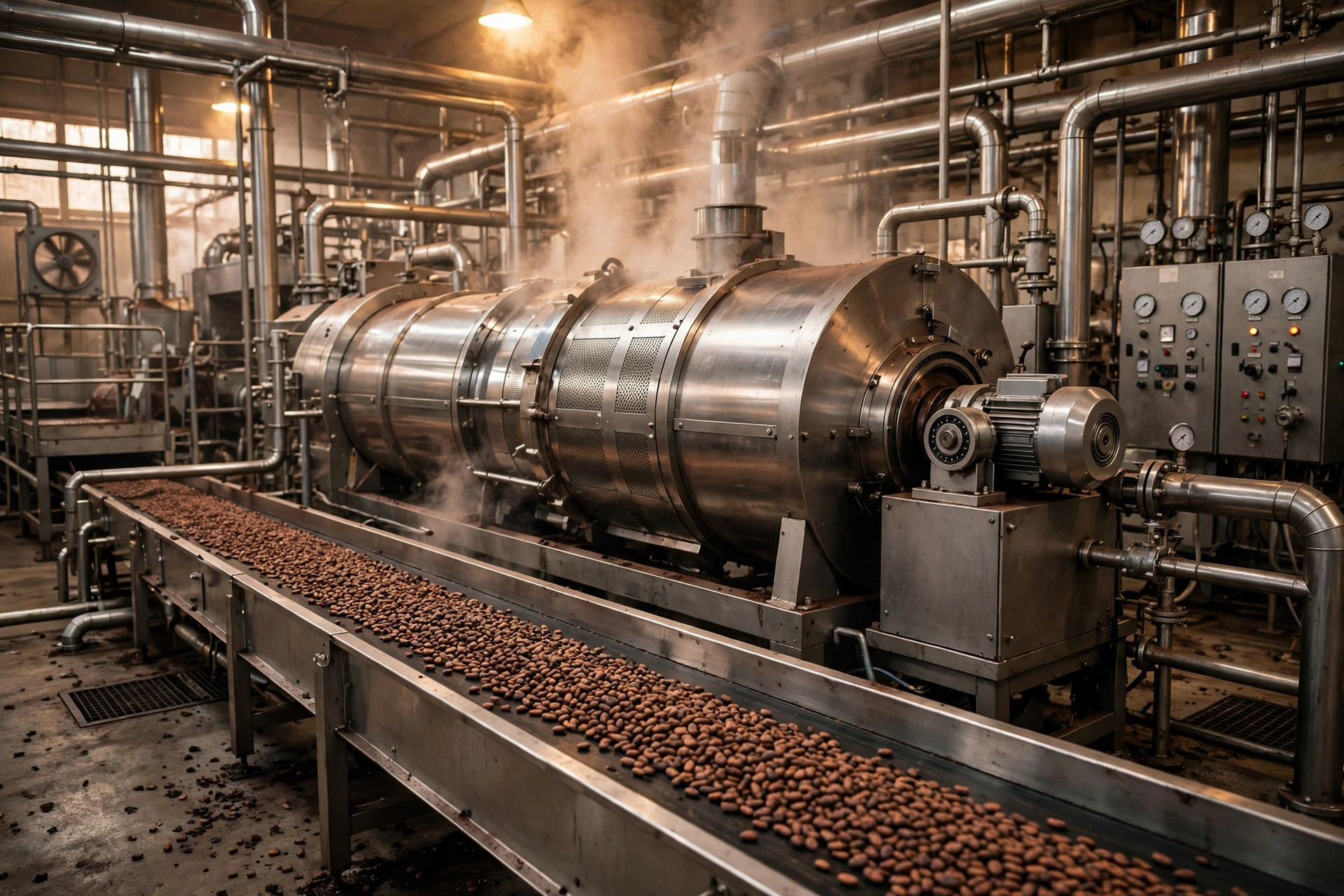
A cocoa plant is a thermal process that happens to use electricity, and that single fact decides the generator size. Most buyers get it wrong in the same direction: they add the steam load and the electrical load together and specify a set two or three times larger than the site needs. Roasting, drying and conching are heat-hungry steps. In most plants above craft scale, that heat comes from a steam boiler burning gas, oil or biomass — not from the generator. The generator carries the electrical slice: motors, drives, fans, pumps, refrigeration and controls.
The scale of the industry sets the context. The International Cocoa Organization put world cocoa production at 4.73 million tonnes in 2024/25, with grindings — beans actually ground into liquor, butter and powder — at 4.61 million tonnes. Côte d’Ivoire grew 1.85 million tonnes, about 38% of world output, and ground 730,000 tonnes at home, about 16% of world grindings. Ghana grew 600,000 tonnes and ground 210,000 tonnes. The Netherlands, the largest destination grinder, ground 580,000 tonnes. Four West African countries — Côte d’Ivoire, Ghana, Nigeria and Cameroon — grow roughly two-thirds of the world’s cocoa, and the grinding plants that serve them sit in exactly the countries where the grid is least reliable.
How much electricity does grinding actually take? A study of three cocoa processing factories in south-western Nigeria, published in the CIGR Journal in 2017, measured the direct energy of turning raw beans into cocoa powder across eight unit operations: cleaning, roasting, winnowing, milling, alkalising, pressing, butter packing and pulverising. The total came to 2.23 MJ per kilogram of beans on grid power and 2.38 MJ per kilogram on diesel — about 0.62–0.66 kWh per kilogram. Pressing took 58% of the total energy and milling 26.3%. From 7.2 tonnes of beans, the line produced 2,825 kg of powder and 2,925 kg of butter, with 20.14% weight loss along the line. A separate life-cycle review put dark chocolate processing at up to 421.9 kWh per tonne of finished chocolate, with average electricity around 0.5 kWh per kilogram of chocolate product. A Colombian study of post-harvest cocoa processing found refining alone consumed more than 30% of the total energy in the production line.
Why pressing dominates the electrical bill
The press is the heart of a grinding plant, and it is the load that sizes the generator. Cocoa nibs are roughly half fat — cocoa butter — and the hydraulic press squeezes that fat out of the liquor under pressures of 400–600 bar, leaving cocoa cake that is then pulverised into powder. A single press runs on a 45–110 kW hydraulic power pack, and a grinding line runs several presses in sequence, cycling load as each press closes, holds and opens. The press motor starts under load, draws a heavy inrush, and then runs at a high, steady draw for the full pressing cycle. That combination — high starting current, high running load, repeated cycling — is what the generator must absorb without a voltage dip that trips the drives on the rest of the line.
Milling is the second load. The nib is ground to liquor in ball mills or stone mills, then refined with sugar and milk powder to a particle size of about 20 microns. Above 30 microns, the finished chocolate reads as gritty on the tongue. Refining is a slow, heavy, continuous load: a five-roll refiner draws 30–75 kW and runs for hours. A Colombian energy audit found the refining step alone took more than 30% of the plant’s total energy. In some plants the nib grinding stage runs 72–96 hours per batch, with friction from the grinding itself holding the mass at 49–54 °C.
The table below gives typical electrical running loads for the equipment a generator must actually carry. These are running loads; starting surge is a separate problem, covered in the sizing section.
| Equipment | Typical running load | Notes |
|---|---|---|
| Bean cleaning and aspiration | 5–15 kW | Fans, destoner, magnets; steady load |
| Roaster (gas-heated) | 15–40 kW | Electric drives, fans and controls; heat is steam or gas |
| Winnower | 10–25 kW | Cracking, air separation of shell from nib |
| Nib grinder / ball mill | 30–90 kW | Continuous heavy load; 72–96 h runs in some plants |
| Hydraulic cocoa press | 45–110 kW | Per press; several presses cycle in sequence |
| Pulveriser (cocoa cake) | 20–50 kW | Intermittent, high starting current |
| Five-roll refiner | 30–75 kW | Continuous; over 30% of plant energy in some audits |
| Conche | 25–60 kW | Per conche; 10–24 h runs, must not stop mid-batch |
| Tempering unit | 10–25 kW | Precise temperature control, 27–32 °C working range |
| Moulding and packaging line | 20–60 kW | Conveyors, depositors, cooling tunnel |
| Refrigeration / chilled water | 40–120 kW | Cooling tunnel, tempering, storage rooms |
| Compressed air | 15–45 kW | Press controls, pneumatic conveying, packaging |
| Lighting, HVAC, offices | 10–30 kW | Steady base load |
A mid-size grinder running at 10 tonnes of beans a day draws roughly 150–300 kW of electrical load while the line is running, with peaks when the presses cycle together and the refiner, conche and packaging line run at the same time. A full chocolate plant adds tempering, moulding and a cooling tunnel, and the refrigeration load alone can match the entire grinding line.
What Size Generator Does a Cocoa Processing Plant Need?
The answer starts with a load list, not a catalogue page. Walk the line, write down every motor with its running kilowatts and its starting method, and add the loads that run together. Then apply three rules that catch most sizing mistakes in this industry.
First, separate the steam load from the electrical load. Roasting at 98–120 °C for 90–95 minutes in the Nigerian study, or 120–150 °C in many European roasters, is a thermal job. The roaster’s electrical draw is its drives and fans — 15–40 kW — not the heat itself. A buyer who sizes the generator for the roaster’s thermal rating buys a set two to three times too large and then runs it at 25% load, where wet stacking starts. The same applies to the conche, which is held at about 79 °C largely by friction heat from the kneading itself, and to the boiler, which needs only its fans, pumps and controls — typically 10–30 kW — from the generator.
Second, size for the presses, not the average. A grinding line’s average load understates the peak by 30–40% because the presses cycle. When two presses close at the same moment the refiner is running and a pulveriser starts, the generator sees a step load of 100–150 kW in under a second. A set sized to the average will dip voltage, and the variable-speed drives on the refiners and conches are the first to trip on undervoltage. The correct figure is the coincident peak, plus a 20–25% margin for the next press starting. This is the same step-load problem that trips UPS systems on generator power, and the motor starting method — direct-on-line, star-delta or soft starter — decides how large the dip is.
Third, decide the rating before the kVA. A grinder in Abidjan or Tema that runs on generator power for several hours a week during load shedding is on prime duty, not standby duty. ISO 8528-1 allows a standby-rated set 200 hours a year; a plant that loses the grid for 56 hours a month — the sub-Saharan African average recorded by World Bank Enterprise Surveys in 2024 — passes that limit in under four months. The standby and prime ratings decide whether the manufacturer will stand behind the set at that duty, and a prime rating is typically 10–15% lower in kVA than the standby rating of the same frame. The generator sizing guide gives the full method; the bands below are the shortcut for a first budget.
| Plant type | Beans per day | Typical critical load | Generator size |
|---|---|---|---|
| Craft chocolate maker | 1–2 t | 40–80 kW | 60–100 kVA |
| Small grinder (liquor and butter) | 5 t | 100–180 kW | 150–250 kVA |
| Mid-size grinder | 10 t | 180–280 kW | 250–400 kVA |
| Large grinder (pressing line) | 50 t | 500–800 kW | 700–1,000 kVA |
| Integrated chocolate plant | 50–100 t | 800–1,200 kW | 1,000–1,500 kVA |
| Large destination grinder | 200 t+ | 1,500–2,500 kW | 2,000–3,000 kVA |
A worked sizing example: 10 tonnes a day
Take a mid-size grinder in Tema, Ghana, processing 10 tonnes of beans a day on a single shift. The load list reads: cleaning and aspiration 10 kW, roaster drives 25 kW, winnower 15 kW, ball mill 60 kW, three hydraulic presses at 75 kW each running in sequence, pulveriser 30 kW, refiner 50 kW, compressed air 25 kW, chilled water 60 kW, lighting and offices 15 kW. Running load with two presses cycling and the rest of the line up: 10 + 25 + 15 + 60 + 150 + 30 + 50 + 25 + 60 + 15 = 440 kW. That is the coincident load, not the nameplate total.
At 0.8 power factor, 440 kW is 550 kVA. Add a 20% margin for the third press starting and for the next year’s growth, and the requirement is 660 kVA. The correct order is a 750 kVA prime-rated set — or a 700 kVA set if the presses are sequenced so two never start together. A 500 kVA standby set, the figure a catalogue quote would most likely offer, is short by a third and would be run beyond its rating on the first busy day. The same arithmetic scales down: a craft maker with a 40 kW coincident load needs a 60–75 kVA set, not the 30 kVA unit that looks adequate on a nameplate list.
What Happens in the First Minutes of an Outage
The first ten seconds decide the batch. The automatic transfer switch senses the loss of mains, starts the generator and transfers the load — normally within 10 seconds under NFPA 110. Ten seconds is short for a motor. It is long for a cocoa plant, because three things are already in motion when the power goes.
The roaster stalls hot. Beans at 120 °C sit in a drum that has stopped turning, with no airflow to carry the heat away. In 90 seconds, the beans at the bottom of the drum scorch while the beans at the top cool. A roast that was 40 minutes into a 90-minute cycle cannot be resumed: the temperature profile is broken, the flavour development is uneven, and the batch is downgraded to industrial grade or written off. A roaster holds 500–2,000 kg of beans per batch; at 2024 bean prices averaging US$7.33 per kilogram, a single scorched batch costs US$3,700–14,700 in raw material alone.
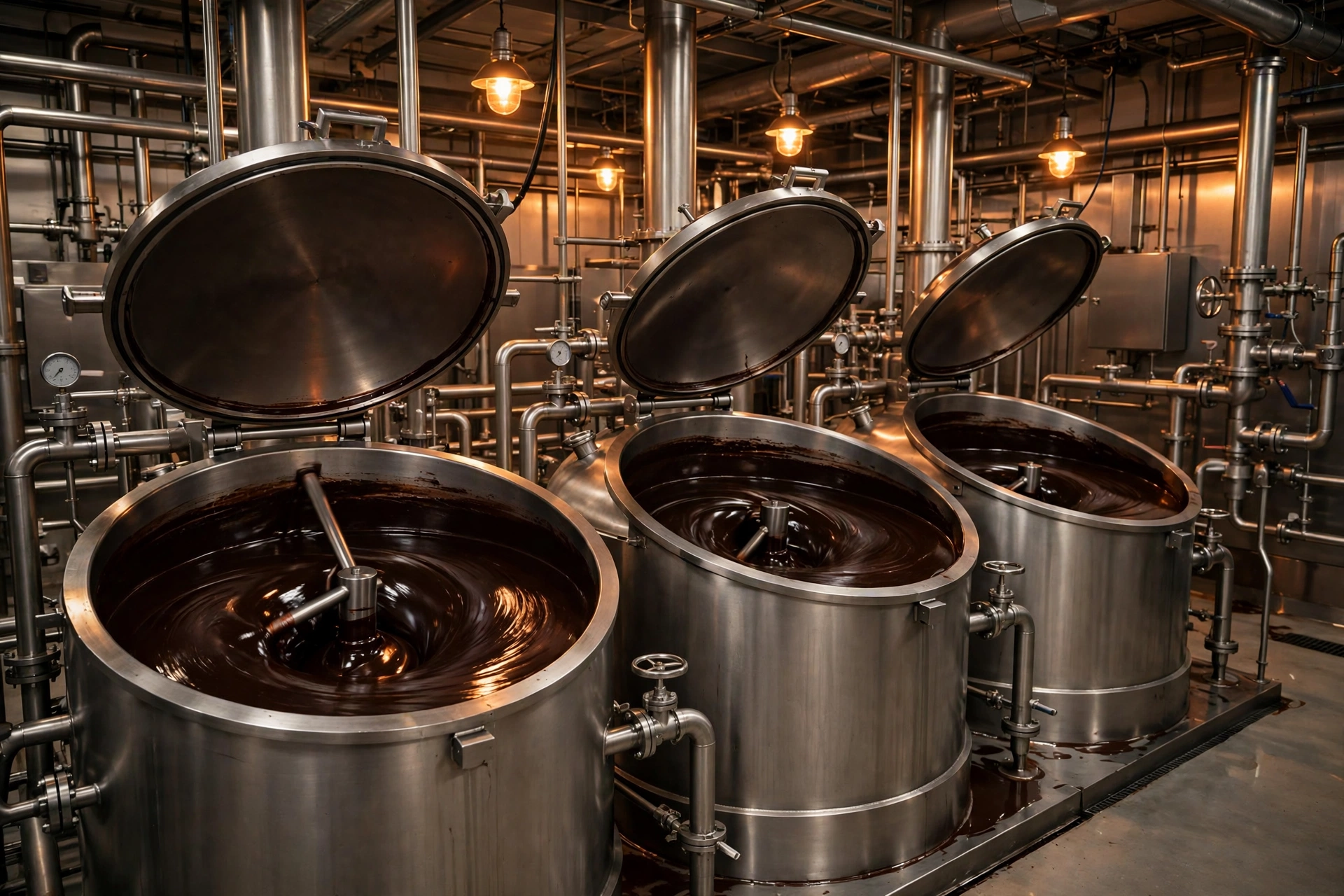
The liquor starts to set. Cocoa liquor is liquid only while it is hot and agitated. It is roughly half cocoa butter, and cocoa butter begins to crystallise as soon as the temperature falls below 34 °C. The grinding and holding tanks are jacketed and heated, but the jackets are electric. Lose the heat and the agitation, and the liquor thickens in the pipes, the pumps and the bottom of the conche. Restarting a line with set liquor in it means steam-lancing pipes, stripping pumps and re-melting tanks — a 4–8 hour job that costs more in lost production than the generator that would have prevented it.
The press line stops mid-cycle
The third failure is the least visible and the most expensive to fix. A hydraulic press mid-cycle holds 400–600 bar of pressure on a cake of cocoa solids. Lose power and the press stops with the cake half-pressed, the hydraulic oil cooling and thickening, and the press platens locked. The cake must be removed manually, the press re-primed and the cycle restarted from the beginning. Each interrupted press cycle loses 30–60 minutes of production and one partially pressed cake, which goes back to the grinder as rework. On a line running three presses, a single 20-minute outage can cost 2–3 hours of effective production once the restart sequence is counted.
The pattern is consistent across the industry: the damage from an outage is not the minutes without power. It is the hours of restart, rework and downgraded product that follow. A generator that starts in ten seconds and picks up the essential board — roaster drives, press hydraulics, liquor heating and agitation, conche drives and refrigeration — prevents all three failures. A generator that starts in ten seconds but is too small to hold the step load when the presses restart trips on overload, and the plant is back where it started, with a running generator and a stopped line.
Three Plants, Three Outages
Case 1: The Tema grinder and three weeks of load shedding
In June 2024, Ghana’s grid operator announced a three-week load-shedding programme after gas supply from Nigeria fell. The state power company, the Electricity Company of Ghana, owed about US$1.2 billion to private energy producers, and the government needed about US$400 million to buy gas and liquid fuel for its power plants. Ghana’s electricity mix is 63% gas and 34% hydro, so a gas shortfall becomes a power shortfall within days. The cuts were rotational — different areas at different times — which is the worst pattern for a processing plant, because the outage arrives without warning and the plant cannot plan its batches around it.
A grinding plant in Tema, processing 10 tonnes of beans a day into liquor and butter, ran its 500 kVA standby set through that programme. The set started every time. The problem was the duty. By the end of the second week the set had run 96 hours — nearly half its 200-hour annual standby allowance in fourteen days — and the load was the full pressing line, not a test load. Oil consumption rose from one litre every 12 hours to one litre every 7 hours. By the third week the set was tripping on high coolant temperature at 85% load, and the plant was running the presses one at a time, at half its normal throughput, to keep the generator alive. The three weeks cost the plant an estimated 180 tonnes of unground beans, about US$1.3 million in bean value at 2024 prices, against a generator that had cost US$68,000. The replacement order, placed the following month, was a 750 kVA prime-rated set with a 5,000-litre bulk tank — the set the plant should have bought first.
Case 2: The conche that stopped at hour 14
A chocolate maker in the Netherlands runs two conches, each holding 3 tonnes of chocolate mass, on a 20-hour conching cycle. Conching is the step that makes chocolate taste like chocolate: the mass is kneaded at about 79 °C for 10–24 hours, driving off volatile acids and coating every particle in cocoa butter. The conche cannot be paused. Stop the kneading and the temperature falls, the mass thickens, and the acids that should have been driven off stay in the batch.
In this plant, a substation fault cut power for 47 minutes at hour 14 of a 20-hour cycle. The generator — a 400 kVA set sized for the building, not the process — started, but the transfer panel had been wired so the conches were on the non-essential board. The drives stopped. The mass cooled from 79 °C to 52 °C in 47 minutes. When power returned, the conche motors could not restart against the thickened mass: the torque required had risen past the motor’s starting capacity, and the drives tripped on overload three times before the maintenance team gave up and steamed the conches out. Both batches — 6 tonnes of chocolate mass — were reworked as industrial coating chocolate at a 40% price discount, a loss of roughly €18,000 on the two batches. The fix cost €4,200: moving the two conche drives to the essential board and adding a load-shedding relay that drops the packaging line first. The generator was never the problem. The board was.
Case 3: The press line that tripped its own generator
A large destination grinder in Malaysia runs a pressing line of six hydraulic presses behind a 1,500 kVA set. The set was sized correctly for the running load. It was not sized for the restart. After a grid outage, the plant’s restart sequence brought all six presses back at once, each drawing 5–6 times its running current for the first seconds of the hydraulic pump start. The step load hit 2,100 kVA against a 1,500 kVA set. The generator’s voltage dipped to 312 V on a 400 V system, the undervoltage protection tripped the main breaker, and the whole line went dark again — this time with a running generator and no load at all.
The plant lost 90 minutes restarting the presses one at a time, and the incident repeated twice more before the sequence was changed. The fix was procedural, not capital: a staggered restart, one press every 30 seconds, with the refiner held off until the third press was running. The lesson is the one the motor starting guide states plainly — a generator is sized for the largest step it must swallow, not for the average load it must carry — and a pressing line’s restart step is larger than its running load by a factor that surprises every first-time buyer.
The Liquor That Cannot Set: Conching and Tempering on Generator Power
Conching and tempering are the two steps where a cocoa plant’s product is most vulnerable to a power cut, and they are the two steps most often left off the essential load list. Both are temperature-critical, both run for hours, and neither can be restarted cleanly once stopped.
Conching runs 10–24 hours per batch. The mass is held at about 79 °C while rollers or paddles knead it, driving off acetic acid and other volatiles left from fermentation and coating each particle — ground to about 20 microns — in cocoa butter. The heat comes largely from friction, which means the conche heats itself while it runs and cools itself when it stops. A conche that stops for 30 minutes loses 15–20 °C. Restarting against a cooled, thickened mass needs more torque than the motor can deliver, and the batch must be steamed out and reworked. The rule for the generator specification is simple: the conche drives go on the essential board, and the load-shedding relay drops the packaging line, the offices and the yard lighting before it touches a conche.
Tempering is tighter still. Cocoa butter crystallises in six forms, and only Form V — melting at 33.8 °C — gives finished chocolate its gloss, snap and shelf life. Tempering is controlled crystallisation: dark chocolate is melted to 45–50 °C, cooled to 27–28 °C to grow crystals, then held at a working temperature of 31–32 °C. Milk chocolate works at 29–30 °C, white chocolate at 28–29 °C. The window is 2–3 °C wide. A tempering unit that loses power for 15 minutes drifts out of that window, and the chocolate it deposits after the restart is untempered: dull, soft, and streaked with fat bloom within a day or two. The batch is not destroyed — it can be re-melted and re-tempered — but the moulding line loses 1–2 hours and the rework costs the plant its production slot for the day.
What the generator must carry — and what it must not
The essential board for a chocolate plant is short: roaster drives and fans, liquor heating and agitation, press hydraulics, conche drives, tempering units, refrigeration and the control system. The non-essential board is everything else: packaging, palletising, offices, yard lighting, the canteen. The mistake in Case 2 — conches on the non-essential board — is the most common wiring error in this industry, and it is also the cheapest to fix. A load-shedding relay that drops the packaging line when the generator reaches 85% load costs less than one reworked conche batch, and it is the difference between a plant that survives an outage and a plant that restarts one.
Refrigeration deserves its own line on the essential board. The cooling tunnel after the moulding line, the tempering room and the finished-goods store all run on chilled water, and a chocolate store that warms past 25 °C starts to bloom within hours. A 40–120 kW refrigeration load is not optional during a summer outage in West Africa, where ambient temperatures run 30–35 °C and a warehouse without cooling becomes a warm room in under an hour. The same logic applies to the bean store: dried beans are stable, but a store that loses its ventilation in humid air takes on moisture, and moisture is the start of mould.
How Long Can a Cocoa Processing Plant Run on a Generator?
The answer is a fuel calculation, not a generator specification. A set’s tank decides the runtime, and the tank that ships with a standard canopy set is sized for a test run, not a production shift. The Cummins C500D5 — 500 kVA standby / 455 kVA prime — carries a 645-litre tank and burns 49.0 L/h at 50% prime load, 69.9 L/h at 75% and 93.2 L/h at full prime load. At 75% load that is 9.2 hours on the standard tank. A plant that needs 72 hours of autonomy needs 5,000 litres of usable fuel, not 645.
The table below uses the C500D5 figures at 75% prime load, the most common operating point for a grinding line.
| Runtime | Fuel needed (75% load) | Tank | Notes |
|---|---|---|---|
| 8 hours (one shift) | 560 L | Standard 645 L tank | Covers a single shift with margin |
| 24 hours | 1,680 L | 2,000 L bulk tank | Covers a full day of load shedding |
| 72 hours | 5,030 L | 5,500 L bulk tank | Covers a three-day grid event |
| 7 days | 11,700 L | 12,000 L bulk tank + delivery contract | Needs a contracted fuel supplier |
Three practical points follow from the numbers. First, diesel fuel ageing matters more in a cocoa plant than in most standby installations, because the set runs often and the tank turns over slowly between events. Fuel older than 6–12 months in a hot, humid store grows water and microbes, and a clogged filter at hour 30 of a 72-hour run stops the plant as surely as a grid failure. Test the fuel every 6 months and polish it annually. Second, a bulk tank needs a bund: a 5,500-litre tank needs secondary containment for 110% of its volume, and the bund, the fill point and the transfer pump belong in the same specification as the generator. Third, the fuel bill is not small. At 69.9 L/h and a West African diesel price of roughly US$1.00–1.20 per litre, a 72-hour run costs US$5,000–6,000 in fuel alone — against a single scorched roaster batch worth US$3,700–14,700 and a lost week of grinding worth far more. The fuel is the cheapest part of the outage.
The 72-hour question
Seventy-two hours is the planning horizon most cocoa plants should use, and it comes from the grid, not from the generator. Ghana’s June 2024 load-shedding programme ran three weeks, but it was rotational — any single plant lost power for hours at a time, not days. A 72-hour autonomy covers the worst realistic single event: a substation failure, a storm-damaged feeder, or a fuel-supply interruption at the utility. Beyond 72 hours, the constraint is not the tank but the fuel supply chain: a plant that cannot get a tanker delivery in three days has a logistics problem, not a generator problem, and the correct investment is a fuel contract with a named supplier and a guaranteed delivery window, not a larger tank. The food processing plants that share the same grid face the same arithmetic, and the plants that survive long outages are the ones with a supplier’s phone number, not the ones with the biggest tank.
Frequently Asked Questions
What size generator does a cocoa processing plant need?
A craft chocolate maker grinding 1–2 tonnes of beans a day usually needs 60–100 kVA. A mid-size grinder at 10 tonnes a day needs 250–400 kVA, a large grinder at 50 tonnes a day needs 700–1,000 kVA, and an integrated chocolate plant at 50–100 tonnes a day needs 1,000–1,500 kVA for its critical loads. Size from the coincident peak load — presses, refiner, conche and refrigeration running together — plus a 20% margin, not from the nameplate total.
Do cocoa processing plants need a backup generator?
Yes, wherever the grid is unreliable — and most cocoa is grown and ground where it is. Côte d’Ivoire and Ghana grow about half the world’s cocoa, and sub-Saharan African firms averaged 56 hours of outages per month in 2024. A grinding plant loses a roaster batch, a conche batch and a press cycle in the first minutes of an outage, and the restart costs hours. A plant without a generator does not lose minutes of production; it loses batches.
How long can a cocoa processing plant run on a generator?
As long as the fuel lasts. A 500 kVA set at 75% prime load burns about 69.9 litres per hour, so the standard 645-litre tank gives about 9 hours. A 2,000-litre bulk tank gives 24 hours and a 5,500-litre tank gives 72 hours. Plan for 72 hours of autonomy with a contracted fuel delivery, and test the stored fuel every 6 months — aged diesel with water and microbes will stop the set mid-event.
What happens to a cocoa processing plant during a power outage?
Three things fail in the first minutes: the roaster stalls hot and scorches the beans in the drum, the cocoa liquor begins to set in the pipes and tanks as heating and agitation stop, and the hydraulic presses lock mid-cycle with a half-pressed cake inside. Conching and tempering are the most vulnerable steps — a conche that cools 15–20 °C cannot restart against the thickened mass, and a tempering line that drifts out of its 2–3 °C window produces untempered chocolate that blooms within days.
Can a diesel generator power a cocoa processing plant?
Yes — a diesel set is the standard backup for cocoa grinding and chocolate plants across West Africa, South-East Asia and Latin America, and it is also the standard for the coffee roasting plants and tea processing plants that share the same grids and the same thermal-process shape. The set must be sized for the coincident peak including press starting surge, rated prime if the plant runs on generator power for more than 200 hours a year, and wired so the roaster drives, press hydraulics, conche drives, tempering units and refrigeration sit on the essential board.
Specification Checklist: Before You Order the Set
1. Which rating is quoted — ESP, PRP or COP? A plant that loses the grid for 56 hours a month is on prime duty. The rating letters must appear on the datasheet and the contract.
2. What is the coincident peak, not the average? List every motor with its running load and starting method, then add the loads that run together. The presses cycling, the refiner running and a pulveriser starting is the figure that sizes the set.
3. Are the conches and tempering units on the essential board? If the transfer panel drops them, the generator is protecting the building and sacrificing the product. Check the board schedule line by line.
4. Is the restart sequenced? One press every 30 seconds, refiner held off until the third press is running. A simultaneous restart trips the set on overload.
5. What is the fuel autonomy? A 645-litre standard tank gives about 9 hours at 75% load on a 500 kVA set. Order the bulk tank and the bund with the generator, not after the first long outage.
6. At what site conditions? A set rated at 25 °C and sea level loses output in a 35 °C West African plant room. Ask for the derated figure at the actual maximum temperature, and for the ventilation the room needs.
7. Will the warranty stand at the stated duty? Ask in writing: “If this set runs at the stated duty, for the stated annual hours, at the stated site conditions, will the warranty remain valid?” A direct answer, with the rating letters attached, is worth more than a 5% discount.
A cocoa plant buys a generator for the same reason it buys a roaster: the batch in the machine is worth more than the machine. A roaster batch is US$3,700–14,700 of beans. A conche batch is 3 tonnes of chocolate mass and 10–24 hours of work. A press cycle is an hour of production. The generator that protects them costs less than one bad week on the grid — and in Côte d’Ivoire, Ghana and Nigeria, a bad week on the grid is not a possibility. It is the schedule. Before requesting a price, send the supplier four lines: duty in words, honest annual hours including tests, the load list with the largest press and its starting method, and site altitude, maximum temperature and enclosure type. Any manufacturer that knows its business — PAVO included, with a range of 9 to 3750 kVA in open, silent and containerised configurations, powered by Cummins, Weichai, Yuchai and Shanghai Diesel — will price the correct rating from those four lines. To discuss the right set for a grinding line or a chocolate plant, contact PAVO.