

What Size Generator Does a Brewery Need? Guide | PAVO
A brewery does not lose an hour of production when the power fails. It loses the batch in the fermenter, the bottles in the pasteuriser, and the cold store full of finished beer. The generator is what stands between a ten-second outage and a week’s worth of beer going down the drain.
What size generator does a brewery need? A 5,000-hectolitre craft brewery needs 100–150 kVA for its critical loads, a 20,000-hectolitre regional brewery needs 250–400 kVA, and a 100,000-hectolitre plant needs 800–1,500 kVA. The set never powers the whole brewery. It powers the glycol, the fermenters and the cold store that cannot warm up.
Contents
1. Why a Brewery Is Not Just Another Factory Load
2. What Size Generator Does a Brewery Need?
3. The Fermentation Damage Window: What Happens When Cooling Stops
4. The Loads That Decide the Set: Glycol Chillers, Brewhouse and Packaging
5. Fuel Autonomy: How Long a Brewery Can Actually Run
6. Three Breweries, Three Outages
7. Frequently Asked Questions
8. Specification Checklist: Five Questions Before the Deposit
Why a Brewery Is Not Just Another Factory Load
A brewery is a food factory that happens to make a live product. That distinction decides everything about its backup power. Most factories lose an hour of production when the grid fails. A brewery loses the hour, the batch, and often the next two weeks of production planning, because the beer in the tanks was halfway through a biological process that cannot be paused and restarted like a machine.
The numbers explain why. A brewery typically uses 20–50 kWh of heat and electricity per hectolitre of beer produced, according to the EU Best Available Techniques reference document for the food, drink and milk industries (2019). Electricity alone runs 8–12 kWh per hectolitre, and refrigeration is the largest single user of that electricity — about 35% of the total. Cooling itself consumes 3.5–5 kWh per hectolitre. Those figures describe a large brewery. A small craft brewery, running shorter production days and smaller vessels, uses more energy per hectolitre, not less, because the fixed loads — glycol circulation, cold store, compressed air — run whether the brewhouse is producing or not.
No diesel generator set powers a whole brewery. A buyer who asks for one has misunderstood the job, in the same way a food-plant buyer misunderstands it when he asks a generator to run the entire factory. The generator’s job in a brewery is narrower and more valuable: keep the glycol chillers running so fermentation temperature holds, keep the cold store at 0–4°C so finished beer does not warm, keep the fermenters under control so yeast does not stall or run away, and keep the safety systems — CO2 alarms, ventilation, lighting — alive so the building stays safe while the grid is down.
The load profile in numbers
Electricity is the smaller half of a brewery’s energy. Heat dominates. Wort boiling alone consumes roughly 45% of brewhouse energy, and heating water from 78°C to 99°C takes another 30%. Krones thermal-process data for a 100,000-hectolitre brewery puts heat consumption at 44.1 kWh per barrel of sales beer and cooling at 7.7 kWh per barrel. A barrel is 117 litres, so that cooling figure is roughly 6.6 kWh per hectolitre — in line with the 3.5–5 kWh per hectolitre range for the cooling system alone once auxiliary pumps and fans are included.
That split shapes the electrical specification. The largest electrical loads are not the brewhouse itself, which is mostly steam or direct-fired heat, but the glycol chiller that serves the fermenters, the cold store refrigeration, the air compressor that drives the packaging line, and the pumps that move wort, beer and cleaning chemicals. A worked example from a brewery backup-power study puts a mid-size plant at cooling 60 kW, bottling line 50 kW, compressors and washing 30 kW — about 140 kW in total, or roughly 175 kVA of electrical load before starting surges. That is the scale a buyer should have in mind: the critical board of a working brewery is measured in hundreds of kVA, not tens.
Water matters too, because it drives the refrigeration load. A typical brewery uses 3.5–7.5 hectolitres of water per hectolitre of beer, and the best plants get below 3.5. Every litre of that water that ends up in a fermenter must be cooled to fermentation temperature, and every litre of hot liquor must be heated first. The chiller sees both sides of the process.
A wet building full of CO2
A brewery is one of the wettest industrial buildings a generator will ever serve. Floors are hosed down daily, fermentation halls run at high humidity, and caustic cleaning chemicals are sprayed around stainless steel that must stay food-safe. Electrical equipment in a brewery needs the protection to match: RCD protection on final circuits, sealed fittings in washdown areas, and switchboards kept clear of the refrigerated spaces. A generator installation that would be acceptable in a dry warehouse is not acceptable in a brewery, and the cost of getting it wrong is not a failed inspection — it is a fault that takes the fermenters down with it.
Carbon dioxide is the other hazard that changes the specification. Fermentation produces roughly 3.5–4 kg of CO2 per hectolitre of beer. A single 100-hectolitre fermenter releases 350–400 kg of CO2 during primary fermentation. CO2 is heavier than air, it pools in low areas and cellars, and it is odourless. The occupational exposure limit is 5,000 ppm as an eight-hour average, and concentrations above 40,000 ppm are immediately dangerous to life. A brewery that loses power also loses its CO2 extraction fans and its gas monitors if those loads are not on the generator board. The set must carry them, and the generator itself must not be installed in a pit or a low-lying room where CO2 can accumulate. This is a placement rule, not a sizing rule, and it is the one most often missed by buyers who treat a brewery like any other factory.
Why the brewery cannot simply stop
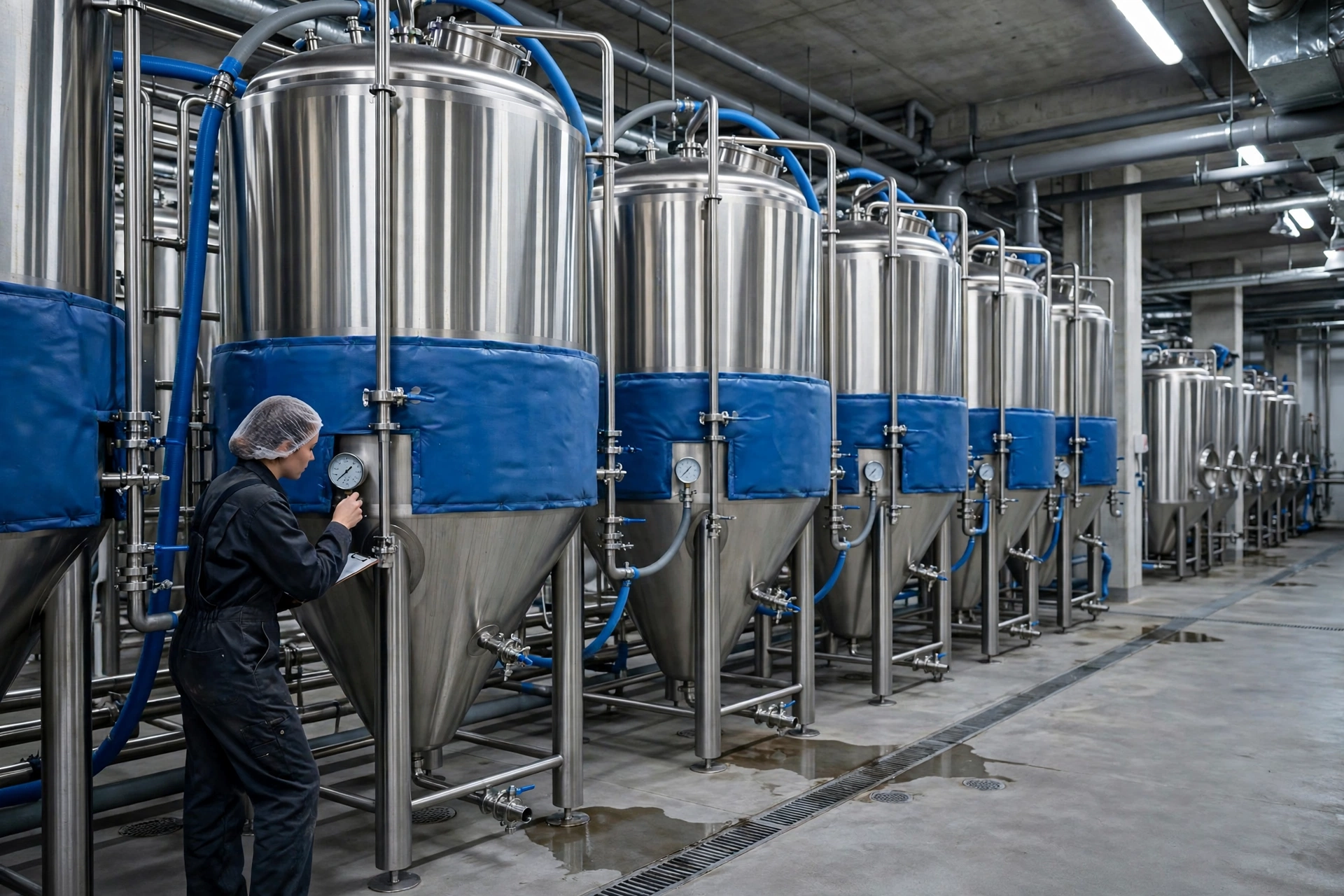
Fermentation is a living process, and living processes do not wait for the grid. Ale yeast works at 18–22°C, lager yeast at 8–13°C, and the yeast itself generates heat as it works — a large fermenter can warm by 1–2°C per day from fermentation heat alone if the glycol stops. The glycol circuit is the only thing holding the temperature, and it runs on electricity.
The restart is where the money goes. A controlled restart after a planned stop takes an hour. A restart after an uncontrolled outage takes a day or more, because the glycol system must be rebalanced, the fermentation temperature profile must be re-established, the batch must be tested for off-flavours, and the packaging line must be cleared of bottles that were trapped mid-fill. A single 30-hectolitre batch of craft beer is about 9,000 bottles at 330 ml. At a wholesale price of $2.50 a bottle, that batch is worth $22,500. A regional brewery running ten fermenters has $200,000 or more of beer in process at any moment. The generator is not protecting a building. It is protecting stock that cannot be remade on demand.
What Size Generator Does a Brewery Need?
The honest answer starts with a load list divided into three tiers, not with a nameplate total. Breweries that skip this step end up with a set that is either twice the size it needs to be, because it tries to carry everything, or half the size it needs to be, because it was sized from a total that nobody triaged.
Tier 1 — must stay on. Glycol chillers and circulation pumps, fermenter temperature control, cold store refrigeration, CO2 monitors and extraction fans, effluent pumps, emergency lighting and the control system. Without these, the beer in process is at risk and the building is unsafe.
Tier 2 — should stay on. Brewhouse at reduced rate, compressed air for the packaging line, CIP circulation, water treatment, the bright-beer tanks and the keg washer. These keep the brewery ready to restart quickly and keep product moving.
Tier 3 — can wait. The full packaging line at full speed, the complete brewhouse at full rate, non-essential HVAC, offices, the taproom and the full-speed filler. These return when the grid returns.
Craft brewery, 1,000–5,000 hectolitres a year
A craft brewery producing 1,000–5,000 hectolitres a year typically draws 60–120 kW in total on a brew day. Its critical board runs 100–150 kVA. The glycol chiller is the largest single load, typically 30–50 kW of electrical input for a 20–40 kW cooling duty, plus 10–15 kW for the cold store and 10–20 kW for pumps, controls and CO2 safety. The workhorse frame here is a 100–150 kVA set: a Cummins C110D5-class set, or a Weichai equivalent, covers the critical board of most craft breweries with room for one large compressor start.
The trap for craft breweries is the brewhouse. A 20-hectolitre electric brewhouse can draw 36–48 kW of heating elements alone, and a buyer who puts the brewhouse on the critical board doubles the set size for a load that does not need to run during an outage. The mash can wait. The fermenters cannot.
Regional brewery, 10,000–50,000 hectolitres a year
A regional brewery producing 10,000–50,000 hectolitres a year draws 250–600 kW in total. Its critical board runs 250–400 kVA. The glycol system grows to 80–150 kW of electrical input, the cold store to 30–60 kW, and the air compressor and packaging support to 40–80 kW. The 250 kVA frame is the workhorse here, and many regional breweries buy a 300–400 kVA set to cover the largest chiller start and leave room for one more fermenter.
This is also the size where the rating decision starts to matter. A regional brewery in an area with an unreliable grid, losing power 300 hours a year or more, needs a prime rating, because the set will run long enough each year to wear like a prime set. The difference between the standby and prime power ratings is about 9% in kVA on the same frame, and the wrong choice shows up as early wear, not as a fault code. A brewery that loses grid power 40–60 hours a year, plus monthly testing, sits comfortably inside the 200-hour annual limit for a standby rating under ISO 8528-1.
Large brewery, 100,000 hectolitres a year and above
A large brewery producing 100,000 hectolitres a year or more draws 1.5–4 MW in total. Its critical board runs 800–1,500 kVA, and it is almost always supplied by two paralleled sets rather than one large unit. Paralleling buys two things: the ability to add capacity as the brewery grows, and the ability to keep half the critical load alive if one set fails to start. A single 1,500 kVA set is cheaper per kVA. Two 800 kVA sets are cheaper per outage.
At this scale the set also covers loads that a craft brewery never thinks about: the CO2 recovery plant, which captures fermentation gas for carbonation and is worth $30,000–$80,000 a year in purchased CO2 avoided; the wastewater treatment plant, which must keep running or the brewery breaches its discharge permit; and the boiler house, which keeps hot liquor and CIP water available. None of these is optional at 100,000 hectolitres.
| Brewery size | Annual output | Total site load | Critical-board generator size |
|---|---|---|---|
| Craft / microbrewery | 1,000–5,000 hL | 60–120 kW | 100–150 kVA |
| Small regional | 5,000–10,000 hL | 120–250 kW | 150–250 kVA |
| Regional brewery | 10,000–50,000 hL | 250–600 kW | 250–400 kVA |
| Large brewery | 100,000–500,000 hL | 1.5–4 MW | 800–1,500 kVA (paralleled) |
These bands are starting points, not quotations. The correct figure comes from the load list, the largest single motor and its starting method, and the site conditions — altitude, maximum ambient temperature and duty. That is the same discipline the generator sizing guide applies to every industrial site, and it matters more in a brewery than in most, because the gap between the total site load and the critical board is so large. A quotation that sizes the set from the brewery’s total demand is either a quotation for a power station or a misunderstanding.
The Fermentation Damage Window: What Happens When Cooling Stops
Ten seconds is the standard answer for how long a standby system takes to restore power. Ten seconds is also long enough to lose the temperature profile of a fermenter, stall a pasteuriser and strand a packaging line. The damage window in a brewery is not measured in seconds of darkness. It is measured in what the beer does in the hours afterwards, and in how much of it can still be sold.
A well set up standby system restores power in about 10 seconds: 1–3 seconds for the automatic transfer switch to confirm the outage, 5–8 seconds for the engine to crank and stabilise, and under a second to move the load. The timers set most of that time. What matters for the brewery is not the 10 seconds themselves but whether the loads that protect the beer survive them.
The fermenter: hours, not minutes
A fermenter full of beer has enormous thermal mass. A 100-hectolitre vessel holds 10,000 litres of liquid, and that liquid does not change temperature quickly. In a cool cellar, a fermenter that loses glycol for 4–6 hours will drift by only 1–2°C. That sounds reassuring, and for a homebrewer it is: a homebrew batch that drops from 20°C to 18°C over a day usually finishes fine, because the yeast simply slows down.
A commercial brewery cannot accept the same drift. Beer is sold on consistency, and a fermentation that drifts 2–3°C above its profile produces measurable off-flavours: excess diacetyl, which tastes of butterscotch; fusel alcohols, which taste hot and solvent-like; and esters that push a clean lager towards a fruity ale. The batch may still be drinkable, but it is no longer the beer on the label, and a brewery that sells it has spent its reputation to save a day of production. The damage window for a fermenter is therefore not the hours it takes to warm. It is the 2–3°C of drift that makes the batch unsaleable, and that drift arrives in 6–12 hours without glycol in a warm climate, or 12–24 hours in a cool cellar.
Lager is the worst case. A lager ferments at 8–13°C, and its yeast is slow and temperature-sensitive. A lager that warms to 18°C does not just drift off-profile; it can stall, because the yeast drops out of suspension and stops working, or it can produce sulphur compounds that take weeks of lagering to clear. A lager that loses cooling on day two of a ten-day fermentation is a batch that needs a decision, not a repair.
The brewhouse, mid-boil
An outage mid-brew is the most expensive ten seconds in a brewery, because the brewhouse is a sequence, not a single machine. A mash that loses heat mid-conversion stops converting starch to sugar. A wort that loses its boil stops isomerising hops, so the bitterness is wrong even if the boil resumes. A whirlpool that loses power stops separating trub, so the wort that goes to the fermenter carries solids that should have been left behind.
The numbers are unforgiving. A mash held at 65–67°C for 60 minutes converts fully. A mash that drops to 55°C and sits there for two hours converts slowly and incompletely, and the wort that results is thin, under-attenuated and prone to infection, because the natural antimicrobial effect of a hot mash is gone. A homebrewer who loses power mid-mash can drain, sparge and boil when the power returns, and the beer is usually drinkable. A commercial brewery that does the same thing produces a batch that does not match its specification, and specification is the product.
The cold store and the pasteuriser
The cold store is the brewery’s bank vault, and it is the load most buyers forget. Finished beer sits at 0–4°C, and every degree above that accelerates staling. Beer held at 20°C stales roughly three times faster than beer held at 4°C. A cold store that loses refrigeration for 24 hours in a warm climate can rise to 12–15°C, and the beer inside it loses weeks of shelf life in a day. The loss is invisible at the time — the beer looks the same — and it shows up as customer complaints three months later, when the batch is already in the market. That is why the cold store belongs on Tier 1 of the load list, not Tier 2, and why the same logic applies to any business that holds perishable stock, as the cold storage backup power guide explains in detail.
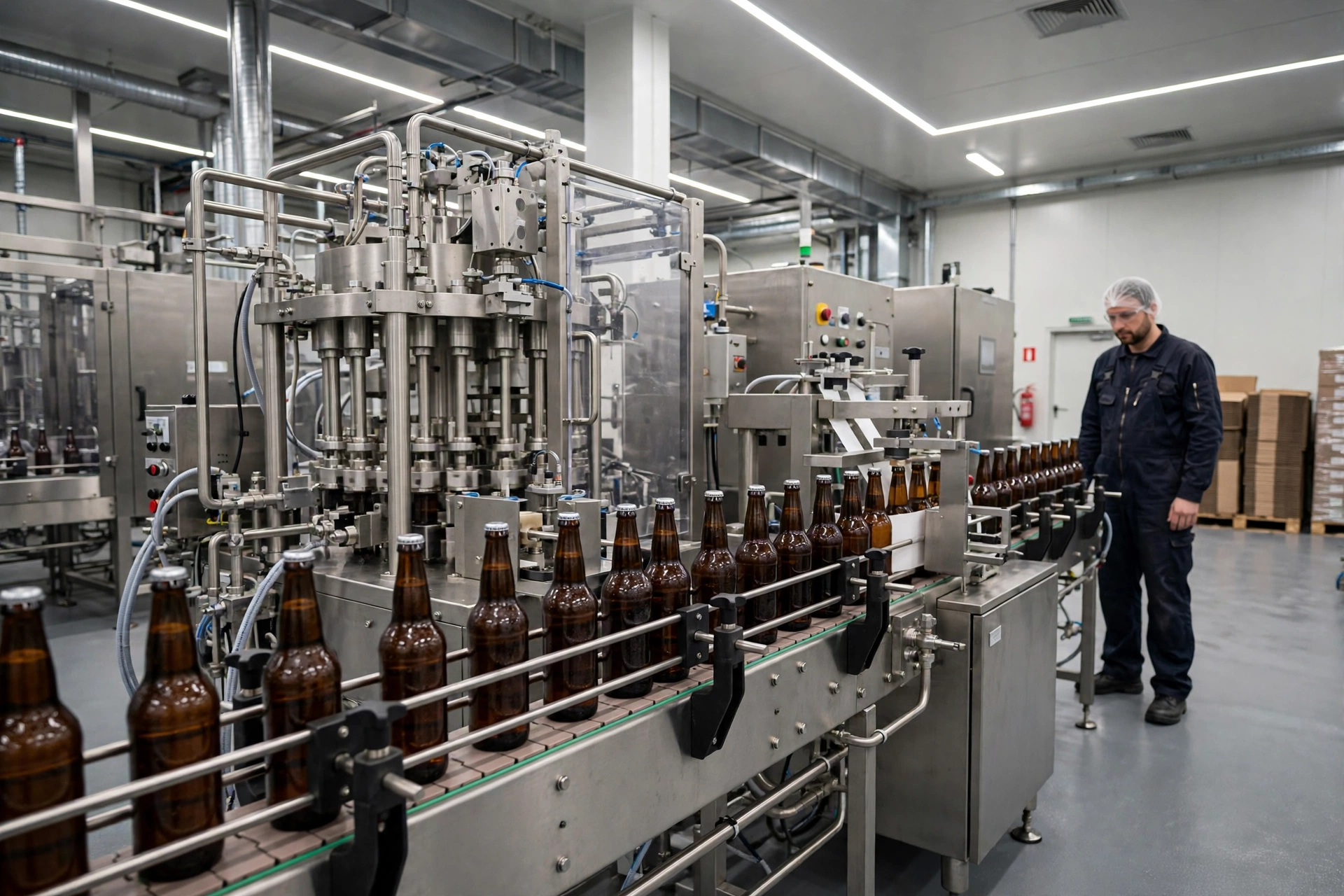
The pasteuriser is the opposite problem: it fails fast, not slow. A tunnel pasteuriser holds bottles at 60–62°C for about 20 minutes, and a line stoppage strands bottles inside the tunnel. Bottles that sit in the hot zone too long over-pasteurise and taste cooked. Bottles that sit in the cold zone too long under-pasteurise and spoil on the shelf. Either way, the bottles in the tunnel at the moment of the outage — often 500–1,000 bottles — are rejected, and the line takes 2–3 hours to clear, re-sterilise and restart. A brewery that runs its packaging line on the critical board avoids most of that loss. A brewery that does not must budget for it.
The Loads That Decide the Set: Glycol Chillers, Brewhouse and Packaging
The generator specification for a brewery is decided by four loads. Get these four right and the rest of the load list is arithmetic. Get one wrong and the set either trips on its largest motor start or runs at 30% load for its whole life, which is the fastest route to wet stacking.
Glycol chillers and refrigeration
The glycol chiller is the largest and most important load in the brewery. It supplies -4 to -5°C glycol to the fermenter jackets, the bright-beer tanks and the cold store, and it runs 24 hours a day, 340 days a year. A craft brewery’s chiller draws 30–50 kW of electrical input. A regional brewery’s chiller draws 80–150 kW. A large brewery’s refrigeration plant draws 300–600 kW and is usually split across two or three compressors, which is an advantage: a split system can restart one compressor at a time, so the generator never sees the whole starting surge at once.
The starting surge is the number that decides the set size. A refrigeration compressor motor draws 5–7 times its running current on direct-on-line start, and a chiller that draws 40 kW running can demand 200–280 kVA for the first second. A soft starter or a variable-speed drive cuts that surge to 2–3 times running current, and it is the cheapest kVA a brewery will ever buy: a $2,000–$4,000 soft starter can save 50–100 kVA of generator size, which is $8,000–$15,000 of set. The same starting logic applies to every large motor in the building, and the motor starting guide works through the methods in detail.
Brewhouse and hot liquor
The brewhouse is a heat load first and an electrical load second. Mash tuns, kettles and hot liquor tanks are heated by steam, direct gas firing or electric elements, and the electrical demand is mostly pumps, agitators and controls — 10–25 kW in a craft brewery, 30–60 kW in a regional plant. The exception is a fully electric brewhouse, where the heating elements alone draw 36–48 kW for a 20-hectolitre system and 80–120 kW for a 50-hectolitre system. A fully electric brewhouse on the critical board doubles the set size, which is why most breweries with generator backup heat with steam or gas and keep only the pumps and controls on the generator.
The hot liquor tank deserves a line of its own. It holds 2,000–10,000 litres of water at 78–85°C, and it is the brewery’s thermal battery. A hot liquor tank that is full and hot at the moment of an outage lets the brewery resume brewing the moment the grid returns, because the water is already at temperature. A hot liquor tank that goes cold costs 2–3 hours of reheating before the next brew can start. Keeping the tank’s heating element on the generator board is rarely worth the kVA, but keeping the tank insulated and full is free, and it is the cheapest form of outage resilience a brewery owns.
Packaging, compressed air and CIP
The packaging line is the load with the worst power quality. A bottling or canning line draws 30–80 kW in a regional brewery, and it draws it in steps: the depalletiser, the filler, the labeller and the packer each start and stop on their own cycle. The air compressor that drives the line’s pneumatics draws 15–37 kW and starts under load, which is the hardest start in the building. A compressor that short-cycles — starting every few minutes as the air receiver empties — can trip a generator that was sized from average load rather than peak load. The fix is a larger receiver, not a larger generator: a 1,000-litre receiver instead of a 500-litre receiver halves the start frequency.
CIP — cleaning in place — is the load that decides whether the brewery can restart at all. A CIP cycle circulates hot caustic and acid through the tanks and lines, and a cycle interrupted mid-way leaves caustic in the lines. The lines must be flushed and the cycle restarted from the beginning, which costs 1–2 hours and 500–1,000 litres of water and chemicals. Keeping the CIP pumps on the generator board costs 5–10 kW and saves the restart. It is one of the best returns on generator capacity in the whole building.
Fuel Autonomy: How Long a Brewery Can Actually Run
A brewery does not need to run on a generator for a week. It needs to run long enough to protect the beer in process and to finish the day’s work, and that is usually 24–72 hours. The fuel calculation is simple, but it is the calculation most buyers get wrong, because they size the tank from the set’s full-load consumption and then discover that the set runs at 60% load and the tank lasts half as long as they expected.
The fuel maths
A diesel generator at 75% load burns roughly 0.21–0.24 litres per kVA per hour. A 150 kVA set at 75% load therefore burns 28–32 litres an hour. A 250 kVA set burns 45–50 litres an hour. A 500 kVA set burns 90–95 litres an hour — the Cummins C500D5 datasheet gives 93.2 litres an hour at full prime load. At 60% load, the same 250 kVA set burns about 38 litres an hour, and that is the number to use for planning, because a brewery’s critical board runs at 50–70% of the set’s rating, not at 100%.
| Generator size | Load | Fuel use | 24 h fuel | 72 h fuel |
|---|---|---|---|---|
| 150 kVA | 75% | 30 L/h | 720 L | 2,160 L |
| 250 kVA | 75% | 48 L/h | 1,150 L | 3,450 L |
| 400 kVA | 75% | 75 L/h | 1,800 L | 5,400 L |
| 800 kVA | 75% | 150 L/h | 3,600 L | 10,800 L |
The table makes the point that surprises most buyers. A regional brewery on a 250 kVA set needs 3,450 litres of fuel for three days, and that fuel must be on site before the outage, because a fuel delivery during a regional power cut is not guaranteed. The sub-base tank that comes with the set typically holds 8–12 hours of fuel. Everything beyond that is a bulk tank, and the bulk tank is a separate purchase that must be in the quotation.
Tank size and the delivery window
The practical rule is to size the bulk tank for 72 hours of critical-load running, and to keep it at least half full at all times. That gives the brewery three days of autonomy and a realistic delivery window, because a fuel supplier that can deliver in 24 hours on a normal day may need 48 hours when the whole region is without power. A brewery that keeps its tank at a quarter full has bought a 72-hour tank and is using it as an 18-hour tank.
Fuel quality is the second half of the calculation. Diesel in a standby tank ages, absorbs water and grows microbes, and a brewery’s generator may sit for six months between runs. Fuel that has been in the tank for more than 12 months without testing or polishing is a risk, not a reserve, and the failure mode is the worst possible one: the set starts, runs for twenty minutes, and then stops on a blocked filter, just as the fermenters need it most. The diesel fuel ageing guide covers testing, polishing and the 12-month rule in detail, and the maintenance schedule sets out the monthly test that keeps the fuel and the set ready.
Three Breweries, Three Outages
Case 1: The craft brewery that lost a lager
A 3,000-hectolitre craft brewery in the north of England runs a 10-hectolitre brewhouse, eight 20-hectolitre fermenters and a 40 kW glycol chiller, all on a single 150 kVA set that the owner bought second-hand. The set covers the critical board — glycol, cold store, pumps and controls — and the brewery has never had an outage longer than three hours. In January 2024, a storm took the grid down for 26 hours. The generator started in 9 seconds and ran for the full 26 hours on its 1,000-litre sub-base tank plus a 500-litre drum the owner had filled the previous week.
The beer survived. The lager in two fermenters drifted from 11°C to 13.5°C over the outage, which is outside the brewery’s specification, and the head brewer made the call to sell it as a limited release rather than as the flagship lager. The batch was 40 hectolitres, about 12,000 bottles, and the limited-release price recovered roughly 80% of the value. The lesson the owner took from the outage was not about the generator, which worked. It was about the tank: the set burned 780 litres in 26 hours, and the drum ran dry with 90 minutes of fuel left in the sub-base tank. The brewery has since fitted a 2,000-litre bulk tank and a low-fuel alarm wired into the same panel as the CO2 monitor.
Case 2: The regional brewery that kept the cold store
A 25,000-hectolitre regional brewery in Victoria, Australia, runs a 30-hectolitre brewhouse, a 120 kW glycol plant and a 60 kW cold store, on a 400 kVA set with a 3,000-litre bulk tank. The brewery is in a bushfire-prone area, and the grid has failed four times in three years, twice for more than 24 hours. The brewery’s rule is simple: the set carries the glycol, the cold store, the CO2 safety systems and the effluent plant, and nothing else. The packaging line and the brewhouse wait.
During a 41-hour outage in February 2025, the set ran at 62% load and burned 3,050 litres — the bulk tank, plus a 500-litre top-up delivered on the second day. The brewery lost no beer. The cold store held at 2°C throughout, the fermenters never moved more than 0.5°C, and the brewery packaged the next day on schedule. The cost of the outage was $4,800 in fuel and overtime. The cost of losing the cold store would have been $180,000 of finished beer, and the cost of losing the fermenters would have been $90,000 of beer in process. The set, bought for $68,000 installed, has paid for itself twice over in avoided losses.
Case 3: The large brewery that learned about CO2
A 150,000-hectolitre brewery in Southeast Asia runs two 800 kVA paralleled sets, a 500 kW refrigeration plant and a CO2 recovery unit that captures fermentation gas for carbonation. In 2023, a substation fault took the grid down for 9 hours. The sets started, the glycol held, and the beer was safe. What failed was the CO2 recovery plant, which had been left off the critical board because it was classified as a production load, not a safety load.
The recovery plant stops, the fermenters keep producing CO2, and the gas has nowhere to go. The brewery’s extraction fans, which were on the critical board, kept the cellar safe, but the brewery vented roughly 2,800 kg of CO2 to atmosphere over the outage — gas it would otherwise have captured and reused. The purchased CO2 to replace it cost $1,400, a small number, but the real cost was the lesson: the recovery plant is now on the critical board, and the brewery’s specification for its next site lists CO2 recovery as Tier 1. A brewery that captures its own CO2 is not just saving money. It is removing a load from the generator board that it then has to put back on, at the worst possible moment. The same logic — that the loads which protect the product belong on the critical board even when they look like production loads — applies to any food plant, as the food processing plants guide shows.
Frequently Asked Questions
What size generator does a brewery need?
A craft brewery producing 1,000–5,000 hectolitres a year needs 100–150 kVA for its critical loads, a regional brewery producing 10,000–50,000 hectolitres needs 250–400 kVA, and a large brewery above 100,000 hectolitres needs 800–1,500 kVA in paralleled sets. The set covers the glycol chillers, the cold store and the safety systems, not the whole brewery, so the correct figure always comes from a tiered load list rather than the site’s total demand.
Do breweries need a backup generator?
Yes, if the brewery has beer in fermenters or in the cold store. A brewery without backup power risks the batch in every fermenter, the finished beer in the cold store, and the bottles trapped in the pasteuriser, and a single 30-hectolitre batch is worth $20,000 or more at wholesale. A brewery that brews only occasionally, with no beer in process and an empty cold store, can manage without one, but that describes a hobby, not a business.
How long can a brewery run on a generator?
As long as the fuel lasts. A 250 kVA set at 75% load burns about 48 litres an hour, so a 3,450-litre bulk tank gives 72 hours of running. The practical limit is fuel delivery, not the generator: a standby set is rated for 200 hours a year, and a brewery that runs it for 72 hours in one outage has used a third of its annual allowance. Beyond 72 hours, the question is not whether the set can keep running but whether the fuel supplier can keep delivering.
What happens to beer during a power outage in a brewery?
The beer in the fermenters drifts off its temperature profile, the cold store warms and the beer inside loses shelf life, and the bottles trapped in the pasteuriser are rejected. A fermenter that drifts 2–3°C off profile produces off-flavours — diacetyl, fusel alcohols, excess esters — and a lager that warms from 11°C to 18°C can stall completely. The beer is not automatically ruined, but it is no longer the beer on the label, and the brewery must decide whether to sell it, blend it or dump it.
Can a diesel generator power a brewery?
Yes, and it is the standard solution. A diesel set powers the glycol chillers, the cold store, the fermenter controls, the CO2 safety systems and the pumps, which are the loads that protect the beer. It does not need to power the whole brewery, and it should not: the brewhouse, the full packaging line and the taproom can wait for the grid. The set must be sized from a tiered load list, fitted with a soft starter or variable-speed drive on the largest compressor, and given a bulk fuel tank sized for 72 hours.
Specification Checklist: Five Questions Before the Deposit
1. Which loads are Tier 1? Get the load list in writing, with the glycol chillers, cold store, fermenter controls, CO2 monitors and extraction fans, effluent pumps and emergency lighting on Tier 1. If the quotation sizes the set from the site’s total demand instead of the tiered list, it is the wrong quotation.
2. What is the largest motor start? Ask for the starting kVA of the largest compressor or pump, and for the starting method. A soft starter or variable-speed drive that costs $2,000–$4,000 can save 50–100 kVA of generator size. A set sized from running load alone will trip on its first compressor start.
3. How many hours of fuel are on site? The sub-base tank holds 8–12 hours. The bulk tank should hold 72 hours at 75% load, and it should be at least half full at all times. Ask for the fuel consumption at 75% load, not at full load, and check the arithmetic yourself.
4. Where does the set sit? The generator must be outside the CO2 risk area, above any flood level, and clear of the washdown zone. The exhaust must not discharge towards the brewhouse air intake, and the fuel tank must be bunded. A set installed in a low-lying room where CO2 can pool is a hazard, not a backup.
5. What is the rating, and what does the test prove? A brewery that loses power 40–60 hours a year needs a standby rating. A brewery that loses power 300 hours a year needs a prime rating. Ask for a factory acceptance test that includes a step-load test at the largest motor start, and a monthly test schedule that runs the set at at least 30% load — a no-load run proves the engine starts and nothing else.
A brewery buys a generator once, and then lives with it for twenty years. The right set is the one that keeps the glycol running, the fermenters on profile and the cold store cold, on the worst day the grid can produce. The wrong set is the one that was sized from a total nobody triaged, installed where the CO2 can reach it, and fuelled for eight hours in a 72-hour outage. The difference between the two is a load list, a bulk tank and a soft starter — about $15,000 on a $60,000 installation, and the price of every batch in the building.
For a brewery specification with a load list and a fuel plan, contact PAVO — send PAVO the brewery size, the glycol load, the largest compressor and the site conditions, and the quotation will come back with the rating, the critical-board size and the fuel autonomy stated in writing.