

What Size Generator Does a Cement Plant Need? | PAVO
A cement plant does not lose power the way a warehouse does. It loses a 1,450°C kiln, a process that runs 24 hours a day, and a restart measured in days, not minutes.
What size generator does a cement plant need? Most integrated plants need 1,000–5,000 kVA of essential-load backup, not the 10–25 MW the whole plant draws. The set carries the kiln drive, the induced-draft fan, the cooler, controls and lubrication — the loads that keep a 1,450°C kiln turning — while the mills wait for the grid.
In this article:
- Why a Cement Plant Loses More Than Power When the Grid Fails
- What Size Generator Does a Cement Plant Need?
- The Kiln System: Auxiliary Drive, Fans and the 15-Minute Rule
- Fuel, Running Cost and How Long a Plant Can Run
- Dust, Heat and Placement: Siting the Set
- Three Plants, Three Outages
- Frequently Asked Questions
- Specification Checklist
Why a Cement Plant Loses More Than Power When the Grid Fails
Cement is one of the most energy-intensive products on earth. A tonne of cement needs 80–120 kWh of electricity and 2.8–3.6 GJ of thermal energy, and the industry produces about 4.1 billion tonnes a year. Energy accounts for 50–60% of the manufacturing cost. A modern dry-process plant making 1 million tonnes a year draws 10–15 MW of electricity, continuously.
That continuity is the point. A rotary kiln runs 24 hours a day and is stopped only for a few days, once or twice a year, for essential maintenance. Heating up and cooling down are long, wasteful and damaging processes. A five-minute stop can cost hours of production, and a bad stop can cost days.
A warehouse that loses power loses light and loading. A cement plant that loses power loses the process itself.
The kiln is the clock
The rotary kiln is a steel tube, lined with refractory brick, sloping at 1–4° and rotating at 30–250 revolutions per hour. Inside it, raw meal is heated to around 1,450°C and converted to clinker. The shell is hot, heavy and unevenly heated by design. While it turns, the heat is distributed. The moment it stops turning, the heat is not.
A stationary kiln at 1,400°C will warp within 15 minutes. The shell distorts, the refractory cracks, and the damage extends to the drive system, the support rollers, the tyres and the foundations. Emergency procedures are written around that window: fuel cut-back must begin within 60 seconds of the alarm, the auxiliary drive must be engaged within 5 minutes, and the full emergency-stop sequence — including clinker diversion and cooler isolation — must be complete within 15 minutes. If the stop exceeds 4 hours, the refractory contractor is called before restart, and a shell-temperature scan is scheduled first.
The cost of missing the window is direct. A single kiln emergency stop at a 5,000 tpd plant burns $38,000–$52,000 per hour in lost production, fuel cool-down and restart energy. A warped shell and damaged refractory turn a four-hour recovery into a three-day outage, and a three-day outage at that rate is over $2.7 million in lost production alone.
No other load on the plant carries that arithmetic. That is why the kiln, not the total plant load, decides the generator.
The mills stop, the material does not
The kiln is the most expensive load to lose, but it is not the only one that suffers. When power fails, the raw mill, the cement mill and the crusher all stop with material inside them. Raw meal sits in the preheater. Clinker sits on the cooler grate. Cement sits in the mill.
Material left hot in the system sets, blocks and has to be cleared by hand. A preheater blocked with set raw meal can take a full shift to clear. A cooler grate buried under a stalled clinker bed can take longer. The packing line stops, so bagged cement stops leaving the plant even though the silos are full. Dispatch stops, trucks queue, and orders slip by a day for every few hours of outage.
The controls stop too, and that matters as much as the motors. A cement plant runs on a distributed control system. Without power, the operators lose the kiln shell temperature profile, the preheater pressures and the cooler air flows — the numbers they need to decide whether the kiln is safe to restart. A plant that restarts blind is a plant that restarts twice.
What Size Generator Does a Cement Plant Need?
The first mistake in sizing a cement plant generator is sizing for the whole plant. A 1 Mt/year integrated plant draws 10–15 MW. Backing up all of it would need a 12–18 MVA installation — several containerised sets, a dedicated switchroom and a fuel farm. Almost nobody buys that. The correct question is not how big the plant is, but how much of it must keep running when the grid fails.
The answer is the essential load: the equipment that protects the kiln, keeps the process safe and lets the plant restart. Grinding is the largest electrical consumer on site — the raw mill, coal mill and finish mill together take 60–70% of all power — and none of it is essential during an outage. The mills restart after the grid returns. The kiln cannot wait.
The essential-load method
An essential-load list for an integrated cement plant has the same shape at every capacity. The items change in size, not in kind:
| Essential load | Typical size | Why it must run |
|---|---|---|
| Kiln main drive | 75–200 kW | Turns the kiln at full speed during controlled shutdown |
| Kiln auxiliary drive | 15–30 kW | Turns the kiln slowly during cool-down, prevents shell warp |
| Induced-draft fan | 500–1,500 kW | Keeps gas flowing, protects refractory from thermal shock |
| Clinker cooler fans and grate | 200–600 kW | Cools clinker from 1,450°C, protects grate plates |
| Lubrication and hydraulic systems | 30–75 kW | Bearing oil for kiln, mills and fans |
| Compressed air | 100–300 kW | Instruments, baghouse pulsing, pneumatic conveying |
| DCS, controls and UPS charging | 20–50 kW | Operators keep their instruments and the restart decision |
| Cooling water pumps | 50–150 kW | Bearing and gearbox cooling |
| Lighting and communications | 20–40 kW | Safe working during a night outage |
Everything else — crusher, raw mill, cement mill, packing line, workshop, offices — is shed at the transfer switch and restarted in sequence when the grid returns. The generator sizing guide gives the full method for building a load list and applying diversity and starting factors to it.
Sizing bands by plant capacity
Applied to real plants, the essential-load method produces a consistent pattern. The figures below are for integrated dry-process plants at 50 Hz, 0.8 power factor, with the kiln system fully on the essential board:
| Plant capacity | Total electrical demand | Essential load | Typical backup set |
|---|---|---|---|
| 500 tpd grinding-only | ~2 MW | 300–500 kVA | 500 kVA standby |
| 1,000 tpd integrated | ~4–5 MW | 800–1,200 kVA | 1,250 kVA standby |
| 3,000 tpd integrated | ~12–15 MW | 2,000–3,000 kVA | 2,500–3,750 kVA, or 2 × 1,250 kVA in parallel |
| 5,000 tpd integrated | ~20–25 MW | 3,500–5,000 kVA | 2 × 2,500 kVA in parallel |
Two points in that table deserve attention. First, the essential load is 15–25% of the total plant demand at every capacity — the ratio holds because the kiln system is a fixed share of the process. Second, above 3,000 tpd the sensible answer is usually two sets in parallel rather than one large one. Two sets give redundancy on the essential board, let the plant run one set at efficient load during a long outage, and allow maintenance on one set without losing the kiln.
A grinding-only plant — one that buys clinker and grinds it to cement — is a different and much cheaper problem. There is no kiln to protect, no 1,450°C process to save, and the essential load is mostly dust collection, conveying and packing. A 500 kVA set covers most grinding plants, and the sizing question becomes a straightforward load list.
Motor starting on the mill floor
Sizing by running kW alone will undersize the set. The plant’s motors start hard, and the set must accept the largest single start without the voltage dipping far enough to drop out contactors and drives.
The crusher is the worst starter on most plants: a 200–400 kW motor started direct-on-line draws 5–7 times its running current for a few seconds. The raw mill and cement mill main drives are larger — 1,000–4,000 kW — but they usually run on variable-speed drives or slip-ring motors, which limits their starting current to 1.5–2.5 times running current. The induced-draft fan, at 500–1,500 kW, is normally soft-started or driven through a VFD for the same reason.
The practical rule is to restart in sequence, largest motor first, with a 5–10 second gap between starts, and to check the voltage dip against ISO 8528 G2/G3 limits — typically 15–20% transient dip for the loads a cement plant carries. The motor starting article covers locked-rotor kVA, starting methods and voltage dip in full, and the same arithmetic applies here: a set that can run the essential load but cannot start the induced-draft fan is not a backup set, it is a disappointment with a fuel tank.
One more check belongs in the sizing exercise. The kiln main drive is small — 75–200 kW — and it is easy to forget that it must restart under a hot, loaded kiln. A kiln that has been turning on the auxiliary drive for an hour is still full of hot clinker. The main drive must break that load away from rest. The starting torque, not the running kW, is the number to confirm with the kiln supplier.
The Kiln System: Auxiliary Drive, Fans and the 15-Minute Rule
Everything about the kiln system is built around one fact: a hot kiln must keep turning. The main drive turns it at production speed. The auxiliary drive turns it slowly when the main drive cannot. The fans keep gas moving and clinker cooling. Lose all three at once, and the kiln is damaged in minutes. Keep the small ones running, and the kiln survives an outage that would otherwise cost millions.
The automatic transfer switch is the first link in that chain. The ATS must detect the failure, start the set and transfer the essential board within 10 seconds — the NFPA 110 window for emergency power — because the kiln emergency procedure starts its clock at the moment of failure, not at the moment the generator reaches speed. A set that starts in 30 seconds is a set that has already spent a third of the fuel cut-back window doing nothing.
The auxiliary drive
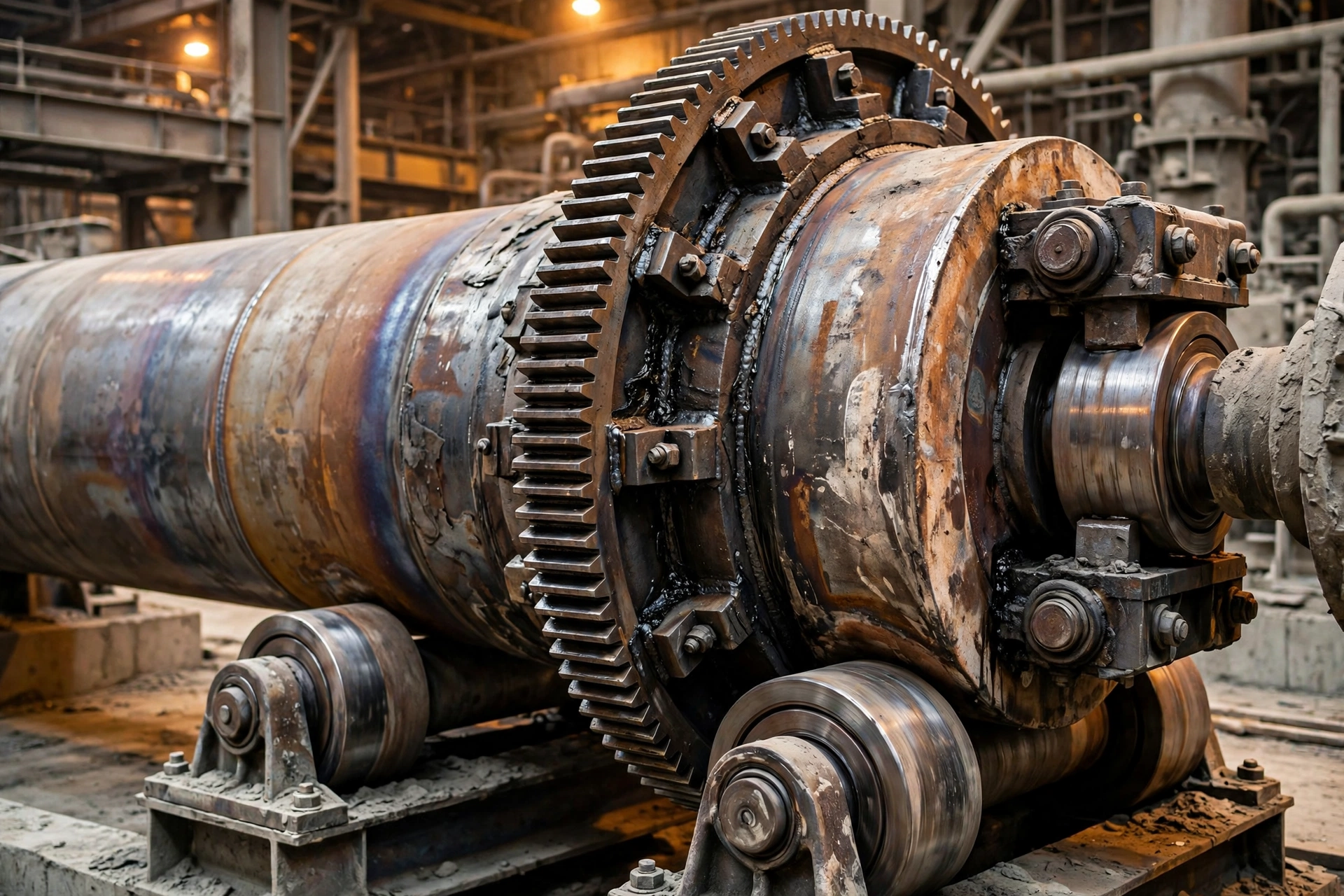
The auxiliary drive is the cheapest insurance on the plant, and the most commonly neglected. It is a small motor — 15–30 kW — geared to turn the kiln at a fraction of production speed, typically one revolution every few minutes. Its purpose is not production. It exists to distribute heat evenly around the shell while the kiln cools, and to prevent the shell from taking a permanent set.
Factory Mutual’s loss-prevention data sheet FM DS 6-17 requires the auxiliary drive to be engaged after shutdown, with a turning schedule maintained during cool-down. The same rule applies after a drive failure or a power outage: provide a means of turning the drum, either an auxiliary drive or a backed-up supply to the main drive, and cut heat input immediately.
Two designs are in common use. The electric auxiliary drive runs from the generator through the essential board, and it is the standard arrangement on most modern plants. The direct diesel auxiliary drive couples a small diesel engine straight to the kiln girth gear, independent of the electrical system entirely. The diesel version costs more and needs its own maintenance, but it keeps turning when the generator itself has failed — the one failure the electric version cannot cover.
Whichever design the plant uses, the test regime is the same. The auxiliary drive must be engaged and run under load every month, and the engagement time must be measured from the trip signal, not from the moment somebody walks to the kiln. A drive that engages in 4 minutes in a test and 12 minutes in a real outage — because the operator had to find the key, or the hydraulic coupling was cold — is a drive that has already missed its window.
The induced-draft fan and the clinker cooler
The induced-draft fan is the largest single motor on the essential board, and the easiest to overlook. It draws gas through the preheater, the kiln and the cooler, and it holds the pressure profile that keeps the process stable. On a power failure, the procedure is to reduce the main burner fuel to 30% within 90 seconds, then cut to zero if shell distortion is flagged — and to maintain the induced-draft fan at minimum speed throughout, to protect the refractory from thermal shock.
A fan that stops dead lets the gas path stagnate. Hot spots form in the preheater. The refractory sees a temperature swing it was not designed for. The restart then has to deal with a preheater that is thermally stressed before the first tonne of raw meal has moved.
The clinker cooler has the same logic at the other end of the kiln. Clinker leaves the kiln at around 1,450°C and must be cooled to roughly 100°C before it reaches the conveyor. The cooler grate and its fans do that work, and if they stop with a full bed of hot clinker on the grate, the grate plates overheat and warp. The emergency procedure diverts clinker to the emergency chute and isolates the cooler grate bed — but that procedure needs power for the grate drive, the fans and the diverting dampers.
The pattern is consistent: the kiln system is a set of small-to-medium motors, each individually modest, that together decide whether the plant restarts in hours or in days. The generator is sized for their sum, and the transfer switch is wired so that they are the first loads back on.
Fuel, Running Cost and How Long a Plant Can Run
A generator that saves the kiln and then runs out of fuel has only postponed the damage. Fuel planning for a cement plant is a different exercise from fuel planning for a hospital or a data centre, because the run is longer and the consumption is larger.
The fuel figures below are scaled from the Cummins C500D5 datasheet — 500 kVA standby, 455 kVA prime, 93.2 L/h at full prime load and 69.9 L/h at 75% — and they hold closely enough across the Weichai, Perkins and Cummins ranges that PAVO builds to quote from:
| Set size | Output at 75% load | Fuel at 75% load | Fuel per 24 hours | Fuel per 72 hours |
|---|---|---|---|---|
| 500 kVA | 300 kW | 70 L/h | 1,680 L | 5,040 L |
| 1,250 kVA | 750 kW | 175 L/h | 4,200 L | 12,600 L |
| 2,500 kVA | 1,500 kW | 350 L/h | 8,400 L | 25,200 L |
| 3,750 kVA | 2,250 kW | 525 L/h | 12,600 L | 37,800 L |
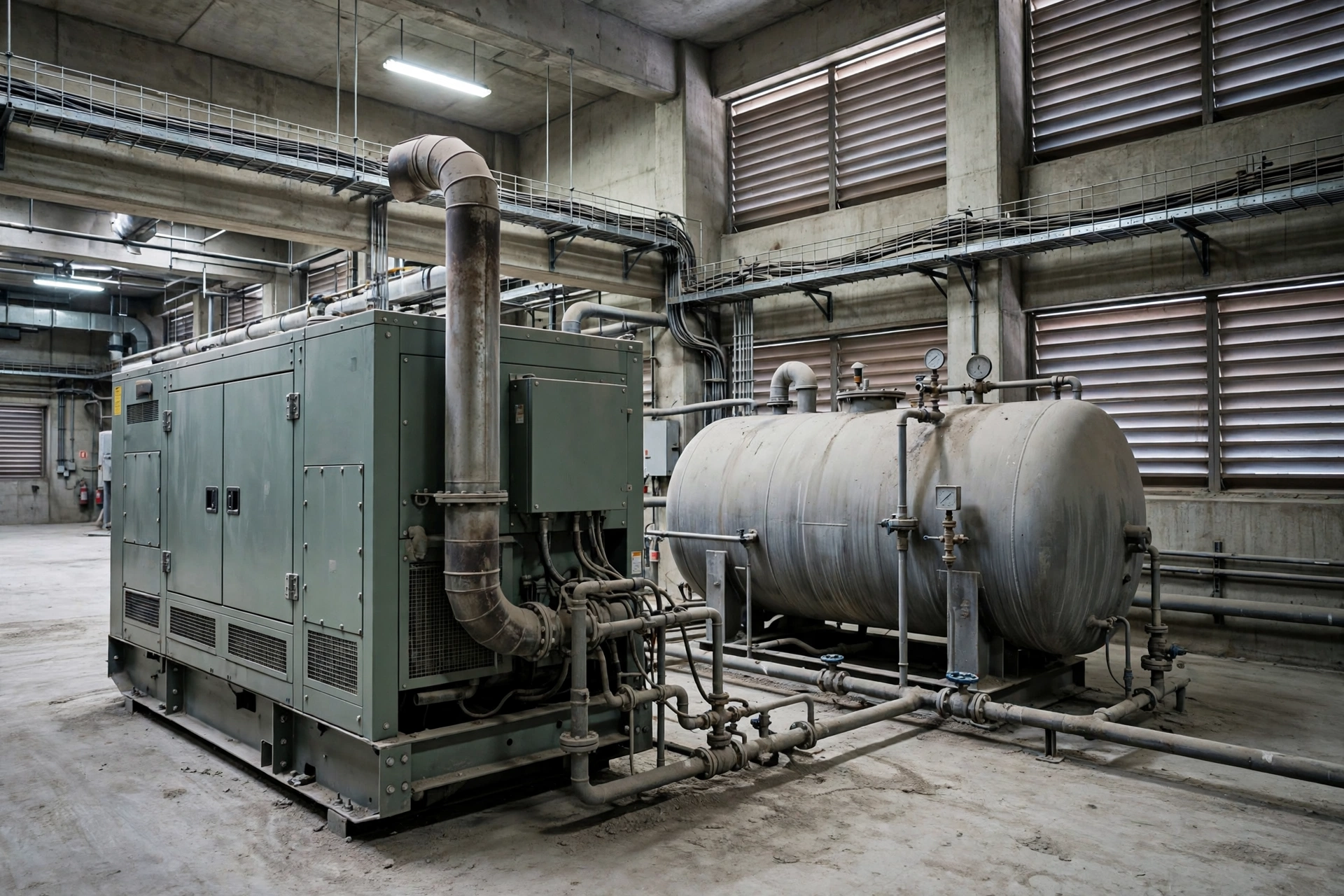
A 1,250 kVA set — the size for a 1,000 tpd plant — burns a 10,000-litre bulk tank in about 57 hours at 75% load. A 2,500 kVA set empties the same tank in 28 hours. The tank that looked generous on the quotation is, in practice, a two-day supply.
The 72-hour fuel plan
Seventy-two hours is the right planning horizon for a cement plant in a weak-grid market. Grid outages in Nigeria, Pakistan, Bangladesh and parts of South-East Asia routinely run to two or three days, and a kiln that has been saved for 48 hours and then lost for want of fuel is a worse outcome than a kiln lost on day one — the plant has burned the fuel, paid the running cost and still faces the refractory bill.
The plan has four parts. First, a bulk tank sized for the longest outage the plant expects, plus a 24-hour margin — 15,000 litres for a 1,250 kVA set, 30,000 litres for a 2,500 kVA set. Second, a standing fuel delivery contract with a supplier who can reach the plant during an outage, when roads are congested and every other industrial user is ordering at the same time. Third, a low-fuel alarm wired to the control room, with remote monitoring so the plant manager sees it on their phone, set to trigger with at least 12 hours of running left. Fourth, fuel quality management — diesel fuel ageing is a real risk in a tank that sits for months between outages, and a polishing and testing regime belongs in the maintenance schedule alongside the oil and filter changes.
The cost side of the equation is the easiest part of the argument. At $1.00–1.50 a litre, a 1,250 kVA set at 75% load costs $175–260 per hour to run. A 2,500 kVA set costs $350–525 per hour. Set against the $38,000–$52,000 per hour cost of a stopped kiln at a 5,000 tpd plant, the fuel bill is a rounding error. The expensive decision is not running the generator. The expensive decision is not having one, or having one with an empty tank.
One rating question belongs here. If the plant’s grid is weak enough that the set runs 1,000 hours or more a year, it is a prime-power set, not a standby set. The standby and prime power ratings decide warranty, service intervals and design life, and a standby-rated set run as a prime set will follow the familiar pattern: acceptable for months, then rising oil consumption, then an early overhaul and a refused warranty claim. Cement plants in weak-grid markets are prime-duty sites by definition, and the quotation should say so.
Dust, Heat and Placement: Siting the Set
A cement plant is one of the hardest environments a diesel generator will ever work in. The air is full of fine, alkaline, abrasive dust. The ambient temperature in the Middle East, North Africa and South Asia regularly exceeds 45°C. The set is expected to start, cold, after weeks idle, and take full load in seconds. Placement and protection decide whether it can.
Dust and the air filter
Cement dust is not ordinary dirt. It is fine enough to pass a standard air filter in weeks, alkaline enough to attack metal surfaces, and abrasive enough to wear cylinder bores if it reaches the combustion air. A set installed in a cement plant with a standard single-stage filter will show rising fuel consumption and falling power within months, and the failure will be blamed on the engine rather than on the air it breathes.
The fix is layered. A cyclone pre-cleaner or a two-stage air filter keeps the bulk of the dust out of the element. The element itself is inspected weekly and changed on condition, not on the calendar — a filter that looks clean after a month in a packing hall is a filter that is not doing its job, and a filter that is black after a week near the raw mill is a filter that needs changing now. The radiator is washed down on the same weekly round, because a radiator blocked with dust is a set that overheats at 60% load on a hot day.
The enclosure matters too. An open set in a cement plant needs a roof, a bund and a clean-air intake. A silent canopy set is the better default: the canopy keeps dust off the engine and the alternator, and its intake can be ducted away from the dustiest part of the plant. The canopy is rated IP54 or better, and the intake is pointed away from the raw mill, the packing hall and the clinker conveyor — the three dustiest points on the site.
Heat, derating and ventilation
The second environmental fact is heat. Ratings are stated at 25°C and sea level. A cement plant in Saudi Arabia, Egypt or Pakistan sees 45–50°C for months of the year, and the set loses output whether the budget allows for it or not. The alternator loses about 3% for every 10°C above 40°C. A set rated 1,250 kVA at 25°C delivers roughly 1,150 kVA at 50°C — and that is before the radiator, sized for the same conditions, is asked to reject full-load heat into 50°C air.
The remedy is to specify the set for the site, not the catalogue. Ask for the derated figure at the actual maximum ambient temperature, and size the radiator for 50°C ambient with a margin. Generator room ventilation is the other half of the same calculation: the room needs enough air for combustion and for radiator cooling, and in a cement plant that air must come through a filtered louvre, not an open vent that admits dust by the tonne.
Placement ties the two together. The set should sit close to the kiln electrical room, to keep cable runs short and voltage drop low, but away from the raw mill and the packing hall. It should sit on a concrete plinth above the flood line, with a bund holding 110% of the fuel tank volume, and with clear access on all four sides for the weekly filter and radiator round. A set that cannot be reached for maintenance will not be maintained, and a set that is not maintained will not start when the kiln needs it.
Three Plants, Three Outages
The rules above are not theory. Three plants, in three countries, learned them in the order that matters: one by preparation, one by a near miss, and one by paying for the lesson.
Case 1: A 1,200 tpd plant in Ogun State, Nigeria — the kiln that kept turning
A 1,200 tpd integrated plant in Ogun State, Nigeria, runs on a grid that fails two or three times a month, usually for 4–12 hours. The plant’s essential board is carried by a 1,250 kVA Cummins set, prime-rated, with a 15,000-litre bulk tank and a 10-second automatic transfer switch.
At 02:14 on a Tuesday in the dry season, the grid failed with the kiln at full production. The transfer switch started the set and transferred the essential board in 9 seconds. The kiln auxiliary drive engaged at 4 minutes. The induced-draft fan held at minimum speed. The operators cut the main burner fuel to 30% within 90 seconds, following the written emergency procedure.
The grid returned 6 hours later. The kiln was restarted from a hot, turning shell, and the plant was back at full production the same shift. No refractory damage. No shell scan. No contractor call-out.
The same plant had lost a kiln shell in 2021, before the backup set was installed. The shell warped during a 40-minute outage, the refractory was damaged, and the repair cost $180,000 with 11 days of lost production. The 1,250 kVA set, the transfer switch and the bulk tank cost less than that single failure.
Case 2: A 3,000 tpd plant in northern Vietnam — the set that could not breathe
A 3,000 tpd plant in northern Vietnam installed a 2,500 kVA set to carry its kiln system, sized correctly from a load list and tested at the factory under load. The first real outage came six months later, in the hot season, with the ambient temperature at 38°C.
The set started, took the essential board, and tripped on high coolant temperature at 40% load. The kiln auxiliary drive stopped with it. The operators restarted the set, it tripped again, and the kiln sat stationary for 22 minutes before the grid returned. The shell survived — the damage threshold is 15 minutes for warping, but the margin was gone, and the plant spent two days on shell-temperature scans and refractory inspection before it trusted the kiln again.
The cause was dust. The set had been installed 30 metres from the raw mill, with its intake facing the mill, and the radiator had not been washed in six weeks. The air filter was choked, the radiator was blocked with cement dust, and the set could not reject heat into 38°C air at anything above 40% load.
The fix cost less than $2,000: a cyclone pre-cleaner on the air intake, a weekly radiator wash added to the maintenance round, and the intake ducted to the clean side of the building. The set was retested at full load in 40°C ambient and held temperature. The lesson is that a correctly sized set, installed in the wrong place and never cleaned, is not a correctly sized set.
Case 3: A 5,000 tpd plant in Punjab, Pakistan — the fuel that ran out at hour 29
A 5,000 tpd plant in Punjab, Pakistan, had done most things right. Two 2,500 kVA sets in parallel, prime-rated, a 10-second transfer switch, a written emergency procedure, a monthly load test. The grid failed on a Friday evening, and the sets took the essential board without a fault.
The outage lasted 72 hours. The bulk tank held 10,000 litres. At 350 L/h per set — one set carrying the essential load, the second on standby — the tank emptied at hour 29. The fuel supplier, called on Saturday morning, could not reach the plant until Monday: every industrial user in the district was ordering at the same time, and the roads were congested.
The kiln cooled unevenly for the remaining 43 hours. The refractory was damaged, the shell needed scanning, and the restart took 3 days. The plant lost more in those three days than a 30,000-litre tank and a standing delivery contract would have cost in ten years.
The rule that came out of it is now written on the plant’s control room wall: the tank is sized for the longest outage the plant expects, plus 24 hours — and the fuel order is placed the moment the outage starts, not the moment the tank is half empty.
Frequently Asked Questions
What size generator does a cement plant need?
Most integrated cement plants need 1,000–5,000 kVA of essential-load backup, depending on capacity. A 1,000 tpd plant typically needs a 1,250 kVA set, a 3,000 tpd plant needs 2,500–3,750 kVA, and a 5,000 tpd plant needs two 2,500 kVA sets in parallel. The correct figure always comes from an essential-load list — kiln drive, induced-draft fan, cooler, controls and lubrication — never from the plant’s total 10–25 MW demand.
Do cement plants need a backup generator?
Yes, in almost every case. A cement plant loses money within minutes of a power cut: a stationary kiln at 1,400°C warps within 15 minutes, and a single kiln stop at a 5,000 tpd plant costs $38,000–$52,000 per hour. In countries with unreliable grids, such as Nigeria, Pakistan and Bangladesh, a plant without a generator risks its kiln shell and refractory on every outage, and buyers will move orders to plants that can guarantee delivery.
How long can a cement plant run on a generator?
As long as the fuel lasts. A prime-rated set can run indefinitely, limited only by fuel supply and the 250-hour service interval. A 1,250 kVA set at 75% load burns roughly 175 litres an hour, so a 10,000-litre bulk tank gives about 57 hours of running. A plant should size its tank for the longest outage it expects, plus a 24-hour margin, and keep a standing fuel delivery contract in place.
What happens to a cement kiln during a power outage?
The main drive stops and the kiln stops turning, which is the dangerous part. The auxiliary drive must engage within 5 minutes to keep the shell turning slowly while it cools, the burner fuel must be cut back within 60 seconds, and the full emergency-stop sequence must be complete within 15 minutes. If the kiln stands still at 1,400°C for longer than 15 minutes, the shell warps and the refractory cracks, and the restart takes days instead of hours.
Can a diesel generator power a cement plant?
Yes — the essential loads, which is what matters. Diesel generators from 500 kVA to 5,000 kVA power cement plants across Africa, South Asia and South-East Asia every day, and they are the standard backup source for the industry. Backing up the whole plant would need 12–18 MVA, which almost nobody buys; the set carries the kiln system, the fans, the controls and the lubrication, while the grinding mills restart when the grid returns.
Specification checklist — before the order is placed
- Load list complete: kiln drive, induced-draft fan, cooler, lubrication, compressed air, controls, water pumps — listed with running kW, starting current and duty
- Rating checked: prime-rated if the set will run more than 200 hours a year, standby-rated only for genuinely occasional outages
- Kiln protection proven: auxiliary drive tested monthly under load, engages within 5 minutes, turning schedule written into the emergency procedure
- Starting surge verified: staggered restart programmed, soft starters or variable-speed drives on large motors, largest motor start within voltage dip limits
- Fuel autonomy confirmed: bulk tank sized for the longest expected outage plus 24 hours, low-fuel alarm fitted, delivery contract in place, fuel tested
- Dust plan in place: cyclone pre-cleaner, weekly filter and radiator cleaning, intake away from the raw mill, IP54 enclosure or silent canopy
- Testing regime agreed: monthly load test with the full restart sequence, not a no-load run, with the kiln auxiliary drive and the transfer switch proven every time
A cement plant buys a generator once and lives with it for 15–20 years. The plants that get it right size from an essential-load list, buy a prime-rated set, put the kiln system on the essential board, and test the whole system under load every month. The plants that get it wrong buy from the total plant load, discover the kiln on the first real outage, and pay for the lesson in refractory and lost production. To size a set for a grinding plant, an integrated line or a 5,000 tpd kiln system, contact PAVO with the load list, and the engineering team will return a sized quotation with the fuel, tank and transfer switch specified to match.