

What Size Generator for a Tea Processing Plant? | PAVO
Fresh tea leaf starts losing value the hour it is plucked. A factory that cannot keep its fans, rollers and dryers running through a power cut does not lose a shift. It loses the crop.
What size generator does a tea processing plant need? A bought-leaf CTC factory making 900 kg of tea a day needs 100–125 kVA; a 10,000 kg green-leaf factory needs about 250 kVA; a 70,000 kg factory needs 800–1,000 kVA. Size from peak demand — withering fans, CTC rollers and the dryer — not from daily energy use.
Contents
- Why Tea Processing Has No Pause Button
- The Tea Process, Load by Load
- How Big a Generator Does a Tea Factory Need?
- What Happens When the Power Fails Mid-Shift
- How Long Can a Tea Factory Run on a Generator?
- Standby, Prime or Continuous — and Where the Set Sits
- Frequently Asked Questions
- Specification Checklist: Ten Lines Before the Deposit
Why Tea Processing Has No Pause Button
Tea is the most-consumed drink in the world after water, and almost all of it passes through a factory within hours of plucking. The International Tea Committee puts world made-tea output at 7.05 million tonnes in 2024: China 3.74 million tonnes (53%), India 1.285 million tonnes (18%), Kenya 599,000 tonnes (8%) and Sri Lanka 262,000 tonnes (4%). Behind those figures sit tens of thousands of factories, most of them in highland districts where the grid is thin, the weather is wet, and the nearest service engineer is a day away.
A tea factory is not a warehouse with a few lights. It is a continuous process line. Green leaf arrives from the fields through the day, and every stage of manufacture depends on the one before it finishing on time. Withering takes 12 to 18 hours for orthodox tea. Rolling and CTC cutting take minutes but must follow withering without delay. Fermentation runs two to three hours and cannot be paused. Drying drives moisture from about 60% to 3% at inlet temperatures of 100–120 °C. A break anywhere in that chain does not delay the batch. It downgrades it, or destroys it.
That is what makes the generator question different for tea than for most factory loads. The set is not protecting a building. It is protecting a perishable raw material that is already on the factory floor, already withering, already fermenting. The leaf cannot wait for the grid to come back, and it cannot be stored while the factory decides what to do. A factory that loses power for three hours in the middle of a flush-season day has not lost three hours of production. It has lost the day’s leaf, and the price that leaf would have fetched at auction.
The economics sharpen the point. Sri Lanka exported 300 million kg of tea in 2021, and auction prices hit a record $5.17 per kg in July 2022 while factories were running three to four days a week for lack of power and fuel. Kenya made 598 million kg of made tea in 2024. India made 1,303.53 million kg in 2024, down 6.5% from 1,393.66 million kg in 2023. Every kilogram lost to a power cut is a kilogram that cannot be re-plucked. The bush will grow more leaf, but the flush that was in the troughs that day is gone.
This article sizes the generator for a tea processing plant from the process loads upward: what each stage draws, what size set each factory throughput needs, how long the fuel lasts, which rating fits a seasonal factory, and what a power failure actually costs when it arrives mid-shift.
The Tea Process, Load by Load
Tea manufacture has five electrical stages. Four of them are continuous loads. One of them — drying — is mostly a heat load, but its fans, feeders and dust extraction still draw real power. The electrical energy needed to make one kilogram of made tea is modest, 0.4–0.7 kWh, according to a review published in Renewable and Sustainable Energy Reviews in 2021. The thermal energy is far larger, 4.45–6.84 kWh per kg, mostly wood, coal or briquettes burned to heat withering and drying air. The generator does not carry the heat load. It carries the motors, fans and controls that move the leaf through the heat.
Withering troughs and fans
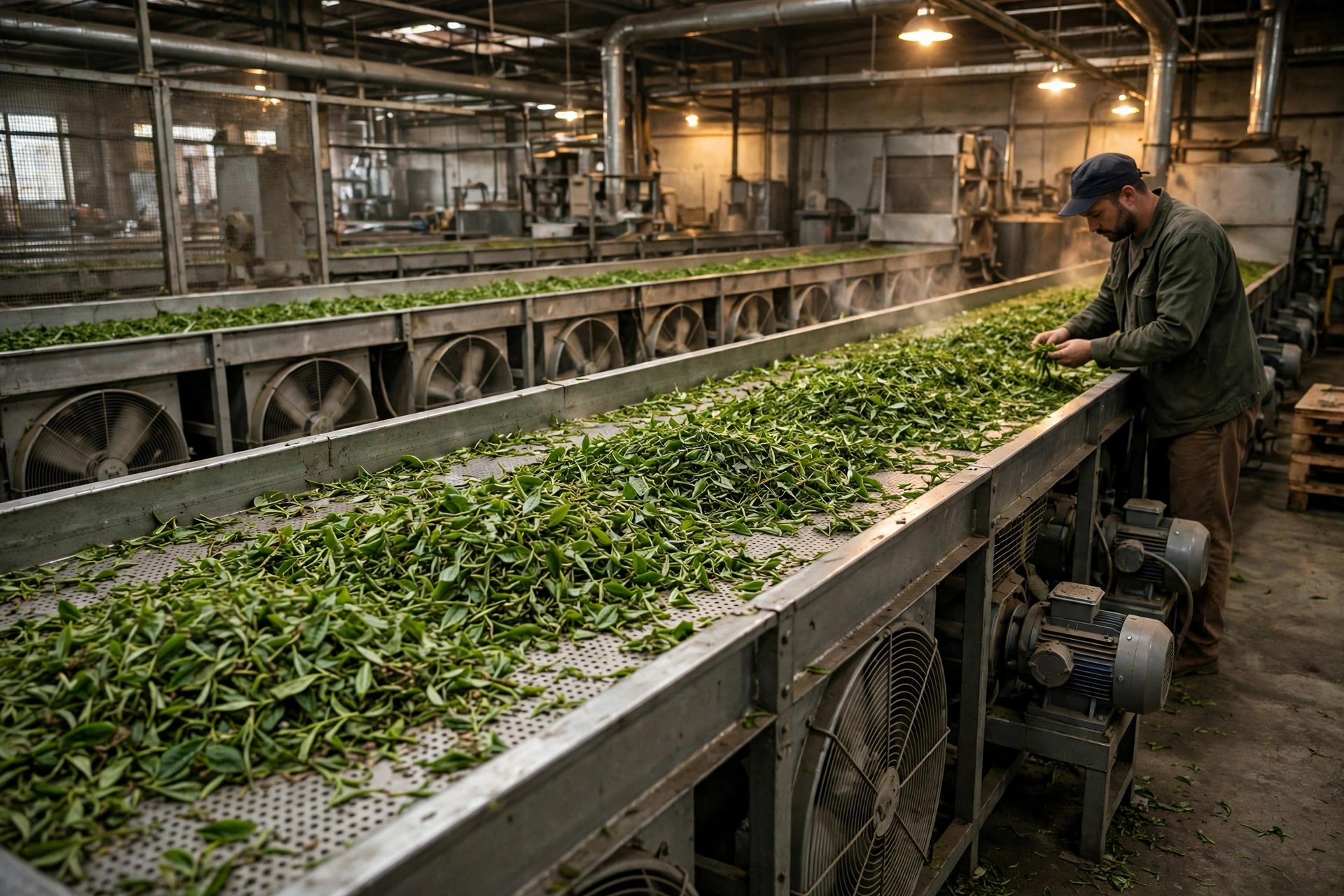
Withering is the longest stage and the largest electrical load in most factories. Fresh leaf arrives at about 78% moisture and must lose water until it reaches 68–70%, soft enough to roll without breaking. The leaf is spread 10–15 cm deep on mesh troughs, and axial fans blow air up through it for 12–18 hours in orthodox manufacture, shorter for CTC.
The fans run continuously for the whole withering cycle, which makes them the base load of the factory. A detailed energy study of Kapkoros Tea Factory in Bomet County, Kenya, published in 2026, measured the withering section at 403.52 kW of demand for a shift processing 70,000 kg of green leaf — 960 kg and 560 kg troughs served by seven-blade aluminium axial fans and six-blade cast-iron fans. Over a seven-hour withering cycle that section alone consumed 2,824.64 kWh. The same study put total factory energy at 8,427.54 kWh for the shift, or 0.535 kWh per kg of made tea at a 22.5% outturn — 15,750 kg of made tea from 70,000 kg of leaf.
Withering is also the stage most sensitive to interruption. Air must keep moving. If the fans stop, the leaf in the trough heats where it sits, ferments unevenly, and develops patchy wither. In the monsoon, when ambient humidity is high, troughs need warm air to wither on time at all; uneven warming gives patchy wither and poor liquor. A two-hour fan stoppage in wet weather does not just delay the batch — it changes the chemistry of the leaf in a way no later stage can correct.
Rolling and CTC
Once withered, the leaf is rolled to break the cells and release the juices that drive fermentation. Orthodox factories use rollers that twist the leaf gently over 30–45 minutes. CTC factories use a different machine entirely: a series of cylindrical rollers with sharp teeth that cut, tear and curl the leaf into small pellets. CTC is faster, harder on the leaf, and draws more power per kilogram — typically three CTC machines in series, each with its own motor.
The electrical split measured in Indian factories puts rolling at 0.20 kWh per kg of made tea, against 0.46 kWh/kg for withering. That is the average across the whole factory day. At the moment the CTC line is running, the draw is concentrated: three machines, each 15–25 kW, starting in sequence, with the first cut drawing the heaviest load. CTC motors start direct-on-line in most older factories, so the starting surge matters for generator sizing — a subject covered in the section on motor starting below.
Drying — the heat load
Drying is where the thermal energy goes. Fermented leaf enters the dryer at about 60% moisture and leaves at 3%, and the water has to be evaporated by hot air at 100–120 °C inlet temperature. A Malawian material and energy flow study measured drying at 6.37 kWh of thermal energy per kg of made tea — 78.2% of the factory’s total energy — against 0.83 kWh/kg for withering. Total factory energy in that study was 8.47 kWh/kg, of which 85% was thermal and 15% electrical. The equivalent figures for Sri Lanka were 7.25 kWh/kg and for India 5.11 kWh/kg.
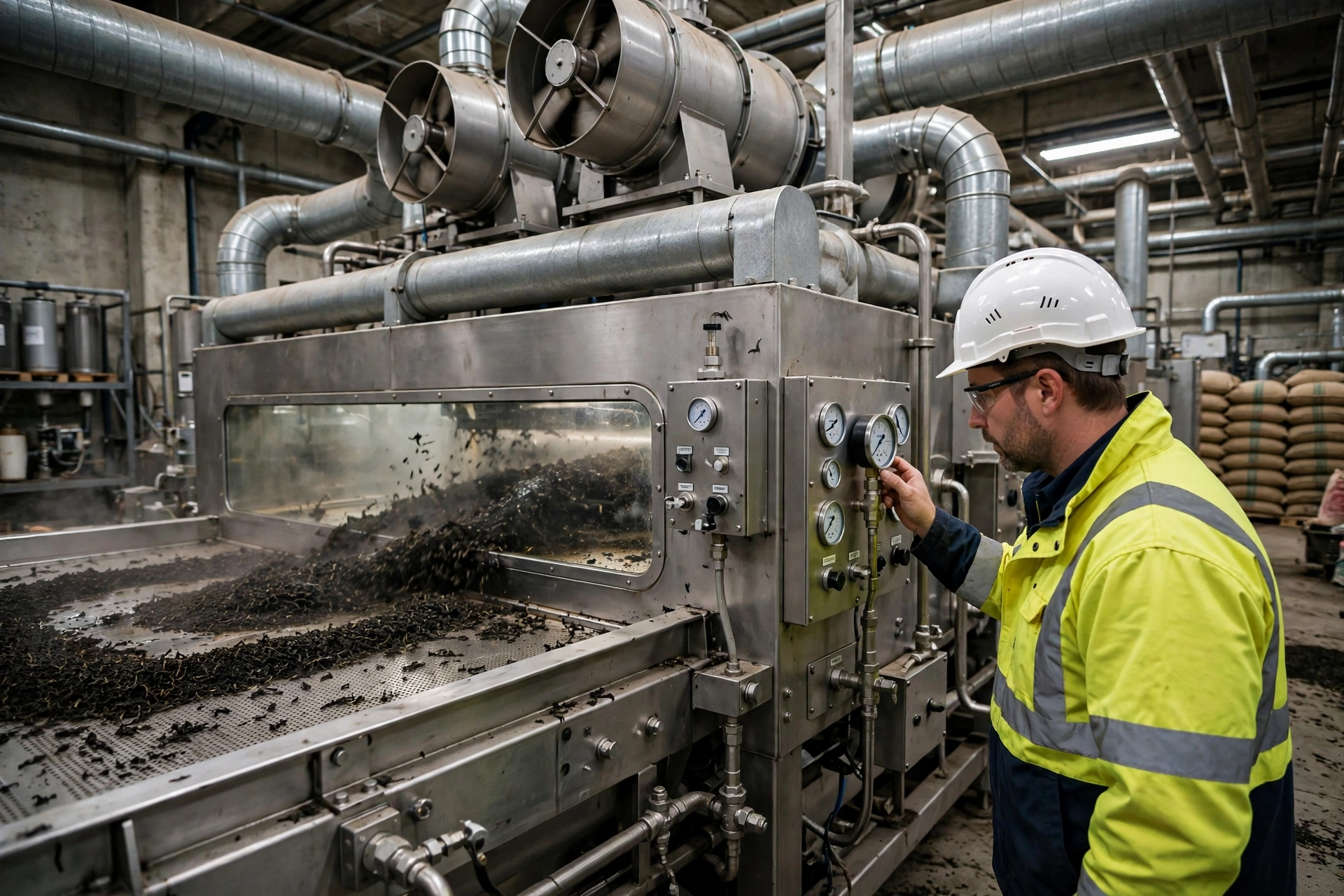
The dryer’s electrical draw is smaller than its heat draw, but it is not small. A TIGL Conquest combination dryer, a common machine in Indian and African CTC factories, lists its drying system at 25–45 HP depending on model — 19–34 kW — plus 15–40 HP for dust collection, with water evaporation capacity of 570–1,125 kg/h. The hot-air fan uses aerofoil blades to cut power consumption, and the dryer is compatible with solid, liquid or gaseous fuel-fired hot air generators. The key point for generator sizing is that the dryer cannot be treated as an optional load. If the dryer stops mid-batch, fermented leaf sits in a hot chamber with no airflow and scorches, or cools and goes stale. Either way the batch is lost.
Sorting, grading and packing
After drying, the tea is sorted into grades by vibrating sieves, winnowed to remove stalk and fibre, and packed into sacks or chests. Sorting is the lightest electrical stage — 0.12 kWh per kg of made tea in the Indian measurements — but it runs at the end of the line, when the day’s output is being finished. A power cut at sorting time leaves dried tea sitting in bins, exposed to humidity, instead of sealed in sacks. In a highland factory where afternoon humidity reaches 85–90%, dried tea left unsealed reabsorbs moisture within hours and loses the 3% moisture target the dryer worked to achieve. The handling discipline at this stage is the same as in food processing plants, where a sealed pack is the only thing standing between the product and the humidity.
| Process stage | Electrical energy (kWh/kg made tea) | What stops if power fails |
|---|---|---|
| Withering | 0.46 | Fans stop; leaf heats, ferments unevenly, patchy wither |
| Rolling / CTC | 0.20 | Line stops; withered leaf waits, over-withers |
| Fermentation | 0.07 | No direct load, but the clock keeps running — leaf over-ferments |
| Drying | 0.09 | Fans and feed stop; leaf scorches or goes stale in the dryer |
| Sorting / grading | 0.12 | Sieves stop; dried tea sits unsealed, reabsorbs moisture |
| Total electrical | 0.94 | The whole line stops; the batch is at risk |
The figures are from energy audits of Indian tea factories; the Malawi study measured 1.27 kWh/kg electrical and Sri Lanka 0.94 kWh/kg, so the order of magnitude is consistent. The thermal energy — 4.45–6.84 kWh/kg — is carried by wood, coal or briquettes, not by the generator, which is why the generator can be far smaller than the factory’s total energy bill suggests.
How Big a Generator Does a Tea Factory Need?
Sizing a generator for a tea factory starts from the wrong number in most quotations. Suppliers quote from daily energy — so many kilowatt-hours per day — and divide by running hours. That gives an average load. A generator does not carry averages. It carries the peak, and in a tea factory the peak arrives when the withering fans, the CTC line and the dryer are all running at once, which is most of the working day.
The correct method is the one in the generator sizing guide: list every load, add the running kilowatts, apply a diversity factor for loads that never run together, add 20–25% for motor starting, and divide by 0.8 power factor to get kVA. The table below gives the result for the four factory sizes that cover most of the industry, from a bought-leaf factory to a large estate factory.
| Green leaf per day | Made tea per day | Peak electrical demand | Generator size (standby) |
|---|---|---|---|
| 4,000 kg | ~900 kg | 60–90 kW | 100–125 kVA |
| 10,000 kg | ~2,200 kg | 150–200 kW | 250 kVA |
| 30,000 kg | ~6,700 kg | 350–450 kW | 500–625 kVA |
| 70,000 kg | ~15,750 kg | 600–750 kW | 800–1,000 kVA |
The smallest row is a real factory, not a round number. Sunniva’s application note AN-042 describes a bought-leaf factory processing 4 tonnes of green leaf a day and making about 900 kg of CTC tea a day from it. Its withering troughs take 263 kWh/day of heat and its dryer air preheat 1,659 kWh/day, with total useful heat of 2,018 kWh/day averaged over 18 running hours. The electrical peak for a factory of that size is 60–90 kW, which is why a 100–125 kVA set covers it with room for starting.
Worked example — a 10,000 kg/day CTC factory
Take a mid-size CTC factory in Assam processing 10,000 kg of green leaf a day and making about 2,200 kg of made tea at a 22% outturn. The load list reads:
- Withering fans, 12 troughs: 55 kW running
- CTC line, three machines: 55 kW running
- Dryer, drying system plus dust collection: 45 kW running
- Sorting, winnowing and packing: 12 kW running
- Water pumps, lighting, office and workshop: 18 kW running
- Total running load: 185 kW
At 0.8 power factor that is 231 kVA of running demand. Add 25% headroom for motor starting and the next flush-season load growth, and the figure becomes 289 kVA. The nearest standard frame is a 300 kVA standby set, or a 250 kVA set if the factory accepts load-shedding the sorting line during a transfer — which most do, since sorting can wait an hour and withering cannot.
That worked example is the reason the table gives a range rather than a single number. Two factories processing the same leaf can need different sets, because one runs its dryer on a separate boiler fan and the other does not, or one has three CTC machines and the other has two. The load list is the authority, not the leaf tonnage.
Starting surge — the part that trips the set
Tea factory motors are mostly direct-on-line. A withering fan motor draws five to seven times its running current for a few seconds at start. A CTC roller motor draws the same. If the generator is sized to the running load with no margin, the first fan that starts after a transfer drags the voltage down, the contactors drop out, and the factory is back in the dark with a running generator.
The rule used across the industry is to size for the largest single motor starting last, with the rest of the factory already running. In practice that means 20–25% headroom above running kVA, and a generator with a G2 or G3 performance class under ISO 8528, which governs voltage dip and recovery. The full treatment of starting methods, locked-rotor kVA and voltage dip is in the article on motor starting. The short version for a tea factory: never size to the running load alone, and never let a supplier quote a set without asking which motors start direct-on-line.
What Happens When the Power Fails Mid-Shift
A power failure in a tea factory is not one event. It is three, arriving in sequence, and the cost rises with each one.
The first is the withering trough. The fans stop, the air stops, and the leaf in the troughs starts to heat where it sits. In dry weather the damage is slow. In wet weather, when the leaf is already warm and damp, it is fast: the leaf over-withers, ferments in the trough, and comes off the trough patchy — some leaves properly withered, some already oxidising. That batch will not make a single grade. It will make a mix of grades, sold at the price of the lowest one.
The second is the dryer. Fermented leaf inside a dryer with no airflow and no heat control scorches where it touches the hot plates and goes stale where it does not. The dryer cannot be emptied and restarted later; the leaf in it is finished. A dryer holds 30–60 minutes of production at any moment, so a single failure costs that much tea outright, plus the time to clean, reheat and restart the machine.
The third is the fermentation clock. Fermentation runs two to three hours from the moment the leaf leaves the CTC machine. It does not stop because the power stopped. Leaf that has been rolled and is waiting for the dryer keeps fermenting. An hour past its window it is over-fermented: dark, flat, and worth a fraction of its intended grade. There is no way to reverse it.
Case 1: Sri Lanka, 2022 — three hours a day, three days a week
Sri Lanka’s economic crisis in 2022 gave the tea industry a stress test no engineer would design. Power cuts of three hours a day began on 27 June 2022, and the Colombo Tea Traders’ Association reported that manufacturers were “unable to process the harvest on time due to lack of diesel for the generators”. Factories were working three to four days a week. The Sri Lanka Tea Factory Owners Association warned that all factories in seven districts could come to a stop, with 264 privately owned factories and 258 firms operating with extreme difficulty.
The damage was not only the lost production. Smallholders contribute more than 70% of Sri Lanka’s tea, and they rely on the factories to process their leaf. When a factory cannot run, the smallholder’s leaf has nowhere to go. The leaf dries out in the field and loses quality before it is even plucked into a basket. Transport collapsed at the same time: tea haulers ran out of diesel, estates handed fuel from their own stocks to the contractors, and workers cycled to work. Auction prices rose to a record $5.17 per kg in July 2022, but that was the price of scarcity, not of profit — the tea that was not made could not be sold at any price.
The lesson from Sri Lanka is that a generator is only as good as its fuel supply. Factories that had sets but no diesel were in the same position as factories with no set at all. Fuel autonomy — days of running, not hours — is a separate line in the specification, and it is treated as one in the section on fuel below.
Case 2: Assam Barak Valley — 5.5 million kg lost in four months
Assam’s Barak Valley reported the same problem in a different form in 2020. Erratic power supply was, in the Tea Association of India’s words, a “serious challenge” to the industry, and the valley reported crop loss of approximately 5.5 million kg between March and June 2020. The Association’s secretary general, P. K. Bhattacharjee, put the cost plainly: captive power generation in the absence of regular grid supply costs almost double grid power, and “erratic grid supply with frequent interruption causes deterioration in quality of tea manufactured, thereby inflicting a loss in revenue in realization of tea prices.”
The same statement noted a second cost that rarely appears in generator quotations: “frequent tripping also damages electrical accessories of the machinery reducing its longevity.” Every unplanned stop is a voltage transient through the factory’s motors, contactors and controllers. A set that starts late, or that cannot hold voltage during transfer, damages the machinery it is supposed to protect. That is why the automatic transfer switch matters as much as the generator: a switch that transfers in 10 seconds under NFPA 110 protects the line; a switch that hunts, chatters or drops the load twice damages it.
Case 3: Kenya, November 2026 — a nine-hour planned outage
Not every outage is a crisis. Some are announced, and a factory that plans for them loses nothing. Kenya Power published a maintenance notice for Saturday 14 November 2026 covering the Ragati Tea Factory area in the Mt. Kenya region, with power off from 08:00 to 17:00 — nine hours, a full working day.
A factory with a correctly sized set and a full tank treats that notice as a fuel-delivery reminder. The set starts at 08:00, carries the withering fans, the CTC line and the dryer, and stops at 17:00 when the grid returns. A factory with an undersized set, or a set that has not been tested under load, discovers the problem at 08:05, when the dryer fan stalls on start and the whole line is down for the day. The difference between the two factories is not the generator. It is the weekly test under load and the maintenance schedule that keeps the set ready — the same discipline that separates the factories that survived Sri Lanka’s 2022 crisis from the ones that closed for three days a week.
How Long Can a Tea Factory Run on a Generator?
The answer depends on three numbers: the set’s fuel consumption at the factory’s actual load, the size of the tank, and how many days the factory needs to keep running. The first number comes from the datasheet. The second is a choice. The third is a business decision that should be made before the outage, not during it.
Take the Cummins C500D5, a 500 kVA standby / 455 kVA prime set on the QSZ13-G5 engine. Its fuel consumption at prime rating is 29.2 L/h at 25% load, 49.0 L/h at 50%, 69.9 L/h at 75% and 93.2 L/h at 100%. Its standard tank holds 645 litres. At 75% load — the load a 30,000 kg/day factory puts on a 500 kVA set — that tank lasts 9.2 hours. At 50% load it lasts 13.2 hours. Neither figure covers a full day.
| Running time | Fuel needed, 500 kVA set at 75% load (69.9 L/h) | Fuel needed, 250 kVA set at 75% load (~35 L/h) |
|---|---|---|
| 8 hours | 559 L | 280 L |
| 24 hours | 1,678 L | 840 L |
| 48 hours | 3,355 L | 1,680 L |
| 72 hours | 5,033 L | 2,520 L |
The 250 kVA column is an estimate from the same fuel-per-kVA ratio, not a datasheet figure — the point is the order of magnitude, and it is the same order of magnitude on every manufacturer’s sheet. A factory that wants 72 hours of autonomy on a 500 kVA set needs about 5,000 litres of usable fuel on site, which is a bulk tank and a delivery contract, not a bigger day tank. A factory that wants 24 hours needs about 1,700 litres, which a 2,000-litre bulk tank covers with margin.
Fuel use at the loads that matter
A tea factory rarely runs its generator at full load. The set carries the withering fans and the dryer through the working day and drops to a fraction of that load overnight, when only the withering fans and the security lights are running. Fuel planning should therefore be done at two loads: the working-day load, and the overnight load. The working-day figure decides the tank size. The overnight figure decides whether the set can run through the night without a refuel — and in a tea factory, the night matters, because withering runs overnight and the leaf in the troughs does not stop needing air at 22:00.
A 250 kVA set carrying a 150 kW working load burns roughly 35 L/h. Over a 16-hour working day that is 560 litres. Overnight, at 60 kW, it burns about 15 L/h, or 120 litres for an eight-hour night. A full day is therefore about 680 litres, and a 1,000-litre tank gives roughly 36 hours of autonomy. Those are the numbers that should be on the factory’s whiteboard next to the generator, not the datasheet’s full-load figure.
Tank sizing for 24, 48 and 72 hours
Three rules govern the tank. First, size for the worst week, not the average week: the flush season, when leaf intake is highest and the factory runs longest, is also the season when grid faults are most likely, because the same monsoon weather that drives the flush also brings down the lines. Second, keep a minimum stock, not a maximum: a bulk tank that is allowed to fall to 10% before a delivery is ordered will run dry during a long outage, because delivery trucks cannot reach a highland estate in a storm. Third, protect the fuel. Diesel in a standby tank ages, grows water and microbes, and clogs filters at the worst moment — the full treatment of that problem is in the article on diesel fuel ageing, and the short version is to polish the fuel, test it, and turn the stock over.
The Sri Lanka case shows why. Factories with generators but no diesel were closed. The fuel plan is part of the generator specification, and a quotation that prices the set without pricing the tank and the first delivery is incomplete.
Standby, Prime or Continuous — and Where the Set Sits
The rating question for a tea factory is a seasonal question. Most tea factories run their generators as standby sets: the grid carries the factory, the set waits, and it starts only when the grid fails. For most of the year that is the correct rating, and the standby and prime ratings article explains the difference in full. But the flush season changes the arithmetic.
During the flush, a factory in Assam or Kenya can run 16–18 hours a day, six or seven days a week, for weeks at a time. If the grid is unreliable during that period — and in the Barak Valley it is — the set can accumulate 200 hours of running in a single month. The standby rating under ISO 8528-1 allows 200 hours a year. A set that runs 200 hours in one flush month has used its annual allowance before the second flush begins. The wear does not announce itself. Oil consumption rises, cylinder glazing develops, and the failure appears a year later, at 2,000 hours, when the set should have had 20,000 hours of life left.
When the flush season makes it a prime set
A factory that expects its generator to run more than 200 hours a year — two flush months on an unreliable grid, or a full season of scheduled outages — should buy a prime-rated set, or at least a set one frame larger than the standby calculation gives. A prime rating costs roughly 10–15% more per kVA. Against the cost of a rebuild at 2,000 hours, or a refused warranty claim on grounds of misapplication, it is the cheaper purchase. The same logic applies to bought-leaf factories that run their set as the primary power source during the peak season, when the grid cannot carry the load at all.
Altitude, heat and dust
Tea grows in the highlands, and the generator sits where the tea grows. A factory at 1,500–2,000 m in the Kenyan highlands or the Sri Lankan hill country has already lost 5–10% of its rated output to altitude before it starts — output falls by about 1% per 100 m above 1,000 m. A factory at 40 °C ambient in the Assam plains loses a further 3% per 10 °C above 40 °C on the alternator. A 500 kVA set at 1,500 m and 40 °C delivers roughly 430 kVA. The derating must be applied before the order is placed, not discovered on commissioning day.
Dust is the other highland problem. Tea factories generate fine leaf dust, and the generator room shares the site with it. Dust blocks radiators, coats alternator windings and clogs air filters. The set needs a room with filtered intake air, a radiator that can be cleaned from the front, and a service interval shortened for the environment — not the standard interval in the manual. remote monitoring pays for itself here: a Deep Sea controller with a modem lets the factory manager in the office, or the service engineer in the nearest town, see coolant temperature, oil pressure and battery voltage without driving to the estate.
Placement and fuel storage
The set should sit close enough to the factory that the cable run is short and the voltage drop is small, and far enough from the withering troughs that its vibration and exhaust do not reach the leaf. A 10–15 m separation with a bunded fuel tank between the set and the factory wall is the usual compromise. The tank needs secondary containment — a bund holding 110% of the tank volume — because a diesel spill on a tea estate is an environmental incident and a lost fuel stock at the same time. The fuel store should be locked, the filler capped, and the delivery logged, because diesel on a remote estate is worth stealing and hard to replace.
Frequently Asked Questions
What size generator does a tea processing plant need?
A bought-leaf CTC factory making 900 kg of tea a day needs 100–125 kVA; a factory processing 10,000 kg of green leaf a day needs about 250 kVA; a factory processing 70,000 kg a day needs 800–1,000 kVA. Size from the peak running load — withering fans, CTC rollers and dryer together — plus 20–25% for motor starting, not from daily energy use.
Do tea processing plants need a backup generator?
Yes, in every tea-growing region where the grid is unreliable, and that covers most of them. Fresh leaf cannot wait: withering, fermentation and drying form a continuous chain, and a power cut mid-shift downgrades or destroys the batch in the troughs and the dryer. Assam’s Barak Valley lost about 5.5 million kg of crop to erratic supply in four months of 2020, and Sri Lankan factories ran three to four days a week during the 2022 crisis.
How long can a tea processing plant run on a generator?
As long as the fuel lasts. A 500 kVA set at 75% load burns 69.9 L/h, so a 645-litre tank gives about 9 hours and a 5,000-litre bulk tank gives about 72 hours. A 250 kVA set at the same load fraction burns roughly 35 L/h, so a 1,000-litre tank gives about 36 hours. Plan the tank for the worst week of the flush season, and keep a delivery contract in place.
What happens to tea processing during a power outage?
The withering fans stop and the leaf in the troughs heats and ferments unevenly; the dryer stops and the leaf inside scorches or goes stale; the fermentation clock keeps running, so rolled leaf over-ferments and loses grade. A three-hour outage in the middle of a flush-season day costs the day’s leaf, not three hours of production, and repeated tripping damages the factory’s motors and controllers.
Can a diesel generator power a tea processing plant?
Yes. A tea factory’s electrical load is modest — 0.4–0.7 kWh per kg of made tea — because the large heat load for withering and drying comes from wood, coal or briquettes, not from electricity. A correctly sized diesel set carries the fans, rollers, dryer motors and sorting line with ease, provided it is sized for peak demand with starting headroom and derated for the estate’s altitude.
Specification Checklist: Ten Lines Before the Deposit
1. Load list, not leaf tonnage. The quotation must show the running kilowatts of every load — withering fans, CTC machines, dryer, dust collection, sorting, pumps, lighting — and the kVA total with 20–25% starting headroom.
2. Rating in letters. ESP, PRP or COP must appear on the datasheet and the contract. If the set will run more than 200 hours a year, it is a prime duty and should be bought as one.
3. Derated for the estate. Ask for the available kVA at the factory’s actual altitude and maximum ambient temperature, not the catalogue figure at 25 °C and sea level.
4. G2 or G3 performance class. ISO 8528 class governs voltage dip and recovery when the largest motor starts. A tea factory with direct-on-line fan motors needs G2 at minimum.
5. Transfer switch specified. A 10-second transfer under NFPA 110, with the switch rated for the full load and tested under load before handover.
6. Fuel autonomy in days. The tank and delivery contract must cover the worst week of the flush season — 24 hours as a minimum, 72 hours for a remote estate.
7. Fuel quality plan. Polishing, testing and stock rotation, so the fuel in the tank is usable after six months of standing.
8. Dust and ventilation. Filtered intake air, a cleanable radiator, and service intervals shortened for a dusty factory environment.
9. Remote monitoring. A controller with modem or Modbus so the set’s condition can be checked from the office or the nearest town without a site visit.
10. Warranty at the stated duty. Ask in writing: “If this set runs at the stated duty, for the stated annual hours, at the stated site conditions, will the warranty remain valid?” A direct answer is worth more than a 5% discount.
A tea factory buys a generator for the worst day of the year, not the average one. That day arrives in the flush season, in the rain, with the troughs full and the dryer running. The set that carries the factory through that day is the set that was sized from the load list, rated for the real duty, derated for the real altitude, and fuelled for three days instead of nine hours. Everything else is a smaller purchase that costs more in the end. For a quotation sized to a specific factory — leaf intake, altitude, and the load list — contact PAVO.