

What Size Generator Does a Textile Mill Need? | PAVO
A textile mill does not lose money when the lights go out. It loses money when the yarn breaks, the loom leaves a mark, and the dye bath cools mid-batch.
What size generator does a textile mill need? Most mills need 250 kVA to 2,500 kVA: a small weaving unit at the lower end, a spinning mill in the middle, and an integrated mill with dyeing at the top. The correct figure comes from a load list of frames, looms and dyeing machines, not from floor area.
Contents
- What a Textile Mill Actually Runs on Power
- Sizing Bands by Mill Type
- Why Ten Seconds Is Enough to Ruin a Shift
- Starting Surge: The Motors Behind the kVA
- Fuel, Hours and the Cost of Running
- Three Mills, Three Outages
- Placing the Set in a Hot, Humid, Lint-Filled Mill
- Frequently Asked Questions
What a Textile Mill Actually Runs on Power
A textile mill is not one load. It is three different factories under one roof, and each one fails differently when the power goes. Spinning fails slowly, over minutes, as yarn ends break. Weaving fails in seconds, as a loom stops mid-pick and leaves a mark across the cloth. Dyeing fails over hours, as a bath cools and a batch comes out uneven. A generator sized for the building’s lights will watch all three happen at once.
The load list has to be built in process order, because the set has to carry the loads that cannot wait, in the order they cannot wait.
Spinning: the steadiest load in the mill
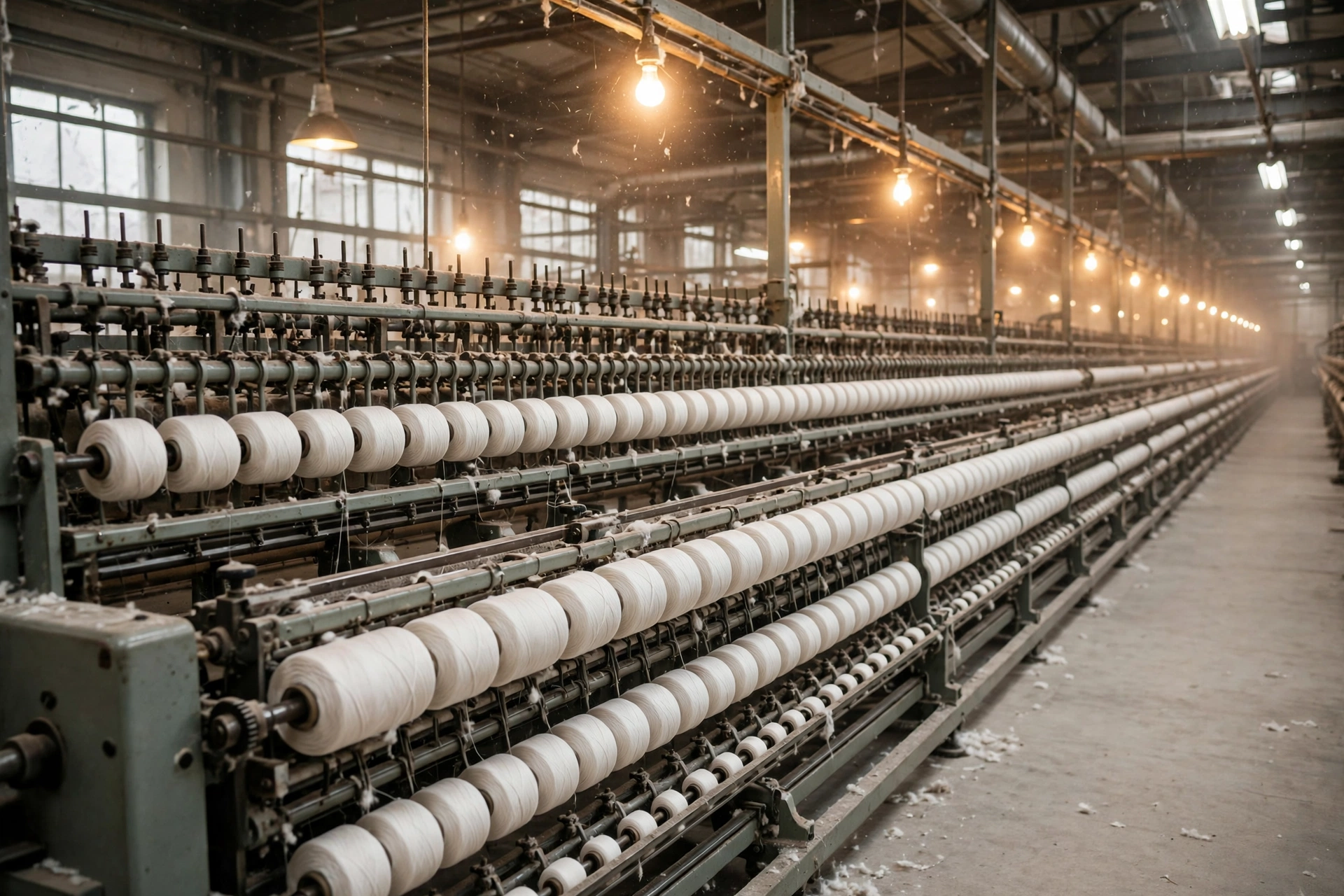
Spinning is the largest and steadiest electrical load in most mills. A modern ring frame carries 1,008 to 1,824 spindles and draws roughly 30–45 kW while it runs. A mill with 30,000 spindles runs 20 to 30 frames, and spinning alone accounts for 600–1,200 kW of connected load. Add blowroom, carding, drawing and roving, and the spinning department typically takes 50–60% of the mill’s total power.
Spinning load is flat. Frames run at constant speed, 24 hours a day, six or seven days a week, and the load factor sits at 85–95%. That flatness is both a blessing and a trap. A flat load is easy to size, but it is also a prime-power load in every sense: a spinning mill on an unreliable grid will run its generator for thousands of hours a year, and a standby-rated set will not survive that duty. The standby and prime power ratings article explains the difference, and the cost of getting it wrong.
Spinning is also sensitive to voltage quality in a way that surprises buyers. A ring frame spindle runs at 20,000–25,000 rpm. A voltage dip slows the frame, the yarn tension changes, and ends break. The frame does not stop. It keeps running with broken ends, producing nothing, until an operator walks the length of the machine and pieces each end by hand.
Weaving: looms, compressed air and stop marks
Weaving is a smaller electrical load per machine and a much harder load to restart. A modern air-jet loom draws 5–7 kW running, a rapier loom 3–5 kW, and a water-jet loom around 4 kW. A weaving shed with 120 air-jet looms carries roughly 600–840 kW of loom load — but the looms are only half the story.
Air-jet looms run on compressed air, and compressed air is the load buyers most often forget. Each air-jet loom consumes roughly 0.4–0.7 Nm³/min of air at 6 bar. A shed of 120 looms needs 50–85 Nm³/min of compressed air, which means 250–400 kW of air compressors running continuously. A generator sized for the looms alone, without the compressors, will start the looms and then watch them stall as air pressure collapses.
Weaving also needs humidity. A weaving shed is held at 65–75% relative humidity and 25–30°C, because dry air makes yarn brittle and ends break. Humidification plant, air washers and fans run continuously, and they are part of the essential load. Lose them for an hour in a dry season and the ends-down rate climbs for the rest of the shift.
Dyeing and finishing: heat, water and steam
Dyeing is the most time-sensitive load in the mill. A jet dyeing machine holds 500–1,000 kg of fabric in a liquor bath at up to 130°C for polyester, or 95–100°C for cotton, for 2–6 hours per batch. The machine itself draws modest power — circulation pumps, a heat exchanger, controls — but the batch inside it is worth $3,000–8,000 in fabric and dye, and a power cut mid-cycle can destroy it.
Finishing adds stenter frames, sanforising ranges and compactors, all with large fan and drive motors and all with heated zones that must cool in sequence. A stenter stopped hot leaves fabric scorched in the chamber. A dyeing machine stopped mid-cycle leaves fabric with a levelness fault that no amount of re-dyeing will fully hide.
Dyeing and finishing also consume the mill’s steam and water. Boilers need electricity for fans, feed pumps and controls, and effluent treatment pumps need power to keep running. A mill that loses power and cannot treat effluent cannot restart legally in many jurisdictions, even after the generator starts.
Sizing Bands by Mill Type
Sizing starts with a load list, not a floor area. Every frame, loom, compressor and pump on the essential board is listed with its running kW, its starting current and its duty. The list is reduced by a demand factor, because not every machine runs at once, and converted from kW to kVA at the site power factor, usually 0.8.
| Mill type | Typical backup load | Generator frame |
|---|---|---|
| Small weaving unit, 20–40 looms | 100–250 kW | 150–350 kVA |
| Dyeing house, 4–8 jet machines | 150–400 kW | 250–500 kVA |
| Spinning mill, 10,000–20,000 spindles | 400–900 kW | 500–1,250 kVA |
| Spinning mill, 30,000–50,000 spindles | 900–1,800 kW | 1,250–2,500 kVA |
| Weaving mill, 100–200 air-jet looms | 700–1,500 kW | 1,000–2,000 kVA |
| Integrated mill, spinning + weaving + dyeing | 1,500–3,500 kW | 2,000–5,000 kVA |
The generator sizing guide covers the full method, including demand factors and power factor correction. Two rules from it apply to every textile mill. First, never size from the headline kVA alone. Second, never size from the connected load without a demand factor, or the set will be oversized, run below 30% load for long periods, and develop wet stacking.
A 20-loom weaving unit
A small weaving unit is the simplest case, and the one most often sized wrong. Twenty air-jet looms draw roughly 100–140 kW running, plus 60–90 kW of air compressors, 15–25 kW of humidification and fans, and 10–15 kW of lighting and controls. The connected load is around 200–270 kW, and a demand factor of 0.85 brings the working load to 170–230 kW. At a power factor of 0.8, the apparent load is 210–290 kVA, so a 250 kVA frame fits with little margin and a 350 kVA frame fits with room to grow.
The mistake is to buy a 150 kVA set because the looms alone add up to 140 kW. The set starts, the looms start, the compressors start, the voltage collapses, and the contactors drop out. The unit then runs on half its looms, or not at all.
A spinning mill
A spinning mill is a different problem. The load is large, flat and continuous, which makes it a prime-power application in any country with an unreliable grid. A 20,000-spindle mill draws roughly 700–900 kW including preparatory machinery, humidification and lighting. With a demand factor of 0.9, the working load is 630–810 kW, or 790–1,010 kVA at a power factor of 0.8. The order is a 1,000 kVA or 1,250 kVA prime-rated set, not a standby-rated set of the same size.
The prime rating matters because the hours add up fast. A spinning mill in Gazipur or Faisalabad can run its generator 2,000–4,000 hours a year during summer load shedding. A standby-rated set is designed for 200 hours a year under ISO 8528-1. Run it for 3,000 hours and the engine will wear out years early, the warranty will not cover it, and the mill will learn the difference between the two ratings the expensive way.
An integrated mill
An integrated mill — spinning, weaving and dyeing on one site — is usually a 2,000–5,000 kVA job, and it is almost always a paralleling job. Two or three sets in parallel give the mill N+1 redundancy: one set can be down for service while the others carry the load. A single 4,000 kVA set is cheaper to buy and far more expensive to lose, because one failed alternator stops the whole mill.
Paralleling also lets the mill match generation to load. At night, when dyeing is idle and only spinning runs, one set carries the load at 70–80%, where it is efficient. At midday, when all three departments run, two or three sets share the load. A single oversized set would spend half its life below 30% load, glazing its bores and building up carbon.
Why Ten Seconds Is Enough to Ruin a Shift
The automatic transfer switch typically restores generator power within 10 seconds of a mains failure. Ten seconds sounds short. In a textile mill, ten seconds is long enough to break yarn, mark cloth and spoil a dye bath. The damage is not in the ten seconds without power. It is in the 30 to 60 minutes it takes to recover from them.
Spinning: ends down across the floor
When a ring frame stops, the yarn ends break. Not some of them — a large proportion of them, across every frame in the hall. A frame with 1,200 spindles can come back with 100–200 ends down, and each end has to be pieced by hand. An experienced piecer takes 20–30 seconds per end. One frame takes 40–90 minutes to bring back to full production, and a hall with 20 frames needs every piecer on the floor at once.
The cost is not the electricity. It is the lost production. A 30,000-spindle mill produces roughly 15–20 tonnes of yarn a day. An hour of recovery across the hall costs 600–800 kg of yarn, worth $1,500–2,500 at current cotton yarn prices, plus the overtime to catch up. A mill that loses power twice a day loses that amount twice a day, every day, until the generator is fixed.
Weaving: the stop mark nobody can sell
A loom that stops mid-pick leaves a stop mark: a visible line across the fabric where the weft density changed. A stop mark on greige fabric can sometimes be repaired. A stop mark on finished fabric, or on fabric woven to a buyer’s specification, usually cannot. The roll is downgraded to second quality, sold at a 20–40% discount, or rejected outright.
The arithmetic is brutal for an export weaver. A 100-metre roll of export shirting is worth $300–600. A single stop mark can downgrade the whole roll. A shed with 120 looms that stops and restarts can produce 20–40 marked rolls in one event. That is $6,000–24,000 of downgraded fabric from a ten-second outage, and the buyer who finds stop marks in a shipment does not order again.
Electronic jacquard and dobby heads make the problem worse, not better. A jacquard head holds its pattern in memory, and a power cut can corrupt the pattern or lose the pick position. The loom restarts, but the pattern is one pick out, and the fabric is wrong for the first metres. The ISO 8528 G2 performance class exists for exactly this reason: it limits voltage and frequency transients to levels that electronic controls can tolerate.
Dyeing: the batch sitting in the bath
A jet dyeing machine that loses power stops circulating. The fabric sits in a hot bath that is no longer moving, and the dye settles unevenly. When the machine restarts, the fabric has a levelness fault — darker in some places, lighter in others — that no amount of re-dyeing will fully correct. The batch is reworked at a cost of $500–1,500 in dye and chemicals, or scrapped entirely.
The temperature matters as much as the circulation. A polyester dyeing cycle runs at 130°C under pressure. If the machine cools below 100°C and is reheated, the dye uptake changes and the shade shifts. A shade fault on 1,000 kg of fabric is a $4,000–8,000 loss, and the customer who ordered that shade will not accept a different one. The batch is the product, and the batch is lost.
Starting Surge: The Motors Behind the kVA
The running load sizes the engine. The starting surge sizes the alternator. A textile mill is full of motors that draw four to seven times their running current at start-up, and if the alternator cannot hold voltage through the surge, the contactors drop out and the motors trip in sequence. The motor starting guide covers the methods and the maths in detail. Three loads in a textile mill deserve special attention.
Ring frames and looms on restart
A ring frame does not start like a light bulb. The main motor, the drafting motors and the suction fans all start together, and the frame draws a locked-rotor surge for 3–5 seconds. A 40 kW frame motor can demand 160–280 kVA for those seconds. Twenty frames restarting at once demand 3,200–5,600 kVA — more than the generator can supply — and the voltage collapses.
The answer is staggered restart, built into the mill’s control system. Frames restart one at a time, with a 10–30 second delay between starts, so the generator sees one surge at a time. Soft starters and variable-speed drives cut locked-rotor current to 2–3 times running current, and they are standard on new frames. A mill that restarts all its frames at once, after every outage, will trip its generator every time.
Looms restart the same way, but with an extra complication. An air-jet loom needs air pressure before it can weave, and the compressors need power before they can make air. The restart sequence has to be compressors first, looms second, with a 30–60 second gap for pressure to build. A mill that starts the looms first will watch them fault on low air pressure and stop again.
Compressed air: the load buyers forget
Compressed air is the most commonly underestimated load in a weaving mill, and the most expensive to get wrong. Air-jet looms are the obvious consumer, but they are not the only one. Pneumatic valves, air-jet cleaning, yarn splicers and the spinning department’s suction systems all draw air, and the total is 20–30% larger than the loom figure alone.
A 120-loom shed needs roughly 50–85 Nm³/min of air for the looms, plus another 10–20 Nm³/min for the rest of the mill. The compressors that supply it draw 250–400 kW, and they start hard: a 75 kW screw compressor starting direct-on-line can demand 300–525 kVA for a few seconds. Two compressors starting together double that figure.
The practical answer is a dedicated compressor strategy. Compressors start on variable-speed drives, which limit the surge to 1.5–2 times running current. The air receiver is sized for 5–10 minutes of loom air at full load, so the looms can keep weaving through a short transfer gap. And the compressor load is listed separately on the load list, with its own demand factor, so it is never forgotten in the sizing calculation.
Chillers, humidification and HVAC
Textile mills run hot, and the cooling load is large. A weaving shed with 120 looms releases roughly 600–800 kW of heat from the machines alone, plus heat from lighting, people and the sun on the roof. The humidification plant and air washers that remove that heat draw 100–200 kW, and the chillers that serve the dyeing department draw more.
These loads are steady, which makes them easy to size, but they are also the loads a mill is most tempted to drop from the essential board. Dropping them is a false economy. A weaving shed without humidification dries out in 30–60 minutes, the ends-down rate climbs, and the looms stop anyway — not from lack of power, but from lack of humidity. The generator has to carry the air handling, or it has not really protected the mill.
Fuel, Hours and the Cost of Running
A textile mill generator does not run for an hour and stop. It runs for the whole outage, and in countries with unreliable grids, outages are measured in hours a day, not minutes a year. Fuel is the largest running cost, and it has to be planned in litres, not in hope.
| Generator frame | Fuel use at 75% load | Fuel per 8-hour shift | Fuel per 24 hours |
|---|---|---|---|
| 250 kVA | ~40 L/h | ~320 L | ~960 L |
| 500 kVA | ~75 L/h | ~600 L | ~1,800 L |
| 1,000 kVA | ~150 L/h | ~1,200 L | ~3,600 L |
| 1,250 kVA | ~185 L/h | ~1,480 L | ~4,440 L |
| 2,000 kVA | ~300 L/h | ~2,400 L | ~7,200 L |
The figures are for prime-rated sets at 75% load, the load factor most textile mills actually run at. A Cummins C500D5, rated 500 kVA standby / 455 kVA prime, burns 93.2 L/h at full prime load, which works out to roughly 75 L/h at 75% load. The pattern is consistent across manufacturers: a diesel set burns roughly 0.20–0.22 litres per kWh at its efficient point, and the fuel bill scales with the load, not with the nameplate.
Fuel use by set size
The fuel table is the planning tool. A 500 kVA set running a weaving unit through an 8-hour outage burns 600 litres. A 1,250 kVA set running a spinning mill through the same outage burns 1,480 litres. A 2,000 kVA set running an integrated mill for 24 hours burns 7,200 litres — more than a standard road tanker carries.
That is why the tank matters as much as the set. A 500 kVA set with a 645-litre sub-base tank runs for about 8–9 hours at 75% load before it needs refuelling. A mill that faces 6 hours of load shedding a day needs a bulk tank, not a sub-base tank, and a mill that faces 12 hours needs a bulk tank plus a delivery contract. Diesel fuel ageing also matters: fuel that sits in a bulk tank for months grows water and microbes, and a mill that only uses its generator in summer should test and polish its fuel before the season starts.
The 24-hour fuel bill
The cost is straightforward to calculate, and mills should calculate it before they buy. Diesel costs around $0.90–1.10 a litre across Bangladesh, Pakistan and India in 2026. A 1,000 kVA set running 24 hours at 75% load burns 3,600 litres, which costs $3,240–3,960 a day. A 500 kVA set running the same 24 hours costs $1,620–1,980 a day.
Those numbers look large until they are compared with the alternative. A spinning mill that loses a day of production loses 15–20 tonnes of yarn, worth $35,000–50,000. A weaving mill that loses a day loses 5,000–10,000 metres of fabric, worth $15,000–30,000. The fuel bill is 5–10% of the production at risk. A mill that cannot afford the fuel cannot afford the outage either.
The comparison also settles the prime-versus-standby question in financial terms. A prime-rated set costs 10–15% more than a standby-rated set of the same size, and it burns the same fuel. A standby-rated set run on prime duty fails early, and the replacement engine costs more than the price difference ten times over.
Three Mills, Three Outages
The numbers above are generic. The three cases below are specific, and they show what actually happens when a mill’s power plan meets a real outage.
Case 1: Gazipur, Bangladesh — a spinning mill learns the cost of ends down
A spinning mill in Gazipur, north of Dhaka, runs 30,000 spindles and employs 420 people across three shifts. The mill’s grid supply is unreliable in summer, with load shedding of 4–6 hours a day during the peak months of April to June. In 2024 the mill installed a 1,250 kVA Cummins-powered set, prime-rated, with a 10,000-litre bulk tank and an automatic transfer switch.
Before the installation, the mill lost power twice a day on average in summer. Each outage cost 40–90 minutes of recovery time across the spinning hall, as piecers walked the frames and brought the ends back up. Production fell by 8–12% in the summer months, and the mill paid $12,000–18,000 a month in overtime to catch up on orders.
After the installation, the transfer gap fell to under 10 seconds, and the recovery time fell to 15–20 minutes, because the frames only lost a small number of ends instead of most of them. The set burns 185 litres an hour at 75% load, which costs roughly $170 an hour at local diesel prices — and the mill recovers that in the first 20 minutes of production it would otherwise have lost. The mill’s manager now plans maintenance around the generator, not around the grid: the set is serviced every 250 hours, the oil and filters are changed on schedule, and the maintenance schedule is pinned to the wall of the generator room.
Case 2: Faisalabad, Pakistan — stop marks on export fabric
A weaving unit in Faisalabad runs 120 air-jet looms producing cotton shirting for European buyers. The unit’s backup was a 350 kVA open set, bought second-hand, sized from the loom load alone. The compressors were not on the essential board, because the original load list had been drawn up by the loom supplier, not by an electrical engineer.
In the summer of 2025, a grid fault cut power for 35 minutes. The generator started, the looms started, and then the air pressure collapsed. The compressors had not been started, and by the time the operator started them manually, the looms had faulted on low pressure and stopped again. The unit produced 34 marked rolls that day — 3,400 metres of shirting, worth about $15,000, downgraded to second quality. The buyer rejected two rolls outright and put the next order on hold.
The fix cost less than the loss. A 500 kVA prime-rated set replaced the 350 kVA unit, the compressors were moved onto the essential board, and a staggered restart sequence was programmed into the controller: compressors first, 60 seconds for pressure to build, then looms in groups of 20. The next outage, three weeks later, produced zero marked rolls. The mill now tests the full sequence every month, under load, and the test is logged.
Case 3: Tiruppur, India — a dyeing batch that could not be saved
A dyeing house in Tiruppur, Tamil Nadu, runs six jet dyeing machines and supplies knitwear exporters. The house had a 500 kVA standby-rated set, installed in 2019, and a 2,000-litre day tank. The set was tested weekly, unloaded, for 30 minutes, and it always started.
In June 2025, a substation fault cut power for 6 hours. The generator started and carried the load for 4 hours, then stopped: the day tank was empty, the bulk tank had not been refilled, and the delivery truck could not get through because the outage had also stopped the fuel station’s pumps. Two dyeing machines were mid-cycle, holding 2,000 kg of cotton knit between them. The baths cooled, the dye settled, and both batches came out with levelness faults. The fabric was scrapped: $9,000 of material, dye and chemicals, plus a $4,000 penalty from the exporter for the missed delivery date.
The house now runs an 800 kVA prime-rated set with a 10,000-litre bulk tank, a low-fuel alarm wired to the manager’s phone, and a standing delivery order for 5,000 litres every fortnight in summer. The weekly test is now a load test, not a no-load run, and the test is long enough to prove the fuel system works, not just the engine.
Placing the Set in a Hot, Humid, Lint-Filled Mill
A textile mill is one of the hardest places in industry to put a diesel generator. The air is hot, humid and full of lint. The building is full of people working 24 hours a day. The fuel is stored next to a building full of combustible fibre. Every one of those facts changes the installation.
Heat, humidity and lint
A weaving shed runs at 30–35°C in summer, and a spinning hall is not much cooler. A generator in that environment derates: roughly 1% of power per 100 metres above 1,000 metres of altitude, and about 3% per 10°C above 40°C for the alternator. A set installed in a 45°C generator room in Faisalabad in July will not deliver its nameplate kVA, and the mill that sizes from the nameplate will find out in the hottest week of the year.
Lint is the bigger problem. Cotton lint is light, airborne and everywhere in a spinning mill, and it clogs a radiator faster than dust does. A radiator choked with lint raises the coolant temperature, and the set derates or trips on high temperature. The fix is a weekly radiator cleaning routine — compressed air, blown from the inside out, never a pressure washer — and a radiator screen that can be removed and cleaned without tools. The generator room ventilation guide covers the airflow numbers: a generator room needs roughly 1.5–2 times the engine’s combustion air in ventilation air, and in a textile mill the intake has to be filtered, or the lint comes in with the air.
Humidity adds a third problem. A mill that holds its weaving shed at 70% relative humidity will corrode an unprotected set. The alternator windings, the control panel and the battery terminals all suffer. A silent canopy set with a sealed control panel and a space heater in the alternator is worth the premium in a mill, because it keeps the moisture out of the places that fail first.
Noise next to the weaving shed
A weaving shed already runs at 90–100 dB(A), above the 85 dB(A) eight-hour exposure limit that OSHA and most national regulators set. A generator does not make that worse for the weavers, because the set is outside. It makes it worse for everyone else: the offices, the neighbouring houses, and the workers in the yard.
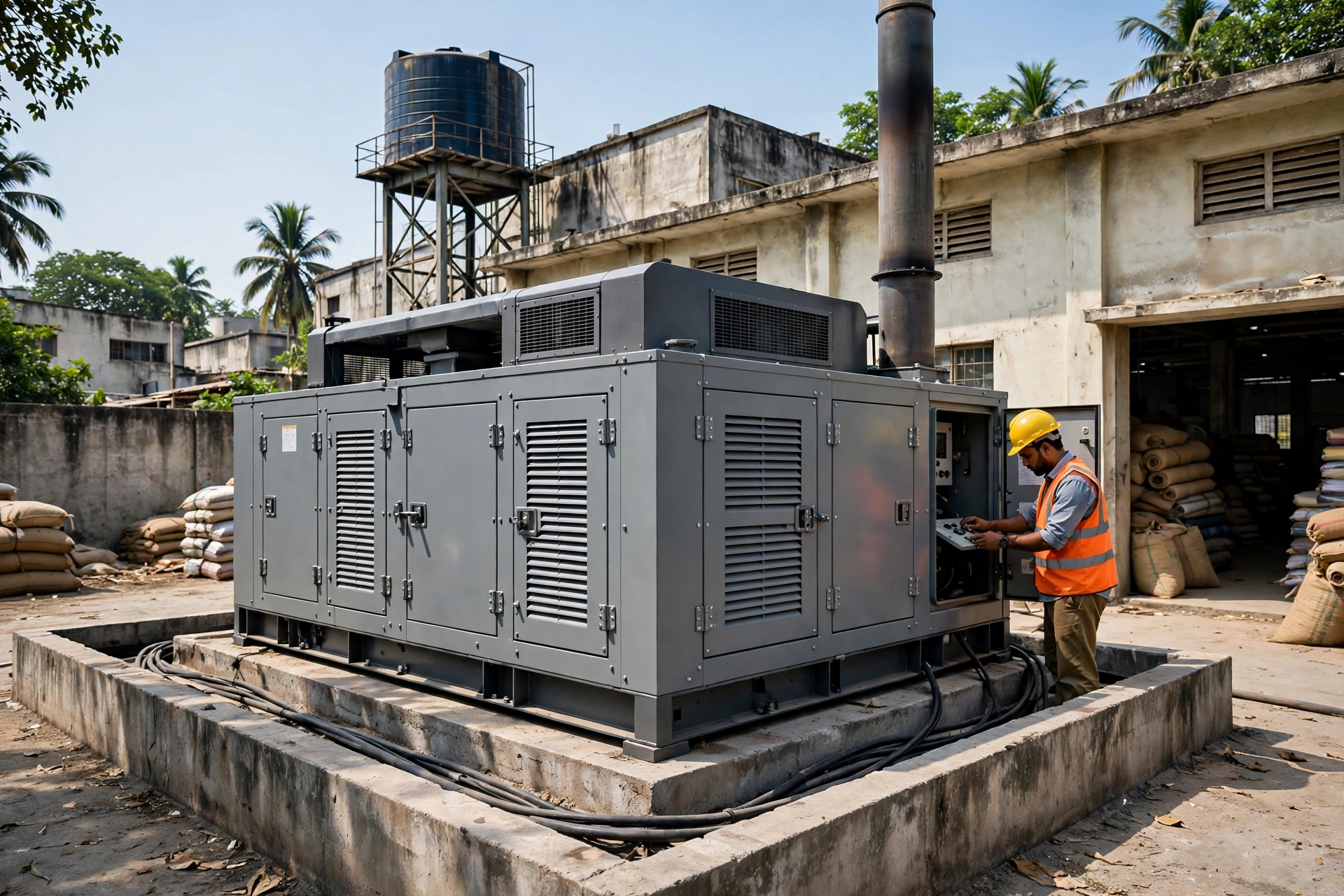
A silent canopy set, rated at 75 dB(A) at 7 metres, is the right choice for a mill in a built-up area, and it is not much more expensive than an open set at the sizes textile mills buy. The canopy also keeps lint off the engine and rain off the control panel, which matters in a monsoon climate. An open set is cheaper to buy and harder to live with: it needs a purpose-built room, the room needs ventilation, and the room has to be cleaned of lint as often as the radiator.
The mill should also check the local noise rules before it buys. Many industrial zones in Bangladesh, Pakistan and India set a 75 dB(A) daytime limit at the boundary, and a mill that installs an open 1,000 kVA set without a canopy can fail that limit at the fence line.
Fuel storage, fire and the bund
A textile mill stores fuel next to a building full of cotton, yarn and fabric. The fire risk is real, and the fuel installation has to be designed for it. The bulk tank sits in a bund — a walled enclosure that holds 110% of the tank’s volume if the tank leaks — and the bund is kept clear of lint, rags and waste. The generator room is separated from the production floor by a 2-hour fire-rated wall, and the fuel line runs outside the building, not through it.
The mill should also keep the fuel system simple. A day tank beside the generator, fed by a transfer pump from the bulk tank, with a float switch and a low-level alarm, is the standard arrangement. A mill that relies on an operator to carry fuel in drums will run out of fuel during the outage that matters most, as the Tiruppur case above shows. The fuel system is part of the generator, and it should be tested as part of the generator, every month, under load.
Frequently Asked Questions
What size generator does a textile mill need?
Most textile mills need 250 kVA to 2,500 kVA, depending on the process. A small weaving unit with 20–40 looms needs 150–350 kVA, a spinning mill with 10,000–20,000 spindles needs 500–1,250 kVA, and an integrated mill with spinning, weaving and dyeing needs 2,000–5,000 kVA. The correct figure always comes from a load list of frames, looms, compressors and dyeing machines, never from floor area.
Do textile mills need a backup generator?
Yes, in almost every case. A textile mill loses money within minutes of a power cut: yarn ends break in spinning, looms leave stop marks on fabric, and dyeing batches are ruined if the bath cools. In countries with unreliable grids, such as Bangladesh, Pakistan and India, a mill without a generator loses 8–12% of its production in the summer months, and buyers will move orders to mills that can guarantee delivery.
How long can a textile mill run on a generator?
As long as the fuel lasts. A prime-rated set can run indefinitely, limited only by fuel supply and the 250-hour service interval. A 1,000 kVA set at 75% load burns roughly 150 litres an hour, so a 10,000-litre bulk tank gives about 66 hours of running. A mill should size its tank for the longest outage it expects, plus a 24-hour margin, and keep a standing fuel delivery order in the outage season.
What happens to fabric during a power outage in a textile mill?
Three things, depending on the process. In spinning, yarn ends break across every frame, and the mill loses 40–90 minutes bringing them back. In weaving, looms stop mid-pick and leave stop marks that downgrade the fabric by 20–40% or get it rejected. In dyeing, the bath stops circulating and cools, and the batch comes out uneven — a 1,000 kg batch worth $4,000–8,000 can be scrapped by a single outage.
Can a diesel generator power a textile mill?
Yes. Diesel generators from 150 kVA to 5,000 kVA power textile mills across South Asia, Africa and South-East Asia every day, and they are the standard backup source for the industry. The set must be prime-rated if the mill runs it for thousands of hours a year, the alternator must be sized for the motor starting surge, and the compressors, humidification plant and dyeing machines must all be on the essential load list — a generator sized for the looms alone will not keep a mill running.
Specification checklist — before the order is placed
- Load list complete: every frame, loom, compressor, pump and dyeing machine listed with running kW, starting current and duty
- Rating checked: prime-rated if the set will run more than 200 hours a year, standby-rated only for genuinely occasional outages
- Starting surge verified: staggered restart programmed, soft starters or variable-speed drives on large motors, compressors before looms
- Fuel autonomy confirmed: bulk tank sized for the longest expected outage plus 24 hours, low-fuel alarm fitted, delivery contract in place
- Placement planned: ventilation sized for the room, radiator accessible for weekly lint cleaning, silent canopy specified for built-up areas
- Fire protection in place: bund holding 110% of tank volume, 2-hour fire-rated separation from production, fuel line routed outside the building
- Testing regime agreed: monthly load test, not a no-load run, with the full restart sequence and the fuel system proven every time
A textile mill buys a generator once and lives with it for 15–20 years. The mills that get it right size from a load list, buy a prime-rated set, put the compressors on the essential board, and test the whole system under load every month. The mills that get it wrong buy from the loom catalogue, discover the compressors on the first real outage, and pay for the lesson in downgraded fabric. To size a set for a spinning mill, a weaving shed or an integrated plant, contact PAVO with the load list, and the engineering team will return a sized quotation with the fuel, tank and transfer switch specified to match.