

What Size Generator Does a Sugar Mill Need? | PAVO
A sugar mill is the one factory that makes its own power — and still cannot afford to lose it. For five or six months a year the mill burns its own bagasse, drives its own turbo-alternators and exports surplus electricity to the grid. Then the turbine trips, or the grid tie opens, or the season ends, and the diesel generator is the only machine standing between a controlled restart and a mill full of cooling massecuite, choked mills and cane that is losing sugar by the hour.
What size generator does a sugar mill need? A small 1,250 TCD mill needs a 300–500 kVA set, a mid-size 2,500 TCD mill needs 500–750 kVA, and a large 5,000 TCD mill needs 1,000–1,250 kVA. The set is sized for black start and essential loads, not for crushing cane.
Contents
- Why a Sugar Mill Is Not Like Any Other Load
- What the Generator Actually Has to Carry
- Sizing the Set: What Size Generator Does a Sugar Mill Need?
- Black Start: Bringing a Dead Mill Back to Life
- The Damage Window: What an Outage Does to Cane, Massecuite and the Mill
- Three Mills That Learned the Hard Way
- Frequently Asked Questions
- Specification Checklist: Before You Sign the Order
Why a Sugar Mill Is Not Like Any Other Load
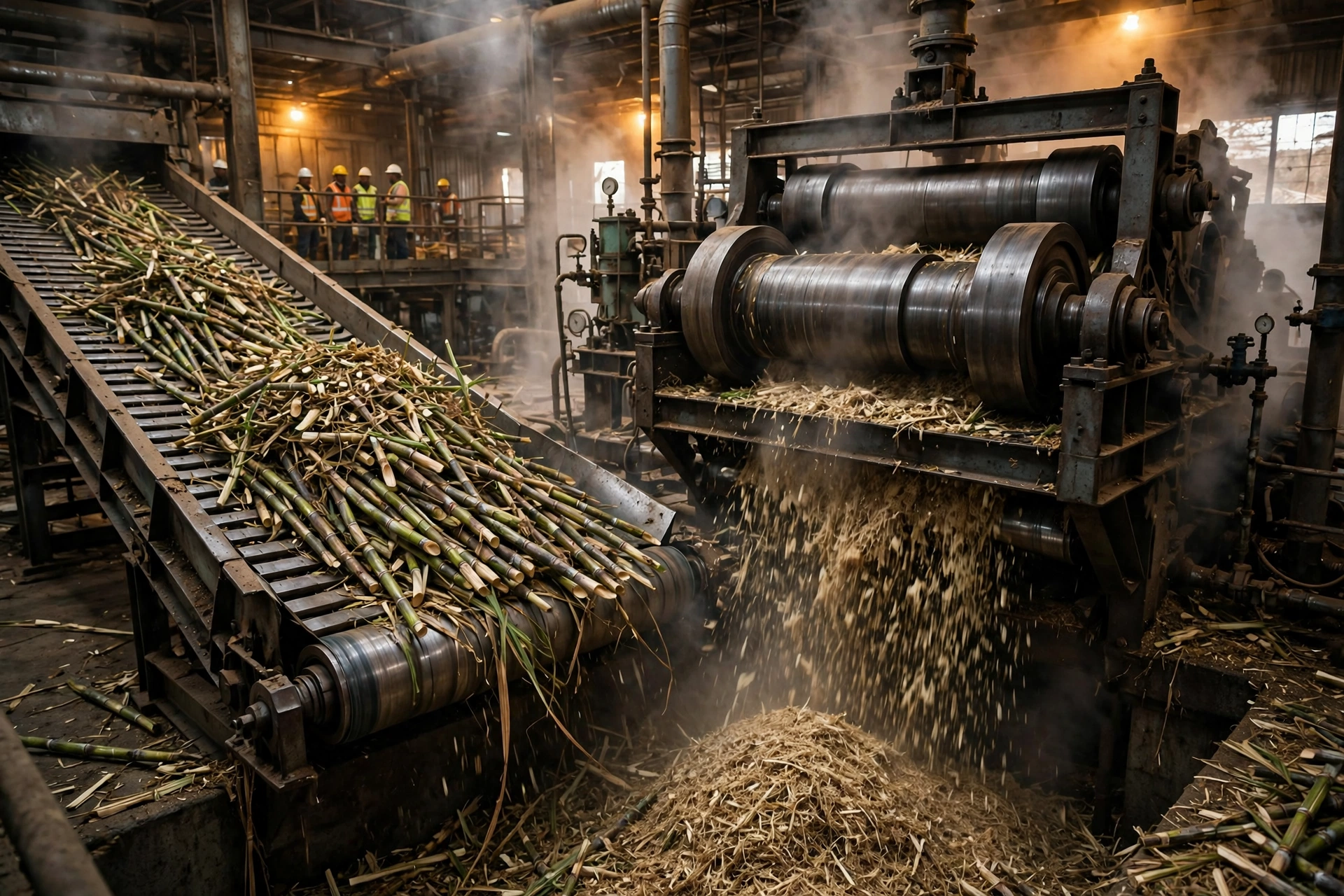
Most factories buy power and lose it. A sugar mill makes power and loses it differently. During the crushing season the mill is a power station that happens to make sugar: bagasse from the milling tandem fires the boilers, the steam drives turbo-alternators and often the mill turbines themselves, and the plant exports surplus power to the distribution company under a cogeneration agreement. In Telangana and coastal Andhra the season runs roughly 150 to 180 days. Outside the season the plant imports power for maintenance. The diesel generator sits in the middle of that architecture, and its job is not what a buyer from any other industry expects.
The first fact is that the diesel set is not sized to crush cane. A 5,000 TCD plant — 5,000 tonnes of cane crushed per day — needs about 4 MW of electrical power by the industry thumb rule of TCD × 80%, plus a 10% margin, taking it to 4.4 MW, before the labour colony at 4–5% and a 60 KLPD distillery at another 0.88–1.1 MW are added. No diesel set of sensible size covers that. The set is sized to get the cogeneration plant running from a dead bus, to protect the process when the in-house generation trips, and to keep the plant alive during the off-season. A buyer who sizes a diesel generator to run the whole mill has misunderstood the mill. A buyer who sizes it only to run the lights has misunderstood the black start.
The second fact is the season. A sugar mill runs hard for five or six months and then stands still for six or seven. The diesel generator stands still with it. A set that ran perfectly at the end of one season is a set that has sat idle through a hot, humid off-season, with fuel ageing in its tank, batteries self-discharging and seals drying out. The season start is the moment the set is needed most — the first black start of the year — and it is also the moment it is least likely to be ready. Mills that treat the generator as a season-start item, serviced in the last week before crushing begins, discover the fact at the worst possible time. The set needs a pre-season programme of its own, and it needs it before the first cane truck arrives.
The third fact is the fuel. The mill’s main fuel is bagasse, and bagasse is free at the point of use — it is the fibre left after the juice is squeezed out, about 28–29% of the cane by weight, or 1,450 tonnes a day from a 5,000 TCD plant. The diesel set burns a different fuel, bought fuel, and it burns it at a rate the mill’s accountants notice: a 1,000 kVA set at 75% load burns roughly 126 litres an hour. A mill that runs its diesel set as a substitute for its turbo-alternator, even for a day, is buying power at the most expensive rate in the plant. The economics of the set are the economics of insurance, not of generation, and the specification should be judged on that basis.
The fourth fact is the process. Sugar making is a continuous, timed process with almost no buffer. Cane is cut, transported, crushed, clarified, evaporated, crystallised and centrifuged in a single flowing line, and the material in the line at any moment is worth money only if it keeps moving. Juice that stops moving cools and ferments. Massecuite that stops moving sets solid in the pans and crystallisers. Cane that waits in the yard loses sucrose by the hour. The mill’s own power generation is the first line of defence against all of that, and the diesel set is the second. The two lines of defence have to work together, and the transfer between them has to be automatic, because the damage starts in minutes, not hours.
The fifth fact is the grid. Mills that export power operate in parallel with the utility, and the grid codes that govern that parallel operation are written for utility-scale generation, not for a 5 MW sugar-factory turbo-alternator. A paper presented to the South African Sugar Technologists’ Association in 2025 makes the point plainly: the grid code struggles to differentiate between a 765 MW utility base-load unit and an embedded 5 MW cogeneration turbo-alternator at a sugar factory. When the grid has a cascading event, it sheds load within 2–3 seconds or the whole system goes down — and restoration after a national blackout can take up to two weeks. A mill that exports power is exposed to the grid’s failures as well as its own, and its diesel set has to be ready for both.
What the Generator Actually Has to Carry
The essential bus of a sugar mill is built in tiers, and the tiers decide the generator size, the transfer scheme and the fuel autonomy. A tier left off the bus is a tier that fails in the first outage. The tiers below are the ones used in practice on mills from 1,250 TCD to 5,000 TCD.
Tier 1 — Safety and control: the loads that must never fail
The distributed control system (DCS) and instrumentation, the turbine lube oil and jacking oil pumps, the boiler safety systems, the gas and flame supervision, the emergency lighting and the control-room UPS sit in Tier 1. These loads are small — typically 40–100 kW on a mid-size mill — but they are non-negotiable. The turbine is the reason. A steam turbine that loses its lube oil supply while it is still spinning will wipe its bearings in minutes, and a turbine that has wiped its bearings does not restart for the rest of the season. The jacking oil pump keeps the rotor lifted on its oil film while it turns at barring speed. The DCS holds the boiler and turbine logic. The UPS bridges the 10 seconds it takes the diesel set to start and accept load under NFPA 110 Level 1, and it is sized in minutes, not hours — typically 10–15 minutes at full load.
Tier 2 — Black-start auxiliaries: the loads that restart the mill
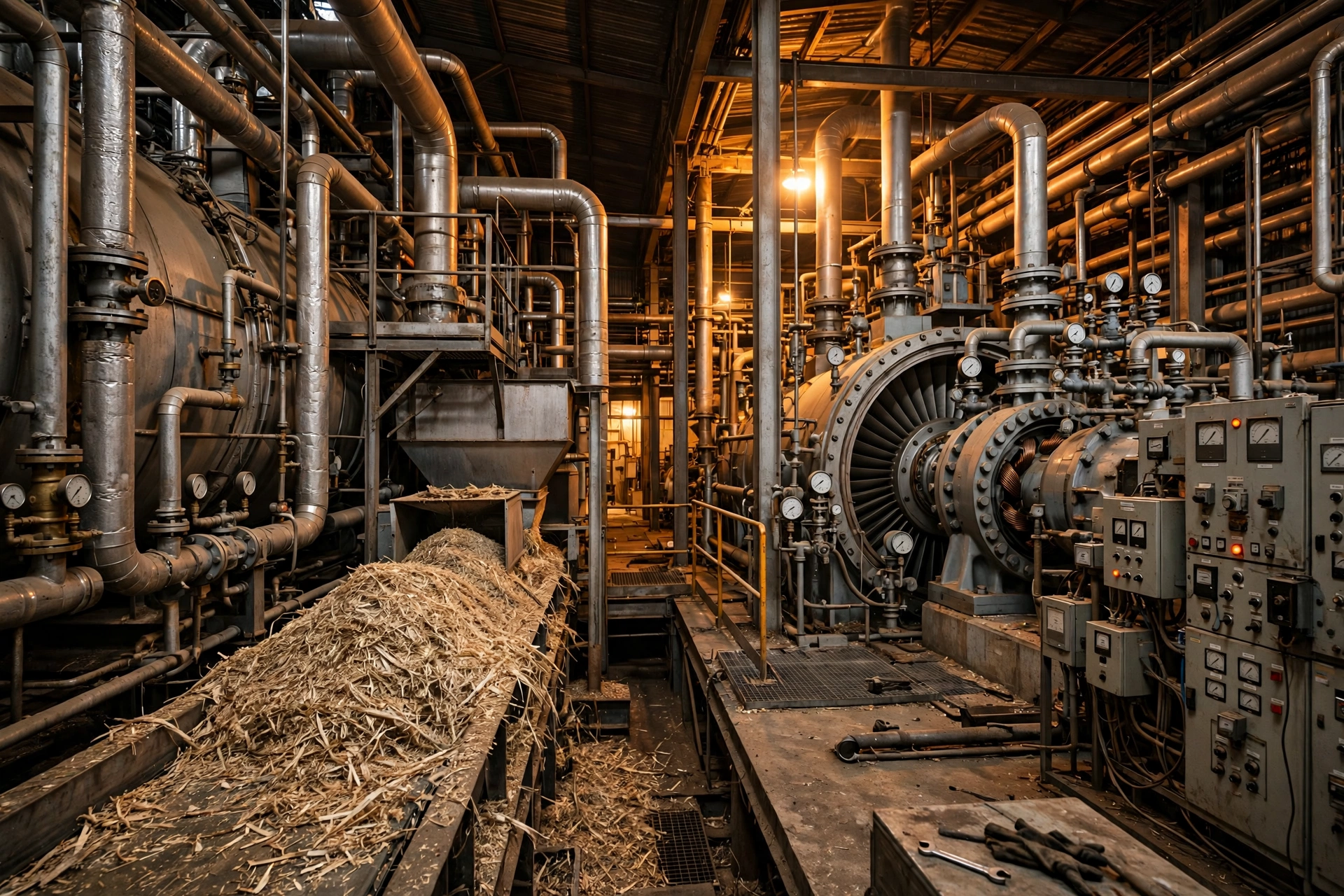
The boiler feed pump, the forced and induced draught fans, the bagasse feeders, the cooling-water and condensate pumps and the turbine auxiliaries sit in Tier 2. These are the loads that bring the boiler back from cold and the turbo-alternator back to synchronisation. A 5,000 TCD mill’s boiler feed pump alone is typically 200–315 kW, and the ID and FD fans together add another 150–220 kW. The largest single start on the essential bus is usually the boiler feed pump, started direct-on-line at six times running current. Tier 2 is where the sizing work happens: the generator is sized for the running load on the essential bus plus the largest single starting transient, with a 15–20% margin for load growth and for the voltage dip limit. The motor starting guide covers the starting methods in detail; the rule for a sugar mill is the same as for any plant with large motors — size for the start, not for the running load.
Tier 3 — Process protection: the loads that stop the damage
The massecuite and juice pumps, the crystalliser stirrers, the centrifugal brakes and controls, the cane carrier and mill controls, the vacuum and condensate pumps and the pan-floor lighting sit in Tier 3. These are the loads that keep the process alive while the boiler and turbine are being restarted. Massecuite in a pan that has stopped being stirred cools and sets; juice in a line that has stopped moving ferments; a batch centrifugal that stops mid-cycle with a full basket needs its brake and its controls to unload safely. Tier 3 is usually 150–300 kW on a mid-size mill, and it is the tier most often under-specified, because it looks like production load and gets cut from the essential bus on cost grounds. Cutting it is the most expensive saving in the specification: the set starts, the boiler restarts, and the mill still loses the batch that was in the pans.
Tier 4 — Off-season and utilities: the loads that keep the mill alive between seasons
The workshops, the cranes, the maintenance pumps, the water-treatment plant, the offices and the colony supply sit in Tier 4. During the off-season these are the loads the diesel set carries when the grid import is unreliable or expensive — typically 100–250 kW on a mid-size mill, running for weeks rather than hours. The set that carries Tier 4 in the off-season is the same set that carries Tier 1 to Tier 3 in the season, and the specification has to cover both duties: short, heavy black-start duty in the season, and long, light maintenance duty out of it. A set rated only for standby duty and then run for weeks at a time in the off-season will not last. The standby and prime power ratings explain the difference; a mill that expects weeks of off-season running should size on the prime rating, or buy a larger standby set and run it at 70–80% of nameplate.
Sizing the Set: What Size Generator Does a Sugar Mill Need?
Sizing starts with a load list, not a catalogue. The load list records every load on the essential bus, its running kW, its starting method and its starting kVA. The generator is then sized for the running load plus the largest single starting transient, with a 15–20% margin. The generator sizing guide covers the full method; the table below gives the bands that experienced buyers use as a first check. The bands are for the essential bus and black-start duty — not for the whole mill, which runs on its own cogeneration.
| Mill size | Total plant demand | Essential bus | Typical set | Fuel at 75% load |
|---|---|---|---|---|
| 1,250 TCD, small mill | ~1.0 MW | 250–400 kW | 1 × 400 kVA | ~50 L/h |
| 2,500 TCD, mid-size mill | ~2.0 MW | 400–600 kW | 1 × 750 kVA | ~95 L/h |
| 5,000 TCD, large mill | ~4.4 MW | 800–1,000 kW | 1 × 1,250 kVA | ~158 L/h |
| 5,000 TCD + distillery, export cogen | ~5.7 MW | 900–1,200 kW | 1 × 1,500 kVA | ~189 L/h |
Fuel figures use the standard rule of thumb of 0.21 litres per kWh generated. A 400 kVA set (320 kW) at 75% load produces 240 kW and burns about 50 L/h. A 750 kVA set (600 kW) at 75% load burns about 95 L/h. A 1,250 kVA set (1,000 kW) at 75% load burns about 158 L/h. The Cummins C500D5 datasheet gives a measured figure for the same frame: 500 kVA standby / 455 kVA prime, 93.2 L/h at prime full load. Real consumption is always lower than the catalogue figure at part load, and always higher than the buyer hoped at full load. Size the tank on the measured figure, not the brochure figure.
The plant demand column comes from the industry thumb rules. A typical sugar mill consumes 25–32 kWh of electricity and 350–600 kg of steam per tonne of cane processed into raw crystalline sugar. At 5,000 TCD that is 125–160 MWh of electricity a day, and the power thumb rule — crushing capacity × 80% — gives 4 MW, plus 10% margin 4.4 MW, before the labour colony at 4–5% and a 60 KLPD distillery at another 0.88–1.1 MW take the total to 5.7 MW. The boiling house alone needs steam at 40% on cane, which for a 5,000 TCD plant is 85 tonnes per hour. Those are the numbers the cogeneration plant is built around. The diesel set is built around a much smaller number: the essential bus, which is 15–25% of the total plant demand.
A worked example makes the method concrete. A 5,000 TCD mill in Maharashtra runs a 45 bar boiler and a back-pressure turbo-alternator, exporting surplus power. Its essential bus carries DCS and instrumentation 40 kW, turbine lube and jacking oil pumps 55 kW, boiler feed pump 250 kW, ID and FD fans 180 kW, bagasse feeders 60 kW, massecuite and juice pumps 120 kW, crystalliser stirrers 45 kW, centrifugal brakes and controls 35 kW, cooling-water and condensate pumps 90 kW, and emergency lighting 25 kW — 900 kW of running load, or about 1,125 kVA at 0.8 power factor. The largest single start is the 250 kW boiler feed pump, started direct-on-line at six times running current, about 1,500 kVA of starting demand for two seconds. Running load minus that motor plus the starting transient gives 1,125 − 313 + 1,500 = 2,312 kVA of transient demand — too much for a single 1,250 kVA set. The answer is not a bigger set. It is a soft starter or a variable-speed drive on the feed pump, which cuts the starting demand to about 1.5 times running current, or roughly 470 kVA, bringing the transient demand to 1,125 − 313 + 470 = 1,282 kVA — inside the capacity of a 1,500 kVA set with margin. The mill ordered the 1,500 kVA set with a soft starter on the feed pump. That is the arithmetic that decides whether a generator works on the day it matters. Sizing by catalogue kVA alone would have bought a set that tripped on its first black start.
The voltage matters as much as the size. Most mills run their essential bus at 400 V, and a set up to about 2,000 kVA is practical at that voltage. Larger black-start sets — for the biggest mills, or where the essential bus sits a long way from the generator — may need 11 kV, and that is a different machine with a different price. The high-voltage question is covered in the companion article on high-voltage sets; the rule for a sugar mill is simple — if the essential bus is more than 300 metres from the generator, or the set is above 2,000 kVA, price the 11 kV option before ordering at 400 V.
How long the set can run
Fuel autonomy is the second half of the sizing question, and it is the half most buyers get wrong. A 750 kVA set at 75% load burns 95 L/h, so 8 hours needs 760 litres, 24 hours needs 2,280 litres and 72 hours needs 6,840 litres. A 1,250 kVA set at 75% load burns 158 L/h, so 8 hours needs 1,260 litres and 24 hours needs 3,800 litres. The sub-base tank under the set holds 8–12 hours at most. Everything beyond that is a bulk tank, and a bulk tank is a separate project with its own bund, its own permits and its own diesel fuel ageing problem: fuel that sits for a year grows water and microbes, and a generator that starts perfectly on bad fuel stops within the hour.
The honest answer to the autonomy question is that a sugar mill does not need to run for 72 hours on diesel power. It needs to run long enough to restart the boiler and synchronise the turbo-alternator — typically one to a few hours — or to protect the process through a trip and restart, or to carry the off-season maintenance load until the grid returns. For most mills that is 8–24 hours of fuel, with a refuelling contract for anything longer. The mills that genuinely need 72 hours are the ones in regions where the grid fails for days — and those mills buy prime-rated sets, bulk tanks and fuel contracts, not a bigger sub-base tank. The fuel in the tank also has to survive the off-season: a mill that fills its bulk tank at the end of one season and leaves it standing for seven months will find water, microbes and degraded fuel at the start of the next. Fuel polishing and a pre-season test run are not optional extras. They are part of the specification.
Black Start: Bringing a Dead Mill Back to Life
A black start is the hardest job a sugar mill’s diesel generator will ever do, and it is the job the whole specification exists for. The grid is down, the turbo-alternator is stopped, the boiler is cold, and the only source of power in the plant is the diesel set. From that dead bus, the plant has to rebuild itself in the right order, one load at a time, until steam is available and the turbo-alternator can be synchronised. The sequence is fixed, and it is fixed by physics, not by preference.
Step 1 — The DCS and the turbine oil
The first loads on the essential bus are the DCS and instrumentation, on UPS power, and the turbine lube oil and jacking oil pumps. The turbine rotor is still turning down from its last run, or it is sitting on its barring gear, and it needs oil on its bearings before anything else happens. The jacking oil pump lifts the rotor on its oil film while it turns at barring speed. If the rotor sits without oil, the bearings score, and a scored turbine bearing is a season-ending repair. The DCS holds the boiler and turbine logic, the interlocks and the alarm history. Without it, the operators are blind, and a blind boiler start is a boiler start that should not happen. The diesel set takes these loads first, within seconds of starting, and the UPS bridges the gap.
Step 2 — The boiler feed pump and the draught fans
The second loads are the boiler feed pump and the forced and induced draught fans. The feed pump puts water into the boiler; the fans put air through it. The feed pump is the largest single start on the essential bus, and it is the load that decides whether the black start works. A 5,000 TCD mill’s feed pump at 250 kW, started direct-on-line, demands about 1,500 kVA for two seconds — more than the whole running load of the essential bus. The standard answer is a soft starter or a variable-speed drive, which cuts the starting demand to about 1.5 times running current and brings the transient inside the set’s capacity. The fans start after the feed pump, one at a time, with a delay of 5–10 seconds between steps. The sequencing is programmed into the automatic transfer switch or the plant’s load-shedding controller, and it is tested on the monthly test run — or it is not tested at all, and the first real black start is the first test.
Step 3 — The bagasse feeders and the turbine auxiliaries
The third loads are the bagasse feeders and the turbine auxiliaries. The feeders put fuel into the boiler; the auxiliaries — the cooling-water pumps, the condensate pumps, the gland steam and the barring gear — prepare the turbine for its first roll. The boiler is now building steam, and the steam is going nowhere yet: it is heating the boiler, the steam lines and the turbine casing, and it is being vented or condensed until the parameters are right. This is the slow part of the black start. A boiler that has gone cold takes one to three hours to raise steam, and there is no way to hurry it without damaging the boiler. The diesel set runs at part load through this period, carrying the auxiliaries and the process-protection loads, burning roughly 60–100 litres an hour on a 1,250 kVA set. The fuel in the sub-base tank has to cover this whole period with margin, because the mill cannot refuel a running set from a bulk tank that has not been maintained.
Step 4 — Synchronisation and load transfer
The fourth step is synchronisation. The turbo-alternator is rolled, brought to speed, excited and synchronised to the essential bus, and the load is transferred from the diesel set to the turbo-alternator in steps. The diesel set is then unloaded, cooled down and stopped — or kept running on standby if the grid is still down and the mill wants a second source. The whole sequence, from dead bus to a synchronised turbo-alternator, takes one to a few hours on a well-run mill. The diesel set is the machine that makes those hours possible, and it is the machine that has to be ready after seven months standing idle. A black start that fails because the set’s batteries are flat, or its fuel is bad, or its cooling system is clogged with bagasse dust, is not a generator failure. It is a maintenance failure, and it is the most common kind.
The Damage Window: What an Outage Does to Cane, Massecuite and the Mill
An outage in a sugar mill does not damage the mill the way an outage damages a warehouse. The damage is chemical and thermal, it starts in minutes, and it is measured in lost sugar, not lost hours. The three damage windows below are the ones the essential bus exists to close.
The cane in the yard
Cut cane starts losing sucrose the moment it is cut. The industry rule is that cane should be crushed within 24 hours of harvest, and the loss accelerates after that — invert sugars rise, dextran forms, and the recoverable sugar falls. A mill that crushes 5,000 tonnes a day holds a yard stock of one to two days’ crushing, and an outage that stops the mills for a day puts that whole stock at risk. The loss is not dramatic on any single tonne, but across 5,000–10,000 tonnes of yard cane it is a real number: at a typical recovery of 10–11%, a 1% loss of recoverable sugar on 5,000 tonnes of cane is 50–55 tonnes of sugar, worth tens of thousands of dollars at current prices. The cane in the yard is also the mill’s working capital — it has been bought and paid for, and it cannot be returned to the field. The diesel set cannot crush cane. What it can do is keep the mills turning on the essential bus long enough to clear the yard, or restart the plant fast enough that the yard stock is still crushable. The farm generators that power the cane fields and the irrigation pumps are part of the same chain: a mill that loses its field power and its factory power in the same storm loses both ends of its supply.
The massecuite in the pans
Massecuite — the thick mixture of sugar crystals and mother liquor in the vacuum pans and crystallisers — is the most time-critical material in the mill. It is held at 65–75°C and kept moving by stirrers. When the power fails, the stirrers stop, the massecuite cools, and it starts to set. The window is measured in tens of minutes, not hours. Massecuite that has set in a pan has to be steamed out or chipped out by hand, and the pan is out of service until it is cleared. A mill with four pans that loses two of them to set massecuite has lost half its crystallising capacity for the rest of the shift, and the syrup backs up through the evaporators and the juice heaters until the whole boiling house is stopped. The essential bus carries the crystalliser stirrers, the massecuite pumps and the pan-floor lighting precisely because of this window. A generator that takes 30 seconds to start is a generator that has already failed this tier, even if it starts perfectly — which is why the UPS and the transfer scheme matter as much as the set itself.
The boiler and the turbine
The boiler and the turbine are the most expensive machines in the mill, and they are the machines an outage damages most quietly. A boiler that loses its feed pump and its draught fans while it is still hot will suffer thermal shock as the water level falls and the tubes are exposed. A turbine that loses its lube oil while it is still spinning will wipe its bearings. A turbo-alternator that trips on a grid fault and is not isolated cleanly can motor — drawing power from the grid instead of supplying it — and damage its windings. The damage does not show up on the day. It shows up as a bearing that fails three weeks later, a tube that leaks at the next season start, a winding that tests low on insulation resistance. The essential bus carries the lube oil pumps, the jacking oil pump, the feed pump and the boiler safety systems because the cost of protecting them is trivial next to the cost of repairing them. A turbine bearing replacement costs weeks of the season and more than the diesel set that would have protected it.
Three Mills That Learned the Hard Way
A 5,000 TCD mill in Maharashtra: the trip that set the pans
A 5,000 TCD mill in Maharashtra, running a 45 bar boiler and a back-pressure turbo-alternator with a 60 KLPD distillery, was mid-crush on a normal afternoon when its turbo-alternator tripped on a grid fault. The grid tie opened, the in-house generation stopped, and the essential bus transferred to the diesel set — a 1,000 kVA unit that had been sized five years earlier, when the mill was 3,500 TCD and the essential bus was smaller. The set started and accepted load. Then the operators tried to restart the crystalliser stirrers and the massecuite pumps, and the set’s voltage collapsed. The essential bus had grown since the set was bought — a second pan, a larger feed pump, a new distillery — and nobody had re-checked the load list. The set tripped on overload. The massecuite set in two pans. The mill lost six hours restarting, steamed out two pans by hand, and wrote off 400 tonnes of cane that had waited in the yard past its crushing window. The repair was not a new generator. It was a new load list, a 1,500 kVA set with a soft starter on the feed pump, and a rule that the essential bus is re-checked every time a load is added. The set had done nothing wrong. The specification had.
A Queensland mill: the grid tie that opened during export
A large Queensland mill — one of the eight in the Wilmar group, which together generate 202 MW and about 620,000 MWh a year — was exporting surplus power to the grid when a fault on the utility network opened the grid tie. The mill’s islanding scheme worked as designed: the turbo-alternators stayed on the island, the non-essential loads were shed, and the plant kept crushing. The diesel set started, took the essential bus, and stood by for 40 minutes while the operators confirmed the island was stable. Then the grid returned, the tie was re-closed, and the set was stopped. Nothing was damaged. Nothing was lost. The difference between this mill and the Maharashtra mill was not luck. It was that the islanding scheme had been tested — the grid tie, the load shedding and the transfer had all been proved on a planned test, with the diesel set running, before the real event. The mill’s engineers had also done the arithmetic that most mills skip: the set was sized for the essential bus plus the largest start, and the essential bus had been re-checked after every plant change. The set cost the mill 40 minutes of diesel fuel. The absence of a set, or a set that failed, would have cost it the day.
A 1,250 TCD mill in Telangana: the season that started without a generator
A small 1,250 TCD mill in Telangana finished one season, shut down for maintenance, and left its 400 kVA diesel set standing in its enclosure for seven months. The fuel in the sub-base tank was not polished. The batteries were not charged. The coolant was not checked. The set was not test-run once in the whole off-season. When the next season started, the mill’s first job was a black start: the grid was down, the boiler was cold, and the diesel set was the only source of power in the plant. It cranked, coughed and stopped. The batteries were flat. The fuel was contaminated with water. The mill waited three days for a replacement battery and a fuel delivery, and the first cane of the season — cut and delivered on the strength of the season-start date — sat in the yard losing sugar. The mill now runs its set on load for 30 minutes every month through the off-season, polishes its fuel before the season starts, and replaces its batteries on a fixed three-year schedule whether they look good or not. The maintenance schedule for a mill set is not a suggestion. It is the difference between a black start and a three-day delay. The set that fails at season start is the set that was ignored all winter.
Frequently Asked Questions
What size generator does a sugar mill need?
A small 1,250 TCD mill needs a 300–500 kVA set, a mid-size 2,500 TCD mill needs 500–750 kVA, and a large 5,000 TCD mill needs 1,000–1,250 kVA — or 1,500 kVA if the boiler feed pump is started direct-on-line. The set is sized for the essential bus and black start, not for the whole mill, which runs on its own bagasse cogeneration.
Do sugar mills need a backup generator?
Yes. A sugar mill makes its own power from bagasse, but it still needs a diesel set for black start, for essential loads when the turbo-alternator trips, and for off-season maintenance power. Without it, a turbine trip sets the massecuite in the pans, and a cold boiler cannot be restarted at all.
How long can a sugar mill run on a generator?
A mill runs on its diesel set for one to a few hours — long enough to restart the boiler and synchronise the turbo-alternator — or for days in the off-season on light maintenance load. The set is not sized to crush cane: a 5,000 TCD mill needs 4.4 MW, and no diesel set of sensible size covers that.
What happens to sugar cane during a power outage in a sugar mill?
Cut cane loses sucrose from the moment it is cut, and the loss accelerates after 24 hours; massecuite in the pans cools and sets within tens of minutes; juice in the lines ferments. A mill that cannot restart quickly loses the yard stock, the batch in the pans and the shift’s production.
Can a diesel generator power a sugar mill?
A diesel generator can power the essential bus and black-start a sugar mill, but it cannot power the whole mill. The milling tandem alone draws 70–164 kW per tonne of fibre per hour, and the whole plant needs megawatts. The set protects the process and restarts the cogeneration plant; the bagasse boiler does the real work.
Specification Checklist: Before You Sign the Order
1. Load list first. List every load on the essential bus with running kW, starting method and starting kVA. Size for the largest start plus the running load, with a 15–20% margin. Re-check the list every time a load is added.
2. Black-start sequence in writing. DCS and turbine oil first, feed pump and fans second, bagasse feeders and turbine auxiliaries third, synchronisation last. Program the steps into the transfer scheme with 5–10 second delays.
3. Soft starter on the boiler feed pump. A direct-on-line start at six times running current is the single most common reason a sugar-mill black start fails. A soft starter or variable-speed drive cuts the starting demand to about 1.5 times running current.
4. Rating for both duties. Standby rating for season black starts, prime rating if the set will run for weeks in the off-season. A standby set run for weeks at full load will not last.
5. Fuel for the real job. 8–24 hours in the sub-base tank for black start and restart, a bulk tank and a refuelling contract for anything longer. Polish the fuel before every season, and test-run the set on load every month through the off-season.
6. Batteries on a fixed schedule. Replace starting batteries every three years whether they look good or not, and keep them on a charger through the off-season. A flat battery at season start is the most common black-start failure.
7. Ventilation and dust. Bagasse dust clogs radiators and air filters. Site the set upwind of the bagasse yard, fit a pre-filter, and clean the radiator at every service. The generator room ventilation guide covers the airflows.
8. Test the transfer, not just the engine. A monthly no-load test proves the engine starts and nothing else. Test the full black-start sequence — transfer, load steps, synchronisation — at least once before every season.
9. Get the contract right. The specification should state the essential-bus load list, the black-start sequence, the starting method for the feed pump, the fuel autonomy and the off-season maintenance programme. If it is not in the contract, it will not be in the delivery.
A sugar mill is the one factory that makes its own power, and the diesel generator is the machine that makes that power possible. Size it for the black start, protect the process it carries, and maintain it through the months it stands idle — and the mill will restart when the grid fails, instead of waiting for it.
To specify a set for a sugar mill, or to check the essential-bus load list on an existing mill, contact PAVO for a sizing review and a quotation.