

What Should a Diesel Generator Quotation Include?
A quotation that states only a kVA figure and a price is not a quotation. It is a guess with a dollar sign attached.
What should a diesel generator quotation include? Fourteen lines: the rating in letters, the engine and alternator by model, the fuel curve, the tank size, the controller, the test report, the warranty terms, the Incoterm, the delivery time, the payment split, the documents, and the exclusions. If any line is missing, the price cannot be compared with another price.
A buyer who asks for those fourteen lines before paying a deposit will spend an extra week on paperwork. A buyer who skips them will spend the next five years paying for the omissions. This article goes through each line, shows what a weak version looks like, and puts real numbers on what the gaps cost.
- Why Two Quotations for the Same kVA Are Never the Same Price
- The 14 Lines Every Quotation Must Carry
- The Price Gap, Explained in Numbers
- Payment Terms: Where Your Leverage Sits
- FOB, CIF and EXW: Who Owns the Risk at Each Step
- The Warranty Paragraph That Decides the Next Five Years
- Frequently Asked Questions
- Specification Checklist: 14 Lines Before the Deposit
Why Two Quotations for the Same kVA Are Never the Same Price
Two suppliers quote a 200 kVA diesel set. One asks $18,500. The other asks $24,000. The buyer who picks the cheaper one has not saved $5,500. He has bought a different machine, and the quotation will not tell him so unless he knows what to look for.
The difference hides in the lines that are absent. The cheaper quotation may state “200 kVA” without saying whether that is standby or prime. A 200 kVA standby set is roughly a 180 kVA prime set, and on a site that runs eight hours a day that distinction is the difference between a five-year service life and a rebuild in year two. The guide to standby and prime power explains the rating letters in full; the short version is that a quotation without ESP, PRP or COP on the rating line is not a specification.
The cheaper quotation may also omit the alternator brand, the controller model, the tank size, the battery, the exhaust silencer, the automatic transfer switch, and the test report. Each of those items costs money. A Deep Sea DSE7320 controller and a basic auto-start panel are several hundred dollars apart. A 200-litre base tank and a 600-litre tank are a different order. A quotation that lists none of them has not priced them — it has deferred them, and the buyer will meet them later as extras, at retail prices, with the deposit already paid.
There is a third possibility, and it is the most common. Both quotations describe the same machine, and the cheaper one is genuinely cheaper — because the supplier builds 20,000 sets a year in a 33,000-square-metre factory and buys engines by the thousand, while the expensive one is a trader adding a margin on a machine he did not build. The fourteen lines are how a buyer tells the second case from the first. A factory that owns its production answers each line with a document. A trader answers with a delay.
The 14 Lines Every Quotation Must Carry
A quotation is a contract in waiting. Every line that is vague now becomes a dispute later, and disputes after the deposit is paid are settled on the supplier’s terms. The fourteen lines fall into four groups.

Lines 1–4: The Machine Itself
Line 1 — Rating in letters. ESP, PRP or COP, with the kVA and kW at 0.8 power factor. “200 kVA” alone is not a rating. The line should read, for example, “200 kVA ESP / 182 kVA PRP, 160 kW / 146 kW, 0.8 pf, ISO 8528-1.”
Line 2 — Engine, by model. Brand and model, not just brand. “Cummins” is not a specification; “Cummins 6BT5.9-G2” is. The engine model fixes the displacement, the governor type, the emission configuration and the parts catalogue. Two engines from the same brand, one generation apart, can differ by 30% in parts prices and by a full service interval.
Line 3 — Alternator, by model. Brand, model, insulation class and protection degree. A Stamford S1L2 alternator and an unbranded copy differ in copper content, in temperature rise and in whether a replacement AVR is available in the buyer’s country in three days or three months. Insulation class H and IP23 are the normal export standard; anything less should be stated, not discovered.
Line 4 — Enclosure and noise. Open, silent canopy, or containerised, with the noise figure in dB(A) at a stated distance — 75 dB(A) at 7 metres is the common export figure. A canopy is not a box with a door. It is insulation, a silencer, a radiator sized for the enclosure, and a derating the supplier must already have applied. A quotation that prices a silent set at the open-set price has forgotten one of those.
Lines 5–8: Performance, Proved on Paper
Line 5 — Fuel consumption curve. Litres per hour at 25%, 50%, 75% and 100% load, at the quoted rating. A single figure — “30 L/h” — is useless without the load it refers to. The Cummins C500D5, for example, burns 29.2 L/h at 25% prime load and 93.2 L/h at full prime load. A buyer who budgets on the wrong figure will run out of fuel on the third day of an outage. The guide to fuel consumption and tank sizing shows how the curve turns into a tank size.
Line 6 — Tank size and runtime. Litres in the base tank, and the hours that tank gives at the site’s real load — not at 25% load in a brochure. For a 72-hour autonomy requirement, the quotation should state the bulk tank size as well, or state plainly that the base tank does not meet it.
Line 7 — Controller and transfer. Controller brand and model, auto-start function, and whether the automatic transfer switch is included, with its rating in amps and its transition type. An ATS is a $600 to $3,000 item depending on rating; leaving it out of the quotation and adding it later is the single most common post-deposit surprise in standby installations.
Line 8 — The test report. A written commitment to a factory acceptance test, with the load steps recorded, and a copy of the report before the balance is paid. A supplier that tests 100% of its sets can produce a sample report with the quotation. A supplier that cannot produce one is telling the buyer something, whether it means to or not. What a real report contains is covered in the guide to the factory acceptance test report.
Lines 9–11: The Commercial Terms
Line 9 — Price, with the Incoterm named. FOB Shanghai, CIF Lagos, EXW Wuhu — the price means nothing without the term. Section 5 below explains why. The quotation should also state the currency, USD in almost all export cases, and the validity period, typically 15 to 30 days. Steel and engine allocations move; a price held for 90 days is either padded or fictional.
Line 10 — Delivery time, in days after deposit. Not “about a month” but “20–25 working days after receipt of deposit and confirmed specification.” Built-to-spec sets typically need 15 to 35 days after deposit, longer for containerised or dual-fuel builds. A supplier that promises 10 days for a 1,000 kVA custom set is promising a set from stock, and the buyer should ask which stock.
Line 11 — Payment split and release points. Deposit percentage, balance trigger, and the documents that release each payment. The standard export structure is 30% deposit with 70% balance before shipment, or 100% letter of credit at sight for larger first orders. What matters is not the percentage but the trigger: the balance should follow evidence — a signed test report, photographs or video of the test — not a calendar date.
Lines 12–14: After the Sale
Line 12 — Warranty, in writing. Duration in months and in running hours, whichever comes first — 12 months or 1,000 hours is the industry standard — plus what is covered, whether labour is included, and where warranty service is performed. A warranty that requires the set to be returned to China is not a warranty for a buyer in Accra. Section 6 below goes through the warranty paragraph line by line.
Line 13 — Spare parts and service. The first-service parts list, the recommended stocking list with prices, and the name of the service agent or parts stockist nearest the buyer’s site. A set whose nearest parts stock is 4,000 kilometres away is a set that will sit idle for six weeks over a $40 fuel filter. The guide to spare parts stocking lists what a sensible first order contains.
Line 14 — Documents and exclusions. The export document set — commercial invoice, packing list, certificate of origin, emission certificate, test report — and a written list of what is NOT included: foundation, cabling, exhaust pipework, installation, commissioning, local transport. An exclusions list is the most honest line on any quotation, and its absence is the most expensive.
The Price Gap, Explained in Numbers
A quotation is comparable only when all fourteen lines are present. The two cases below show what happens when they are not.
Case 1: A 200 kVA Quotation in Lagos That Was $4,000 Light
A contractor in Lagos received two quotations for a 200 kVA standby set for a commercial building. Supplier A: $18,500. Supplier B: $22,400. The contractor chose A.
The set arrived, and the installation bill began. The ATS was not included: $1,150 for a 400 A open-transition switch, plus $380 for cabling. The base tank was 220 litres, giving about 7 hours at the building’s 150 kVA running load; the 72-hour autonomy the client had asked for needed a 1,500-litre bulk tank at $1,900 installed. The battery charger was a basic trickle unit, replaced within a year for $240. Commissioning, excluded from the quotation, cost $650. Total additions: $4,320 — and the $18,500 quotation had become $22,820, $420 more than Supplier B’s price, for a set with a smaller tank and a cheaper controller.
Supplier B’s quotation had carried all fourteen lines. The contractor had read the price line only.
Case 2: A 500 kVA Hospital Quotation Where the Rating Was the Gap
A hospital group in Nairobi compared quotations for a 500 kVA set. Both were headed “500 kVA”. One was $11,000 cheaper. The datasheets showed the difference: the cheaper set was rated 500 kVA standby, the dearer one 500 kVA prime — the same pattern described in the standby and prime power guide, where the Cummins C500D5 carries 500 kVA standby and 455 kVA prime on the same frame.
The hospital’s load was 380 kW, and grid outages totalled about 300 hours a year. That is a prime duty. The standby-rated set would have run, for a time, and then followed the standard pattern: rising oil consumption, cylinder glazing, an early overhaul, and a refused warranty claim on grounds of misapplication. The $11,000 saving would have bought a rebuild costing more than the saving, two years earlier than planned. The hospital bought the prime-rated set. The price gap was not a gap in price. It was a gap in duty, and the quotation that stated the rating in letters was the only one that made the gap visible.
Payment Terms: Where Your Leverage Sits
How much deposit should I pay for a diesel generator? Around 30% is the common figure for standard export orders, and the range around it tells the buyer more than the number itself. Below roughly 20%, most factories will not schedule production, because the deposit is what buys the engine. Above 50%, the buyer is financing the factory rather than the order, and should ask why the factory needs the buyer’s money to buy its own materials.
The deposit percentage is the least important number in the deal. What protects the buyer is which milestone each payment is tied to, and who inspects before it moves. The standard structure — 30% deposit to start production, 70% balance before shipment — means the buyer’s remaining leverage expires before the unit leaves the factory. The correct response is not to renegotiate blindly, but to attach the balance release to acceptance documents: a signed factory acceptance test report, the parameter record, and photographs or video of the test. If those documents cannot be produced, the balance should not be released, and that condition should be written into the contract rather than assumed.
The 30/70 Split and What It Means in Practice
On a $22,000 order, 30% is $6,600. That deposit buys the engine allocation, the alternator and the production slot — typically 15 to 35 days of works time for a built-to-spec set. The $15,400 balance is due before loading, which means before the buyer has seen the machine. A buyer who pays the balance on a phone call has paid for a promise. A buyer who pays it against a test report, with the serial number on the report matching the serial number on the nameplate in the photographs, has paid for a machine that has been proved to run at its rated load.
Larger or first-time orders often use a letter of credit at sight instead. A bank stands between both parties, and the documents — not a phone call — trigger payment. It costs more in bank fees, typically 1–2% of the order value, and it is the right choice when the order is large, the supplier is new, or the buyer cannot commission an inspection. Long-lead containerised or dual-fuel builds sometimes use stage payments tied to milestones: deposit, engine delivery to the factory, test completion, shipment. Each stage should still be tied to something the buyer can see.
One rule covers all of it. No payment should be released on a date alone. Every payment should be released on a document, a photograph, or a test result.
FOB, CIF and EXW: Who Owns the Risk at Each Step
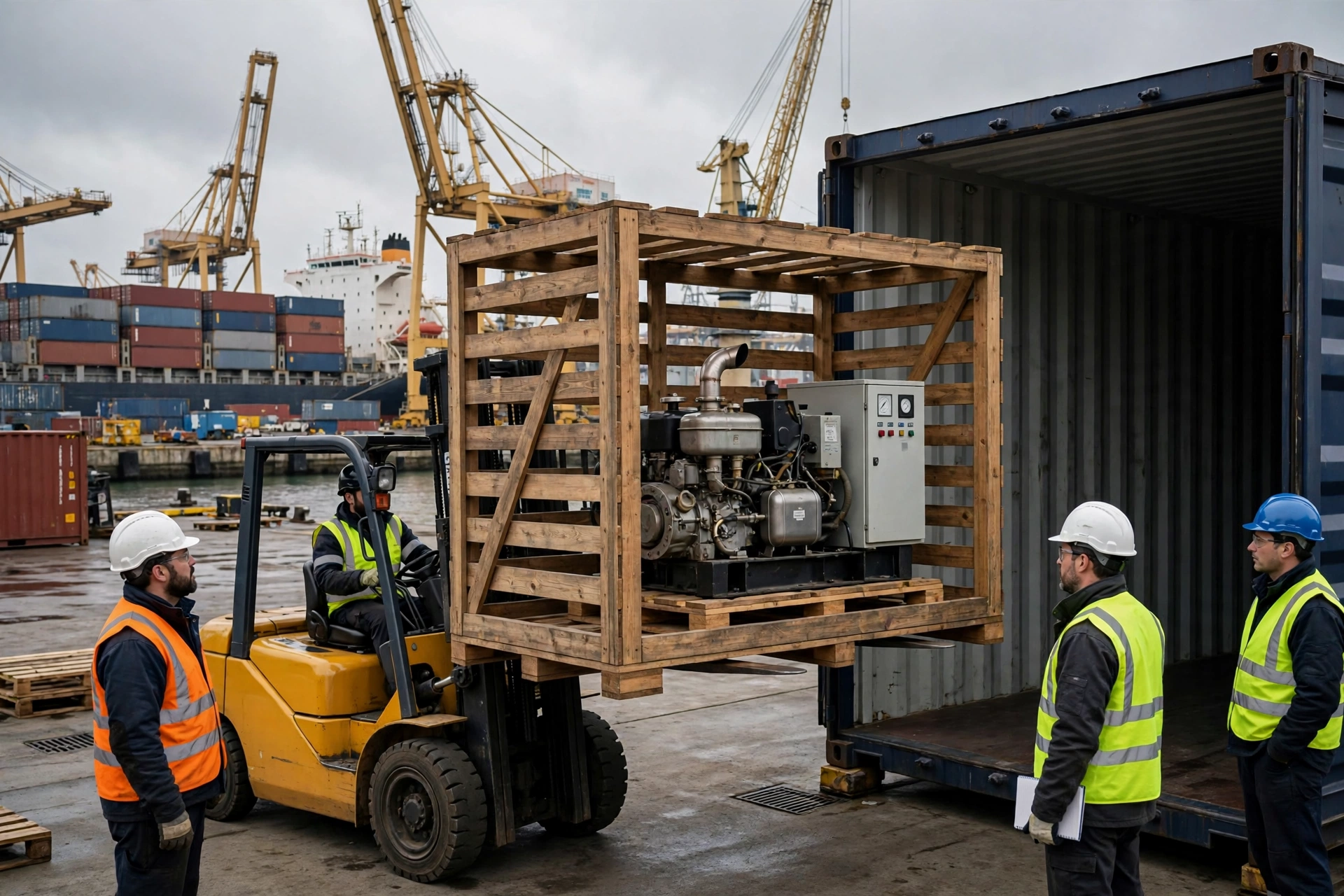
What is FOB vs CIF for a diesel generator? Both are Incoterms 2020 rules that fix where the seller’s responsibility ends and the buyer’s begins — and on a 2,500-kilogram machine in a wooden crate, that point is worth thousands of dollars.
EXW, ex works, leaves everything with the buyer from the factory gate: export clearance, inland transport to the port, ocean freight, insurance, destination clearance. It looks cheapest on the quotation and is the most expensive in practice, because the buyer is arranging freight for a machine he has never shipped, in a country whose export paperwork he has never filed. EXW suits only a buyer with his own freight forwarder already working in China.
FOB, free on board, places the set on the vessel at the load port and hands over risk there. The seller handles export clearance and delivers the crate to the ship. The buyer arranges and pays ocean freight and insurance from that point. FOB is the honest middle: the seller does what the seller is good at — building the set and getting it onto a ship — and the buyer controls the freight leg he can price himself.
CIF, cost insurance and freight, adds ocean freight and marine insurance through to the destination port. The seller arranges the shipment, and the risk transfers when the goods are on board, even though the seller has paid the freight. CIF suits a first-time buyer who wants one price and one responsible party through to his own port. It does not cover destination clearance, port charges, or inland transport from the port to the site — those are still the buyer’s, and on a 40-foot container they commonly add $800 to $2,500 depending on the port.
What CIF Does Not Cover
The most expensive misunderstanding in export generator buying is the belief that CIF means delivered. It does not. A buyer in Mombasa who paid CIF Mombasa still pays port handling, customs duty, VAT, and the truck from the port to the site. A buyer in Lagos who paid CIF Lagos still pays the same, plus the demurrage if clearance takes a week. The quotation should state the named port — CIF Lagos, not CIF — and the buyer should price the destination leg separately before comparing quotations. Two CIF quotations to different ports are not comparable, and a CIF quotation compared against an FOB quotation is a comparison of two different things.
The practical rule: compare FOB against FOB, and CIF against CIF, to the same named port. Then add the destination leg once, from the buyer’s own forwarder, to whichever quotation wins. The guide to shipping a diesel generator overseas covers packing, ISPM 15 crates and container loading in detail.
The Warranty Paragraph That Decides the Next Five Years
What warranty should a diesel generator come with? Twelve months or 1,000 running hours, whichever comes first, is the standard across the export market. It is also the paragraph most buyers read last and regret first, because the duration is the least important part of it.
Four questions decide whether a warranty is worth the paper it is written on. First, what is covered — engine, alternator, controller, canopy, or only the engine? A warranty that covers the engine and excludes the alternator and controller covers the part least likely to fail first. Second, does it include labour and parts, or parts only, with the buyer paying a technician’s travel? On a remote site, the technician’s travel can cost more than the part. Third, where is warranty service performed — at the buyer’s site by a named agent, or at the factory after the buyer ships the set back? A warranty that requires return to China is a warranty the buyer will never use. Fourth, what voids it — and here the rating returns. A standby-rated set run at prime duty, a set run without its scheduled oil changes, a set fitted with non-genuine filters: each is a standard exclusion, and each is reasonable, provided the buyer knew the duty and the service schedule before the deposit was paid.
The warranty should also state the response time: how many days between a claim and a technician on site, or a part dispatched. A warranty with no response time is a warranty with no deadline. And the buyer should ask, in writing, the question that settles the rating issue before the order is placed: “If this set runs at the stated duty, for the stated annual hours, at the stated site conditions, will the warranty remain valid?” A direct answer, with the rating letters attached, is worth more than a 5% discount. A vague answer is a warning.
A note on engine brands, since the warranty question is usually asked alongside it. The choice between Cummins vs Weichai vs Perkins is, in practice, a choice about parts and service in the buyer’s market, not about which engine is better in the abstract. A Cummins with no parts stockist in the buyer’s country is a worse warranty than a Weichai with a dealer two hours away. The warranty paragraph should name the service agent. If it cannot, the buyer has learned something about the next five years.
Frequently Asked Questions
What should a diesel generator quotation include?
A diesel generator quotation should include the rating in letters (ESP, PRP or COP), the engine and alternator by model, the fuel consumption curve, the tank size and runtime, the controller and transfer switch, the test report commitment, the price with the Incoterm named, the delivery time, the payment split, the warranty terms, the spare parts list, the export documents, and a written list of exclusions. Fourteen lines in total. A quotation missing any of them cannot be compared with another supplier’s price.
How much deposit should I pay for a diesel generator?
Around 30% is the common deposit for a standard export order, with the 70% balance paid before shipment against a signed factory test report. Below roughly 20%, most factories will not schedule production, because the deposit buys the engine. Above 50%, the buyer is financing the factory. Larger or first-time orders often use a 100% letter of credit at sight instead, which puts a bank between both parties and ties payment to documents.
What is FOB vs CIF for a diesel generator?
FOB means the seller delivers the set on board the vessel at the load port and the buyer arranges and pays ocean freight and insurance from there. CIF means the seller also pays the ocean freight and marine insurance through to the named destination port, while risk still transfers when the goods are on board. Neither term covers destination clearance, port charges or inland transport to the site, which the buyer must price separately.
How long does it take to build and ship a diesel generator?
A built-to-spec set typically needs 15 to 35 days of works time after the deposit is received and the specification is confirmed, longer for containerised or dual-fuel builds. Ocean freight then adds 15 to 45 days depending on the route — Shanghai to Lagos is typically 30 to 40 days, Shanghai to Mombasa 25 to 35 days. A supplier promising 10 days for a custom 1,000 kVA set is quoting from stock, and the buyer should ask which stock.
What warranty should a diesel generator come with?
A diesel generator should come with 12 months or 1,000 running hours, whichever comes first, covering the engine, alternator and controller, with parts and labour included and service performed at the buyer’s site by a named agent. The warranty should state a response time, and the buyer should confirm in writing that it remains valid at the stated duty, annual hours and site conditions. A warranty that requires the set to be returned to the factory is of little use to an overseas buyer.
Specification Checklist: 14 Lines Before the Deposit
| # | Line | What to demand on the quotation |
|---|---|---|
| 1 | Rating | ESP / PRP / COP in letters, kVA and kW at 0.8 pf, ISO 8528-1 |
| 2 | Engine | Brand and model, e.g. Cummins 6BT5.9-G2, with emission level |
| 3 | Alternator | Brand and model, insulation class H, protection IP23 |
| 4 | Enclosure | Open / silent / containerised, noise dB(A) at stated distance |
| 5 | Fuel curve | L/h at 25%, 50%, 75% and 100% load at the quoted rating |
| 6 | Tank | Litres, and hours at the site’s real load, not brochure load |
| 7 | Controller & ATS | Controller model, ATS included, rating in amps, transition type |
| 8 | Test report | FAT with load steps recorded, copy before the balance is paid |
| 9 | Price & Incoterm | Currency, named term and port, validity 15-30 days |
| 10 | Delivery time | Working days after deposit and confirmed specification |
| 11 | Payment | Deposit %, balance trigger tied to documents, not dates |
| 12 | Warranty | Months and hours, coverage, labour, service agent, response time |
| 13 | Parts & service | First-service parts, stocking list with prices, nearest agent |
| 14 | Documents & exclusions | Export document set, plus a written list of what is NOT included |
A quotation that carries all fourteen lines can be compared with another quotation that carries all fourteen lines, and the cheaper one is then genuinely cheaper. A quotation that carries five lines can be compared with nothing, and the price on it is a number without a meaning. Ask for the fourteen lines, read the rating line before the price line, and pay the deposit only when every line has an answer in writing. For a quotation that meets this standard on a set from 9 to 3750 kVA, contact PAVO — a manufacturer that prices from the buyer’s duty, load and site conditions, not from a kVA figure alone.