

What Size Generator Does a Recycling Plant Need? | PAVO
A sorting line stops in seconds. The bales it was supposed to make that day do not.
What size generator does a recycling plant need? A recycling plant needs a 250–1,000 kVA generator, sized to its sorting lines, shredders and balers rather than to the building. A 10-tonne-per-hour county plant runs on a 250–350 kVA set; a 30–35-tonne-per-hour MRF needs 500–800 kVA; a 70-tonne-per-hour dual-line plant needs 1,000–1,250 kVA.
Contents
- What a Recycling Plant Actually Runs on Power
- Sizing Bands by Plant Throughput
- The Jammed-Line Window: What Happens in the First Minutes
- Three Plants, Three Outages
- Motor Starting: Shredders, Balers and the Surge That Trips a Small Set
- Fuel Autonomy and Placement: How Long, and Where the Set Sits
- Frequently Asked Questions
- Specification Checklist
What a Recycling Plant Actually Runs on Power
A materials recovery facility, or MRF, is a factory that sorts other people’s rubbish at industrial speed. The incoming stream is mixed, wet, heavy and unpredictable. The plant’s job is to turn it into bales of cardboard, PET, HDPE, steel and aluminium that a reprocessor will pay for, plus a residue stream that goes to landfill or energy recovery. Every step of that conversion runs on electricity, and most of it runs on motors that do not tolerate a sag.
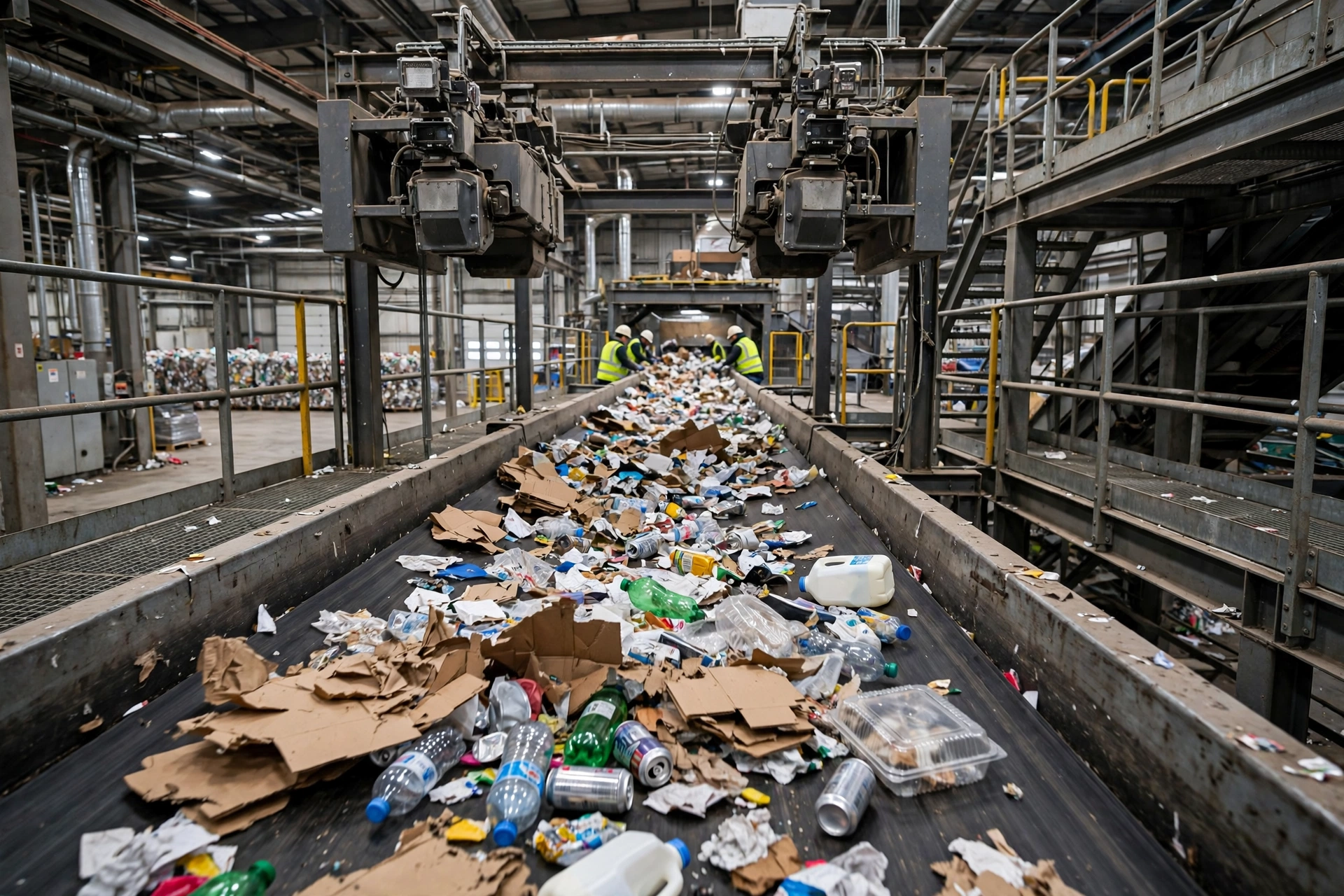
The load is not one machine. It is a chain of machines, and the chain is only as strong as its weakest motor. A 30-tonne-per-hour single-stream line typically carries 150 to 250 motors: infeed conveyors, bag breakers, star screens, ballistic separators, magnets, eddy current separators, optical sorters, picking belts, balers, air handling and dust extraction. The Republic Services Southern Nevada Recycling Center, a 70-tonne-per-hour plant in Las Vegas, wired around 200 electric motors into its two 35-tonne-per-hour lines. Air handling and conveyance together account for 60 to 70 percent of a typical MRF’s electrical draw, according to industry benchmark data compiled by MFG Calcs, so the fans and belts matter as much as the headline machines.
Sorting lines and optical sorters
The sorting line is the plant’s heart. Material arrives on the tipping floor, is pushed into the infeed by a wheel loader, and rides a chain of conveyors through the screens. Star screens separate cardboard from containers. A magnet pulls the steel. An eddy current separator throws aluminium cans off the belt. Optical sorters — near-infrared units such as the TOMRA AUTOSORT — identify PET, HDPE and mixed plastics by polymer type and fire air jets to eject them. Canada Fibers’ Toronto MRF, the largest single-stream plant in North America at 350,000 tonnes a year, runs ten TOMRA optical sorting units on its lines. The FCC Environmental Services MRF in Dallas runs four.
Optical sorters draw modest power individually, typically 3 to 8 kW each including their compressors, but they are the most sensitive load in the building. Their sensor heads and control electronics expect a clean 50 or 60 Hz supply. A voltage dip of 20 percent for half a second is enough to fault a sorter controller and drop its calibration. When a sorter faults mid-run, the line keeps feeding it unsorted material, and every tonne that passes while it is down goes to residue. At a residue rate of 13.7 percent — the average measured across seven US MRFs in 2019 by The Recycling Partnership — a plant already throws away one tonne in seven. A faulted sorter pushes that share higher within minutes.
The manual picking line is the last quality gate. A typical human sorter sustains 30 to 40 picks per minute; top performers reach 45 to 50. Robotic pickers, such as AMP Robotics’ Delta Compact, are rated at up to 65 picks per minute. Pickers work under bright lighting on a belt that never stops, and they stop working the moment the belt stops. Their labour cost does not stop with the belt.
Shredders and balers
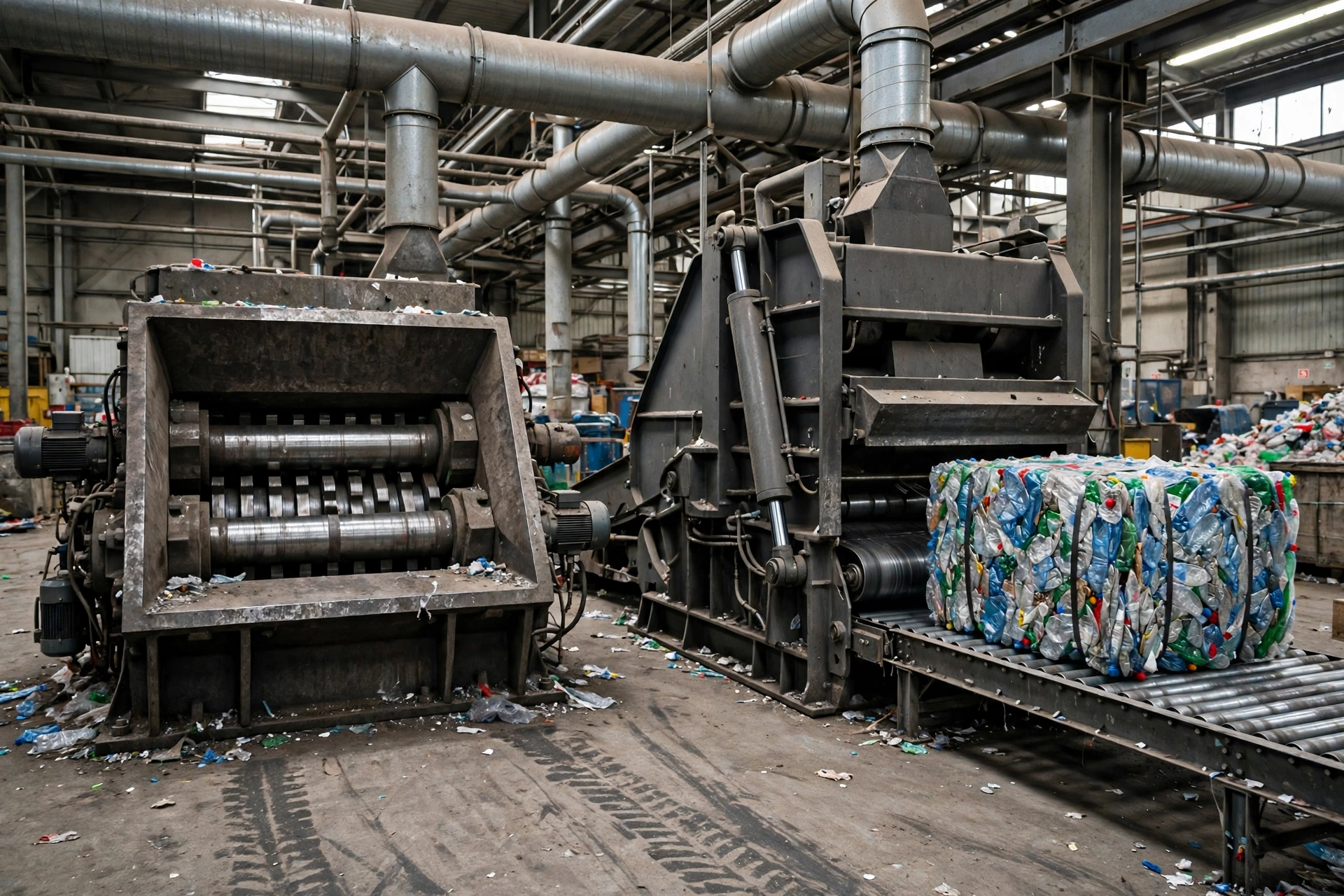
Th
The baler is the plant’s cash register. A horizontal auto-tie baler takes the sorted fractions and presses them into bales that a truck can load. A typical unit carries a 30 to 37 kW hydraulic motor, applies 188 tonnes of nominal ram pressure, and completes a bale in a 45 to 60 second cycle. Bales weigh 300 to 500 kg depending on material. The baler motor is not a steady load: it is loaded hard while the ram advances and unloaded while the cylinder retracts, so it cycles with every bale. The baler is also the machine the plant cannot run without. Sorted material with nowhere to go piles up on the floor, and the line stops within the hour.
Conveyors, air handling and utilities
Between the headline machines sits the bulk of the load. Infeed and transfer conveyors, star-screen drives, air classifiers, dust extraction fans, lighting, the weighbridge, the control room, the fire detection system and the compressed-air plant all draw power at the same time. A 1,000 kg-per-hour PET washing line — the kind a plastics recycler runs behind its shredder — carries a connected motor load of 130 to 220 kW, with the shredder upstream adding another 55 to 110 kW. That is a single processing line, not a whole plant.
The numbers add up fast. A mid-size MRF’s connected load is commonly 600 to 900 kW. Its running load, with the line at full throughput, is 450 to 650 kW. The gap between those two figures is the reason a generator sized to the running load alone will trip on the first shredder restart. Sizing is a motor-starting exercise, not an addition exercise, and the generator sizing guide explains the method step by step.
| Load | Typical drive | Running draw | Starting behaviour |
|---|---|---|---|
| Twin-shaft shredder | 90 kW motor, geared to 5–32 RPM | 55–75 kW | 6–7x locked-rotor current, full hopper |
| Single-shaft shredder | 110 kW motor, 40–80 RPM | 70–95 kW | 5–6x locked-rotor current |
| Horizontal auto-tie baler | 30–37 kW hydraulic pump motor | 18–30 kW, cycling | 5–6x on ram start |
| Optical sorter (each) | 3–8 kW incl. compressor | 3–6 kW | Sensitive to voltage dip, faults below −20% |
| Star screens (set of 3) | 3 x 11–15 kW | 25–35 kW | 5x, staggered starts |
| Conveyors and air handling | 150–250 kW total | 120–200 kW | VFD soft starts, 1.5–2x |
| Picking line, lighting, controls | 40–60 kW | 35–50 kW | Steady |
| Compressed air plant | 30–55 kW | 25–45 kW | 4–5x on compressor start |
Sizing Bands by Plant Throughput
The honest way to size a recycling-plant generator is to start from throughput, because throughput fixes the line, and the line fixes the load. The table below gives bands that hold for single-stream municipal MRFs. A plastics-washing plant, a construction-and-demolition plant or a metals shredder will differ in detail, but the banding logic is the same: find the largest motor, add the running load, then check the starting surge.
| Plant class | Throughput | Running load | Generator set | Fuel at 75% load |
|---|---|---|---|---|
| County / small MRF | 5–10 tph | 120–200 kW | 250–350 kVA | 45–55 L/h |
| Mid-size single-stream MRF | 15–25 tph | 300–450 kW | 500–650 kVA | 70–90 L/h |
| Large single-stream MRF | 30–40 tph | 450–650 kW | 750–1,000 kVA | 95–130 L/h |
| Dual-line mega MRF | 60–80 tph | 800–1,100 kW | 1,250–1,500 kVA | 160–200 L/h |
These are standby ratings for a set that carries the plant through an outage, not prime ratings for a set that runs every day. The distinction matters: a standby set is rated for a limited number of hours a year at varying load, while a prime set is rated for unlimited hours. The standby and prime ratings article sets out the difference, and the 10 percent overload rule that applies to prime sets. A plant that loses grid power three times a year for four hours at a time is a standby application. A plant in a region where the grid fails weekly is a prime application, and it needs a larger, differently rated set.
Small county MRF: 5–10 tonnes per hour
A county plant processing 5 to 10 tonnes per hour typically runs one short sorting line, a single optical sorter or none at all, a 45 kW twin-shaft shredder and one 30 kW baler. Its running load sits at 120 to 200 kW. A 250 to 350 kVA set covers it, provided the shredder is started on a soft starter or a variable-frequency drive. Without a soft starter, the shredder’s locked-rotor current alone can pull a 250 kVA alternator down by 25 percent, and the optical sorter — if the plant has one — will fault. The set for this class of plant usually sits in a silent canopy at the back of the yard, fuelled from its own sub-base tank, and tested weekly under load. The capital cost is modest: a 300 kVA silent set with an automatic transfer switch typically lands at $35,000 to $55,000 installed, depending on the market and the switchgear.
Mid-size single-stream MRF: 15–25 tonnes per hour
This is the most common plant size in the industry. A 20-tonne-per-hour line carries a bag breaker, two or three star screens, a magnet, an eddy current separator, two or three optical sorters, a picking belt with six to ten sorters, a 90 kW shredder and two balers — one for fibre, one for containers. Running load is 300 to 450 kW. A 500 to 650 kVA set is the right band, and the Cummins C500D5 — 500 kVA standby, 455 kVA prime — is a common choice at this size, burning 69.9 litres per hour at 75 percent load and 93.2 litres per hour at full load.
At this size the starting sequence becomes a design exercise rather than a guess. The screens start first, then the conveyors, then the optical sorters, then the balers, and the shredder last, with 10 to 15 seconds between steps. A Deep Sea controller with a staged-start sequence handles this automatically. The alternative — starting everything at once — is how a 500 kVA set ends up tripping on a 400 kW load.
Large and dual-line MRF: 30–80 tonnes per hour
A 30 to 35-tonne-per-hour line, like the FCC Dallas plant or the Monterey Regional Waste Management District’s 80-tonne-per-hour facility in California, carries four or more optical sorters, two shredders and two or three balers, and its running load is 450 to 650 kW. The Monterey plant, a $24 million build on 100,000 square feet, runs two lines: a 30-tonne-per-hour single-stream line and a 40-tonne-per-hour construction-and-demolition line, with a PAAL Konti baler at the end of the fibre line. A plant of this size needs 750 to 1,000 kVA, and the largest plants — the 70-tonne-per-hour Southern Nevada centre, with its dual 35-tonne-per-hour lines and 265,000 tonnes a year of capacity — need 1,250 to 1,500 kVA, usually as two paralleled sets rather than one very large one. Two sets give the plant a half-capacity fallback if one set fails, and they let the plant run one set at efficient load on a quiet day.
The Jammed-Line Window: What Happens in the First Minutes
A recycling plant does not fail gracefully when the power goes out. It fails in the middle of a process, with material in every machine, and the damage is measured in the minutes it takes to get the line moving again. The first ten seconds belong to the automatic transfer switch: it senses the loss of mains, starts the generator, and transfers the load. The NFPA 110 10-second rule sets the standard for life-safety loads, and a recycling plant’s safety systems — fire detection, emergency lighting, the baler e-stop circuit — sit in the same class. The plant’s production load, however, does not restart in ten seconds. It restarts in the sequence the operator commands, and that sequence takes 20 to 40 minutes.
The shredder stalls with a full hopper
The shredder is the first machine to suffer and the last to recover. When power fails, the shredder’s twin shafts stop with the hopper full of mixed waste: cardboard, plastic film, a length of strapping, a piece of timber. The material settles and locks between the cutters. Restarting a shredder with a full hopper is the hardest start in the plant. The motor must break the locked material free before it can reach speed, and a direct-on-line start will draw locked-rotor current for several seconds. If the generator is too small, the voltage dips, the shredder’s protection trips, and the operator’s only option is to open the hopper and clear it by hand — a 30 to 60 minute job that puts a worker inside a machine that has just been under load.
Plants that have lived through this fit a hydraulic reverse on the shredder and a soft starter on its motor. The reverse backs the shafts out of the jam; the soft starter ramps the current over 10 to 15 seconds instead of slamming it on. Both are cheap compared with a second outage. Neither helps if the generator cannot hold voltage during the ramp.
The baler blocks and the floor fills
The baler is the second casualty. When the baler stops mid-cycle, the ram sits wherever it was: half-advanced, with a half-formed bale in the chamber and sorted material still arriving on the infeed conveyor. The line behind it does not stop feeding instantly. The picking belt keeps delivering fibre for the 30 to 60 seconds it takes the conveyors to run clear, and that material lands on the floor at the baler infeed. A 30-tonne-per-hour line moves 500 kg a minute. Five minutes of stopped baler is 2.5 tonnes of loose cardboard on the floor, and loose cardboard is a fire load.
Restarting the baler is not a matter of pressing a button. The operator must retract the ram, clear the chamber, re-tie the bale wire, and restart the tying cycle. That takes 15 to 25 minutes on a clean stop and longer if the bale has jammed in the chamber. During that time the sorting line cannot run, because it has nowhere to send its output. The baler is the plant’s bottleneck in the most literal sense: the whole factory waits for one hydraulic cylinder.
Optical sorters and controls lose calibration
Optical sorters are the most expensive casualty of a short outage, because their damage is invisible. A sorter that loses power mid-scan drops its calibration and its valve timing. When power returns, it runs — but it runs blind until it is re-calibrated, and re-calibration takes a trained technician and 20 to 40 minutes per unit. A plant with four sorters, like the Dallas MRF, can lose two hours of accurate sorting to a 30-second outage if the sorters are restarted without calibration. During those two hours, PET goes into the HDPE bale and HDPE goes into the residue, and the bale purity that the plant sells on — 92 to 94 percent for PET at a typical plant, 96 to 98 percent at a world-class one — falls below the grade the buyer specified. A downgraded bale is worth 20 to 40 percent less, and a rejected bale is worth the cost of re-sorting it.
The control system suffers the same way. A modern MRF runs on a SCADA system with a PLC at every machine. A hard power cut can corrupt a PLC’s running program or leave a conveyor’s drive in a fault state that needs a manual reset at the panel. Plants that protect their controls with a small UPS — even a 3 kVA unit on the control circuit — restart in minutes instead of hours. The UPS is not there to run the plant. It is there to let the plant shut down cleanly and start up cleanly.
The battery-fire risk that an outage makes worse
There is one risk in a recycling plant that an outage makes actively worse, and it is the fastest-growing one in the industry. Lithium-ion batteries arrive in the waste stream hidden inside vapes, phones, laptops, e-bike packs and power tools. When a battery is crushed in a shredder or a baler, it can go into thermal runaway: a self-sustaining fire that reaches 600°C and cannot be put out with water.
The numbers are stark. Battery fires in UK bin lorries and waste sites reached more than 1,200 in 2023–24, a 71 percent increase from about 700 in 2022, according to the National Fire Chiefs Council. A later estimate by Material Focus and the consultancy Eunomia put the figure at 2,839 fires in the most recent year, at an annual cost of £2.37 billion. The Environmental Services Association reported 1,518 fires at its members’ sites in the year to March 2026, at least 541 of them directly attributed to lithium-ion batteries, with a further 216 battery fires in bin lorries. Battery fires at recycling centres now run at more than ten a week in the UK. Insurer Zurich UK has seen individual claims reach £20 million.
An outage does not cause these fires, but it strips away the plant’s defences against them. The dust extraction fans stop, so the air in the sorting hall stagnates. The fire detection system runs on battery backup for a limited time. The water-mist suppression system needs pump power. A battery that starts smouldering in a shredder hopper during an outage is discovered later, by a worker with a torch, instead of sooner, by a detector. That is why the fire system, the extraction fans and the emergency lighting belong on the generator’s first-priority circuit, ahead of production. A plant that protects its baler before its fire pump has its priorities backwards.
Three Plants, Three Outages
The following three cases are worked examples built from real plant specifications — the FCC Dallas MRF, the Southern Nevada Recycling Center and a typical UK county MRF — with the outage figures calculated from their published throughputs and loads. They show how the same 30-minute grid failure costs three very different amounts, and why the generator decision is a business decision, not an engineering one.
Case 1: A 35-tonne-per-hour single-stream MRF in Texas
The plant is modelled on the FCC Dallas facility: a 60,000-square-foot building, a 30 to 35-tonne-per-hour single-stream line, four TOMRA AUTOSORT 4 optical sorters, a Bollegraaf HBC-120S baler, and a running load of about 480 kW. The plant runs two shifts, six days a week, and processes roughly 700 tonnes a day.
A grid failure at 10:00 on a Tuesday stops the line with 12 tonnes of material in it. The automatic transfer switch starts the plant’s 750 kVA set in 10 seconds, but the staged restart — screens, conveyors, sorters, balers, shredder — takes 35 minutes, and the optical sorters need a further 40 minutes of re-calibration. Total lost production is 75 minutes, or about 44 tonnes of throughput. At a tipping fee of $75 a tonne and commodity revenue of roughly $40 a tonne, the lost intake is about $5,000, before the cost of diverting two collection trucks to a competitor’s plant at $400 a load. The generator burns about 110 litres of diesel an hour at 75 percent load; the outage costs the plant roughly $400 in fuel. The ratio is the point: $400 of diesel protects $5,000 of revenue an hour.
Case 2: A 70-tonne-per-hour dual-line plant in Nevada
The plant is modelled on the Southern Nevada Recycling Center: 110,000 square feet, a $35 million build, dual 35-tonne-per-hour lines, five optical sorters, around 200 motors, and 265,000 tonnes a year of capacity. Its running load is close to 950 kW, and it runs on two paralleled 750 kVA sets.
A grid failure here is a two-line event. The plant’s load-shedding logic drops one line entirely and runs the other at reduced speed on a single 750 kVA set, keeping the balers, the fire system and the controls alive. The second line’s material — about 20 tonnes — sits in its conveyors and screens and must be cleared by hand before that line restarts. The plant loses 90 minutes on one line and four hours on the other, or about 160 tonnes of throughput. The parallel-set design is what saves the day: a single 1,500 kVA set would have left the plant with nothing if it failed to start, while two sets give the plant a half-capacity fallback. The fuel bill for the outage is about 300 litres an hour across the two sets. The plant’s insurance premium, which fell by 12 percent after the parallel sets were installed, pays for the second set’s maintenance in under three years.
Case 3: A 10-tonne-per-hour county MRF in the UK
The plant is a county facility processing 10 tonnes an hour on a single short line, with one optical sorter, a 45 kW shredder, one 30 kW baler and a running load of 160 kW. It runs on a 250 kVA silent-canopy set, and its grid supply is a rural overhead line that fails three or four times a year, usually in a storm.
A storm outage at 14:00 on a Friday stops the line with the week’s last 40 tonnes still to process. The plant has no parallel set and no UPS on its sorter controller. The restart takes 50 minutes, and the sorter needs re-calibration that the plant’s single technician cannot do until Monday. The plant runs the weekend on manual picking only, at half its normal recovery rate, and its residue rate rises from 13 percent to over 20 percent for two days. The direct cost is about £3,000 in lost commodity revenue and diverted loads. The indirect cost is worse: the county council, which contracts the plant, records the missed tonnage against the plant’s service-level agreement. A £2,500 UPS on the control circuit and a £4,000 soft starter on the shredder would have cut the restart to 15 minutes. The plant ordered both the following week.
Motor Starting: Shredders, Balers and the Surge That Trips a Small Set
Motor starting is where recycling-plant generator sizing is won or lost. A recycling plant’s motors are large, numerous and badly behaved on start-up, and the alternator that feeds them is the component that pays for every mistake. The rule is simple: a motor’s locked-rotor current is five to seven times its running current, and the alternator’s voltage dips in proportion to the current it is asked to supply. A dip of more than 20 percent will fault an optical sorter, drop a PLC, and trip a contactor. A dip of more than 30 percent will stall the motor that caused it.
The shredder is the worst case. A 90 kW twin-shaft shredder with a full hopper draws roughly 550 amps at 400 V on a direct-on-line start, against a running current of about 160 amps. That starting current is a 380 kVA demand from the alternator, before any other load is counted. A 500 kVA set can supply it — but only if nothing else is starting at the same time, and only if the alternator’s subtransient reactance is low enough to hold the voltage. The practical answer is a soft starter or a variable-frequency drive on the shredder, which cuts the starting current to two to three times running current and stretches the start over 10 to 15 seconds. The cost is $3,000 to $8,000, and it is the cheapest generator capacity a plant will ever buy.
The shredder’s locked-rotor start
A shredder’s starting current depends on what is in the hopper. An empty hopper starts cleanly. A hopper full of wet cardboard and strapping starts like a locked rotor. The difference is 30 to 40 percent of starting current, and it is the reason a generator that passed its commissioning test on an empty hopper can trip on a real outage. The test that matters is a restart with the hopper full, after a 30-minute stop, with the material settled. Plants that write this test into their commissioning checklist — and repeat it at the annual service — do not get surprised. The commissioning article on this site sets out what a proper factory acceptance test looks like, and the same logic applies on site.
The baler pump’s hydraulic cycle
The baler’s hydraulic pump motor starts under load every time the ram advances, and its current rises with the pressure in the cylinder. A 37 kW pump motor draws about 200 amps at 400 V on start, against 65 amps running. Two balers starting together — fibre and containers — draw 400 amps before the shredder has even been considered. The answer is sequencing: start the fibre baler, wait 10 seconds, start the container baler, wait 10 seconds, then start the shredder. A Deep Sea controller with a staged-start program does this automatically, and it is the single most valuable feature on a recycling-plant generator. The alternative is a written procedure taped to the control panel, which works until the one operator who knows the procedure is on holiday.
Sorters, VFDs and the harmonics question
Optical sorters, VFD-driven conveyors and the plant’s compressed-air system all draw non-linear current, and non-linear current creates harmonics. Harmonics heat an alternator’s windings and distort its voltage waveform, and a waveform that is already distorted by a shredder start becomes worse. The rule used in the industry is to oversize the alternator by a factor of 2.5 to 3 relative to the non-linear load, or to fit a permanent-magnet generator excitation system that holds voltage better under distortion. The harmonics article on this site explains the mechanism in full. For a recycling plant, the practical check is simple: if the plant’s VFDs and sorters add up to more than 100 kW, the alternator needs to be one frame size larger than the engine rating suggests.
Fuel Autonomy and Placement: How Long, and Where the Set Sits
A generator that runs out of fuel during an outage is worse than no generator at all, because the plant has already committed to running on it. Fuel autonomy is a calculation, not a guess: take the set’s fuel consumption at the plant’s real load, multiply by the hours the plant needs, and add a margin for the fuel that is already in the tank.
| Set size | Load | Fuel at 75% load | 8 hours | 24 hours | 72 hours |
|---|---|---|---|---|---|
| 350 kVA | 200 kW | 52 L/h | 416 L | 1,250 L | 3,740 L |
| 500 kVA (C500D5) | 340 kW | 69.9 L/h | 560 L | 1,680 L | 5,030 L |
| 800 kVA | 550 kW | 105 L/h | 840 L | 2,520 L | 7,560 L |
| 1,000 kVA | 700 kW | 130 L/h | 1,040 L | 3,120 L | 9,360 L |
The Cummins C500D5 figures are from the manufacturer’s datasheet: 93.2 litres per hour at full load, 69.9 at 75 percent, 49.0 at 50 percent and 29.2 at 25 percent. At $1.20 a litre, a 500 kVA set running a mid-size MRF through a 24-hour outage costs about $2,000 in fuel. The same outage without a generator costs the plant $5,000 an hour in lost intake. Fuel is not the constraint. Tank size is.
Eight, 24 and 72 hours
Eight hours covers the common case: a storm, a substation fault, a cable strike. A 500 kVA set needs 560 litres for eight hours, which fits in the set’s own sub-base tank. Twenty-four hours covers a serious failure — a transformer fire, a flood — and needs 1,680 litres, which means a bulk tank beside the set. Seventy-two hours is the standard for plants that cannot stop: a plant that holds a municipal collection contract with penalty clauses, or a plant whose tipping floor is full and whose collection trucks have nowhere else to go. Seventy-two hours on a 500 kVA set needs just over 5,000 litres, and that is a tank that needs its own bund, its own planning permission and its own delivery schedule. The bunding article on this site sets out the secondary-containment rules in numbers.
The mistake plants make is to size the tank to the set and forget the fuel that is already in it. A sub-base tank that holds 800 litres is a 24-hour tank only if it is full. A plant that tests its generator weekly on a no-load run burns 30 litres a test and never tops the tank up will find 400 litres in it when the outage comes. The fuel-level gauge belongs on the same daily walk-round as the baler wire and the screen cleanout.
Dust, fire risk and where the set sits
A recycling plant is a dusty, corrosive place to put a generator. Paper dust, plastic film and fine glass dust get into everything: radiator fins, air filters, alternator windings, control panels. A set installed inside the sorting hall will have its radiator blocked within a month and its air filter choked within a week. The set belongs outside the hall, in a silent canopy, upwind of the tipping floor and at least 5 metres from the building — further if the local fire code requires it. The canopy needs its own ventilation: a 500 kVA set rejects about 350 kW of heat at full load, and a canopy that cannot shed that heat will derate the set by 10 to 15 percent on a hot day.
The dust is also a fire risk, and the lithium-battery fire figures make the point. A generator’s exhaust runs at 400 to 500°C. A set installed downwind of the tipping floor, with its exhaust pointing at a pile of loose cardboard, is a fire waiting for a windy day. The exhaust must point away from the building and away from stored bales, and the set’s own fuel tank must sit in a bund that holds 110 percent of its volume. The fire-protection article on this site covers generator-room suppression and separation in detail, and its 2-hour fire-separation rule applies to a recycling plant’s generator housing as much as to any other.
Fuel ageing in a set that rarely runs
A standby set at a recycling plant may run 50 hours a year. Its fuel sits in the tank for months, and diesel fuel ages. Water condenses in the tank, microbes grow at the fuel-water interface, and the fuel that was clean in January is a black sludge by September. The plant’s maintenance schedule should include a fuel test every six months and a fuel-polish every 12 to 18 months. The slow failure of diesel fuel ageing works like this: the set starts fine on its weekly test, because the test draws fuel from the top of the tank, and then fails on the first real outage, because the outage draws fuel from the bottom, where the water and the sludge live. The fuel-ageing article explains the mechanism and the test regime. The cost of a fuel polish is $800 to $1,500. The cost of a failed start is the plant’s whole day.
Frequently Asked Questions
What size generator does a recycling plant need?
A recycling plant needs a 250–1,000 kVA generator, sized to its sorting lines, shredders and balers rather than to the building. A 10-tonne-per-hour county plant runs on a 250–350 kVA set, a 30–35-tonne-per-hour single-stream MRF needs 500–800 kVA, and a 70-tonne-per-hour dual-line plant needs 1,000–1,250 kVA. The shredder’s locked-rotor start, not the running load, is the number that decides the set size.
Do recycling plants need a backup generator?
Yes. A recycling plant is a continuous process: the moment the power fails, the sorting line stops with material in every machine, the baler blocks, and the optical sorters lose calibration. A 30-minute outage costs a 35-tonne-per-hour plant about 44 tonnes of throughput and roughly $5,000 in lost intake, while the generator that prevents it burns about $400 of diesel. Plants that hold municipal collection contracts, or that run a tipping floor with no alternative outlet, need a generator as a condition of the contract, not as an option.
How long can a recycling plant run on a generator?
A recycling plant can run on a generator for as long as its fuel lasts: 8 hours on a sub-base tank, 24 hours on a bulk tank, and 72 hours on a 5,000-litre tank for a 500 kVA set. The practical limit is fuel delivery, not the generator — a standby set is rated for hundreds of hours a year, and a plant that loses grid power for three days needs a fuel supplier that can deliver through the same storm that caused the outage. A 72-hour fuel plan, agreed in writing with the supplier, is part of the specification, not an afterthought.
What happens to a recycling plant during a power outage?
The sorting line stops with material in every machine. The shredder stalls with a full hopper and needs a soft-started, sequenced restart. The baler blocks mid-cycle and the line behind it piles loose material on the floor. The optical sorters lose calibration and need 20 to 40 minutes each to re-calibrate. The fire detection and dust extraction systems fall back to battery backup. A plant with a staged-start generator restarts in 20 to 40 minutes; a plant without one can lose half a day.
Can a diesel generator power a recycling plant?
Yes. A diesel generator is the standard backup power source for recycling plants, because the load is a mix of large motors and sensitive electronics that a diesel set handles well with the right alternator and starting sequence. The set must be sized to the shredder’s locked-rotor current, fitted with a staged-start controller, and protected against the plant’s dust. A 500 kVA set covers a mid-size MRF; a 1,250–1,500 kVA parallel pair covers a dual-line mega plant.
Specification Checklist
- Throughput and running load. Record the plant’s tonnes per hour, its running load in kW and its connected load in kW, measured on the line at full throughput, not from the nameplates.
- Largest motor and starting method. Name the largest motor — usually the shredder — and fit a soft starter or VFD. Test the restart with the hopper full.
- Set size and rating. Size the set to the starting surge, not the running load. Confirm standby or prime rating with the supplier, and confirm the 10 percent overload rule does not apply to a standby set.
- Staged-start controller. Specify a Deep Sea controller with a staged-start sequence: screens, conveyors, sorters, balers, shredder last, 10 to 15 seconds between steps.
- UPS on the control circuit. Fit a 3 kVA UPS on the sorter controllers, PLCs and SCADA, so the plant shuts down cleanly and restarts without re-calibration.
- Fuel autonomy. Specify 8, 24 or 72 hours in writing, with the tank size to match, and agree a 72-hour fuel-delivery plan with the supplier.
- Fire systems on the first circuit. Put fire detection, dust extraction, emergency lighting and the suppression pumps on the generator’s first-priority circuit, ahead of production.
- Placement and dust. Install the set outside the sorting hall, in a silent canopy, upwind of the tipping floor, with the exhaust pointing away from stored bales and a bunded fuel tank.
- Fuel testing and maintenance. Test the fuel every six months, polish it every 12 to 18 months, and run the set under load every week. Record the fuel level on the daily walk-round.
A recycling plant’s generator is not a purchase. It is the difference between a 30-minute outage and a lost day, between a bale that meets its grade and a bale that gets rejected, between a battery fire that the detectors catch and one that a worker finds with a torch. The set that does that job is sized to the shredder, started in stages, fuelled for the outage the plant actually faces, and placed where the plant’s dust and fire risk cannot reach it. The generator sizing guide sets out the sizing method, the motor starting article covers the surge in detail, and paper mills, warehouses and water and wastewater treatment plants face the same load-tier logic with different machines. For a set sized to a real plant, with a real load list and a real fuel plan, contact PAVO.