

What Size Generator Does a Warehouse Need? Guide | PAVO
A warehouse does not stop when the lights go out. It stops when the conveyors stop — and in a fulfilment centre, that is the same minute the orders stop leaving the dock.
What size generator does a warehouse need? A small storage warehouse typically needs 60–100 kVA, a mid-size distribution centre 150–400 kVA, and a large automated fulfilment centre 500–1,500 kVA, sized from conveyor and automation starting loads rather than floor area alone. The motor starting surge, not the running load, decides the figure.
Contents
- What a Warehouse Actually Runs on Generator Power
- Sizing Bands by Warehouse Type
- The Starting Problem: Conveyor Motors, ASRS Cranes and Sorters
- Three Outages, Three Outcomes
- Fuel Autonomy: How Long the Warehouse Really Keeps Trading
- Noise, Placement and the Neighbours
- Frequently Asked Questions
- Specification Checklist: Seven Lines Before the Deposit
What a Warehouse Actually Runs on Generator Power
A warehouse is not one load. It is three systems that happen to share a roof: the material-handling system, the building system and the information system. The material-handling system moves product — conveyors, sorters, automated storage and retrieval (ASRS) cranes, dock levellers, roller doors and forklift chargers. The building system keeps the shell usable — lighting, heating and ventilation, fire alarm and sprinkler pumps, security and CCTV. The information system keeps the orders flowing — the warehouse management system (WMS) servers, the network, barcode scanners, label printers and the Wi-Fi that every handheld terminal depends on.
A generator specification that treats the warehouse as a single number — floor area multiplied by watts per square metre — misses the point. The three systems fail at different speeds, and the set has to be sized for the load that matters most at the moment the grid fails, not for the average load across a quiet Sunday. A 10,000 m² distribution centre may draw 180 kW at its afternoon peak and 45 kW at 3 a.m., when only the WMS servers, the security system and a handful of lights are running. The generator that protects the afternoon peak is three times the size of the one that protects the night shift. Which one the buyer pays for depends on what the warehouse promises its customers.
The honest way to size the set is to sort every load into three tiers before any kVA figure is discussed. Tier 1 must stay on: WMS servers and network, emergency lighting, fire alarm and detection, security and CCTV, and the dock door and leveller controls that let a truck leave. Tier 2 keeps the warehouse trading: conveyors, sorters, ASRS cranes, dock doors, packing lines and the HVAC that keeps staff working. Tier 3 can wait: office air conditioning, non-essential lighting, electric vehicle charging, forklift battery charging bays and the staff canteen. Most warehouses that buy a generator protect Tiers 1 and 2 and shed Tier 3 automatically on transfer. The generator sizing guide works through the same load-list method for any industrial site, and the arithmetic is identical here: add the running loads, then add the starting surge of the largest motors, then add a margin.
Automation and Conveyors
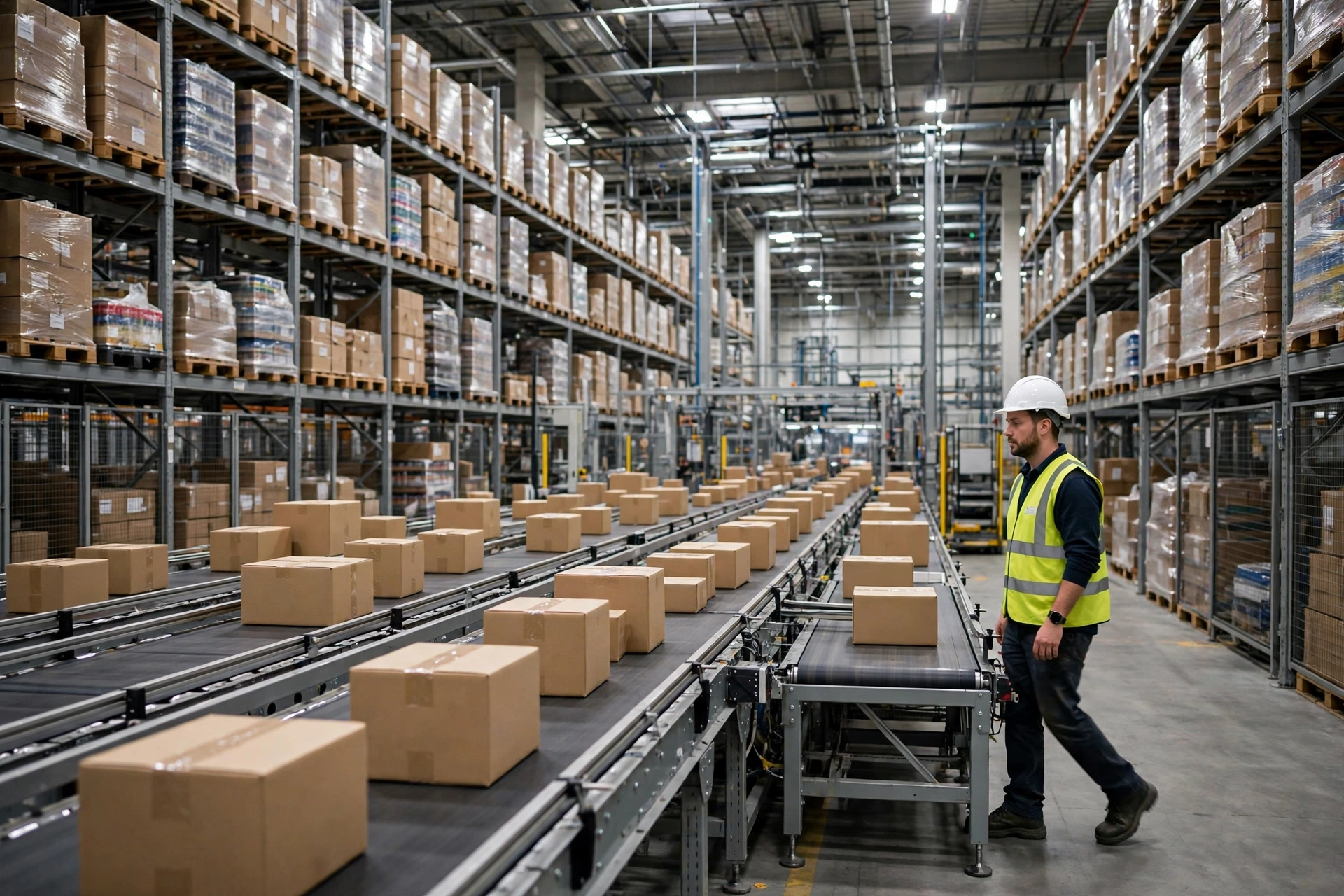
Automation is what changed warehouse backup power in the last ten years. A manual warehouse is mostly lighting, a few dock doors and a forklift charger. An automated fulfilment centre is a factory that happens to store boxes: kilometres of powered conveyor, loop sorters with dozens of induction motors, ASRS cranes running on rails 30 metres up, robotic picking arms and autonomous mobile robots returning to charge points. A single cross-belt sorter line can carry 40–60 kW of installed motor power. A six-aisle ASRS installation adds 90–150 kW. The motors are not large individually — most conveyor drives are 2.2–7.5 kW — but there are hundreds of them, and they restart together when power returns.
Dock Operations
The dock is where an outage turns into a queue of trucks. A distribution centre with 20 dock doors runs 20 dock levellers, 20 roller doors and 20 sets of dock lights, plus the yard lighting and the gate. None of these loads is large — a leveller motor is typically 1.1–1.5 kW — but a dock that cannot open a door cannot load a truck, and a truck that cannot load misses its departure slot. In a 3PL operation running timed departures every 30 minutes, one missed slot cascades into the next. Dock loads belong on the generator, but they belong in Tier 2, behind the WMS and the fire systems, because a door that opens an hour late costs less than a server room that loses its data.
WMS, IT and Lighting
The information system is the smallest electrical load in the building and the most expensive one to lose. A WMS server rack and its network draw 3–8 kW — less than a single conveyor drive — but without them, the warehouse does not know where anything is. Pickers stand still, scanners show nothing, and the outbound queue stops even though the conveyors have power. Every warehouse generator specification should put the server room on a UPS first and on the generator second, with the automatic transfer switch closing the gap between the two. The UPS covers the ten seconds the generator needs to start; the generator covers the hours the outage lasts. Lighting is the other small load with an outsized effect: LED high-bay lighting across a 10,000 m² warehouse draws 25–40 kW, and a dark warehouse is a warehouse that cannot be worked in safely, whatever the conveyors are doing.
Sizing Bands by Warehouse Type
The table below gives sizing bands that buyers can use as a starting point. They are bands, not quotations: two warehouses of the same floor area can need sets two sizes apart, because one runs manual picking and the other runs a fully automated sortation hall. The bands come from the indicative 60–500 kVA range published for warehouses and logistics sites by UK generator suppliers, cross-checked against the motor loads in the sections above.
| Warehouse type | Typical floor area | What the generator carries | Sizing band |
|---|---|---|---|
| Small storage warehouse | 2,000–5,000 m² | Lighting, dock doors, WMS servers, security, small office | 60–100 kVA |
| Mid-size distribution centre | 5,000–20,000 m² | Conveyors, sortation, packing lines, dock operations, HVAC | 150–400 kVA |
| Large automated fulfilment centre | 20,000–50,000 m² | ASRS cranes, loop sorters, robotics charging, full dock | 500–1,500 kVA |
| Cold-storage cross-dock | 3,000–15,000 m² | Refrigeration compressors, dock doors, blast chillers | 200–500 kVA |
| 3PL multi-client hub | 10,000–40,000 m² | Mixed automation, multiple dock banks, office and IT | 400–1,000 kVA |
A 3PL hub is the hardest case to size, because the load changes with the client mix. A hub that handles fashion in the morning and grocery in the afternoon runs two different load profiles in one day, and the generator has to cover the heavier one. The practical answer for large sites is paralleling: two or three sets that share the load, so the site can run one set at night and all of them at the afternoon peak. A logistics hub in Riyadh, documented by the sizing contractor, measured a 600 kW peak across conveyors and refrigeration and installed two synchronised 400 kVA sets with 20% redundancy — zero downtime across two unexpected shutdowns, and a 16% fuel saving against the single oversized set originally proposed. Paralleling costs more in switchgear and controls, and it pays that cost back in fuel and in the ability to keep trading when one set is down for service.
Standby or Prime — the Rating That Sets the Hours
Most warehouse sets are standby rated, because the grid is the normal supply and the generator runs only during outages and tests. Standby and prime ratings are not marketing labels; they are different duty definitions. A standby set is designed for a limited number of hours a year at varying load, typically with a 10% overload allowance for one hour in twelve. A prime set is designed to run unlimited hours at varying load, with a lower rating for the same engine. A warehouse that loses the grid for 200 hours a year is well inside standby duty. A warehouse on an unreliable grid — a site in a region where outages run to 1,000 hours a year, or a remote logistics park with no grid connection at all — needs a prime-rated set, and the same engine will carry roughly 10% less on its prime rating. The rating decision is made before the kVA figure, not after it, because a 500 kVA standby set and a 500 kVA prime set are different machines at different prices.
The Starting Problem: Conveyor Motors, ASRS Cranes and Sorters
Warehouse sizing goes wrong in one place more than any other: the starting surge. An induction motor draws 5–7 times its running current for the first few hundred milliseconds after switch-on, while its rotor accelerates from standstill. A 7.5 kW conveyor drive that draws 14 A running can demand 90 A at start. One motor is a footnote. Fifty conveyor drives restarting together after a transfer is a voltage dip that trips the UPS, stalls the ASRS cranes and drops the generator’s frequency low enough for the WMS servers to reboot.
The running load of a mid-size distribution centre might be 180 kW. The starting load, if every conveyor and sorter motor restarts in the same second, can exceed 600 kVA for a fraction of a second. The generator does not have to deliver that current for long — the surge decays in under a second — but it has to deliver it without the voltage falling more than 15–20%, the limit most motor starters and UPS units will tolerate. That is why warehouse sets are sized on starting kVA, not running kW, and why a set that looks oversized on paper is often exactly right on site.
The Simultaneous-Restart Trap
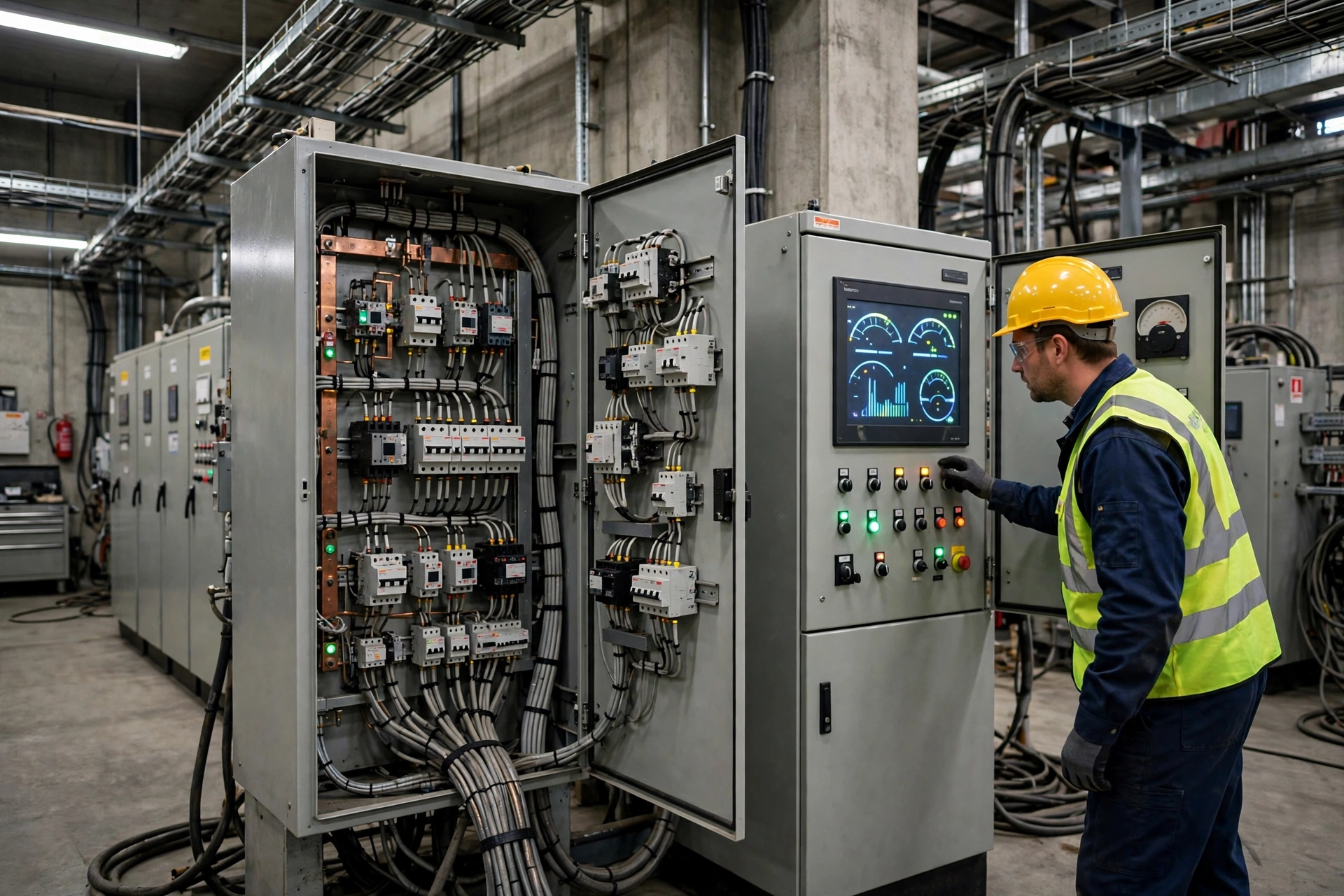
The trap is not the surge itself. It is that the surge happens all at once. When the grid fails, the conveyors stop. When the generator takes the load, the control system restarts every conveyor in the same scan cycle — the same way a PLC restarts a production line after a power cut. The drives all demand locked-rotor current simultaneously, the generator voltage dips, the drives fault on undervoltage, and the system restarts them again. The cycle repeats until someone switches the conveyors to manual and restarts them in groups. The fix costs nothing in hardware: a staged restart sequence in the PLC, starting the conveyors in groups of five or six with a 2–3 second delay between groups, spreads the surge across 30 seconds instead of one. Every warehouse that has been through a real outage learns this. The smart ones learn it before the first outage, during commissioning, by running a full transfer test under load and watching the voltage trace.
Soft Starters and VFDs
Where staged restart is not enough, the motors themselves can be tamed. A soft starter ramps the voltage to a conveyor drive over 5–10 seconds, cutting the starting current to 2–3 times running current instead of 5–7 times. A variable frequency drive (VFD) does the same job with finer control and adds speed control, which is why most new sortation lines are VFD-driven. The catch is that VFDs draw harmonic current, and a generator alternator sees harmonics differently from a utility transformer: the alternator’s subtransient reactance is higher, so the same VFD load produces more voltage distortion on generator power than on grid power. The rule used in practice is to size the alternator at 2.5–3 times the VFD load, or to specify a generator with a low-reactance alternator. The motor starting guide works through direct-on-line, star-delta, soft starter and VFD options in detail, with the voltage dip each one produces — the same numbers apply to warehouse conveyors, and the same mistake, sizing for running load only, produces the same failed transfer.
Three Outages, Three Outcomes
Case 1: 3PL Fulfilment Centre, Midlands, United Kingdom
A third-party logistics operator runs a 22,000 m² fulfilment centre outside Coventry, handling same-day e-commerce orders for three retail clients. The site’s service level agreement promises dispatch within 4 hours of order receipt, with penalties of £2.50 per parcel for every order that misses the carrier cut-off. The connected load is 420 kW: conveyors and sortation 190 kW, ASRS cranes 85 kW, dock operations 45 kW, lighting and HVAC 60 kW, WMS and IT 12 kW, office and miscellaneous 28 kW. The operator installed a 500 kVA standby set with a 1,000-litre sub-base tank and an automatic transfer switch rated for the full load.
In November 2025 the grid failed at 14:20, in the middle of the afternoon peak, when 6,000 parcels were in the system. The generator started in 9 seconds, the transfer closed, and the conveyors restarted in staged groups. The site lost 11 minutes of production — the transfer plus the staged restart — and dispatched 94% of the day’s orders before the 18:00 carrier cut-off. The 6% that missed the cut-off cost £1,850 in penalties. The same outage without a generator would have cost the full day’s dispatch — roughly 9,400 parcels and £23,500 in penalties, before the client compensation claims. The generator paid for itself in that one afternoon. The operator’s only regret, recorded in the incident review, was that the forklift charging bays were on the generator load. Three forklifts plugged in during the outage added 22 kW of load the sizing had not counted, and the set ran at 96% of rating for two hours. The charging bays are now on the shed list.
Case 2: Regional Distribution Centre, Riyadh, Saudi Arabia
A regional distribution centre in Riyadh measured a 600 kW peak across conveyor belts and refrigeration loads, and the sizing contractor proposed two synchronised 400 kVA diesel sets with 20% redundancy and an auto-start ATS system, instead of a single 800 kVA set. The two-set design let the site run one set at night, when the load falls to 180 kW, and both sets at the afternoon peak. The result, documented by the contractor: zero downtime across two unexpected shutdowns, and a 16% fuel saving against the single oversized set originally proposed, because a 400 kVA set running at 75% load burns far less fuel per kWh than an 800 kVA set running at 35% load. The Riyadh case is the clearest argument for paralleling in warehouse work: the load profile of a logistics site swings by a factor of three between night and peak, and a single set sized for the peak spends most of its life lightly loaded, wet stacking and wasting fuel.
Case 3: Cold-Storage Cross-Dock, Cebu, Philippines
A cold-storage cross-dock outside Cebu City runs a 200 kW refrigeration load through a 250 kVA diesel standby set with a 1,000-litre bulk tank — about 30 hours at 75% load without a delivery. Typhoons take the grid down two or three times a year, for 12–36 hours at a time, and the site’s annual generator hours are about 120, including tests. The refrigeration compressors cycle, so the average load is about 150 kW, and the annual fuel bill is about $4,500. The cross-dock is a warehouse first and a cold store second: the dock doors, the conveyors and the WMS run on the same set, and the refrigeration load is the one that cannot be shed. The full cold-chain arithmetic — compressor cycling, the four-hour food safety clock and the fuel-polishing routine for a tank that sits for months — is worked through in the cold storage backup power guide, and the Cebu site follows it: fuel polished twice a year, a monthly loaded transfer test, and a contracted fuel delivery that arrives within 12 hours of a call.
Fuel Autonomy: How Long the Warehouse Really Keeps Trading
Fuel autonomy is the second sizing decision, and it is made in hours, not litres. A warehouse that promises same-day dispatch needs enough fuel to cover the longest outage its region produces, plus the delivery time of the next fuel truck. The table below uses published fuel consumption figures: a 125 kVA set burns about 22 L/h at three-quarter load and 28 L/h at full load; a 375 kVA set burns about 61 L/h at three-quarter load and 81 L/h at full load; a 500 kVA Cummins C500D5 burns 69.9 L/h at 75% prime load and 93.2 L/h at full prime load.
| Set size | Fuel at 75% load | 24-hour fuel use | Tank for 24 h | Tank for 72 h |
|---|---|---|---|---|
| 125 kVA (100 kW) | 22 L/h | 528 L | 600 L | 1,600 L |
| 250 kVA (200 kW) | 42 L/h | 1,008 L | 1,100 L | 3,000 L |
| 375 kVA (300 kW) | 61 L/h | 1,464 L | 1,500 L | 4,400 L |
| 500 kVA (400 kW) | 70 L/h | 1,680 L | 1,800 L | 5,000 L |
| 1,000 kVA (800 kW) | 140 L/h | 3,360 L | 3,500 L | 10,000 L |
Two points in the table deserve attention. First, the 72-hour column is where most warehouse specifications fail: a 500 kVA set needs 5,000 litres for three days, which is a bulk tank, not a sub-base tank, and a bulk tank needs a bund, a delivery access route and a fuel management plan. Second, the figures assume the set runs at 75% load. A warehouse that sheds Tier 3 loads on transfer — office HVAC, forklift charging, non-essential lighting — typically runs at 55–65% load, and the fuel lasts 20–30% longer than the table shows. Load shedding is free fuel autonomy, and it is the reason the tier list in the first section matters more than the tank size.
Fuel that sits in a tank for months is a separate problem. A standby set at a warehouse may run 50–100 hours a year, which means the fuel in the bulk tank can be a year old before it is burned. Diesel absorbs water, grows microbes and forms sludge, and a tank that has never been polished will feed the engine contaminated fuel on the one night it matters. Diesel fuel ageing is covered in detail in the fuel-ageing guide: test the fuel every six months, polish it — filter and circulate the tank contents — at least once a year, and keep the tank full, because a full tank has less air, less condensation and less water for the microbes to grow in.
Noise, Placement and the Neighbours
A warehouse generator is usually installed outdoors, beside the dock or behind the building, and its neighbours are other warehouses, a housing estate across the road, or a night-shift workforce sleeping in the rooms above the office. The noise figures decide the enclosure. An open diesel set produces 95–105 dB(A) at 7 metres — loud enough to be heard across an industrial estate and to breach most local noise limits at a residential boundary. A silent canopy set produces 60–75 dB(A) at 7 metres, roughly the level of normal conversation at the lower end, and that is the figure most warehouse operators actually buy. The canopy costs 15–25% more than the open set and adds a small fuel penalty, because the enclosure restricts cooling air and the radiator fan works harder. The canopy-versus-open cost comparison is worked through in the silent canopy guide, and the conclusion there holds for warehouses: the canopy pays for itself the first time a neighbour complains, and it pays for itself twice when the local authority sets a night-time noise limit.
Placement has three rules that are easy to state and expensive to ignore. First, the set needs air: a 500 kVA set rejects about 400 kW of heat through its radiator and needs roughly 8–10 m³/s of cooling air, which means the enclosure needs louvres sized for the airflow, not for the appearance. Second, the set needs access: a fuel delivery truck, a service van and a crane for a major overhaul all have to reach it, which means the pad cannot be tucked behind the dock where the trucks queue. Third, the set needs distance from the building’s air intakes: exhaust gas contains carbon monoxide and nitrogen oxides, and an intake downwind of the stack will pull exhaust into the warehouse on a still night. The stack should discharge at least 3 metres above the roofline, and the generator should sit downwind of the building’s fresh-air intakes, not upwind of them.
Frequently Asked Questions
What size generator does a warehouse need?
A small storage warehouse typically needs 60–100 kVA, a mid-size distribution centre 150–400 kVA, and a large automated fulfilment centre 500–1,500 kVA. The figure comes from the conveyor and automation starting loads, not from floor area: size for the locked-rotor surge of the largest motors, then check the running load.
Do warehouses need a backup generator?
A warehouse that promises timed dispatch, runs a WMS or holds temperature-controlled stock needs one. A manual storage warehouse with no dispatch deadline and no cold chain can often manage without, accepting that an outage stops work until the grid returns. The decision is a commercial one: compare the cost of one lost trading day against the cost of the set.
How long can a warehouse run on a generator?
As long as the fuel lasts. A 500 kVA set with a 1,800-litre tank runs about 24 hours at 75% load; with a 5,000-litre bulk tank it runs about 72 hours. Load shedding extends that by 20–30%. The practical limit is fuel delivery, not engine hours: a standby set can run for days if the fuel keeps arriving.
Can a diesel generator power a warehouse?
Yes. A diesel set powers the whole warehouse — conveyors, sorters, ASRS cranes, dock doors, lighting, HVAC and the WMS servers — provided the set is sized for motor starting surge and the loads are tiered so non-essential loads shed on transfer. The only loads a diesel set cannot power are the ones the operator chooses to leave off it.
What should a warehouse generator power during an outage?
Tier 1 first: WMS servers and network, emergency lighting, fire alarm and detection, security and CCTV, and dock door controls. Tier 2 next: conveyors, sorters, ASRS cranes, dock doors and packing lines. Tier 3 — office HVAC, forklift charging, EV charging and non-essential lighting — should shed automatically on transfer, to protect fuel autonomy and keep the set inside its rating.
Specification Checklist: Seven Lines Before the Deposit
- Load list in tiers. Tier 1, Tier 2 and Tier 3 loads listed separately, with running kW and starting kVA for every motor above 5 kW.
- Starting surge calculated, not guessed. Locked-rotor current for the largest motors, staged restart sequence written into the PLC, and a full-load transfer test at commissioning.
- Rating matched to duty. Standby rating for a grid-backed site, prime rating for an unreliable grid or an off-grid logistics park — and the hours per year written into the order.
- Fuel autonomy in writing. Tank size, hours at 75% load, bund capacity and a contracted fuel delivery with a stated response time.
- Noise limit agreed. dB(A) at the boundary, day and night, and the canopy specification that meets it — before the set is ordered, not after the first complaint.
- Remote monitoring connected. Controller status, fuel level, battery voltage and alarms visible from the operator’s office and phone, so the set is checked every week without a site visit. Remote monitoring for a diesel set is now a standard controller option, not an accessory.
- Service and spares priced. First-year service, filter and battery replacement intervals, and the critical spares held on site — filters, belts, a battery charger and a spare starter battery — quoted with the set, not after it.
A warehouse generator is not bought for the day it is installed. It is bought for the afternoon the grid fails during the peak, when 6,000 parcels are in the system and the carrier cut-off is four hours away. The set that earns its price is the one sized on starting surge, fuelled for three days, tested under real load every month and monitored from anywhere. The rest is a machine sitting in a yard. For a sizing review on a specific warehouse — floor area, conveyor list and dispatch deadlines included — contact PAVO with the load list, and the engineering team will return a rated specification with fuel autonomy and a delivered price.