

What Size Diesel Generator Does a Feed Mill Need? | PAVO
A feed mill does not make a product that waits. The animals eat every day, and a mill that stops on a Friday afternoon has a weekend of hungry livestock and a Monday of angry customers to answer for.
What size generator does a feed mill need? A 2 t/h farm mill runs on 50–75 kVA, a 10 t/h pellet line needs 250–400 kVA, and a 50 t/h integrated plant needs 1,500–2,000 kVA. Size depends on tonnes per hour, whether the line pellets, and which motors start together.
This article works through the load list of a real feed mill, the energy numbers per tonne that set the generator size, the starting surge of hammer mills and pellet presses, the die stall window that turns a short outage into a half-day clean-out, and the grain-dust rules that decide where the set may stand. It covers farm mills, commercial pellet lines and integrated plants, with the fuel, placement and specification numbers a buyer needs before paying a deposit.
Contents
- The Feed Mill’s Clock: A Batch That Cannot Wait
- What a Feed Mill Actually Runs: The Load List
- Sizing by Mill Type: From a 2 t/h Farm Mill to a 50 t/h Plant
- Starting Surge and the Pellet Die Stall Window
- Three Outages That Show What a Feed Mill Loses
- Grain Dust, Fuel and Placement: Running a Generator in a Feed Mill Yard
- Frequently Asked Questions
- Specification Checklist: Ten Lines Before the Deposit
The Feed Mill’s Clock: A Batch That Cannot Wait
Feed is the largest single cost in livestock production, about 70% of the cost of raising an animal, and the mill that makes it sits at the narrow end of a supply chain that cannot pause. A broiler integrator with 200,000 birds in the sheds needs feed delivered on schedule, every day, because a missed delivery shows up as lost weight gain within 48 hours and as mortality soon after. A dairy cooperative with 5,000 cows in milk needs its total mixed ration ground, mixed and delivered on the same day, because a cow that goes short on energy drops milk yield the same week. The feed mill is not a warehouse that can catch up on Monday. It is a daily service, and a power cut is a missed service.
The arithmetic of a missed day is straightforward. A 10 t/h pellet line running two 8-hour shifts produces 160 tonnes a day. At a typical compound feed price of $350 to $450 a tonne, that is $56,000 to $72,000 of product that was never made. The mill still pays its staff, still pays the lease on the building, and still owes its customers feed. Buying emergency feed from a competitor at spot prices adds a premium of 10 to 20% on top of the lost margin, and the transport has to be arranged at a day’s notice. A 24-hour outage costs a mid-size mill more than the price of the generator that would have prevented it.
The mill’s own clock is shorter than a day. Inside the pellet line, the product is hot, wet and moving, and it does not tolerate being left still. Mash conditioned with steam at 80 °C sits in the conditioner and the die, and when the power stops the steam stops with it. The mash cools, sets and hardens in the die holes. The standard restart procedure, published by pellet-mill manufacturers, is blunt about the consequences: on a sudden stop caused by power failure, the operator must open the press and remove all uncompressed material from the die. If the interruption is short and the die has not had time to cool, the mill can be restarted. If the interruption is long enough for the die temperature to fall to room temperature, the operator may have to remove the die entirely and clean every hole by hand. A ring die costs $3,000 to $15,000 depending on size, and a plugged die costs two to six hours of labour plus the lost production. A 10-second transfer delay is nothing. A two-hour outage that cools a die is a half-day of lost output.
There is a second clock, and it is the one that kills people. Grain dust is explosive. The five conditions of every dust explosion — fuel, oxidiser, containment, dispersion and ignition — are present in every feed mill, every day. The mill’s own motors, bearings and conveyors are the ignition sources the safety standards are written around, and a generator installed in the wrong place adds another one. The DeBruce Grain Elevator explosion in Wichita, Kansas, on 8 June 1998, killed seven workers and injured ten when a seized roller bearing heated to 260 °C — 40 °C above the ignition temperature of layered grain dust — and the blast travelled through a facility that was, at the time, the largest grain elevator in the world, 2,717 feet long with 310 silos holding 20.7 million bushels. The generator for a feed mill must be specified with that event in mind, not as an afterthought. Where the set stands, how its intake air is filtered, and whether its exhaust can ignite suspended dust are specification items, not installation details.
The rest of this article follows the same order a buyer should follow. First the load list, then the sizing table, then the starting surge and the die stall window, then three outages that show what the losses look like in practice, then dust, fuel and placement, then the specification checklist.
What a Feed Mill Actually Runs: The Load List
A feed mill’s electrical load looks simple on a single-line diagram and behaves badly in practice. Almost everything on the list is a motor, the two largest motors start with a surge that can pull the voltage down by a fifth, and the whole line has to start in sequence — grinding before mixing, mixing before pelleting, pelleting before cooling. A generator that cannot carry the starting sequence cannot carry the mill, however generous its running rating looks on paper.
The energy split is the first thing to understand, because it decides where the money goes. Feed mills consume 15 to 50 kWh per tonne of feed produced, depending on equipment, raw materials and operating conditions, and energy accounts for up to 30% of a mill’s operating costs. The spread is wide because the mills themselves are wide: a coarse-grind cattle feed plant at the bottom of the range uses a third of the electricity per tonne of a fine-grind poultry pellet plant at the top. The generator sizing guide explains how to turn these per-tonne figures into a load list; the sections below give the numbers to put in it.
Receiving, cleaning and conveying: small motors, constant running
Grain arrives by truck, is weighed, sampled and tipped into a receiving pit, then lifted by bucket elevator and moved by screw and drag conveyors to the bins. None of these motors is large — a bucket elevator runs 7.5 to 22 kW, a drag conveyor 5.5 to 15 kW — but they run for most of the shift, and they all start at the same time when the line starts. Conveying as a whole uses 1 to 2 kWh per tonne.
Cleaning sits in the same group: screens, destoners and magnets that remove stones, tramp metal and foreign bodies before the grain reaches the hammer mill. The magnets matter for more than product quality. A piece of tramp metal that reaches a hammer mill running at 3,000 rpm becomes an impact spark inside a dust cloud, which is exactly the ignition source NFPA 61 is written to prevent. The cleaning line is a small load and a large safety item, and it must be on the generator board, not left on the grid side of the transfer switch. Rice milling is a different process again — husking and polishing rather than grinding for feed — and the companion guide to rice mills covers its load list and the parboiling window.
Grinding: the hammer mill eats half the power
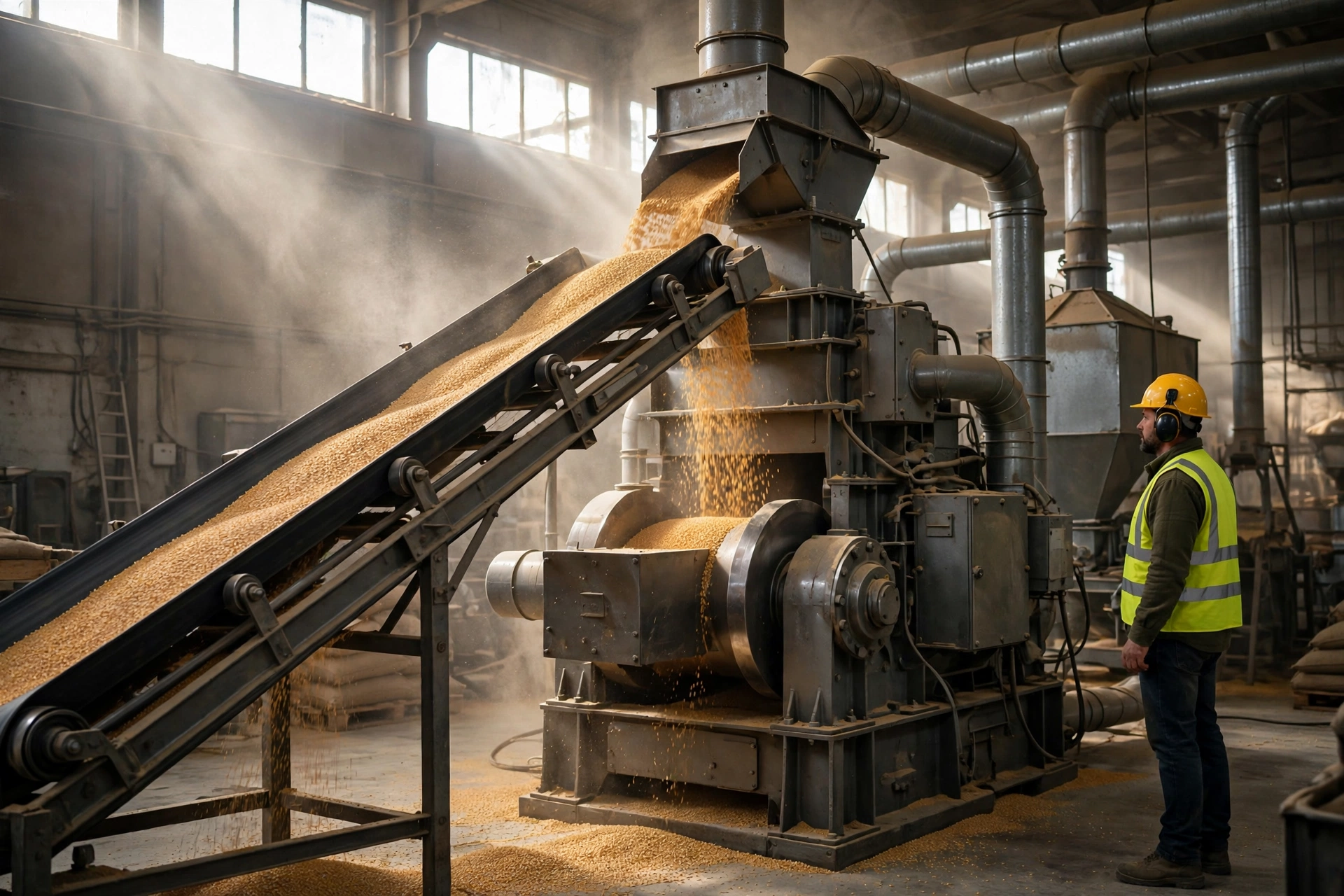
Grinding is the largest single electrical load in a feed mill. Hammer mills account for up to 50% of a mill’s total electricity consumption, using 8 to 30 kWh per tonne depending on mill design, screen size, rotor speed and the hardness of the grain. A well-maintained hammer mill grinding mash runs 10 to 15 kWh per tonne; the best in class, on coarse grinds, gets down to 8 to 10 kWh per tonne. Roller mills, used where a uniform particle size matters more than throughput, use 6 to 10 kWh per tonne for the grind alone. Grain milling for flour follows the same grinding principles, and the companion guide to flour mills covers roller-mill sizing and the flour-dust rules in detail.
The reason grinding is so expensive is that most of the energy never becomes useful work. A field study at the Piensos Cienfuegos plant in Cuba, published in 2026, measured hammer-mill process efficiency at 26 to 28% even though the motors themselves ran at 90 to 92% efficiency. The rest was lost in the transmission and in the grinding process itself. The same study showed how sharply efficiency falls when a mill runs below its rated throughput: when Mill III’s throughput dropped from 16 t/h to 5 t/h, its grinding efficiency fell from 31.1% to 9.7%, and its specific energy consumption rose from 3.50 to 11.2 kWh per tonne. A hammer mill run at a third of its rated capacity uses three times the electricity per tonne. For generator sizing, that means the set must be sized on the mill running at its rated throughput, and the operator must not try to save fuel by running the mill half-loaded — the saving is an illusion.
A separate Cuban case study, published in 2025, found that improving hammer-mill operation — feed rate, moisture control, hammer condition and screen choice — cut energy consumption by 18%, equivalent to 4 kWh per tonne, and improved particle-size uniformity by up to 30%. The saving is real money: at 20,000 tonnes a year, 4 kWh per tonne is 80,000 kWh, and at $0.12 per kWh that is $9,600 a year. But it is a saving on the running load, not on the generator size. The set is sized on the worst case, which is a worn hammer mill grinding hard wheat through a fine screen at full throughput.
Mixing, conditioning and the steam bill
The mixer is a modest load: 2 to 4 kWh per tonne, with motors of 15 to 37 kW on a 10 t/h line. It is also a load that cannot be skipped. A batch that is not mixed properly is not a batch — it is a liability, because an uneven ration can poison one group of animals and starve another. The mixer runs on a timer, and the timer runs on the generator.
Conditioning is where the steam bill arrives. Before pelleting, the mash is conditioned with steam to raise it from about 27 °C to 80 °C, which takes roughly 26 kWh of thermal energy per tonne. The pelleting line as a whole consumes about 40% of the mill’s electricity and 80 to 90% of its steam. A mill that makes its own steam with a boiler needs the boiler’s fans, pumps and controls on the generator board too — a detail that is easy to miss, because the boiler is often treated as a separate system. A pellet line without steam is a pellet line that cannot run, however large the generator.
Pelleting: the press sets the ceiling
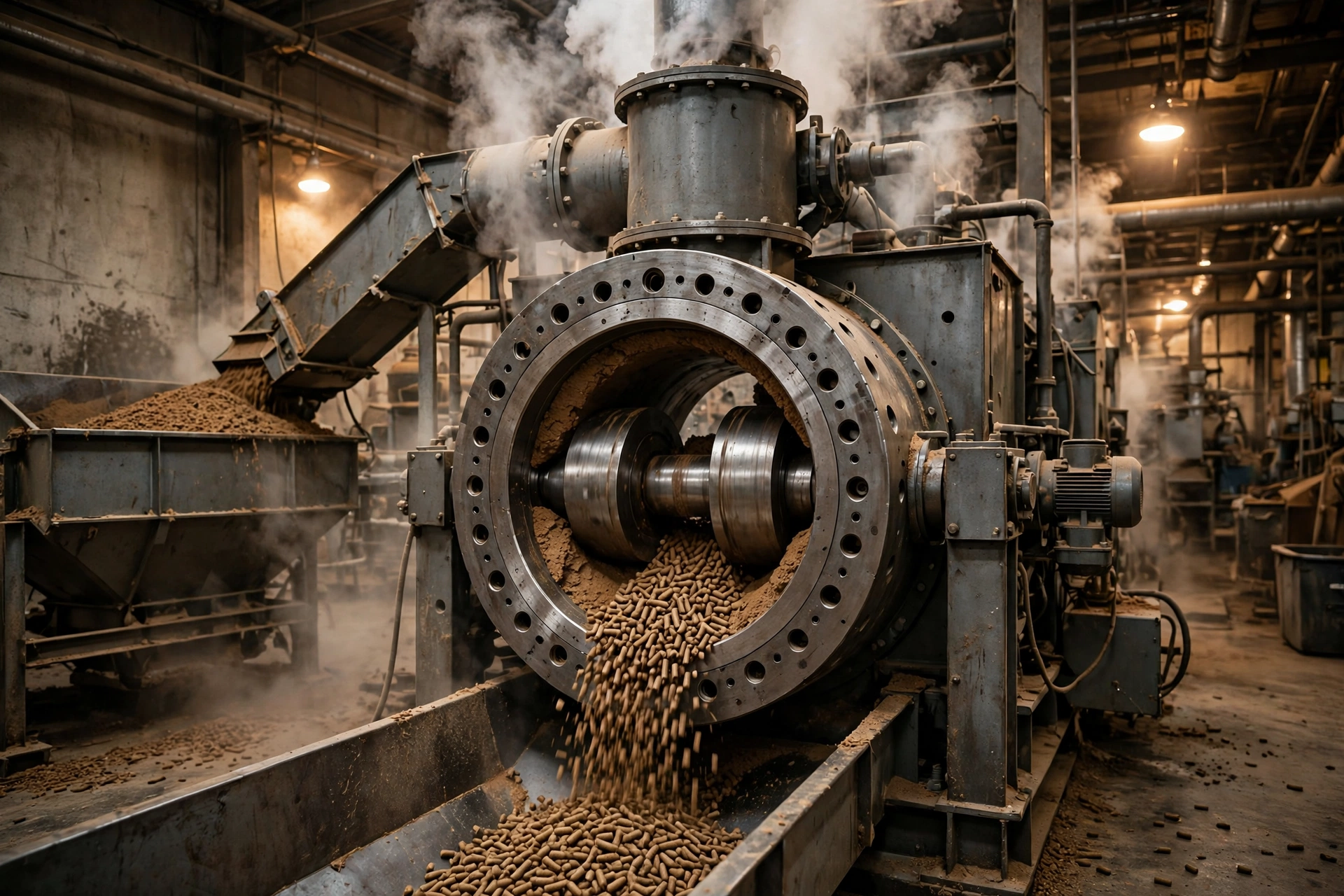
The pellet mill is the second-largest electrical load and the hardest to start. Pelletizer motors use 5 to 7 kWh per tonne, and pelleted feed as a whole uses 25 to 40 kWh per tonne, depending on die and formula. The average figures by ration type are 20 to 24 kWh per tonne for ruminant feed, 10 to 12 kWh per tonne for poultry feed, and 15 to 17 kWh per tonne for pork feed. Fat in the formula cuts pelleting energy by up to 30% when the fat content rises from 2% to 5.5%, which is why high-fat rations are easier on the generator than lean ones.
The press motor sets the ceiling on the line’s throughput, and it is the motor that decides the generator’s starting capability. A 10 t/h pellet line typically carries a 132 to 160 kW pellet mill motor and a 110 kW hammer mill motor. A 50 t/h plant carries two or three pellet lines, each with its own 200 to 315 kW press, and the largest single motor on the site is usually the pellet press. The starting current of that motor, and the voltage dip it causes, is the number that sizes the generator’s alternator, not the running load.
Cooling, screening, bagging and the air compressor
After the die, the pellets are hot, soft and wet, and they must be cooled before they can be handled. A counterflow cooler draws 15 to 30 kW of fan load on a 10 t/h line and runs for as long as the press runs. Screening removes the fines, which go back to the pellet mill, and bagging or bulk loading moves the finished feed out. None of these is large on its own, but together they add 10 to 15% to the line’s running load, and they all start when the transfer switch closes.
The air compressor is the load most often forgotten. A 50 t/h feed mill’s air compressor consumes 75 kW, about 5% of the whole plant’s electricity, running the pneumatic conveying, the bagging lines and the dust-collection pulse jets. It starts on its own timer and draws a surge of its own. A generator specification that omits the compressor will be undersized by a margin that shows up the first time the plant restarts after a transfer.
| Process step | Energy per tonne | Share of plant electricity | Typical motor, 10 t/h line |
|---|---|---|---|
| Hammer mill grinding | 8–30 kWh/t | Up to 50% | 110 kW |
| Pellet mill press | 5–7 kWh/t | Part of pelleting ~40% | 132–160 kW |
| Mixing | 2–4 kWh/t | 5–8% | 22 kW |
| Conveying and elevators | 1–2 kWh/t | 3–5% | 7.5–22 kW |
| Cooling, screening, bagging | 2–3 kWh/t | 8–12% | 15–30 kW |
| Air compressor | — | About 5% | 30–75 kW |
| Steam conditioning | ~26 kWh/t thermal | 80–90% of steam | Boiler fans and pumps |
| Whole plant, pelleted feed | 25–40 kWh/t | 100% | 250–350 kW connected |
Sizing by Mill Type: From a 2 t/h Farm Mill to a 50 t/h Plant
The sizing rule for a feed mill is simple to state and easy to get wrong: tonnes per hour multiplied by kWh per tonne gives average kilowatts, and the generator must carry that average plus the starting surge of the largest motor, plus the site derating. A 10 t/h line making pelleted poultry feed at 20 to 25 kWh per tonne draws 200 to 250 kW on average. At a power factor of 0.8, that is 250 to 312 kVA of running load before any starting surge is added. The standby and prime ratings on the datasheet decide whether the set survives the season: a mill that runs 16 hours a day, five days a week, is a prime-power application, not a standby one, and a standby-rated set run at prime duty will age fast and fail early.
The table below gives the working range a buyer should start from. Every figure is a starting point for a load list, not a substitute for one — the generator sizing guide explains how to build the list, add the starting surge and apply the site derating. The ranges assume the set carries the full line, including the boiler auxiliaries and the air compressor.
| Mill type | Capacity | Typical running load | Generator size | Duty |
|---|---|---|---|---|
| Farm mill, mash only | 2 t/h | 30–45 kW | 50–75 kVA | Standby |
| Small commercial, mash and pellets | 5 t/h | 100–150 kW | 150–200 kVA | Standby / prime |
| Mid-size pellet line | 10 t/h | 200–250 kW | 250–400 kVA | Prime |
| Commercial plant, two lines | 20 t/h | 500–650 kW | 600–800 kVA | Prime |
| Integrated plant, three lines | 50 t/h | 1,200–1,500 kW | 1,500–2,000 kVA | Prime |
A 2 t/h farm mill: 50–75 kVA
A farm mill that grinds its own grain and mixes its own ration is the smallest case in this article, and the easiest to get right. The load is a 22 to 37 kW hammer mill, a 7.5 kW mixer, a small elevator and a conveyor, for a connected load of about 45 kW. A 50 to 75 kVA set covers it with room for the hammer mill’s starting surge, and the set can be a simple standby unit with a basic automatic transfer switch, because the mill runs a few hours a day and the set is idle most of the time. The mistake to avoid is buying a set sized on the average load and forgetting the hammer mill starts under load, with grain already in the chamber. A 50 kVA set that cannot start a 37 kW hammer mill is not a backup system. It is a decoration.
A 10 t/h pellet line: 250–400 kVA
A single pellet line is the most common commercial size, and it is where the sizing gets serious. The line carries a 110 kW hammer mill, a 132 to 160 kW pellet press, a 22 kW mixer, a 30 kW cooler fan, conveyors, the boiler auxiliaries and a 30 to 45 kW air compressor, for a connected load of 350 to 400 kW and a running load of 200 to 250 kW. A 250 to 400 kVA set covers the running load, but only if the starting sequence is controlled: the hammer mill and the pellet press must never start together, and the press must be started empty, with the die clear and the feeder off, so that its starting current is the no-load value rather than the full-load value. A set at the bottom of the range needs a soft starter or a variable-speed drive on the press. A set at the top of the range can start the press direct-on-line. The choice is a cost trade-off, and it should be made before the set is ordered, not discovered on the first outage.
A 50 t/h integrated plant: 1,500–2,000 kVA
A 50 t/h plant is a different scale of problem. The running load is 1,200 to 1,500 kW, the connected load is higher, and the plant has three pellet lines, each with its own press, plus a 75 kW air compressor, a boiler house and a laboratory. A single 2,000 kVA set can carry it, but two 1,000 kVA sets in parallel are the better answer for most plants: one set can be taken out for service while the other carries the critical loads, and the plant can shed a line and keep two running when one set is down. The fuel bill is the number that surprises first-time buyers. A 1,500 kVA set at 75% load burns roughly 225 to 250 litres an hour. A 24-hour outage burns 5,400 to 6,000 litres, which is a full road tanker. A plant that buys a 1,500 kVA set with a 1,000-litre day tank has bought eight hours of autonomy, not 24, and the fuel contract matters as much as the generator.
Starting Surge and the Pellet Die Stall Window
Two things decide whether a feed mill restarts cleanly after a transfer: whether the generator can start the largest motors without the voltage dipping far enough to trip something else, and whether the pellet die is still hot enough to restart. The first is an electrical problem. The second is a mechanical one. Both are decided before the outage, by the way the set and the line are specified.
Starting a hammer mill and a pellet press
An induction motor started direct-on-line draws six to seven times its rated current for the first few hundred milliseconds, and the voltage dip that follows is proportional to the size of the motor relative to the generator. A 160 kW pellet press started direct-on-line against a 400 kVA set will pull the voltage down by 20 to 25% for a second or two. That is enough to drop out the contactors on the cooler fan, the conveyors and the boiler auxiliaries, and to trip the under-voltage protection on the press itself. The line then has to be restarted by hand, one motor at a time, which takes 20 to 30 minutes even when everything works.
The fix is sequencing and starting method, and it is cheaper than a larger generator. For a feed mill, motor starting options are, in order of cost: start the motors one at a time with a 10 to 15 second gap, so that each starting surge has decayed before the next begins; fit a soft starter to the pellet press, which cuts the starting current to three to four times rated and the voltage dip roughly in half; or fit a variable-speed drive, which starts the motor at full torque with barely more than rated current and adds the benefit of speed control for throughput. The soft starter costs a few thousand dollars. The variable-speed drive costs more but pays for itself in energy saving on a press that runs at part load. The larger generator costs tens of thousands of dollars. The sequencing costs nothing.
The starting order matters as much as the method. The hammer mill starts first, empty, and is allowed to reach full speed before the feeder is opened. The mixer starts next. The pellet press starts last, empty, with the die clear and the feeder off, and the feeder is only opened once the press is at speed and the ammeter is steady. The cooler fan and the conveyors start with the press, because they have to be running when the first pellets arrive. A mill that starts its press with mash already in the conditioner, or with the die still full from the last run, is asking the generator to start a motor against a locked load, and the set will either stall or trip. The transfer switch panel should enforce the sequence automatically. Relying on an operator to remember it at 2 a.m., in the dark, during a storm, is not a plan.
The die stall window: minutes, not hours
The pellet die is the most unforgiving part of the line. The die runs hot — 80 to 90 °C at the die face during normal production — and the mash inside it is plastic and flowing. When the power stops, the die starts to cool. The published restart procedure for a sudden stop on power failure is specific: open the press, remove all uncompressed material from the die, and if the interruption was short and the die has not had time to cool, close the door and restart, feeding material in again. If the interruption was long enough for the die temperature to fall to room temperature, the mash in the die holes has hardened, and the operator may have to remove the die from the press and clean every hole by hand.
The window is measured in tens of minutes. A die that is still above 60 °C restarts cleanly. A die that has fallen below 40 °C is a problem. A die at room temperature is a half-day job: pull the die, soak it, drill or punch out the hardened mash from several hundred holes, refit it, reheat it with oily feed, and run a test batch before production resumes. The normal-stop procedure exists precisely to prevent this: before a planned stop, the operator runs oily product through the press for a few minutes, so that the die holes are filled with an elastic, oily material that can be pushed out easily at the next start. A mill that loses power mid-run has no chance to do this. That is why the transfer switch matters more than the generator’s fuel tank for a pellet line: a 10-second transfer keeps the die hot and the line running. A 10-minute delay while someone drives to the site and starts a manual set is the difference between a restart and a die clean-out.
The conditioner is the second part of the window. Mash conditioned with steam at 80 °C sits in the conditioner when the power stops, and it cools and sets there too. A conditioner full of cold, set mash has to be emptied by hand before the line can restart, and the mash that is emptied is waste — it cannot be fed back into the line without re-grinding. A 10 t/h line holds 200 to 300 kg of mash in the conditioner and the die at any moment. That is a small quantity in tonnes, but it is the quantity that decides whether the line restarts in 10 minutes or in four hours.
Three Outages That Show What a Feed Mill Loses
The DeBruce explosion: a bearing, a dust cloud, seven deaths
The worst feed-industry power story is not an outage. It is what happens when the dust is ignored. On 8 June 1998, at 9:18 a.m., a series of dust explosions tore through the DeBruce Grain Elevator near Wichita, Kansas. Seven workers were killed and ten were injured. The elevator was the largest in the world at the time — 2,717 feet long, 310 silos, 20.7 million bushels of storage, enough wheat, the investigators noted, to supply all the bread consumed in the United States for nearly six weeks.
The ignition source was ordinary. A roller bearing on a conveyor had seized through lack of lubrication, locking the roller in place while the belt continued to run over it. Friction heated the roller to 260 °C, 40 °C above the 220 °C needed to ignite layered grain dust, and the dust that had accumulated inside the roller and throughout the elevator did the rest. The explosion travelled through the headhouse and shot in both directions through the galleries. The investigation, led by OSHA’s newly created Grain Elevator Explosion Investigation Team, concluded that excessive accumulations of grain dust were the primary cause.
The lesson for a feed mill buying a generator is direct. The mill’s own dust is the hazard, and the generator is an ignition source that has to be kept out of it. The set’s exhaust, its hot surfaces, its electrical terminations and its fuel system all have to be placed and protected as if the dust were already in the air, because on a windy day, or during a clean-down, it is. NFPA 61, the standard for agricultural and food processing facilities, and NFPA 652, which requires a dust hazard analysis, are the documents the placement decision should be checked against, not the generator supplier’s catalogue.
The Iowa derecho: a week without grid power across a feed state
The second case is a grid outage, and it is the one that shows what a feed mill loses when the set is too small or absent. On 10 August 2020, a derecho — a long-lived, straight-line windstorm — crossed Iowa with gusts above 100 mph, flattening crops, tearing roofs off grain elevators and knocking out power to more than a million customers. Iowa State University estimated that the storm damaged or destroyed grain storage holding about 57 million bushels, and feed mills, elevators and ethanol plants across the state ran on generators or not at all for days.
A feed mill in that situation faces two problems at once. The first is its own power: without a set, the mill cannot grind, mix or pellet, and its customers’ animals go short. The second is its supply: the grain it buys arrives from elevators that are themselves without power, and the trucks that deliver it run on roads blocked by fallen trees and grain bins. A mill with a generator sized for the full line could keep producing from the grain already in its bins, and it could do so for as long as its fuel lasted. A mill with a set sized only for the office and the lights could do nothing. The derecho is the case that justifies sizing the set for the whole line, not for a token load, and it is the case that justifies a fuel contract with a supplier who can deliver a tanker to a site the roads have not yet reached.
The pellet die stall: a two-hour outage that costs a day
The third case is the most common, and the least dramatic, which is why it is the most expensive in aggregate. A 10 t/h poultry-feed mill in a provincial town loses grid power at 3 p.m. on a Thursday. The mill has a 200 kVA standby set, bought years ago for the office and the bagging line, and no automatic transfer switch — the set has to be started by hand. The operator walks to the generator house, starts the set, and closes the breaker 25 minutes after the outage began. By then the die has cooled from 85 °C to below 50 °C, the mash in the conditioner has set, and the press will not restart.
The rest of the day goes to the clean-out. The die is pulled, the holes are cleaned, the conditioner is emptied by hand, and the line is reheated with oily feed before a single tonne of saleable pellets is made. Production resumes at 9 p.m., six hours after the outage began, and the mill has lost 60 tonnes of production — about $21,000 to $27,000 of feed — plus the labour of the clean-out and the waste mash. The generator ran for six hours and burned 300 litres of fuel. The mill’s loss was not the power cut. It was the 25 minutes it took to start the set, and the die that cooled in that time. An automatic transfer switch that starts the set in 10 seconds would have kept the die hot, the line running, and the 60 tonnes in the warehouse.
Grain Dust, Fuel and Placement: Running a Generator in a Feed Mill Yard
A feed mill yard is a hostile place for a generator. The air carries grain dust, the ground is covered in spilled meal, the trucks kick up more dust every time they move, and the mill itself runs 16 hours a day in a building that is never fully clean. A set installed as if it were in a clean warehouse will not last, and a set installed as if the dust were harmless is a fire risk. The three decisions — where the set stands, how much fuel it holds, and how it is tested — are the difference between a backup system and a liability.
The dust rules: NFPA 61, the explosion pentagon and ATEX zones
Every dust explosion needs the same five conditions, called the explosion pentagon: fuel, oxidiser, containment, dispersion and ignition. Grain dust is the fuel. Air is the oxidiser. A bin, a conveyor housing, a mill room or a dust collector is the containment. A puff of air — from a compressed-air blow-down, a dropped bag, or a fan starting — is the dispersion. And a hot bearing, a spark, a hot exhaust manifold or a static discharge is the ignition. Remove any one of the five and there is no explosion. A feed mill cannot remove the fuel, the air or the containment, so it has to control the dispersion and the ignition.
NFPA 61, the Standard for the Prevention of Fires and Dust Explosions in Agricultural and Food Processing Facilities, is the document that sets the rules: housekeeping to keep dust accumulation below the threshold at which a suspended cloud can reach its minimum explosible concentration, dust collection at every point where dust is liberated, explosion venting on bins and collectors, and electrical equipment rated for the dust hazard. NFPA 652 requires a dust hazard analysis for the facility, which identifies where the hazardous areas are and what equipment may go in them. In Europe, the same ground is covered by the ATEX directives and IEC 60079, which classify dust areas as Zone 20 (dust cloud present continuously), Zone 21 (likely in normal operation) and Zone 22 (unlikely, and short-lived if it occurs). Grain dust itself is defined as combustible at a particle size of 420 microns or smaller — fine enough to pass through a kitchen sieve, and fine enough to stay airborne for minutes.
The generator’s place in this scheme is straightforward. The set, its fuel tank and its exhaust must stand outside the dust zones, upwind of the mill where possible, with its air intake filtered and its exhaust routed away from any dust-handling equipment. The generator room or canopy must be kept clean of dust, not used as a store for bags of meal, and its ventilation must bring in clean air, not air drawn from the mill building. The generator maintenance schedule should include a dust check: if the set’s radiator is clogged with grain dust, it will overheat under load, and the first time the set is needed for a long outage is the worst time to discover it.
Fuel autonomy: size the tank on the longest outage, not the average
Fuel autonomy is a number, not a feeling, and it is calculated from the set’s consumption at the load it will actually carry. A 400 kVA set at 75% load burns roughly 60 to 65 litres an hour. A 24-hour outage burns 1,440 to 1,560 litres. A 1,500 kVA set at 75% load burns 225 to 250 litres an hour, and a 24-hour outage burns 5,400 to 6,000 litres. The day tank that comes with the set — typically 500 to 1,000 litres — covers eight to sixteen hours on a 400 kVA set and four hours on a 1,500 kVA set. A mill that wants 24 hours of autonomy needs a bulk tank, and a mill that wants 72 hours needs a fuel contract with a supplier who will deliver during an outage, when every other mill in the district is calling for the same tanker.
The second half of the fuel decision is diesel fuel ageing. A standby set’s fuel sits in the tank for months between runs, and diesel degrades: water condenses in the tank, microbes grow at the fuel-water interface, and the fuel that reaches the injectors after six months of storage is not the fuel that was delivered. A mill that tests its fuel twice a year, polishes it when the water content rises, and keeps the tank full to limit condensation will start its set on the first attempt. A mill that does not will discover the problem at 2 a.m., when the set cranks, fires, and dies on a blocked filter. The fuel test is a $100 item. The failed start is a lost day.
Testing under load: the monthly run that actually proves something
A feed mill’s generator should be tested under load every month, for at least 30 minutes, at 50% of its rated load or more. A 15-minute no-load run proves that the engine starts. It proves nothing about the alternator, the cooling system, the fuel system or the transfer switch, because none of them is loaded. The monthly test should transfer the mill’s critical loads — the hammer mill, the mixer, the press — onto the generator, run them, and record the voltage, frequency, coolant temperature, oil pressure and fuel consumption. The record matters: a set whose fuel consumption has risen 10% since the last test has a problem developing, and a set whose voltage dips further on starting than it did last month has a problem developing faster.
The test should also prove the starting sequence. The transfer switch should start the motors in the right order, with the right gaps, without an operator touching anything. If the sequence relies on a person remembering to wait 15 seconds between starts, it will fail on the night it matters, because the person who remembers is the person who is on holiday. Automate the sequence, test it monthly, and write the result down.
Frequently Asked Questions
What size generator does a feed mill need?
A 2 t/h farm mill needs 50–75 kVA, a 10 t/h pellet line needs 250–400 kVA, and a 50 t/h integrated plant needs 1,500–2,000 kVA. Multiply tonnes per hour by 25–40 kWh per tonne to get the average kilowatts, then add the starting surge of the largest motor and the site derating.
Do feed mills need a backup generator?
Yes, if the mill sells feed on a daily schedule. Feed is about 70% of livestock production cost, animals eat every day, and a missed delivery shows up as lost weight gain within 48 hours. A 10 t/h line loses 160 tonnes a day, worth $56,000–$72,000, and a cooled pellet die can add a half-day clean-out on top.
How long can a feed mill run on a generator?
As long as the fuel lasts. A 400 kVA set at 75% load burns 60–65 litres an hour, so a 1,500-litre tank gives about 24 hours. A 1,500 kVA set burns 225–250 litres an hour, so the same 24 hours needs 5,400–6,000 litres — a full road tanker — and a fuel contract that delivers during an outage.
What happens to a feed mill during a power outage?
The line stops, the pellet die cools and the mash in the conditioner sets. A short outage with a 10-second automatic transfer restarts cleanly. A long outage, or a manual start that takes 25 minutes, cools the die enough to force a pull-and-clean that costs two to six hours, plus the lost production and the wasted mash.
Can a diesel generator power a feed mill?
Yes, and it is the standard answer for mills away from a reliable grid. Size the set on tonnes per hour times kWh per tonne, sequence the motor starts, put the set outside the dust zones, and test it under load every month. A mill that runs 16 hours a day, five days a week, needs a prime-rated set, not a standby-rated one.
Specification Checklist: Ten Lines Before the Deposit
- Load list in writing: every motor, its kW, its starting method and its starting current, with the hammer mill and the pellet press identified as the two largest starts.
- Rating: prime, not standby, if the mill runs more than 8 hours a day or more than 200 hours a year on the set — check the standby and prime ratings on the datasheet.
- Starting sequence: automatic, enforced by the transfer switch panel, with 10 to 15 seconds between motor starts and the pellet press started empty.
- Pellet press starting: soft starter or variable-speed drive specified in the quotation if the set is at the bottom of its size range.
- Dust placement: set, fuel tank and exhaust outside the ATEX Zone 20/21/22 areas, upwind of the mill, intake air filtered, in line with NFPA 61 and the site dust hazard analysis.
- Fuel autonomy: bulk tank sized for the longest outage the site has seen, plus a margin — 24 hours minimum, 72 hours where the fuel supplier cannot guarantee delivery during an outage.
- Fuel care: water and microbe testing twice a year, fuel polishing when the water content rises, tank kept full to limit condensation.
- Testing: monthly load test, 30 minutes minimum, at 50% of rated load or more, with voltage, frequency, coolant temperature, oil pressure and fuel consumption recorded.
- Boiler auxiliaries and air compressor on the generator board, not left on the grid side — the pellet line cannot run without steam, and the bagging line cannot run without air.
- FAT report in the contract: full-load test at the factory, with the load-bank results, the starting-sequence test and the voltage-dip figures in writing before the balance is paid.
A feed mill buys a generator for the day the grid fails, and that day will come on a Friday afternoon, in the middle of a pellet run, with a full order book and a die at 85 °C. The set that earns its price is the one that starts in 10 seconds, carries the hammer mill and the press without tripping anything else, keeps the die hot, and runs until the fuel contract delivers the next tanker. Anything less is a machine that starts and a mill that still stops. To size a set for a feed mill, contact PAVO with the load list and the tonnes per hour, and the rating will be confirmed before the set goes into production.