

What Size Generator Does a Sawmill Need? Kiln & Saws | PAVO
A sawmill does not sell logs. It sells boards that were cut straight, dried to the right moisture and delivered on the day the buyer promised them to a customer — and a power cut that stops the head rig mid-log and the kiln fans mid-charge turns a week’s production into degrade, rework and apologies.
What size generator does a sawmill need? A 20 m³/day hardwood mill needs 100–200 kVA, a 60 m³/day mill with kilns needs 300–500 kVA, and a 100 m³/day line needs 500–800 kVA. The head rig sets the starting surge; the kiln fans and dust extraction set the running load.
This article works through the load list of a real sawmill, the sizing bands by mill throughput, the starting surge of head rigs, kiln fans and dust extraction, the days-long window in which a stopped kiln charge becomes degraded lumber, and the sawdust, kiln heat and placement rules that decide where the set may stand. It covers portable band mills, mid-size hardwood mills and large softwood lines, with the fuel, placement and specification numbers a buyer needs before paying a deposit.
Contents
- The Sawmill’s Clock: Minutes That Decide a Kiln Charge
- What a Sawmill Actually Runs: The Load List
- Sizing by Mill Throughput: From a 5 m³/day Portable Mill to a 100 m³/day Line
- Starting Surge: Head Rigs, Kiln Fans and the Restart Sequence
- Three Outages That Show What a Sawmill Loses
- Sawdust, Kiln Heat and the Fire Risk Nobody Sizes For
- Frequently Asked Questions
- Specification Checklist: Ten Lines Before the Deposit
The Sawmill’s Clock: Minutes That Decide a Kiln Charge
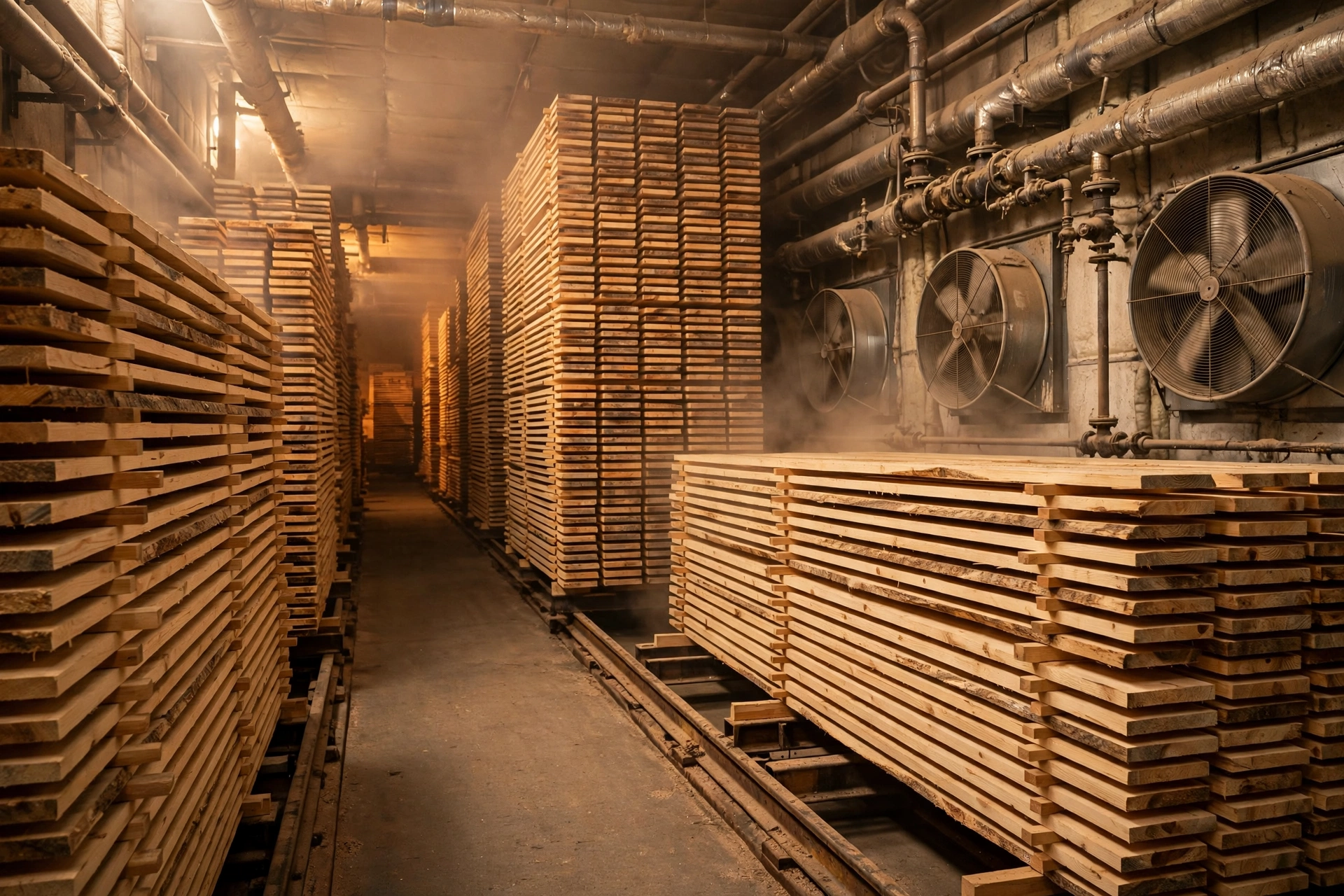
A sawmill runs on two clocks, and they tick at very different speeds. The first clock is measured in seconds. A band saw head rig cuts a log in minutes, and the blade is either cutting or it is not. Stop the power mid-cut and the blade stops in the log. That is an inconvenience, not a disaster: the operator backs the head out, checks the blade, and restarts. The second clock is measured in days, and it is the one that costs real money. A kiln charge of 4/4 red oak takes about 30 days from green to 8% moisture content. A charge of 4/4 hard maple takes about 10 days. A charge of 4/4 white oak takes 21–35 days, and 8/4 stock in the same species can take 45–90 days. The kiln operator holds that charge inside a narrow band of temperature and humidity for the whole period — starting near 110 °F at high humidity when the lumber is green, and finishing near 170–180 °F when the moisture content has fallen to 10–15%. Lose power for a few hours and the kiln does not simply pause. The fans stop, the heat stops, and the moisture gradient inside every board starts to move the wrong way.
The damage mechanism is straightforward, and it is the reason kiln drying is the most expensive mistake a sawmill can make slowly. Green lumber holds free water in the cell cavities and bound water in the cell walls. The fibre saturation point — around 28–30% moisture content for most species — is where the free water is gone and the bound water starts to leave. Below that point the wood shrinks, and if the surface shrinks faster than the core, the board checks on the surface, honeycombs inside, or case-hardens with internal stresses that show up later, when the board is ripped or planed and springs out of shape. A kiln schedule exists to keep the drying stresses below the strength of the wood at every temperature and moisture content. Stop the fans and the heat, and the schedule is broken. The surface of the boards at the outside of the stack cools and reabsorbs moisture from the still, humid air inside the kiln, while the core keeps giving up water. Restart the kiln and the operator must decide whether to pick up the schedule where it stopped — and risk surface checking on boards that have already been stressed — or to step the schedule back and add days to the charge. Either way, the charge costs more than it was supposed to. A 50 m³ charge of 4/4 red oak is about 21,200 board feet; at wholesale prices of $2.40–3.00 per board foot for 1&Btr red oak, that charge is worth $51,000–64,000 before it is dried. A 50 m³ charge of white oak at $4.30 per board foot is worth more than $91,000. Degrade of even 10% of a charge is $5,000–9,000 of value destroyed by a power cut that lasted a few hours.
The third clock belongs to the log yard. Lumber cut from a maple log should be in the kiln within one week to limit defects, because end checking, sapstain and enzymatic stain start in the log yard, not in the kiln. A mill that loses power for two days does not only lose two days of sawing. It loses the window on the logs already on the deck. White woods such as sugar maple and red maple stain fast in warm weather, and a log that sits for a fortnight in summer can lose a grade before it ever reaches the head rig. The generator that keeps a sawmill running protects the log yard as well as the kiln, because the yard is where the next charge is waiting.
The fourth clock is the order book. A sawmill sells to flooring plants, furniture factories, pallet makers and export buyers who run their own schedules. A flooring plant that expects 20 m³ of kiln-dried red oak on the first of the month does not accept it on the fifteenth. A pallet factory that runs three Wood-Mizer WM4000 head rigs and produces 3,000 pallets a day needs its timber every day, and a missed delivery stops a line that employs forty people. The cost of an outage in a sawmill is therefore not the electricity bill. It is the charge in the kiln, the logs on the deck, and the customer who buys the next load from someone else.
What a Sawmill Actually Runs: The Load List
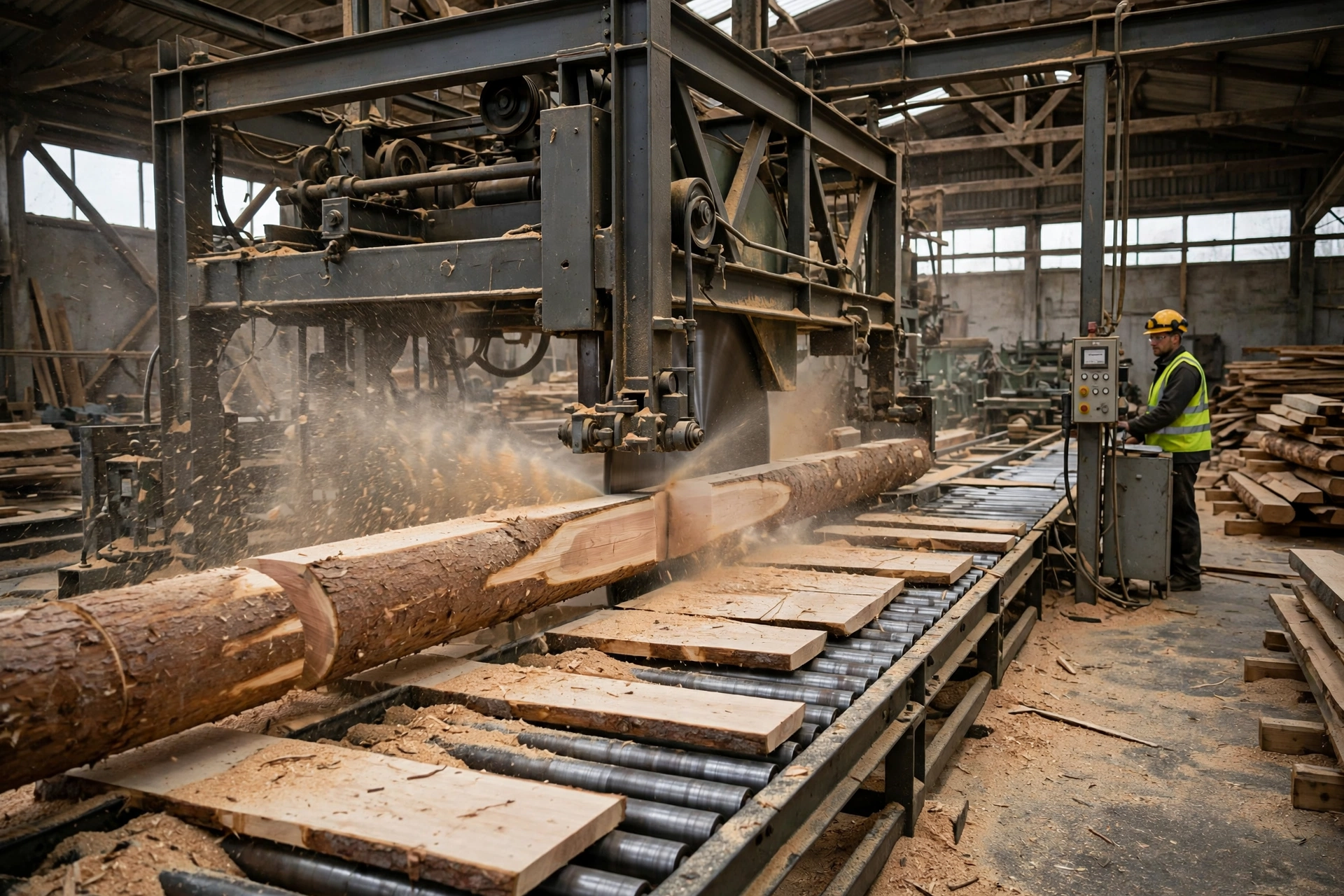
The surprise in a sawmill is how much of the load is motors, and how little of it is the saw itself. A modern band head rig is an efficient machine. The Wood-Mizer LT70, the standard professional band mill, runs on a 15 kW electric motor as standard, with an 18.5 kW option, and the heavy-duty version takes 22 kW. The industrial WM4000 head rig runs a 22 kW standard motor with a 30 hp blade motor, and its normal power usage is listed at 35.9 kVA. The head rig is not the load. The mill around it is.
The first group is the sawing line itself. The head rig draws 15–22 kW on a band mill and far more on a circular head rig, where a 75–150 kW arbor motor is common on a large softwood line. Behind the head rig sits the edger — the Wood-Mizer EG400 industrial edger draws 22 kW — and the resaw, which on a two-head line draws another 15–30 kW. The trim saw, the green chain and the sorting line add 10–25 kW of conveyors and small motors. A mid-size mill’s sawing line therefore draws 60–150 kW while it is cutting, and every one of those motors starts under load or against a log.
The second group is the kiln, and it is the group most buyers underestimate. The FAO’s energy tables for a 100 m³/day hardwood sawmill put kiln drying at 70.7 kWh/m³ of electrical energy against 44 kWh/m³ for a mill that air-dries, and kiln fans alone take 25% of the mill’s electrical requirement when a kiln is running. The heat for the kiln is usually thermal — wood waste, gas or steam — and it accounts for 87% of the mill’s total energy, but the fans, the vents and the controls are all electric, and they must run for the whole charge. A single kiln chamber with four to six circulation fans draws 15–30 kW of fan load, and a mill with three chambers draws 45–90 kW before a single board is sawn. The fans are also a load that cannot be shed. Shed them and the charge is lost.
The third group is dust extraction, and it is the largest single motor group in many mills. A sawmill turns roughly half of every log into lumber; the rest leaves as slabs, edgings, sawdust and bark. Every saw, edger and planer is connected to a dust system, and the system that serves a mid-size mill draws 30–75 kW across its main fan and booster fans. The dust collector is also a safety device, not a convenience. Fine sawdust is a combustible dust, and the US Chemical Safety Board recorded 281 combustible dust incidents in the United States between 1980 and 2005, killing 119 workers and injuring 718; lumber and wood accounted for 15% of them, and the dust collector itself was the equipment involved in 52% of incidents. Stop the extraction and the mill fills with dust in minutes. The generator must keep it running.
The fourth group is the planer and moulder. A four-sided planer/moulder that surfaces dried boards draws 30–55 kW across its cutter heads and feed motors, and it runs in bursts — a stack of boards goes through, then the operator changes the setup. The planer is also the machine that exposes kiln degrade: a board that case-hardened in a stalled kiln springs out of shape the moment the planer takes a cut off it, and the operator discovers the damage weeks after the outage that caused it.
The fifth group is materials handling, and the FAO tables put it at 32.5% of a sawmill’s electrical requirement — the largest single share after sawing itself. Log decks, transfer chains, forklifts and loaders, the debarker at 5–11 kW, the chipper at 15–37 kW, and the boiler feed system for the kiln all draw power, and they draw it all day. Add the air compressor at 7.5–15 kW, the building’s lighting and HVAC at 10–20 kW, and the office and grading room at 3–8 kW, and the mill’s background load is a third of the total before the head rig starts.
| Load group | Typical running load | Starting behaviour | Can it be shed? |
|---|---|---|---|
| Head rig (band mill) | 15–22 kW | Blade motor, 5–7x surge on DOL start | No — it is the business |
| Edger and resaw | 22–55 kW | Motors start under load | No — boards pile up without them |
| Kiln fans (per chamber) | 15–30 kW | Fan start, 4–6x surge | No — the charge is lost without them |
| Dust extraction | 30–75 kW | Main fan, 4–6x surge | No — safety device, not a convenience |
| Planer / moulder | 30–55 kW | Cutter heads, 5–7x surge | Briefly — but it blocks dispatch |
| Chipper and debarker | 20–48 kW | Starts under load | Briefly — residue piles up fast |
| Materials handling | 25–60 kW | Many small motors, staggered | Partly — the log deck can wait |
| Compressor, lighting, offices | 15–30 kW | Compressor cycles, moderate surge | Partly — offices first |
A load list built this way gives a 5 m³/day portable band mill a running load of 20–35 kW, a 20 m³/day hardwood mill 80–140 kW, a 60 m³/day mill with two kiln chambers 200–350 kW, and a 100 m³/day softwood line 350–550 kW. The head rig is one line on the list. The kiln and the dust system are the generator.
Sizing by Mill Throughput: From a 5 m³/day Portable Mill to a 100 m³/day Line
Sizing a generator for a sawmill starts with the head rig, but it ends with the kiln fans and the dust extraction. The table below gives the bands that hold in practice, for mills that saw eight to ten hours a day, five to six days a week, with the kilns running around the clock. The figures assume the head rig, edger, kiln fans, dust extraction and one planer all run, and that the largest motor starts while the rest of the mill is at full load.
| Mill size | Throughput | Running load | Generator size | Fuel at 75% load |
|---|---|---|---|---|
| Portable band mill | 5 m³/day, 1 head rig | 20–35 kW | 30–50 kVA | 6–10 L/h |
| Small hardwood mill | 20 m³/day, 1 kiln | 80–140 kW | 100–200 kVA | 20–35 L/h |
| Mid-size mill | 60 m³/day, 2 kilns | 200–350 kW | 300–500 kVA | 55–75 L/h |
| Large softwood line | 100 m³/day, 3 kilns | 350–550 kW | 500–800 kVA | 75–110 L/h |
The portable mill is the simplest case, and it is the one most often bought wrong. A Wood-Mizer LT70 Super Hydraulic with a 41 kW (55 hp) diesel engine saws up to 1,050 board feet per hour — about 2.47 m³/h — and it carries its own engine. The buyer who electrifies the same mill with a 15 kW motor and then adds a second-hand edger, a small dust fan and a compressor has built a 30–40 kW load, and a 30 kVA set will not start it. The 30–50 kVA band exists because the edger starts while the head rig is cutting, and the generator must carry both at once. A 50 kVA set with a 40 kW prime rating is the right size for a portable mill that has grown into a yard with an edger and a fan; a 30 kVA set is right only for the head rig alone.
The small hardwood mill is where the kiln first appears on the load list, and it changes the sizing completely. A 20 m³/day mill sawing red oak and white oak runs a 22 kW head rig, a 22 kW edger, a 15–30 kW kiln chamber and a 30 kW dust system, and the running load is 80–140 kW. The Appalachian hardwood study measured 160.89 kWh of electricity per thousand board feet across audited mills, and a 20 m³/day mill saws about 8,480 board feet a day — roughly 1,360 kWh of electricity a day, or 170 kW averaged over an eight-hour shift. The 100–200 kVA band covers that load with room for the largest motor to start. A 200 kVA set running at 75% load burns about 35 L/h, so a 1,000-litre day tank gives the mill 28 hours of running — enough for a two-day outage with the kiln fans kept alive overnight.
The mid-size mill is the band most buyers actually need, and it is the band where the honest limit appears. A 60 m³/day mill with two kiln chambers draws 200–350 kW, and the generator that covers it is 300–500 kVA. The 500 kVA Cummins C500D5, a standard frame in this class, is rated 500 kVA standby / 455 kVA prime and burns 93.2 L/h at full prime load. At 75% load it burns about 70 L/h, so a 72-hour outage needs 5,040 litres of fuel — a bulk tank, not a day tank, and a fuel delivery contract that works on a weekend. The mill that buys a 500 kVA set for a 60 m³/day line and then adds a third kiln chamber has bought a set that is too small, and the third chamber is the load that will trip it on the hottest afternoon of the year.
The large softwood line is the top of the range, and it is where the generator stops being a backup and becomes a second power system. A 100 m³/day line — the size of the FAO’s reference hardwood mill — draws 350–550 kW while sawing, and its kiln fans alone take a quarter of the electrical load. The generator for that line is 500–800 kVA, and at 800 kVA the buyer should be asking whether two 400 kVA sets in parallel are better than one large set. Two sets give the mill a set to run at night for the kilns alone, and a set to shut down for service without stopping the mill. The generator sizing guide gives the step-by-step method for building the load list that these bands are drawn from, and it is worth working through before the order is placed, because the bands above assume the kilns and the dust system run. A mill that sheds the kiln fans on generator power can drop a band — and can lose a charge doing it.
The load factor matters as much as the peak. A sawmill does not draw its peak load all day. The head rig cuts in bursts, the planer runs in batches, and the kiln fans run continuously. The standby and prime ratings explain why that matters: a standby-rated set is built for short outages and limited hours, while a prime-rated set is built to run at varying load for unlimited hours. A sawmill that expects a 72-hour outage on a standby-rated set is using the wrong rating, and the set will tell the buyer so by failing on the second day. The mill that buys prime-rated, with a 10% overload allowance it never plans to use, is the mill that survives a three-day outage with its kiln charges intact.
Starting Surge: Head Rigs, Kiln Fans and the Restart Sequence
The number that trips generators in sawmills is not the running load. It is the starting surge, and the worst surge in a sawmill is the one nobody plans for: the restart after an outage, when everything tries to start at once.
A 22 kW head-rig motor on direct-on-line start draws five to seven times its running current for a few seconds. That is 110–154 kW of apparent power for a motor that runs at 22 kW, and it lasts long enough to pull the generator’s voltage down by 15–25% if the set is already loaded. The kiln fans are no better. A 15 kW fan motor draws four to six times its running current on start, and a chamber with six fans that start together draws a surge of 360–540 kW of apparent power before it settles to 90 kW of running load. The dust extraction main fan is the same story at larger scale: a 37 kW fan draws 150–220 kW of apparent power for the first seconds. Whether a generator holds its voltage when the largest motor starts is a question of motor starting, and the rule is simple: the generator must be sized for the surge, not the running load, and the surge must be sequenced.
The restart sequence is where a sawmill earns its generator back. The automatic transfer switch picks up the essential board within 10 seconds of a mains failure — the NFPA 110 requirement for emergency power — and the generator is at speed and ready to take load in that window. But the load must not all arrive at once. The sequence that works in practice is this: first the kiln fans, because the charge is the most valuable load in the mill and the fans are the load that cannot wait; then the dust extraction, because the mill cannot saw without it; then the head rig, one motor at a time; then the edger and resaw; then the planer; and last the compressor and the building loads. Each step waits for the voltage to recover before the next motor starts, and the whole sequence takes two to three minutes. A mill that lets the transfer switch dump the whole board onto the generator at once will see the voltage dip, the head-rig contactor drop out, and the operator restart the rig by hand — if the blade survived the stop.
Soft starters and variable-frequency drives change the arithmetic. A 22 kW head-rig motor on a soft starter draws two to three times its running current instead of five to seven, and a kiln fan on a variable-frequency drive draws barely more than its running current at all. The cost of a soft starter for the head rig is a few hundred dollars; the cost of the next size of generator is several thousand. The buyer who fits soft starters to the three largest motors in the mill can often drop a generator band, and the set that results runs cooler, quieter and longer. The mistake is to fit a soft starter to the head rig and forget the dust fan, because the dust fan is the motor that starts next, and it is the one that trips the set.
The second surge is the one that happens at the end of the outage, when the mains returns. The transfer switch must not re-transfer the load back to the grid while the generator is still carrying a kiln charge that has been running for two days. The safe sequence is to let the generator cool down for five to ten minutes at no load, re-transfer the non-essential loads first, and then bring the kiln fans across last, because the kiln is the load that suffers most from a second interruption. A mill that re-transfers everything at once gets a second outage, five minutes long, and a second shock to the same charge.
Three Outages That Show What a Sawmill Loses
The numbers above are abstract until a real mill loses power with a real charge in the kiln. The three cases below are drawn from the published energy and drying data for the mills they describe, and from the outage patterns — storms, grid failures and remote-site supply — that sawmills actually face.
Case 1: A 20 m³/day Hardwood Mill in West Virginia — The Red Oak Charge
A hardwood mill in the Appalachian region saws 20 m³ a day — about 8,480 board feet — of red oak and white oak, and dries it in a single chamber kiln. The mill’s electricity use matches the published audit average for the region: 160.89 kWh per thousand board feet, or about 1,360 kWh a day. A summer thunderstorm takes the grid out on day 18 of a 30-day red oak charge, when the boards are at 22% moisture content and the kiln is running at 140 °F with the vents nearly closed. The mill has a 150 kVA standby set, bought years earlier for the office and the head rig, and no connection to the kiln at all.
The fans stop. The heat stops. The chamber sits at 140 °F with no air moving, and the boards at the outside of the stack cool first. The surface of those boards reabsorbs moisture from the still air while the core keeps drying, and the moisture gradient reverses. The outage lasts nine hours. When the grid returns, the kiln operator restarts the schedule from the step it stopped at, because stepping back would add four days to a charge that is already sold. Three weeks later, when the charge comes out and goes through the planer, 12% of the boards show surface checking and case-hardening, and the planer operator downgrades them from 1&Btr to 2 Common. The downgrade costs about $1.20 per board foot on 2,500 board feet — $3,000 of value — plus the four days of kiln time the operator spends re-conditioning the charge. The 150 kVA set that could have kept the kiln fans alive for nine hours on 250 litres of fuel was never connected to them, because nobody had put the kiln on the essential board.
Case 2: A 1,500 m³/month Mill in the Czech Republic — The Storm That Stopped Two Head Rigs
A mill in the Czech highlands runs two Wood-Mizer WM4000 head rigs and two LT40s, producing 1,500 m³ of timber a month — 500 m³ from each WM4000 and 500 m³ from the two LT40s together. The mill saws ten hours a day and runs its kilns around the clock. A winter storm brings down the overhead line to the village, and the outage lasts 31 hours. The mill has a 400 kVA prime-rated set, sized for the head rigs and the dust system, and the kiln fans are on the essential board.
The transfer switch picks up in 10 seconds. The kiln fans restart first, then the dust extraction, then one WM4000. The mill saws at half capacity for the first day, because the second head rig stays off until the operator is sure the set is stable. The kiln charges — two chambers of pine at 18% moisture and one of oak at 30% — never stop. The fans run for the whole 31 hours, and the chambers hold their schedules. The set burns about 55 L/h at 75% load, so the outage uses 1,700 litres from a 3,000-litre bulk tank. The mill loses one day of sawing on the second head rig — about 25 m³, or $6,000 of production at pine prices — but it loses no kiln charge, and no customer delivery slips. The difference between this mill and the West Virginia mill is not the size of the generator. It is that the kiln fans were on the essential board, and the restart sequence was written down before the storm.
Case 3: A Remote Tropical Hardwood Mill in Sabah, Malaysia — Prime Power, Not Backup
A tropical hardwood mill in Sabah saws merbau and keruing for export, 40 m³ a day, at a site where the grid fails for four to six hours three or four times a month in the wet season. The mill does not buy a standby set. It buys a 500 kVA prime-rated set and runs it as the primary supply for the sawing line, with the grid as the backup — because the grid is the less reliable of the two. The set runs 10 hours a day, six days a week, and the mill’s fuel bill is 70 L/h at 75% load, or about 420 litres a day.
The mill’s problem is not the head rig. It is the kiln. Tropical hardwoods dry slowly — merbau at 4/4 takes 25–35 days — and the kiln chambers run on steam from a wood-waste boiler. The boiler’s fans, feed system and controls are electric, and a power cut that stops the boiler stops the kiln’s heat as surely as a cut that stops the fans. The mill’s answer is a load-shedding board: on generator power, the planer and the second edger drop off, and the boiler and the kiln fans stay on. The set carries 350 kW of essential load and sheds 120 kW of non-essential load, and the mill keeps sawing on one head rig while the kilns hold their schedules. The fuel bill is the price of reliability in a place where the grid is not reliable, and the mill’s export buyers — who pay a premium for kiln-dried merbau at 8–10% moisture — never see a missed shipment. The maintenance schedule for a set that runs 3,000 hours a year is a different document from the schedule for a standby set that runs 50 hours a year, and the mill’s service contract is priced accordingly.
Sawdust, Kiln Heat and the Fire Risk Nobody Sizes For
A sawmill is a fire risk before it is a power problem, and the generator must not make the fire risk worse. The US Chemical Safety Board’s record — 281 combustible dust incidents between 1980 and 2005, 119 deaths and 718 injuries — includes two sawmills in British Columbia in 2012 that exploded within weeks of each other, killing four workers and injuring 52. The cause in both cases was fine, dry sawdust from beetle-killed pine, accumulated on beams and in ductwork, ignited and then re-ignited by the pressure wave shaking more dust loose. The lesson for a generator buyer is direct: the dust extraction system is a life-safety load, and it belongs on the essential board with the kiln fans. A mill that sheds its dust extraction on generator power is a mill that fills with dust while its saws keep running.
The placement rules follow from the same risk. The generator set must stand clear of the dust. A set installed inside the sawmill building, next to the head rig, breathes sawdust into its radiator and its air filter, and the filter clogs in days instead of months. The set belongs outside, in a ventilated enclosure, at least 5 metres from the dust extraction discharge and the sawdust silo, and downwind of neither. The fuel tank belongs further still: diesel fuel ageing in a bulk tank is a slow problem, but a fuel leak in a sawmill is a fast one, because sawdust soaks up diesel and holds it against a hot surface. The bund under the tank must hold 110% of the tank’s volume, and the tank must be inspected for water and microbial growth every month, because a standby set that has sat for a year with water in its tank will not start when the kiln needs it.
The kiln itself is a heat risk. A kiln chamber runs at 170–180 °F at the end of a charge, and the steam pipes and the boiler run hotter. The generator’s exhaust must not point at the kiln building, and the kiln’s vents must not blow hot, humid air across the generator’s radiator, because a radiator that breathes 50 °C air loses a quarter of its cooling capacity. The set’s own heat is a problem too: a 500 kVA set rejects about 150 kW of heat through its radiator at full load, and a set installed in a closed shed without ventilation will cook itself in an hour. The ventilation numbers for a generator room are a separate calculation, and the mill that gets them wrong discovers the mistake on the hottest day of the year, with a kiln charge in the balance.
The restart after an outage is the most dangerous moment in a sawmill, and it is the moment the generator buyer forgets. The mill restarts, the head rig starts, the planer starts, and the dust that settled during the outage is shaken loose by the vibration. The operator who restarts the dust extraction last, after the saws are already running, has built a cloud of fine dust in a building full of running motors. The sequence in the previous section — kiln fans first, dust extraction second, saws third — is a fire sequence as well as a power sequence, and it should be written on the wall next to the transfer switch. Here is where remote monitoring helps: a Deep Sea controller with a modem tells the owner, from another country, that the set started, that the kiln fans are running, and that the fuel level is falling — and the owner who knows the set ran for 31 hours knows to check the dust system before the next shift starts.
Frequently Asked Questions
What size generator does a sawmill need?
A 20 m³/day hardwood mill needs 100–200 kVA, a 60 m³/day mill with two kiln chambers needs 300–500 kVA, and a 100 m³/day line needs 500–800 kVA. The head rig sets the starting surge and the kiln fans and dust extraction set the running load, so the size comes from a load list, not from the head rig alone.
Do sawmills need a backup generator?
Yes, if the mill dries its own lumber. A mill that only saws green lumber can lose a day of sawing to an outage and recover it. A mill with a kiln charge in progress loses the charge — or part of it — because the fans and heat stop and the moisture gradient inside every board moves the wrong way. The generator protects the kiln charge first and the sawing line second.
How long can a sawmill run on a generator?
As long as the fuel lasts and the rating allows. A prime-rated set can run indefinitely at varying load; a standby-rated set is built for short outages and limited hours. A 500 kVA set at 75% load burns about 70 L/h, so a 72-hour outage needs about 5,040 litres — a bulk tank and a fuel delivery contract, not a day tank.
What happens to a sawmill during a power outage?
The head rig stops mid-cut, which is an inconvenience. The kiln fans and heat stop, which is the real damage: the boards in the kiln cool unevenly, the moisture gradient reverses, and the charge risks surface checking, honeycombing and case-hardening. The dust extraction stops too, and the mill fills with dust while the saws are still spinning down.
Can a diesel generator power a sawmill?
Yes, and it is the standard answer for mills off the grid or on an unreliable grid. A diesel set powers the head rig, edger, kiln fans, dust extraction and planer, provided it is sized for the starting surge of the largest motors and sequenced so they do not all start at once. A 500 kVA prime-rated set runs a 60 m³/day mill; a 100 m³/day line needs 500–800 kVA, or two sets in parallel.
Specification Checklist: Ten Lines Before the Deposit
- Throughput and kilns: State the mill’s throughput in m³/day and the number of kiln chambers, because the kiln fans set the running load and the head rig sets the surge.
- Load list, measured: List every motor with its running kW and its starting method — direct-on-line, soft starter or variable-frequency drive — and size the set for the surge, not the running load.
- Rating: Prime power for a mill that expects outages longer than a day or runs the set as its primary supply; standby power only for short, rare outages.
- Kiln fans on the essential board: Confirm in writing that the kiln fans, the boiler feed and the dust extraction are on the generator board, and that the restart sequence starts with them.
- Restart sequence: Get the sequence in writing — kiln fans first, dust extraction second, head rig third — with a time delay between each motor start.
- Fuel autonomy: Size the tank for the longest outage the mill expects, at 75% load, plus a margin. A 72-hour outage on a 500 kVA set needs about 5,040 litres.
- Dust and placement: Site the set outside the mill building, at least 5 metres from the dust extraction discharge and the sawdust silo, with a bund under the fuel tank holding 110% of the tank’s volume.
- Ventilation and cooling: Confirm the radiator has clean air at ambient temperature, not hot air from the kiln vents, and that the enclosure is ventilated for the set’s full heat rejection.
- Controller and monitoring: Specify a Deep Sea or Smartgen controller with remote monitoring, so the owner knows the set started, the kiln fans are running and the fuel level is falling.
- Test before the deposit is gone: Witness a load-bank test at the factory with the kiln fan load simulated, and keep a retention on the final payment until the set has started the mill’s largest motor on site.
A sawmill buys a generator for the worst day it will ever have, not the average one. The worst day is a storm, a kiln charge at 22% moisture, and a grid that stays down for two days. The set that carries that day is the set that was sized from a load list, sequenced for its motors, and connected to the kiln fans before the storm arrived. For a generator sized to the mill — head rig, kilns, dust extraction and all — contact PAVO with the mill’s throughput, kiln chambers and largest motor sizes, and the set will be specified to the load list, not to a catalogue page.