

What Size Generator Does a Meat Processing Plant Need | PAVO
A meat processing plant does not stop politely. When the power goes, the slaughter line stops mid-carcass, the chill room starts warming, and a day’s production begins a countdown that no one can pause.
A meat processing plant needs a generator sized to its cold chain, not to its nameplate total. What size generator does a meat processing plant need? A small abattoir runs on 150–250 kVA, a regional beef or pork plant on 400–800 kVA, and a large integrated plant on 1,500–2,500 kVA — once chilling, freezing, cutting and rendering are counted with starting surge.
Contents
- What a Meat Processing Plant Actually Runs on Power
- How to Size the Generator: Throughput to kVA
- The Damage Window: What Happens in the First Minutes
- Chilling, Freezing and the Cold Chain
- Cutting, Packing and the Production Floor
- Fuel Autonomy, Hygiene and Placement
- Frequently Asked Questions
- Specification Checklist
What a Meat Processing Plant Actually Runs on Power
A meat processing plant is not one load. It is five different loads that happen to share a roof, and they behave differently when the power fails. The slaughter line is a precision machine that stops mid-carcass. The chill room is a slow thermal mass that forgives ten seconds and punishes ten hours. The blast freezer is a heavy electrical load that cannot be allowed to warm. The rendering plant is a steam-hungry process that most people forget until it stops. The offices, yard and workshop are the only part of the plant that can wait.
Sizing starts by sorting every load into three tiers. Tier 1 loads must never stop, or must restart within seconds. Tier 2 loads must restart within the hour, or product is lost. Tier 3 loads can wait until the grid returns. The farms that supply the plant have their own backup needs — see farm backup power — but this article covers the plant itself, from the lairage gate to the loading dock. A plant that sizes its generator for Tier 1 plus Tier 2, and deliberately leaves Tier 3 off the essential board, buys a set half the size of the plant that backs up everything.
| Tier | Loads | Why it matters |
|---|---|---|
| Tier 1 — never stop | Chill rooms, blast freezers, cold stores, refrigeration compressors, water treatment, control systems, emergency lighting | Meat warms past its legal limit within hours; restart takes a full CIP cycle |
| Tier 2 — restart within the hour | Slaughter line, cutting and boning lines, packing machines, rendering, CIP system, boiler feed | Production stops but product survives if these restart promptly |
| Tier 3 — can wait | Offices, yard lighting, workshops, non-essential HVAC, vehicle charging | No product at risk; these add 15–25% to connected load for no benefit |
The split matters because the connected load of a meat plant is always larger than the essential load. A regional beef plant processing 400 cattle a day carries roughly 700–900 kW of connected load. The essential board — Tier 1 plus Tier 2 — is typically 450–650 kW. The difference, 200 kW or more, is offices, yard, workshop and comfort cooling. A generator sized for connected load is a 1,000 kVA set. A generator sized for the essential board is a 750 kVA set. The saving is real money, and it is also a better set: a generator that runs at 70–80% load is efficient, clean-burning and long-lived. A generator that runs at 45% load wet-stacks, glazes its cylinders and fails early.
Tier 1 — loads that must never stop
Refrigeration is Tier 1, and it is the load that decides the generator size more often than any other. A meat plant’s refrigeration system is not a fridge. It is an ammonia plant. Screw compressors of 75–250 kW each drive evaporators in the chill rooms, the blast freezers and the cold stores, and they run 24 hours a day. The legal limits are strict: under EU Regulation 853/2004, meat must be chilled to a core temperature of 7°C or below, offal to 3°C, and cutting rooms must stay at 12°C or below. The FDA Food Code sets the same boundary in American terms: time-and-temperature-controlled food held above 5°C for more than four hours must be discarded. These are not guidelines. They are the line between saleable product and condemned stock.
The chill room forgives a short outage. A full chill room holding 300 beef carcasses at 2°C gains roughly 0.5–1°C per hour without cooling in a warm climate, slower if the doors stay shut. Two hours without refrigeration does not ruin the stock. Eight hours does. The compressors are also the hardest load to restart: a 110 kW screw compressor draws six to seven times its running current at start, and if three compressors try to start together the generator voltage collapses. That is why the refrigeration plant is sized on starting surge, not on running load.
Water treatment is Tier 1 because a meat plant uses water the way a brewery uses water — constantly, and in large volumes. Slaughter, washing, chilling, CIP and boiler feed all need treated water, and a plant that stops its water stops within minutes. Water treatment loads are modest — 20–40 kW for a regional plant — but they are non-negotiable. Effluent treatment is Tier 1 for the same reason in reverse: a plant that stops its effluent plant while it keeps slaughtering floods its own drains within the hour.
Tier 2 — loads that must restart within the hour
The slaughter line belongs in Tier 2, not Tier 1, and that surprises people who have seen one. A beef slaughter line running 60 head an hour is a large, fast, expensive machine, and it looks like the most critical load in the plant. It is not, because it can stop safely. When power fails, the line stops with carcasses on the rail. The carcasses are not damaged. They hang, they cool slowly, and the line restarts when power returns. The cost of a slaughter-line stop is measured in minutes of production, not in product loss — provided the chill rooms are still running.
Cutting, boning and packing lines are Tier 2 for the same reason. They stop, the product on them is held at temperature, and they restart when power returns. The risk is a hygiene problem, not a write-off: meat that sits on a warm cutting table for more than two hours is outside its temperature limit, and the plant’s HACCP plan will require it to be assessed or discarded. CIP is Tier 2 because it is the recovery tool: after an outage, the plant needs CIP to clean and re-sterilise the line before production resumes, and CIP needs 20–40 kW of pumps and heating. A plant that leaves CIP off the essential board discovers, after its first real outage, that it cannot restart at all.
Rendering is Tier 2 because it is the plant’s waste stream. Blood, fat, bone and trimmings go to the rendering plant, and a rendering plant that stops for more than a few hours backs up the whole site. Rendering loads are steam-heavy and electrically modest — 40–80 kW of conveyors, crushers and cookers — but a backed-up rendering plant is a hygiene and environmental problem within a shift.
Tier 3 — loads that can wait until the grid returns
Offices, yard lighting, workshops and non-essential HVAC are Tier 3. They are also the loads that creep onto the essential board during design, because nobody wants to be the person who left the office dark. Resist that. Every kilowatt of Tier 3 load on the essential board is a kilowatt the generator must carry, and a kilowatt of starting surge the generator must absorb. A 100 kW office air-conditioning load adds roughly 125 kVA to the generator size and adds nothing to production. The rule is simple: if a load does not protect product, protect the line, or protect people, it does not go on the essential board.
How to Size the Generator: Throughput to kVA
Meat plants are sized by throughput, not by floor area. A plant’s output is measured in head per day, or tonnes per day, and every major load scales with that number. The slaughter line, the cutting lines and the packing machines all scale linearly with throughput. Refrigeration scales with throughput and with climate. Rendering scales with throughput and with the species — a pork plant renders more than a beef plant of the same size. The table below gives the working bands that plant engineers use when they first scope a generator, before the detailed load list is drawn up.
| Plant type | Throughput | Running load (kW) | Generator (kVA) | Fuel at 75% load (L/h) |
|---|---|---|---|---|
| Small abattoir | 20–50 cattle/day | 90–160 | 150–250 | 28–48 |
| Regional beef or pork plant | 200–500 cattle/day | 320–550 | 400–800 | 65–110 |
| Large beef plant | 1,000–2,000 cattle/day | 800–1,400 | 1,000–1,800 | 130–200 |
| Large integrated plant | 2,000–3,000 cattle/day + rendering | 1,200–1,900 | 1,500–2,500 | 190–260 |
| Poultry plant | 100,000–200,000 birds/day | 500–900 | 650–1,250 | 90–160 |
These are starting points, not quotations. The generator sizing guide math still applies: add up the running loads, add the largest starting surge, apply a diversity factor, and check the result against the alternator’s motor-starting capability. A meat plant is a motor-heavy load — compressors, pumps, conveyors, fans and saws — and motor starting is what decides the set size more often than running load does. The motor starting rules for a meat plant are the same as anywhere else: a direct-on-line motor draws six to seven times its running current, a soft starter cuts that to three to four times, and a variable-speed drive cuts it to barely more than running current. Good motor starting practice — soft starters on the large compressors, staged start logic in the controller — routinely saves a full frame size on the generator.
A small abattoir: 150–250 kVA
A small abattoir processing 20–50 cattle a day is the smallest plant that needs a serious generator. Running load is 90–160 kW: a slaughter line at 15–25 kW, a chill room at 30–50 kW, a small blast freezer at 20–35 kW, water treatment at 8–12 kW, and cutting and packing at 15–25 kW. A 200 kVA prime-rated set covers it, with headroom for the refrigeration compressor start. This is the size where buyers most often under-specify: a 150 kVA set looks adequate on running load and fails on the first compressor start after a hot day. The margin between 150 kVA and 200 kVA costs a few thousand dollars. The cost of a failed start is a lost production day — and, in summer, a chill room full of meat that has to be assessed.
A regional beef or pork plant: 500–800 kVA
A regional beef or pork plant processing 200–500 cattle a day is the most common meat plant size in the world, and the most commonly mis-sized. Running load is 320–550 kW. The slaughter line draws 40–70 kW. The chill rooms draw 80–140 kW. The blast freezers draw 60–120 kW. Refrigeration compressors, taken together, are the largest single load in the plant at 150–300 kW. Water treatment, CIP, conveyors, cutting and packing add another 60–100 kW. Rendering adds 40–80 kW. A 650 kVA prime-rated set is the usual answer, and the Cummins C500D5 illustrates the rating gap on one datasheet: 500 kVA standby, 455 kVA prime, the same engine, about 9% apart. A plant that runs its generator for hundreds of hours a year — grid outages, load shedding, peak shaving — is on prime duty, and it must buy the prime figure. The standby and prime power ratings explain the difference: a standby-rated set is designed for up to 200 hours a year, and a plant that exceeds that wears its engine out years early.
A large integrated plant: 1,500–2,500 kVA
A large integrated plant processing 2,000–3,000 cattle a day, with its own rendering plant and cold stores, is a different machine. Running load is 1,200–1,900 kW. The refrigeration plant alone draws 400–700 kW across four to six screw compressors. The slaughter and cutting lines draw 150–250 kW. Blast freezers draw 150–250 kW. Rendering, water and effluent treatment, compressed air and the boiler house add another 250–400 kW. A 2,000 kVA set is the usual answer, and at this size the plant rarely buys one set. It buys two 1,000 kVA sets in parallel, so that one set can be serviced while the other carries the essential board, and so that a single failure does not take the whole plant down. Two sets also solve the starting problem: the first set starts the compressors in sequence, the second set synchronises and takes the production lines. Paralleling is a capital decision, not a technical luxury, at this scale.
The Damage Window: What Happens in the First Minutes
The question buyers ask is how long the generator takes to start. The question that matters is how much meat is destroyed before it starts, and how long the plant takes to recover after it starts. A meat plant’s damage window is measured in hours, not minutes, and it is measured in product, not in electricity. The automatic transfer switch takes about 10 seconds to transfer load — NFPA 110 requires Level 1 emergency power within 10 seconds, and a correctly specified set meets that. The 10 seconds are survivable. The 10 hours after the generator fails to start are not, unless the plant has planned for them.
A slaughter line stops mid-carcass with meat on the rail. The chill room stops cooling and starts warming. The blast freezer stops freezing and the product inside begins to thaw at the edges. The CIP system cannot run until water temperature is back. Each of these is a small loss on its own. Together they are the reason a 10-minute outage costs a meat plant two hours of production — and a 10-hour outage costs it a day’s production and a veterinary inspection.
The arithmetic is unforgiving. A regional beef plant processing 400 cattle a day produces roughly 120 tonnes of carcass meat a day, at a wholesale value of $4,000–$5,500 a tonne. A two-hour stop is 10 tonnes of lost production, or $40,000–$55,000. A full day lost is $480,000–$660,000 of production. A chill room full of meat that warms past 7°C core temperature is not a production loss. It is a condemnation — the whole room, assessed by the veterinary inspector, and written off. A 650 kVA generator costs roughly $55,000–$75,000 ex-works. The payback is measured in months, not years.
Case 1 — A beef abattoir in Queensland: the chill room that warmed past 7°C
A beef abattoir outside Rockhampton, Queensland, processes 300 cattle a day, six days a week. The grid in the region is reliable by Australian standards and unreliable by the plant’s standards: short outages of 5–20 minutes, two or three times a month, usually in the afternoon when air-conditioning load peaks across the state. The plant had a 400 kVA standby set, bought for the offices and the yard, and nobody had connected the chill rooms to it.
One afternoon in January 2025, the grid dropped for 40 minutes during a 38°C heatwave. The chill rooms, holding 280 carcasses at 2°C, started warming. The doors stayed shut, and the room gained roughly 1°C per hour — slow, but relentless. The generator, a standby set that had not been load-tested in 14 months, failed to start. Its starting batteries were flat. By the time the grid returned, the core temperature of the carcasses nearest the door had reached 6.4°C. The plant’s veterinary inspector ordered a full assessment. Fourteen carcasses were condemned outright, and the rest were held for 24 hours while samples were tested. The direct loss was 14 carcasses, about $42,000 at wholesale. The indirect loss was the line: the plant lost a full production day, and the held stock had to be re-chilled and re-inspected before it could be sold.
The plant’s answer was not a bigger generator. It was a different one. The 400 kVA standby set was replaced with a 750 kVA prime-rated set on the essential board, with the chill rooms, blast freezers, refrigeration compressors and water treatment all connected. The set starts in under 10 seconds, and the starting batteries are now tested weekly under load. The plant has had nine short outages since. Production lost: zero carcasses.
Case 2 — A pork plant in Iowa: the ice storm that froze the rendering line
A pork processing plant in western Iowa processes 8,000 pigs a day, running two shifts. The grid in the county is rural and exposed: ice storms in January, thunderstorms in July. The plant had a 1,000 kVA standby set, sized for the whole plant, and a maintenance contract that nobody had read in three years.
In January 2025, an ice storm took down the transmission line feeding the plant. The outage lasted 11 hours. The generator started cleanly and carried the chill rooms and the cold stores. What it did not carry was the rendering plant — the rendering cookers had been left off the essential board during a panel upgrade two years earlier, and nobody had noticed. Rendering stopped. Blood, fat and offal backed up into the holding tanks within four hours. By hour eight, the tanks were full, and the slaughter line had to stop — not for lack of power, but for lack of anywhere to put the by-products. The plant lost half a day of production, about 4,000 pigs, or roughly $480,000 at wholesale. The rendering backlog took two days to clear, and the plant paid $18,000 in emergency disposal fees for material that could not wait.
The fix cost $12,000: a panel change that put the rendering cookers and conveyors back on the essential board, and a load-shedding scheme that drops the cutting lines before it drops the rendering plant. The lesson is the one every meat plant learns the hard way: the loads that matter are not always the loads that look important. The rendering plant is ugly, noisy and easy to forget. It is also the load that stops the whole plant when it stops.
Case 3 — A poultry plant in the Netherlands: the scalding line that could not restart
A poultry plant in the eastern Netherlands processes 120,000 broilers a day on a single high-speed line. The grid in the region is among the most reliable in Europe, and the plant had never lost power for more than a few minutes. Its 800 kVA standby set was tested monthly, and it always started.
In March 2025, a substation fault took the plant down for 55 minutes. The generator started in nine seconds and carried the chill rooms, the freezers and the water treatment. The slaughter line stopped, as designed, and the birds on the line were held. The problem was the scalding line. Scalding needs water at 52–54°C, and the scald tanks lost temperature within 15 minutes of the outage. When power returned, the line could not restart until the scald water was back to temperature — a 40-minute reheat. The evisceration line, which needs birds at the right temperature to work, sat idle. The plant lost 90 minutes of production, about 11,000 birds, or roughly $22,000 at wholesale.
The fix was not a bigger generator. It was a change to the restart procedure: the scald tanks are now on the essential board, with a dedicated 30 kW heater circuit that keeps the water at temperature through an outage, and the line’s restart sequence starts with scalding, not with slaughter. The plant has had two outages since. Production lost: zero birds.
Chilling, Freezing and the Cold Chain
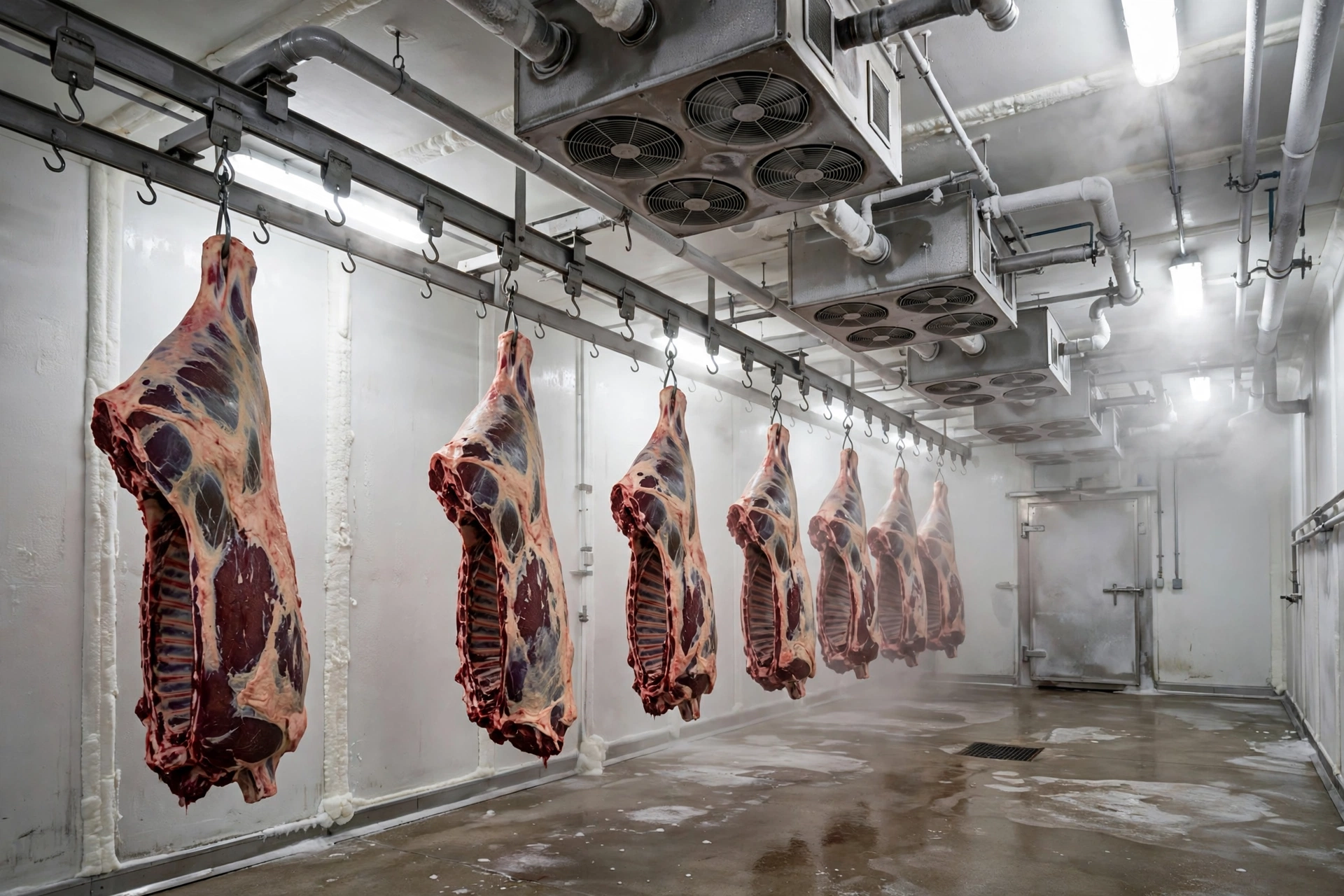
Refrigeration is the load that decides whether a meat plant survives an outage, and it is the load that most buyers size wrong. The mistake is to size refrigeration on running load. A chill room’s running load is modest — 30–50 kW for a room holding 300 carcasses. Its starting load is not. A screw compressor draws six to seven times its running current at start, and a refrigeration plant with four compressors can demand 1,500–2,000 kVA of starting capacity in the first three seconds if they all try to start together. No generator in the plant’s price range can supply that. The answer is not a bigger generator. It is staged starting: the controller starts one compressor, waits for it to settle, starts the next, and so on. A plant with staged starting can run a 400 kW refrigeration plant on a 650 kVA set. A plant without it needs a 1,000 kVA set for the same load.
The second mistake is to size refrigeration on the cold store and forget the blast freezer. A blast freezer is a different animal. It runs at −35°C to −40°C, it pulls product down from 7°C to −18°C in 18–24 hours, and its compressors run at full load for the whole cycle. A blast freezer that stops mid-cycle does not just pause. The product inside begins to thaw at the edges, and the freezer must be re-pulled from scratch when power returns — another 18–24 hours. A plant that loses a blast freezer load loses two days of freezing capacity, not two hours.
The chill room: why the first two hours decide everything
A chill room is a thermal battery. A full room holding 300 beef carcasses at 2°C contains roughly 90 tonnes of meat, and that mass holds its temperature well. The room gains 0.5–1°C per hour without cooling, slower if the doors stay shut and the room is full. Two hours without refrigeration is survivable. The carcasses warm from 2°C to 3–4°C, still inside the legal limit. Four hours is the boundary: the FDA Food Code’s four-hour rule and the EU’s 7°C core-temperature limit converge here. Eight hours is a condemnation. The carcasses nearest the door, where warm air leaks in, cross 7°C first. The ones in the middle follow. The veterinary inspector’s decision is not about the average temperature. It is about the warmest carcass in the room.
The rule that follows is simple: the chill rooms go on the essential board first, before anything else. Not the slaughter line. Not the offices. The chill rooms. A plant that backs up its chill rooms and nothing else can survive a 24-hour outage with its product intact. A plant that backs up its production lines and not its chill rooms loses its product in eight hours and its production in the same eight hours.
Blast freezers and cold stores
Blast freezers and cold stores are Tier 1 for the same reason, but they behave differently. A cold store holding finished product at −18°C to −22°C gains temperature slowly — roughly 0.3–0.5°C per hour without cooling, because frozen meat is a better thermal battery than chilled meat. A cold store can survive 12–24 hours without power if the doors stay shut. A blast freezer cannot. A blast freezer running a freezing cycle is pulling heat out of warm product, and when it stops, the product warms from the outside in. The outer 20–30 mm of a carton thaws first, and that is enough to fail a quality inspection. The product is not unsafe. It is unsaleable as frozen, and it must be sold as chilled at a lower price, or re-frozen at a quality loss.
The practical answer is to put the cold stores and the blast freezers on the same essential board as the chill rooms, and to accept that the generator must carry them all. The sizing and autonomy rules for cold storage backup power apply here in full — the freezer is a cold store that runs colder and harder. The alternative — leaving the freezers off the board and hoping the outage is short — is a gamble that pays off until the day it does not, and on that day it costs a cold store full of product.
Ammonia refrigeration and the compressor problem
Most meat plants run on ammonia. R717 is cheap, efficient and proven, and it is also toxic and flammable in the wrong concentration. An ammonia refrigeration plant is a controlled environment, and its safety systems — gas detection, ventilation, alarms — are Tier 1 loads in their own right. A plant that loses power to its ammonia detection system loses its ability to know whether it has a leak. The detection and ventilation systems draw only 5–10 kW, but they are the loads that protect people, and they go on the essential board before anything else.
The compressors themselves are the starting problem. A 110 kW screw compressor on direct-on-line start draws 660–770 kW of apparent power for two to three seconds. Three of them together draw more than 2,000 kVA. The solution is soft starters or variable-speed drives, and staged start logic in the generator controller. A soft starter cuts the starting current to three to four times running current. A variable-speed drive cuts it to barely more than running current, and it also lets the compressor run at part load when the plant is quiet — which is where a meat plant spends most of its night. The drive costs $8,000–$15,000 per compressor. It saves a full frame size on the generator, and it pays for itself in fuel within two years.
Cutting, Packing and the Production Floor
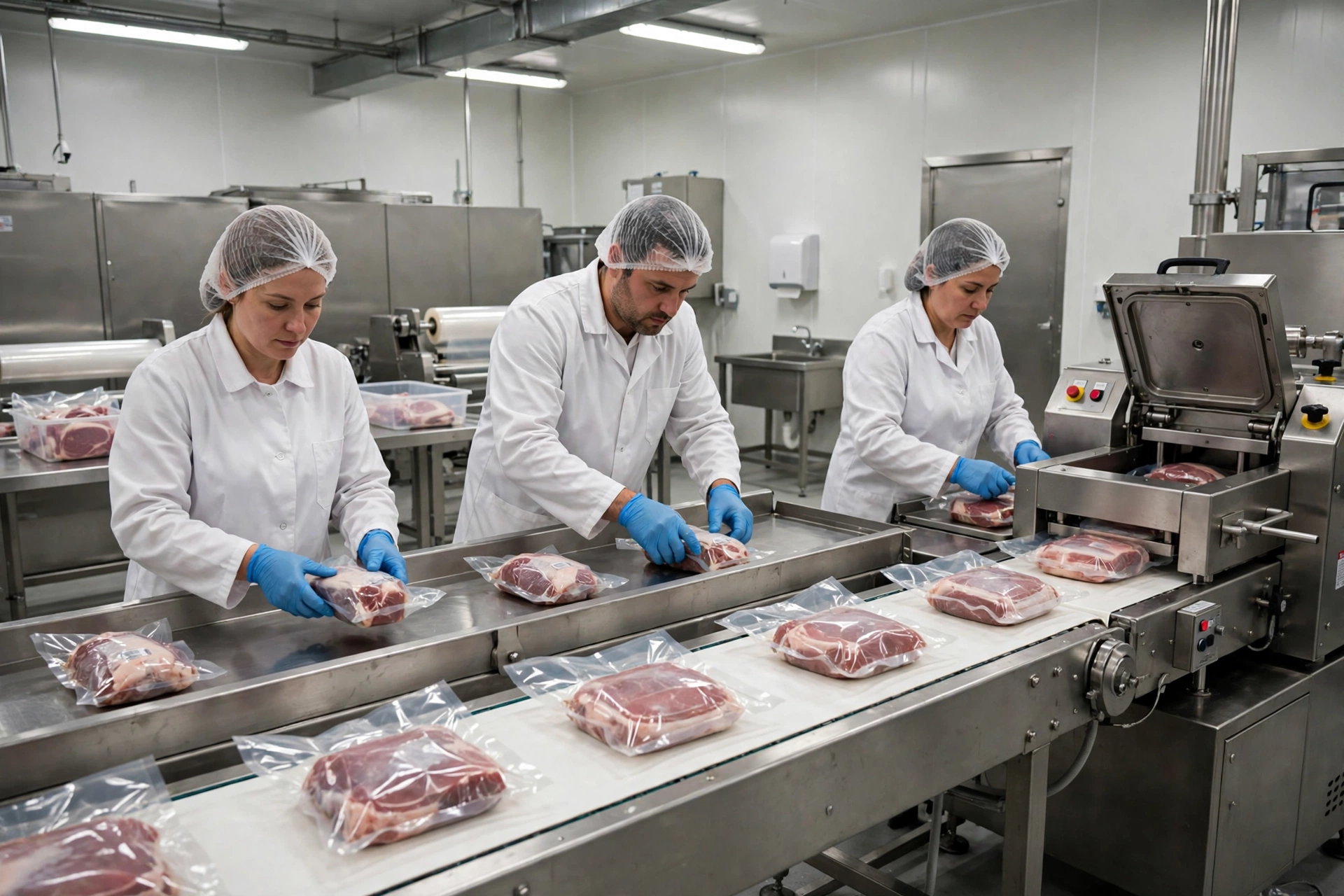
The production floor is where the plant makes its money, and it is also where the loads are most varied. The production-floor loads follow the same pattern as any food processing plant backup power design: many small motors, one large starting surge, and a controller that must stage them. A packing line is a set of vacuum packers, labellers and checkweighers, each with its own motor and its own starting surge. None of them is large. Together they are 100–200 kW in a regional plant, and they all try to start at once when the generator comes online — unless the controller stages them.
The hygiene rules shape the electrical design more than most buyers expect. Cutting rooms must stay at 12°C or below under EU rules, and the air-conditioning that holds that temperature is a Tier 1 load in summer. A cutting room that warms to 18°C is not just uncomfortable. It is outside its hygiene limit, and the plant’s HACCP plan will require the room to be cleared and re-cleaned before production resumes. The cutting-room cooling is 20–40 kW in a regional plant, and it is the load that most often gets left off the essential board — because it looks like air-conditioning, and air-conditioning is Tier 3. It is not. It is product protection.
The slaughter line stops in seconds
A slaughter line is a chain of small machines: stunners, bleed rails, hide pullers, evisceration stations, splitters and washers. Each draws 2–10 kW. Together they draw 40–70 kW in a regional beef plant. When power fails, the line stops in seconds, and the carcasses on the rail hang where they are. The damage is not to the meat. It is to the schedule. A line that stops for 30 minutes loses 30 minutes of production, and the plant’s daily throughput drops by the same amount. A line that stops for two hours loses two hours, and the plant cannot make it up — the cattle are already in the lairage, and the chill rooms are already full.
The restart is the expensive part. After an outage, the line must be cleaned and re-sterilised before it can run again. That is the CIP cycle, and it takes 45–90 minutes even when everything goes well. The plant’s real outage cost is not the outage. It is the outage plus the CIP cycle plus the reheat of the scald tanks plus the re-priming of the lines. A 10-minute outage costs a meat plant two hours of production. A one-hour outage costs it three.
Cutting, boning and packing
Cutting and boning lines are Tier 2 because they can stop safely, but they are also the loads that most often fail on restart. A bandsaw that stops mid-cut leaves a carcass half cut, and the cut must be finished by hand. A vacuum packer that stops mid-cycle leaves packs half sealed, and the packs must be opened, re-packed and re-sealed. A labeller that stops mid-label leaves a pallet of unlabelled product that must be re-run. None of these is a disaster. All of them cost time, and time is the one thing a meat plant cannot buy back.
The packing line’s real risk is the cold chain inside the room. Vacuum-packed meat is packed at 0–4°C, and the packing room’s cooling holds that temperature. If the room warms, the packed product warms with it, and the plant’s quality system will hold it. The packing room’s cooling is 15–30 kW, and it belongs on the essential board with the cutting-room cooling — for the same reason, and with the same justification.
Rendering, effluent and the loads nobody counts
Rendering and effluent treatment are the loads that nobody counts, and they are the loads that stop the plant when they stop. Rendering draws 40–80 kW of conveyors, crushers and cookers, and it runs on steam as much as on electricity. A rendering plant that stops for more than a few hours backs up the whole site, and the backlog takes days to clear. Effluent treatment draws 30–60 kW of pumps, aerators and screens, and it runs 24 hours a day. A plant that stops its effluent plant while it keeps slaughtering floods its own drains within the hour, and the environmental fine that follows is larger than the cost of the generator that would have prevented it.
Compressed air is the other forgotten load. A meat plant runs on compressed air: pneumatic tools, actuators, blow-off nozzles and packaging machines all need it, and the compressors draw 30–75 kW. A plant that leaves its air compressors off the essential board discovers, after its first real outage, that its production lines cannot run even when they have power — because the tools that run them have no air. The compressors belong on the essential board, with a staged start, and with a receiver large enough to ride through the 10 seconds between grid failure and generator power.
Fuel Autonomy, Hygiene and Placement
Fuel autonomy is the question buyers ask last and regret first. A meat plant’s generator does not run for an hour. It runs for a day, or for three days, or for as long as the grid is down. A regional plant running a 650 kVA set at 75% load burns roughly 90–110 litres an hour. A 24-hour outage burns 2,200–2,600 litres. A 72-hour outage burns 6,500–7,800 litres. The plant’s bulk tank must hold that, plus a margin, plus the fuel the plant’s own vehicles need. A plant with a 5,000-litre tank and a 72-hour outage runs dry on the second day. A plant with a 10,000-litre tank and a fuel delivery contract does not.
The fuel itself is a risk. Diesel in a standby tank ages, absorbs water and grows microbes, and a generator that has not run for six months can fail on its first real start because its fuel is bad. diesel fuel ageing is a slow problem with a sudden consequence, and the answer is fuel polishing, regular testing and a rotation policy that keeps the tank fresh. A plant that tests its fuel twice a year and polishes it once a year does not have a fuel problem. A plant that does neither discovers it at 2 a.m., in the middle of an outage, when the generator coughs and dies.
How much fuel a plant burns in a day
The table below gives the working numbers for a regional plant. These are 75%-load figures, which is where a well-sized generator runs during an outage. A set running at 50% load burns roughly 65% of its full-load fuel. A set running at 100% load burns its full-load figure, and it also wears faster.
| Generator size | Fuel at 75% load (L/h) | Fuel per 24 h (L) | Fuel per 72 h (L) | Tank for 72 h + margin |
|---|---|---|---|---|
| 250 kVA | 38–48 | 900–1,150 | 2,700–3,450 | 5,000 L |
| 500 kVA | 65–85 | 1,560–2,040 | 4,700–6,100 | 8,000 L |
| 750 kVA | 90–115 | 2,160–2,760 | 6,500–8,300 | 10,000 L |
| 1,000 kVA | 120–150 | 2,880–3,600 | 8,600–10,800 | 12,000 L |
| 2,000 kVA | 200–260 | 4,800–6,240 | 14,400–18,700 | 20,000 L |
The Cummins C500D5 datasheet gives the anchor point: 93.2 litres an hour at prime full load for a 500 kVA set. The rest of the table scales from that figure at roughly 0.19–0.21 litres per kVA-hour, which is the normal range for a modern turbocharged diesel at 75% load. A plant that knows its fuel burn knows its autonomy. A plant that does not is guessing, and the guess is usually optimistic.
Placement: outside the hygiene zone, close enough for a short cable run
A meat plant’s generator does not go inside the hygiene zone. It goes outside it, in a utility yard, on a bunded plinth, with a short cable run to the main switchboard. The reasons are hygiene and heat. A generator in a food hall is a contamination risk — dust, exhaust and oil mist have no place near open meat. A generator in a separate room is a heat problem — a 750 kVA set rejects roughly 350–400 kW of heat, and a room that cannot shed that heat cooks the set within the hour.
The cable run matters more than most buyers expect. A 750 kVA set at 400 V carries 1,080 amps. A 50-metre cable run at that current needs 2 × 240 mm² copper per phase, and it costs $8,000–$12,000 installed. A 150-metre run needs larger cable, more money, and a voltage drop that the plant will feel on motor starting. The generator belongs as close to the switchboard as the hygiene rules allow, and the switchboard belongs as close to the chill rooms as the building allows. Every metre of cable is money, and every metre of voltage drop is a failed compressor start.
The bund matters too. A meat plant’s generator sits on a bunded plinth with 110% containment, because a diesel spill in a food plant is a hygiene incident, not just a mess. The bund is inspected, the fuel lines are double-skinned or run in containment, and the tank is fitted with a high-level alarm. A plant that treats its fuel system as part of its hygiene system does not have a spill problem. A plant that treats it as an afterthought does — and the afterthought costs more than the bund ever did.
Washdown, steam and the wet-environment rules
A meat plant is a wet environment. Walls are washed down daily with high-pressure hoses. Steam fills the slaughter hall. Water runs across the floors. The generator’s electrical installation must survive that, and the rules are the same as anywhere wet: IP65 enclosures for outdoor equipment, IP54 minimum for the switchboard, cable glands that seal, and a generator room — if there is one — with drainage, ventilation and a floor that slopes away from the set.
The washdown rule has a second consequence: the generator must not be washed. A silent-canopy set is weatherproof, not hose-proof, and a high-pressure hose aimed at its louvres will drive water into the alternator and the control panel. The plant’s cleaning procedure must say so, in writing, and the cleaning crew must know it. A generator that has been hosed down is a generator that will fail on its next start, and the failure will look like an electrical fault until someone opens the panel and finds the water.
The steam rule is the same. A slaughter hall runs at 25–30°C with 80–90% humidity. A generator room next to it must be ventilated, and the generator’s air intake must not draw steam. A set that breathes steam corrodes its alternator windings and its control contacts, and the corrosion shows up as a starting failure six months later, on the night the grid goes down. Ventilation is not a comfort item. It is a reliability item, and the ventilation rules for a generator room are the same in a meat plant as anywhere else — sized on the set’s heat rejection, not on the room’s floor area.
Frequently Asked Questions
What size generator does a meat processing plant need?
A small abattoir needs 150–250 kVA, a regional beef or pork plant needs 400–800 kVA, and a large integrated plant needs 1,500–2,500 kVA. The size is set by refrigeration and starting surge, not by running load alone. A load list and a motor-starting calculation give the exact figure — the bands in this article are the starting point, not the quotation.
Do meat processing plants need a backup generator?
Yes, and the reason is the cold chain, not the production line. A meat plant without backup power loses its chill rooms within hours and its product within a day. The legal limits — 7°C core temperature under EU rules, four hours above 5°C under the FDA Food Code — turn a long outage into a condemnation. A generator is the cheapest insurance a meat plant buys.
How long can a meat processing plant run on a generator?
As long as its fuel lasts. A regional plant on a 650 kVA set burns 90–110 litres an hour, so a 10,000-litre tank gives roughly 72 hours of autonomy. The generator itself can run indefinitely on prime duty, with oil and filter changes at the manufacturer’s intervals. The limit is fuel, not the engine — which is why the tank size and the delivery contract matter as much as the set.
What happens to meat during a power outage in a processing plant?
The chill rooms start warming at 0.5–1°C per hour, the blast freezers stop mid-cycle, and the slaughter and cutting lines stop in seconds. Two hours is survivable. Four hours is the boundary — the FDA’s four-hour rule and the EU’s 7°C core-temperature limit converge here. Eight hours without cooling is a condemnation for the warmest carcasses in the room, decided by the veterinary inspector, not by the plant.
Can a diesel generator power a meat processing plant?
Yes. A diesel generator can power the whole essential board of a meat plant — chill rooms, blast freezers, refrigeration compressors, water treatment, slaughter and cutting lines, rendering and effluent treatment — provided it is sized on starting surge and the loads are staged on start. A plant that sizes on running load alone will find its generator tripping on the first compressor start. A plant that sizes on starting surge, with soft starters and staged start logic, runs cleanly for days.
Specification Checklist
Before ordering a generator for a meat processing plant, confirm each line below. A set that fails any one of them will fail on the night it matters.
| Check | What to confirm | Why it matters |
|---|---|---|
| Rating | Prime rating, not standby, if the set runs more than 200 hours a year | A standby set on prime duty wears out years early |
| Sizing | Sized on starting surge, with the largest compressor’s 6–7x inrush counted | Running-load sizing fails on the first compressor start |
| Staged starting | Controller stages compressors and production lines on start | Three compressors starting together collapse the voltage |
| Essential board | Chill rooms, freezers, compressors, water and effluent treatment, rendering, CIP | The loads that protect product, protect the line, or protect people |
| Fuel autonomy | Tank sized for 72 hours at 75% load, plus a delivery contract | A 24-hour tank and a 72-hour outage is a dry tank on day two |
| Fuel quality | Fuel tested twice a year, polished once a year, rotated | Bad fuel is the commonest cause of a failed start |
| Hygiene placement | Set outside the hygiene zone, on a bunded plinth, short cable run | A diesel spill in a food hall is a hygiene incident |
| Washdown rules | Cleaning procedure states the generator must not be hosed down | High-pressure water in the alternator is a failed start |
| Testing | Weekly start test under load, monthly load-bank test, batteries tested | A set that has not been tested is a set that has not been proven |
| Spares | Starting batteries, fuel and oil filters, belts, fuses and a spare AVR on site | The parts that fail are the parts that must be on the shelf |
A meat processing plant’s generator is not a purchase. It is a cold-chain decision. The plant that buys the right size, on the right rating, with the right loads on the essential board, keeps its product safe through an outage of any length. The plant that buys on price alone discovers the difference at 2 a.m., in the middle of an outage, when the chill room is warming and the generator will not start. Size it on the cold chain. Test it under load. Keep its fuel fresh. And when the specification is ready, contact PAVO for a quotation sized to the plant’s throughput, its refrigeration load and its fuel autonomy — not to its nameplate total.