

What Size Generator Does a Winery Really Need? | PAVO
In a winery, the grid does not fail at a convenient hour. It fails in the middle of crush, with tanks fermenting and a year’s crop on the line.
What size generator does a winery need? A 10,000-case winery typically needs a 150–250 kVA standby set to carry the crush pad, glycol chiller and barrel-room cooling through harvest. Smaller boutique wineries manage on 30–60 kVA, while a 100,000-case estate needs 800 kVA or more, usually as two paralleled sets.
- What a Winery Actually Loads
- The Fermentation Window: Why the First 48 Hours Decide the Vintage
- Sizing by Winery Size
- Three Wineries That Lost Power — and What It Cost
- Fuel Autonomy: How Long a Winery Can Run on a Generator
- Where to Put the Set: Rural Sites, Dust, Heat and Fire Season
- Frequently Asked Questions
- Specification Checklist
What a Winery Actually Loads
A winery’s electrical load looks nothing like a factory’s. There is no single big machine that dominates the bill. Instead the load is a stack of medium-sized motors and one large refrigeration plant, and the refrigeration plant is the part that cannot stop. An E-Source survey of United States wineries puts refrigeration at 37% of winery electricity, process equipment at 25%, compressed air at 9%, heating and cooling at 10% and lighting at 10%. More than 60% of the electricity goes to refrigeration and process equipment. Rutgers University’s winery energy work puts the same three blocks — refrigeration, compressed air and process equipment — at 68–84% of total energy in large wineries, with lighting and heating taking a bigger share only in small ones.
The load is also seasonal in a way few other industries match. Winemaking in California uses more than 400 GWh of electricity a year, the second-largest electricity-consuming food industry in the state, according to Lawrence Berkeley National Laboratory figures cited by the University of California, Davis. Most of that energy is spent in six to eight weeks. A winery that draws 40 kW on a quiet February afternoon can draw 150 kW on a September afternoon, with every tank fermenting at once. That is the load the generator has to carry, and it is the load most winery owners underestimate, because they size from the annual bill instead of the crush-week peak.
The crush pad
Crush is the loudest, busiest part of the year. Grapes arrive by the truckload, and the pad runs twelve to sixteen hours a day for six to eight weeks. A destemmer-crusher draws 5.5–11 kW, a must pump 3–7.5 kW, a basket or bladder press 7.5–15 kW, and the conveyors, sorting tables and augers add a few kilowatts each. None of these is large on its own. Together, with two or three machines running at once, the pad draws 25–40 kW at a mid-size winery.
The pad is also where the year’s work is most exposed. A 10,000-case winery crushes roughly 130 tonnes of grapes in a season, at about three to four tonnes a day. If the power fails at midday with a truck waiting and a press half full, the fruit sits in the sun. Grapes left in a hot press for hours start to oxidise and pick up wild yeast. The loss is not the electricity. It is the fruit, and the fruit cannot be re-crushed.
Fermentation cooling
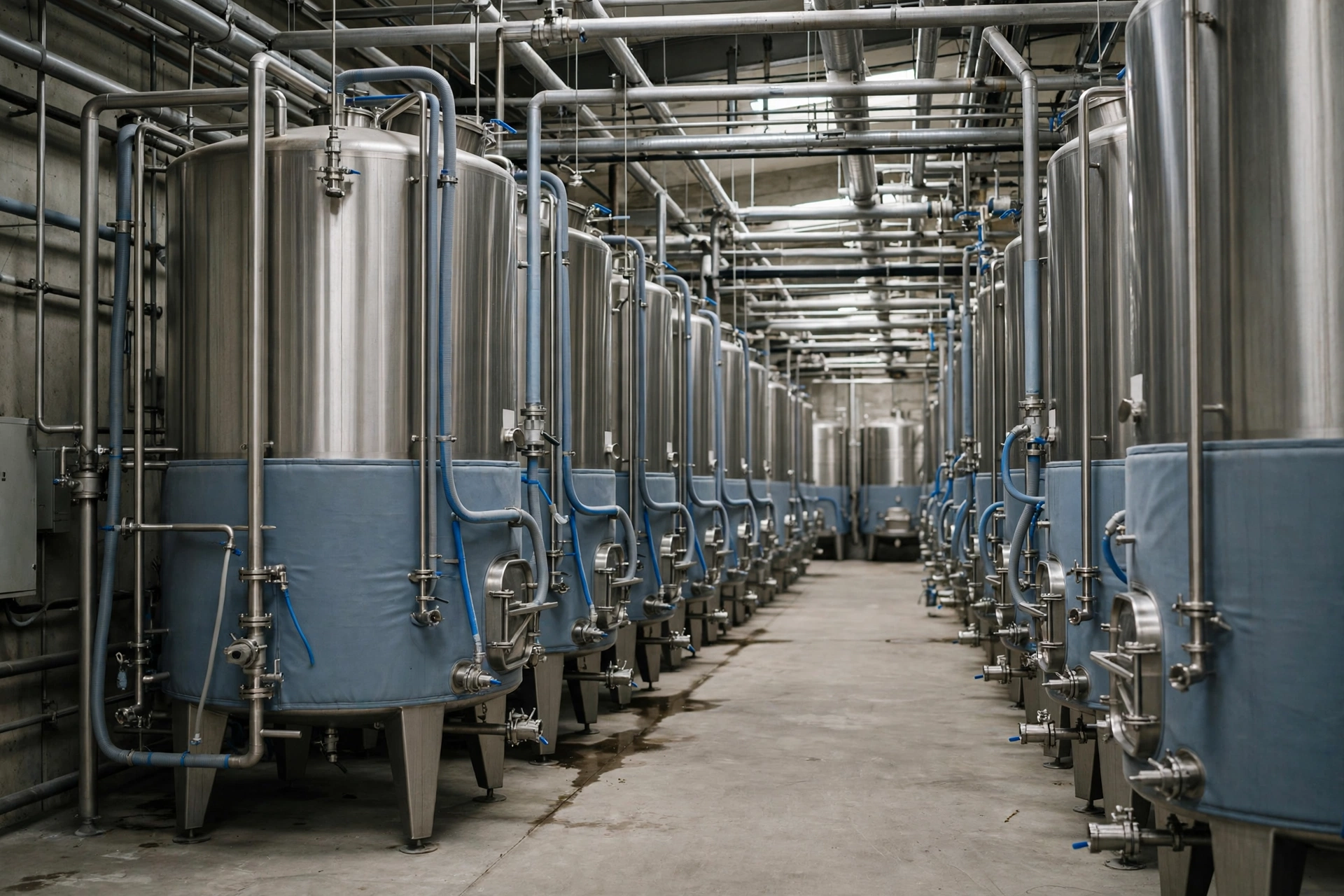
The glycol chiller is the largest single electrical load in most wineries, and it is the load that decides whether the wine survives an outage. Fermentation is exothermic: yeast turning sugar into alcohol releases heat, and a large tank generates that heat faster than its walls can shed it. The chiller removes it through glycol jackets on the tanks, holding each ferment within a degree or two of its target. A mid-size winery’s chiller draws 20–60 kW at peak, and it runs around the clock through the ferment, with the heaviest demand in the first two to three days after pitching.
Refrigeration runs hardest between August and November, during crushing and primary fermentation, and it never fully stops. Barrel rooms and tank farms need cooling all year. That is why the chiller, not the press, is the load to size around. A generator that can run the pad but not the chiller saves the grapes and loses the wine.
The barrel hall and cellar
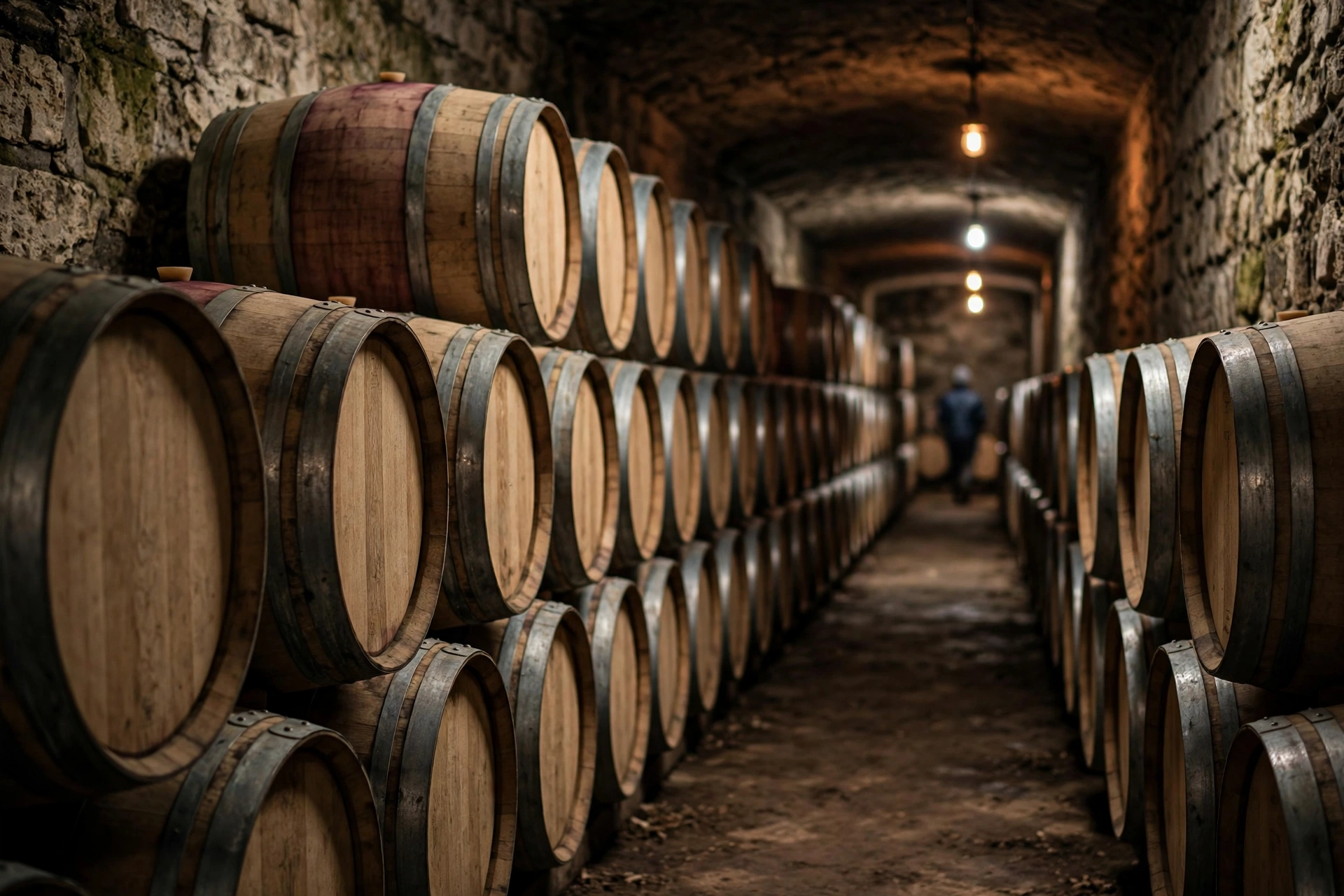
The barrel hall is a quieter load but a permanent one. A barrel room is held at about 13°C (55°F) and 70% relative humidity, year-round, and the cooling plant that holds it draws 5–15 kW depending on the size of the room and the insulation of the building. Racking pumps, topping pumps and lighting add a little more. The load is small, but the consequence of losing it is slow and expensive: wine held above 20°C for weeks ages fast, loses fruit and picks up volatile acidity. A barrel hall that warms up for a weekend is a nuisance. A barrel hall that warms up for a month is a write-off.
Unlike breweries, where a stalled ferment costs one batch, a winery’s barrel hall holds a year or more of production at once. A 5,000-barrel hall at 225 litres a barrel holds more than a million litres of wine. At $15 a bottle that is over $20 million of stock sitting in one room, kept sound by a cooling plant that draws less power than a domestic oven.
Bottling, packaging and the tasting room
Bottling is a batch load, and that is useful. A bottling line — filler, corker, labeller, capsule spinner — draws 15–25 kW while it runs, and the compressed air plant behind it draws 5.5–11 kW. The forklift charger, the water pumps and the wastewater plant add a few kilowatts more. The tasting room, with its heating, cooling, lighting, point-of-sale terminals and refrigeration, draws 10–20 kW on a busy Saturday.
The practical point is that bottling can wait. If the generator is short of capacity, the bottling line is the first load to shed, not the chiller. A winery that schedules bottling for the weeks after crush, and keeps it off the generator’s peak, can buy a smaller set than a winery that tries to run everything at once. The load list in the sizing section below is built on that principle: protect the ferment first, the barrel hall second, and everything else when there is capacity to spare.
The Fermentation Window: Why the First 48 Hours Decide the Vintage
Fermentation is a live biological process, and that is what makes a power cut in a winery different from a power cut anywhere else. When the power fails in a warehouse, the lights go out and the work stops. When the power fails in a winery during ferment, the cooling stops but the heat does not. The yeast keeps working, the temperature keeps climbing, and the wine keeps changing while nobody can do anything about it.
The numbers are unforgiving. A must at 22°Brix can rise 25°C above its starting temperature if no heat is removed, according to Yair Margalit’s reference work on wine chemistry. Each degree Brix of sugar fermented releases about 1.14 kcal of heat. Emile Peynaud put it another way: fermenting 100 grams of sugar has the potential to raise the temperature of one litre of water by 30°C. A tank does not need a heatwave to overheat. It generates its own.
Red and white ferment at different temperatures
Red and white wines ferment at different temperatures because they are made for different things. Red wine ferments with its skins, and heat helps extraction: colour, tannin and flavour compounds move from skin to wine faster as the temperature rises. White wine ferments without skins, and its value is in volatile aromatics that heat destroys. The two styles therefore need different cooling, and a power cut hurts them in different ways.
| Wine style | Fermentation temperature | What happens if it rises |
|---|---|---|
| Red, Cabernet and Syrah | 20–32°C | Volatile acidity, cooked fruit, loss of fresh character |
| Red, Pinot Noir | 20–26°C | Loss of delicate esters and spice |
| White, Chardonnay and Sauvignon Blanc | 12–22°C | Aroma stripped, higher alcohols, harsh finish |
| Rosé | 12–18°C | Sluggish yeast, reduction, flat fruit |
A white ferment that drifts from 14°C to 24°C loses the aromatics that define the wine. A red ferment that drifts from 28°C to 38°C risks stopping altogether. The window is narrow, and the glycol system is the only thing holding it.
The heat a ferment makes
The heat load peaks 24–72 hours after pitching, when yeast activity is at its highest. A worked example from fermentation-cooling engineering puts the scale in plain terms: a 10,000 kg ferment at 22% sugar, with 10% of its sugar fermenting per hour at peak, releases about 14.4 kW of heat that the cooling system has to remove. That is one tank, at one moment, in the middle of the night. A winery with six tanks at the same stage needs 85 kW of cooling at the same moment, and the chiller that provides it draws roughly 30–40 kW of electricity.
Glycol supply temperatures tell the same story. White wine fermentation typically takes glycol at −2 to 2°C; red wine takes it at 8–12°C. The chiller is not a comfort-cooling unit. It is process equipment, sized to hold a ferment within ±1°C, and it has to keep doing that through the hottest nights of the year, when the ambient temperature is highest and the grid is most likely to fail.
What a stuck fermentation costs
Yeast is stressed above 33°C, severely stressed above 45°C, and at 50°C some 99% of viable yeast cells die within five minutes. Below 5°C the yeast goes dormant. Between those two edges, a ferment that gets too hot does not simply slow down. It sticks: the yeast stops, the sugar stays, and the wine is left sweet, unstable and vulnerable to spoilage organisms. Malolactic fermentation, which softens the wine after the primary ferment, runs best at 20–25°C and stalls below 18°C, so a cold snap after an outage can stall the second ferment as well.
A stuck ferment can sometimes be restarted with fresh yeast, nutrients and patience. Sometimes it cannot, and the tank is blended down, distilled or discarded. Put a price on it: a 10,000-litre tank of Cabernet is 13,333 bottles. At $15 a bottle that is $200,000 of retail value in one tank. A winery with ten tanks fermenting at once has $2 million of wine in a process that depends entirely on a chiller that draws less power than a small car. That is the arithmetic behind the generator.
Sizing by Winery Size
Size the set from the crush-week load list, not the annual average. The annual average is a trap: it blends six frantic weeks with forty-six quiet ones and produces a number that is too small for the only weeks that matter. Work the numbers the way a generator sizing guide lays them out — running load first, then starting load, then a margin — and size for the hour when the press, the chiller and the barrel-room cooling are all running at once.
| Annual production | Crush-week peak load | Recommended standby set |
|---|---|---|
| Boutique, 2,000 cases | 25–45 kW | 30–60 kVA |
| Small, 5,000 cases | 50–90 kW | 60–125 kVA |
| Medium, 10,000 cases | 100–180 kW | 150–250 kVA |
| Large, 25,000 cases | 200–320 kW | 250–400 kVA |
| Estate, 50,000 cases | 320–640 kW | 400–800 kVA |
| Industrial, 100,000+ cases | 640–1,200 kW | 800–1,500 kVA, usually two sets |
The bands are wide because wineries differ. A winery that bottles on site, runs a restaurant and heats its tasting room with electricity sits at the top of its band. A winery that crushes and ferments only, and bottles off site, sits at the bottom. The only way to land on the right number is a load list taken from the actual equipment nameplates, not from a rule of thumb.
Sizing bands by annual production
Energy benchmarks give a cross-check on the load list. A survey of English wine production put the average at 0.557 kWh per litre of wine produced, with a range from 0.040 to 2.065 kWh per litre across the wineries surveyed. A 10,000-case winery makes 90,000 litres a year, so about 50 MWh a year at the average. A study of an Italian Prosecco cellar put the cellar’s own energy demand at 5–16 kWh per hectolitre, and found that cooling can be up to 90% of a cellar’s total energy. The two studies measure different boundaries, but they agree on the point that matters: cooling is the load, and crush is when it peaks.
Worked example: a 10,000-case winery
Take a 10,000-case winery in a warm climate, crushing 130 tonnes over six weeks, fermenting in stainless steel, ageing in oak, and bottling on site. The load list, from equipment nameplates, looks like this:
| Load | Running power |
|---|---|
| Destemmer-crusher | 7.5 kW |
| Must pump | 5.5 kW |
| Press | 11 kW |
| Glycol chiller | 40 kW |
| Barrel-room cooling | 10 kW |
| Bottling line | 20 kW |
| Compressed air | 7.5 kW |
| Water and wastewater pumps | 5 kW |
| Tasting room, lighting and HVAC | 12 kW |
| Total, everything running | 118.5 kW |
Everything never runs at once. Apply a diversity factor of 0.85 and the realistic peak is about 100 kW. Add the motor starting allowance for the chiller compressor, which draws five to seven times its running current at start, and the set needs to be a 200 kVA standby unit, roughly 160 kW of usable power with headroom. An automatic transfer switch moves the load in under ten seconds, so the ferment never notices the gap. Check the standby and prime ratings before ordering: a 200 kVA standby set is typically around 180 kVA on prime duty, and a winery that runs the set for days at a time during a long shutoff is running it closer to prime than to standby.
Motor starting and the chiller problem
The chiller is the starting problem. A 40 kW chiller compressor draws 200–280 kW for a fraction of a second at start, and a generator sized only for running load will dip in voltage, stall the compressor or trip on overload. Three fixes exist, and a good specification uses at least two of them. A variable-speed drive or soft starter on the compressor cuts the starting draw to two to three times running current. A load-sequencing controller starts the chiller first, waits for it to settle, then adds the press and the pumps one at a time. And the set itself is sized with the starting load in the calculation, not added as an afterthought. A winery that buys a set on running load alone discovers the problem on the first hot night of crush, when the chiller tries to start and the generator cannot hold the voltage.
Three Wineries That Lost Power — and What It Cost
Fisher Vineyards, Calistoga — the 2019 shutoffs
In October 2019, the Kincade Fire burned through Sonoma County and Pacific Gas and Electric cut power to nearly 1 million customers to stop its lines starting more fires. Fisher Vineyards, a family winery in Calistoga, was not in the path of the fire. Its power went out anyway. The family had just built a new barrel room, and the room has to be held at 55°F to keep the wine sound. With the grid down and no notice of when it would return, the winery retrofitted its facilities with propane-fuelled backup generators to keep harvest, processing and fermentation running.
The winery’s chief executive, Rob Fisher, put the stakes plainly: during harvest, 100% of the winery’s value is coming through the building. The shutoffs came with little or no notice of when power would go off or come back. A winery in that position cannot plan around the outage. It can only be ready for it, and being ready means a generator that is already installed, already fuelled and already tested — not a rental booked after the lights go out.
Beaulieu Vineyard, Rutherford — two sets, sized for the risk
Beaulieu Vineyard, founded in 1900 in the heart of Napa Valley, reached the same conclusion from the other direction. Its directors calculated that thousands of gallons of priceless inventory could be ruined during an extended outage, and bought two Generac diesel generator sets: an 800 kW unit that backs up the winery and its operational equipment, and a 300 kW unit dedicated to the refrigeration system that keeps the wine preserved. The larger set runs through a 2,000-amp transfer switch, the smaller through a 600-amp switch, and the temperature control system runs constantly, all year.
The Beaulieu specification is the model for a large winery: split the load, protect the refrigeration on its own set, and size the main set for the whole operation. The 800 kW set is roughly 1,000 kVA. It is a large machine, and it is large because the winery it protects is large. A winery that tries to protect a million litres of wine with a set sized for a house will find out, in the first hour of an outage, that it bought the wrong machine.
The Glass Fire, Napa — 31 wineries damaged in 23 days
The Glass Fire started at 3:48 a.m. on 27 September 2020 near St. Helena and burned for 23 days, covering 67,484 acres and destroying 1,555 structures. Thirty-one wineries, restaurants and lodges in the region were damaged or destroyed. Chateau Boswell was destroyed outright. Burgess Cellars on Howell Mountain was completely destroyed. Castello di Amorosa, the castle winery near Calistoga, lost its wine warehouse and about $5 million of wine. The Restaurant at Meadowood, a three-Michelin-starred restaurant, burned to the ground on 28 September.
The fire did more than burn buildings. Smoke taint left 8% of the season’s wine grapes unharvested as unusable, and several wineries decided not to produce a 2020 vintage of some or all of their red wines. The 2017 fires had already burned six Napa wineries. A generator cannot stop a wildfire, and no honest specification claims it can. What a generator does in fire season is narrower and still valuable: it keeps the ferment cool, the barrel hall at temperature and the pumps running while the grid is down for days, so that the wine that was not burned is not lost as well.
Domaine Carneros — the microgrid answer
Domaine Carneros, a sparkling wine house in Napa Valley, took the third route: a microgrid. A 250 kW solar array and a 280 kW / 540 kWh battery system, run by Schneider Electric’s EcoStruxure microgrid platform, let the winery island itself from the grid entirely. The winery now self-generates 70–80% of its energy, cuts carbon emissions by 375 tonnes a year, saves more than $70,000 a year in energy costs, and cuts its diesel generator use by up to 70% during outages, stretching its fuel reserves to as much as a week.
The microgrid does not replace the generator. It changes what the generator has to do. The battery carries the winery through the first hours of an outage and through the night, when the load is low. The generator starts only when the battery runs down, and runs at its most efficient load while the solar recharges the battery during the day. For a winery with the capital and the roof space, that combination is the most resilient answer available. For a winery without it, a well-sized diesel set on its own is still the answer that works.
Fuel Autonomy: How Long a Winery Can Run on a Generator
A generator is only as good as its fuel. A winery that buys a 200 kVA set and a 500-litre tank has bought about twenty hours of power at harvest load, and a Public Safety Power Shutoff in California commonly lasts two to five days. The tank is the part of the specification that gets cut first, because it is the least visible, and it is the part that decides whether the winery is still running on the third day of an outage.
Fuel use by set size
Diesel consumption tracks load, not set size. A useful rule is about 0.21 litres of diesel per kilowatt-hour at 75% load, and the manufacturer’s datasheet gives the exact figures for the set in question. A Cummins C500D5, a 500 kVA standby / 455 kVA prime set, burns 93.2 litres an hour at full prime load, 69.9 litres an hour at 75% load and 49.0 litres an hour at 50% load.
| Set size | Typical load | Fuel use |
|---|---|---|
| 60 kVA | 36 kW | about 8 litres per hour |
| 125 kVA | 75 kW | about 16 litres per hour |
| 200 kVA | 120 kW | about 25 litres per hour |
| 400 kVA | 240 kW | about 50 litres per hour |
| 500 kVA, Cummins C500D5 | 341 kW at 75% load | 69.9 litres per hour |
Sizing the tank for 24, 48 and 72 hours
Take the worked example: a 200 kVA set carrying 120 kW at harvest, burning about 25 litres an hour. Twenty-four hours needs 600 litres. Forty-eight hours needs 1,200 litres. Seventy-two hours needs 1,800 litres. A 2,000-litre bulk tank covers three days with a margin, and it is the minimum a winery in a shutoff-prone area should accept. A sub-base tank under the set, typically 500–1,000 litres, covers the first day and buys time for a delivery. A winery that relies on a sub-base tank alone is betting that a fuel truck can reach it during a wildfire, which is a bet that has lost before.
The tank also needs a diesel fuel ageing plan. A standby set’s fuel sits for eleven months a year, and diesel that sits absorbs water, grows microbes and drops sediment. Fuel polishing and testing before each crush, a water drain at the bottom of the tank and a biocide dose where the climate demands it are part of the specification, not an afterthought. A generator that starts on the first day of crush and stops on the second because its fuel is contaminated has failed in the most expensive possible way.
Renting a set for harvest
Renting is the alternative, and the 2019 shutoffs showed its limits. Wineries that tried to rent generators in the middle of harvest paid about $1,500 a day for a set large enough to run crushing equipment and hold fermentation tanks at temperature, plus construction and installation fees, and many could not get a set at all. The rental market in wine country is small, and every winery in the valley wants the same machine in the same week.
A rental booked in July costs a fraction of one booked in October, and a rental that arrives before crush can be tested under load, which is the only test that matters. For a winery that cannot justify owning a set, a pre-booked seasonal rental with a fuel contract is a real option. For a winery that can justify owning one, the rental market is the backup plan, not the plan.
Where to Put the Set: Rural Sites, Dust, Heat and Fire Season
Wineries sit at the end of rural power lines, on hillsides, at the end of dirt roads. That is part of their charm and most of their power problem. The grid connection is long, exposed and last on the repair list. The generator has to be sited for that reality, not for a suburban industrial estate.
Placement and access
Put the set on a level concrete pad, with a metre of clear space on all sides for service, and with the exhaust and the radiator discharge pointed away from the tasting room and the barrel hall. The fuel delivery truck needs to reach the tank: a 10,000-litre tanker needs turning room and a firm surface, and it will not come down a muddy track in the rain. Drainage matters too. A pad that floods in the first storm of winter will have its set standing in water, and a generator in standing water is a generator that does not start.
Noise at the tasting room
A silent-canopy set runs at 65–75 dB(A) at seven metres. That is quiet for a generator and loud for a tasting room, where the target indoors is below 45 dB(A). Put the set 30–50 metres from the tasting room, behind a wall or a bank, and test it during a tasting, not at noon on a Tuesday when the room is empty. Guests who can hear a diesel engine over the winemaker’s description of the vintage will remember the engine, not the wine. A winery that hides its generator well has solved a problem its visitors never know existed.
Fire season and fuel delivery
Fire season changes the rules. Keep 72 hours of fuel on site, because the roads may be closed and the fuel truck may not come. Clear 10 metres of vegetation around the set and the fuel tank, fit ember-resistant vents on any enclosure, and keep the set itself clean: a generator caked in dust and dry leaves is a fire risk, not a fire defence. Follow a maintenance schedule that tests the set under load every month, and log the hours, the oil pressure and the coolant temperature, so that the set that has to run for five days in October is a set that is known to work, not a set that is hoped to work. Unlike distilleries, where the stills run on gas or steam and the generator is a supporting player, a winery’s generator is the only thing standing between the ferment and the heat. It deserves the same attention as the wine.
Frequently Asked Questions
What size generator does a winery need?
A 10,000-case winery typically needs a 150–250 kVA standby set to carry the crush pad, glycol chiller and barrel-room cooling through harvest. A boutique winery of 2,000 cases manages on 30–60 kVA, and a 100,000-case estate needs 800 kVA or more, usually as two paralleled sets. Size from the crush-week load list, not the annual average.
Do wineries need a backup generator?
Yes, if the winery ferments or ages wine on site. Fermentation is a live process that generates its own heat, and a power cut that stops the cooling can stall or kill the ferment within hours. Wineries in shutoff-prone areas such as California’s wine country treat a generator as part of the winemaking equipment, not as an optional extra.
How long can a winery run on a generator?
As long as the fuel lasts. A 200 kVA set at harvest load burns about 25 litres an hour, so a 2,000-litre tank gives roughly three days. A set on a sub-base tank alone runs for less than a day. Size the tank for 72 hours and keep a fuel supplier on the crush-season call list.
What happens to a winery during a power outage?
The crush pad stops, the pumps stop and, most seriously, the glycol chiller stops while the ferment keeps generating heat. A white ferment loses its aromatics as the temperature climbs; a red ferment risks a stuck fermentation if the yeast dies. The barrel hall warms slowly, and a long outage in fire season can also close the roads that fuel trucks need.
Can a diesel generator power a winery?
Yes. Diesel sets from 30 kVA to 1,500 kVA cover every size of winery, from a boutique cellar to a 100,000-case estate, and the standard package is a silent-canopy set with an automatic transfer switch and a bulk fuel tank. The set has to be sized for the chiller’s starting current, not just its running load, and tested under load before crush.
Specification Checklist
- Size the set from the crush-week load list, taken from equipment nameplates, not from the annual electricity bill.
- Rate the set on standby duty and confirm the prime rating for multi-day shutoffs.
- Specify a glycol chiller with a variable-speed drive or soft starter to cut the starting current.
- Fit an automatic transfer switch with a ten-second transfer and a weekly self-test.
- Size the fuel tank for 72 hours at harvest load, with a sub-base tank for the first day.
- Test and polish the fuel before each crush, and drain water from the bottom of the tank.
- Put the set 30–50 metres from the tasting room, behind a wall or a bank, and test the noise during a tasting.
- Keep ten metres of cleared ground around the set and the fuel tank in fire season.
- Test the set under load every month, and log the hours, oil pressure and coolant temperature.
- Keep a rental contact and a fuel supplier on the crush-season call list, booked before harvest starts.
A winery’s generator is bought once and judged once a year, in the six weeks when a whole year’s value passes through the crush pad. Size it for the ferment, not the average, and test it before the grapes arrive. For a set matched to the winery’s production, crush load and fire-season fuel plan, contact PAVO for a specification and a quotation.