

What Size Generator Does a Garment Factory Need | PAVO
A garment factory does not lose money the way a warehouse does. It loses a ship date — and the ship date is the order.
What size generator does a garment factory need? A small workshop with 100 sewing machines runs on 100–150 kVA, a mid-size factory with 500 machines on 250–500 kVA, and a large factory with dyeing on 1,000–2,000 kVA. Size it from the sewing, cutting, dyeing and finishing loads — not the building’s total connected load.
Contents:
- What a Garment Factory Actually Runs on Power
- Sizing Bands by Factory Size
- The Order That Cannot Miss Its Ship Date
- Motor Starting and Power Quality on the Sewing Floor
- Dyeing, Steam and the Boiler That Needs Power Too
- Fuel Autonomy: How Long the Factory Can Run
- Frequently Asked Questions
- Specification Checklist
What a Garment Factory Actually Runs on Power
A garment factory is a process plant with a thousand small motors instead of a few large ones. The cutting room, the sewing floor, the dyehouse, the finishing section and the boiler house all run at the same time, and most of them cannot be paused mid-cycle without scrapping work. The generator is sized for the process, not for the building.
The load list below covers a typical cut-and-sew factory with in-house washing and dyeing. Spinning and weaving are upstream of the garment factory and are covered in the textile mills guide; this article starts where the fabric arrives. A factory that buys dyed fabric and only cuts and sews drops the dyehouse rows entirely. A denim laundry adds stone-washing and ozone. The numbers are the running loads a buyer should collect from equipment nameplates before any sizing conversation starts.
| Equipment | Typical size | Duty |
|---|---|---|
| Single-needle lockstitch machine, servo motor | 0.4–0.55 kW each | Intermittent |
| Overlock / interlock machine | 0.4 kW each | Intermittent |
| Buttonhole / button attaching machine | 0.4–0.75 kW each | Intermittent |
| Straight-knife cutting machine | 1.1 kW | Intermittent |
| Automatic CNC cutter (Lectra / Gerber) | 3–7 kW + vacuum | Intermittent |
| Fabric spreading machine | 1.5–3 kW | Intermittent |
| Steam iron / pressing station | 1.5–3 kW each | Intermittent |
| Fusing press | 6–12 kW | Intermittent |
| Jet dyeing machine | 15–37 kW motor + steam | Batch |
| Industrial washing machine | 15–50 kW | Batch |
| Hydro-extractor | 7.5–15 kW | Batch |
| Stenter / fabric dryer | 15–30 kW + steam | Continuous |
| Air compressor | 15–37 kW | Intermittent |
| Steam boiler auxiliaries (pumps, fan, controls) | 10–30 kW | Continuous |
| Needle detector, CAD room, servers, QC lab | 5–15 kW | Mixed |
| Lighting, fans, HVAC, packing lines | 30–120 kW | Continuous |
Two loads surprise first-time buyers. The first is the sewing floor itself. One machine draws only 0.4–0.55 kW, so it looks trivial on a load list. A floor with 1,000 machines draws 400–550 kW at full simultaneity, and even at a realistic 60–65% diversity factor it still draws 260–360 kW — more than the rest of the factory combined. The second is steam. The boiler is fired by gas or diesel, but its feedwater pumps, burner fan, controls and condensate system all need electricity. Without them, there is no steam for ironing, pressing, fusing or dyeing, and the whole finishing section stops.
Cutting
Cutting is the first process and the first place a power cut does damage. A lay — a stack of 50 to 200 plies of fabric spread on the cutting table — takes 30 to 90 minutes to spread, and the straight-knife or CNC cutter then cuts it in one pass. Stop the cutter halfway through a lay and the cut pieces no longer match: the top plies are cut, the bottom plies are not, and the whole lay has to be re-spread or scrapped. A 100-ply lay of shirting fabric represents 800–1,200 shirt fronts. The cutting room load is small — a straight-knife cutter draws 1.1 kW, an automatic cutter 3–7 kW — but the cost of an interrupted lay is measured in fabric, not in kilowatts.
The Sewing Floor
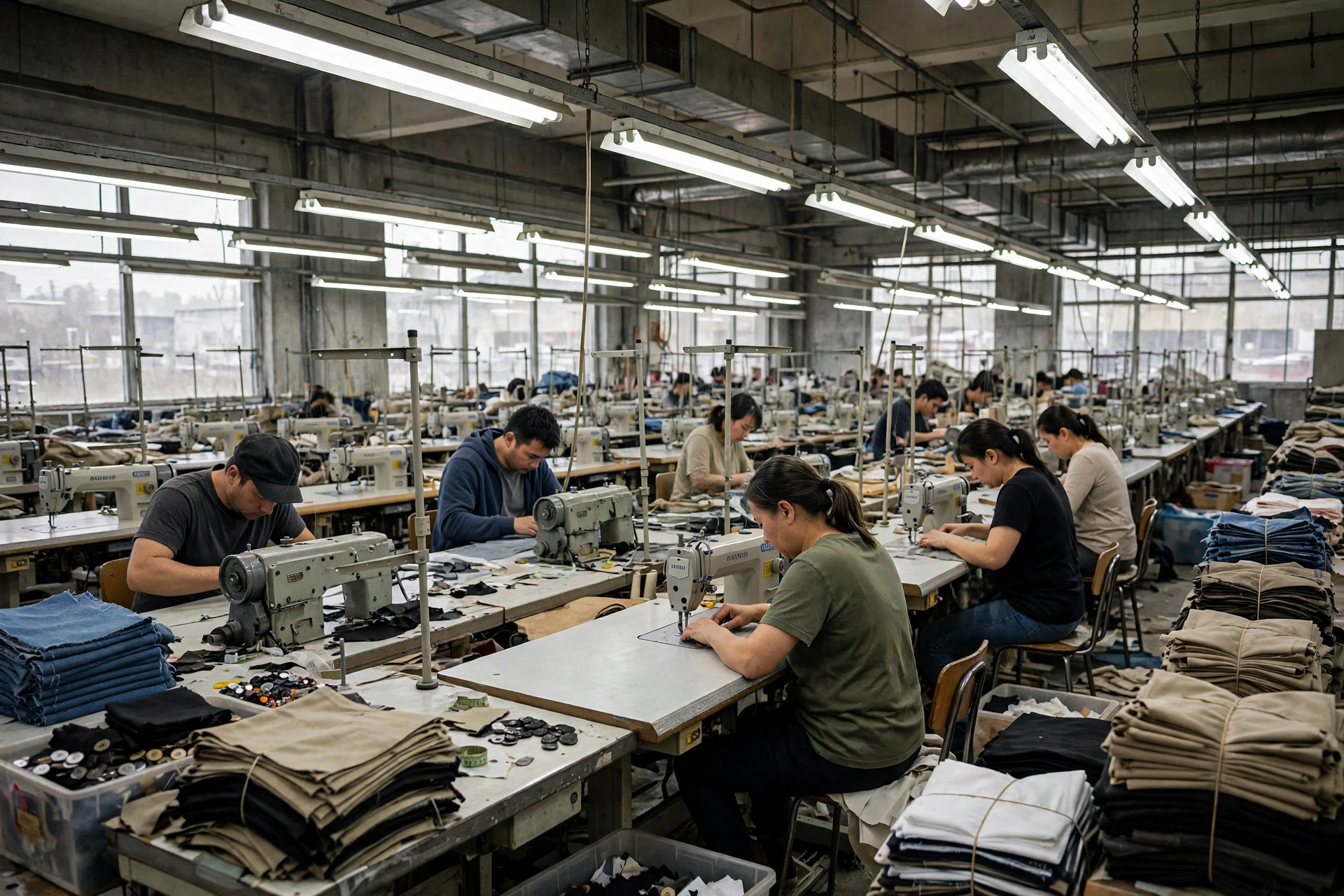
The sewing floor is where the factory earns its money, and it is where the generator earns its keep. A single-needle lockstitch machine with a modern servo motor draws 400–550 W while sewing and 30–60 W at idle. The old clutch motors it replaced drew 400 W continuously whether the needle was moving or not, so the servo conversion that swept the industry in the 2010s cut sewing-floor power by roughly a third. What it did not change is the arithmetic: 500 machines at 60% diversity draw 120–165 kW; 1,000 machines draw 240–330 kW; 2,000 machines draw 480–660 kW.
The sewing floor also sets the power-quality bar. Servo motors are sensitive to voltage dips and frequency swings in a way the old clutch motors were not. A dip below 190 V on a 220 V single-phase circuit, or a frequency swing beyond ±2 Hz, trips the servo drives and stops the line. The generator, the alternator and the AVR have to hold voltage and frequency inside those limits under a step load, or the set is protecting the factory on paper and tripping it in practice.
Dyeing and Washing
Dyeing and washing are batch processes, and batch processes are the least forgiving loads in the factory. A jet dyeing machine holds 300–500 kg of fabric in a liquor bath at 120–130 °C, circulating it continuously through the dye. The circulation pump motor draws 15–37 kW, and the steam coil holds the temperature. Stop the pump and the fabric sits still in hot liquor. Within 30 minutes the dye strikes unevenly, crease marks set into the cloth, and the batch comes out as seconds — sold at a discount, or scrapped. A 500 kg batch of cotton jersey is worth $2,000–4,000 in fabric alone, before the labour and the dye chemicals.
Washing is the same story at lower temperature. An industrial washing machine draws 15–50 kW, and a hydro-extractor 7.5–15 kW. A wash cycle interrupted mid-rinse leaves garments waterlogged in the drum, and a denim stone-wash interrupted mid-cycle leaves a load that cannot be matched to the approved shade. The dyehouse and the laundry do not need the largest generator in the factory. They need a generator that starts, takes load, and stays on — because a 10-minute gap is enough to ruin a batch.
Finishing and Packing
Finishing is the bottleneck at the end of the line, and it is almost entirely steam and heat. Each pressing station draws 1.5–3 kW for its steam iron, a fusing press draws 6–12 kW, and a factory with 40 pressing stations and 4 fusing presses carries 84–168 kW of finishing load. The needle detector at the end of the line draws almost nothing, but it is a buyer requirement: no garment ships without passing metal detection, and the detector needs power, a stable supply, and a calibrated test piece every hour.
Packing is the lightest load in the factory — conveyors, carton sealers, strapping machines and the warehouse lighting, typically 10–25 kW. It is also the load that decides whether the ship date is met. A factory that sews 20,000 pieces a day and cannot pack them is a factory that misses its container booking.
Sizing Bands by Factory Size
The bands below are for a cut-and-sew factory at 50 Hz, 400 V three-phase, with a 0.8 power factor. They assume a standby-rated set sized at the peak essential load, with 20% headroom for growth. A factory that buys dyed fabric and has no dyehouse sits one band lower. A factory with in-house dyeing and washing sits one band higher.
| Factory size | Sewing machines | Typical essential load | Generator band |
|---|---|---|---|
| Small workshop | 50–150 | 60–100 kW | 100–150 kVA |
| Mid-size factory | 300–600 | 180–350 kW | 250–500 kVA |
| Large factory | 1,000–1,500 | 500–800 kW | 750–1,250 kVA |
| Integrated factory with dyehouse | 2,000+ | 1,000–1,600 kW | 1,500–2,500 kVA |
A 500-machine factory is the most common size in the export trade, and it is the size most often undersized. The arithmetic runs like this. Sewing: 500 machines × 0.55 kW × 65% diversity = 179 kW. Cutting: 10 kW. Pressing and fusing: 20 stations × 2 kW + 2 presses × 9 kW = 58 kW. Air compressor: 22 kW. Lighting, fans and HVAC: 60 kW. Packing and QC: 15 kW. Boiler auxiliaries: 20 kW. Total essential load: 364 kW, or 455 kVA at 0.8 power factor. Add 20% growth headroom and the answer is a 500 kVA standby set — a Cummins 6LTAA8.9-G2 or Weichai WP10 frame, running at 73% of its standby rating at peak load.
The mistake is to size from the connected load. The connected load of that same factory is 600–700 kW, because it counts every machine at full rating at the same time. Sized that way, the buyer orders an 800–1,000 kVA set, pays 40–60% more for the machine, and then runs it at 40–50% load for its whole life — the exact range where wet stacking, carbon build-up and glazed cylinder bores start. The generator sizing guide gives the full load-list method; the bands above are the shortcut for a first conversation.
The second mistake is the opposite one: sizing from the sewing floor alone and forgetting the steam. A factory that sizes a 250 kVA set for its 500 machines and forgets the 58 kW of pressing, the 22 kW compressor and the 20 kW of boiler auxiliaries discovers the error on the first real outage, when the set takes the sewing load, the pressing stations come on, and the breaker trips. The generator did not fail. The load list did.
The Order That Cannot Miss Its Ship Date
A garment factory sells time, not fabric. The buyer — a brand in Europe or North America — places an order with a ship date, and the factory’s whole year is built around hitting it. A power cut does not just stop the machines. It pushes the ship date, and a pushed ship date has a price list attached: late-shipment penalties of 5–10% of the order value, air freight at 5–10 times the cost of sea freight, and a buyer who moves the next order to a competitor. A 40-foot container of garments ships by sea for $3,000–5,000. The same container by air costs $30,000–50,000. One missed sailing can erase the margin on the whole order.
The scale of the exposure is set by the countries that make the world’s clothes. Bangladesh’s ready-made garment sector exports $38.7 billion a year, employs around 4 million people, and accounts for 84% of the country’s total exports. Vietnam’s garment and textile exports run to roughly $44 billion a year. In both countries, the grid is the weakest link in the supply chain, and the diesel generator is the link that holds it together.
Dhaka, Bangladesh — the 1,200-Hour Month
In August, state-run power providers in Bangladesh recorded 1,200 hours of unscheduled outages nationwide. At the Ha-Meem Group’s Ashulia complex outside Dhaka, the sewing floors produce 9.3 million apparel items a month for Gap, American Eagle and JCPenney. When the grid stutters, four diesel generators take the load within seconds. The head of energy at Ha-Meem put it plainly: after gas, diesel is the most reliable energy in Bangladesh, and grid electricity is third. Almost the entire economy moves on diesel.
The cost is not hidden. Factories running on diesel during blackouts report production costs rising by up to 40%. A September 2026 survey of 134 knitwear factories found 55% had reduced or cancelled buyer orders because of gas and electricity shortages, and 78% had been forced to partially shut down. One large factory reported that high diesel prices alone added 2–3% to its production cost — about Tk 50 lakh a month. The generator is not a luxury in Dhaka. It is the difference between shipping and not shipping.
Bac Ninh, Vietnam — the 2023 Blackout Weeks
In May and June 2023, northern Vietnam suffered rolling blackouts as a heatwave pushed demand past the capacity of the grid and low reservoir levels cut hydropower output. Factories in Bac Ninh and Bac Giang — the industrial provinces that supply Samsung, Foxconn and the garment trade — were told to cut consumption or face forced outages, and many ran on diesel for weeks. The blackouts lasted hours a day, not minutes, and the factories that had no generator simply stopped. The ones that did kept their lines running, and the buyers noticed the difference: orders moved, within the same season, from factories that could not guarantee power to factories that could.
The lesson from Bac Ninh is about duration, not just starting. A 10-second start is useless if the fuel tank runs dry after four hours. The factories that survived the blackout weeks were the ones with 72-hour fuel autonomy and a fuel supplier on contract — the ones that had sized the tank for a bad week, not a bad afternoon.
Izmir, Turkey — the Dyehouse That Lost a Batch
A denim laundry in Izmir runs 12 jet dyeing machines and 8 washing machines on a two-shift pattern, turning out 40,000 pairs of jeans a week for European brands. The dyehouse load is 320 kW: 12 machines at 22 kW average, plus steam, water treatment and extraction. The factory’s 500 kVA set covers the sewing floor and the offices, but the dyehouse was left off the essential board when the set was specified — the original buyer had treated dyeing as a day-shift luxury, not a critical load.
A 45-minute grid failure at 14:20 on a Tuesday proved otherwise. Three jet machines were mid-cycle with 1,400 kg of denim in hot liquor. The circulation pumps stopped, the fabric sat still at 125 °C, and by the time power returned the dye had struck unevenly across all three batches. The jeans were downgraded to seconds and sold at a 40% discount — a $18,000 loss on one afternoon, against a dyehouse sub-board that would have cost $4,000 to add to the essential load. The factory has since added the dyehouse to the generator board and upsized to a 750 kVA set. The batch paid for the upgrade twice over.
Motor Starting and Power Quality on the Sewing Floor
A sewing floor is a hundred small motors starting at random. No single machine is a starting problem — a 550 W servo motor draws 2–3 A at start, against a running current of 2.5 A — but a hundred of them restarting together after a transfer is a different matter. When the automatic transfer switch moves the load from the grid to the generator, every machine that was running restarts at once. The inrush is brief, but it is simultaneous, and the generator has to absorb it without dipping voltage below the level that trips the servo drives.
The numbers are forgiving if the set is sized correctly. A 500 kVA alternator with a 2.5–3 times subtransient reactance margin absorbs a 100 kVA step load with a voltage dip of 10–15%, which the servo drives ride through. The same step on a 250 kVA set sized too tightly dips 25–30%, and the drives trip. The set has not failed — it has done exactly what its alternator was built to do. The sizing was wrong.
The motor starting calculation is the same one the motor-starting guide covers for large motors, applied to a hundred small ones. The rules are the same: add up the running load, add the largest single step, check the dip, and leave headroom. On a sewing floor, the largest single step is not a machine. It is the air compressor starting — 22–37 kW with a 5–7 times inrush — or the cutting-room vacuum table coming on under a full lay. Sequence those loads in the controller, and a 500 kVA set carries a floor that would otherwise need 650 kVA.
Power quality matters for a second reason: the cutting room. A CNC cutter’s servo drives and vacuum system are as sensitive as the sewing machines, and a voltage dip mid-cut leaves a blade mark across a lay of 100 plies. The fix is the same as on the sewing floor — a set with a properly sized alternator, an AVR that holds ±1% voltage regulation, and a step-load test at commissioning that proves it. A generator that has never been load-bank tested at 75% load has never been proven to hold voltage under the load it will actually see.
Frequency matters too. Servo motors tolerate ±2 Hz on a 50 Hz supply. A governor that hunts — swinging between 48 and 52 Hz as loads switch — trips drives and stalls cutters. The electronic governors on Cummins and Weichai engines hold ±0.5% frequency under steady load, but only if the set is not overloaded. A set running at 95% of its standby rating has no headroom for a step load, and the governor cannot hold frequency against a load it cannot supply.
Dyeing, Steam and the Boiler That Needs Power Too
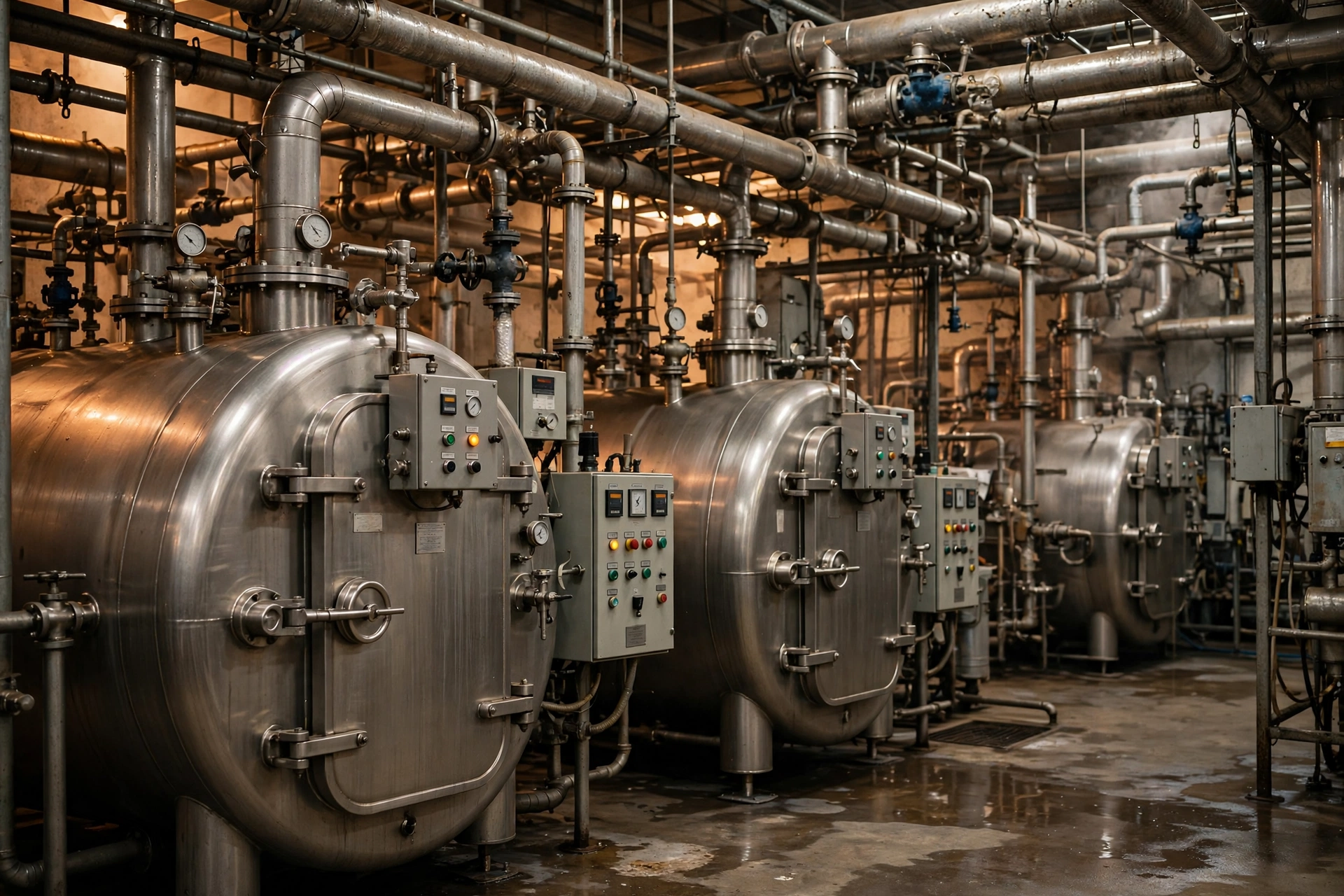
The dyehouse is the most misunderstood load in a garment factory, because most of its energy is steam, not electricity. A jet dyeing machine’s motor draws 15–37 kW, but the steam coil that heats the liquor bath to 130 °C draws its energy from the boiler, not from the generator. Buyers who size the generator from the electrical load list alone conclude that the dyehouse is a small load. They are right about the kilowatts and wrong about the dependency.
The boiler is the dependency. A 2–4 tonne-per-hour steam boiler, gas or diesel fired, needs electricity for its feedwater pump, its burner fan, its controls and its condensate return. The total is 10–30 kW — small against a 500 kVA set — but without it there is no steam, and without steam there is no ironing, no pressing, no fusing and no dyeing. The boiler auxiliaries belong on the essential board in every garment factory, and they are the first load that gets forgotten in a sizing exercise. A factory that protects its sewing machines and forgets its boiler has a generator that runs and a factory that cannot finish a single garment.
The second dependency is water. A jet dyeing machine uses 8–12 litres of water per kilogram of fabric, and a 500 kg batch needs 4,000–6,000 litres of softened, heated water. The water treatment plant, the softener, the pumps and the effluent treatment system all need power, and the effluent system needs it most urgently: a dyehouse that stops its effluent aeration for more than a few hours breaches its discharge permit, and a permit breach closes the dyehouse for days. The water and wastewater article covers the pumping and treatment loads in detail; the point here is that the dyehouse is a system, and the generator has to carry the system, not just the machines with the biggest motors.
The third dependency is the finishing section’s heat. A stenter — the machine that dries and sets fabric width after dyeing — draws 15–30 kW electrically and far more in steam or gas heat. A factory that runs its stenter on the generator has to count the fan and drive motors; a factory that runs it on gas has to count the gas supply, which is the same grid that failed in Bangladesh. In Dhaka, the factories that kept running through the gas crisis were the ones whose boilers could switch to diesel, and whose generators could carry the boiler auxiliaries through the switch.
The 10-Second Rule, Applied to Fabric
The automatic transfer switch takes 10 seconds from grid failure to generator power, under the NFPA 110 10-second rule for emergency power. Ten seconds is nothing to a sewing machine. It is everything to a dye bath. A jet machine that loses circulation for 10 seconds recovers — the pump restarts, the liquor circulates, the batch survives. A machine that loses circulation for 10 minutes does not. The gap that matters is not the 10 seconds the ATS takes. It is the 10 minutes a buyer spends deciding whether the generator is worth the money, and the 10 hours a factory spends without fuel because the tank was sized for an afternoon.
Fuel Autonomy: How Long the Factory Can Run
Fuel autonomy is the second half of the sizing decision, and it is the half most often guessed. A diesel generator at 75% load burns about 0.21 litres per kWh. A 500 kVA set carrying 300 kW burns 63 litres an hour. A 1,000 kVA set carrying 600 kW burns 126 litres an hour. The arithmetic is simple; the judgement is in how many hours to buy.
| Generator | Load at 75% | Fuel per hour | 24 hours | 72 hours |
|---|---|---|---|---|
| 250 kVA (200 kW) | 150 kW | 32 L/h | 768 L | 2,304 L |
| 500 kVA (400 kW) | 300 kW | 63 L/h | 1,512 L | 4,536 L |
| 750 kVA (600 kW) | 450 kW | 95 L/h | 2,280 L | 6,840 L |
| 1,000 kVA (800 kW) | 600 kW | 126 L/h | 3,024 L | 9,072 L |
| 1,500 kVA (1,200 kW) | 900 kW | 189 L/h | 4,536 L | 13,608 L |
The table assumes the set runs at 75% of its standby rating, which is the realistic sustained load for a factory that has shed its non-essential circuits. A factory that runs at 50% load burns proportionally less — about 0.23 L/kWh at light load, because the engine is less efficient there — but the tank should be sized for the 75% case, not the best case.
In a garment factory, diesel fuel ageing matters more than in most sites, because the set runs hard during a crisis and then sits for months. Fuel stored for more than 6–12 months grows water, microbes and sludge, and a clogged filter at 02:00 on the second night of an outage is a failure the factory will remember. The fuel-ageing article covers testing and polishing; the practical rule is to test the fuel every 6 months, polish it every 12 months, and turn the tank over — burn the oldest fuel first — so no litre sits for more than a year.
Three rules decide the tank. First, size for 72 hours at 75% load, not 24. The Bac Ninh blackouts lasted weeks, and the Dhaka crisis has run for months. A 24-hour tank is a tank for a storm, not for a grid. Second, keep the day tank and the bulk tank separate, with a transfer pump and a high-level alarm, so a transfer-pump failure does not flood the generator room with diesel. Third, put the fuel contract in writing before the crisis: a supplier who delivers 2,000 litres in 24 hours during a normal week may take 72 hours during a regional blackout, when every factory in the district is calling the same supplier.
Placement matters as much as capacity. A garment factory is a building full of combustible material — fabric, lint, cardboard cartons and finished garments — and the generator room and the fuel store need to be separated from the fabric stores by a fire-rated wall, with the fuel tank bunded to 110% of its capacity. Lint dust is the quieter risk: it settles on hot exhaust manifolds and electrical contacts, and a generator room that shares its air with the cutting room will be full of it within a month. The generator room needs its own ventilation, its own air intake, and a housekeeping routine that cleans the lint out every week. The fire-protection article covers the suppression and separation rules; the point here is that a garment factory is one of the few industrial sites where the fire load is the product itself.
Frequently Asked Questions
What size generator does a garment factory need?
A small workshop with 50–150 sewing machines needs 100–150 kVA, a mid-size factory with 300–600 machines needs 250–500 kVA, and a large factory with 1,000–1,500 machines needs 750–1,250 kVA. An integrated factory with in-house dyeing and washing needs 1,500–2,500 kVA. The exact size comes from a load list — sewing machines at 60–65% diversity, plus cutting, pressing, compressor, boiler auxiliaries and lighting — not from the building’s total connected load.
Do garment factories need a backup generator?
Yes, wherever the grid cannot be relied on for the full production week. In Bangladesh, where the ready-made garment sector exports $38.7 billion a year, factories run diesel generators as their primary power mode during outages, and 78% of knitwear factories surveyed in September 2026 had been forced to partially shut down. Even in countries with reliable grids, a generator protects the ship date: one missed sailing can cost $30,000–50,000 in air freight.
How long can a garment factory run on a generator?
As long as the fuel lasts. A 500 kVA set carrying 300 kW burns about 63 litres an hour, so a 4,500-litre tank gives 72 hours of running. The practical limit is the fuel contract, not the machine: a set rated for continuous duty runs indefinitely with fuel, oil top-ups and a service every 250 hours. Size the tank for 72 hours and keep a supplier on contract, and the factory outlasts any outage the grid has produced so far.
What happens to a garment factory during a power outage?
The sewing floor stops immediately, a cut lay is ruined if the cutter stops mid-pass, and a dye bath starts to go wrong within 30 minutes as the circulation pump stops and the dye strikes unevenly. The steam boiler loses its feedwater pump and burner fan, so ironing, pressing and fusing stop even though the boiler itself is fired by gas or diesel. The financial damage is the ship date: late-shipment penalties of 5–10%, air freight at 5–10 times sea freight, and buyers moving the next order elsewhere.
Can a diesel generator power a garment factory?
Yes — a diesel generator is the standard backup power source for garment factories worldwide, from 100 kVA workshops to 2,500 kVA integrated plants with dyehouses. The set must be sized for the sewing floor at realistic diversity, the boiler auxiliaries, and the dyehouse circulation pumps, with an automatic transfer switch that restores power within 10 seconds. The standby and prime ratings article explains which rating applies: standby for backup duty, prime where the set is the main supply.
Specification Checklist
- List every load from the equipment nameplates — sewing machines, cutters, presses, dyehouse, boiler auxiliaries, compressor, lighting — and apply 60–65% diversity to the sewing floor.
- Size the set so the peak essential load sits at 70–80% of the standby rating, with 20% headroom for growth. Check the result against the generator sizing guide.
- Put the boiler auxiliaries, the dyehouse circulation pumps and the effluent treatment on the essential board — not just the sewing machines.
- Specify an automatic transfer switch with a 10-second start, and test the full transfer monthly under load.
- Size the fuel tank for 72 hours at 75% load, test the fuel every 6 months, and hold a written fuel-supply contract.
- Place the generator room and the fuel store behind fire-rated separation from fabric stores, with 110% bunding and weekly lint cleaning.
- Set the maintenance schedule to the manufacturer’s hours — oil and filters every 250 hours, coolant and belts annually — and keep the spare filters, belts and a spare AVR on site.
- Add remote monitoring so the factory manager sees fuel level, running hours and alarms from anywhere, and so the generator supplier sees them too.
- Load-bank test the set at 75% load at commissioning and annually, and record the voltage dip on the largest step load.
- Confirm the alternator holds voltage within ±1% and frequency within ±0.5% under the sewing floor’s step loads, and get it in writing on the FAT report.
A garment factory buys a generator for the same reason it buys fabric insurance: not because it expects the worst week, but because the worst week costs more than the cover. The set that keeps 500 machines sewing through a blackout, keeps the dye bath circulating and keeps the container on its sailing is not an expense. It is the cheapest order the factory will ever place.
To size a set for a specific factory — machine count, dyehouse load, boiler size and the fuel autonomy the ship dates demand — contact PAVO with the load list. PAVO builds 9–3750 kVA sets with Cummins, Weichai, Perkins and other engines, and sizes every set from the factory’s own equipment list before it leaves the floor.