

Does a Generator Room Need Fire Suppression? | PAVO
A generator room holds the three ingredients of a fire in one small space — fuel, hot metal and air — and nobody watches it.
Does a generator room need fire suppression? For a Level 1 emergency set, yes — NFPA 110 requires a 2-hour fire-rated room and an approved suppression system. For Level 2 or optional standby sets the code is less prescriptive, but the same fuel, hot surfaces and unattended operation make suppression the difference between a damaged engine and a lost building.
Contents:
- What Starts a Generator Room Fire
- The Codes That Decide the Room
- Separation: The 2-Hour Room and the 5-Foot Rule
- Detection: Seeing the Fire Before Suppression Has To
- Suppression: Clean Agent, CO2, Foam, Water Mist and Water
- Three Fires, Three Lessons
- Frequently Asked Questions
- Specification Checklist: Before the Inspector Arrives
What Starts a Generator Room Fire
A diesel generator room fire needs three things, and the room supplies all three without being asked. Diesel fuel is the fuel. A turbocharger or exhaust manifold running at several hundred degrees is the ignition source. The radiator fan, moving 8–12 m³/s of air through the room at full load on a 500 kVA set, is the oxygen supply. Remove any one of the three and there is no fire. The design problem is that the machine cannot run without all three present at the same time.
Fuel: the leak that finds the hot surface
Fuel is the first cause in most generator room fires, and the leak is usually small. A fuel hose weeps at a fitting for weeks before anyone notices it. A day tank seam opens a pinhole. A return-line clamp works loose under vibration. Diesel does not need a large spill to become dangerous: the flash point of #2 diesel is about 52°C, and a fine spray from a pressurised line ignites far more readily than a pool. Atomised fuel from a pinhole leak at 2–3 bar will flash on contact with a surface above 210°C, the autoignition temperature of diesel vapour. The turbocharger and exhaust manifold on a loaded set run at 400–600°C. The distance between a weeping hose and a hot turbo is often less than 30 cm.
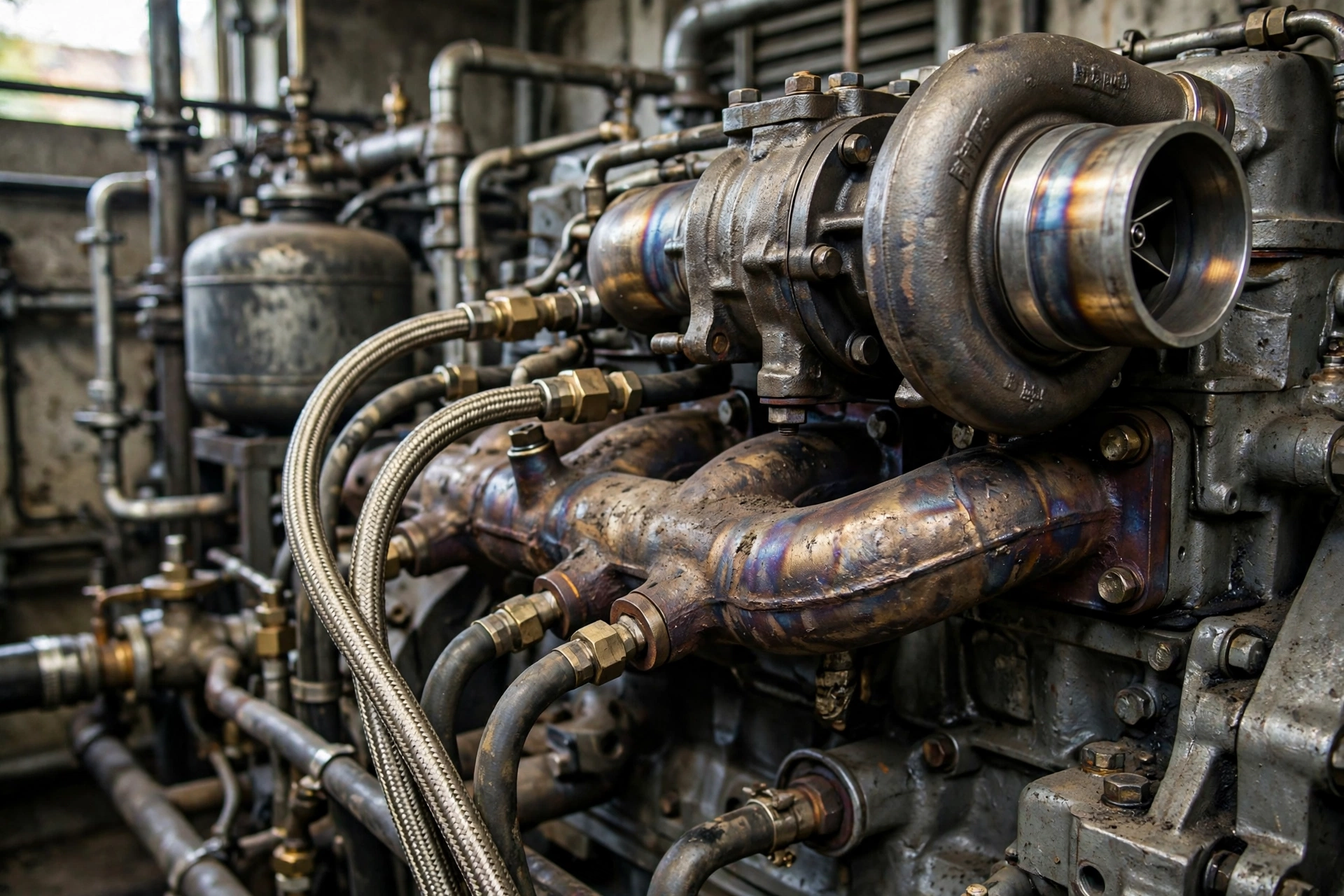
The fuel load in the room is larger than most owners realise. A Cummins C500D5 carries a 645-litre sub-base tank, and a hospital or data centre bulk tank beside the room can hold 10,000 litres or more. At 93.2 L/h at prime full load, the 500 kVA set burns through its sub-base tank in under seven hours — but a fire does not need seven hours of fuel. The full fuel consumption and tank sizing method, including how to size a tank for 8, 24 and 72 hours of autonomy, is covered separately. A 645-litre pool fire in a closed room reaches flashover conditions in minutes, and the fuel system design — where the day tank sits, where the transfer pump stops, whether a solenoid valve closes on alarm — decides whether the fire gets 645 litres or 20 litres.
Oil and the turbocharger
The second cause is lubricating oil on a hot surface. Engine oil leaks from the same places fuel leaks from: turbocharger oil feed and drain lines, rocker cover gaskets, crankshaft seals, oil filter housings. The difference is that oil leaks are treated as a maintenance nuisance rather than a fire risk, so they run longer. A turbocharger oil drain line that seeps 50 ml a day coats the turbine housing in a thin film within a week. Turbo surface temperatures under load can exceed 480°C. Oil on that surface does not need a spark. It smokes first, then chars, then ignites — and the first sign is often the smell during a monthly test, by which time the deposit is already there.
Wet stacking makes this worse. A set run for years at 30–40% load builds carbon and unburned fuel in the exhaust. The deposits insulate the manifold, raise surface temperatures and provide a ready fuel bed when a leak finally arrives. A set that is tested monthly at no load and never properly loaded is a set whose exhaust system is being prepared, slowly, to burn.
Electrical faults and the battery charger
The third cause is electrical. The alternator output connections carry hundreds of amps. A loose connection at the alternator terminal box heats under load, oxidises, heats further and eventually arcs. The control panel carries 24 V DC control wiring next to 400 V AC power wiring. A battery charger that fails can overcharge the starting batteries, boil off electrolyte and release hydrogen into a room that may have no ventilation when the set is not running. Hydrogen at 4% concentration in air is flammable. A charger fault, a hydrogen pocket near the ceiling and a relay sparking in the panel is a complete fire triangle in a room nobody enters for weeks at a time.
Table 1 — Ignition sources:
| Ignition source | Typical surface temperature | What it ignites |
|---|---|---|
| Turbocharger housing, loaded | 480–650°C | Diesel spray, oil film, rags |
| Exhaust manifold | 400–600°C | Diesel vapour, oil, debris |
| Alternator terminal, loose connection | 150–300°C at the fault | Insulation, dust, nearby fuel vapour |
| Battery charger fault / hydrogen | Spark + 4% H₂ in air | Hydrogen-air mixture |
| Block heater element, failed | 200–300°C | Oil, dust, stored material |
The Codes That Decide the Room
No single document answers the fire protection question. Four standards share the job, and the authority having jurisdiction — the AHJ, usually the local fire marshal or building official — decides which edition applies and how the gaps between them are filled. A design that satisfies the engine manufacturer but not the AHJ fails inspection. A design that satisfies the AHJ but ignores the engine manufacturer’s clearances fails on the first hot day.
NFPA 110: the room itself
NFPA 110, the Standard for Emergency and Standby Power Systems, governs the installation in Chapter 7. For a Level 1 system — one where failure of backup power could cost lives, which covers hospitals, high-rise life safety and emergency systems — the emergency power supply must sit in a separate room with a minimum 2-hour fire-resistance rating. The room door carries a 90-minute fire rating. Nothing else is permitted in the room except equipment that serves the space: no ladders, no stored spares, no paint, no cleaning supplies. The room must be designed to minimise damage from flooding, including water from firefighting. The minimum room temperature is 4.5°C, so the engine starts, and ventilation air must come direct from outside through a 2-hour rated enclosure, so the fire rating is not defeated by the air path.
Chapter 7 also addresses suppression directly. Section 7.11 sets the conditions: carbon dioxide or halon suppression is not to be used unless combustion air comes from outside the room, and dry chemical suppression only with the engine manufacturer’s certification that it causes no harm. Fire detection follows NFPA 72. A remote manual stop station must sit outside the room, labelled, so the set can be shut down without entering a burning space. The standard does not name one suppression agent as mandatory. It sets the constraints and leaves the choice to the designer and the AHJ. The duty rating is a separate decision from the room, and it should be settled before the set is specified: the difference between standby and prime power decides how many hours a year the set is designed to run. The automatic transfer switch that moves the building onto generator power is part of the same protected system, and it belongs inside the rated room or in its own rated enclosure — a fire that takes the switch takes the power with it.
NFPA 37: the engine and its clearances
NFPA 37, the Standard for the Installation and Use of Stationary Combustion Engines and Gas Turbines, governs the engine itself. It requires a minimum 1-hour separation between an indoor engine room and other parts of the building, and it sets the outdoor clearances: 5 ft (1.5 m) from openings in a structure and from structures with combustible walls. Indoor fuel tanks are generally limited to 660 gallons (about 2,500 litres); larger indoor tanks trigger additional containment and suppression requirements. The standard allows reduced clearances where a listed enclosure has been fire-tested — some manufacturers hold test documentation permitting 18 inches to a non-combustible wall — but the reduction must be documented and accepted by the AHJ, not assumed from a brochure. A set that also drives a fire pump generator faces stricter rules still: NFPA 20 treats the pump as more important than the machine driving it, and the generator’s protection must alarm rather than trip.
The AHJ has the last word
The third layer is the local building code and the fire code, which adopt NFPA standards by reference and add their own requirements. Some jurisdictions require automatic suppression in every generator room regardless of level. Some require it only for Level 1. Some accept the 2-hour room as the protection and require no suppression at all for a Level 2 set. The same installation can be compliant in one city and red-tagged in the next. The only reliable sequence is to confirm the requirement with the AHJ before the room is built, not after the set is installed. Moving a wall costs a fraction of rebuilding a room, and a suppression system designed after the louvres are cut is a system fighting the building.
Separation: The 2-Hour Room and the 5-Foot Rule
Separation is the cheapest fire protection on the project, and it is the layer most often compromised. A 2-hour wall costs little when it is drawn on the plan. It costs a great deal when it has to be retrofitted around a running generator, a fuel line and a cable tray that all pass through it.
The indoor room: two hours, one door, no storage
The Level 1 room is a fire compartment, not a plant room with a fire rating. The walls, floor and ceiling carry a 2-hour rating, the door 90 minutes, and every penetration — fuel pipe, exhaust pipe, cable tray, ventilation duct — is sealed with a listed firestop to the same rating. An unsealed 100 mm pipe penetration defeats a 2-hour wall in the same way an open window defeats a locked door. The ventilation path is the hardest part: generator room ventilation for a 500 kVA set moves about 12 m³/s of air, and the intake and discharge openings in a 2-hour wall need fire dampers rated to the same standard, arranged so they close on alarm without starving the engine of cooling air during a test.
The “nothing else in the room” rule is the one most often broken in practice. A generator room is large, dry and locked, which makes it the most attractive storage space in the building. Within a year of handover it accumulates oil drums, filters, a spare battery, cardboard boxes and a ladder. Every item is fuel load, and every item is a reason for someone to be in the room with a reason to leave the door open. The rule exists because a fire that starts in stored material reaches the fuel system faster than a fire that starts at the engine, and because a room full of storage cannot be inspected. A monthly walk-through that checks the room is empty takes five minutes. It is the highest-value five minutes in the maintenance schedule.
The outdoor set: five feet, with exceptions
An outdoor set in a weatherproof enclosure follows a different rulebook. NFPA 37 requires 5 ft (1.5 m) between the generator enclosure and any opening in a building — windows, doors, vents, air intakes — and 5 ft from any structure with combustible walls. The distance serves two purposes: it keeps exhaust gas and fuel vapour out of the building, and it keeps a fire at the generator from reaching the building. A wall with a 1-hour fire-resistance rating can qualify for a reduced clearance, and a manufacturer enclosure with listed fire-test documentation can sit as close as 18 inches to a non-combustible wall. Both exceptions need the AHJ’s agreement in writing.
Maintenance access has its own clearances, and these are the ones installers actually violate: 3 ft at the front and both ends of the unit, 5 ft overhead for lifting. A set shoehorned against a wall to satisfy the 5-foot rule on the other side cannot be serviced, and a set that cannot be serviced develops the leaks that start fires. Clearance is a single design problem with two constraints — fire separation on the outside, service access on the inside — and both must be satisfied at once.
Fuel inside the room: the 660-gallon line
NFPA 37 generally limits indoor fuel storage to 660 gallons (about 2,500 litres). A 500 kVA set with a 645-litre sub-base tank sits just inside that limit. A 1,000 kVA set with a 1,500-litre base tank and a separate 2,000-litre day tank does not. Above the line, the design needs additional containment, additional separation or the tank moved outside the room with a transfer pump. The practical answer on most projects is to keep the bulk tank outside and the day tank inside, with the transfer pump controlled by the day tank level switch and a solenoid valve that closes on fire alarm. That arrangement limits the fuel inside the fire compartment to the day tank volume, and it gives the suppression system a fire it can actually extinguish.
Table 2 — Separation requirements:
| Requirement | Indoor (Level 1, NFPA 110) | Outdoor (NFPA 37) |
|---|---|---|
| Room / enclosure rating | 2-hour fire resistance | Enclosure weatherproof; 5 ft from openings |
| Door | 90-minute fire rated | Enclosure doors latched, accessible |
| Other equipment in the room | None except what serves the space | N/A — enclosure holds the set only |
| Indoor fuel storage | 660 gallons (2,500 L) general limit | Sub-base tank part of generator footprint |
| Clearance to combustibles | 2-hour separation | 5 ft, or 1-hour wall / listed enclosure |
| Ventilation air | Direct from outside, 2-hour enclosure | Louvres clear of exhaust discharge |
| Remote stop | Outside the room, labelled | Accessible, outside the enclosure |
Detection: Seeing the Fire Before Suppression Has To
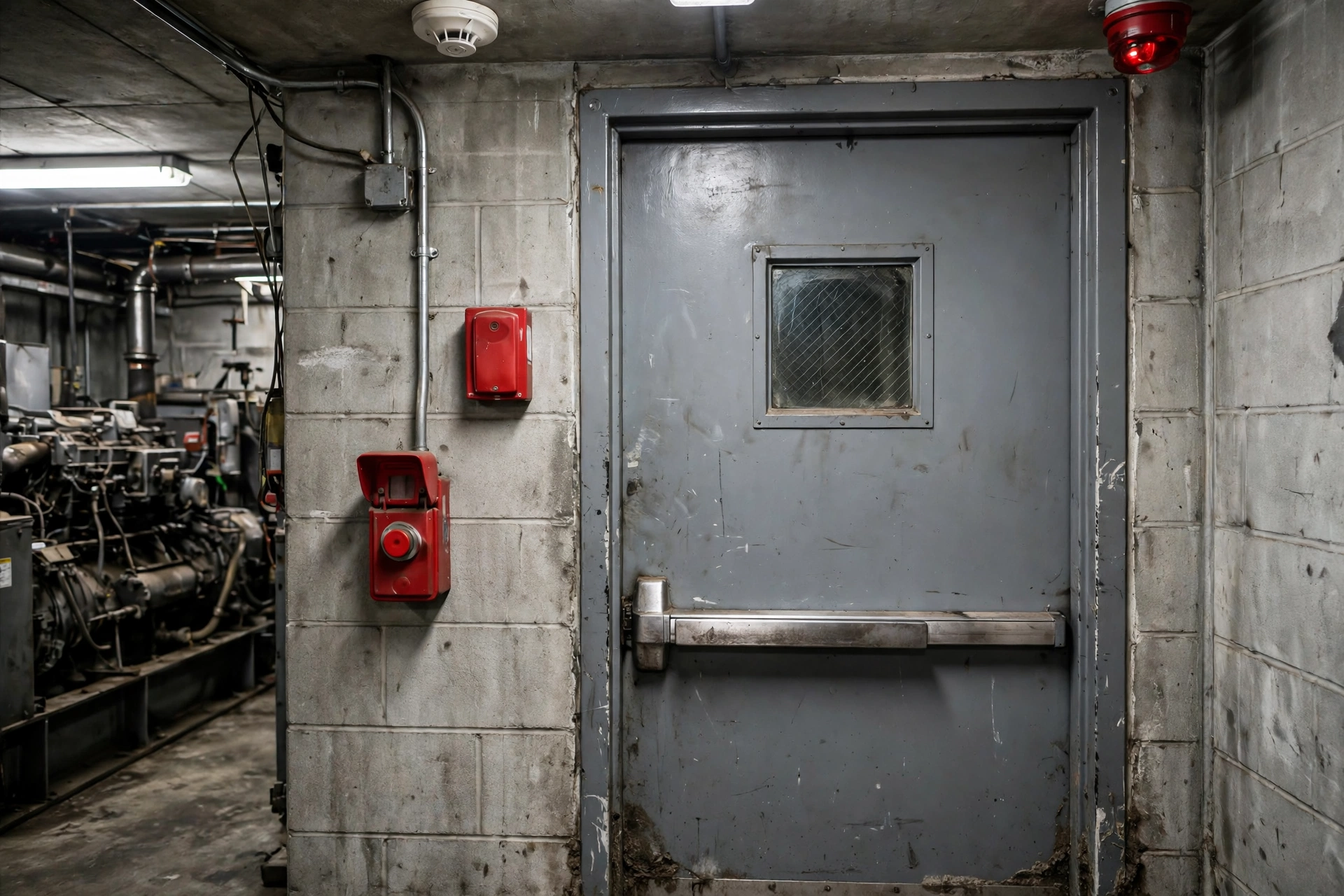
Suppression is the last resort. Detection is what makes suppression unnecessary most of the time, and what makes it effective when it is needed. A fire found in its first minute is a damaged hose and a service call. A fire found in its tenth minute is a new generator. The detection system has one job: buy time, and buy it reliably, in a room full of dust, vibration, hot air and exhaust fumes.
Smoke, heat or flame: three detectors, three jobs
Smoke detectors are the earliest warning, and the least reliable in a generator room. A photoelectric smoke detector will catch the first wisps from smouldering insulation or a hot oil film. It will also catch dust from the louvres, exhaust fumes during a cold start and the smoke from a load-bank test. False alarms in a generator room are not a nuisance — they train people to ignore the panel, and they trigger suppression discharges that shut the building’s backup power down for a fault that was not a fire.
Heat detectors suit the room better. A fixed-temperature detector set at 57°C (135°F) or 74°C (165°F), or a rate-of-rise detector that trips on a rapid temperature climb, ignores dust and exhaust and responds to a real fire. The trade-off is speed: a heat detector waits until the fire is large enough to heat the ceiling, which in a room with a 12 m³/s airflow can take minutes. Rate-of-rise detectors close part of that gap, because a fuel fire raises the temperature fast even in moving air.
Flame detectors — infrared or ultraviolet — are the fastest of the three for a flaming fuel fire, responding in seconds to the radiation from the flame itself. They need line of sight to the fire, they cost several times a smoke detector, and they can be blinded by sunlight through a louvre or by a dirty lens. They belong above the engine and the day tank, where the fuel is, not scattered around the room.
Where the detectors go — and where they do not
Detector placement decides whether the system works. Detectors go above the engine, above the day tank, and along the fuel piping run — the three places fuel and heat meet. They do not go in the direct path of the radiator discharge, where hot air trips heat detectors on every test run, or above the intake louvre, where cold air delays them. They do not go where the exhaust stack discharges, where soot coats the lens of a flame detector within a month. Linear heat detection cable — a heat-sensitive cable run along the fuel lines and above the engine — covers the long, low risks that point detectors miss: a weeping hose along a 6-metre pipe run, a drip tray filling slowly under a day tank.
Two detectors before discharge
For a clean-agent system, the release is normally cross-zoned: two detectors in different zones must agree before the agent discharges. One detector raises the alarm. Two detectors release the gas. The rule exists because a single false alarm that dumps a room full of clean agent shuts down the building’s emergency power, empties a cylinder that costs thousands to refill, and leaves the room unprotected until the system is recharged. Cross-zoning halves the false-discharge risk without measurably slowing a real fire, because a fuel fire in a generator room trips two detectors within seconds of each other. The pre-discharge alarm — typically 30 seconds of horn and strobe before release — gives anyone in the room time to leave, and gives the control system time to shut the engine down, close the dampers and close the fuel solenoid.
Suppression: Clean Agent, CO2, Foam, Water Mist and Water
Choosing a suppression agent for a generator room is a choice between five imperfect options, and the right answer depends on the room, the level of the system and what the AHJ will accept. The wrong answer is usually the cheapest one, or the one copied from the office sprinkler design.
Clean agent: the default for a Level 1 room
Clean agent systems — FM-200 (HFC-227ea), Novec 1230 (FK-5-1-12) and inert gases such as INERGEN (IG-541) — are the standard choice for an indoor Level 1 generator room, governed by NFPA 2001. They extinguish by interrupting the chemical chain reaction of the fire or by displacing oxygen, they are electrically non-conductive, and they leave no residue. A set that survives a clean-agent discharge can be inspected, serviced and restarted the same day. That is the decisive advantage in a room whose entire purpose is keeping the building powered.
The constraints are real. The room must be sealed well enough to hold the design concentration for 10 minutes, and the system must discharge within 10 seconds of release. A generator room is a leaky box by design — louvres, cable penetrations, a door that does not quite close — and every leak is agent lost. The nozzles must be inside the canopy as well as in the room, because a silent canopy traps heat and fuel vapour and the fire starts inside it. Novec 1230 has largely replaced FM-200 in new installations because its global warming potential is 1 against FM-200’s 3,220, and it breaks down in the atmosphere within days. The agent costs more per kilogram than water. It costs far less than a new generator.
CO2 and foam: effective, with conditions
Carbon dioxide, governed by NFPA 12, is highly effective on a Class B fuel fire and leaves no residue. It is also lethal at extinguishing concentrations, which is why NFPA 110 restricts its use unless combustion air comes from outside the room, and why any CO2 system needs lockout, pre-discharge alarms and a strict personnel procedure. A CO2 discharge into a room with a running generator and a technician inside is a fatality, not a fire drill. CO2 suits unoccupied spaces with no other option, and it suits few generator rooms.
Foam, governed by NFPA 11, blankets a fuel pool and stops vapour release. It is the right agent for a bulk fuel storage area or a fuel farm, where the hazard is a large pool of diesel on a floor. Inside a generator room it is the wrong tool: it coats the alternator windings, the control panel and the engine in a residue that takes days to clean, and it does nothing for an electrical fire. Foam belongs outside the room, protecting the bulk tank, not inside it.
Water: the argument that never ends
Water is the most argued-over agent in generator room design, and the argument has no single winner. A conventional sprinkler system is cheap, familiar and effective on a Class A fire in ordinary combustibles. It is also water, delivered onto a running generator, an alternator and a control panel full of electronics. Some jurisdictions omit sprinklers from rooms used solely for generators, transformers or switchboards. Others, following the International Building Code, refuse to omit sprinklers merely because the room contains electrical equipment. The practical middle ground is a pre-action or dry-pipe sprinkler, which holds water back until a detector confirms a fire, or a water mist system under NFPA 750, which uses fine droplets to cool and displace oxygen with a fraction of the water volume. Either is better than a wet-pipe sprinkler over a control panel, and either is worse than a clean agent for a Level 1 room whose set must be restartable the same day.
Table 3 — Suppression agents compared:
| Agent | Standard | How it works | Residue | Room sealing | Personnel |
|---|---|---|---|---|---|
| Novec 1230 / FM-200 | NFPA 2001 | Chemical interruption | None | Sealed, 10-min hold | Safe at design concentration |
| INERGEN (IG-541) | NFPA 2001 | Oxygen displacement | None | Sealed, 10-min hold | Safe, reduces O2 to ~12% |
| Carbon dioxide | NFPA 12 | Oxygen displacement | None | Sealed | Lethal at design concentration |
| Foam | NFPA 11 | Blankets fuel pool | Heavy | Not required | Safe, messy cleanup |
| Water mist | NFPA 750 | Cooling + O2 displacement | Water | Not required | Safe |
| Sprinkler (wet pipe) | NFPA 13 | Cooling | Water damage | Not required | Safe, damages electrics |
Three Fires, Three Lessons
The codes and the agent tables describe the ideal room. The fires describe the real one. Three cases from service records show where the design failed, and in each case the failure was in a detail that cost little to get right at the design stage.
Case 1: A hospital set, a weeping hose and an open louvre
A district hospital ran a 1,000 kVA standby set in a 2-hour rated room, protected by a Novec 1230 system with cross-zoned detection. During a monthly test the set ran at 60% load for 30 minutes. A return-line hose that had been weeping for weeks sprayed a fine mist onto the exhaust manifold. The heat detectors tripped, the dampers closed, the fuel solenoid closed, and the agent discharged within its 10-second design window. The fire went out. Then it came back.
The room’s intake louvre damper had been wedged open during a ventilation repair six months earlier and never restored. The agent concentration fell below the design level within three minutes instead of holding for ten, the hot manifold re-ignited the residual fuel, and the fire burned until the fire brigade arrived 22 minutes later. The set was a total loss — £180,000 for the replacement, plus 11 days on a rental set at £1,400 a day while the room was rebuilt. The suppression system had worked exactly as designed. The room had not. A damper position check, added to the monthly test sheet after the fire, takes two minutes. The hospital’s maintenance schedule now includes it, and the damper is padlocked in its correct position.
Case 2: A data centre battery charger and a hydrogen pocket
A colocation data centre in Frankfurt ran two 2,000 kVA containerised sets, N+1, with a 72-hour fuel autonomy. The fire did not start at the engine. It started at the battery charger. A charger fault overcharged one bank of starting batteries, boiled off electrolyte and released hydrogen into the container. The container’s ventilation ran only when the set ran, so the hydrogen collected near the ceiling for three days. A relay in the control panel sparked during a weekly test. The resulting flash fire burned for less than a minute — there was little fuel in the air — but it destroyed the control panel, the charger and the battery bank, and it tripped the set offline during the test.
The repair cost €38,000. The real cost was the nine days the site ran on N+0 redundancy while the panel was rebuilt, with the second set carrying the full load alone. The fix cost less than the repair: a charger with a temperature-compensated float voltage, a hydrogen detector in the container wired to run the ventilation fan, and a battery inspection added to the monthly test. The lesson is that the fire risk in a generator room is not only fuel and hot metal. The electrical system carries its own fuel, in the form of hydrogen, and its own ignition source, in the form of a relay.
Case 3: A warehouse, a locked room and a drum of paint
A logistics warehouse outside Dubai ran a 500 kVA prime set in a dedicated room, supplying a cold-storage facility. The room met the 2-hour rating. The suppression system was a clean agent, correctly sized. The failure was housekeeping. Over two years the room accumulated a drum of paint, four 20-litre cans of solvent, a stack of cardboard packaging and a pallet of cleaning chemicals — all stored there because the room was large, dry and locked. A solvent can leaked onto the floor. The vapour reached the block heater element on the engine, which runs continuously in standby, and ignited.
The clean agent discharged and extinguished the fire at the engine. It did not extinguish the fire in the stored paint and cardboard, which had spread across the floor away from the nozzles and which the agent concentration, designed for the engine fire, could not control. The fire brigade extinguished the room fire in 40 minutes. The set survived. The cold-storage facility lost £60,000 of stock when the power failed during the fire, and the room was out of service for six weeks. The inspector’s report contained one line that mattered: the room had violated NFPA 110’s rule that nothing except equipment serving the space may be kept in it. The rule is not bureaucracy. It is the difference between a fire the suppression system was designed for and a fire it was not.
Frequently Asked Questions
Does a generator room need fire suppression?
For a Level 1 emergency set, yes — NFPA 110 requires a 2-hour fire-rated room and an approved automatic suppression system, with the agent chosen to suit the room and accepted by the AHJ. For a Level 2 or optional standby set the code is less prescriptive, but the fuel load, hot surfaces and unattended operation make suppression the practical choice on most commercial installations.
How to prevent a diesel generator fire?
Prevention is mostly inspection. Check fuel hoses, fittings and day tank seams for weeps at every service, keep oil off the turbocharger and exhaust manifold, keep the room empty of stored material, and test the detection and suppression system on the same schedule as the generator. Most generator room fires start as a leak that was visible for weeks before it ignited.
What causes a diesel generator to catch fire?
The common causes are a fuel leak reaching a hot surface, an oil leak onto the turbocharger or exhaust manifold, an electrical fault at the alternator terminals or battery charger, and stored combustible material in the room. Diesel flash point is about 52°C and turbo surfaces exceed 480°C, so a leak and a hot surface are the only two ingredients a fire needs.
What fire rating does a generator room need?
A Level 1 emergency power supply room needs a 2-hour fire-resistance rating under NFPA 110, with a 90-minute fire-rated door and sealed penetrations. NFPA 37 requires a minimum 1-hour separation for indoor engine rooms generally. The higher rating applies where the set serves life safety loads, and the AHJ decides which applies on a given project.
How far should a diesel generator be from a building?
NFPA 37 requires 5 ft (1.5 m) from openings in a structure and from structures with combustible walls. The distance can be reduced where the wall has a 1-hour fire rating or where the enclosure is listed and fire-tested for a closer clearance, sometimes 18 inches. Portable generators are a different case: fire and carbon monoxide guidance puts them at least 20 ft (6 m) from a building.
Specification Checklist: Before the Inspector Arrives
- Level confirmed. Level 1 or Level 2, in writing, with the loads listed. The level decides the room rating and the suppression requirement.
- Room rating. 2-hour walls, floor and ceiling for Level 1; 90-minute door; every penetration firestopped to the same rating; ventilation air in a 2-hour enclosure.
- Nothing else in the room. No storage, no spares, no paint, no solvents. A monthly walk-through confirms the room is empty.
- Clearances. 5 ft from openings and combustible walls outdoors; 3 ft maintenance access at front and ends; 5 ft overhead.
- Fuel inside the room. Day tank only, within the 660-gallon (2,500-litre) indoor limit; bulk tank outside with a transfer pump and a solenoid valve that closes on fire alarm.
- Detection. Cross-zoned detection per NFPA 72 — smoke, heat or flame detectors above the engine and day tank, linear heat cable along fuel lines, none in the radiator discharge path.
- Suppression agent chosen and sealed. Clean agent for a Level 1 room, with the room sealed to hold concentration for 10 minutes, dampers that close on alarm, and nozzles inside the canopy as well as the room.
- Shutdown sequence tested. Engine stop, damper closure, fuel solenoid closure and ventilation shutdown, all proven on the monthly test — not assumed from the wiring diagram.
- Remote stop. Manual stop station outside the room, labelled, tested.
- Housekeeping and spares. Fuel hose age recorded and replaced on schedule, oil leaks cleaned at the service, battery charger and hydrogen detection checked monthly.
A generator room fire is a small fire in a small room that owns the building’s backup power. The protection is not one system. It is a rated room that contains the fire, detection that finds it in the first minute, suppression that extinguishes it without destroying the set, and a shutdown sequence that cuts off the fuel. Any one of the four can be bought. All four have to work together, and the only way to know they do is to test them together — on the monthly test, with the dampers, the solenoid and the detectors in the loop. If you are planning a generator room and want the fire protection specified before the walls go up, contact PAVO — the engineering team will size the room, the detection and the suppression to the set and the code that applies on your site.