

What Does Tier 3 Mean for a Data Centre Generator? | PAVO
Tier III is not a promise that the power will never fail. It is proof that the generator plant was designed, built and tested to a standard most buyers never read.
What does Tier 3 mean for a data centre generator? It means the generator plant is designed so any set, fuel leg or distribution path can be taken out for planned maintenance without dropping the IT load — concurrently maintainable, N+1 as a minimum, with at least 12 hours of on-site fuel and a rating that carries no hour limit.
That one sentence decides most of the money in a data centre generator purchase. The tier is not a marketing badge. It is a topology standard, written and certified by the Uptime Institute, and it treats the diesel generator plant as the primary source of power for the building. The utility is the economic alternative. Once that inversion is understood, the requirements that follow — the rating, the fuel arithmetic, the certification tests — stop looking like over-engineering and start looking like the minimum that keeps a hall online.
This article explains what Tier III and Tier IV actually require from diesel backup power, where buyers most often fail the standard, and what to demand in writing before a deposit is paid.
Contents
- Tier I to Tier IV: What the Four Grades Actually Test
- The Generator Is the Primary Power Source, Not the Backup
- Ratings That Qualify: ESP, PRP, COP and DCC
- Fuel Autonomy: 12 Hours Is the Floor, Not the Target
- What Certification Actually Involves
- Three Sites, Three Lessons
- Frequently Asked Questions
- Specification Checklist: Eight Lines Before the Deposit
Tier I to Tier IV: What the Four Grades Actually Test
A tier describes topology, not a guaranteed uptime number. The percentages printed alongside the tiers — 99.671%, 99.741%, 99.982% and 99.995% — come from an industry table that predates the current certification programme, and Uptime Institute itself is careful about them. What the tier certifies is the shape of the infrastructure: how many independent paths deliver power and cooling, and whether the site can be maintained or survive a failure without stopping the IT load.
| Tier | Definition | Commonly quoted availability | Downtime per year | Typical generator configuration |
|---|---|---|---|---|
| Tier I | Basic capacity | 99.671% | 28.8 hours | Single N set, optional |
| Tier II | Redundant capacity components | 99.741% | 22.7 hours | N+1 components, single path |
| Tier III | Concurrently maintainable | 99.982% | 1.6 hours | N+1, multiple paths |
| Tier IV | Fault tolerant | 99.995% | 0.4 hours | 2N or 2(N+1), fully separate paths |
The jump that matters most for buyers is from Tier II to Tier III. It is also the jump where generator specifications most often fail.
Tier I and Tier II: the baseline
Tier I is a single path with no redundant components. A generator is optional. Tier II adds redundant capacity components — a spare generator, a spare UPS module — on a single distribution path. Either tier tolerates a shutdown for maintenance, and either tolerates a single failure taking the load down. For a small enterprise hall or an edge site, that is often an honest choice. The mistake is buying Tier II hardware and selling Tier III availability to tenants.
Tier III: concurrently maintainable
Tier III requires that every capacity component and every distribution path can be taken offline for planned work without affecting the IT load. Any generator can be serviced. Any fuel leg can be isolated. Any switchboard can be opened. The load never notices. That is what “concurrently maintainable” means in practice, and it is why Tier III pushes the generator plant to at least N+1 across multiple paths — not one spare set on a single path, but redundant capacity applied to each and every component and path.
Tier III does not promise survival of an unplanned failure during a maintenance window. If a generator fails while another is already out for service, the load is exposed. Uptime is explicit about that gap. It is the single most misunderstood line in the standard, and it is the reason Tier IV exists.
Tier IV: fault tolerant
Tier IV adds fault tolerance on top of concurrent maintainability. No single failure — of any component, any path, any operator action that the design can foresee — may interrupt the IT load. That demands 2N or 2(N+1) topology, with two physically and electrically separate plants, separate fuel systems and separate exhaust paths. The two halves sit in separate fire compartments. A fire in one generator room cannot take the other.
The cost difference is large. A Tier IV plant roughly doubles the generator count of a Tier III plant of the same load, doubles the fuel storage, and doubles the switchgear. The set count itself — how many generators a data centre needs for a given load — is a separate sizing exercise, covered in the companion guide to containerised data centre gensets. Industry practice for a Tier IV hall is 2N with a 96-hour bulk fuel tank. The decision is commercial, not technical: Tier IV is bought by financial trading, hyperscale AI training and operators whose outage cost exceeds the capital premium. For most colocation halls, Tier III is the right grade — provided it is actually built to Tier III, which is where the rest of this article comes in.
One further distinction matters for procurement. ANSI/TIA-942 is the other framework buyers meet. It rates telecommunications, architectural, electrical and mechanical systems separately, and the facility takes the lowest of the four ratings. A site can have Tier III electrical infrastructure and a TIA-942 Rated-2 building. The two standards are not interchangeable, and a quotation that cites one while the tenant contract demands the other is a dispute waiting to happen. Confirm which standard the contract names before the generator order is placed.
The Generator Is the Primary Power Source, Not the Backup
The most consequential sentence in the Uptime Institute Tier Standard is the one most buyers skip. For Tier III and Tier IV, Uptime treats the engine-generator plant as the primary source of power and the utility as an economic alternative. The premise is stated plainly: the only reliable source of power is that generated on site.
That inversion changes every downstream decision. A generator bought as a backup is judged on whether it starts. A generator bought as the primary source is judged on whether it can carry the whole site, for as long as the outage lasts, with no limit on hours. The two judgements produce different machines, different ratings and different fuel systems.
Why Uptime treats the utility as the economic alternative
The reasoning is empirical. Uptime Institute’s 2022 Global Data Center Survey found that 43% of respondents reporting significant outages attributed them to on-site power failures — not to the utility. The 2025 outage analysis puts the median significant outage at 53 minutes, with 57% of operators reporting that their most recent major outage cost more than $100,000. ITIC’s 2025 survey puts median downtime at $9,000 per minute for large enterprises, about $540,000 an hour. Power accounts for 45% of impactful outages.
A data centre that treats the grid as its primary source and the generator as a rarely-used accessory is therefore betting its availability on the least reliable link in the chain. Uptime’s standard reverses the bet: design the generator plant to carry the building indefinitely, and treat grid power as the cheaper way to run it day to day. That is why the standard’s generator requirements are written the way they are, and why a set that satisfies a hospital or a factory specification can fail a Tier III audit.
The no-hour-limit rule
The practical consequence is a rule with no exceptions at Tier III and Tier IV: the generator plant must be large enough to carry the entire data centre load, and there can be no limit on the hours it can run. A rating that caps annual run time at 200 hours fails the test outright, whatever the kVA figure on the brochure says. A rating that caps the 24-hour average load factor at 70% also fails, unless the site load genuinely sits below that line with margin — which a data centre load, running flat at 85–95% of design load around the clock, does not.
This is the point at which a procurement conversation either goes right or goes wrong. A supplier who quotes a standby-rated set for a Tier III hall is either unaware of the standard or hoping the buyer is. Either way, the certificate is at risk before the container is loaded. The rating section below shows which ratings qualify and what they cost.
Ratings That Qualify: ESP, PRP, COP and DCC
ISO 8528-1 defines four ratings. Only two of them meet the Uptime no-hour-limit test on their own terms, and the industry has added a fifth — a manufacturer rating built specifically for this application — because the gap between them is expensive.
| Rating | Code | Annual hours | Load factor | Tier III / IV |
|---|---|---|---|---|
| Emergency standby power | ESP | Up to 200 hours | Variable, average 70% | No |
| Prime power | PRP | Unlimited | Variable, average 70% | Conditional |
| Continuous operating power | COP | Unlimited | Constant, 100% | Yes |
| Data centre continuous | DCC | Unlimited | Variable or constant, up to 100% | Yes |
The full definitions, and the kVA differences between ratings on the same engine, are covered in the guide to standby, prime and continuous ratings. The points below are the ones that decide a Tier III or Tier IV purchase.
Why a standby rating fails the test
A standby (ESP) rating allows no more than about 200 hours of operation a year on a variable load. A Tier III hall that tests monthly under load and rides through several real outages a year can exceed that without noticing — until the warranty claim is refused or the certification audit asks for the rating basis in writing. The 200-hour cap is not a maintenance suggestion. It is a design limit, and it conflicts directly with a standard that requires unlimited runtime.
There is a second, quieter problem. In the United States, an emergency engine’s non-emergency running — testing, maintenance, demand response — is capped at 100 hours a year under EPA rule 40 CFR 60.4211, with true emergencies exempt. A Tier III site that runs its monthly tests, its annual full-load test and its certification blackout test on an emergency-rated fleet can find itself over the legal limit as well as the rating limit. The two caps are different rules from different authorities, and both have to be satisfied.
The data centre continuous rating
The industry’s answer is the data centre continuous (DCC) rating — also sold as DCCP or DCP, depending on the manufacturer. It is not part of ISO 8528-1. It is a manufacturer-defined rating, reviewed by the Uptime Institute, built around the data centre load profile: unlimited hours, with no average load-factor restriction, at variable or constant load.
Cummins lists its QSK95 series with a data centre continuous range of 2,500–3,350 kW at 50 or 60 Hz. mtu’s Series 4000 sheets, revision 2026-03, show the same idea in numbers: the 16V4000 DS2250 is rated 2,250 kWe on its standby sheet and 2,045 kWe on its data centre continuous sheet — about 9% lower, the margin the manufacturer reserves for unlimited hours at full load. The DCC sheet also permits a 10% overload for one hour in twelve, and states explicitly that the rating complies with Uptime Institute Tier III and Tier IV requirements where a utility feed is present.
The DCC rating exists because full continuous (COP) rating is honest but expensive: it means buying considerably more engine than the load needs, since COP assumes a constant 100% load factor. DCC splits the difference. It is cheaper than COP and it passes the audit — provided the buyer reads the terms. DCC is a manufacturer rating, so its terms vary by vendor, and some datasheets make the rating subject to a site-specific assessment. Ask for the rating basis in writing when comparing bids. A DCC figure quoted without its terms is no better than a standby figure quoted without its hours.
What the rating costs, and what it saves
A 2,680 kW set on a DCC rating burns about 664 litres per hour at full load — roughly 0.25 litres per kWh. That fuel figure is the same on either rating. What changes is the engine frame, the alternator size and the price. As a rule of thumb, the DCC figure on a given frame runs 8–12% below the standby figure, and the price per kW runs correspondingly higher.
Against that premium, set the cost of the alternative. A Tier III hall that fails certification on its generator rating does not lose a line item. It loses the certificate, and with it the tenants whose contracts require one. A single failed audit costs more than the rating premium on the whole generator plant. The rating is the cheapest part of the certification.
Performance class matters alongside the rating. Data centre loads are UPS loads, and the generator must hold voltage and frequency tight enough for the UPS to stay on line. ISO 8528-5 class G3 — voltage regulation around ±1% and frequency regulation of ±0.25% in steady state, with fast recovery from transients — is the reference class for sensitive electronic loads. A set that meets the rating but not the class will start, accept load, and then watch the UPS refuse it. The guide to the ISO 8528 G3 performance class explains the transient limits, and the guide to UPS–generator compatibility covers what happens when the two disagree.
Fuel Autonomy: 12 Hours Is the Floor, Not the Target
Every tier requires a minimum of 12 hours of on-site fuel storage at full load. That is the Uptime floor, set by the Owners Advisory Committee and applied at N load to all tiers. Treat it as the floor, not the target. Industry practice runs well above it: 48–72 hours on site at some hyperscale campuses, and 96 hours at many Tier III and Tier IV facilities.
The more important rule is how Uptime counts the fuel. Only the fuel that survives the loss of a redundant component counts toward the tier.
The 12-hour rule — and how Uptime counts it
An owner claiming 48 hours of fuel from two 24-hour tanks has only 24 hours of concurrently maintainable fuel. Take one tank out of service for cleaning or repair — which Tier III requires you to be able to do without dropping the load — and the remaining tank holds 24 hours. The certificate is judged on what remains after the redundant component is removed, not on the raw tank capacity. The same logic applies to fuel transfer pumps, day tanks and delivery routes: every element of the fuel system that the tier requires to be concurrently maintainable must be redundant, or the fuel number falls.
NFPA 110 adds its own vocabulary. It classifies emergency power supply systems by Level, Type and Class. Data centres usually specify Level 1, Type 10 — power restored within 10 seconds of grid failure — and a Class that states the minimum runtime at full rated load without refuelling. Class 48 means 48 hours. The class is a contract figure, not a tier figure, but the two have to agree: a Class 48 system on a site whose tier counts only 24 hours of fuel is a specification that contradicts itself.
Worked example: a 12 MW hall
Take a 12 MW IT hall with N+1 generator plant. The generator load is higher than the IT load — cooling, UPS losses and auxiliaries add roughly 10–15% — so the plant carries about 13.5 MW at full load. At 0.25 litres per kWh, the plant burns about 3,400 litres per hour at full load. The fuel arithmetic follows:
| Autonomy target | Fuel required | Tank volume | Tanker loads (30,000 L each) |
|---|---|---|---|
| 12 hours (Uptime minimum) | ~41,000 L | ~45 m³ | 2 |
| 24 hours | ~82,000 L | ~90 m³ | 3 |
| 48 hours | ~163,000 L | ~180 m³ | 6 |
| 72 hours | ~245,000 L | ~270 m³ | 9 |
| 96 hours (common Tier III/IV spec) | ~326,000 L | ~360 m³ | 11 |
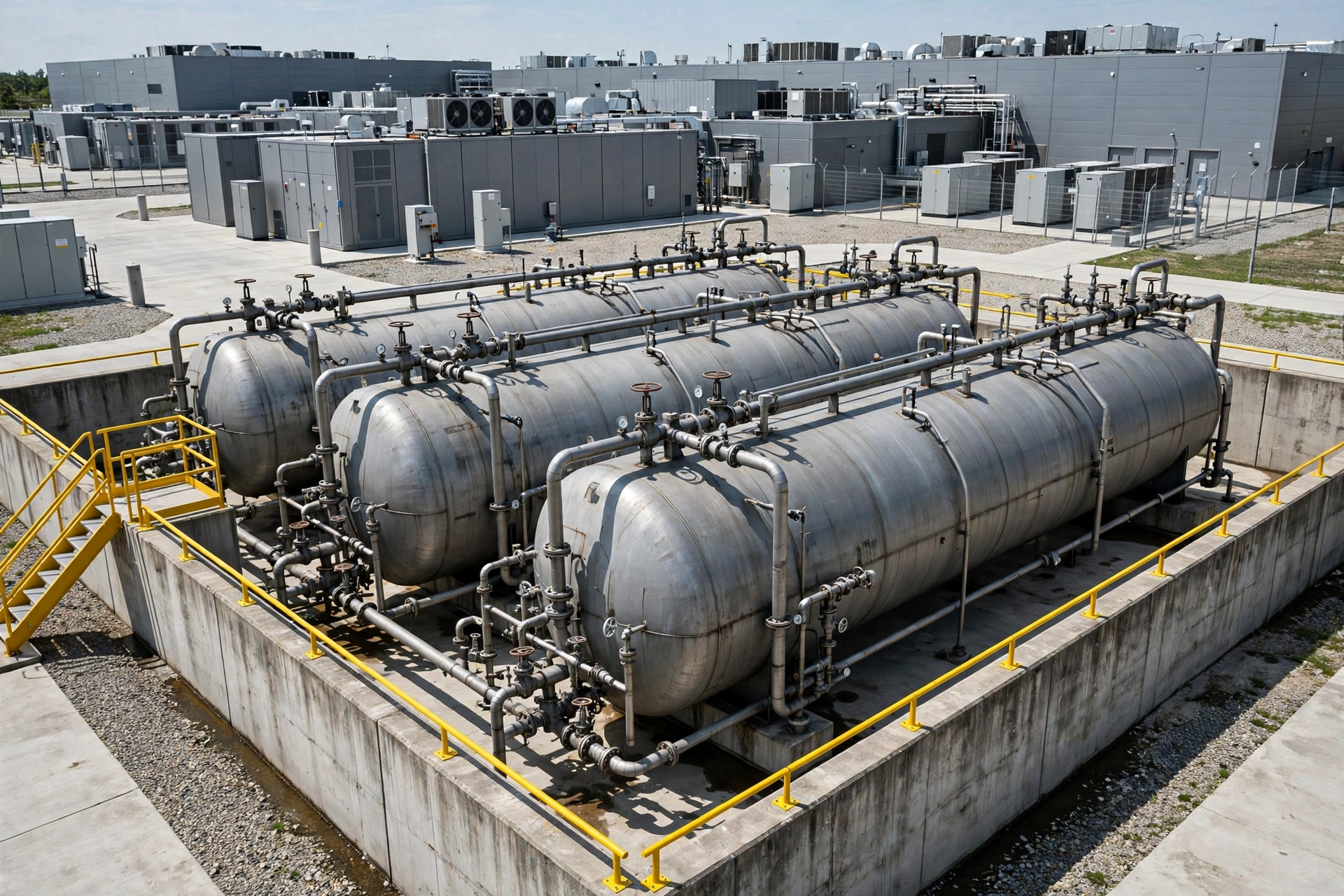
Those are N-load figures, before the concurrent-maintainability discount. A Tier III site specifying 96 hours needs 326,000 litres that survive the loss of one tank — which means at least two tanks, each holding a meaningful share, plus a transfer system that can move fuel between them while the plant runs. At roughly $1.10–$1.30 per litre for diesel in most markets, 96 hours of fuel is about $360,000–$425,000 of inventory sitting in the ground, before the tanks, the bunding and the fire protection. That is the real price of the tier, and it is decided at the civil design stage, not at the generator order.
What 96 hours costs in space and money
Space is the constraint buyers underestimate. A 360 m³ fuel farm needs bunding at 110% of the largest tank, fire separation from the generator rooms, tanker access for an 11-load resupply, and a delivery route that works during a regional outage — when the roads are congested and the fuel supplier is serving every other data centre in the same grid area. Refuelling during a regional outage is the weak point of every long-autonomy design, which is why the resupply contract, the delivery route and the fuel testing regime matter as much as the tank size.
Fuel that sits for 96 hours of runtime — which, in practice, means fuel that sits for years between real outages — also ages. Water condenses in the tank, microbes grow at the fuel-water interface, and a full tank of degraded fuel is worse than a smaller tank of fresh fuel. The guide to how long a generator runs on a full tank covers the sizing arithmetic, and the guide to diesel fuel ageing covers the testing and polishing regime that keeps a 96-hour reserve usable. A Tier III site with a fuel polishing system, an annual fuel test to NFPA 110 8.3.7, and a contracted rotation schedule has a reserve. A site with a full tank and no test history has a liability.
What Certification Actually Involves
Uptime Institute offers three separate awards, and they are not interchangeable. A site can hold one without the others, and tenants who know the system check which ones a hall actually holds.
Tier Certification of Design Documents
The first award certifies the design. Uptime’s engineers review the drawings, the single-line diagrams, the generator datasheets, the fuel system design and the redundancy calculations, and confirm that the design as drawn meets the tier. This is the cheapest point at which to find a generator problem — a standby rating, a fuel system that counts non-maintainable fuel, a single distribution path that the designer thought was two. It is also the point at which most generator disputes are settled, because changing a drawing costs nothing next to changing a poured concrete fuel farm.
Tier Certification of Constructed Facility
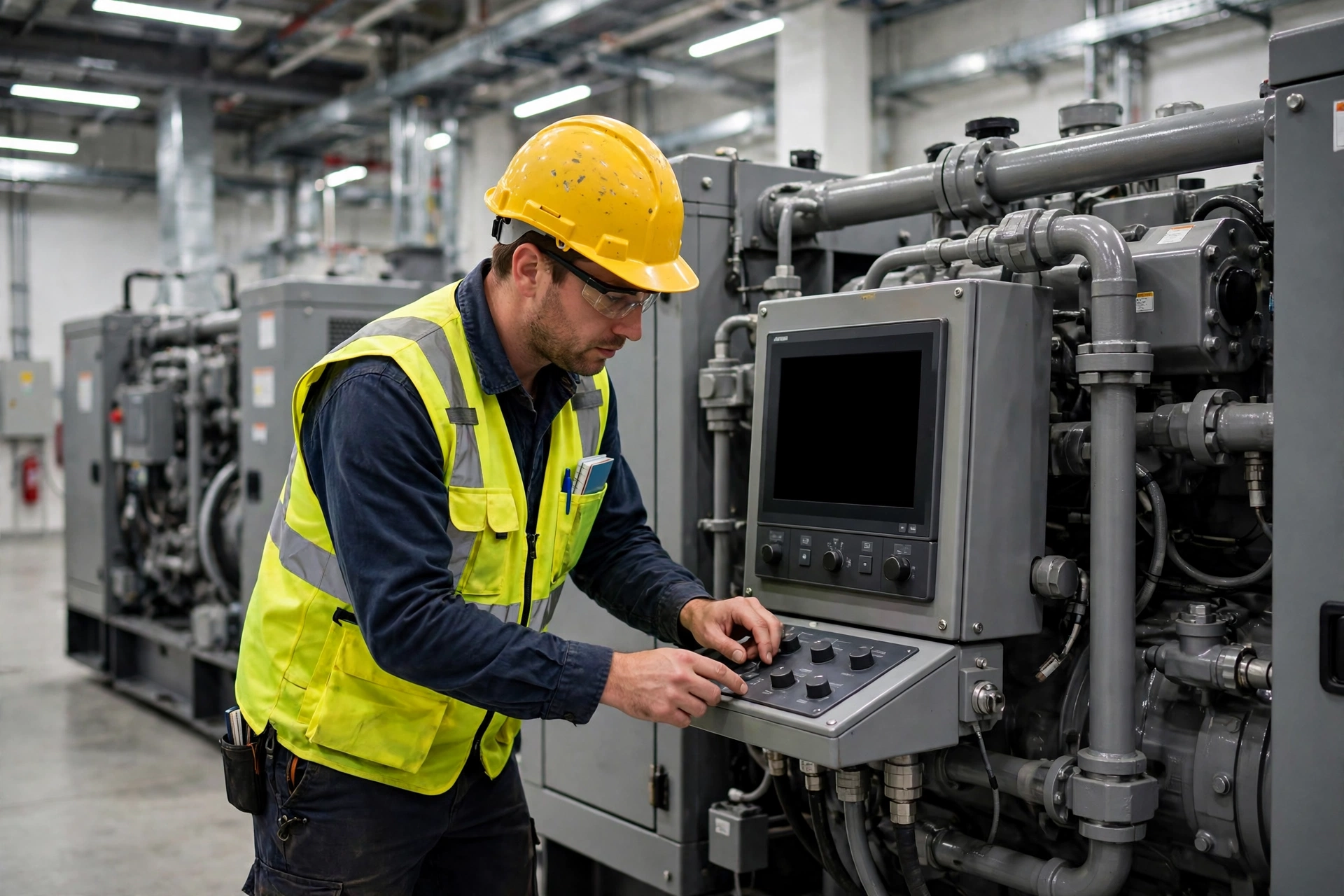
The second award certifies the building as built. Uptime’s engineers visit the site, walk the generator rooms, check the fuel system against the drawings, and witness tests. The tests are the part buyers should plan for: a blackout test that drops the utility and proves the generators carry the load, a load acceptance test on each set, a fuel transfer test that proves the day tanks refill under load, and a maintenance demonstration that proves a generator can be isolated and serviced while the hall runs. The generator start time sequence — 1–3 seconds for the transfer switch to confirm the outage, 5–8 seconds for the engine to crank and stabilise, under a second to move the load — is measured, not assumed.
A site that passes the design award can fail the constructed-facility award on installation details: a fuel line routed through the wrong compartment, a generator room ventilation shortfall, a paralleling switchboard that cannot isolate one set without dropping the bus. The generator supplier’s commissioning scope should name these tests explicitly, with a witnessed factory acceptance test before shipment. The guide to reading a factory acceptance test report explains what a real FAT report contains and what a thin one hides.
Tier Certification of Operational Sustainability
The third award certifies how the site is run. It covers staffing, training, operating procedures, maintenance records and the management systems that keep a Tier III plant at Tier III after the engineers leave. A generator plant that is concurrently maintainable on paper and never actually maintained is not concurrently maintainable. The award expires, and it has to be re-earned. Operators who treat certification as a one-time event lose it quietly, usually discovered when a tenant’s auditor asks for the current certificate and finds one dated three years ago.
The three awards together are the answer to the question this article’s title asks. What Uptime Institute expects from diesel backup power is not a brand, a kVA figure or a brochure claim. It is a plant that can be designed, built, tested and operated to a standard that survives inspection at each of those four stages.
Three Sites, Three Lessons
Case 1: Digital Realty Erskine Park, Sydney — the rating done right
Digital Realty’s Erskine Park facility in Sydney was built to Tier III certification, and the generator specification shows what that means in practice. Cummins delivered six roof-mounted C2250D5 sets powered by QSK60-G4 engines, together with custom acoustic enclosures and fuel systems, to provide 9.6 MW of prime power. The rating was prime, not standby — the certification required the generator power to be regarded as prime power for the data centre, with the sets forming part of the N+1 redundancy.
The fuel system carried 80,000 litres of underground diesel storage, enough for a minimum of 24 hours at full load. Commissioning included an eight-hour load test on each generator set, plus full integrated system testing at completion to prove the whole power system worked together — generators, UPS and transfer equipment — rather than each component in isolation. The UPS carries the load for the seconds the generators need to start, and the generators take over within 10 seconds. That is a Tier III plant built the way the standard intends: rated for the duty, fuelled for the autonomy, and tested as a system.
Case 2: A 20 MW colocation hall in Frankfurt — the fuel that did not count
A 20 MW colocation hall in Frankfurt specified 48 hours of on-site fuel and passed its design review with that figure in the submission. Two bulk tanks, each sized for 24 hours at full load, sat in the fuel farm. The design award was granted. The problem surfaced at the constructed-facility stage, when the Uptime engineers applied the concurrent-maintainability rule: take one tank out of service for cleaning, and the site holds 24 hours, not 48.
The hall had three options. It could add a third tank, at roughly €180,000 for the tank, bunding and pipework, plus a month of civil work. It could accept a 24-hour fuel figure in its certification and amend the tenant contracts that promised 48. Or it could redesign the fuel transfer system so that one tank could be isolated without removing its fuel from the available total — a valving and transfer-pump change that cost about €40,000 and two weeks. The operator chose the third option, and the certificate was granted at 48 hours. The lesson is arithmetic, not engineering: the fuel number that matters is the fuel that survives the loss of a redundant component, and that number has to be calculated before the tanks are ordered, not discovered at the audit.
Case 3: A Tier IV trading hall — the failure that was not a failure
A Tier IV financial trading hall in London runs a 2N generator plant: two complete, independent systems, each able to carry the full load, in separate fire compartments with separate fuel systems. During a planned maintenance window, one half of the plant was isolated for a generator service — a routine Tier III operation, and one Tier IV is built to survive without noticing.
The incident was not a generator fault. A technician, working on the isolated half, opened the wrong breaker and dropped the fuel transfer pump on the live half. The day tank on the live side held 90 minutes of fuel. The generator kept running, the alarm reached the control room in under a minute, and the pump was restored in 11 minutes. The load never dropped. The hall kept its Tier IV status, because the design survived an operator error — which is precisely what Tier IV is for.
The same error on a Tier III hall, during the same maintenance window, would have been an outage. That is the difference the tier buys, and it is also why the Uptime survey’s finding — 43% of significant outages attributed to on-site power failures — needs its second half: a large share of those on-site failures are human error and maintenance exposure, not equipment failure. The generator plant is only as reliable as the procedures around it, and the Operational Sustainability award exists because Uptime knows it.
Frequently Asked Questions
What does Tier 3 mean for a data centre generator?
Tier III means the generator plant is concurrently maintainable: any single generator, fuel leg or distribution path can be taken out for planned maintenance without dropping the IT load. In practice that means N+1 redundancy as a minimum, multiple distribution paths, at least 12 hours of on-site fuel at full load, and a generator rating with no limit on run hours. It does not guarantee survival of an unplanned failure during a maintenance window — that is Tier IV.
What is the difference between Tier 3 and Tier 4 data centre backup power?
Tier III survives planned maintenance; Tier IV survives unplanned failure. A Tier III plant is N+1, so any one component can be serviced without dropping the load, but a failure during that maintenance window exposes the load. A Tier IV plant is 2N or 2(N+1), with two physically and electrically separate systems, separate fuel systems and separate exhaust paths, so no single failure of any component or path can interrupt the IT load. Tier IV roughly doubles the generator count and the fuel storage of a Tier III plant of the same load.
How much fuel does a Tier 3 data centre need for its generators?
The Uptime minimum is 12 hours of on-site fuel at full load, at N load, for all tiers. Industry practice for Tier III facilities runs to 48–96 hours. The number that matters is the fuel that survives the loss of a redundant component: two 24-hour tanks count as 24 hours, not 48, because one tank can be out of service. A 12 MW hall needs roughly 41,000 litres for 12 hours and 326,000 litres for 96 hours at full load, before the concurrent-maintainability discount.
What is a data centre continuous rating for a diesel generator?
A data centre continuous (DCC) rating is a manufacturer-defined rating built for Uptime Tier III and Tier IV applications: unlimited operating hours with no average load-factor restriction, at variable or constant load. It sits between the ISO prime rating, which caps the 24-hour average load factor at 70%, and the ISO continuous rating, which assumes a constant 100% load. Cummins lists QSK95 sets at 2,500–3,350 kW on DCC; mtu’s 16V4000 DS2250 is rated 2,250 kWe standby and 2,045 kWe on DCC. Terms vary by manufacturer, so ask for the rating basis in writing.
How does Uptime Institute certify a data centre tier?
Uptime offers three separate awards: Tier Certification of Design Documents, which reviews the drawings and generator datasheets; Tier Certification of Constructed Facility, which inspects the site as built and witnesses blackout, load acceptance and fuel transfer tests; and Tier Certification of Operational Sustainability, which audits staffing, procedures and maintenance records. A site can hold one without the others, and the awards expire and must be re-earned. Only Uptime Institute awards Tier Certification against its standard.
Specification Checklist: Eight Lines Before the Deposit
1. Which tier does the contract name — Uptime Tier III or Tier IV, or TIA-942 Rated-3 or Rated-4? The two standards are not interchangeable. Get the standard and the tier in writing before the generator order, not after.
2. Which rating is quoted — ESP, PRP, COP or DCC — and what are its terms? For Tier III and Tier IV, the rating must carry no limit on run hours. A standby rating fails the test. A DCC rating must come with its terms, including any site-specific assessment condition.
3. At what load factor, and at what site conditions? The rating must be stated at the actual altitude and maximum ambient temperature, at the actual load profile. A data centre load runs flat at 85–95% of design load; a prime rating capped at 70% average load factor does not cover it.
4. What is the redundancy configuration — N+1, 2N or 2(N+1) — and does it apply to every component and path? Redundancy on the generators alone is not Tier III. Fuel legs, transfer pumps, switchboards and distribution paths must all be concurrently maintainable.
5. How much fuel survives the loss of a redundant component? Ask for the concurrently maintainable fuel figure, not the raw tank capacity. Two 24-hour tanks are 24 hours, not 48. Ask for the resupply contract and the delivery route as well.
6. What is the performance class — G2 or G3 — and has the UPS been tested against it? A set that meets the rating but not the class will start and then watch the UPS refuse the load. The UPS and the generator must be tested together, under load, before handover.
7. What does the commissioning scope include? Demand a witnessed factory acceptance test, an eight-hour load test per set, a blackout test, a fuel transfer test under load, and a maintenance demonstration that proves one generator can be isolated while the hall runs. If the FAT report is thin, the site test will find out.
8. What are the lead time and the emissions basis? Large data centre sets in the 1,250–3,250 kW range quoted 52–78 weeks in 2026 industry lead-time tracking. Order early, and confirm the emissions tier — a Tier 2 emergency set and a Tier 4 Final set are different machines with different legal territory.
Before requesting a price, a buyer should provide five lines: the tier and the standard the contract names, the IT load and the total generator load including cooling and UPS losses, the fuel autonomy target in hours at full load, the site altitude and maximum ambient temperature, and the commissioning tests the certificate requires. Any manufacturer that knows the data centre business — PAVO included, with a range of 9 to 3750 kVA in open, silent and containerised configurations, powered by Cummins, Weichai, Yuchai and Shanghai Diesel — will price the correct rating and the correct fuel system from those five lines. A supplier that prices from kVA alone has not read the standard, and the certificate will find out.
The tier does not buy uptime. It buys the right to be tested, and the discipline to pass. Read the rating line, count the fuel that survives a failure, and ask for the certificate by name — before the deposit, not after the audit.
For a Tier III or Tier IV generator plant priced to the standard, contact PAVO with the tier, the load and the fuel autonomy target, and the quotation will state the rating, the redundancy and the fuel figure in full.