

Can a Diesel Generator Run in 50 Degree Heat? | PAVO
Can a Diesel Generator Run in 50°C Heat? What Extreme Heat Does to Starting, Power and Life
A 500 kVA set bought for a Riyadh summer is not a 500 kVA set. At 50°C ambient it is a 400 kVA set with a radiator working at its limit — and the quotation that never mentions temperature is the one that fails in July.
Can a diesel generator run in 50 degree heat? Yes, but not at nameplate power. At 50°C ambient a set loses roughly 10–13% of engine output and up to 20% of alternator capacity, while a radiator sized for 25°C trips on high coolant temperature under full load. The fix is a heat-rated specification, not a bigger engine alone.
Contents
- The 50°C Problem: Three Derates Hit at Once
- What Happens Inside the Set at 50°C
- Three Sites, Three Ways Heat Wins
- Specifying for 50°C: Seven Lines That Change the Quotation
- Running a Hot Set Day to Day
- The Cold End of the Same Problem
- Frequently Asked Questions
- Specification Checklist: Eight Questions Before the Deposit
The 50°C Problem: Three Derates Hit at Once
Every rating on a generator datasheet is quoted at reference conditions: 25°C ambient, 100 kPa barometric pressure, 30% relative humidity, the world of ISO 8528 and ISO 3046. Almost no tropical or desert site matches those conditions. Riyadh reaches 50°C in summer. Jakarta averages 32°C with humidity above 85% year-round. Lagos, Manila, Dubai, Dar es Salaam — all operate well outside the rated envelope of a standard “global” set.
Heat attacks a generator in three places at the same time, and the three losses multiply rather than add. The engine loses air density and therefore power. The alternator loses cooling and therefore capacity. The radiator loses temperature difference and therefore heat-rejection margin. A buyer who derates only the engine has sized for one of three problems.
The engine loses air, not just power
A diesel engine burns oxygen mass, not air volume. At 50°C, air is about 8% less dense than at 25°C, so each intake stroke carries about 8% less oxygen. The engine controller pulls fuel back to keep the air-fuel ratio safe and exhaust temperature within limits. Less fuel, less power.
Manufacturer guidance clusters around the same figures. A tropical-climate engineering guide puts engine derating at 7–10% at 45°C and 10–13% at 50°C for a standard set, and Himoinsa’s extreme-climate white paper puts the loss above 40°C at roughly 5–6% before other factors are counted. Turbocharged engines lose less than naturally aspirated ones, because the turbocharger compensates for part of the density loss — but the turbocharger itself works harder, exhaust temperature becomes the ceiling, and the compensation is partial, not free.
The alternator is the tighter limit
The alternator derates faster than the engine. Copper windings carry more resistance when warm, insulation temperature limits are fixed, and the cooling air passing over the windings is already hot. The same tropical guide puts alternator derating at 12–15% at 45°C and 17–22% at 50°C. At 50°C the alternator, not the engine, usually decides what the set can deliver.
That ordering matters in procurement. A quotation that derates the engine by 10% and ignores the alternator still overstates available power by roughly a tenth. The correct figure is the lower of the two derated values, and it should appear on the datasheet as a site-rated figure, not as a footnote.
The radiator’s margin disappears first
The radiator rejects heat by temperature difference. Coolant leaves the engine at roughly 85–95°C and the radiator must dump that heat into ambient air. At 25°C ambient the difference is about 60–70 K. At 50°C it is about 35–45 K — roughly a third less driving force, for the same heat load.
A radiator sized for 25°C ambient is therefore undersized at 50°C by construction, not by wear. The set starts, takes load, and the coolant temperature climbs past its normal 75–85°C band toward the high-temperature shutdown, commonly set at 98–105°C in the controller. The shutdown is not a fault in the engine. It is the cooling system reporting that the specification was written for the wrong climate.
| Ambient temperature | Engine derate | Alternator derate | Available from a 500 kVA set |
|---|---|---|---|
| 25°C (reference) | 0% | 0% | 500 kVA |
| 40°C | ~3–5% | ~5–8% | ~465 kVA |
| 45°C | ~7–10% | ~12–15% | ~430 kVA |
| 50°C | ~10–13% | ~17–22% | ~400 kVA |
| 55°C | ~13–16% | ~22–27% | ~370 kVA |
The table uses the lower of the two derated figures at each temperature, which is the alternator from 45°C upward. A standard 500 kVA set therefore delivers about 400 kVA at 50°C — a fifth of its nameplate gone before the load is connected. A site that needs 450 kVA at 50°C must buy the next frame up, not a 500 kVA set with a hopeful margin.
What Happens Inside the Set at 50°C
Derating tables describe power. They do not describe what heat does to the machine hour by hour. Four systems degrade in the heat, and each one fails in a different way.
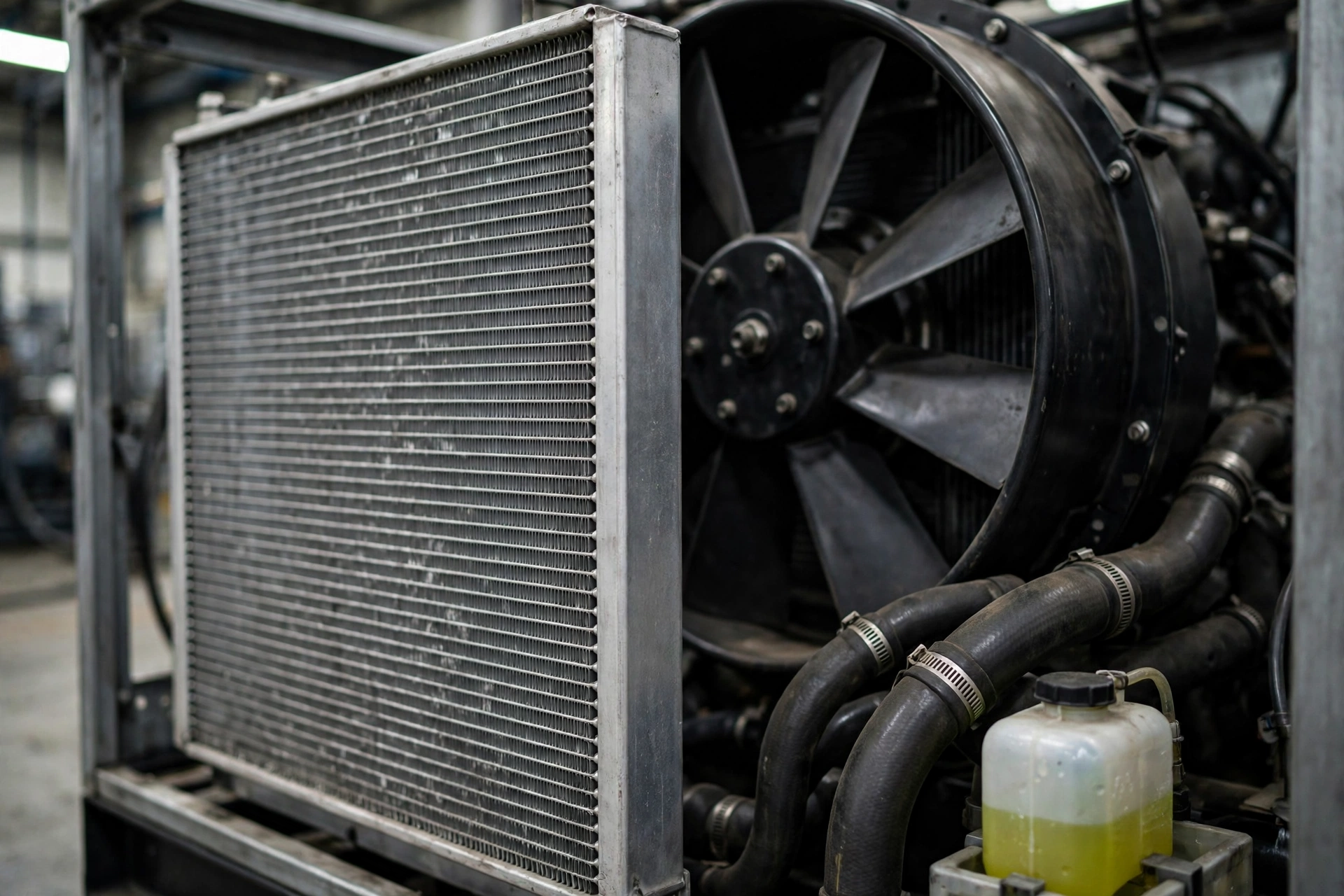
Coolant: the trip that looks like a fault
Normal coolant temperature after warm-up is 75–85°C, and a healthy set holds that band across most of its load range. In 50°C ambient, the same set runs 5–10 K hotter at the same load, because the radiator cannot shed heat as fast. The margin to the 98–105°C shutdown shrinks to a few degrees. Any second problem — a partially blocked radiator, a slipping fan belt, low coolant, a thermostat opening late — consumes that margin and trips the set.
The diagnostic order matters. If temperature climbs steadily from the first minute after start, the problem is circulation or airflow. If it climbs only under load, the suspects are overload, a blocked radiator or a late thermostat. If it rises only on hot summer afternoons, ventilation and dust are the most likely drivers. A set that trips every afternoon at 3 p.m. and runs clean at 8 a.m. has a cooling-margin problem, not an engine problem. The coolant maintenance routine — level, glycol concentration, additive condition — is the cheapest defence, and it is the one most often skipped on standby sets that sit for months between runs. coolant maintenance
Oil thins, and the turbo pays first
Engine oil does two jobs: it lubricates, and it carries heat away from pistons, bearings and the turbocharger. At high ambient temperature the oil runs thinner, its film strength falls, and its ability to carry heat drops. The turbocharger is the most exposed part: it spins past 100,000 rpm on a shaft the thickness of a thumb, its turbine housing runs above 600°C under load, and it sits last in line for oil.
Heat soak is the specific failure. A set shut down from full load stops its oil pump instantly, but the heat in the turbine housing keeps soaking backward into the bearing housing. The oil sitting in those bearings flash-cooks into hard carbon deposits that score bearings and plug passages on the next start. The fix costs nothing: idle the set for three to five minutes before shutdown, with no load, while exhaust temperature falls and the turbo spools down. Almost nobody does it, and the turbocharger is the part that records the omission.
Batteries and starters in the heat
Heat is usually discussed as a cold-start problem, and cold does kill batteries — a battery that delivers full power at 20°C delivers roughly half at −10°C. Heat damages batteries differently and more quietly. Sustained high temperature accelerates water loss in flooded batteries, corrodes plates faster, and shortens service life by roughly half for every sustained 8–10 K above design temperature. A battery that tests well in March can fail its first hot start in July, because the capacity it lost over the summer never shows on a voltage check.
The starter motor also works harder in the heat. Cranking a hot engine is easier than cranking a cold one, but a hot starter that has just cranked a heat-soaked engine repeatedly — three crank attempts of ten seconds each after a failed start — builds winding heat fast. On a standby set, the battery charger matters as much as the battery: a charger that died quietly six months earlier leaves a battery at partial charge, and partial charge plus 50°C ambient is a failed start waiting for the first real outage.
Three Sites, Three Ways Heat Wins
Heat does not fail generators in the abstract. It fails them at particular sites, in particular ways, and the pattern repeats often enough to recognise.
Case 1: Riyadh — the 500 kVA set that tripped every afternoon
A logistics warehouse outside Riyadh bought a 500 kVA standby set for a 420 kVA load: refrigeration compressors, lighting, dock doors and office air conditioning. The quotation was priced at 25°C reference conditions. Summer ambient reached 48–50°C on the roof where the set sat in a steel canopy, in direct sun.
The set passed its commissioning test in March, at 31°C, at full load, without incident. In July it began tripping on high coolant temperature between 2 p.m. and 4 p.m., always at full load, always on the hottest afternoons. The first three call-outs replaced the thermostat, then the coolant, then the temperature sensor. None of them was faulty.
The arithmetic explained the trips. At 50°C the set could deliver about 400 kVA — below the site’s 420 kVA load. The engine was overloaded by roughly 5% at the hottest hour, the radiator had no margin left, and the coolant temperature walked up to the 102°C shutdown setpoint over about forty minutes at full load. The fix was a 50°C radiator — a larger core with more surface area — plus a load-shedding relay that dropped the office air conditioning when the set was on generator power. Total cost: about $4,800 for the radiator and $900 for the relay. The original quotation had saved roughly $3,500 by supplying a standard 40°C radiator. The saving cost three months of afternoon outages and four wasted service visits.
Case 2: Lagos — humidity, salt air and the alternator
A cold-storage facility in Lagos runs a 400 kVA prime set, 8–12 hours a day, 300 days a year, because grid supply is unreliable. Ambient temperature is moderate by Gulf standards — 32–36°C — but humidity runs above 85% for much of the year, and the site sits 2 km from the coast.
The failure mode was not a trip. It was slow decline. After 14 months the alternator insulation resistance had fallen by half, the control panel showed intermittent faults on humid mornings, and the set’s available output had dropped by roughly 8% even though the engine was healthy. Condensation formed inside the windings during idle hours, when the set cooled to ambient and humid air entered the alternator. Salt air accelerated corrosion on terminals and the radiator’s aluminium fins.
The specification that would have prevented it costs little at order time and a great deal as a retrofit: anti-condensation heaters in the alternator, kept on whenever the set is idle; IP55 enclosure protection on the control panel; tropicalised varnish on the windings; and a radiator with coated fins. The facility’s second set, ordered with those four lines, has run two years without an insulation fault. The first set needed a $6,200 alternator rewind at 18 months — more than the tropical options would have cost on both sets combined.
Case 3: A desert site — 48°C by day, 4°C by night
A construction camp in the Sahara runs a 250 kVA prime set around the clock for site offices, a water pump and a batching plant. Daytime ambient reaches 48°C; night-time temperature falls to 4°C. The 44 K daily swing is the hardest climate a generator faces, because it demands the hot kit and the cold kit at the same time.
By day the set derates to about 205 kVA and the radiator works at its limit; the site runs the batching plant only before noon. By night the fuel in the day tank cools, wax crystals begin to form in standard diesel below about −5°C only in the coldest weeks, but the real night problem is the battery: a battery at 4°C delivers noticeably less cranking power than at 25°C, and the set must start cold at 5 a.m. for the morning shift. The site’s solution is a 50°C radiator for the day and a 1.5 kW jacket water heater plus battery warmer for the night — two specifications that look contradictory on one quotation and are both necessary on one site. The camp’s fuel consumption at 75% load is about 38 L/h, and the 1,000-litre bulk tank gives roughly 26 hours at that load — a figure the site manager checks every morning, because the nearest fuel delivery is a six-hour round trip.
Specifying for 50°C: Seven Lines That Change the Quotation
A heat-rated set is not a different machine. It is the same machine with seven specification lines changed. Each line is cheap at order time and expensive as a retrofit.
A 50°C radiator, not a 40°C one
The single most important line. A radiator must be sized for the maximum ambient temperature at the site, not the average. A 50°C radiator has a larger core, more surface area and a higher-capacity fan than a standard 40°C radiator, and it typically adds 5–8% to the price of the set. The Riyadh case shows what the saving costs. The radiator specification should state the design ambient temperature in writing — “radiator rated for 50°C ambient at full load” — because a quotation that says only “tropical radiator” has promised nothing measurable.
Alternator class H, PMG excitation and a bigger frame
At 50°C the alternator is the binding constraint, so the alternator deserves its own specification. Class H insulation (rated to 180°C) gives more thermal headroom than class F (155°C). PMG excitation — a permanent magnet generator feeding the voltage regulator — holds voltage better under motor-starting loads in the heat, where a self-excited alternator sags. And one frame size larger than the engine requires costs little and removes the alternator as the limit. On a 500 kVA set, the larger alternator frame typically adds $1,500–2,500 and returns it in the first summer.
Enclosure, fuel and controls for tropical duty
The remaining lines are smaller individually and decisive together. The canopy needs IP55 protection and a tropical paint system, not a standard enclosure, where humidity and salt air are present. The fuel system needs a day tank sized for expansion — diesel expands by roughly 0.08% per K, so a tank filled to the brim at 25°C overflows at 50°C — and diesel fuel ageing accelerates in the heat: water condenses in the tank, microbes grow faster, and fuel that lasts 12 months in a cool climate can degrade in 6 months in the tropics. diesel fuel ageing The control panel needs its own cooling or at least a shaded, ventilated position, because electronics derate too: a controller rated to 55°C in a canopy that reaches 65°C in direct sun will fault on the hottest day. A remote radiator is the right answer where the generator room cannot move enough air — the generator room ventilation guide puts the figure at about 12 m³/s for a 500 kVA set generator room ventilation — and a room that cannot pass that volume needs the radiator outside, not a bigger fan inside.
| Specification line | Standard set | 50°C-rated set | Typical added cost |
|---|---|---|---|
| Radiator | 40°C design | 50°C design, larger core | 5–8% of set price |
| Alternator | Class F, self-excited | Class H, PMG, one frame larger | $1,500–2,500 |
| Enclosure | Standard canopy | IP55, tropical paint, coated radiator fins | $800–1,500 |
| Alternator heaters | None | Anti-condensation heaters, on when idle | $300–600 |
| Fuel system | Standard day tank | Expansion allowance, water drain, polishing point | $400–700 |
| Battery | Standard | Heat-rated, larger capacity, monitored charger | $500–900 |
| Acceptance test | 25°C, no load | Full load at hottest hour, temperature logged | Half a day on site |
Running a Hot Set Day to Day
Specification decides whether a set can survive 50°C. Daily practice decides whether it does. Three habits cost nothing and prevent most hot-weather failures.
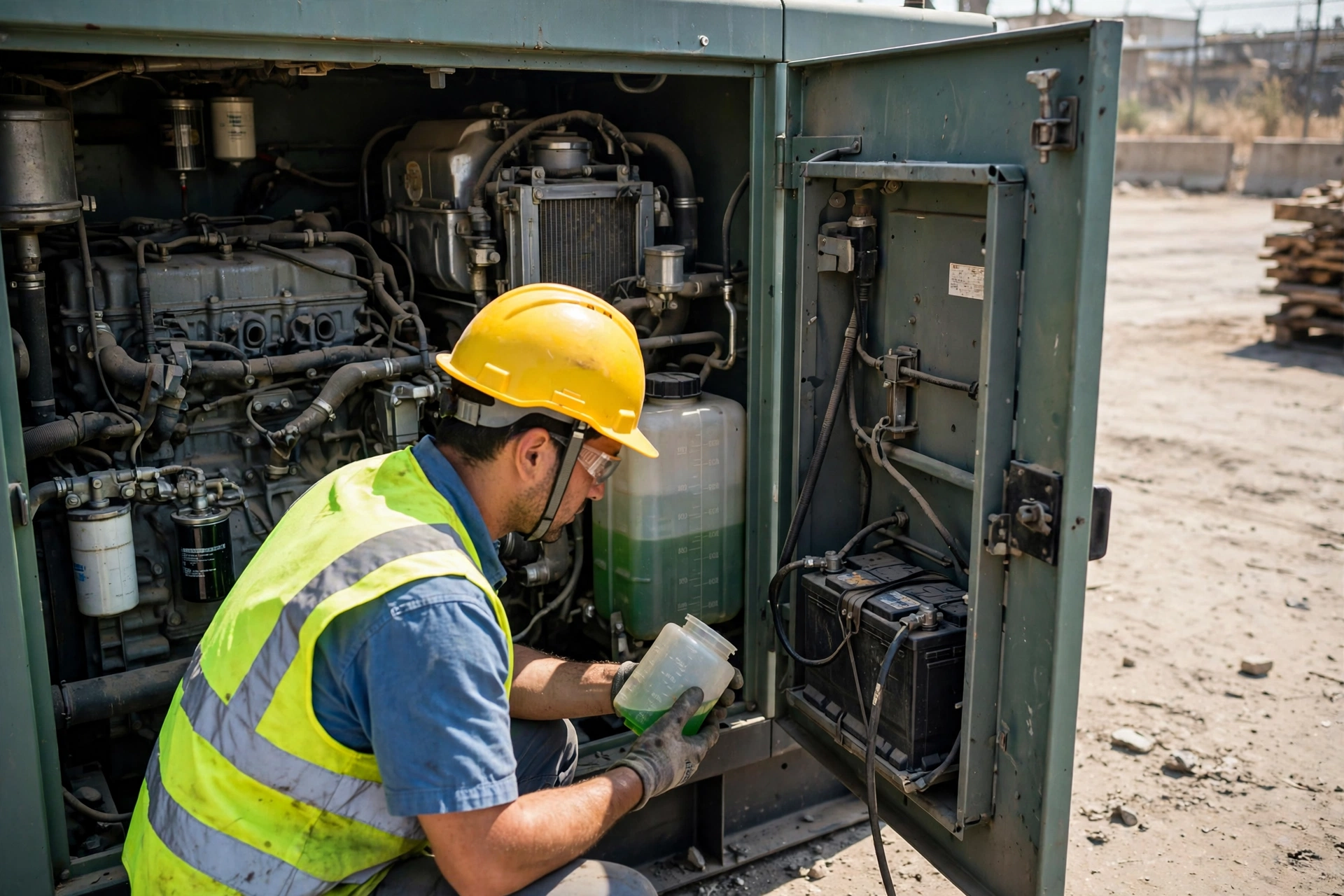
The morning checks that cost nothing
Coolant level, checked cold, before the first start of the day. Oil level and colour — oil that has thinned and darkened faster than the service interval suggests is a heat symptom, not a normal wear pattern. Battery terminals clean and tight, charger showing float voltage, no fault codes on the controller. Radiator intake clear of dust, leaves and plastic sheeting. Each check takes under a minute. Together they catch the low coolant, the dying charger and the blocked intake before the hottest hour turns them into a shutdown.
Load discipline on the hottest afternoons
A set that carries 90% load at 30°C carries an effective 105% load at 50°C, because the available rating has fallen while the load has not. The practical rule: above 45°C ambient, shed non-essential load — office air conditioning, non-critical lighting, battery charging banks — or accept that the set will trip. Sites that plan load shedding in advance, with a relay and a written list, keep running. Sites that improvise during an outage lose the load they needed most. The load list should be written into the operating procedure, not decided at 3 p.m. on the hottest day of the year.
Cleaning the radiator: the cheapest kilowatt on site
Dust is the most common cause of a hot-weather trip, and the cheapest to fix. Radiator fins cake with dust, airflow falls, coolant temperature creeps up, and the set derates or trips on a 38°C afternoon when it should have coped. On construction and mining sites, fins need blowing out with low-pressure air every two to four weeks in the dry season — never with a pressure washer, which bends the fins and makes the blockage permanent. A clean radiator is worth more than a larger one that is never cleaned.
The Cold End of the Same Problem
The heat specification and the cold specification look like opposites, and on some sites both are needed. A buyer who understands one end of the range should understand the other, because the same set can face both in a single week.
What −20°C demands — and why it is the opposite kit
At −20°C the problem inverts. Cold air is dense, so power is not the constraint; starting is. Oil viscosity roughly doubles for every 12–15 K the temperature falls, cranking speed sags, and compression heat falls below the level that ignites diesel. The standard answer is a jacket water heater of 1–3 kW, holding coolant near 40°C around the clock, plus an oil sump heater — a bolt-on pad of 75–250 W or an immersion element of 300–500 W — because warm coolant leaves the oil in the sump cold. oil sump heater Battery warmers and winter-grade 5W-40 synthetic oil complete the kit. Without those aids, many sets will not start at all within their crank allowance at −20°C, and the automatic transfer switch cannot transfer power a set has not produced. automatic transfer switch The cold-start kit is covered in detail in the companion guides on start time and oil heating; it is summarised here only so that a buyer specifying for heat does not forget that the same set may also face a cold morning.
One set, two climates: desert day and night
The desert camp in Case 3 runs both kits on one set: a 50°C radiator for the afternoon and a jacket water heater plus battery warmer for the 4°C dawn start. The combination is not a contradiction. It is the recognition that a generator’s enemy is temperature difference from its design point, in either direction. The specification question is always the same: what is the highest temperature this set will run at, and what is the lowest temperature it will start at? A quotation that answers both questions, with numbers, is a quotation that will survive its first year on site.
Frequently Asked Questions
Can a diesel generator run in 50 degree heat?
Yes, but derated. A standard 500 kVA set delivers about 400 kVA at 50°C ambient, because the engine loses 10–13% and the alternator loses 17–22% of capacity. A set specified with a 50°C radiator, class H alternator and PMG excitation runs at 50°C without tripping, provided the load stays within the site-rated figure rather than the nameplate figure.
Why does my diesel generator keep overheating in summer?
The most common causes are a radiator sized for 25°C or 40°C ambient, dust-blocked fins, low or degraded coolant, and a load that exceeds the derated rating at high ambient temperature. Check the coolant level cold, clean the radiator fins, and compare the load against the set’s rating at the actual ambient temperature before replacing parts.
How much power does a diesel generator lose in hot weather?
Above 40°C, a standard set loses roughly 5–6% of power, rising to 10–13% of engine power and 17–22% of alternator capacity at 50°C. Combined with altitude, the loss is larger: a set at 1,000 m and 45°C can lose a fifth of its nameplate rating. The altitude derating guide gives the combined figures for high sites. altitude derating
How to keep a diesel generator cool in hot weather?
Size the radiator for the maximum ambient temperature, keep the fins clean, maintain coolant level and chemistry, provide the full ventilation airflow the set needs, shed non-essential load above 45°C. Shade the canopy from direct sun, never let hot radiator air recirculate into the intake, and idle the set for three to five minutes before shutdown so the turbocharger cools on flowing oil.
What is the maximum temperature a diesel generator can run in?
Most standard sets are rated to 40°C ambient, and a normal working environment temperature should not exceed 50°C. Above 50°C, only a set specified for that temperature — 50°C or 55°C radiator, class H alternator, tropical enclosure — should be run at load, and the available power must be taken from the manufacturer’s derate curve for the exact engine model at that temperature.
Specification Checklist: Eight Questions Before the Deposit
1. At what ambient temperature is this set rated? The datasheet must state a design ambient temperature — 40°C, 50°C or 55°C — not just a kVA figure at 25°C reference conditions. A sheet that will not name its design temperature is a warning.
2. What is the site-rated kVA at the hottest month’s temperature? Ask for the derated figure at the actual maximum ambient, with engine and alternator derates shown separately. The lower of the two is the available power.
3. Is the radiator sized for that temperature? “50°C radiator, larger core, rated at full load” is a specification. “Tropical radiator” is a slogan. Confirm the core size and fan capacity in writing.
4. What alternator class and excitation? Class H insulation and PMG excitation, one frame larger than the engine requires, are the heat-rated combination. Class F with self-excitation is the standard combination, and it is the one that fails first at 50°C.
5. What is the duty — standby or prime? A standby set and a prime set carry different ratings for the same frame, and heat narrows both. Confirm the rating letters — ESP, PRP or COP — against the standby and prime power guide before the deposit is paid. standby and prime power
6. How is the fuel protected from heat? Ask about tank expansion allowance, water drains, and a fuel-polishing point. Fuel that degrades in six months in the tropics needs a maintenance plan, not a larger tank.
7. What proves the set works at temperature? The acceptance test should run at full load, at the hottest hour the site allows, with coolant temperature, oil temperature and alternator winding temperature logged. A no-load test at 25°C proves nothing about 50°C.
8. Will the warranty stand at the stated site conditions? Ask in writing: “If this set runs at the stated duty, for the stated annual hours, at 50°C maximum ambient, will the warranty remain valid?” A direct answer, with the derated rating attached, is worth more than a 5% discount. A vague answer is a warning.
A generator bought for a hot climate fails in one of two places: on the datasheet, where the temperature was never written down, or on the hottest afternoon of its first summer, where the omission becomes a shutdown. The quotation that states its design temperature, its derated kVA and its radiator size in writing is the quotation that survives July. Read the temperature line before the price line.
To specify a set for a hot site, or to check whether an existing set is rated for the temperatures it actually faces, contact PAVO — PAVO builds diesel generator sets from 9 to 3750 kVA in open, silent and containerised configurations, powered by Cummins, Weichai, Yuchai and Shanghai Diesel, and rates every set for the site conditions it will work in, not the reference conditions on the brochure. contact PAVO