

What Size Generator Does a Bottling Plant Need | PAVO
A bottling line does not stop politely. When the power goes, the filler stops mid-bottle, the carbonator loses its gas, and the blow moulder leaves a rack of hot preforms to cool into scrap.
A beverage bottling plant needs a generator sized to its line, not to its nameplate total. What size generator does a beverage bottling plant need? A craft line runs on 150–250 kVA, a regional line on 400–800 kVA, and a high-speed PET line on 1,000–2,000 kVA — once filling, blow moulding, compressors and refrigeration are counted with starting surge.
Contents
- What a Bottling Plant Actually Runs on Power
- How to Size the Generator: Bottles per Hour to kVA
- The Damage Window: What Happens in the First Minutes
- Filling Lines, Carbonation and Refrigeration
- Blow Moulding and Compressed Air: The Hidden Load
- Fuel Autonomy, Placement and the Wet-Environment Rules
- Frequently Asked Questions
- Specification Checklist
What a Bottling Plant Actually Runs on Power
A bottling plant is not one load. It is five different loads that happen to share a roof, and they behave differently when the power fails. The filler is a precision machine that stops mid-cycle. The blow moulder is a furnace that cannot cool halfway. The refrigeration plant is a slow thermal mass that forgives ten seconds and punishes ten hours. The air compressors are the largest single electrical load in most PET plants. The offices, lights and yard are the only part of the plant that can wait.
Sizing starts by sorting every load into three tiers. Tier 1 loads must never stop, or must restart within seconds. Tier 2 loads must restart within the hour, or product is lost. Tier 3 loads can wait until the grid returns. A plant that sizes its generator for Tier 1 plus Tier 2, and deliberately leaves Tier 3 off the essential board, buys a set half the size of the plant that backs up everything.
| Tier | Loads | Why it matters |
|---|---|---|
| Tier 1 — never stop | Filling line, carbonator, refrigeration compressors, water treatment, control systems, emergency lighting | Product in process is lost within minutes; restart takes hours |
| Tier 2 — restart within the hour | Blow moulder, conveyors, labellers, packers, CIP system, boiler feed | Production stops but product survives if these restart promptly |
| Tier 3 — can wait | Offices, yard lighting, workshops, non-essential HVAC, vehicle charging | No product at risk; these add 15–25% to connected load for no benefit |
The split matters because the connected load of a bottling plant is always larger than the essential load. A regional carbonated soft drink plant with a 24,000 bottles-per-hour line carries roughly 700–850 kW of connected load. The essential board — Tier 1 plus Tier 2 — is typically 480–620 kW. The difference, 200 kW or more, is offices, yard, workshop and comfort cooling. A generator sized for connected load is a 1,000 kVA set. A generator sized for the essential board is a 750 kVA set. The saving is real money, and it is also a better set: a generator that runs at 70–80% load is efficient, clean-burning and long-lived. A generator that runs at 45% load wet-stacks, glazes its cylinders and fails early.
Tier 1 — loads that must never stop
The filling line is the heart of the plant, and it is the least forgiving load in the building. A rotary filler running at 24,000 bottles per hour fills 400 bottles a minute — nearly seven a second. When power fails mid-cycle, the filler stops with bottles half full, valves open, and product exposed. The line cannot simply restart. It must be drained, cleaned, re-sterilised and re-primed. That is the CIP cycle, and it takes 45–90 minutes even when everything goes well.
Refrigeration is Tier 1 for a different reason. The cold store holds finished product at 2–4°C, and the glycol system holds process water and carbonation at the same temperature. A cold store gains roughly 1°C per hour without cooling in a warm climate, faster if the doors are opened. Two hours without refrigeration does not ruin finished stock. Eight hours does. The refrigeration compressors are also the hardest load to restart: a 75 kW screw compressor draws six to seven times its running current at start, and if three compressors try to start together the generator voltage collapses.
Water treatment is Tier 1 because every beverage is mostly water. A reverse-osmosis plant, de-aeration unit and blending system run continuously during production. Stop the water and the line stops within minutes, whatever the filler is doing. Water treatment loads are modest — 15–30 kW for a regional plant — but they are non-negotiable.
Tier 2 — loads that must restart within the hour
The blow moulder belongs in Tier 2, not Tier 1, and that surprises people who have seen one. A rotary PET blow moulder is a large, hot, expensive machine, and it looks like the most critical load in the plant. It is not, because it can stop safely. When power fails, the moulder stops with preforms in the oven. The preforms cool and are scrapped — a few hundred bottles of plastic, worth tens of dollars. The machine itself is undamaged. Restart takes 20–30 minutes to bring the oven back to temperature. The cost of a blow moulder stop is measured in minutes of production, not in product loss.
Conveyors, labellers and packers are Tier 2 for the same reason. They stop, the product on them is held, and they restart when power returns. The risk is a jam or a pile-up on restart, not a write-off. CIP is Tier 2 because it is the recovery tool: after an outage, the plant needs CIP to clean and re-sterilise the line before production resumes, and CIP needs 20–40 kW of pumps and heating. A plant that leaves CIP off the essential board discovers, after its first real outage, that it cannot restart at all.
Tier 3 — loads that can wait until the grid returns
Offices, yard lighting, workshops and non-essential HVAC are Tier 3. They are also the loads that creep onto the essential board during design, because nobody wants to be the person who left the office dark. Resist that. Every kilowatt of Tier 3 load on the essential board is a kilowatt the generator must carry, and a kilowatt of starting surge the generator must absorb. A 100 kW office air-conditioning load adds roughly 125 kVA to the generator size and adds nothing to production. The rule is simple: if a load does not protect product, protect the line, or protect people, it does not go on the essential board.
How to Size the Generator: Bottles per Hour to kVA
Bottling plants are sized by line speed, not by floor area. A plant’s output is measured in bottles per hour, and every major load scales with that number. The filler, the labeller, the conveyors and the packaging all scale linearly with speed. The blow moulder and the compressors scale faster, because higher speeds need more air at higher pressure. Refrigeration scales with throughput and with climate. The table below gives the working bands that plant engineers use when they first scope a generator, before the detailed load list is drawn up.
| Line type | Speed (bph) | Running load (kW) | Generator (kVA) | Fuel at 75% load (L/h) |
|---|---|---|---|---|
| Craft / small regional | 2,000–6,000 | 90–160 | 150–250 | 28–48 |
| Regional CSD / water | 12,000–24,000 | 320–550 | 400–800 | 65–110 |
| High-speed PET water | 36,000–48,000 | 700–1,100 | 1,000–1,500 | 140–200 |
| High-speed CSD / aseptic | 48,000–72,000 | 1,100–1,600 | 1,500–2,000 | 200–260 |
These are starting points, not quotations. The generator sizing guide math still applies: add up the running loads, add the largest starting surge, apply a diversity factor, and check the result against the alternator’s motor-starting capability. A bottling plant is a motor-heavy load — fillers, compressors, pumps, conveyors and fans — and motor starting is what decides the set size more often than running load does. The motor-starting rules for a bottling plant are the same as anywhere else: a direct-on-line motor draws six to seven times its running current, a soft starter cuts that to three to four times, and a variable-speed drive cuts it to barely more than running current. Good motor starting practice — soft starters on the large compressors, staged start logic in the controller — routinely saves a full frame size on the generator.
A 6,000 bph craft line: 150–250 kVA
A craft brewery or small juice bottler running 6,000 bottles an hour is the smallest plant that needs a serious generator. Running load is 90–160 kW: a small rotary or inline filler at 12–18 kW, a labeller at 5–8 kW, conveyors at 8–12 kW, a 30–45 kW refrigeration plant, water treatment at 8–12 kW, and a small blow moulder or a supply of pre-blown bottles. A 200 kVA prime-rated set covers it, with headroom for the refrigeration compressor start. This is the size where buyers most often under-specify: a 150 kVA set looks adequate on running load and fails on the first compressor start after a hot day. The margin between 150 kVA and 200 kVA costs a few thousand dollars. The cost of a failed start is a lost production day.
A 24,000 bph regional line: 500–800 kVA
A regional carbonated soft drink plant running 24,000 bottles an hour is the most common bottling size in the world, and the most commonly mis-sized. Running load is 320–550 kW. The filler draws 30–45 kW. The blow moulder draws 110–160 kW. The high-pressure compressor draws 75–160 kW. Refrigeration draws 60–120 kW. Water treatment, CIP, conveyors, labellers and packers add another 60–100 kW. A 650 kVA prime-rated set is the usual answer, and the Cummins C500D5 illustrates the rating gap on one datasheet: 500 kVA standby, 455 kVA prime, the same engine, about 9% apart. A plant that runs its generator for hundreds of hours a year — grid outages, load shedding, peak shaving — is on prime duty, and it must buy the prime figure. The standby and prime power ratings explain the difference: a standby-rated set is designed for up to 200 hours a year, and a plant that exceeds that wears its engine out years early.
A 60,000 bph high-speed line: 1,500–2,000 kVA
A high-speed PET water line at 60,000 bottles an hour is a different machine. Running load is 1,100–1,600 kW. The blow moulder alone draws 200–280 kW. The high-pressure air system draws 250–400 kW across two or three compressors. Refrigeration, water treatment and the filling line add another 400–600 kW. A 2,000 kVA set is the usual answer, and at this size the plant rarely buys one set. It buys two 1,000 kVA sets in parallel, so that one set can be serviced while the other carries the essential board, and so that a single failure does not take the whole plant down. Two sets also solve the starting problem: the first set starts the compressors in sequence, the second set synchronises and takes the filling line. Paralleling is a capital decision, not a technical luxury, at this scale.
The Damage Window: What Happens in the First Minutes
The question buyers ask is how long the generator takes to start. The question that matters is how much product is destroyed before it starts, and how long the line takes to recover after it starts. A bottling plant’s damage window is measured in minutes, not hours, and it is measured in product, not in electricity. The automatic transfer switch takes about 10 seconds to transfer load — NFPA 110 requires Level 1 emergency power within 10 seconds, and a correctly specified set meets that. The 10 seconds are survivable. The 10 minutes after the generator starts are not, unless the plant has planned for them.
A rotary filler stops mid-cycle with bottles half full and valves open. The product in those bottles is exposed to air and to the filler bowl, and it cannot be sold. The carbonator loses pressure, and carbon dioxide comes out of solution. The blow moulder stops with preforms in the oven. The CIP system cannot run until water temperature is back. Each of these is a small loss on its own. Together they are the reason a 10-second outage costs a bottling plant two hours of production.
The arithmetic is unforgiving. A 24,000 bottles-per-hour line fills 400 bottles a minute. A 10-minute stop is 4,000 bottles of lost production. At a wholesale value of 20–40 cents a bottle, that is $800–$1,600 of product. A two-hour stop — the time it takes to drain, clean, re-sterilise and re-prime a carbonated line — is 48,000 bottles, or $9,600–$19,200. A plant that loses power twice a month loses $230,000–$460,000 a year in production alone, before the cost of wasted product, wasted CO2, wasted PET preforms and overtime to catch up. A 650 kVA generator costs roughly $55,000–$75,000 ex-works. The payback is measured in months, not years.
Case 1 — A carbonated soft drink plant in Ho Chi Minh City: the batch that went flat
A regional carbonated soft drink plant outside Ho Chi Minh City runs a 24,000 bottles-per-hour line, six days a week, 16 hours a day. The grid in the industrial zone is reliable by Vietnamese standards and unreliable by the plant’s standards: short outages of 2–10 minutes, three or four times a month, usually in the afternoon when air-conditioning load peaks across the city. The plant had a 500 kVA standby set, bought for the offices and the yard, and nobody had connected the filling line to it.
One afternoon in May 2024, the grid dropped for six minutes. The filler stopped mid-cycle with 340 bottles on the carousel. The carbonator, held at 2°C and 3.5 bar, lost pressure in under a minute. Carbon dioxide came out of solution in the product tank, and the carbonation level in the next 2,000 bottles drifted below specification. The plant’s quality system caught it — the bottles were quarantined, tested and dumped. The direct loss was 2,340 bottles, about $700 of product. The indirect loss was the line: drain, CIP, re-prime and re-carbonate took 2 hours 40 minutes, during which the plant produced nothing. The shift lost 64,000 bottles of production, roughly $19,000 at wholesale.
The plant’s answer was not a bigger generator. It was a different one. The 500 kVA standby set was replaced with a 750 kVA prime-rated set on the essential board, with the filling line, carbonator, refrigeration and water treatment all connected. The set starts in under 10 seconds, and the plant’s restart procedure now takes 35 minutes instead of 2 hours 40 minutes, because the carbonator never loses pressure and the filler never drains. The plant has had 11 short outages since. Production lost: zero bottles.
Case 2 — A PET water plant in Lagos: the generator that never stops
A PET bottled-water plant in the Lagos industrial area runs a 36,000 bottles-per-hour line, 24 hours a day, six days a week. The grid supply is so unreliable that the plant treats it as a bonus, not a supply: the plant runs on its own generators for 60–70% of its operating hours, and the grid, when it is there, is used to reduce fuel burn. This is prime power in the strictest sense — the set is the power station, and the grid is the backup.
The plant runs two 1,250 kVA prime-rated sets in parallel, with a third 1,250 kVA set as standby. The load is 1,400–1,700 kW: a rotary blow moulder at 200–280 kW, high-pressure compressors at 300–400 kW, the filling line at 60–80 kW, refrigeration at 150–200 kW, water treatment at 40–60 kW, and packaging at 80–120 kW. Fuel burn at 75% load is about 380 litres an hour across the two running sets. A 24-hour day burns roughly 9,100 litres. The plant holds 40,000 litres in bulk storage — four and a half days — and takes a 10,000-litre delivery every day.
The lesson from Lagos is not about size. It is about duty. A plant that runs its generator 4,000 hours a year cannot buy a standby-rated set. A standby set is designed for 200 hours a year. Run it for 4,000 hours and the engine wears out in 18 months: the pistons, the liners, the turbocharger, all of them. The Lagos plant’s sets are prime-rated, serviced every 250 hours, and overhauled at 12,000 hours. The maintenance cost is real — roughly $0.04–$0.06 per kWh generated, or about $18,000–$25,000 a year per set — but it is a fraction of the cost of a plant that stops. A bottling plant that runs on prime power is a power station that happens to make water.
Case 3 — A juice plant in Paraná, Brazil: the aseptic line that could not restart
A juice bottler in Paraná state runs a 12,000 bottles-per-hour aseptic line, filling pasteurised juice into PET bottles in a sterile environment. The line is the most demanding in the plant: the product is held at 95°C, the filling zone is sterile, and any break in sterility means the line must be re-sterilised from scratch. The plant had a 400 kVA standby set, sized for the filling line alone, and a maintenance team that tested it monthly — on no load, for 30 minutes, as the manual suggested.
In October 2024, the grid failed for 47 minutes during a thunderstorm. The generator started in 9 seconds. The filling line restarted in 20 minutes. And then the plant discovered the problem: the CIP system, which was not on the essential board, could not run. The line had stopped mid-cycle with hot juice in the filler, and the only way to restart was a full CIP cycle — drain, caustic wash, rinse, sterilise, re-prime. The CIP pumps needed 25 kW. The generator had the capacity. The cable was not there.
The line was down for 6 hours 20 minutes. The plant lost 76,000 bottles of production, about $22,800 at wholesale, and dumped 4,200 litres of juice that had sat in the filler above 60°C for too long. The fix cost less than $3,000: a cable, a breaker, and a change to the essential board that put CIP on it. The plant’s engineer put it plainly in the incident report: the generator was the right size, the test was the right test, and the plant still failed, because the recovery system was not on the essential board. A generator that cannot restart the line is a generator that protects the building, not the business.
Filling Lines, Carbonation and Refrigeration
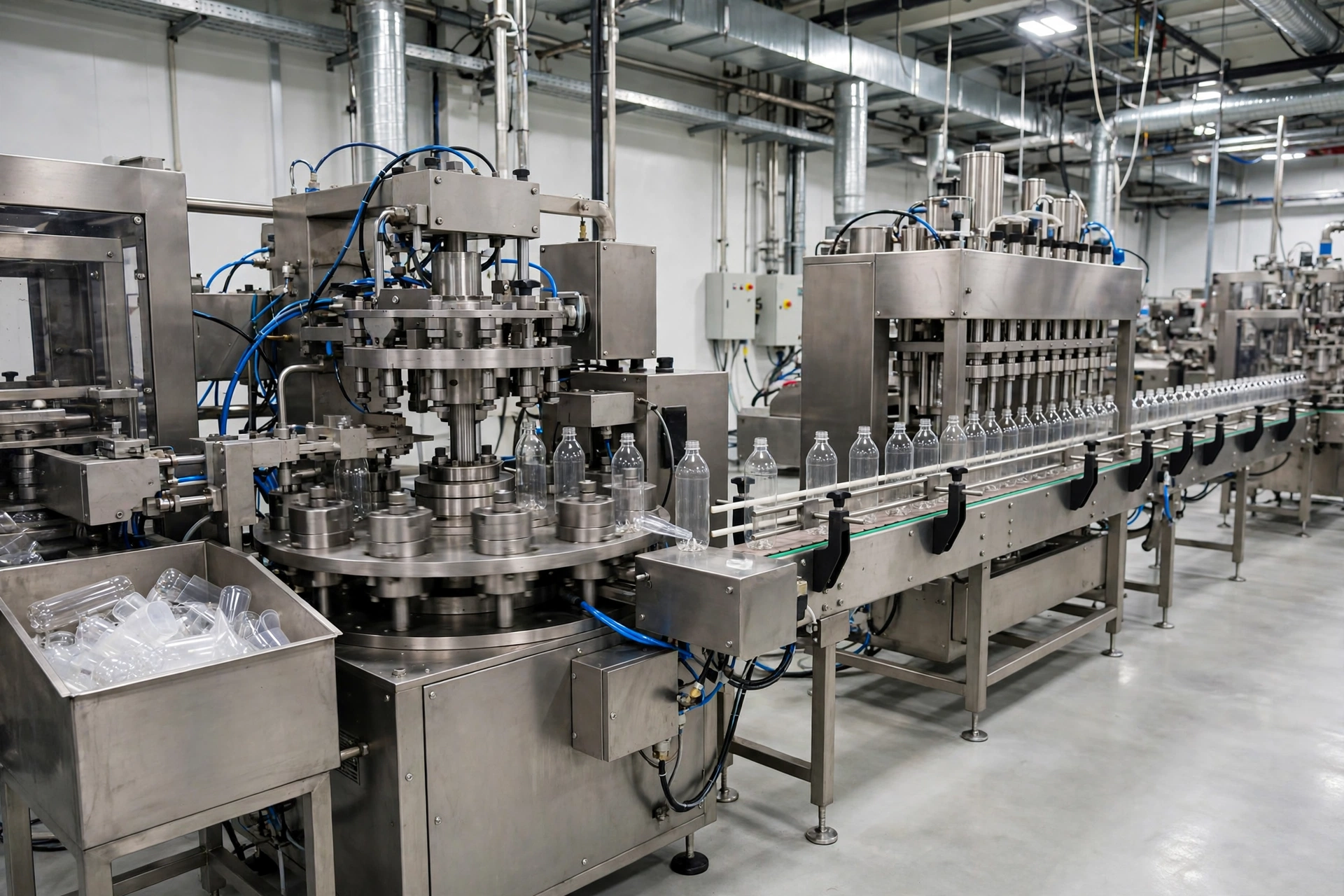
The filling line is where the plant makes its money, and it is where a power failure does the most damage. Understanding the filler, the carbonator and the refrigeration plant — what they draw, what they do when power fails, and what they need to restart — is the core of sizing a bottling plant generator. These three systems are also the reason a bottling plant cannot be sized from a nameplate total. Their running loads are modest. Their starting loads and their recovery loads are not.
The rotary filler: 30–45 kW that stops seven bottles a second
A modern rotary filler for a 24,000 bottles-per-hour line is a 40–60 station machine, 3–4 metres in diameter, driven by a 15–22 kW main motor with servo-driven valves. Total electrical load, including the filler, the rinser and the capper, is 30–45 kW. The load is steady, the power factor is good, and the starting current is modest — the filler is a soft-start load, and it restarts cleanly.
The risk is not electrical. It is product. When the filler stops, the bottles on the carousel are half full, the valves are open, and the product is exposed. The filler bowl holds 200–400 litres of product, and that product cannot be sold: it has been exposed to air, it has lost carbonation, and it has sat at the wrong temperature. The loss per stop is 300–500 bottles on the carousel plus the bowl contents — roughly 600–800 bottles, or $120–$320 at wholesale. The real cost is the restart: drain, CIP, re-prime, re-carbonate, and a quality check on the first 200 bottles. A plant that has practised the restart does it in 35–45 minutes. A plant that has not does it in two hours.
Carbonation: the gas that leaves in under a minute
Carbonation is the most time-sensitive process in a soft drink plant, and the least understood by people who size generators. Carbon dioxide dissolves in water under pressure and at low temperature: a carbonated soft drink is held at 2–4°C and 3–4 bar, and at those conditions the CO2 stays in solution. Lose pressure, and the CO2 comes out. Lose temperature, and it comes out faster. A carbonator that loses power loses its refrigeration and its pressure control at the same time, and the carbonation level in the product tank starts to fall within a minute.
The carbonator itself draws little power — 5–10 kW for the pumps and controls. The refrigeration that holds it at 2°C draws 40–80 kW. The CO2 that is lost costs real money: a plant running 24,000 bottles an hour uses roughly 60–80 kg of CO2 an hour, and food-grade CO2 costs $0.50–$1.00 a kilogram in most markets. A two-hour outage wastes the CO2 in the product tank — 100–150 kg, or $50–$150 — and, worse, it wastes the product: 2,000–4,000 bottles that fail the carbonation test and are dumped. The same problem faces brewery backup power, where fermentation and carbonation are equally time-sensitive, and the answer is the same: the carbonator and its refrigeration must be on the essential board, and the generator must start before the pressure falls.
Refrigeration and the cold store: the slow clock
Refrigeration is the largest continuous load in most bottling plants after the compressors, and it is the most forgiving of a short outage. A cold store holding finished product at 2–4°C gains roughly 1°C per hour without cooling in a warm climate, faster if the doors are opened for dispatch. Two hours without refrigeration does not ruin finished stock. Eight hours does. The process refrigeration — the glycol system that cools the carbonator, the product tanks and the filling line — is less forgiving: product temperature rises within 30 minutes, and carbonation starts to fall.
The electrical problem is starting. A 75 kW screw compressor draws six to seven times its running current at start — 450–525 kW of inrush for a few seconds. A plant with three 75 kW compressors that start together asks the generator for 1,350–1,575 kW of inrush. No 650 kVA set can deliver that. The fix is sequence, not size: compressors start one at a time, minutes apart, with the filling line held off until refrigeration is stable. Good motor starting practice — soft starters or variable-speed drives on the larger compressors, staged start logic in the controller — turns a 1,350 kVA problem into three 400 kVA steps the set can absorb. A variable-speed drive on the lead compressor also pays for itself in normal operation: refrigeration load follows the production schedule, and a compressor running at 60% speed uses far less power than one cycling on and off at full speed. The same logic applies to cold storage backup power in a warehouse, where the cold store is the product, and in a bottling plant the cold store is the product too.
Blow Moulding and Compressed Air: The Hidden Load
Ask a plant manager what the biggest electrical load in a PET bottling plant is, and most will say the filling line. They are wrong. In a PET plant, the biggest load is the air. The blow moulder and its compressors together draw 40–55% of the plant’s total electricity, and they are the load that most often gets under-counted when a generator is sized. A plant that sizes its generator for the filling line and forgets the air buys a set that starts the filler and then collapses when the compressors try to start.
The reason is physics. A PET bottle is made by heating a preform to about 100°C and then blowing it into a mould with air at 30–40 bar. That pressure is 30–40 times atmospheric pressure, and producing it takes energy: roughly 0.11–0.13 kWh per cubic metre of air at 40 bar. A 12,000 bottles-per-hour line uses 400–600 cubic metres of high-pressure air an hour. A 36,000 bottles-per-hour line uses 1,200–1,800 cubic metres an hour. The compressors that produce that air are the largest motors in the building.
The blow moulder: 110–280 kW of heat and motion
A rotary PET blow moulder for a 12,000 bottles-per-hour line is a 6–8 cavity machine, drawing 110–160 kW: the oven heaters take 60–90 kW, the drives take 20–30 kW, and the cooling and controls take the rest. A 36,000 bottles-per-hour line uses a 16–20 cavity machine drawing 200–280 kW. The load is steady once the oven is at temperature, and the oven has thermal inertia: it takes 20–30 minutes to cool and 20–30 minutes to reheat. That inertia is the reason the blow moulder is Tier 2, not Tier 1. It can stop safely. The cost of a stop is the preforms in the oven — 100–300 preforms, worth $10–$30 — and 30–45 minutes of production while the oven reheats.
The blow moulder’s electrical risk is on restart, not on stop. When the oven reheats, all the heater zones switch on together, and the load jumps to full power in seconds. A generator that has just started the filling line and the refrigeration compressors, and then sees the blow moulder oven switch on, can be overloaded. The fix is sequencing: the oven reheats in zones, or the blow moulder restarts after the filling line is stable. A controller that stages the restart is worth more than a larger generator.
The high-pressure compressors: 75–400 kW, and the starting surge that decides the set
The high-pressure air system is the load that decides the generator size in a PET plant. A 12,000 bottles-per-hour line needs one 75–110 kW compressor, delivering 6–9 cubic metres a minute at 40 bar. A 24,000 bottles-per-hour line needs a 160–200 kW compressor, or two 110 kW machines. A 60,000 bottles-per-hour line needs 300–400 kW of compression, usually split across two or three machines so that one can be serviced while the others run.
The starting surge is the problem. A 110 kW compressor motor draws 660–770 kW of inrush on direct-on-line start. A 650 kVA generator, which can deliver roughly 520 kW, cannot start that motor while carrying the rest of the plant. Three solutions exist, and good plants use all three. First, soft starters or variable-speed drives on the compressors, cutting inrush to two to three times running current. Second, staged starting: compressors start one at a time, minutes apart, with the filling line held off. Third, an air receiver large enough to ride through the start: a 5,000-litre receiver at 40 bar holds enough air for 3–5 minutes of production, which is enough time for the compressors to start in sequence. A plant that has none of these buys a generator one frame size larger than it needs, and still has starting problems.
Low-pressure air and CIP: the loads that finish the job
Low-pressure air — 7–10 bar for the filler, the labeller, the packer and the pneumatic controls — draws 15–30 kW in a regional plant, and it is a Tier 1 load: without it, the filler cannot run, the labeller cannot apply labels, and the pneumatic valves do not move. The low-pressure compressor is usually a small screw machine, 15–22 kW, and it starts cleanly. The risk is that it is forgotten. A load list that includes the filling line and forgets the air that drives it is a load list that produces a generator that cannot run the plant.
CIP — clean-in-place — is the recovery system, and it is the load that plants most often leave off the essential board. A CIP set draws 20–40 kW: circulation pumps at 11–22 kW, heating at 10–20 kW, and controls. After an outage, the plant needs CIP to drain, clean, sterilise and re-prime the line. A plant that leaves CIP off the essential board can start its generator, start its filling line, and then discover that it cannot restart production at all — the case of the Paraná juice plant, above. The fix is a cable and a breaker, and it costs less than $3,000. The lesson is to size the generator for the recovery, not just for the production.
Fuel Autonomy, Placement and the Wet-Environment Rules
A bottling plant generator is sized in kVA and bought in litres. The kVA decides whether the line runs. The litres decide how long it runs. A plant that sizes the set correctly and then puts a 1,000-litre day tank on it has bought a generator that runs for 14 hours and then stops — in the middle of the outage it was bought for. Fuel autonomy is a design decision, not an afterthought, and it is the decision that separates a plant that rides through a storm from a plant that runs out of fuel at 3 a.m.
| Generator size | Fuel at 75% load (L/h) | 8-hour run (L) | 24-hour run (L) | 72-hour run (L) |
|---|---|---|---|---|
| 200 kVA | 32 | 256 | 768 | 2,304 |
| 500 kVA | 70 | 560 | 1,680 | 5,040 |
| 750 kVA | 105 | 840 | 2,520 | 7,560 |
| 1,000 kVA | 140 | 1,120 | 3,360 | 10,080 |
| 2,000 kVA | 280 | 2,240 | 6,720 | 20,160 |
The table uses the Cummins C500D5 as its anchor: 500 kVA prime, 93.2 litres an hour at full load, about 70 litres an hour at 75% load. The other sizes scale proportionally, and the scaling is close enough for planning: a diesel generator burns roughly 0.19–0.21 litres per kWh at 75% load, whatever its size. The practical question is how many hours the plant needs. A plant in a city with a reliable grid plans for 8 hours: a day tank of 1,000 litres on a 500 kVA set. A plant in a region with load shedding plans for 24 hours: a 2,000-litre bulk tank. A plant in a region with storm outages plans for 72 hours: a 5,000-litre bulk tank, a delivery contract that works during a regional outage, and a fuel management routine that keeps the fuel clean.
Fuel cost is the running cost that buyers underestimate. A 500 kVA set at 75% load burns 70 litres an hour. At $1.00–$1.30 a litre — the range in most markets in 2026 — that is $70–$91 an hour, or $1,120–$1,456 for a 16-hour production day. A plant that runs its generator 500 hours a year spends $35,000–$45,500 a year on fuel. A plant that runs it 4,000 hours a year, like the Lagos water plant, spends $280,000–$364,000 a year. That is why fuel efficiency matters more than purchase price for a prime-power plant, and why a set that runs at 70–80% load — efficient, clean-burning, long-lived — is cheaper over five years than a set that runs at 45% load and wet-stacks.
Fuel storage: the tank that outlasts the outage
The day tank is the first line of defence, and it is usually too small. A 500 kVA set with a 1,000-litre day tank runs for 14 hours at 75% load. A 24-hour outage needs 1,680 litres. A 72-hour outage needs 5,040 litres. The answer is a bulk tank, bunded, with a transfer pump and a level alarm — and a delivery contract. A plant that holds 5,000 litres and has no delivery contract has bought 72 hours of autonomy and no way to extend it. A plant that holds 2,000 litres and has a supplier who delivers during a regional outage has bought 24 hours and a way to extend it indefinitely.
Fuel quality is the second line of defence, and it is the one that fails most often. Diesel fuel absorbs water, grows microbes and forms sludge in storage. A bulk tank that has sat for a year, absorbing water through its vent and growing a microbial mat at the fuel-water interface, is not a reserve. It is a filter-blocking liability that reveals itself at hour 20 of the outage, when the filters clog and the generator stops. Good diesel fuel ageing discipline — a fuel test every six months, a water drain every month, a biocide dose on delivery, and a polish every two years — costs a few hundred dollars a year and prevents the failure that no generator size can fix.
Placement: outside the hygiene zone, close enough for a short cable run
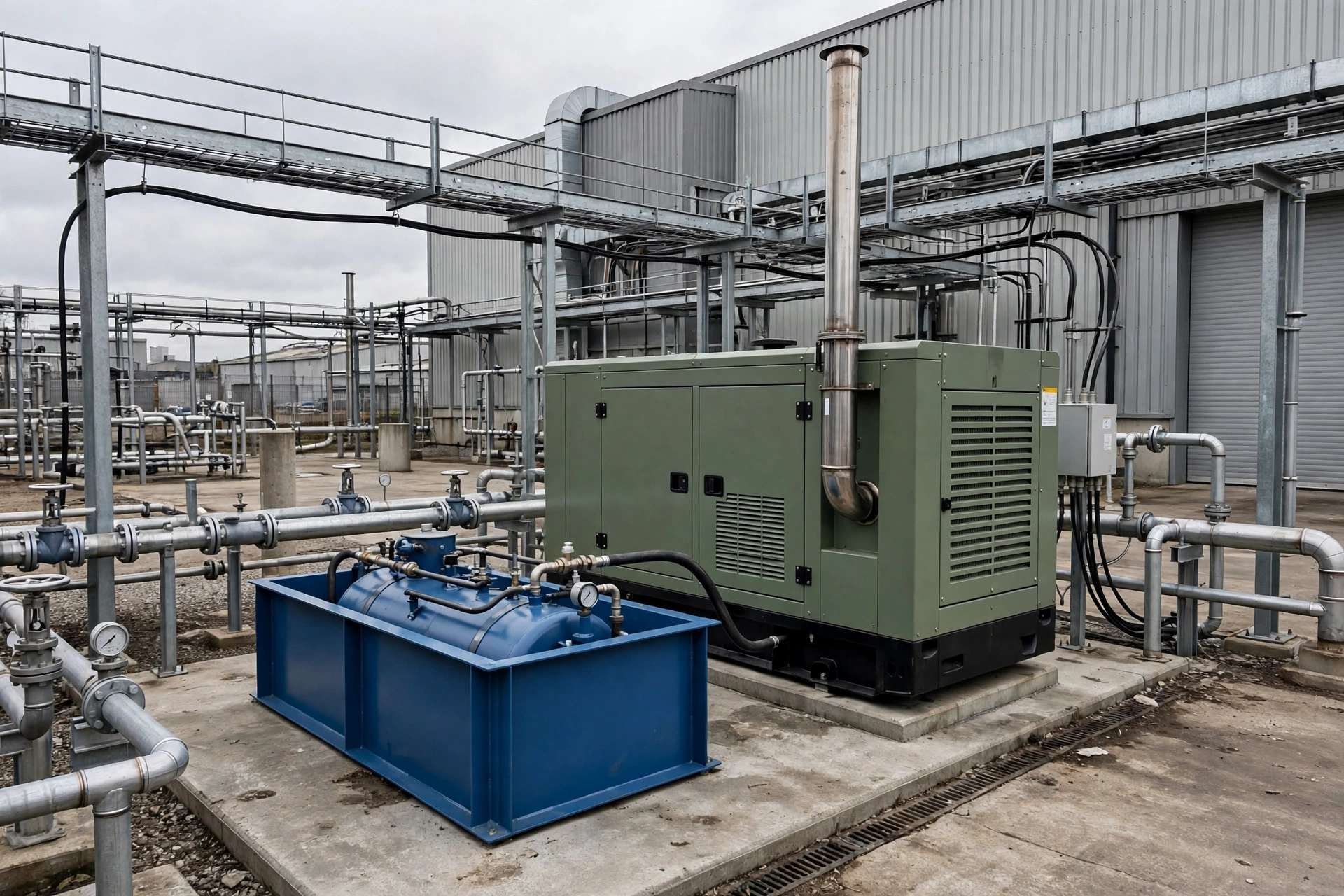
A bottling plant is a wet environment. Floors are washed down daily, steam and water are everywhere, and hygiene zones separate the process areas from the outside. The generator belongs outside the hygiene zone, on a bunded concrete pad, with its fuel tank bunded separately. The same placement question faces food processing plant backup power, and the answer is the same: the generator must be close enough for a short cable run and far enough that washdown water, steam and product never reach it.
Three placement rules apply. First, the generator room or pad needs ventilation sized for the radiator: a 500 kVA set rejects roughly 350–400 kW of heat through its radiator and needs 6–8 cubic metres of air a second. Second, the exhaust must be routed away from air intakes, product storage and staff areas, and the stack must be high enough that exhaust does not re-enter the building. Third, the generator needs a bund: a 110% bund around the day tank, and a bund around the bulk tank, sized for the full tank volume plus 10%. A spill that reaches a drain in a food plant is a contamination event, not a cleaning job.
Noise is a placement question too. A bottling plant in an industrial zone can run an open set at 85–90 dB(A) at 7 metres. A plant near housing needs a silent canopy at 68–72 dB(A) at 7 metres. The canopy costs 15–25% more than the open set, and it adds a small fuel penalty — the enclosure restricts airflow and the set runs 1–2°C hotter. The penalty is worth paying if the plant runs at night. A noise complaint that shuts the plant down at 10 p.m. costs more than the canopy.
Frequently Asked Questions
What size generator does a beverage bottling plant need?
A craft line running 2,000–6,000 bottles an hour needs 150–250 kVA; a regional line at 12,000–24,000 bottles an hour needs 400–800 kVA; and a high-speed PET line at 36,000–72,000 bottles an hour needs 1,000–2,000 kVA. The size is set by the filling line, the blow moulder, the high-pressure compressors and refrigeration, counted with starting surge — not by the connected load total, which is always 15–25% higher than the essential load.
Do bottling plants need a backup generator?
Yes, if the plant’s product is at risk in the first minutes of an outage. A carbonated line loses product within minutes of a power failure, and the restart — drain, CIP, re-prime and re-carbonate — takes 35 minutes at best and over two hours at worst. A plant that loses power twice a month loses $230,000–$460,000 a year in production alone. A 650 kVA generator costs $55,000–$75,000 ex-works, so the payback is measured in months.
How long can a bottling plant run on a generator?
As long as the fuel lasts. A 500 kVA set at 75% load burns about 70 litres an hour, so a 1,000-litre day tank runs for 14 hours and a 5,000-litre bulk tank runs for 72 hours. The practical limit is the fuel delivery contract: a plant with a bulk tank and a supplier who delivers during a regional outage can run indefinitely, while a plant with a day tank and no contract stops when the tank empties.
What happens to a bottling line during a power outage?
The filler stops mid-cycle with bottles half full and valves open, the carbonator loses pressure and carbon dioxide comes out of solution, the blow moulder stops with preforms in the oven, and the refrigeration compressors stop. The product on the line is lost, and the line cannot restart until it has been drained, cleaned, re-sterilised and re-primed — a CIP cycle of 45–90 minutes. The generator starts in under 10 seconds, but the recovery takes hours unless the plant has planned for it.
Can a diesel generator power a beverage bottling plant?
Yes. Diesel sets from 150 kVA to 2,000 kVA cover the full range of bottling plants, from a 6,000 bottles-per-hour craft line to a 60,000 bottles-per-hour high-speed PET line. The requirements are a prime-rated set for plants that run hundreds of hours a year, an automatic transfer switch with undervoltage sensing, soft starters or variable-speed drives on the large compressors, staged starting logic, and a fuel plan that covers the plant’s longest realistic outage.
Specification Checklist
| Item | What to specify | Why it matters |
|---|---|---|
| Rating | Prime (PRP) if the set runs more than 200 hours a year | A standby set run on prime duty wears out years early |
| Size | Essential board only — Tier 1 plus Tier 2, not connected load | Saves a frame size and keeps the set at 70–80% load |
| Starting | Soft starters or VSDs on compressors over 55 kW; staged start logic | A 110 kW compressor draws 660–770 kW on direct start |
| ATS | Automatic transfer switch with undervoltage sensing, 10-second transfer | NFPA 110 Level 1; a brownout the ATS ignores burns motors |
| Fuel | Bulk tank sized for the longest realistic outage; 72 hours in storm regions | A 500 kVA set burns 70 L/h at 75% load — 5,040 L for 72 hours |
| Fuel quality | Six-monthly fuel test, monthly water drain, biocide on delivery | Stale fuel clogs filters at hour 20 of the outage |
| CIP | CIP system on the essential board, with cable and breaker | A plant that cannot run CIP cannot restart the line |
| Placement | Outside the hygiene zone, bunded pad, ventilated, exhaust away from intakes | Washdown water and steam must never reach the set |
| Noise | Silent canopy at 68–72 dB(A) at 7 m if the plant runs at night near housing | A noise complaint can shut the plant down at 10 p.m. |
| Testing | Monthly loaded test at 50–70% load, not a no-load run | A no-load test proves the set starts; a loaded test proves it carries the line |
A bottling plant that specifies its generator against this checklist buys a set that protects the product, not just the building. The filler, the carbonator and the refrigeration plant are the loads that matter, the compressors are the loads that decide the size, and the fuel tank is the part that decides how long the plant runs. Get those three right, and the generator is the cheapest insurance the plant will ever buy.
To size a generator for your bottling line, contact PAVO: send the line speed, the filler and blow moulder ratings, the compressor sizes and the longest outage the plant must survive, and PAVO will confirm the set, the fuel tank and the transfer switch before the order is placed.