

What Size Generator Does a Dairy Plant Need? | PAVO
Milk arrives at 37°C, must be cooled to 4°C, heated to 72°C for exactly 15 seconds, and cooled again — all before the tanker that brought it has finished unloading.
What size generator does a dairy processing plant need? A plant taking in 20,000 litres a day needs roughly 150–250 kVA; a 100,000-litre plant needs 500–800 kVA; and a 500,000-litre plant needs 1,500–2,500 kVA — sized on pasteurisation, refrigeration and compressor starting surge, not on connected load alone.
Contents
- Why the First Hour Costs a Dairy Plant More Than a Week Costs a Warehouse
- What a Dairy Plant Actually Runs: Three Load Tiers
- Sizing by Daily Milk Intake
- The Pasteurisation Window: 72°C for 15 Seconds, or the Batch Is Waste
- The Cold Chain: 4°C or It Is Waste
- Three Plants That Learned the Hard Way
- Fuel, Autonomy and Running Cost
- Frequently Asked Questions
Why the First Hour Costs a Dairy Plant More Than a Week Costs a Warehouse
A warehouse that loses power for an hour loses an hour of throughput. A dairy plant that loses power for an hour loses product, and the loss keeps growing after the power returns. Milk is a live biological product. Every minute it spends above 4°C, bacteria multiply. Every minute a pasteuriser sits half-full at the wrong temperature, a batch moves from saleable to waste. Every minute a silo tank warms, the milk inside it moves closer to the rejection limit.
The arithmetic is unforgiving. Raw milk leaves the cow at about 37°C. It must be cooled to 4°C and held there. Cooling one tonne of milk from 37°C to 4°C means removing about 27 kJ per kilogram — roughly 100–120 MJ of electrical energy per tonne through the refrigeration plant, according to FAO figures for modern milk collection and processing. A 100,000-litre plant takes in 100 tonnes a day. That is 10–12 GJ of cooling energy every day, before a single litre is pasteurised, homogenised or packed.
Pasteurisation adds a second clock. High-temperature, short-time (HTST) pasteurisation holds every particle of milk at 72–75°C for 15–20 seconds. The holding time is fixed by the geometry of the holding tube: at the design flow, 15 seconds; at 10% more flow, less than 15 seconds, and the milk is not legally pasteurised. A power cut mid-run does not pause the process. It strands hot milk in the plates, trips the flow-diversion valve, and forces a full clean-in-place (CIP) cycle before the line can restart. A 30-minute outage becomes a three-hour restart.
The third clock is the cold store. Finished product sits at 2–4°C. The US Pasteurized Milk Ordinance requires pasteurised milk to be cooled to 45°F (7°C) or less and held there. Above that, the legal position changes: the milk is no longer compliant product. It is waste, and the plant that ships it anyway faces a recall, not a discount.
The 10-second gap is not the problem — the 10-minute restart is
Much of the industry discussion about backup power focuses on the automatic transfer switch and the 10 seconds between grid failure and generator power. NFPA 110 requires Level 1 emergency power within 10 seconds, and a correctly specified set meets that. The gap itself is survivable: refrigeration compressors ride through 10 seconds on thermal inertia, and silo tanks lose almost no temperature in 10 seconds.
The problem is what happens in the 10 minutes after the generator starts. A dairy plant restarts in sequence, not all at once. The pasteuriser cannot restart until steam or hot water is available. The refrigeration plant cannot restart until its compressors can be staged one at a time without collapsing the generator voltage. The CIP system cannot run until water temperature is back. Each step depends on the one before it, and each step takes minutes. A plant that sizes its generator for running load but not for restart sequence discovers the difference at 2 a.m., during the first real outage.
Milk does not wait for the generator
Bacteria in milk follow temperature, not schedules. Published growth data for Listeria monocytogenes in milk gives doubling times of about 41 minutes at 35°C, roughly 1 hour 50 minutes at 21°C, 5–7 hours at 13°C, 9–14.5 hours at 8°C, and 30–45 hours at 4°C. At 4°C the milk is safe for days. At 13°C — the temperature a silo tank reaches after a few hours without cooling in a warm climate — the count doubles every few hours. At 35°C, the temperature of milk fresh from the cow, it doubles in under an hour.
Cooling rate matters as much as final temperature. Predictive modelling of raw milk cooling shows that milk cooled at 20°C per hour reaches 4°C in 2.3 hours and holds about 310 colony-forming units per millilitre after 48 hours. Milk cooled at 2.5°C per hour takes 11.3 hours to reach 4°C and reaches 7,700 cfu/mL in the same period — 25 times higher. A refrigeration plant that restarts slowly does not just lose time. It loses the race against the bacteria that were already in the milk when it arrived.
What one hour of downtime actually destroys
Put the three clocks together and one hour without power costs a dairy plant:
- The milk in the pasteuriser and holding tube: diverted, unpasteurised, and sent back to the raw silo or to drain. A 10,000 L/h HTST line loses about 1,600 litres of in-process milk per 10 minutes of stoppage, plus the CIP chemicals and 45–60 minutes of restart time.
- The milk in the raw silos: warming at roughly 0.5–1°C per hour in an insulated tank, faster in a warm climate. Two hours without cooling moves a full 50,000-litre silo from 4°C toward 6–7°C, and the plant’s quality team starts testing every tank before it can be processed.
- The finished product in the cold store: holding at 2–4°C on thermal mass for the first hour, then rising. A cold store that reaches 7°C forces a quality hold on everything inside it — and a hold on a full day’s production is a hold on the plant’s revenue for that day.
- The production schedule: a plant that runs 16 hours a day cannot make up a lost hour by running 17. The milk keeps arriving — cows do not stop milking because the grid failed — and the intake queue grows while the plant stands still.
A textile mill loses an hour of weaving. A dairy plant loses an hour of product, an hour of schedule, and sometimes a day of compliance. That is why the generator question for a dairy plant is not a sizing question first. It is a survival question, and sizing follows from it.
What a Dairy Plant Actually Runs: Three Load Tiers
The first step in sizing is not adding up nameplates. It is sorting the plant into three tiers by what happens if each load stops. The tiers decide what the generator must carry, what it must start, and what can be left off until the grid returns.
Tier 1 — loads that must never stop
Tier 1 is the cold chain and the safety systems. Refrigeration compressors, glycol pumps, silo-tank agitators, cold-store fans and the plant’s control and monitoring systems sit here. If these stop, product starts degrading immediately. The load is large — refrigeration is typically 35–45% of a dairy plant’s electrical demand — and it is dominated by compressor motors with high starting current.
Refrigeration also has a property that surprises first-time buyers: it cannot be shed and restarted casually. A screw compressor that trips on high discharge pressure during a voltage dip needs a controlled restart, and a plant with three compressors must start them one at a time, minutes apart, or the combined starting surge trips the generator breaker. The sizing calculation must include the largest single motor start, not just the running total.
Tier 2 — loads that must restart within the hour
Tier 2 is the process: the pasteuriser, homogeniser, separators, standardisers, filling and packing lines, CIP system and compressed air. These can stop for minutes without destroying product, but every hour they stand still costs a batch. The pasteuriser is the critical load in this tier, not because it draws the most power, but because its restart is the slowest. A plate pasteuriser needs hot water or steam at temperature before it can run, and the heating medium comes from a boiler or electric heater that is itself a large load.
CIP deserves attention here. After an unplanned stop, the pasteuriser and the filling lines must be cleaned before they can restart. CIP needs hot water at 75–85°C, circulation pumps and chemical dosing. A plant that leaves CIP off the generator discovers that its pasteuriser is clean and ready — and that it has no hot water to clean it with. CIP is a Tier 2 load, and it belongs on the generator.
Tier 3 — loads that can wait until the grid returns
Tier 3 is everything else: offices, workshops, non-critical lighting, yard lighting, the canteen, and the boiler house auxiliaries that are not needed for the process. These loads are shed automatically on generator start and restored when the grid returns. They cost nothing in generator size, and they buy headroom for the loads that matter.
The discipline is to put Tier 3 on a separate distribution board with an automatic load-shed contactor, and to test it. Plants that skip this step find that the generator is carrying the office air conditioning during an outage — and that the pasteuriser tripped on overload because of it.
| Load | Tier | Typical share of plant demand | On generator? |
|---|---|---|---|
| Refrigeration compressors | 1 | 35–45% | Yes, staged start |
| Glycol pumps, silo agitators | 1 | 3–5% | Yes |
| Cold store fans and controls | 1 | 2–4% | Yes |
| Pasteuriser and homogeniser | 2 | 15–25% | Yes |
| Separators and standardisers | 2 | 5–8% | Yes |
| Filling and packing lines | 2 | 10–15% | Yes |
| CIP and hot water | 2 | 5–10% | Yes |
| Compressed air | 2 | 3–5% | Yes |
| Offices, workshop, yard | 3 | 5–10% | No — shed |
Sizing by Daily Milk Intake
Dairy plants are sized by daily intake, not by floor area. Intake determines the refrigeration load, the pasteuriser capacity, the silo volume and the filling-line hours. A plant that takes in 100,000 litres a day runs a 10,000 L/h pasteuriser for 10 hours; a plant that takes in 500,000 litres runs a 25,000 L/h line for 20 hours or two lines in parallel. The generator follows the same arithmetic.
Measured data from a Norwegian dairy published in the International Journal of Refrigeration (2025) gives the scale: cooling demand of 27.5–43.0 Wh per litre of milk processed, hot-water demand of 34.3–48.4 Wh/L, and an electric steam boiler accounting for 36.4% of the plant’s electricity consumption. Total specific energy reached about 118 Wh per litre. At 100,000 litres a day, that is roughly 11,800 kWh a day — an average draw of about 490 kW across 24 hours, and a peak well above that during the processing window.
The table below converts intake into running load and generator size. Figures assume HTST pasteurisation, ammonia or CO2 refrigeration, and a 16–20 hour processing day. Plants that run UHT lines or spray dryers sit higher; plants that only chill and dispatch raw milk sit lower.
| Daily intake | Running load | Generator (prime) | Typical set |
|---|---|---|---|
| 20,000 L | 120–180 kW | 150–250 kVA | 200 kVA silent set |
| 50,000 L | 250–350 kW | 300–450 kVA | 400 kVA silent set |
| 100,000 L | 400–600 kW | 500–800 kVA | 800 kVA silent set |
| 250,000 L | 800–1,200 kW | 1,000–1,500 kVA | 1,250 kVA containerised |
| 500,000 L | 1,200–2,000 kW | 1,500–2,500 kVA | 2 × 1,250 kVA paralleled |
A 20,000-litre day: 150–250 kVA
A small regional dairy taking in 20,000 litres a day runs a 5,000 L/h pasteuriser for four hours, a 60–80 kW refrigeration plant, and a short filling line. Running load is 120–180 kW. A 200 kVA prime-rated set covers it, with headroom for the refrigeration compressor start. This is the size where buyers most often under-specify: a 150 kVA set looks adequate on running load and fails on the first compressor start after a hot day. The generator sizing guide math applies here exactly as it does at 2,000 kVA — starting surge is a fixed percentage of motor size, and small plants have proportionally larger compressors relative to their total load.
A 100,000-litre day: 500–800 kVA
The worked example for this band: a plant taking in 100,000 litres a day, running 16 hours.
- HTST pasteuriser, 10,000 L/h: 150 kW
- Refrigeration plant (screw compressors, 350 kW cooling): 180 kW
- Homogeniser: 45 kW
- Separators and standardiser: 30 kW
- CIP and hot-water circulation: 60 kW
- Compressed air: 25 kW
- Filling and packing lines: 40 kW
- Lighting, controls and utilities: 30 kW
- Running total: 560 kW, or 700 kVA at 0.8 power factor
Starting surge decides the set. The largest single motor is a 110 kW refrigeration compressor with a locked-rotor current of about six times running current. Staged starting — one compressor at a time, with the pasteuriser already running — adds roughly 150–200 kVA of transient demand. An 800 kVA prime-rated set carries the 700 kVA running load and absorbs the start. A 500 kVA set does not. The difference between the two quotations is usually less than 15% of the set price. The difference in an outage is the whole plant.
A 500,000-litre day: 1,500–2,500 kVA
At this scale the question changes. A 500,000-litre plant runs two pasteuriser lines, a 1–1.5 MW refrigeration plant, spray drying or UHT, and a cold store the size of a warehouse. Running load is 1,200–2,000 kW. A single set of 2,500 kVA is possible but leaves the plant with one point of failure. Two 1,250 kVA sets in parallel cost more, but one set can carry the Tier 1 cold chain alone while the other is serviced — and a dairy plant that loses its only generator during a 72-hour outage loses everything in its silos. Paralleling at this scale follows the same rules as any industrial site: synchronising, load sharing and bus protection must be specified, not assumed.
The rating matters as much as the size. A dairy plant in a region with unreliable grid supply runs its generator for hundreds of hours a year. That is prime duty, and the set must be prime-rated. The standby and prime power ratings explain the difference: a standby-rated set is designed for up to 200 hours a year, and a plant that exceeds that — even by accident, in a bad monsoon season — wears its engine out years early. The Cummins C500D5 illustrates the gap on one datasheet: 500 kVA standby, 455 kVA prime, the same engine, about 9% apart. Buy the prime figure, not the standby figure.
The Pasteurisation Window: 72°C for 15 Seconds, or the Batch Is Waste
Pasteurisation is the one process in a dairy plant where the specification is a legal requirement, not a preference. The time–temperature combinations are set by food-safety law, and the plant’s records must prove that every litre met them. A generator that cannot hold the pasteuriser at temperature does not cause a delay. It causes a rejection.
| Process | Temperature | Time | Product |
|---|---|---|---|
| Batch (vat) | 63°C | 30 minutes | Small batches, cheese milk |
| HTST | 72–75°C | 15–20 seconds | Fresh milk, cream, yoghurt milk |
| HHST | 88–90°C | 1–2 seconds | Extended shelf-life milk |
| Ultra-pasteurised | 138°C | 2 seconds | ESL milk, 60–90 days chilled |
| UHT | 135–140°C | A few seconds | Long-life milk, ambient storage |
HTST — the workhorse
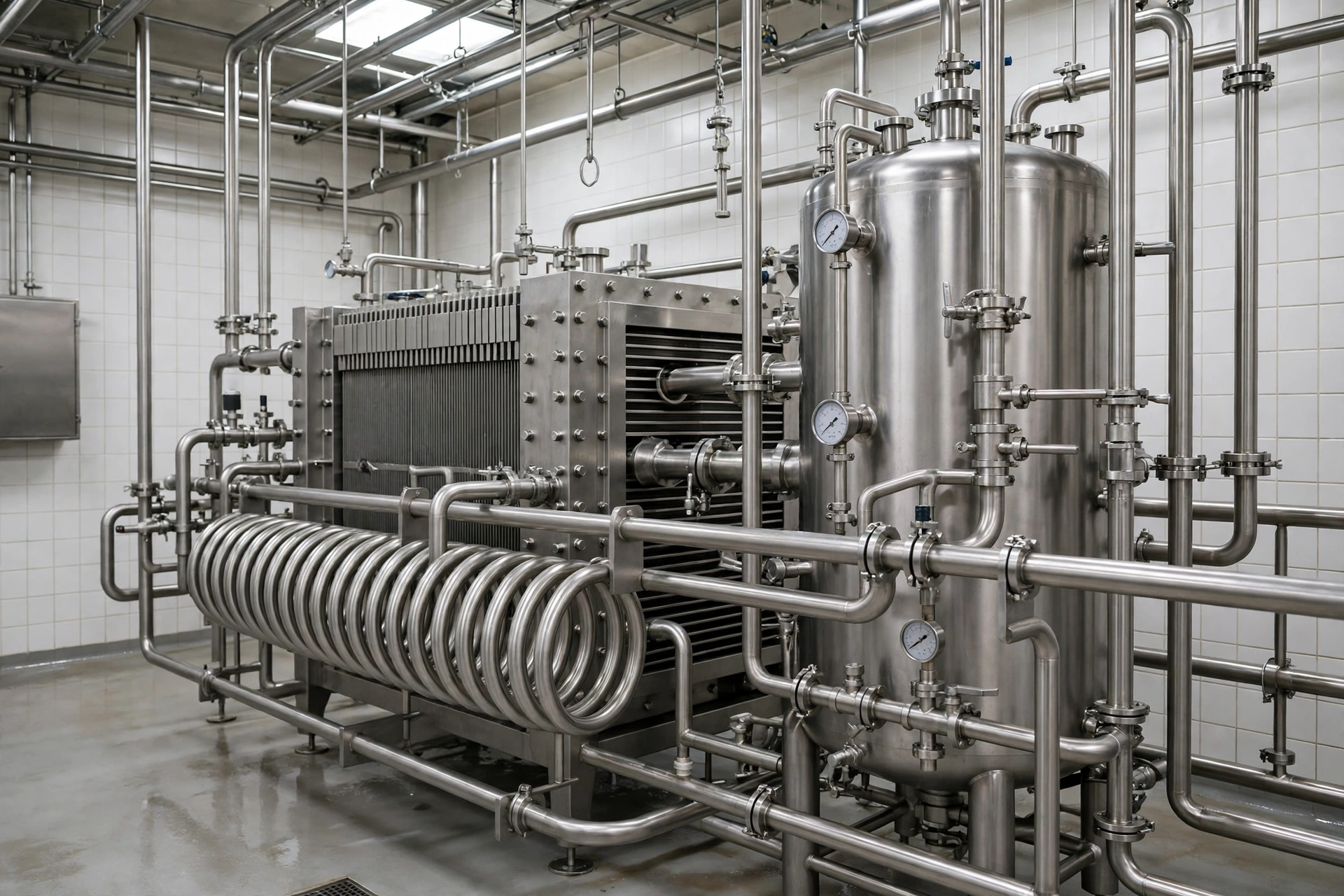
High-temperature, short-time pasteurisation is the standard for fresh milk worldwide. Milk flows through a plate heat exchanger, is heated to 72–75°C, held for 15–20 seconds in a holding tube, and cooled back to 4°C. The system recovers 94–95% of the heat through regeneration — hot pasteurised milk preheats incoming cold milk — so the external heating load is small, roughly 38 kW at 10,000 L/h. The electrical load is the pumps, the controls and the holding-tube instrumentation, not the heat itself.
The holding tube is where the generator matters. Holding time is fixed by tube geometry and flow rate: a 26.5-metre tube of 48.5 mm diameter gives 15 seconds at 10,000 L/h. A 10% rise in flow breaks the legal minimum. When power fails, the flow-diversion valve snaps shut, the milk in the tube is diverted, and the plant must prove — from the temperature recorder — that no milk below 72°C reached the filler. The recorder is a Tier 1 load. If it stops, the plant has no proof, and unproven milk is rejected milk.
Restart is the slow part. The plates must be brought back to temperature, the holding tube re-established at flow, and the diversion valve proved at every start. A practiced crew does it in 30–45 minutes. A crew that has never done it under generator power takes two hours. The difference is a monthly test that includes a full pasteuriser restart, not just a generator start.
UHT and ESL — hotter, shorter, different risk
Ultra-high-temperature processing heats milk to 135–140°C for a few seconds and packs it aseptically. The product keeps for months at ambient temperature, so a UHT plant’s cold-chain exposure is smaller than a fresh-milk plant’s. The risk moves elsewhere: the UHT steriliser runs at high temperature and pressure, and an unplanned stop strands product in the holding section at sterilising temperature, where it scorches. Restart means a full CIP and a fresh sterilisation cycle — two to three hours — and the batch in the line is written off.
Extended shelf-life (ESL) milk, ultra-pasteurised at 138°C for 2 seconds and packed under clean conditions, sits between the two: 60–90 days chilled, but still dependent on the cold chain after packing. A UHT or ESL plant can tolerate a longer outage than a fresh-milk plant, but it pays for every outage with a longer restart and a larger write-off per stop.
Batch vats — slow, simple, and the first to fail
Small plants and cheese makers still use batch pasteurisation: milk held at 63°C for 30 minutes in a jacketed vat. The process is forgiving of temperature — 30 minutes gives a wide margin — but it is unforgiving of power loss, because the vat cools slowly and reheating a half-processed vat means starting the 30 minutes again. A batch plant’s generator must carry the vat heaters and the agitators, and the agitators matter more than the heaters: unstirred milk scalds on the jacket, and scalded milk taints the batch. A 10,000-litre vat with a failed agitator is a 10,000-litre write-off.
The Cold Chain: 4°C or It Is Waste
If pasteurisation is the legal clock, the cold chain is the biological one. Raw milk must be cooled to 4°C as fast as possible after arrival, and held there until it is processed. Pasteurised milk must be cooled to 4°C and held at 2–4°C through storage and dispatch. Every degree above 4°C shortens shelf life and raises bacterial counts, and the relationship is not linear.
Silo tanks and the cooling-rate rule
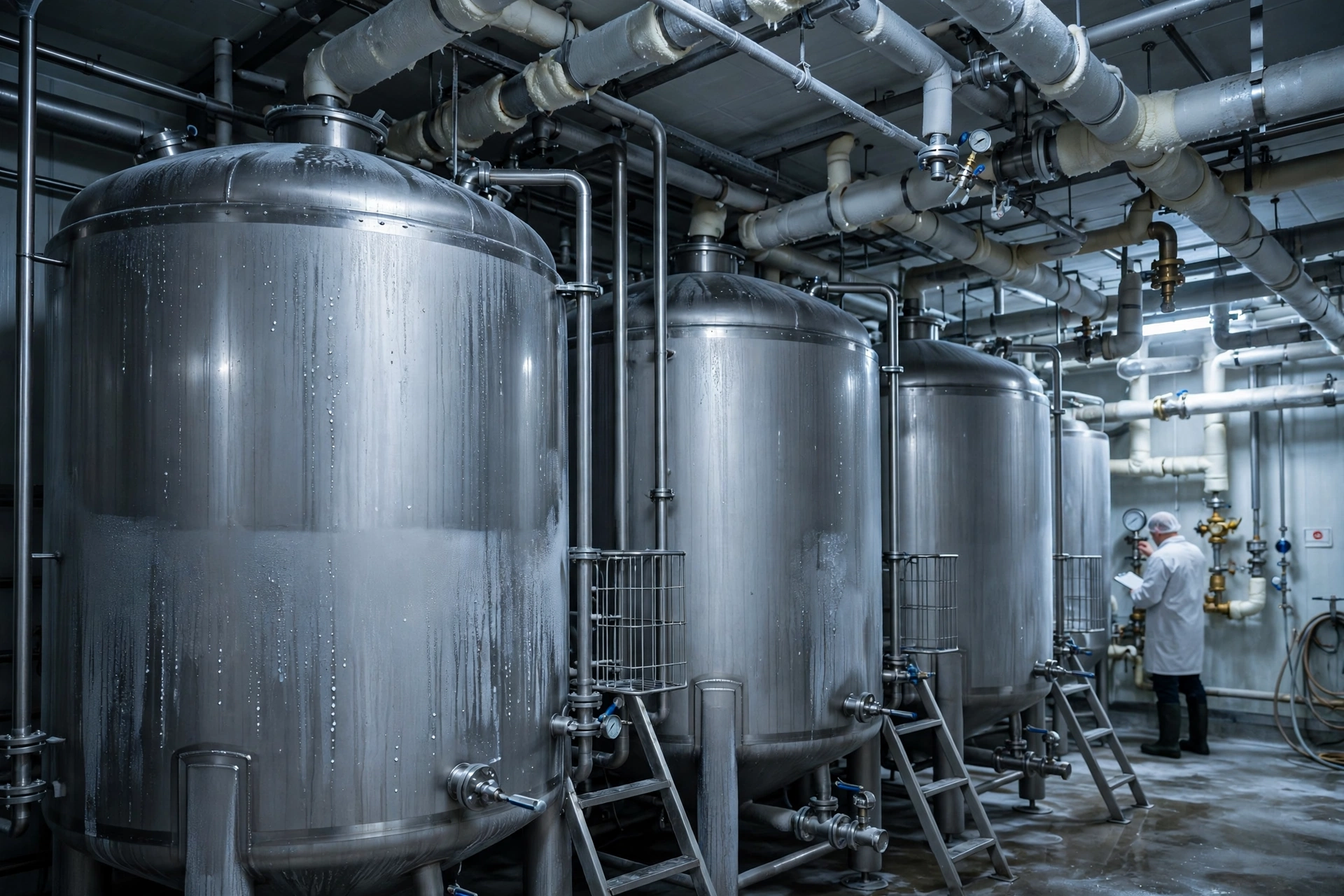
Milk arrives at the plant at 10–15°C from a chilled tanker, or at 30–37°C from a farm without pre-cooling. It goes into insulated silo tanks of 20,000–100,000 litres, where agitators keep it mixed and glycol jackets hold it at 4°C. The tank itself is thermal mass: a full 50,000-litre silo warms slowly, roughly 0.5–1°C per hour without cooling in a temperate climate, faster in the tropics.
The cooling rate on arrival is what sets the bacterial count for the whole batch. The modelling data is stark: milk cooled at 20°C per hour reaches 4°C in 2.3 hours and holds about 310 cfu/mL after 48 hours; milk cooled at 2.5°C per hour takes 11.3 hours and reaches 7,700 cfu/mL. Psychrotrophic bacteria — the cold-loving spoilage organisms that dominate refrigerated milk — grow at about 0.03 log10 per hour at 4°C and 0.10 log10 per hour at 8°C. Three times faster at 8°C than at 4°C. A refrigeration plant that restarts slowly after an outage does not merely lose time; it hands the bacteria the hours they need.
Silo agitators are small loads — a few kilowatts each — but they are Tier 1. Still milk stratifies: cream rises, temperature layers form, and the temperature probe reads the cold layer while the warm layer above it breeds bacteria. Agitators stay on the generator, on the same circuit as the refrigeration, with no load-shed contactor in between.
Refrigeration compressors and the starting surge
Refrigeration is the largest electrical load in most dairy plants, and the hardest to start on a generator. Screw compressors dominate at plant scale: a 110 kW screw compressor draws about six times its running current at start — roughly 660 kVA of transient demand for a few seconds. Two compressors starting together demand 1,300 kVA of transient on a plant whose running load is 700 kVA. The generator breaker trips, the compressors trip, and the plant is dark again.
The fix is sequence, not size. Compressors start one at a time, minutes apart, with the pasteuriser and filling lines held off until the refrigeration is stable. Good motor starting practice — soft starters or variable-speed drives on the larger compressors, staged start logic in the controller, and a generator with enough subtransient reactance margin — turns a 1,300 kVA problem into three 660 kVA steps the set can absorb. A variable-speed drive on the lead compressor also pays for itself in normal operation: refrigeration load follows the processing schedule, and a compressor running at 60% speed uses far less power than one cycling on and off at full speed.
Glycol is the second half of the system. Most plants circulate propylene glycol at −3.5 to −5°C to the silo jackets, plate coolers and cold-store coils. The glycol pumps are small, but they are the circulatory system: if the pumps stop, the cold stays in the refrigeration plant and the milk warms in the silos. Pumps go on the generator with the compressors, on the same Tier 1 board.
The cold store and dispatch
Finished product sits in the cold store at 2–4°C, and dispatch runs on a schedule set by supermarkets, not by the plant. A cold store holds temperature on thermal mass for the first hour of an outage — pallets of milk are a large thermal store — but the fans must run to keep the air moving. Still air stratifies, and the top pallets warm while the floor pallets stay cold. Cold-store fans are a few kilowatts, and they are Tier 1.
The dispatch window is the commercial risk. A plant that misses its 6 a.m. dispatch misses the supermarket’s delivery slot, and the slot does not move. The milk is still saleable at 8 a.m., but the order is lost, and a lost order from a supermarket buyer is not recovered the next day. Plants that have lived through a missed dispatch size their generator for the cold store and the loading dock as carefully as for the pasteuriser — the same problem as cold storage backup power in a warehouse; in a dairy plant the warehouse is the product.
Three Plants That Learned the Hard Way
Case 1 — Littlefield, Texas, February 2021: 8 million gallons dumped
Continental Dairy Facilities Southwest, a balancing plant at Littlefield, Texas, takes raw milk and turns it into butter and dry milk — the plant designed to absorb surplus milk when the market cannot. During the February 2021 Texas freeze, the plant’s gas supply was curtailed by its supplier, Atmos Energy, and the plant stopped for an entire week. The machines normally run 24 hours a day, seven days a week. For seven days they ran not at all.
The plant dumped 1,400 truckloads of milk — about 8 million gallons — at a loss of roughly $12 million to producers. Running the plant on gas at the curtailed price would have cost about $300,000 a day, and the plant was willing to pay it. The gas was not available at any price. The cows did not stop milking, the tankers kept arriving, and there was nowhere for the milk to go.
The lesson is not about gas. It is about single points of failure. A balancing plant that exists to rescue the milk supply in a crisis was itself rescued by nothing, because its backup plan assumed the fuel it needed would be available. A diesel generator with a bulk tank and a contracted delivery is not a luxury for a plant like this. It is the difference between a bad week and a $12 million week. The plant’s business interruption insurance did not pay: there was no physical damage to the facility, only milk that could not be processed.
Case 2 — Mooi River, KwaZulu-Natal, January 2023: 11,800 litres and a burned contactor
Stratford Farms, a dairy farm at Mooi River in KwaZulu-Natal, South Africa, disposed of 11,800 litres of unpasteurised milk — a full day’s production — after load shedding caused its cooling systems to fail. The loss was R85,000, about $4,947, for the milk alone. Repairs to the damaged equipment cost more.
The failure mode is the one that catches plants without a proper transfer system. Eskom’s supply did not fail cleanly. The voltage on the lines was too low to run the cooling system, but high enough that the farm’s equipment indicated it was receiving power — so the generator did not start. Fans and contactors burned out on undervoltage while the cooling system failed and the milk warmed past the point of sale. South African law requires milk to be pasteurised before sale, and the farm had no pasteurisation equipment: its business was selling raw milk to processors. Spoiled milk could not be sold at all.
The farm’s production for the year ran about 15% below budget — roughly 2.5 million litres — as load shedding continued. The case is a farm, not a processing plant, and the scale is small. But the failure mode is exactly the one processing plants face: a brownout, not a blackout, that the automatic transfer switch does not recognise. An ATS that transfers only on complete loss of supply leaves the plant running on 180 volts until something burns. The fix is undervoltage sensing with a defined transfer threshold, and a monthly test that includes a brownout, not just a clean break.
Case 3 — The 1998 ice storm and the Finnish lesson: the outage that outlasts the tank
The January 1998 ice storm in eastern Canada knocked out power to millions of customers, including about 5,500 dairy farmers. About 13.5 million litres of milk was discarded. The storm lasted days, not hours, and the farmers who had generators ran them until the fuel ran out — and then joined the farmers who had none.
A study of storm-induced outages on Finnish dairy farms from 2010 to 2015 found the same shape at smaller scale: farms experiencing outages longer than 72 hours lost 4.6% of their monthly milk yield, and production recovered only in the month after the storm. Outages shorter than three days left almost no trace in the monthly figures. The dividing line was 72 hours — the point where fuel, feed and the animals’ own tolerance all run out together.
For a processing plant, the 72-hour line is the same, and the arithmetic is the same. A 500 kVA set at 75% load burns about 70 litres an hour. Seventy-two hours is 5,000 litres. A 1,000-litre day tank lasts 14 hours. A plant that plans for 72 hours needs a 5,000-litre bulk tank, a delivery contract that works during a regional outage, and diesel fuel ageing discipline — fuel that has sat in the tank for a year, absorbing water and growing microbes, is not a reserve. It is a filter-blocking liability that reveals itself at hour 20 of the outage.
Fuel, Autonomy and Running Cost
A dairy plant’s generator is not a fire extinguisher, used once and forgotten. In regions with unreliable grids it runs weekly, sometimes daily. Fuel is therefore a running cost, not a contingency, and it belongs in the plant’s operating budget alongside electricity, water and chemicals.
Fuel use by set size
Fuel consumption follows load, not nameplate. The Cummins C500D5 — 500 kVA standby, 455 kVA prime — burns 29.2 L/h at 25% load, 49.0 L/h at 50%, 69.9 L/h at 75% and 93.2 L/h at full prime load. At standby rating the same set burns 107.1 L/h at full load. The table below scales the same relationship across the sizes a dairy plant actually buys. Figures are approximate at 75% load, the point where most plants run during an outage.
| Set (prime) | Fuel at 75% load | 8 hours | 24 hours | 72 hours |
|---|---|---|---|---|
| 200 kVA | ~28 L/h | ~225 L | ~670 L | ~2,000 L |
| 500 kVA | ~70 L/h | ~560 L | ~1,680 L | ~5,000 L |
| 800 kVA | ~112 L/h | ~900 L | ~2,700 L | ~8,000 L |
| 1,250 kVA | ~175 L/h | ~1,400 L | ~4,200 L | ~12,600 L |
| 2,500 kVA | ~350 L/h | ~2,800 L | ~8,400 L | ~25,200 L |
At $1.00 per litre, a 500 kVA set costs about $70 an hour to run at 75% load, $1,680 a day, $5,000 for 72 hours. Against the Littlefield plant’s $12 million loss, that is a rounding error. Against a small plant’s monthly margin, it is a real number — which is why the fuel decision is made in advance, in the budget, and not during the outage. A plant that has to ask the finance director for fuel money at hour 30 of an outage will be asking while the milk warms.
The 72-hour question
How long should the plant be able to run without a fuel delivery? The answer comes from the longest outage the region has actually suffered, not the average. The Finnish study puts the dividing line at 72 hours. The Texas freeze lasted a week for some plants. The 1998 ice storm lasted days. A plant that plans for 24 hours and meets a 72-hour outage loses everything after hour 24 — including the fuel it already burned, because the milk it protected for a day is still lost.
Practical autonomy for a dairy plant:
- 24 hours on the sub-base or day tank alone, without any delivery. This is the minimum, and it covers the overnight outages that make up most of the risk.
- 72 hours with a bulk tank on site. A 5,000-litre bulk tank covers a 500 kVA set for 72 hours at 75% load. A 10,000-litre tank covers an 800 kVA set for the same period.
- Beyond 72 hours on a contracted delivery. The contract must name a supplier who delivers during a regional outage, when every other plant is calling the same supplier. A contract signed during a crisis is a queue, not a guarantee.
Fuel quality is part of autonomy. Diesel absorbs water from humid air, and water breeds the microbes that block filters and injectors. A bulk tank that has not been polished or tested in a year can stop a generator at hour 20 of an outage, with 4,000 litres still in it. The maintenance schedule that matters here is not the engine’s — it is the fuel’s. Test quarterly, polish annually, and keep the tank full: a full tank has less air, less condensation, and less water.
The specification checklist
A dairy plant generator specification fits on one page, and it should be written before the quotations arrive, not after them.
| Item | Specify | Why it matters here |
|---|---|---|
| Rating | Prime (PRP), not standby | Plants in weak-grid regions exceed 200 h/year |
| Size | Running load + largest motor start | Compressor starting surge decides the set |
| Transfer | ATS with undervoltage sensing | Brownouts burn equipment without starting the set |
| Start time | 10 seconds to load (NFPA 110 Level 1) | The cold chain tolerates minutes, not hours |
| Staged restart | Compressor sequencing in the controller | Three compressors at once trip the breaker |
| Fuel | 72-hour bulk tank + delivery contract | The 1998 and 2021 outages both outlasted day tanks |
| Fuel care | Quarterly test, annual polish | Stale fuel stops a generator at hour 20 |
| Testing | Monthly load-bank test + pasteuriser restart | A start test does not prove the plant restarts |
| Placement | Outside the wet process area, bunded | Hygiene zone, washdown water and fuel do not mix |
| Monitoring | Remote alarms for start, load, fuel, temperature | The plant manager is not on site at 2 a.m. |
Placement deserves a line of its own. A dairy plant is a wet environment: floors are washed down daily, steam and water are everywhere, and hygiene zones separate the process areas from the outside. The generator belongs outside the hygiene zone, on a bunded concrete pad, with its fuel tank bunded separately. The same placement question faces food processing plants, and the answer is the same: the generator must be close enough for a short cable run and far enough that washdown water, steam and milk never reach it. The dairy farms that supply the plant face a smaller version of the same decision, and the same rules apply at farm scale.
Frequently Asked Questions
What size generator does a dairy processing plant need?
It depends on daily milk intake: roughly 150–250 kVA for 20,000 litres a day, 500–800 kVA for 100,000 litres, and 1,500–2,500 kVA for 500,000 litres. The size is set by refrigeration and pasteurisation load plus the starting surge of the largest compressor motor, not by the total connected load. A load list by tier, with the largest single motor start included, is the only reliable way to size it.
Do dairy processing plants need a backup generator?
Yes, unless the plant can afford to lose a day’s production and a day’s intake. Milk cannot wait for the grid: raw milk warms, pasteurisation stops mid-batch, and finished product leaves the cold chain. The Texas freeze of February 2021 cost one balancing plant about 8 million gallons of dumped milk and $12 million. A plant with no generator is betting its entire daily intake on the grid never failing.
How long can a dairy plant run on a generator?
As long as it has fuel. A 500 kVA set at 75% load burns about 70 litres an hour, so a 5,000-litre bulk tank gives roughly 72 hours. The practical limit is fuel logistics, not the engine: a prime-rated set is designed for unlimited annual hours. Plants in regions with multi-day outages plan for 72 hours on site and a contracted delivery beyond that.
What happens to milk during a power outage in a dairy plant?
Raw milk in the silos warms at roughly 0.5–1°C per hour without cooling, and bacteria multiply faster with every degree — three times faster at 8°C than at 4°C. Milk in the pasteuriser is diverted and must be reprocessed or discarded, and the line needs a full clean-in-place cycle before it can restart. Finished product in the cold store holds for about an hour on thermal mass, then starts to rise toward the 7°C legal limit. After a few hours, the plant is testing every tank before it can process it.
Can a diesel generator power a dairy processing plant?
Yes. Diesel sets from 150 kVA to 2,500 kVA cover the full range of dairy plants, from a 20,000-litre regional dairy to a 500,000-litre industrial plant. The requirements are a prime-rated set, an automatic transfer switch with undervoltage sensing, staged starting for the refrigeration compressors, and a fuel plan that covers 72 hours. Plants that also need steam for UHT or spray drying keep the boiler on its own fuel, and size the generator for the electrical loads only.
Specification checklist — before the deposit is paid: prime rating confirmed on the datasheet; largest compressor start calculated; ATS with undervoltage transfer; 72-hour fuel on site; monthly load-bank test that includes a pasteuriser restart; generator outside the hygiene zone on a bunded pad. A quotation that states only a kVA figure, without a rating, a starting calculation and a fuel plan, should be returned for clarification.
A dairy plant’s generator is not the cheapest line on the quotation. It is the line that decides whether a power cut costs an hour or a week’s production. The milk will keep arriving whatever the grid does. The only question is whether the plant can keep processing it. To size a set for a dairy plant — by daily intake, pasteurisation duty and refrigeration load — contact PAVO for a specification built on the plant’s own load list, not on a catalogue figure.