

What Size Generator Does a Ceramics Plant Need? | PAVO
A ceramics plant does not stop politely when the grid fails. It stops with a kiln full of ware at 1,200°C, a firing curve that has taken hours to build, and a load of tiles, basins or tableware that will not survive an uncontrolled cool-down.
What size generator does a ceramics plant need? A small tableware or sanitaryware plant typically needs a 250–400 kVA set for its essential board, a mid-size tile plant with a roller kiln needs 500–800 kVA, and a large integrated ceramics plant needs 1,000–1,600 kVA for kiln fans, presses, glazing and utilities. The kiln’s heat itself is never on the generator.
Contents
- The Honest Limit: What a Diesel Generator Can and Cannot Do in a Ceramics Plant
- The Ceramics Plant Load Tiers: What Must Stay On and What Can Stop
- What Size Generator Does a Ceramics Plant Need?
- What Happens in the First Hour After the Power Fails
- Three Plants, Three Outages
- Kiln Fans, Motor Starting and the Cooling-Zone Rule
- Frequently Asked Questions
- Specification Checklist: Eight Lines Before the Deposit
The Honest Limit: What a Diesel Generator Can and Cannot Do in a Ceramics Plant
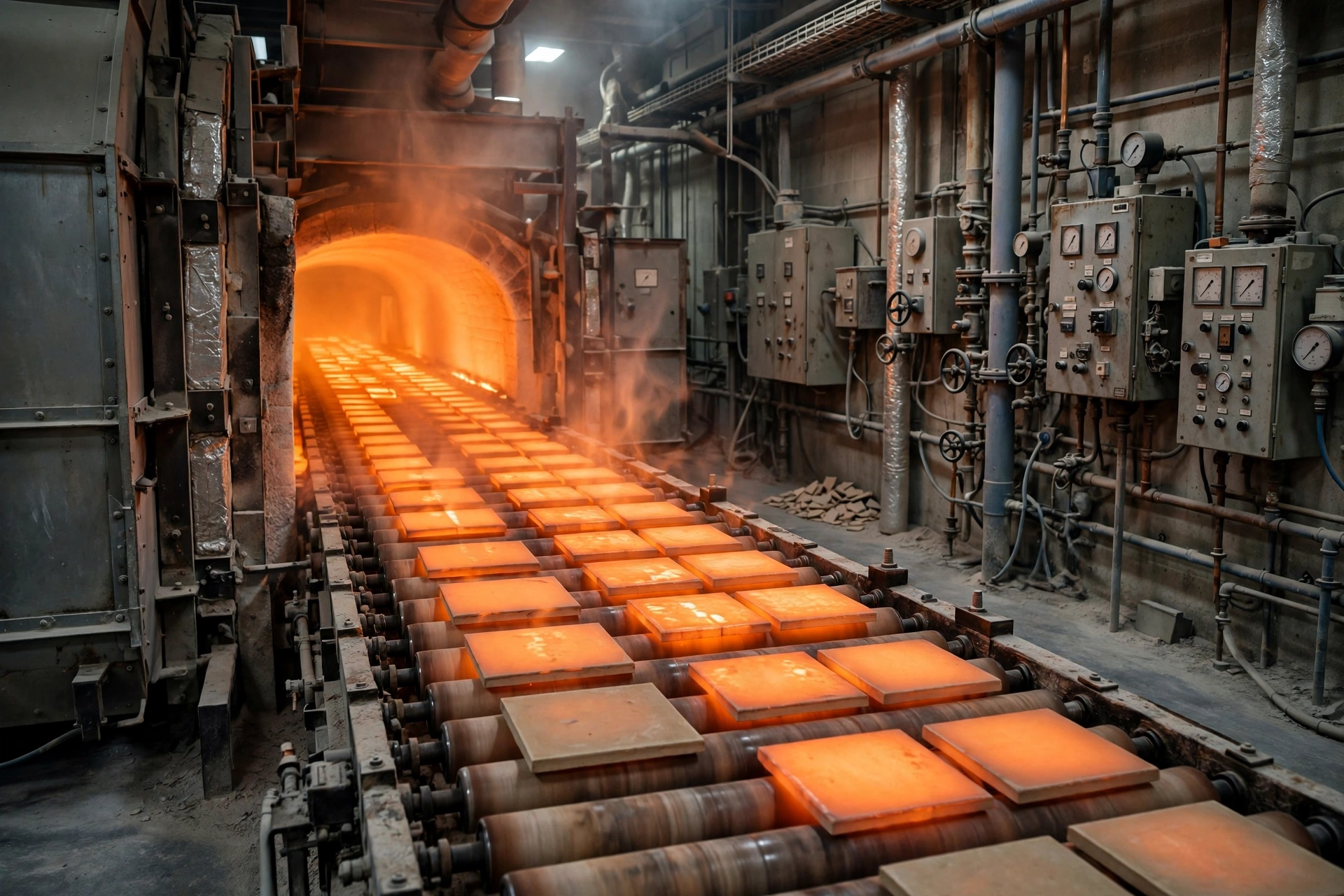
Every other industrial buyer sizes a generator from the running load. A ceramics plant cannot, because the load that defines the plant — the firing — is the one load a diesel set cannot carry, and any quotation that pretends otherwise is either dishonest or wrong. Firing accounts for roughly 55% of the total thermal energy used in ceramic tile production, and it happens at 900–1,300°C inside kilns that run continuously for days, weeks or months. The heat comes from gas burners or electric elements, not from the plant’s electrical board, and no standby diesel set in the PAVO range — and no practical number of them — replaces that heat. The first decision in a ceramics-plant generator project is therefore a subtraction: take the plant’s connected load, remove the firing load entirely, and size the set from what remains.
The numbers make the point plainly. A UNIDO heat diagnosis of a wall-tile tunnel kiln recorded a 120.8-metre kiln running at 1,060°C with 58 burners, a 51–59 hour firing cycle and a specific heat consumption of 3,720–4,465 kJ per kilogram of ware. A modern roller kiln for porcelain tile runs shorter cycles — 50–100 minutes — but still peaks at 1,200–1,250°C. A sanitaryware kiln burns 750 kcal per kilogram of ware over an 8–10 hour cycle. Those are thermal loads measured in megawatts of gas or electricity. A diesel generator’s job is not to replace them. Its job is to keep the electrically driven equipment around the kiln alive long enough for the plant to save the ware, protect the kiln and restart cleanly.
What the set protects is a short, specific list: kiln combustion-air and cooling fans, kiln-car or roller drives, press hydraulics, glazing-line drives and spray booths, dust extraction, compressed air for instruments and valves, water pumps, and the PLCs and kiln instrumentation that run the safe-state sequence. A plant that sizes for this subset typically needs 250–1,600 kVA, depending on kiln type and plant size — a fraction of the plant’s connected load, and a figure that a single set, or two in parallel, can actually deliver.
Why the Firing Load Is Out of Reach
The firing load is out of reach for two separate reasons, and both matter. The first is sheer size. A tunnel kiln for roof tiles or wall tiles draws several megawatts of thermal energy through its burners; an electric kiln for technical ceramics draws the same order of magnitude through its elements. Paralleling ten 1,250 kVA sets to keep one kiln firing would cost more than the kiln, the building and a year of lost production combined. The second reason is time. A kiln is a thermal flywheel. A tunnel kiln holds hundreds of tonnes of refractory, kiln cars and ware at temperature, and its firing curve is measured in days, not minutes. Even if a generator could supply the heat, the ten seconds it takes an automatic transfer switch to start the set and transfer the load is long enough for the firing curve to break. The ware inside does not wait for the switchgear.
The same arithmetic applies to the rest of the heavy thermal plant. A spray dryer that turns slip into press powder draws hundreds of kilowatts through its atomiser and fans. A glaze preparation line, a frit furnace and a drying tunnel all sit in the same position: the heat source is not the problem, the electrically driven auxiliaries around it are. The same limit shapes the neighbouring heavy-thermal industries — a glass plant furnace that must never go cold and a cement plant kiln that cannot stop mid-rotation face the same subtraction, and both size their generators from the auxiliaries, not from the heat. The generator’s job begins where the firing’s own power ends, and the specification has to start from that subtraction rather than from the plant’s nameplate total.
The Ceramics Plant Load Tiers: What Must Stay On and What Can Stop
A ceramics plant is not one load. It is four loads stacked on top of each other, and only two of them belong on the generator. Sorting them before the quotation is what separates a set that saves the plant from a set that merely runs the lights while the kiln dies.
Tier 1 — Protect the Kiln and the Ware
Tier 1 is the load that prevents damage. Kiln combustion-air fans keep the burners supplied and the flame stable while the gas supply is shut down in a controlled sequence. Cooling-zone fans keep the temperature gradient inside the kiln moving in the right direction instead of collapsing. Kiln-car drives in a tunnel kiln, or roller drives in a roller kiln, keep the ware moving slowly through the cooling zone instead of sitting in one spot and cracking. Kiln instrumentation — thermocouples, pressure transmitters, the PLC and the operator screens — is the only way the crew knows what the kiln is doing during the outage. Lose Tier 1 and the damage starts in minutes: ware cracks from thermal shock, glaze crazes, rollers break under a stalled load, and the refractory lining takes a thermal shock it may not survive. Tier 1 is small — typically 60–150 kW on a mid-size plant — and it is the whole reason the generator exists.
Tier 2 — Keep the Plant Safe and Restartable
Tier 2 is the load that lets the plant restart. Dust extraction keeps silica dust out of the air while the presses and mills stop. Compressed air keeps pneumatic valves, kiln dampers and press controls in their safe positions. Water pumps keep cooling circuits and glaze preparation running. Emergency lighting, the fire alarm panel and the gas detection system keep the building safe for the crew that stays behind. Tier 2 is usually 40–100 kW and it runs alongside Tier 1 on the same essential board.
Tier 3 — Production That Can Pause
Tier 3 is everything that makes product and can stop without damage. Ball mills, blungers and slip preparation, hydraulic presses, spray dryers, glazing lines, sorting and packing lines, and the warehouse all belong here. A press that stops mid-stroke loses one tile, not a kiln. A glazing line that stops loses the pieces on the belt, not the plant. Tier 3 is the largest load in the plant — often 500 kW to several megawatts — and putting it on the generator is the single most common sizing mistake in ceramics. The standby and prime power ratings of the set are set by Tiers 1 and 2, not by Tier 3, and a quotation that sizes from the plant’s total connected load is quoting a generator the plant does not need.
Tier 4 — Everything Else
Tier 4 is offices, the canteen, the showroom, yard lighting and the car park. It is the load that gets cut first and restored last. A plant that puts Tier 4 on the essential board pays for generator capacity that protects nothing, and then discovers the set is undersized for the kiln fans because the budget went to the showroom.
| Load tier | What is on it | Typical load, mid-size tile plant | On the generator? |
|---|---|---|---|
| Tier 1 — protect kiln and ware | Kiln fans, kiln drives, kiln instrumentation and PLC | 60–150 kW | Yes, always |
| Tier 2 — safe and restartable | Dust extraction, compressed air, water pumps, emergency lighting, gas detection | 40–100 kW | Yes |
| Tier 3 — production that can pause | Presses, mills, spray dryer, glazing line, packing | 500 kW–3 MW | No, except one press line by agreement |
| Tier 4 — everything else | Offices, showroom, yard lighting | 30–80 kW | No |
What Size Generator Does a Ceramics Plant Need?
Size from the essential load list, not from the plant’s connected total. The method is the same one the generator sizing guide sets out — list every Tier 1 and Tier 2 load, add running kilowatts, apply a diversity factor, then check the largest motor start — but the ceramics application of it has its own bands, because kiln type decides the fan load and the fan load decides the set.
| Plant type | Kiln type | Essential load (Tiers 1 + 2) | Generator size |
|---|---|---|---|
| Small tableware plant, 1 shuttle kiln | Shuttle kiln, 1,240–1,260°C | 120–200 kW | 250–400 kVA |
| Sanitaryware plant, 2–3 kilns | Tunnel or shuttle, 1,250–1,280°C | 200–350 kW | 400–600 kVA |
| Mid-size tile plant, 1 roller kiln | Roller kiln, 80–100 m, 1,200–1,250°C | 300–450 kW | 500–800 kVA |
| Large tile plant, 2–3 roller kilns | Roller kilns, 100–120 m | 500–750 kW | 800–1,250 kVA |
| Integrated ceramics plant, kilns + spray dryer + presses | Tunnel + roller kilns | 700–1,100 kW | 1,000–1,600 kVA |
The bands assume the melt — the firing heat — is off the generator, and the set carries kiln fans, kiln drives, extraction, controls, compressed air and water only. A plant that also wants one press line on the essential board adds 150–300 kVA to the figure above, and should expect the generator price to rise by roughly the same proportion.
A Worked Example: A Mid-Size Tile Plant
A tile plant in Foshan runs one 80-metre roller kiln producing 12,000 m² of porcelain tile a day, with a press line, a glazing line and a spray dryer. Its essential board, measured during a load study, looks like this:
| Essential load | Running kW | Notes |
|---|---|---|
| Kiln combustion-air fans, 2 × 22 kW | 44 | Both run; one cannot carry the kiln alone |
| Kiln cooling-zone fans, 3 × 15 kW | 45 | Staged; all three on the essential board |
| Kiln roller drives, 8 × 3 kW | 24 | Keep ware moving through the cooling zone |
| Kiln instrumentation, PLC and screens | 6 | UPS-backed, then generator |
| Dust extraction fans | 30 | Silica dust control while presses stop |
| Air compressor, 37 kW | 37 | Pneumatic valves, kiln dampers |
| Water pumps, cooling and glaze | 15 | Kiln cooling circuit, glaze preparation |
| Emergency lighting and gas detection | 8 | Life safety, always on |
| One press line (by agreement) | 120 | Hydraulic pump, one press only |
| Total running load | 329 kW | ≈ 410 kVA at 0.8 power factor |
At 329 kW running load the set needs to deliver about 410 kVA continuously, and the largest single motor start — the 37 kW compressor on direct-on-line — adds a starting transient the alternator has to absorb without dipping voltage below the level the kiln PLC tolerates. The plant ordered a 500 kVA set: a Cummins-powered unit at 500 kVA standby / 455 kVA prime, burning 93.2 litres an hour at full prime load and about 70 litres an hour at the plant’s actual 75% load. At 70 L/h, a 5,000-litre bulk tank gives the plant 71 hours of autonomy — three days — and a 2,000-litre day tank gives 28 hours before a refill is needed. The 500 kVA frame costs roughly $55,000–$70,000 installed with the transfer switch and the essential board, against a kiln reline that costs $80,000–$150,000 and a week of lost production. The arithmetic is not close.
The rating matters as much as the figure. A set that runs eight hours a month on a plant with an unreliable grid is on prime duty, not standby. Under ISO 8528-1, standby (ESP) allows 200 hours a year; a plant that loses the grid for 300 hours a year has already exceeded it. The standby and prime power ratings decide whether the manufacturer will stand behind the set at the plant’s real annual hours, and the price difference — roughly 10–15% more per kVA for prime — is small against a kiln reline.
Kiln Type Changes the Answer
The four kiln types a ceramics buyer meets do not put the same load on the generator, and the table below is the quickest way to see why. A tunnel kiln runs for days and carries its ware on refractory cars that weigh more than the ware itself — the car mass can exceed the mass of the product it carries, which is why tunnel-kiln energy consumption is so high. A roller kiln runs fast and light, with tiles riding directly on ceramic rollers, but it has more fan motors and more drives. A shuttle kiln is a batch kiln: one load in, one load out, and a single firing cycle of 8–12 hours that either completes or is lost.
| Kiln type | Firing temperature | Cycle time | Fuel per kg of ware | Generator load driver |
|---|---|---|---|---|
| Tunnel kiln | 1,000–1,300°C | 24–72 hours | 3,720–4,465 kJ/kg | Kiln-car drive, large combustion-air fans |
| Roller kiln | 1,000–1,300°C | 35–100 min (tiles), 8–10 h (sanitaryware) | 420 kcal/kg glazed tiles; 750 kcal/kg sanitaryware | Many small fan and drive motors |
| Shuttle kiln | 1,100–1,300°C | 8–12 hours per batch | 500–700 kcal/kg | Single large fan set, batch controls |
| Electric kiln | Up to 1,600°C (technical ceramics) | 4–24 hours | Electrical, 0.28–0.5 kWh/kg | Elements off the generator; fans and controls only |
What Happens in the First Hour After the Power Fails
The first ten seconds decide whether the plant loses a shift or loses a kiln. Under NFPA 110, a Level 1 emergency power system must restore power within 10 seconds of the outage, and the automatic transfer switch is the device that does it: it senses the loss, starts the set, waits for voltage and frequency to stabilise, and transfers the essential board. Ten seconds is short enough for the kiln’s thermal mass to carry it through — a kiln at 1,200°C does not cool measurably in ten seconds — and long enough for the fans to stop, the dampers to drift and the PLC to log a fault if the switch is slow or the set fails to start.
Minutes 0–10: The Fans Stop, the Kiln Does Not
When the fans stop, the kiln keeps its heat but loses its air. Combustion-air fans stop feeding the burners, cooling-zone fans stop pulling heat out of the cooling zone, and the temperature gradient inside the kiln — the carefully controlled curve from 1,250°C in the firing zone down to 60°C at the exit — starts to collapse. In a roller kiln the tiles stop moving, because the roller drives stop with the fans. Tiles sitting in the firing zone keep absorbing heat; tiles in the cooling zone stop cooling. The kiln’s own thermal mass, hundreds of tonnes of refractory, is the only thing holding the curve, and it holds it for minutes, not hours.
Minutes 10–30: The Generator Carries the Safe State
Once the set is running and the essential board is live, the crew’s job is a sequence, not a scramble. First, restart the kiln fans in the order the kiln manual specifies — combustion air, then cooling, then extraction — because starting them in the wrong order can push hot gas into the cooling zone or starve a burner. Second, restart the kiln drives at low speed and confirm the ware is moving. Third, shut the gas supply down in a controlled sequence if the outage will last, or hold the kiln at temperature on a reduced firing rate if the gas supply is intact and the plant has a procedure for it. A roller kiln that keeps its fans and drives running can hold its firing curve for hours on the generator; a kiln that loses them for thirty minutes has already lost the ware inside it.
Minutes 30–60: The Damage Assessment
After an hour, the question is no longer whether the kiln survives. It is how long the restart will take and what the outage cost. A kiln that held its fans and drives restarts in 1–2 hours once the grid returns: temperature verification, a slow ramp back to the firing curve, first ware out for inspection. A roller kiln that stopped with a full load of tiles inside needs the kiln cleared — tiles that sat in the firing zone are over-fired and warped, tiles in the cooling zone are cracked from the uncontrolled cool-down — and a blockage check, because tiles that deformed can jam between the rollers and break them. A kiln that lost its refractory to thermal shock needs a reline: 7–14 days and $80,000–$150,000. The generator’s fuel consumption in that hour is trivial against those figures: a 500 kVA set burns about 70 litres, roughly $85. The plant that spends $85 an hour to protect a $120,000 kiln lining is not spending money. It is buying the cheapest insurance in the plant.
Three Plants, Three Outages
Kyocera, San Diego: Eight Hours That Nearly Cost Four Months
The best-documented ceramics outage in the generator industry happened in San Diego in September 2011, when a widespread blackout knocked out power across the south-western United States and left Kyocera America’s manufacturing plant without power for eight hours. The plant makes ceramic packages for integrated circuits in two large electric furnaces, and the furnaces were not damaged — but the outage exposed what was at stake. If the furnaces cooled abruptly, the working processes shut down, and recovery from the damage would take three to four months, with several hours of downtime translating into millions of dollars in losses, according to the plant’s manager of automation and plant engineering.
The plant had no standby generator of its own. A rental set, brought in by the local Caterpillar dealer on a truck after the plant engineer drove to the dealership when the phone lines stopped working, kept power flowing to the most critical part of the plant. Without it, the furnaces would have taken major damage. The lesson Kyocera took from the outage was permanent: the plant rebuilt its cogeneration system with two gas generators producing 3,690 kW and a Cat 3512C diesel set providing 1,500 kW of standby power, capable of starting the entire plant from a dead bus — a black start — with no lights and no power at all. A ceramics plant that buys its generator after the outage pays the rental premium and the risk premium together. A plant that buys it before pays only the generator.
A Roller Kiln in Sassuolo: Forty Minutes That Cost a Week
Sassuolo, in northern Italy, is the centre of the Italian tile industry, and its plants run roller kilns around the clock. One mid-size plant, running two 100-metre roller kilns at 1,220°C on porcelain tile, lost the grid on a summer afternoon when a substation fault cut power to the industrial estate. The plant’s generator — a 400 kVA set sized for the essential board — started and transferred in nine seconds. The kiln fans restarted. The roller drives restarted. The firing curve held.
The failure was not the generator. It was a glaze fault that the outage exposed: a batch of tiles with excess glaze on their undersides had been entering the kiln all morning, and the glaze drops had been softening in the firing zone and sticking to the ceramic rollers. When the rollers stopped for nine seconds and restarted, the stuck tiles shifted, piled up and jammed. Within forty minutes the kiln was blocked — tiles stacked on each other, deformed tiles wedged between rollers, and broken rollers across three metres of the firing zone. Clearing the blockage took six days: the kiln had to be cooled in a controlled sequence, the broken rollers replaced, the firing zone inspected for refractory damage, and the kiln reheated over 36 hours before the first tile could run. The plant lost a week of production from a forty-minute event, and the root cause was not the outage. It was a glazing-line fault that the outage turned into a kiln blockage. A generator protects the kiln from the grid. It does not protect the kiln from the plant.
A Sanitaryware Plant in Stoke-on-Trent: The Batch That Could Not Wait
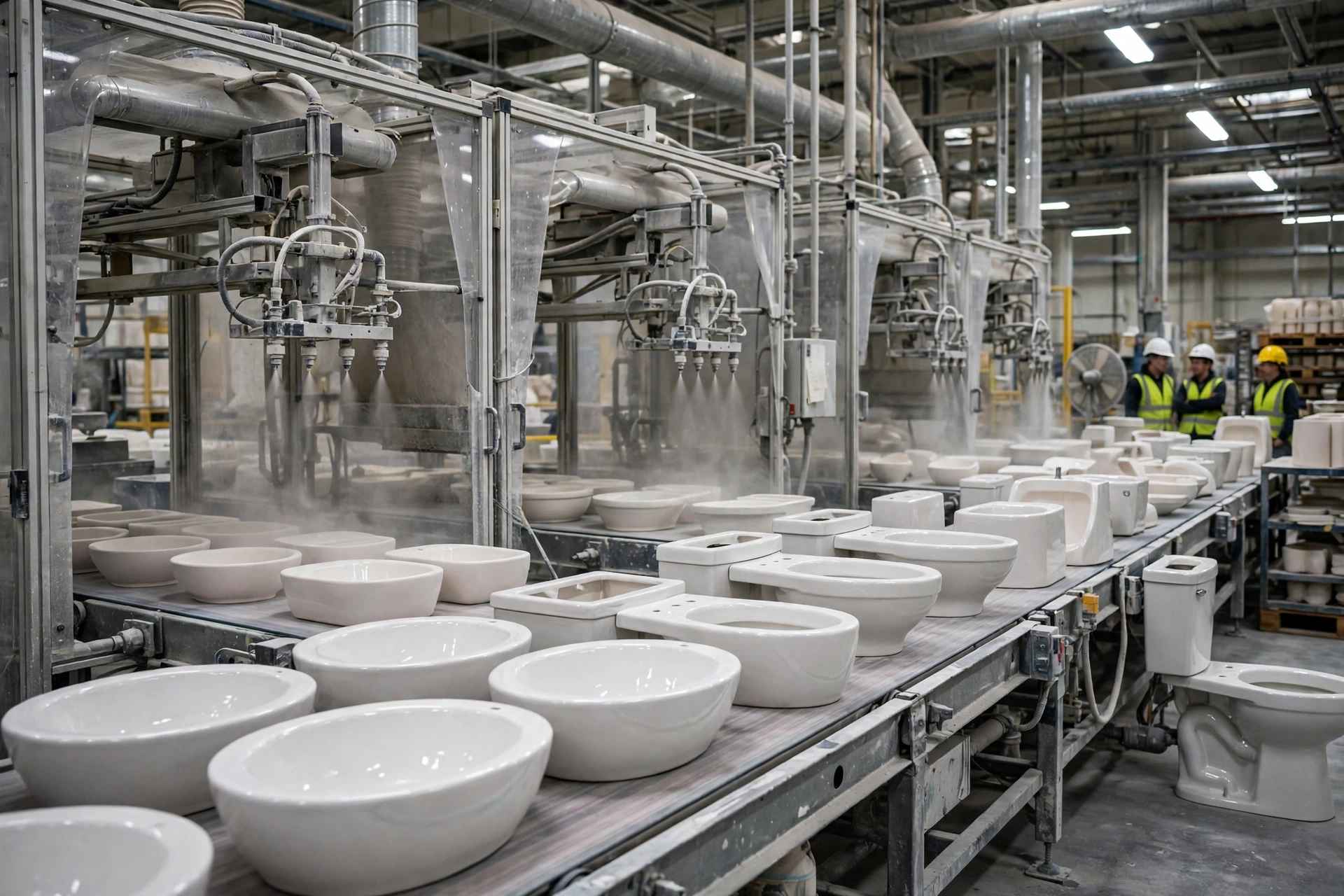
Stoke-on-Trent still makes sanitaryware in shuttle kilns, and a shuttle kiln is the least forgiving kiln in ceramics. One plant runs three shuttle kilns, each holding 280 pieces — wash basins, toilets and bidets — on a 10-hour firing cycle at 1,260°C. A piece that leaves the kiln early is scrap; a piece that cools uncontrolled in the kiln is scrap. When the grid failed at 2 a.m., two kilns were mid-cycle: one at hour six, one at hour nine.
The plant’s 600 kVA set started in eight seconds and carried the essential board — kiln fans, controls, extraction and compressed air — for the eleven hours the outage lasted. The kilns held their curves. The gas supply stayed on, and the kiln burners kept firing on a reduced rate under the control of the PLC, which the generator kept alive. Both kilns completed their cycles. All 560 pieces came out as first quality. The plant’s fuel bill for the night was 770 litres, about $930. The alternative — two kiln loads scrapped, 560 pieces at an average factory-gate value of $60 each, $33,600 of ware, plus the reheat and the lost shift — was more than thirty times the fuel cost. The plant manager’s summary, given to the generator supplier afterwards, was one sentence: the generator paid for itself that night, and it will pay for itself again the next time the grid fails.
Kiln Fans, Motor Starting and the Cooling-Zone Rule
The sizing mistake most ceramics plants make is not the running load. It is the starting load. A kiln’s fans and drives are induction motors, and induction motors draw six to eight times their running current for the first few seconds when started direct-on-line. A plant that sizes its generator from running kilowatts alone discovers the mistake at the worst possible moment: the set starts, the fans start, the voltage dips, the kiln PLC drops out on undervoltage, and the plant is back where it started, with a running generator and a dead kiln.
The Starters Decide the Set Size
Motor starting is what really sizes a diesel generator in a ceramics plant, because the fan motors are the largest single loads on the essential board and they all want to start at once. The four starter types give four different generators. Direct-on-line is the cheapest starter and the generator’s most expensive friend: full voltage into a stalled rotor, six to eight times current, and a working rule of roughly 2.5–3 times the motor’s kW in generator kVA to hold the voltage dip under 20%. Star-delta cuts the starting current to a third — and the starting torque with it, which matters for a fan that has to accelerate a heavy impeller. A soft starter ramps the voltage over a few seconds and holds current to typically two to four times full load. A variable frequency drive spins the motor up from zero hertz with current barely above running current, and it is the kindest start a generator can see.
The practical answer for most ceramics plants is a mix: VFDs on the large cooling-zone fans, where the drive also gives the plant speed control for the cooling curve, and soft starters on the combustion-air fans and the air compressor. A plant that fits VFDs to its three 15 kW cooling fans can cut the starting transient from 270 kVA of locked-rotor demand to under 60 kVA, and the saving goes straight into a smaller generator frame. The VFD costs $1,500–$3,000 per fan. The generator frame it saves costs ten times that.
The Cooling-Zone Rule
The cooling zone is where a ceramics kiln is most vulnerable, and it is the part of the kiln the generator protects most directly. In a roller kiln the cooling zone runs from the firing zone at 1,250°C down to the exit at 60°C, and the tiles pass through it in 15–25 minutes. The cooling air volume sets the rate: too fast and the tiles crack from thermal shock, too slow and they come out too hot to handle and the glaze crazes. The cooling-zone fans are therefore not just ventilation. They are process equipment, and they are the first fans the generator must restart and the last it may shed.
The rule the plant should write into its emergency procedure is simple: the cooling-zone fans restart first, the combustion-air fans second, and the extraction fans third. A kiln that restarts its combustion-air fans before its cooling fans pushes hot gas into a cooling zone that cannot move it, and the tiles in the cooling zone overheat. A kiln that restarts its extraction fans before its combustion-air fans pulls the firing zone cold. The sequence takes two minutes to execute and it is worth rehearsing every quarter, because the night the grid fails is not the night to discover that the fan start order is written on a card nobody can find.
Dust, Heat and Where the Set Sits
A ceramics plant is a hard place for a generator. Silica dust from the press shop and the spray dryer settles on everything, and a generator’s air filter clogs faster in a ceramics plant than in any other factory the set will serve. The diesel generator maintenance schedule should be shortened for a ceramics installation: air-filter inspection every 250 hours instead of 500, and a spare set of filters on the shelf, not on order. The kiln hall is hot — ambient temperatures of 40–45°C beside a tunnel kiln are normal — and a generator rated at 27°C loses roughly 1% of its output for every 5°C above its rating temperature, so a set installed beside the kiln hall needs a derating allowance or a cooler location. The set belongs outside the kiln hall, on a plinth with clear airflow, at least 5 metres from the kiln building and downwind of the spray dryer exhaust. A set that breathes kiln-hall air and silica dust will not reach its rated life, and a plant that discovers that in year three has already paid for the set twice.
Frequently Asked Questions
What size generator does a ceramics plant need?
A small tableware or sanitaryware plant typically needs a 250–400 kVA set for its essential board, a mid-size tile plant with a roller kiln needs 500–800 kVA, and a large integrated ceramics plant needs 1,000–1,600 kVA for kiln fans, presses, glazing and utilities. The kiln’s firing heat is never on the generator — those figures cover kiln fans, kiln drives, extraction, controls, compressed air and water only. Size from the essential load list, not from the plant’s connected total.
Do ceramics plants need a backup generator?
Yes, if the plant runs a continuous kiln. A tunnel kiln or roller kiln that loses its fans for thirty minutes loses the ware inside it, and a kiln that loses its refractory to thermal shock needs a reline costing $80,000–$150,000 and 7–14 days of lost production. A batch shuttle kiln is more forgiving, because one lost batch costs hundreds of pieces rather than a kiln, but the generator still pays for itself the first time it saves a full firing cycle.
How long can a ceramics plant run on a generator?
As long as its fuel lasts and the set is rated for the duty. A 500 kVA set at 75% load burns about 70 litres an hour, so a 5,000-litre bulk tank gives 71 hours — three days — and a 2,000-litre day tank gives 28 hours. The limit is the rating: under ISO 8528-1, a standby (ESP) set is limited to 200 hours a year, so a plant on an unreliable grid that runs the set for 300 hours a year needs a prime-rated set, not a standby one. Diesel fuel ageing also limits long runs — fuel stored for more than six months without treatment and testing should not be trusted for a three-day outage.
What happens to a ceramics kiln during a power outage?
The kiln keeps its heat but loses its air. Combustion-air fans and cooling-zone fans stop, the temperature gradient inside the kiln starts to collapse, and ware sitting in the firing zone over-fires while ware in the cooling zone cracks from uncontrolled cooling. In a roller kiln the tiles stop moving, and deformed tiles can jam between the rollers and break them. If the generator restarts the fans within minutes, the kiln holds its firing curve and the damage is limited to the ware that was in the kiln at the moment of the outage. If the fans stay off for thirty minutes or more, the kiln needs a controlled cool-down, a blockage check and a reheat that takes 36 hours or more.
Can a diesel generator power a ceramics plant?
It can power the essential board of a ceramics plant — kiln fans, kiln drives, instrumentation, extraction, compressed air, water pumps and one press line — but it cannot power the firing itself. The kiln’s heat, at 900–1,300°C and several megawatts of thermal energy, comes from gas burners or electric elements, not from the generator. A plant that understands that limit sizes a 250–1,600 kVA set for the equipment around the kiln and protects the ware, the kiln and the restart. A plant that does not understand it either buys a generator far too large or discovers, during the first outage, that the set it bought cannot do the job it was bought for.
Specification Checklist: Eight Lines Before the Deposit
- Kiln type and firing temperature — tunnel, roller, shuttle or electric; peak temperature and cycle time, because kiln type decides the fan load and the fan load decides the set.
- Essential load list, measured — Tier 1 and Tier 2 loads from a load study, not from the plant’s connected total; the firing load is off the generator.
- Largest motor start, with starter type — locked-rotor kVA of the largest fan or compressor, and whether it starts direct-on-line, star-delta, soft starter or VFD.
- Rating: standby or prime — annual outage hours against the ISO 8528-1 standby limit of 200 hours a year; prime if the grid fails often.
- Transfer time — NFPA 110 Level 1, 10 seconds; the automatic transfer switch specification and its test schedule in writing.
- Fuel autonomy in hours, not litres — bulk tank plus day tank, sized for the outage the plant actually fears, with a fuel-testing and polishing plan.
- Fan start sequence — cooling zone first, combustion air second, extraction third, written into the emergency procedure and rehearsed quarterly.
- Installation: dust, heat and distance — set outside the kiln hall, at least 5 metres from the building, clear airflow, shortened air-filter interval for silica dust.
A ceramics plant buys a generator once and lives with it for twenty years. The eight lines above are the difference between a set that saves the kiln on the night the grid fails and a set that runs the lights while the kiln dies. Get them into the specification before the deposit is paid, not after the first outage.
For a generator sized to your kiln type, your essential load list and your outage history, contact PAVO — send the kiln specification, the fan motor list and the fuel autonomy you need, and PAVO will return a sized quotation with the transfer switch, the essential board and the fuel system included.