

What Size Generator Does a Plywood Plant Need? | PAVO
A plywood plant does not stop when the power fails. It starts losing the panel that is already in the press, the veneer that is already in the dryer and the glue line that is already curing — one press cycle at a time.
What size generator does a plywood plant need? A mill at 20–30 m³ a day needs 150–250 kVA, a line at 100 m³ a day needs 500–1,000 kVA, and a large plant at 200–300 m³ a day needs 1,000–2,000 kVA — the peeling lathe, veneer dryer and hot press are the load; the boiler heat is steam, not electric.
Contents
- What a Plywood Plant Actually Draws: The Load in Numbers
- What Size Generator Does a Plywood Plant Need?
- What Happens in the First Minutes of an Outage
- Three Plants, Three Outages
- The Glue Line That Cannot Wait: Press Cycles on Generator Power
- How Long Can a Plywood Plant Run on a Generator?
- Frequently Asked Questions
- Specification Checklist: Before You Order the Set
What a Plywood Plant Actually Draws: The Load in Numbers
A plywood plant is a heat process that happens to use electricity, and that single fact decides the generator size. Most buyers get it wrong in the same direction: they add the thermal load and the electrical load together and specify a set two or three times larger than the site needs. Drying veneer and curing glue are heat-hungry steps. In most plants above craft scale, that heat comes from a steam boiler or a thermal-oil heater burning wood waste, gas or oil — not from the generator. The generator carries the electrical slice: motors, drives, fans, pumps, dust extraction and controls.
The scale of the industry sets the context. World plywood production reached 111 million cubic metres in 2024, inside a wood-based panels market of 432 million cubic metres. China produced 163 million cubic metres of wood-based panels, about 38% of world output, and exported 10.47 million cubic metres of plywood — more than four times Vietnam’s 2.40 million cubic metres, the fourth-largest exporter. The mills that make those panels sit in exactly the countries where the grid is least reliable: Indonesia, Malaysia, Vietnam, India, Ghana and Brazil. A plywood line in Pontianak, Binh Dinh or Kumasi does not buy a generator for comfort. It buys one because a single outage in the wrong minute costs a press load.
How much electricity does a plywood line actually take? The FAO’s energy study of plywood manufacture, based on a standard well-operated plant of 100 m³ a day producing 5 mm panels from hardwood, measured total electrical consumption at 230 kWh per cubic metre of finished plywood. That is 23,000 kWh a day — an average electrical demand of roughly 960 kW over a 24-hour day, or about 1,150 kW over a 20-hour production day. The same study splits the electrical load by process, and the split is what sizes the generator.
Peeling takes the largest electrical share
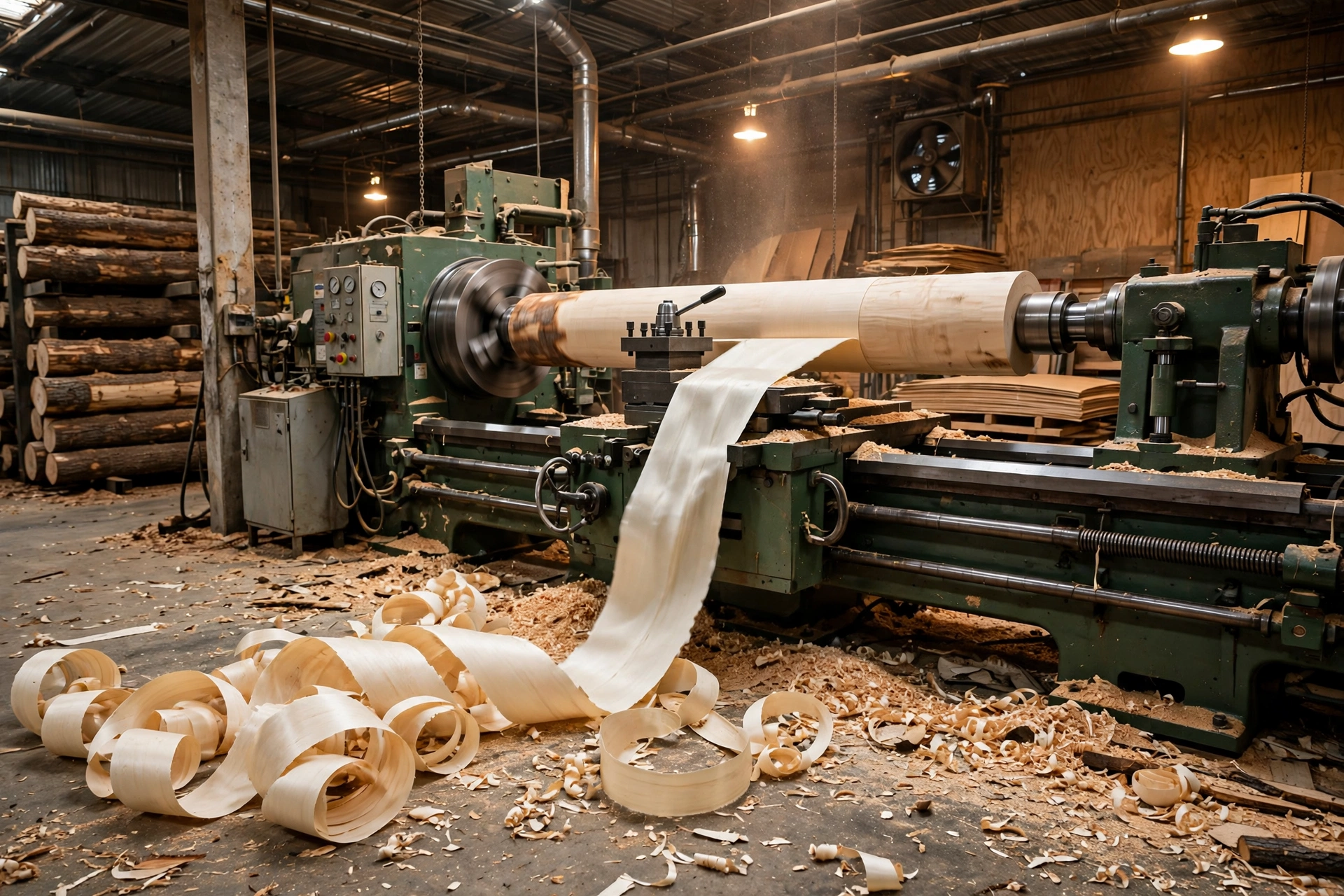
Peeling is the single largest electrical load in the plant, at 23.1% of total electrical consumption. The rotary lathe spins a debarked log against a knife and peels it into a continuous ribbon of veneer, typically 1.5–3.2 mm thick. A spindleless lathe for a mid-size line runs a 45–90 kW main drive, and it runs at a high, steady draw for the whole shift: the log does not stop turning while the knife is engaged. The clipper that cuts the ribbon into sheets draws another 5–15 kW, and the conveyors that move green veneer to the dryer add more. A peeling-only unit — the kind that supplies veneer to mills that do not peel their own — is a small electrical load on its own: the TERI energy profile of the Yamunanagar plywood cluster in India records a peeling unit at 50,281 kWh a year, producing about 3,500 square feet of veneer a day. But inside a full plywood plant, peeling is the load that never pauses.
The dryer is the thermal load, not the electrical load
Drying takes only 7.5% of the plant’s electrical consumption, yet it dominates the plant’s energy bill. The FAO figures put thermal energy for drying at 60.8% of the plant’s total energy — 3.88 GJ per cubic metre — against 87% of total energy from all thermal uses combined. The distinction matters for generator sizing: the dryer’s heat comes from the boiler, but its fans, drives and feeders are electrical, and they are large. A published specification for a 6-deck roller veneer dryer, the GTH612-42, lists total installed power of 680.5 kW with consumption of about 410 kWh per operating hour, drying 15–18 m³ of veneer an hour at 160–180 °C. A 48-metre roller dryer handles about 70 m³ a day. At the other end of the scale, a compact FBH30-13 dryer draws 15 kW and dries 2 m³ an hour. The target is a veneer moisture content of 6–12%, ideally 8–10%, dried at 70–90 °C in the air stream. A dryer that stops mid-load leaves wet veneer sitting in a hot chamber, and a dryer that restarts wrong scorches it.
The hot press and the dust system
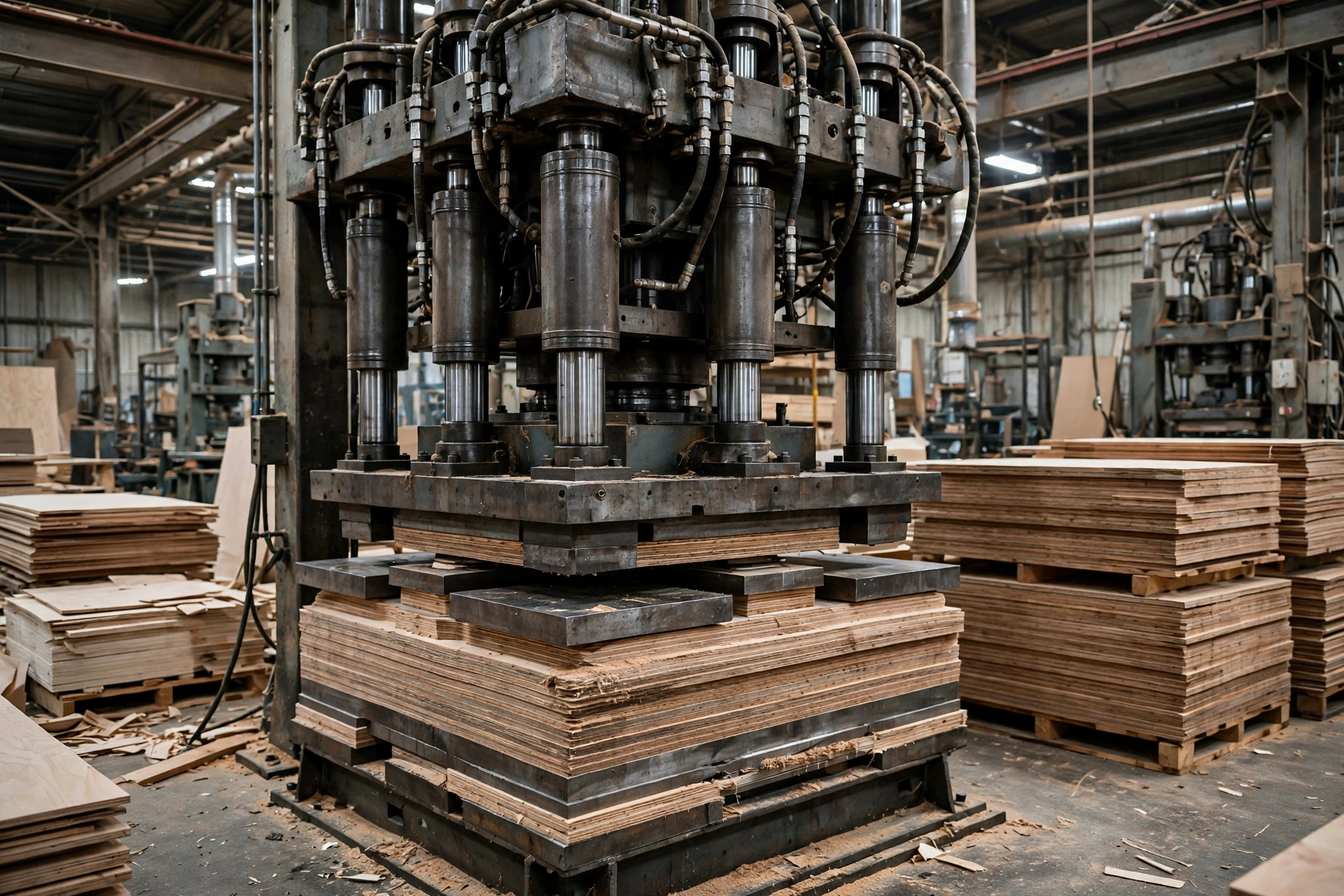
Pressing takes 6.7% of the plant’s electrical consumption and 11.3% of its thermal energy (0.72 GJ/m³). The hot press itself is a hydraulic machine: a 100-tonne press with electric heating lists 48–54 kW of heating power, and a 40-tonne hot press dryer lists a 15.55 kW main motor. In a steam- or thermal-oil-heated plant the press platens are heated by the boiler, so the generator sees only the hydraulic pump, the controls and the loading system — typically 30–75 kW for the press. What the generator must also carry, and what buyers most often forget, is the dust system. Materials handling takes 15.6% of the plant’s electrical consumption, sorting and barking 12.5%, and sanding 7.8%. The dust extraction fans that serve the sanders, saws and trimmers run continuously, and a large plant’s extraction system draws 75–200 kW. It is not a production load. It is a safety load: fine wood dust in a stopped extraction duct is a fire and explosion risk, and the plant falls under NFPA 664 practice with dust-hazard areas classified to ATEX Zone 22.
The table below gives typical electrical running loads for the equipment a generator must actually carry. These are running loads; starting surge is a separate problem, covered in the sizing section.
| Equipment | Typical running load | Notes |
|---|---|---|
| Log debarker and log yard | 15–30 kW | Chains, conveyors; steady load |
| Rotary peeling lathe | 45–90 kW | Largest single electrical load; continuous |
| Veneer clipper and conveyors | 5–15 kW | Intermittent, light load |
| Roller veneer dryer (fans, drives) | 150–400 kW | 6-deck unit: 680 kW installed, ~410 kW average |
| Dryer burner fan and biomass feeder | 15–30 kW | Feeds the boiler or hot-air generator |
| Glue spreader | 5–15 kW | Roller coater, 280–360 g/m² spread |
| Cold press | 15–30 kW | Hydraulic, 0.8–1.2 MPa, 30–60 min cycle |
| Hot press (hydraulic + controls) | 30–75 kW | Heat is steam or thermal oil, not electric |
| Trimmer and edge saw | 15–30 kW | Intermittent, high starting current |
| Wide-belt sander | 30–75 kW | Per sander; several run together |
| Dust extraction system | 75–200 kW | Continuous; safety load, never shed |
| Compressed air | 15–45 kW | Press controls, pneumatic conveying |
| Boiler feed, fans and pumps | 10–30 kW | Keeps the steam and heat running |
| Lighting, HVAC, offices | 10–30 kW | Steady base load |
A mid-size line running at 100 m³ a day draws roughly 400–700 kW of critical electrical load while the line is running, with peaks when the lathe, the dryer fans and two sanders run at the same time and a press pump starts. The load profile is close to that of sawmills, which share the lathe, the dust system and the motor-starting problem — but a plywood plant adds the dryer and the press on top. A full-production backup — every machine, including the sanders and the trimmers — needs roughly 1,150 kW of average load, and the set that carries it is a different machine at a different price.
What Size Generator Does a Plywood Plant Need?
The answer starts with a load list, not a catalogue page. Walk the line, write down every motor with its running kilowatts and its starting method, and add the loads that run together. Then apply three rules that catch most sizing mistakes in this industry.
First, separate the steam load from the electrical load. Veneer drying at 160–180 °C in the dryer and glue curing at 110–150 °C in the press are thermal jobs. The dryer’s electrical draw is its fans and drives — 150–400 kW for a large roller dryer — not the heat itself. The hot press platens are heated by steam or thermal oil; the generator sees the hydraulic pump at 30–75 kW, not the megawatts of heat in the platens. A buyer who sizes the generator for the thermal rating buys a set two to three times too large and then runs it at 25% load, where wet stacking starts. The same applies to the boiler, which needs only its fans, pumps and controls — typically 10–30 kW — from the generator.
Second, size for the lathe and the dryer fans, not the average. A plywood line’s average load understates the peak by 30–40% because the lathe, the dryer and the sanders cycle together. When the lathe drive starts under load, the dryer fans are at full speed and a sander starts, the generator sees a step load of 100–150 kW in under a second. A set sized to the average will dip voltage, and the variable-speed drives on the dryer and the lathe are the first to trip on undervoltage. The correct figure is the coincident peak, plus a 20–25% margin for the next motor starting. This is the same step-load problem that trips UPS systems on generator power, and the motor starting method — direct-on-line, star-delta or soft starter — decides how large the dip is.
Third, decide the rating before the kVA. A plywood mill in Kalimantan or Binh Dinh that runs on generator power for several hours a week during load shedding is on prime duty, not standby duty. ISO 8528-1 allows a standby-rated set 200 hours a year; a plant that loses the grid for 40 hours a month passes that limit in five months. The standby and prime ratings decide whether the manufacturer will stand behind the set at that duty, and a prime rating is typically 10–15% lower in kVA than the standby rating of the same frame. The generator sizing guide gives the full method; the bands below are the shortcut for a first budget.
| Plant type | Output | Typical critical load | Generator size |
|---|---|---|---|
| Peeling-only unit | 3,500 sq ft veneer/day | 15–30 kW | 30–60 kVA |
| Small plywood mill | 20–30 m³/day | 100–180 kW | 150–250 kVA |
| Mid-size plywood line | 100 m³/day | 400–700 kW | 500–1,000 kVA |
| Large plywood plant | 200–300 m³/day | 800–1,500 kW | 1,000–2,000 kVA |
| Full-production backup (100 m³/day) | 100 m³/day | ~1,150 kW average | 1,250–1,500 kVA |
A worked sizing example: 100 m³ a day
Take a mid-size plywood line in Binh Dinh, Vietnam, producing 100 m³ of 18 mm film-faced plywood a day on a single shift. The load list reads: debarker 20 kW, peeling lathe 75 kW, clipper and conveyors 10 kW, roller dryer fans and drives 300 kW, dryer burner fan and biomass feeder 20 kW, glue spreader 10 kW, cold press 20 kW, hot press hydraulic and controls 50 kW, trimmer 20 kW, two wide-belt sanders at 50 kW each, dust extraction 120 kW, compressed air 30 kW, boiler feed and pumps 20 kW, lighting and offices 15 kW. Running load with the lathe, dryer and both sanders up and the press cycling: 20 + 75 + 10 + 300 + 20 + 10 + 20 + 50 + 20 + 100 + 120 + 30 + 20 + 15 = 830 kW. That is the coincident load, not the nameplate total — and it is the load for full production, sanders included.
At 0.8 power factor, 830 kW is 1,038 kVA. Add a 20% margin for the next sander starting and for the next year’s growth, and the requirement is 1,245 kVA. The correct order for full production is a 1,250 kVA prime-rated set. Most mills do not order that. They order the critical-load set: lathe, dryer, press, dust extraction, boiler and controls, with the sanders and trimmers shed — about 550 kW, or 688 kVA, plus a 20% margin, which is an 800 kVA prime-rated set. A 500 kVA standby set, the figure a catalogue quote would most likely offer, is short by a third on the critical load alone and would be run beyond its rating on the first busy day. The same arithmetic scales down: a peeling-only unit with a 20 kW coincident load needs a 30–60 kVA set, not the 15 kVA unit that looks adequate on a nameplate list.
What Happens in the First Minutes of an Outage
The first ten seconds decide the batch. The automatic transfer switch senses the loss, starts the set, and transfers the load — typically 10 seconds from grid failure to generator power on a well-maintained system. What happens in those ten seconds, and in the minutes after, depends entirely on what was running when the grid dropped.
The hot press stalls mid-cycle
The hot press is the worst place in the plant to lose power. A standard UF press cycle for an 18 mm panel runs 14–18 minutes at 110–125 °C and 1.0–1.6 MPa. The cycle has four phases: fast closing in 15–25 seconds, high-pressure bonding for 60% of the cycle, stepped pressure relief — the breathing stage — for 25%, and final decompression in 15–30 seconds. If the grid fails during the bonding phase, the hydraulic pump stops, the platens hold pressure for a while on trapped oil, and then the pressure bleeds away as the oil cools and the seals leak. The glue line is half-cured. The panel that comes out is delaminated or blistered, and there is no re-pressing it: the resin has started to set in the wrong structure. A 20-daylight press holds 20 panels a cycle; at 18 mm and 2.44 × 1.22 m, that is roughly 1.1 m³ of panels per cycle, worth about US$550–700 at export prices — lost in one outage, plus the hour it takes to clean the platens and reheat the press.
The dryer stops with wet veneer inside
The veneer dryer is the second casualty. A roller dryer at 160–180 °C holds several cubic metres of veneer inside it at any moment — a 48-metre dryer running at 70 m³ a day holds roughly 2–3 m³ in the chamber. When the fans stop, the air stops moving, and the veneer nearest the heat source keeps heating while the rest cools. The result is scorched face veneer at the hot end and damp core veneer at the cold end, both downgraded. The dryer cannot simply be restarted: the chamber must be cleared, the scorched sheets pulled, and the temperature profile re-established, which takes 30–60 minutes on a large line. A plant that loses the grid twice a week loses a full shift a month to dryer restarts alone.
Dust extraction stops — and the fire risk starts
The third casualty is the one that burns the plant down. When the dust extraction fans stop, the sanders and saws must stop with them — but the dust already in the ducts does not disappear. Fine wood dust settles in the ductwork, and the sanding heads and saw blades are still hot. A plant that restarts its sanders before the extraction system is back at full speed pushes fresh dust into a duct that has no airflow, and a spark from a nail in a board or a hot bearing is enough. NFPA 664, the standard for wood processing facilities, treats dust extraction as a life-safety system, and the extraction fans belong on the essential circuit with the press and the dryer — never on the sheddable load list. A generator that cannot carry the dust system is a generator that cannot safely restart the plant.
Three Plants, Three Outages
The numbers above are not theory. They are the shape of three real outage patterns that repeat across the plywood belt, from Kalimantan to the Mekong Delta to West Africa.
Case 1 — Pontianak, Indonesia: the press that opened too late
A 100 m³-a-day mill outside Pontianak, West Kalimantan, runs a 20-daylight hot press on PF resin for marine-grade panels: 135–150 °C, 17–22 minutes a cycle. The mill had a 400 kVA standby set that covered the office, the lights and the glue room — not the press. When the grid failed at minute 11 of a 20-minute cycle, the hydraulic pump stopped and the press sat closed, cooling, for 40 minutes while the crew waited for the grid. By the time the platens were opened, the internal steam pressure — normally 0.4–0.8 MPa during the breathing stage — had collapsed, the glue line had set unevenly, and 60 panels failed the delamination test. The direct loss was about US$9,000 in panels, plus 6 hours to clean the platens, reheat the press to 140 °C and re-run the quality checks. The mill now runs an 800 kVA prime-rated set with the press, the dryer fans and the dust extraction on the essential circuit, and the press has a hydraulic accumulator that holds closing pressure for 10 minutes — long enough for the set to take the load.
Case 2 — Binh Dinh, Vietnam: the dryer that cooked the veneer
A veneer dryer line in Binh Dinh runs a 48-metre roller dryer at 70 m³ a day, drying acacia veneer from 50% moisture to 8–10% at 160–180 °C. The line had a generator, but the dryer fans were wired to the sheddable load — the logic being that the dryer was a thermal machine and the boiler would keep it hot. When the grid failed for 25 minutes, the fans stopped, the burner kept firing for 3 minutes on its own inertia, and the veneer in the hottest section of the dryer scorched. 4 m³ of face veneer was downgraded to core stock, a loss of about US$1,200, and the line lost 45 minutes clearing the chamber and re-establishing the temperature profile. The fix cost less than the loss: the dryer fans and the burner controls were moved to the essential circuit, and the set was upsized from 500 kVA to 750 kVA to carry them.
Case 3 — Kumasi, Ghana: the mill that ran on the wrong rating
A 30 m³-a-day mill in Kumasi runs on a grid that fails for roughly 40 hours a month — load shedding plus storm damage, a normal year in the region. The mill bought a 250 kVA standby-rated set and ran it as if it were prime: 40 hours a month is 480 hours a year, more than twice the 200-hour annual limit for a standby rating under ISO 8528-1. After 14 months the set was wet-stacked, smoking, and down on power by 15% — the engine had spent its life running at 30–40% load on a light mill load, never reaching the temperature that burns carbon out of the cylinders. The replacement was a 300 kVA prime-rated set, run on a load bank at 80% load for 2 hours every month to keep it clean, and the mill’s fuel bill fell by 12% because the prime-rated set was sized to the real load instead of oversized to a catalogue figure. The lesson is the same one the standby and prime ratings article states: the rating is a warranty condition, not a marketing label.
The Glue Line That Cannot Wait: Press Cycles on Generator Power
The glue line is the reason a plywood plant needs generator power in minutes, not hours. Everything else in the plant can wait. The glue line cannot.
The UF cure window in numbers
Urea-formaldehyde resin, the standard adhesive for interior plywood, cures at 110–125 °C with a heat factor of 45–60 seconds per millimetre of panel thickness. An 18 mm panel needs 14–18 minutes in the press. Melamine-urea-formaldehyde runs hotter, 120–135 °C, and needs 15–19 minutes. Phenol-formaldehyde, the marine-grade resin, cures at 135–150 °C and needs 17–22 minutes. The glue is spread at 280–360 g/m² on a double line, the veneer moisture is held at 6–12%, and the press closes at 1.0–1.6 MPa for softwoods and 1.4–2.2 MPa for dense hardwoods. Every one of those numbers is a window, and the window closes the moment the press loses heat or pressure. A press that loses power at minute 8 of a 16-minute cycle does not pause the cure. It abandons it. The panel that comes out has a glue line that is cured at the faces and raw at the core, and it will delaminate in the customer’s hands — which is why the delamination test, not the press operator’s judgement, decides whether the batch ships.
What a press restart actually costs
A press restart after an outage is not a button press. The platens must be reheated to the cure temperature — 110–150 °C depending on the resin — which takes 30–60 minutes from cold on a large multi-daylight press. The press must be cleaned: resin that cured on the platens during the outage has to be scraped off, and a platen with cured resin on it will mark every panel it touches. The glue that was spread on the next lay-up has a pot life — UF resin mixed with hardener starts to pre-cure on the veneer within 20–30 minutes at tropical temperatures — so a lay-up that waited through a 40-minute outage is scrap and the veneer must be re-glued. The full cost of a single press-cycle outage on a 100 m³-a-day line is typically US$2,000–5,000 in scrapped panels, wasted glue and lost production time, against a generator that costs US$60,000–90,000 for an 800 kVA prime set. The set pays for itself in 15–30 press-cycle outages — roughly one bad year on an unreliable grid.
How Long Can a Plywood Plant Run on a Generator?
The answer is a fuel calculation, not a guess. A plywood plant that runs on generator power for a full shift burns fuel at industrial rates, and the tank that looks generous on paper runs dry in the middle of the second shift.
A diesel set burns roughly 0.26 litres per kWh at full load. The Cummins C500D5 datasheet — 500 kVA standby / 455 kVA prime — lists 93.2 L/h at full prime load, 69.9 L/h at 75% load and 49.0 L/h at 50% load. The table below applies that consumption rate to the set sizes a plywood plant actually orders, at the 75% load a well-sized set runs at.
| Set size | Load at 75% | Fuel use | 8-hour shift | 24 hours |
|---|---|---|---|---|
| 250 kVA prime | 150 kW | ~39 L/h | ~310 L | ~940 L |
| 500 kVA prime | 273 kW | 69.9 L/h | ~560 L | ~1,680 L |
| 800 kVA prime | 480 kW | ~125 L/h | ~1,000 L | ~3,000 L |
| 1,000 kVA prime | 600 kW | ~156 L/h | ~1,250 L | ~3,750 L |
| 1,500 kVA prime | 900 kW | ~234 L/h | ~1,870 L | ~5,620 L |
A mid-size line on an 800 kVA set burns about 1,000 litres a shift. A standard 1,000-litre day tank lasts one shift. A 5,000-litre bulk tank lasts 5 shifts — about three working days at two shifts a day. A plant that wants 72 hours of autonomy on an 800 kVA set needs roughly 9,000 litres of stored fuel, which is a bunded bulk tank, not a day tank. The fuel must also be fresh: diesel in a standby tank absorbs water, grows microbes and goes stale, and diesel fuel ageing is the most common reason a set that starts perfectly on its weekly test fails on the day it matters. A plant in a hot, humid climate should polish its fuel every 6 months and test it every 3 months — and the fuel supplier should be on a contract that delivers within 24 hours, because a 72-hour tank is useless if the refill takes a week.
The operating cost is straightforward. At a delivered diesel price of US$1.00–1.20 per litre in most of Southeast Asia and West Africa, an 800 kVA set at 75% load costs about US$125–150 an hour in fuel. A 10-hour outage costs US$1,250–1,500 in fuel — against US$2,000–5,000 in scrapped panels and lost production from a single press-cycle failure. The generator is not the expensive option. The outage is.
Fuel storage that survives the outage
Three rules govern the fuel installation. First, the day tank must be sized for the longest single outage the plant expects, plus a margin — 8 hours of fuel in the day tank is the minimum for a plant that runs two shifts, and the transfer pump that fills it from the bulk tank must be on the essential circuit, not the sheddable load. Second, the bulk tank must be bunded: a 110% secondary containment bund is the standard in most jurisdictions, and a spill from a 9,000-litre tank without a bund is an environmental incident, not a housekeeping problem. Third, the fuel must be tested. Water in the tank bottom feeds microbes, microbes make sludge, sludge blocks filters, and a blocked filter at 3 a.m. during a storm outage is the most common cause of a set stopping mid-outage. A maintenance schedule that includes a monthly fuel-water check and a quarterly fuel sample costs almost nothing and catches the failure before it happens.
Frequently Asked Questions
What size generator does a plywood plant need?
A peeling-only unit needs 30–60 kVA, a small mill at 20–30 m³ a day needs 150–250 kVA, a mid-size line at 100 m³ a day needs 500–1,000 kVA for critical loads or 1,250–1,500 kVA for full production, and a large plant at 200–300 m³ a day needs 1,000–2,000 kVA. The peeling lathe, veneer dryer and hot press are the loads that decide the size; the boiler heat is steam, not electric.
Do plywood plants need a backup generator?
Yes, if the plant runs a hot press or a veneer dryer and the grid fails more than a few times a year. A single outage during a press cycle scraps US$2,000–5,000 of panels and production time, and a dryer restart costs 30–60 minutes of line time. The generator also carries the dust extraction system, which is a life-safety load that must never be shed.
How long can a plywood plant run on a generator?
As long as the fuel lasts. An 800 kVA set at 75% load burns about 125 L/h, so a 5,000-litre bulk tank gives roughly 40 hours and a 9,000-litre tank gives about 72 hours. The practical limit is the fuel contract, not the engine: a prime-rated set can run indefinitely at variable load if it is fuelled, serviced and load-banked.
What happens to a plywood plant during a power outage?
The hot press stalls mid-cycle and the glue line under-cures, the dryer stops with wet veneer inside and scorches or dampens it, the dust extraction stops and the sanders must stop with it, and the lay-up waiting for the press exceeds its glue pot life. A 100 m³-a-day line typically loses US$2,000–5,000 per press-cycle outage, plus 1–6 hours of restart and cleaning time.
Can a diesel generator power a plywood plant?
Yes. A plywood plant is a standard industrial motor load: lathes, dryer fans, press hydraulics, sanders and dust extraction, all three-phase, all within the capability of a prime-rated diesel set from 30 kVA for a peeling unit to 2,000 kVA for a large plant. The set must be sized for the coincident peak and the motor starting surge, and the dust extraction must be on the essential circuit.
Specification Checklist: Before You Order the Set
- Load list first. Walk the line and record every motor with running kW and starting method. Size for the coincident peak, not the nameplate total, and add 20–25% margin.
- Separate steam from electric. Dryer heat and press heat come from the boiler. The generator carries fans, drives, hydraulics and controls only — do not size for the thermal rating.
- Choose the rating. More than 200 hours a year on generator power means prime duty under ISO 8528-1. A standby-rated set run as prime loses its warranty and its engine.
- Put the press, the dryer fans and the dust extraction on the essential circuit. The sanders, trimmers and packaging line can be shed. The press, the dryer and the extraction system cannot.
- Fit a hydraulic accumulator on the hot press. Ten minutes of held closing pressure covers the 10-second transfer gap and the set’s run-up.
- Size the fuel for 72 hours. An 800 kVA set needs about 9,000 litres for three days at 75% load. Bund the bulk tank at 110% and polish the fuel every 6 months.
- Plan the motor starts. Lathe, dryer fans and sanders on soft starters or star-delta cut the starting surge by half or more and let a smaller set carry the same line. The motor starting method is the cheapest kVA in the plant.
- Contract the fuel and the service. A fuel supplier that delivers within 24 hours, a service visit every 250 hours or 6 months, and a monthly load-bank run at 80% load keep the set ready — and with remote monitoring, the plant manager can watch the set from another country and catch a low-fuel or high-temperature alarm before it becomes a stop.
- Test the whole system, not the set. A monthly test that transfers the real load — press, dryer and extraction — proves the automatic transfer switch, the set and the load shedding all work together. A set that has never carried the press is a set that has never been tested.
A plywood plant buys a generator for one reason: the glue line cannot wait for the grid. Size the set for the press, the dryer and the dust system, rate it for the hours it will actually run, and fuel it for the outage that lasts three days, not three hours. For a load list and a prime-rated set sized to the plant’s real coincident load, contact PAVO — the PAVO team sizes generator sets for plywood, veneer and panel plants across Southeast Asia, Africa and South America, and will quote the set, the transfer switch and the fuel system as one package.