

What Size Generator for a Concrete Batching Plant? | PAVO
A batching plant is not a building with a generator. It is a production line with a clock running on every batch, and the generator is the only thing that keeps that clock from expiring.
What size generator does a concrete batching plant need? A 30 m³/h mobile plant runs on 70–80 kVA, a 60 m³/h plant needs 110–125 kVA, and a 120 m³/h stationary plant needs 300 kVA. The mixer motor decides the figure, because a loaded mixer draws five to seven times its rated power at start.
This article works through the load list of a real batching plant, the published generator requirements for ten production models, the starting surge that catches most buyers out, and the 90-minute clock that turns a power failure into wasted concrete. It covers stationary and mobile plants, ready-mix and RCC, and the fuel and placement decisions that follow the sizing decision.
Contents
- What a Batching Plant Actually Draws: The Load List
- Sizing by Plant Capacity: The kVA Table
- The Mixer Starting Surge: Why the Biggest Motor Decides the Set
- The 90-Minute Clock: What Happens When Power Fails Mid-Batch
- Three Plants, Three Outages
- Fuel, Autonomy, Placement and the Running Cost
- Frequently Asked Questions
- Specification Checklist
What a Batching Plant Actually Draws: The Load List
A batching plant looks like a simple machine from the road: silos, a conveyor, a mixer, a control cabin. The electrical load list tells a different story. A 120 m³/h stationary plant carries roughly 205 kW of installed motors, spread across a dozen drives that never all run at once — but several of them start at once, and the largest of them starts under load. Sizing a generator for a batching plant means understanding which loads run together, which loads start together, and which loads cannot be allowed to stop.
The mixer — the load that decides everything
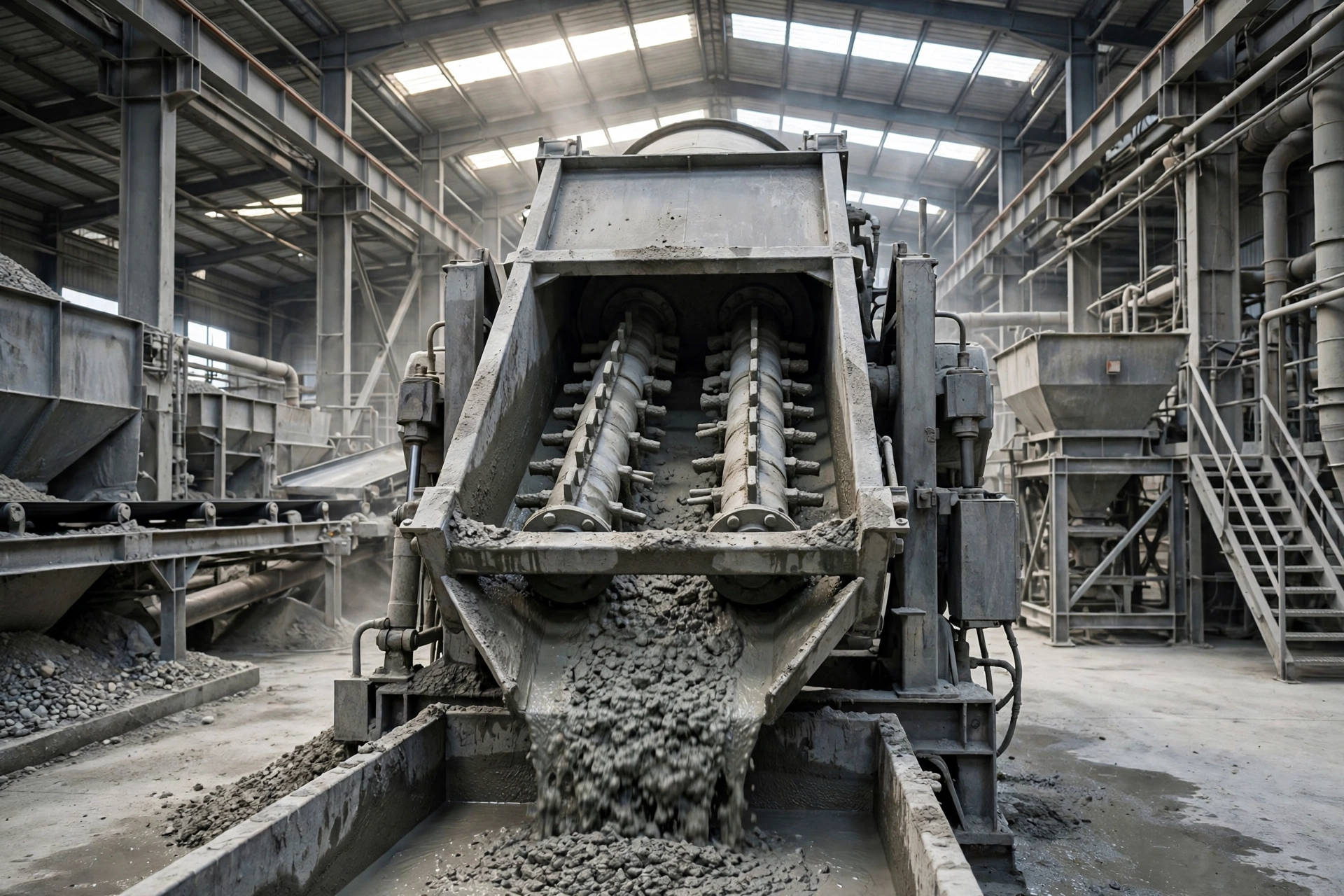
The mixer is the heart of the plant and the largest single motor on it. A twin-shaft mixer on a 60 m³/h plant typically carries a 30–37 kW motor; on a 120 m³/h plant the mixer motor is 55–75 kW, and on an RCC plant the mixer needs roughly 20–25% more motor power than an equivalent-volume ready-mix mixer, because a zero-slump mix behaves more like gravel than concrete. Planetary mixers in the same duty range run 45–75 kW.
The mixer is also the only load that cannot be shed. Aggregate conveyors can wait. The compressor can wait. A mixer full of wet concrete cannot wait, because the concrete inside it is setting. That single fact drives the whole generator specification: the set must be able to start the mixer, under load, every time, on the first attempt.
Aggregate handling: conveyors, hoppers and the inclined belt
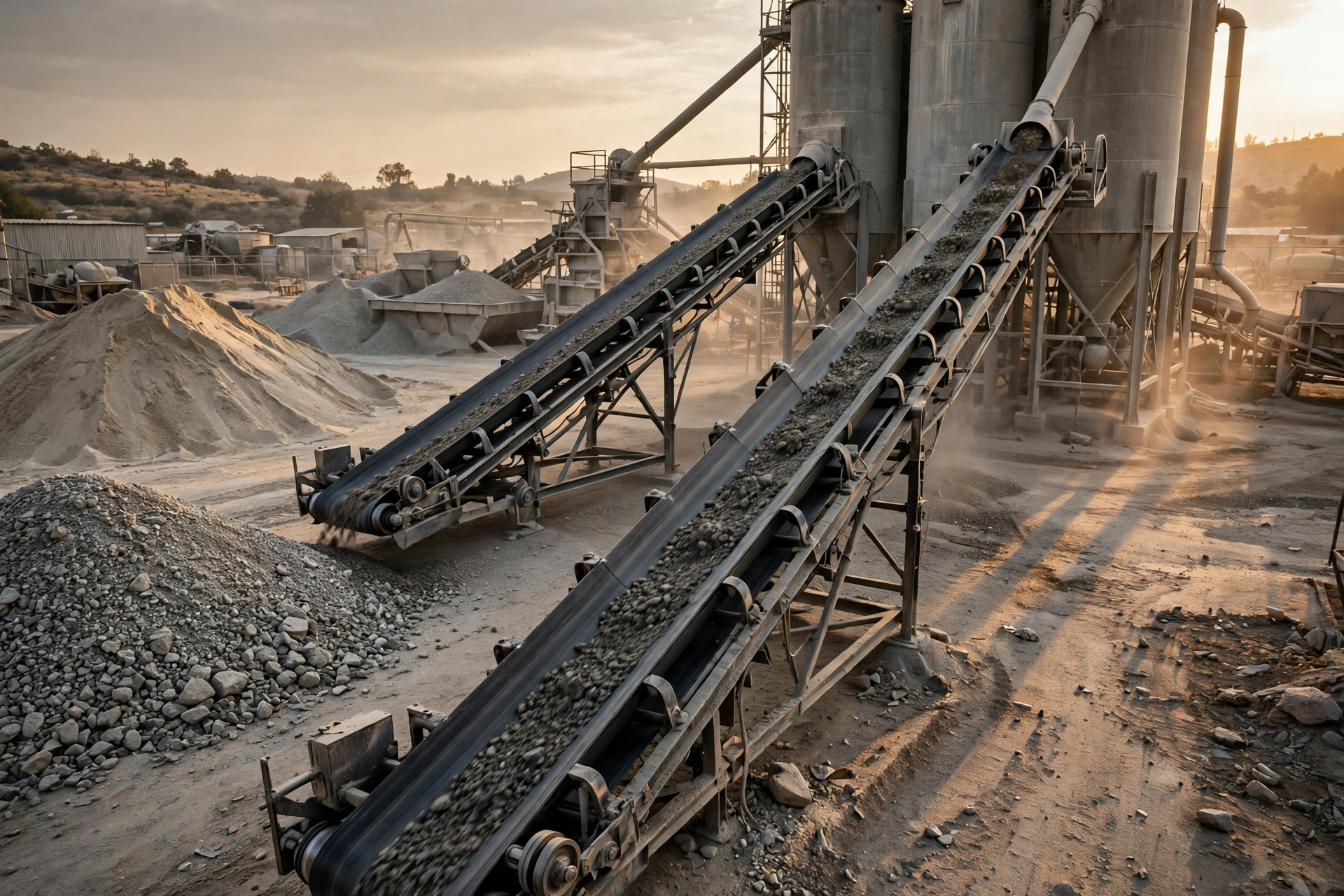
Aggregate is the heaviest part of the load by weight and the most distributed by motor count. A typical plant runs three aggregate bins, each with a weighing conveyor or a belt feeder of 7.5–11 kW, feeding an inclined belt conveyor of 11–15 kW that lifts stone and sand to the mixer. The inclined belt is the second-largest motor after the mixer, and it starts loaded if the belt was stopped mid-feed.
Conveyor motors are forgiving in one respect: they start in sequence, not simultaneously, and a plant operator can interlock them so that no two large conveyors start in the same second. They are unforgiving in another: a belt full of wet aggregate after rain draws measurably more starting current than the same belt running dry, and a plant in a wet climate should be sized for the wet belt, not the dry one.
Cement, water and admixtures: screws, pumps and dosing
Cement arrives through a screw conveyor of 7.5–11 kW, driven from the silo to the mixer, and the silo itself carries a filter, a level indicator and sometimes a fluidisation blower. Water is metered by a pump of 3–7.5 kW. Admixture dosing uses small metering pumps of 0.5–1.5 kW each, but there are usually three or four of them — retarder, plasticiser, air entrainer, accelerator — and they run on precision dosing, which means they need clean voltage and a stable frequency. A generator that hunts under load will not stop the admixture pumps, but it will make their dosing drift, and dosing drift shows up weeks later as a failed strength test.
Air, control and the loads people forget
The air compressor, usually 11–15 kW, powers every pneumatic gate and cylinder in the plant: bin gates, the mixer discharge door, the cement screw air slides. Without air, the plant cannot batch at all, and the compressor is a motor that starts under load every time its receiver pressure drops. The control system — PLC, batching computer, weighbridge, printer, office and lighting — draws only 5–10 kW, but it is the load that must never see a voltage dip, because a PLC that reboots mid-batch loses the batch record and the mix design in progress.
Add the numbers from a real plant and the picture is concrete. INNOTECH-PRO’s worked example for a mid-size plant lists a 55 kW mixer, three 11 kW conveyors, a 15 kW compressor and 10 kW of batchers and controls — about 115 kW in total, with starting peaks of 200–300 kW when the mixer, conveyors and compressor start together. That gap between 115 kW running and 300 kW starting is the whole sizing problem in one line.
Sizing by Plant Capacity: The kVA Table
The most reliable sizing figures for batching plants do not come from a formula. They come from the plant manufacturers, who publish the generator requirement for each model alongside the capacity. Constmach publishes a generator requirement for every batching plant it sells, and the pattern across ten models is consistent enough to use as a sizing table.
| Plant model | Capacity | Generator required |
|---|---|---|
| Mobicom 30 | 30 m³/h | 70 kVA |
| Mobicom 45 | 45 m³/h | 80 kVA |
| Mobile 30 | 30 m³/h | 80 kVA |
| Mobile 60 | 60 m³/h | 110 kVA |
| Compact 60 | 60 m³/h | 125 kVA |
| Mobile 100 | 100 m³/h | 200 kVA |
| Stationary 60 | 60 m³/h | 200 kVA |
| Mobile 120 | 120 m³/h | 300 kVA |
| Stationary 120 | 120 m³/h | 300 kVA |
| Stationary 160 | 160 m³/h | 350 kVA |
Three things stand out in that table. First, the generator grows roughly in step with capacity: about 2–2.5 kVA per m³/h of plant capacity. Second, a stationary plant of the same capacity needs a larger generator than a mobile one — the Stationary 60 needs 200 kVA where the Mobile 60 needs 110 kVA — because stationary plants carry larger mixers, more aggregate bins and heavier conveying. Third, the smallest plants are the most generator-efficient: a 30 m³/h mobile plant runs on 70–80 kVA, which is a set small enough to tow behind the plant itself.
Mobile plants: the generator is part of the package
For a mobile batching plant, the generator is not an accessory. It is part of the plant package, listed on the same specification sheet as the mixer and the conveyor. Constmach’s mobile models ship with a stated generator requirement — 80 kVA for the Mobile 30, 110 kVA for the Mobile 60, 200 kVA for the Mobile 100, 300 kVA for the Mobile 120 — and the plant is designed to start producing while permanent utilities are still being installed. That is the normal condition for a mobile plant: it arrives on a highway job or a dam site with no grid connection at all, and the generator is the prime power source, running eight to twelve hours a day for months.
Prime duty changes the rating decision. A set bought for standby duty at 200 kVA is rated for 200 hours a year; the same frame in prime rating delivers about 180–185 kVA continuously. Buyers who size a mobile plant’s generator from the standby figure and then run it twelve hours a day, six days a week, will overload the set within the first month. The difference between standby and prime ratings is the first thing to settle before the kVA figure is even discussed, and it is worth 9–10% of the set’s capacity.
Why installed kW and generator kVA are never the same number
The Mobile 120 carries about 205 kW of installed motors and needs a 300 kVA generator. The ratio — roughly 1.5 kVA of generator per kW of installed motor — is not waste. It is the margin for starting current, for power factor, and for the fact that a generator’s alternator delivers its rated kVA only at a power factor of 0.8, while a plant full of induction motors runs at a power factor of 0.75–0.8 on a good day and worse when lightly loaded.
A buyer who adds up the motor nameplates and buys a generator of the same kVA has made the most common sizing mistake in the industry. The motors never all run at once, but the ones that do run start at five to seven times their rated current, and the generator must absorb that transient without its voltage dipping far enough to drop out a contactor. The generator sizing guide works through the same calculation for a general load; the batching plant is simply the case where the starting transient is the largest single item in the calculation.
The Mixer Starting Surge: Why the Biggest Motor Decides the Set
If the load list is the map, the mixer start is the mountain on it. Everything else in the sizing calculation is a refinement; the mixer start is the decision.
What a mixer motor draws at start
A 45–75 kW planetary mixer started with a loaded mix draws five to seven times its rated power, according to INNOTECH-PRO’s measurements on batching plants. A 55 kW mixer therefore demands 275–385 kW for the first two or three seconds of its start — more than the entire running load of the plant. A twin-shaft mixer is no kinder: the two shafts, the arms and the liners must break the mix loose from rest, and a mix that has sat in the mixer for even a few minutes has begun to stiffen, raising the breakaway torque further.
The consequence is direct. A generator sized for the running load alone will start the mixer on an empty drum and fail on a loaded one. The failure is not subtle: the voltage dips, the mixer contactor drops out, the motor stalls, and the plant operator is left with a mixer full of concrete and a set that has tripped on overload. Every batching-plant generator specification should be checked against one question — can this set start the mixer, loaded, from cold, with the conveyors already running?
DOL, star-delta, soft starter and VFD — what each costs the generator
The starting method is the cheapest way to shrink the generator, and the most often overlooked. A direct-on-line (DOL) start draws six to seven times rated current. A star-delta start cuts that to roughly a third, but it also cuts the starting torque to a third — and a loaded mixer needs its torque. A soft starter ramps the voltage and holds the current to three to four times rated, which is the usual compromise on a batching plant: the mixer still starts reliably, and the generator sees a transient it can absorb.
A variable-frequency drive is the best technical answer and the most expensive one. It starts the mixer at full torque with barely more than rated current, and it lets the operator run the mixer at reduced speed for cleaning and inspection. It also introduces harmonics, which a generator alternator tolerates less well than a grid supply does, and it costs more than the soft starter it replaces. For a plant that starts its mixer twenty times a day, the soft starter is usually the right answer; for a plant that runs an RCC mixer on a dam job, where every start is a full-load start, the VFD earns its price. The trade-offs between starting methods are covered in detail in the motor starting guide; the batching-plant point is simpler — never specify the generator before the starting method is decided, because the starting method decides the generator.
Worked example: the 120 m³/h plant
Take the Mobile 120 as the worked example. Installed motors total about 205 kW. The mixer is 55–75 kW, the inclined belt 15 kW, three aggregate conveyors 11 kW each, the cement screw 11 kW, the compressor 15 kW, water and admixture pumps 7 kW, controls 10 kW. Running load with the plant at full production is roughly 130–150 kW, or 160–185 kVA at a power factor of 0.8.
Now start the mixer, loaded, on a DOL starter, with the conveyors already running: 55 kW × 6 = 330 kW of transient demand, plus 60–70 kW of running load, for a peak of about 400 kW — roughly 500 kVA of transient. A 300 kVA set cannot supply that on DOL. The same plant with a soft starter on the mixer draws about 55 × 3.5 = 190 kW of transient plus the running load, a peak of about 260 kW, or 325 kVA — and a 300 kVA set with a 10% overload allowance and a properly sized alternator will ride through it. That is why the manufacturer specifies 300 kVA for this plant, and why the specification assumes a soft starter on the mixer. Buy the 300 kVA set and a DOL starter, and the plant will trip on its first loaded start.
The 90-Minute Clock: What Happens When Power Fails Mid-Batch
Every other industrial load in this series has a damage window measured in hours or days. A batching plant has one measured in minutes, and it starts the moment water meets cement.
ASTM C94 and the 90-minute rule
Ready-mix concrete is sold under ASTM C94, and for decades that standard required discharge to be completed within 90 minutes of the mixing water meeting the cement and aggregates, or before the drum had turned 300 revolutions, whichever came first. Since the 2021 edition the buyer and the producer agree the limit between themselves and print it on the delivery ticket, but 90 minutes remains the number every plant plans around — and in hot weather the practical window is shorter, 60 minutes above 32°C and 45–60 minutes on a hot summer day.
The clock matters to the generator because the clock does not stop for a power failure. A batch mixed at 10:00 must be discharged by 11:30. If the grid fails at 10:15 and the generator does not start, the plant has 75 minutes to restore power, finish the batch, load the trucks and get them moving. If the generator starts in 10 seconds, the clock never becomes a problem. If the generator is a manual-start set and the operator is on the other side of the yard, the clock is already half gone.
A full mixer sets in one to two hours
The mixer itself is the worst place in the plant to lose power. A loaded mixer left stationary begins to set within one to two hours, according to INNOTECH-PRO’s field data on batching plants, and a mix that has begun to set cannot be restarted by simply switching the mixer back on — the hardened material must be chipped out by hand, the blades and liners inspected, and in the worst case the mixer arms replaced. A drum-type mixer is no better: if the drum stops with a full charge inside, the concrete sets in the drum, and removing it can mean jackhammers and, in the worst cases documented in US patent filings on mixer protection, destroying the drum itself.
The cost of a set mixer is not the concrete in it. A 2 m³ batch is worth roughly $240–300 of material at typical ready-mix prices. The cost is the mixer: a day of chipping, a set of replacement blades and liners, and a plant that cannot produce while the work is done. A single set mixer can cost more than a month of generator fuel. That arithmetic is the whole business case for the generator in one line.
The trucks in the yard and the cold joint on site
A power failure at the plant does not only stop the mixer. It stops the trucks. A ready-mix truck that has already been loaded and is waiting at the gate carries concrete whose 90-minute clock is running; if the plant cannot discharge the next loads, the trucks queue, the clocks expire, and loads are rejected at the site. A truck that is loaded and cannot move is a worse loss than a batch in the mixer, because the truck, the driver and the load are all idle at once.
And on the site itself, the consequence is the cold joint. Concrete already placed takes its initial set before the next load lands on it, and the two lifts never knit into one monolithic mass. They sit against each other as two separate placements with a seam between them. On a slab, that seam is a weakness the engineer must accept or the contractor must cut out. On a dam or a highway pavement, where RCC is placed continuously and the paver must not stop, a stoppage longer than the initial-set window produces a cold joint that has to be cut out — and the cutting, the rework and the delay are all charged to the day the power failed. The automatic transfer switch is what stands between the plant and that outcome: ten seconds from grid failure to generator power, and the batch clock never notices.
Three Plants, Three Outages
Case 1: The highway camp in Texas — the batch plant that is the grid
A civil contractor building a highway segment in a semi-remote area of Texas needed 24-hour power for a site office, a batch plant and a small workers’ camp. There was no grid connection to fail; the generator was the grid, running as prime power for the whole job. The batch plant was a mobile 60–100 m³/h unit, and its generator — 110–200 kVA depending on the plant — ran ten to twelve hours a day, six days a week, carrying the mixer, the conveyors and the compressor through every start of the shift.
The lesson from that camp is about duty, not size. A standby-rated set would have carried the load on paper and failed in the field, because standby rating allows 200 hours a year and the camp needed more than 3,000. The contractor’s set was specified in prime rating, serviced on an hours-based schedule, and it finished the job. The same plant, the same loads, the same kVA — and the rating decision was the difference between a set that lasted the job and a set that did not last the month.
Case 2: Norgaard Ready-Mix, Merritt — what a stopped plant costs
Not every plant stoppage is a power failure, but every stoppage costs the same way. In January 2013 the Norgaard Ready-Mix batch plant on Nicola Avenue in Merritt, British Columbia, caught fire — a welder’s torch, according to the city fire chief — and the plant was expected to be closed for about a month while the damage was repaired. Fifteen firefighters fought the blaze for four hours. The plant’s customers, the contractors pouring foundations and slabs around Merritt in the middle of winter, had to find concrete elsewhere or wait.
A month of closure is the extreme end of the scale, and it was a fire, not an outage. But it shows the shape of the cost: a batching plant does not lose an hour of production when it stops. It loses its customers’ pours, its trucks’ schedules and its place in the week’s programme. A power failure that stops a plant for a day costs a day of pours; a power failure that sets a mixer costs a day of pours plus a day of chipping. The generator is cheap insurance against both, and the premium is measured in litres of diesel, not in weeks of closure.
Case 3: Worked example — the 120 m³/h stationary plant in Lagos
Take a 120 m³/h stationary plant outside Lagos, Nigeria, running a 300 kVA standby set with a 1,000-litre day tank. The grid in the industrial area fails two or three times a week, usually for one to three hours. Each failure follows the same script: the automatic transfer switch starts the set in ten seconds, the plant keeps batching, and the only cost is diesel.
Run the numbers for a ten-hour production day. The 300 kVA set burns roughly 55–60 litres an hour at 75% load, so a ten-hour day costs 550–600 litres — about $550–600 at a dollar a litre, or $4.60–5.00 per cubic metre of concrete produced at 120 m³/h. Against that, the cost of a single failed day: twelve truckloads rejected or delayed, a mixer that needs chipping, and a pour that must be rescheduled. At $120 a cubic metre, one lost day of 600 m³ is $72,000 of concrete not sold, before the rework.
Now run the numbers the other way — the plant without a generator. A two-hour outage at 11:00 stops the mixer with a 2 m³ batch inside, strands four loaded trucks in the yard, and leaves a slab half-poured on a site 40 minutes away. The batch in the mixer is $240 of material and a day of chipping. The four truckloads are 32 m³, close to $3,800, rejected because their 90-minute clocks expired in the queue. The half-poured slab is a cold joint that the engineer may reject outright. One outage, one afternoon, roughly $4,000 of direct loss and a customer who orders from the next plant next time. The 300 kVA set pays for its diesel for the whole year on that single afternoon.
Fuel, Autonomy, Placement and the Running Cost
Sizing the generator answers the kVA question. Running the plant answers the next three: how much diesel, how big a tank, and where the set sits in a yard full of dust.
How much fuel a shift burns
Fuel consumption follows load, and a batching plant’s load is steadier than it looks — the mixer and conveyors run in a repeating cycle, and the average load over a shift settles at 60–75% of the set’s rating. The table below uses typical consumption figures for modern turbocharged sets at 75% load; the 500 kVA figure is the Cummins C500D5 datasheet value of 93.2 litres an hour at full prime load.
| Generator size | Typical fuel use at 75% load | 10-hour shift | Cost at $1.00/L |
|---|---|---|---|
| 80 kVA | ~15 L/h | ~150 L | ~$150 |
| 125 kVA | ~22 L/h | ~220 L | ~$220 |
| 200 kVA | ~38 L/h | ~380 L | ~$380 |
| 300 kVA | ~55 L/h | ~550 L | ~$550 |
| 350 kVA | ~65 L/h | ~650 L | ~$650 |
At $1.00 a litre — a reasonable planning figure for bulk diesel in most export markets, though the local price varies widely — a 300 kVA set costs about $550 a day to run a 120 m³/h plant. Spread over 1,200 m³ of concrete, that is less than $0.50 per cubic metre. Diesel is the cheapest part of the batching operation. Cement costs roughly ten times as much per cubic metre, and a rejected load costs a hundred times as much.
Tank sizing: the 8-hour, 24-hour and 72-hour question
A batching plant’s fuel autonomy is decided by the working pattern, not by a standard. A plant with a reliable grid and a standby set needs eight hours — one full shift — so that a daytime outage never stops production. A plant on prime power, or a plant in an area where the grid fails for a day at a time, needs 24 hours, which for a 300 kVA set means 1,300–1,400 litres. A plant that must keep pouring through a multi-day outage — a dam job, a highway pour, a plant in a region with scheduled load shedding — needs 72 hours, which is 4,000 litres for the same set, and at that volume the question becomes a bulk tank with a transfer pump rather than a bigger day tank.
Fuel stored for months goes stale, and a standby set that runs twice a month will sit on the same diesel for a season. Diesel fuel ageing — water, microbes and oxidation in a tank that rarely turns over — is the quietest cause of generator failure on a batching plant, because the set that fails to start is the set whose fuel has been sitting since the last outage. Fuel polishing and a six-monthly test are cheaper than a failed start on the day the grid goes down.
Dust, heat and where the set sits
A batching plant is one of the dustiest places a generator can work. Cement dust is fine, alkaline and abrasive; it coats radiators, clogs air filters and settles on alternator windings. A set installed downwind of the cement silo will need its air filter changed twice as often as the same set in a clean yard, and its radiator washed weekly rather than monthly. The practical answer is placement: put the set upwind of the silo and the aggregate stockpiles, on a concrete plinth, with the radiator facing away from the dust source, and fit a pre-cleaner on the air intake if the plant runs in a dry, windy climate.
Heat is the second placement problem. A batching plant in the Gulf or in West Africa works in 45–50°C ambient, and a generator rated at 40°C loses roughly 3% of its output for every 10°C above that — so a 300 kVA set in 50°C air is a 290 kVA set before the first batch is mixed. The cement plant article works through the same derating for kiln-side installations; the batching-plant version is simpler, because the set can usually be shaded and the radiator given clear air. What it cannot be given is a corner behind the silo where the hot air recirculates.
What a kVA costs per cubic metre
The honest way to judge a batching-plant generator is cost per cubic metre of concrete produced. A 300 kVA set at $550 a day, producing 1,200 m³, costs $0.46 per cubic metre. A 200 kVA set at $380 a day, producing 800 m³, costs $0.48. An 80 kVA set at $150 a day, producing 300 m³, costs $0.50. The figures barely move, because the fuel follows the production. The expensive decision is not the size of the set. It is the day the set is not there.
Frequently Asked Questions
What size generator does a concrete batching plant need?
A 30 m³/h mobile plant needs 70–80 kVA, a 60 m³/h plant needs 110–125 kVA, a 100 m³/h plant needs 200 kVA, and a 120–160 m³/h stationary plant needs 300–350 kVA. These are the generator requirements published by Constmach for its own plant models. The mixer motor and its starting method usually decide the final figure, so confirm the mixer starting arrangement before ordering the set.
Do concrete batching plants need a backup generator?
Yes, unless the plant sits on a grid that never fails. A batching plant loses its product, not just its production, when power fails: concrete in the mixer sets within one to two hours, loaded trucks expire their 90-minute discharge window, and a half-poured slab becomes a cold joint. A plant with a generator keeps batching through an outage; a plant without one loses the batch, the trucks and often the customer.
How long can a concrete batching plant run on a generator?
As long as the fuel lasts. A 300 kVA set burns roughly 55 litres an hour at 75% load, so a 1,000-litre day tank gives about 18 hours and a 4,000-litre bulk tank gives about 72 hours. The practical limit is fuel logistics, not the generator: a set in prime rating can run indefinitely with servicing every 250–500 hours, while a standby-rated set is limited to about 200 hours a year.
What happens to concrete during a power outage in a batching plant?
Concrete in the mixer begins to set within one to two hours of the mixer stopping, and a batch that has begun to set must be chipped out by hand. Concrete already loaded in trucks must be discharged within 90 minutes of batching under ASTM C94, so trucks queued at a stopped plant lose their loads. Concrete already placed on site takes its initial set before the next load arrives, leaving a cold joint between the two lifts.
Can a diesel generator power a concrete batching plant?
Yes. Diesel generators are the standard power source for mobile batching plants, which are sold with a published generator requirement, and for stationary plants in areas with unreliable grids. A 120 m³/h plant needs a 300 kVA set, the mixer should be started through a soft starter or VFD, and the set should be sized in prime rating if it will run more than 200 hours a year.
Specification Checklist
Before ordering a generator for a batching plant, confirm each line below in writing — from the plant manufacturer, the generator supplier, or both.
- Plant capacity and model: m³/h, mobile or stationary, mixer type and size — the generator requirement follows the plant model, not a rule of thumb.
- Mixer motor and starting method: kW, DOL or soft starter or VFD — the starting method decides the generator size.
- Running and starting load: total installed kW, running kW, and the calculated starting peak in kVA.
- Rating: standby or prime — prime if the set will run more than 200 hours a year, which every mobile plant will.
- Transfer switch: automatic, with a 10-second start, tested weekly under load.
- Fuel autonomy: 8, 24 or 72 hours, with tank size, transfer pump and a fuel-testing schedule.
- Placement: upwind of the cement silo, shaded, clear radiator air, pre-cleaner on the intake in dusty climates.
- Maintenance: hours-based service intervals, air-filter and radiator cleaning schedule for a dusty yard, and a generator maintenance schedule the operator actually follows.
- Monitoring: remote monitoring of running hours, fuel level and fault codes, so a plant that stops at 2 a.m. is known about at 2 a.m.
A batching plant with the right generator is a plant that never has to explain a cold joint to a customer. The set costs less than half a dollar per cubic metre of concrete. The day without it costs a great deal more. To size a set for a specific plant, contact PAVO with the plant model, the mixer motor rating and the starting method, and the specification can be confirmed before the order is placed.