

What Size Generator Does a Flour Mill Need? | PAVO
A flour mill does not just lose production when the grid fails. It loses the tempered wheat sitting in the bins, the stock choking the rolls and sifters, and hours of cleaning to get the line moving again.
What size generator does a flour mill need? A 10–30 tonne-per-day village mill needs a 60–125 kVA standby set, a 100–300 tonne-per-day commercial mill 250–800 kVA, and a 500 tonne-per-day plant 1,250–2,000 kVA — sized for the roller mills, sifters and pneumatic conveying, not the whole site.
Contents:
- Why a Flour Mill Is Not Just Another Factory Load
- What the Generator Has to Power
- Sizing by Mill Capacity
- The Conditioning Clock: What Happens to Tempered Wheat
- What Happens in the First 60 Seconds
- Three Mills, Three Lessons
- Frequently Asked Questions
- Specification Checklist
Why a Flour Mill Is Not Just Another Factory Load
Wheat is the most widely grown food grain on earth, and almost every tonne of it passes through a mill before it becomes bread, noodles or biscuits. The FAO put world wheat production in 2024/25 at 792.2 million tonnes, the second largest harvest on record, and forecast 2025 production at 796 million tonnes. Every tonne of that wheat has to be cleaned, conditioned, broken, ground, sifted and bagged, and the whole sequence runs on electricity, hour after hour, in a building full of combustible dust. A flour mill is not a warehouse with a few motors. It is a continuous process with a timed raw material, a line that cannot be stopped halfway, and an atmosphere that can explode.
The first difference from an ordinary factory is that the raw material is on a clock before it ever reaches a roll. Wheat is tempered — dampened and rested — so the bran toughens and the endosperm softens, and the mill can separate them cleanly. Hard wheat is tempered for 18–24 hours, soft wheat for 8–12 hours, to a target moisture of 15.5–16.5%. That tempering is a timed chemical process, not storage. Wheat that sits too long after tempering heats, sprouts and grows mould. A mill that loses power with 200 tonnes of tempered wheat in its bins does not just lose a shift. It loses the batch, and the next batch cannot start until the bins are emptied and cleaned.
The second difference is that the milling line cannot be stopped halfway. A modern roller mill is a sequence of 12–16 grinding passages — four break rolls, then reduction rolls — each feeding a plansifter that separates flour, middlings and bran and returns the middlings for another pass. Stock moves between the passages on pneumatic conveying, carried by air from high-pressure fans. When the power fails, the fans stop first and the stock drops out of the air wherever it happens to be: in the pipes, in the sifters, in the roll gaps. The rolls stop with flour packed between them. Restarting is not a matter of pressing a button. The line has to be emptied by hand, the sifter cloths checked for blinding, the rolls cleaned, and the passages restarted one at a time. A mill that stops for ten minutes loses two hours. A mill that stops for a day loses the day and part of the next.
The third difference is the dust. Flour dust is a combustible dust, and the milling building is classified for it. Wheat flour has a minimum ignition energy above 30 mJ, a minimum ignition temperature of 400°C, a minimum explosible concentration of 60 g/m³, a maximum explosion pressure of 8 bar and a Kst value of 125 bar·m/s, placing it in explosion class St1. Under IEC 60079-10-2, the inside of mills, elevator legs, filters and conveyors is Zone 20, the space around transfer points and intakes is Zone 21, and the surrounding area is Zone 22. The historical record is blunt: in the dust-explosion event data compiled for flour processing plants, mills accounted for 51 events, grinders 47 and filters 43. The extraction fans and the dust collection system are therefore not a comfort item. They are the system that keeps the building below the explosible concentration, and they have to keep running — or be safely shut down — when the power fails. A generator that powers the rolls but not the extraction fans has solved the smaller problem and left the larger one running.
The fourth difference is the energy intensity. Milling is one of the most power-hungry food processes there is. A Nigerian study of a large-scale flour milling factory measured 48.8–96.7 kWh per tonne of milled product, averaging 72.29 kWh/t. Miller Magazine puts 50–55 kWh/t as acceptable at an ideal installation. At a 150 tonne-per-day mill, that is 7,500–10,800 kWh a day — the daily consumption of a small town, drawn through one switchboard, for sixteen to twenty hours a day, six or seven days a week. The mill’s electricity bill is its second cost after wheat. In countries where the grid is unreliable, the generator is not a standby asset. It is the difference between milling and not milling.
That combination is the whole subject of this article. Sizing a generator for a flour mill is not a matter of adding up the nameplate and buying the biggest set in the catalogue. It is a matter of deciding which loads must never stop, which loads can wait, how long the tempered wheat can be left without power, and how the line is restarted without choking it a second time.
The raw material is on a clock
Tempering is the step most outsiders miss, and it is the step that sets the damage window. Wheat arrives at the mill at 11–13% moisture. The dampener adds water to bring it to 15.5–16.5%, and the wheat then rests in tempering bins while the moisture migrates from the surface into the kernel. Hard wheat needs 18–24 hours; soft wheat needs 8–12. The bran becomes tough and leathery, the endosperm becomes friable, and the mill can peel one from the other instead of shattering both.
A power cut does not stop tempering. It stops the things that manage it. The dampener stops, the bin discharge stops, the aspiration that keeps the bins ventilated stops, and the wheat sits. In a cool climate, tempered wheat held for an extra 12 hours is usually recoverable, with a small loss of extraction. In a hot climate — a mill in northern Nigeria at 38°C, or in Punjab in June — tempered wheat held for 24 hours starts to heat. Microbial activity raises the temperature, the grain sweats, and the batch develops the sour smell that millers recognise at once. At that point the wheat is not flour. It is animal feed, sold at a third of the price, if it can be sold at all.
The line chokes when it stops
The second clock is the line itself. A roller mill moves stock pneumatically, and pneumatic conveying only works while the air moves. The moment the fans stop, stock falls out of suspension and settles in the horizontal runs of pipe, in the sifter boxes and in the roll gaps. The first break roll in the Czech study that measured grinding-roll power processed 3,006.72 kg/h — three tonnes an hour through one pair of rolls. When that flow stops mid-passage, the stock does not vanish. It sits, compacts and cakes.
Restarting a choked mill is manual work. The pipes are opened and rodded through. The sifter boxes are opened and the cloths brushed or replaced. The rolls are turned by hand to clear packed flour from the gap. A mill that stops cleanly — rolls empty, sifters empty, pipes purged — restarts in 20–30 minutes. A mill that stops mid-grind takes two to four hours to clean out, and the first hour of production after restart is off-specification flour that has to be reworked or downgraded. The cost of a ten-second outage is therefore not ten seconds of lost production. It is the clean-out, the restart and the downgraded flour.
The dust is the hazard
The third clock is the dust, and it is the one that can hurt people. Flour dust suspended in air at 60 g/m³ or more will explode if it finds an ignition source, and the building is full of both: bearings that run hot, motors, static, and the friction of the rolls themselves. The extraction system holds the airborne concentration below the explosible limit during normal operation, and the dust collection filters hold the fine fraction that the sifters release.
When the power fails, the extraction stops with it. Dust that was airborne settles on beams, ledges and floors. On restart, the first vibration of the line shakes that settled dust back into the air, and the first hot bearing or electrical arc can ignite it. The secondary explosion — the settled dust burning through the building — is the mechanism that has destroyed mills. That is why the generator load list for a flour mill must include the extraction fans and the dust collection system, and why the restart procedure after any outage starts with housekeeping and inspection, not with the start button. A set that powers the rolls and leaves the extraction dead has bought production and sold safety.
What the Generator Has to Power
A flour mill’s load list divides into four tiers, and the tiers decide the size of the set. The first tier is the load that must never stop: extraction and dust collection, the tempering-bin discharge, the laboratory and the emergency lighting. The second tier is the load that must restart within minutes: the roller mills, the sifters and the pneumatic conveying. The third tier is the load that can wait an hour: packing, bran handling and the warehouse. The fourth tier is the load that should never be on the generator at all: the office air conditioning, the staff canteen and the non-essential lighting.
The table below is the load split for a 150 tonne-per-day commercial mill, measured from the connected load of each section. It is the working basis for the sizing table in the next section, and it shows why a flour mill needs a larger set than its running load suggests: the connected load is 520 kW, the diversified running load is about 380 kW, and the set still has to start the largest roll motor against a full line.
| Section | Equipment | Connected load (kW) |
|---|---|---|
| Cleaning | Separator, destoner, scourer, aspirator | 45 |
| Conditioning | Dampener, tempering bins, conveying | 25 |
| Break rolls | Four break passages, 1B–4B | 120 |
| Reduction rolls | Six to eight reduction passages | 110 |
| Sifting and purifying | Plansifters, purifiers, bran finishers | 55 |
| Pneumatic conveying | High-pressure fans, airlocks | 90 |
| Packing and bran | Packing lines, bran handling, conveyors | 40 |
| Utilities | Lighting, laboratory, offices, water, compressed air | 35 |
| Total connected | 520 |
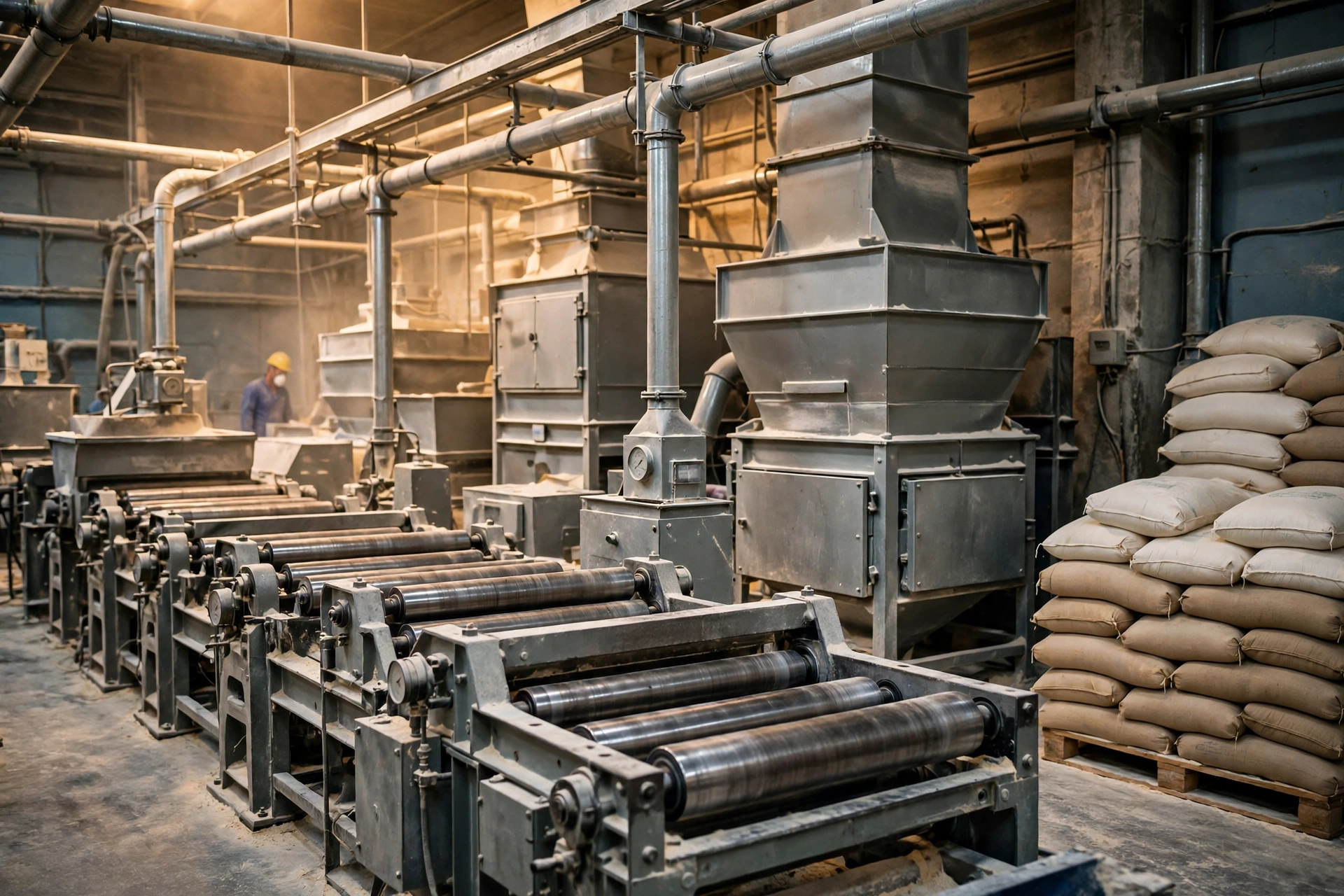
The single largest consumer is the grinding itself. The Czech study that measured individual grinding rolls found specific power consumption of 4.955–24.26 kWh/t per passage, with the first break roll the hungriest, and roll motors of 7.5–45 kW per passage. Fifteen passages at an average of 15 kW is 225 kW of grinding load alone — and every one of those motors is a direct-on-line start unless a soft starter or variable-speed drive has been fitted. That is the motor starting problem in its purest form, and it is why the set is sized on starting kVA, not running kW.
Pneumatic conveying is the second-largest consumer and the most commonly underestimated. The fans that carry stock between passages run continuously at 60–70% of the mill’s total fan load, and they cannot be staged: if the conveying stops, the line stops. A mill that sizes its set for the rolls and forgets the 90 kW of fans will trip the set on the first restart, because the fans and the rolls start together and the combined inrush is more than the alternator can hold.
Cleaning and conditioning
Cleaning is the smallest section on the load list and the most important to keep running. The separator, destoner, scourer and aspirator remove stones, metal, light grain and dust before the wheat reaches the rolls, and a stone that reaches a break roll will damage a £10,000 roll surface in a second. The dampener and the tempering bins are the conditioning section, and their load is small — 25 kW — but their failure window is the longest in the mill. Both sections run at the start of the process, so they are the first loads the generator picks up and the last loads it drops.
The milling line
The milling line is the load the set is bought for: break rolls, reduction rolls, plansifters and purifiers. The four break rolls open the kernel and scrape the endosperm from the bran. The reduction rolls grind the middlings finer, passage by passage, until the flour is fine enough to pass the sifter cloths. The plansifters separate the streams and return the middlings for another pass. Each passage has its own motor, each motor starts direct-on-line, and the passages are started in sequence — break rolls first, then reductions, then sifters — so the inrush is spread over two to three minutes instead of arriving in one step. A mill that starts all fifteen passages at once needs a set 30–40% larger than a mill that starts them in sequence, for the same production.
Packing, storage and utilities
Packing is the section most often left off the generator, and the decision is usually correct. The packing lines, the bran handling and the warehouse conveyors can wait an hour without loss, and dropping them saves 40–60 kW of set capacity. The laboratory cannot wait: the moisture meter, the farinograph and the ash test are the instruments that tell the miller whether the flour coming off the line is on specification, and a mill that restarts blind will produce an hour of off-spec flour before anyone notices. The extraction fans cannot wait either, for the reasons in the previous section. Utilities — water, compressed air for the airlocks, emergency lighting — are small loads with large consequences, and they stay on the essential board.
Sizing by Mill Capacity
Sizing starts from the mill’s capacity in tonnes per day and the energy intensity of 50–72 kWh per tonne. The arithmetic is simple: a mill that processes 150 tonnes a day at 60 kWh/t uses 9,000 kWh a day, and over a 16-hour working day that is an average load of 560 kW. The set is then sized for the running load plus the starting allowance of the largest motor, with a 20–25% margin for voltage dip, and the result is the table below. The generator sizing guide gives the full method; this table is the shortcut for flour mills specifically.
| Mill capacity (t/day) | Typical connected load | Running load | Recommended standby set |
|---|---|---|---|
| 10–30 (village mill) | 60–120 kW | 45–90 kW | 60–125 kVA |
| 50–100 (small commercial) | 150–250 kW | 110–190 kW | 200–315 kVA |
| 100–300 (commercial) | 300–700 kW | 220–520 kW | 400–800 kVA |
| 500 (large mill) | 1,000–1,500 kW | 750–1,100 kW | 1,250–2,000 kVA |
| 1,000 (industrial mill) | 2,000–3,000 kW | 1,500–2,200 kW | 2,500–3,750 kVA |
Two things in that table surprise first-time buyers. The first is how fast the numbers grow: a mill that doubles its capacity from 150 to 300 tonnes a day needs roughly double the set, because milling energy scales with throughput and there is no economy of scale in grinding. The second is that the set is always larger than the running load suggests, because the largest single motor — a 45 kW break-roll motor starting direct-on-line — draws five to seven times its running current for a few seconds, and the alternator has to hold voltage through that dip or the contactors drop out and the whole line trips.
Village mills, 10–30 tonnes a day
A village mill is usually a single-storey building with a 10–30 tonne-per-day line: a cleaner, a dampener, two or three break rolls, two reduction rolls, a sifter and a packing station. Connected load is 60–120 kW, and a 60–125 kVA standby set covers it, usually a single open or silent set on a concrete plinth outside the mill. The duty is almost always standby — the grid is the normal supply and the set runs a few hours a week — so the standby and prime power ratings matter here: a standby-rated set is correct, and a prime-rated set would cost 10–15% more for capability the mill will never use. The failure mode at this size is not undersizing. It is fuel: a 125 kVA set at 60% load burns about 22 litres an hour, and a mill that runs it 12 hours a day uses 260 litres a day. A 1,000-litre day tank lasts four days. Mills that buy the set and forget the fuel contract run dry in the middle of the harvest week, every year.
Commercial mills, 100–300 tonnes a day
A commercial mill is a different machine. At 100–300 tonnes a day the line has 12–16 passages, pneumatic conveying throughout, and a packing hall, and the connected load is 300–700 kW. The recommended set is 400–800 kVA, and at this size the starting sequence becomes the design problem: the passages are started in groups, the fans are started first, and the largest roll motor is started last, so the alternator never sees more than one large inrush at a time. A mill in this band that starts everything at once will trip a set that is correctly sized on paper. The same mill that starts in sequence will run the same set at 70–80% load without a fault.
Duty at this size is often mixed. In Nigeria, Pakistan and Bangladesh, commercial mills run their sets for 8–16 hours a day during the dry season, when the grid is at its worst, and that is prime duty by any definition — unlimited hours, variable load, 70% average load factor. A standby-rated set run that way will follow the familiar pattern: acceptable for months, then rising oil consumption, then glazing, then a rebuild. The rating letters on the datasheet — ESP, PRP or COP — are worth more attention than the headline kVA figure.
Large mills, 500 tonnes a day and above
At 500 tonnes a day and above, the mill is an industrial plant: 1,000–1,500 kW connected, 750–1,100 kW running, and a set of 1,250–2,000 kVA — or two sets in parallel. Above 1,000 tonnes a day the recommendation is 2,500–3,750 kVA, and at that point the question is not one set or two, but how the load is split: two 1,250 kVA sets in parallel give the mill the ability to run one set at night for the tempering bins and the extraction, and both sets during the day for full production. The parallel set also gives the mill a maintenance window — one set can be serviced while the other carries the essential load — which a single set never can.
Large mills also buy differently. They buy on a load list, a starting sequence and a fuel plan, and they test the set at the factory under load before it ships. A 2,000 kVA set that has never been load-bank tested is a £200,000 gamble, and the mills that lose that gamble discover it at 2 a.m. on the first night of a grid failure, not in the test bay.
The Conditioning Clock: What Happens to Tempered Wheat
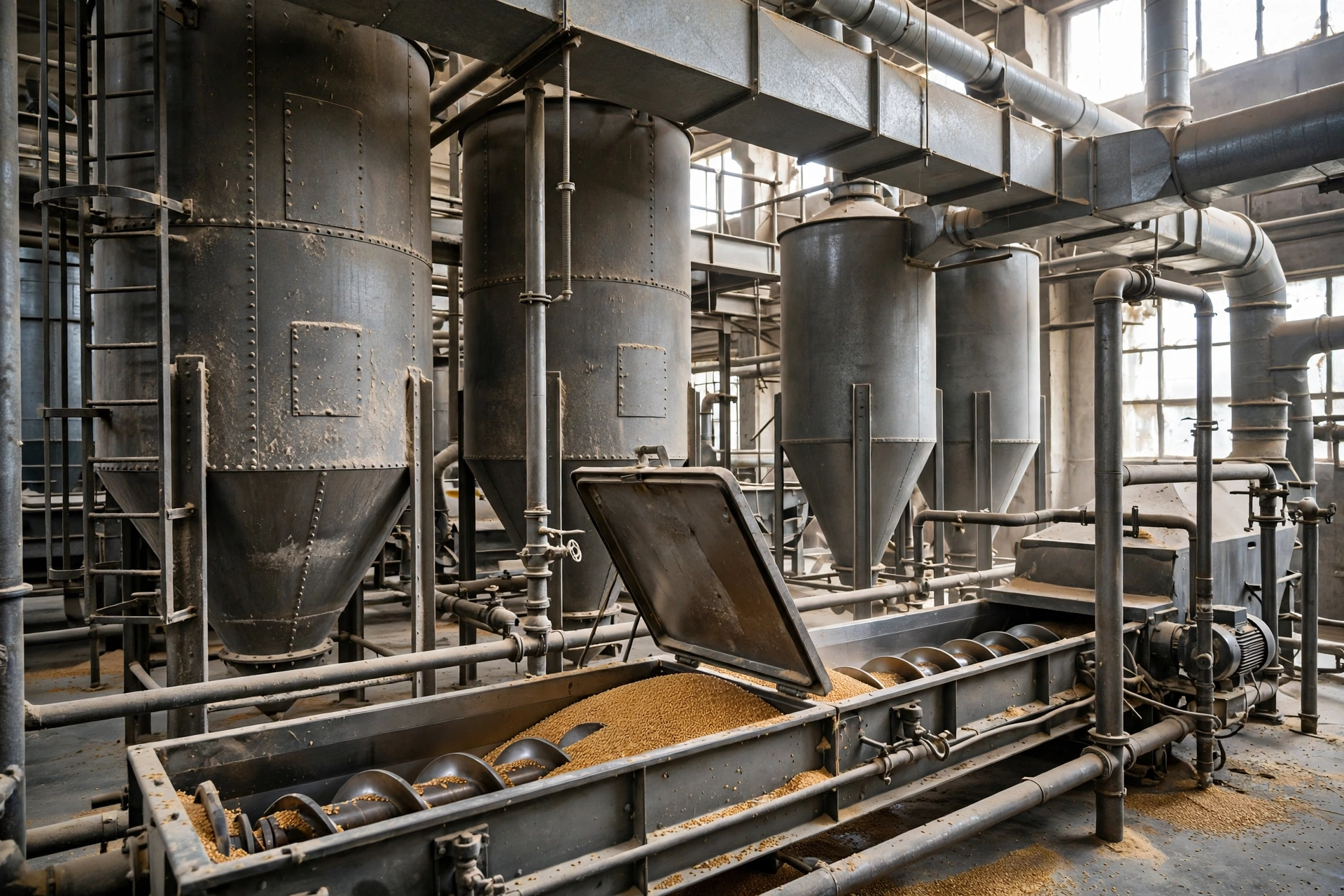
Tempering is the quiet step that decides whether a power cut costs a shift or costs a batch. Nothing about it looks urgent: wheat sits in a bin, water migrates into the kernel, and the mill waits. But the window is fixed, and the mill that does not know its own window will discover it the expensive way.
Tempering is a timed process
The purpose of tempering is mechanical. Dry wheat shatters in the break rolls: the bran breaks into small pieces that end up in the flour as specks, and the extraction falls. Tempered wheat behaves differently. The bran is tough and leathery, so it peels away in large flakes that the sifters can separate, and the endosperm is friable, so it grinds cleanly. The result is a higher extraction — 75–78% white flour from hard wheat, against 70–72% from untempered wheat — and a cleaner flour with a lower ash content. At a mill producing 150 tonnes a day, a 3% loss of extraction is 4.5 tonnes of flour a day, worth more than the electricity for the whole shift.
The timing depends on the wheat. Hard wheat, with its dense, glassy endosperm, needs 18–24 hours for the moisture to reach the centre of the kernel. Soft wheat, with its softer, more porous structure, needs 8–12 hours. The target is the same either way: 15.5–16.5% moisture, evenly distributed. The mill’s tempering bins are sized for that window — a mill that runs 150 tonnes a day holds 200–300 tonnes of tempered wheat in its bins at any moment, a full day and a half of production, turning over continuously.
What a blackout does to a batch
A power cut does not stop tempering, but it stops the mill from managing it. The dampener stops, so no new wheat is tempered. The bin discharge stops, so no tempered wheat reaches the rolls. The aspiration stops, so the bins are no longer ventilated. And the clock keeps running.
In a cool climate, tempered wheat held for an extra 12 hours is usually recoverable. The moisture continues to migrate, the kernel softens a little more than intended, and the extraction falls by 1–2%. The miller notices it in the flour — a slightly higher ash, a slightly lower yield — and moves on. In a hot climate the same delay is a different event. Tempered wheat at 35–38°C is a warm, damp, nutrient-rich mass, and microbial activity starts within hours. The temperature in the centre of the bin rises, the grain sweats, and the sour smell of fermentation appears. Held for 24 hours in those conditions, the batch is no longer milling wheat. It is feed wheat, worth a third of the price, and the mill has to empty the bins, clean them and start the tempering cycle again from dry wheat — a 24-hour delay on top of the outage itself.
The generator’s job here is small and specific. The tempering bins need 25 kW of conveying, discharge and aspiration — a fraction of the milling line — but they need it continuously, and they need it before the milling line restarts. A mill whose generator powers the rolls but not the conditioning section will restart the line and discover that the wheat waiting in the bins has already spoiled. The load list that puts conditioning on the non-essential board is the load list that costs a batch.
The same logic applies to the finished product. Flour is hygroscopic: it absorbs moisture from the air, and a packing hall without dehumidification in a humid climate will see bagged flour gain moisture and cake within days. The packing hall can wait an hour. It cannot wait a week. A mill that plans its fuel autonomy for 72 hours — the standard in this series — covers the packing hall as well as the line, because the flour that is milled on generator power still has to be packed, stored and shipped on generator power.
The same timed-raw-material problem appears in rice mills, where parboiling is a timed soak-steam-dry sequence, and in other food processing plants, where a batch in process cannot wait for the grid.
What Happens in the First 60 Seconds
The first minute of an outage decides the next four hours. The grid fails, the automatic transfer switch senses the loss of voltage, the generator starts, and the load is transferred. On paper the sequence takes 10 seconds: NFPA 110 Level 1 requires emergency power within 10 seconds, and a modern set with a pre-heated engine and a healthy battery will crank, reach speed and accept load inside that window. In a flour mill, the ten seconds are the easy part. The sixty seconds after them are the problem.
The transfer gap
The transfer gap is the ten seconds between grid failure and generator power, and in a flour mill it is long enough to stop everything. The rolls stop. The fans stop. The sifters stop. The stock drops out of the air. The mill does not need a UPS for the whole line — no battery can carry 500 kW of grinding load — but it does need the control system to survive the gap. The programmable logic controller, the load cells on the tempering bins, the moisture meter and the plant SCADA all need to ride through ten seconds without losing their state, or the mill restarts blind: the operator does not know how much wheat is in each bin, what moisture it is at, or which passages were running. A small UPS on the control panel, sized at 3–5 kVA, is the cheapest insurance in the mill, and it is the item most often left out of the quotation.
The transfer itself is a second decision. An open-transition switch breaks the grid connection before it makes the generator connection, and the mill sees a clean 10-second gap. A closed-transition switch parallels the generator with the grid for a fraction of a second, and the mill sees no gap at all — but it needs utility approval, synchronising protection and a switch that costs three times as much. Most flour mills use open transition, and most flour mills accept the ten-second gap, because the mill is a process that can be restarted. The mills that cannot accept it are the ones with a continuous process upstream — a mill that feeds a bakery line directly, or a mill whose tempering bins are full and whose clock is already running.
Motor starting on the mill floor
The starting sequence is where the set is won or lost. The largest single motor in a 150 tonne-per-day mill is a 45 kW break-roll motor, and started direct-on-line it draws five to seven times its running current — 225–315 kVA of inrush for a few seconds. The alternator has to hold voltage through that dip, or the contactors drop out, the control system faults, and the line trips before it has started. The answer is sequencing: fans first, then the smallest passages, then the break rolls one at a time, with 10–15 seconds between starts. The whole line is up in two to three minutes, and the alternator never sees more than one large inrush at a time.
Soft starters and variable-speed drives change the arithmetic. A soft starter on the break-roll motor cuts the inrush to two to three times running current, and a variable-speed drive on the pneumatic fans lets the mill ramp the conveying up slowly instead of slamming it on. A mill that fits soft starters to its four largest motors can run the same production on a set 15–20% smaller — or run the same set with a 20% margin instead of none. The drives cost money. The smaller set saves more.
Restart: the two-hour clean-out
The restart is the part of the outage that no datasheet mentions. When the set is running and the load is transferred, the mill does not resume production. It resumes cleaning. The pipes are opened and rodded through. The sifter boxes are opened and the cloths brushed. The rolls are turned by hand to clear packed flour from the gap. The extraction system is inspected for settled dust before the fans are restarted, because the first vibration of the line will shake that dust back into the air.
A mill that stops cleanly — rolls empty, sifters empty, pipes purged, because the operator had 30 seconds of warning and used it — restarts in 20–30 minutes. A mill that stops mid-grind takes two to four hours to clean out, and the first hour of production after restart is off-specification flour that has to be reworked or downgraded to feed. The difference between those two outcomes is not the generator. It is the shutdown procedure: a mill that trains its operators to purge the line on a grid-failure alarm, before the set even starts, loses half an hour. A mill that does not, loses half a day.
That is also why the generator’s fuel autonomy matters in hours, not in litres. A 500 kVA set at prime rating burns 93.2 litres an hour at full load — the Cummins C500D5 figure — and its 645-litre sub-base tank lasts 6.9 hours. At 75% load it burns 69.9 L/h and lasts 9.2 hours. At 50% load it burns 49.0 L/h and lasts 13.2 hours. A mill that needs 72 hours of autonomy at 75% load needs 5,033 litres in the bulk tank, plus a delivery contract that works on a Sunday. The table below is the same arithmetic for the three set sizes a flour mill is most likely to buy.
| Set size | Fuel at 75% load (L/h) | 24-hour fuel (L) | 72-hour fuel (L) |
|---|---|---|---|
| 125 kVA | 22 | 528 | 1,584 |
| 250 kVA | 40 | 960 | 2,880 |
| 500 kVA | 69.9 | 1,678 | 5,033 |
The quiet failure that follows the fuel plan is diesel fuel ageing: a mill that buys 5,000 litres for a 72-hour autonomy and then does not use it for a year has a tank of stale diesel: water in the bottom, microbes in the water, and a filter that blocks the first time the set runs under load. The fuel has to be tested, polished and turned over, or the autonomy on paper is not autonomy in practice.
Three Mills, Three Lessons
Case 1: Ibadan, Nigeria — the mill that runs on diesel
Eagle Flour Mills in Ibadan is one of the largest flour mills in Nigeria, and its energy record is a case study in what happens when the grid cannot be relied on. A 2022 energy study of the mill’s two milling lines measured the energy intensity of the milling process at 187.49 MJ per tonne in Mill A and 280.37 MJ per tonne in Mill B — milling was the most energy-intensive step in the whole plant, ahead of lighting, which consumed about 7% of the electrical energy supplied. The mill’s diesel generators produced 1.09–1.55 GWh a month across the five months studied, dwarfing the grid supply, which in one month delivered only 2,707 kWh. The gas plant, when it ran, supplied 77% of the energy and brought the energy cost down to N4,404 per tonne — the lowest figure in the study.
The lesson is not that the mill is badly run. It is that in Ibadan the diesel set is not a standby asset. It is the power supply, for weeks at a time, and it has to be specified, fuelled and maintained as prime power. A standby-rated set run at those hours would have failed within a year. The mill’s sets are prime-rated, serviced on hours rather than on the calendar, and fuelled from a bulk tank with a delivery contract — because a mill that mills 400 tonnes a day cannot stop for a fuel delivery that did not arrive.
Case 2: Faisalabad, Pakistan — the mill that sized for the wrong load
A 150 tonne-per-day roller mill in Faisalabad, in the Punjab wheat belt, bought a 500 kVA set on the strength of a load list that added up the running loads and added 20%. On paper the arithmetic was sound: 380 kW running load, 475 kVA at 0.8 power factor, a 500 kVA set with a small margin. On the first grid failure the set started, the transfer switch closed, and the operator started the line the way the mill had always started it on grid power: all passages at once. The alternator voltage collapsed, the contactors dropped out, and the whole line tripped before a single roll had reached speed.
The fix cost less than the mistake. The mill fitted soft starters to the four break-roll motors, rewrote the starting sequence so the fans started first and the passages started one at a time with 15 seconds between them, and added a 5 kVA UPS to the control panel so the PLC survived the transfer gap. The same 500 kVA set now carries the same mill at 70–75% load, and the line restarts in three minutes instead of tripping in three seconds. The set was never undersized. The starting sequence was.
Case 3: Kano, Nigeria — the small mill that could not afford to stop
A 30 tonne-per-day village mill outside Kano runs a 125 kVA silent set, and its story is the story of thousands of small mills across West Africa. The mill’s connected load is 95 kW, its running load is about 70 kW, and the set carries it at 60% load, burning about 22 litres an hour. A 12-hour milling day uses 260 litres, and the mill’s 1,000-litre day tank lasts four days. The miller buys diesel in 200-litre drums from a depot 40 km away, and the price — over N1,000 a litre since the subsidy withdrawal — is the largest single cost after wheat.
The mill’s lesson is about fuel logistics, not engineering. In the 2024 harvest season the depot ran dry for a week, the miller’s drums ran out on a Wednesday, and the mill stood idle for four days while 60 tonnes of tempered wheat sat in the bins and spoiled. The wheat was sold as feed at a third of the price. The miller now keeps a 5,000-litre bulk tank, tests the fuel every month, and orders when the tank reaches half — because the set that runs out of fuel is the same as the set that never started. A 125 kVA set is a small machine. Its fuel plan is not a small problem.
Frequently Asked Questions
What size generator does a flour mill need?
A 10–30 tonne-per-day village mill needs a 60–125 kVA standby set, a 100–300 tonne-per-day commercial mill 250–800 kVA, and a 500 tonne-per-day plant 1,250–2,000 kVA. The size follows the milling line — roller mills, sifters and pneumatic conveying — not the whole site, and the set must be sized on starting kVA, not running kW.
Do flour mills need a backup generator?
Yes, unless the mill is on a grid that never fails. A flour mill loses production, tempered wheat and hours of cleaning time on every outage, and a mill in a hot climate can lose a whole batch of tempered wheat in 24 hours. The generator is the difference between a ten-minute interruption and a lost day.
How long can a flour mill run on a generator?
As long as the fuel lasts. A 500 kVA set at 75% load burns 69.9 litres an hour, so a 645-litre sub-base tank lasts 9.2 hours and a 5,000-litre bulk tank lasts about 72 hours. The rating matters too: a standby-rated set is limited to 200 hours a year under ISO 8528-1, while a prime-rated set has no annual hour limit.
What happens to a flour mill during a power outage?
The rolls, sifters and pneumatic fans stop, stock drops out of the air and chokes the pipes and roll gaps, tempered wheat sits in the bins and starts to spoil, and the extraction fans stop, letting dust settle. Restart takes two to four hours of manual cleaning if the line stopped mid-grind, against 20–30 minutes if it stopped cleanly.
Can a diesel generator power a flour mill?
Yes. A diesel set can power the whole milling line, including the roller mills, sifters, pneumatic conveying and extraction fans, provided it is sized for the starting current of the largest roll motors and the passages are started in sequence. Mills from 30 to 1,000 tonnes a day run on diesel sets, and in parts of Nigeria, Pakistan and Bangladesh the set is the normal power supply, not the backup.
Specification Checklist
1. Which rating is quoted — ESP, PRP or COP? The letters must appear on the datasheet and the contract. A mill that runs its set 8–16 hours a day needs prime power, not standby. A sheet that will not name its rating is a warning.
2. Is the set sized on starting kVA? Ask for the starting sequence in writing: fans first, passages one at a time, 10–15 seconds between starts. A set sized on running kW alone will trip on the first restart.
3. Are the extraction fans and dust collection on the essential board? Flour dust at 60 g/m³ is explosible, and the building is classified Zone 20/21/22. A set that powers the rolls and leaves the extraction dead has bought production and sold safety.
4. Is the conditioning section on the generator? Tempered wheat spoils in 24 hours in a hot climate. The dampener, the tempering bins and their aspiration need 25 kW — a fraction of the line — and they need it before the milling line restarts.
5. What is the fuel autonomy, in hours? Ask for the bulk tank size and the delivery contract, not just the sub-base tank. A 500 kVA set needs 5,033 litres for 72 hours at 75% load, and the fuel has to be tested and turned over so it is still usable when the outage comes.
6. Is there a UPS on the control panel? A 3–5 kVA UPS keeps the PLC, the load cells and the moisture meter alive through the 10-second transfer gap. Without it, the mill restarts blind.
7. Has the set been load-bank tested? Ask for the factory acceptance test report before the balance is paid. A set that has never run at full load is a gamble, and the mill discovers the result at 2 a.m. on the first night of a grid failure.
8. Is the maintenance schedule in hours, not months? A mill that runs its set 3,000 hours a year needs oil, filters and coolant on an hours-based schedule. The maintenance schedule for a standby set that runs 50 hours a year does not apply.
A flour mill is a continuous process with a timed raw material, a line that chokes when it stops, and a building full of combustible dust. The generator that serves it has to be sized for starting, sequenced for restart, fuelled for 72 hours, and rated for the hours it will actually run. The mills that get those four things right mill through the outage. The mills that do not spend the outage cleaning out the line, and the day after it explaining the spoiled wheat. Before requesting a price, send the mill’s capacity in tonnes per day, the load list with the largest roll motor, the tempering-bin capacity, and the site altitude and maximum temperature — and contact PAVO for a set sized on the starting sequence, not just the nameplate.