

Does a Diesel Generator Fuel Tank Need a Bund? | PAVO
A bund is the cheapest insurance on a generator site — and the item most often value-engineered out of the order.
Does a diesel generator fuel tank need a bund? In most cases, yes. Any commercial tank over 200 litres in England needs secondary containment under the Oil Storage Regulations, and US sites over 1,320 gallons need an SPCC plan. A bund must hold 110% of the largest tank, and a double-skinned tank alone does not count.
- What Secondary Containment Actually Is
- The 110% Rule, Worked in Litres
- Does the Law Require a Bund for Your Set?
- What Happens When Diesel Escapes
- The Five Ways Diesel Gets Out of a Generator Tank
- Sizing and Building a Bund That Works
- Frequently Asked Questions
- Specification Checklist: Before the Fuel Delivery Arrives
What Secondary Containment Actually Is
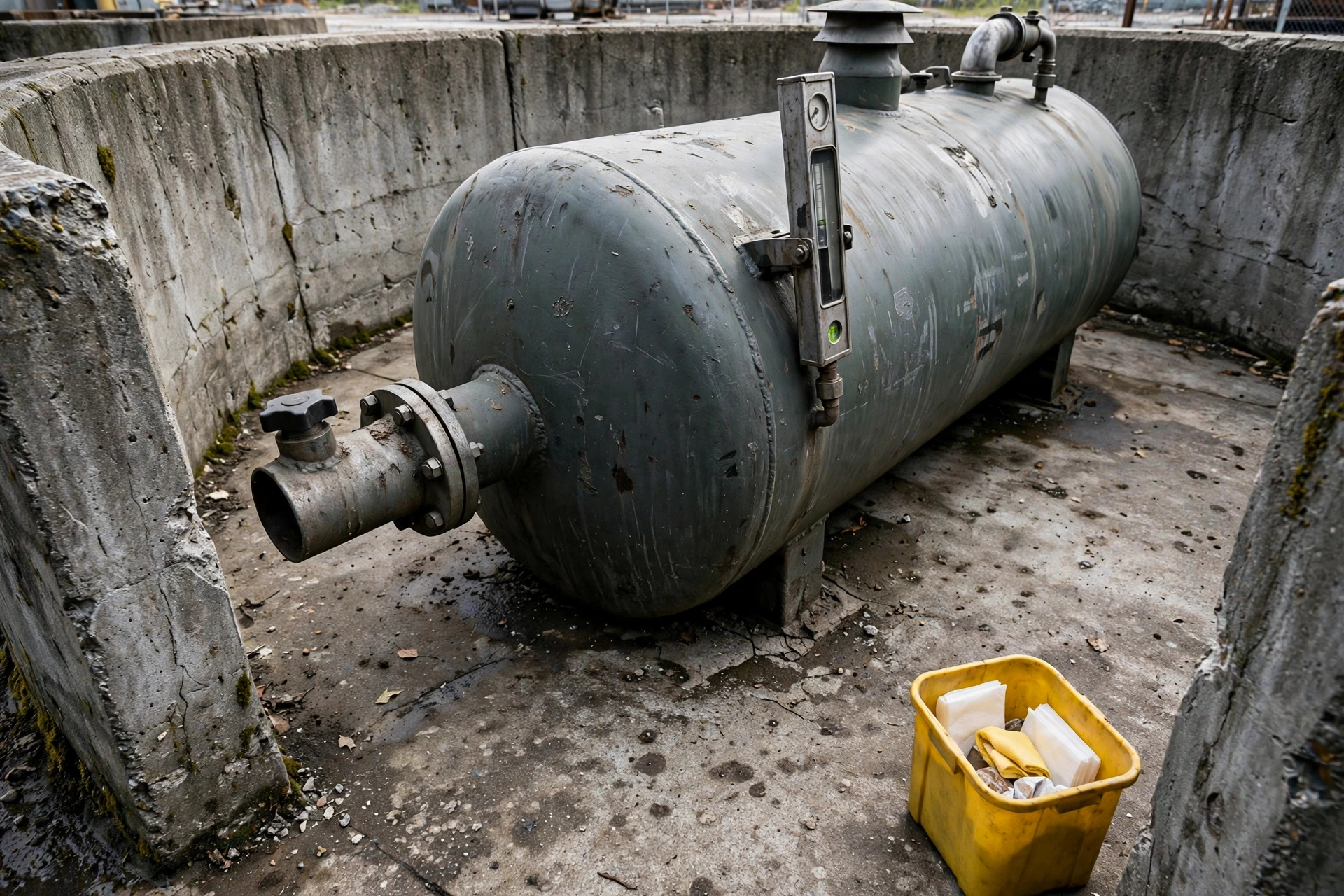
A bund is a second container around the first one. The fuel tank is the primary container. The bund — a low wall, a tray, a double skin with an interstitial space, or a purpose-built concrete enclosure — is the secondary container. Its only job is to catch the fuel when the first container fails, and to hold it until someone deals with it.
That definition matters because three things are routinely mistaken for a bund and are not. A drip tray under a drum is secondary containment for the drum, not for a 10,000-litre bulk tank. A double-skinned tank has a second wall, but under the English regulations a double skin alone does not count as secondary containment unless the interstitial space is monitored and the outer skin is itself contained. And a concrete plinth is not a bund: a plinth holds a tank up, a bund holds fuel in. If the wall has a drain hole, a gap at a pipe penetration, or a crack across the floor, it is decoration.
There are three forms that actually work on generator sites. An integrally bunded tank is a tank inside a tank, built at the factory with a 110% outer shell and a leak alarm between the walls. It is the standard choice up to about 2,000 litres, and it is the form most generator manufacturers supply when the order specifies a bunded base tank. A masonry or concrete bund is a low wall built around a free-standing tank on site, with an impermeable floor and sealed joints. It suits bulk tanks from 5,000 litres upward, where a factory-bunded unit would be too large to transport. A prefabricated steel or GRP bund is a tray or enclosure delivered as a unit and set under or around the tank; it suits day tanks and retrofits where building a concrete wall is impractical. Choosing the right form is part of fuel system design.
The choice between them is decided by tank size, site access and whether the tank already exists. The capacity rule is the same for all three.
The 110% Rule, Worked in Litres
The sizing rule used across the UK is simple: the bund must hold 110% of the largest single container inside it, or 25% of the total capacity of all containers inside it — whichever is greater. The extra 10% is not generosity. It covers the displacement of the tank itself, the pipework inside the bund, and a margin for the first rain.
A 500 kVA set with a 645-litre sub-base tank
The Cummins C500D5 carries a 645-litre sub-base tank and burns 93.2 L/h at prime full load. A bund for that tank must hold 710 litres — 110% of 645. An integrally bunded base tank of that size adds roughly 150 mm to the footprint in each direction and a few hundred pounds to the price. That is the entire cost of compliance for the most common standby set in the world.
A 10,000-litre bulk tank at a hospital
A single 10,000-litre bulk tank needs a bund of 11,000 litres. At a typical wall height of 600 mm, that is a bund floor area of about 18 m² before allowing for the tank footprint. The wall must be high enough that the fuel level in a full-bund event stays below the top of the wall, and the floor must be impermeable — sealed concrete, not bare blockwork.
Three tanks sharing one bund
A data centre fuel farm with tanks of 5,000, 3,000 and 2,000 litres has a combined capacity of 10,000 litres. The two tests give 5,500 litres (110% of the largest) and 2,500 litres (25% of the total). The larger figure applies: 5,500 litres. The rule is often misunderstood here — it does not require the bund to hold all three tanks at once. It requires the bund to hold the worst single failure, with a margin.
| Installation | Largest tank | Total capacity | Bund must hold |
|---|---|---|---|
| 500 kVA sub-base tank | 645 L | 645 L | 710 L |
| Hospital bulk tank | 10,000 L | 10,000 L | 11,000 L |
| Data centre fuel farm, 3 tanks | 5,000 L | 10,000 L | 5,500 L |
| Telecom site, day tank + drums | 2,000 L | 2,400 L | 2,200 L |
| 2,000 kVA containerised, 20,000 L bulk | 20,000 L | 20,000 L | 22,000 L |
One detail catches out otherwise careful designs: the bund volume is the volume available for fuel, not the volume inside the walls. The tank itself sits inside the bund and displaces fuel. A bund that holds 11,000 litres of water with nothing in it holds less than 11,000 litres of fuel with a 10,000-litre tank sitting in it. The calculation must subtract the volume of everything inside the bund below the fuel level — tank supports, pipework, pump plinths — or the wall must be built higher to compensate.
Does the Law Require a Bund for Your Set?
The short answer is that it depends on the country, the tank size and the location, but the direction of travel is the same everywhere: above a modest threshold, secondary containment is a legal requirement, not a recommendation.
England and the UK: the 200-litre line
In England, the Control of Pollution (Oil Storage) (England) Regulations 2001 apply to any business storing oil in a container of more than 200 litres. The container must sit inside a secondary containment system holding 110% of the largest container or 25% of the aggregate, whichever is greater. The base and walls must be impermeable to oil and water, and the bund must have no drain opening. Scotland, Wales and Northern Ireland have their own regulations with the same capacity figures. The regulations do not apply to containers inside a building, wholly underground tanks, or private dwellings with up to 3,500 litres — but a generator in a plant room with a 1,000-litre day tank is a commercial installation, and the exemption for indoor storage does not remove the duty to prevent pollution. It only changes which regulation applies.
United States: the SPCC threshold
In the United States, the EPA’s Spill Prevention, Control, and Countermeasure rule, 40 CFR Part 112, applies to any non-transportation facility that stores more than 1,320 US gallons — about 5,000 litres — of oil aboveground, counting every container of 55 gallons or more, where a discharge could reasonably reach navigable waters. Above that line the site needs a written SPCC plan and secondary containment sized to hold the entire capacity of the largest single container plus sufficient freeboard for precipitation. The federal rule does not prescribe a formula for the freeboard. EPA inspector guidance describes two common approaches: sizing for the rain from a 25-year, 24-hour storm, and the 110% rule of thumb — and warns explicitly that 110% may not be enough where storms are heavy. A single 500 kVA set with a 645-litre tank is below the SPCC threshold on its own. A data centre with twenty sets and a 30,000-litre bulk farm is far above it.
The rest of the world: same principle, different paperwork
Most export markets follow one of these two models or a local variant of them. Australia’s state EPA guidelines, the EU’s Industrial Emissions Directive for permitted sites, and the Gulf states’ environmental permits all require secondary containment for bulk fuel storage, and all use a version of the largest-tank-plus-margin test. The practical point for an export buyer is that the bund should be specified in the generator order, not discovered at the building permit stage. A factory-bunded base tank can be ordered with the set and shipped in the same container. A concrete bund built after the set arrives costs three to five times as much, because it needs a second mobilisation, a second pour and a second inspection.
What Happens When Diesel Escapes
Diesel does not behave like water. It floats, it spreads in a thin film, it seeps into soil rather than running off it, and it persists. The US EPA’s figure is the one that frames every spill: one litre of oil can contaminate up to one million litres of water. A 645-litre sub-base tank, emptied into the ground, is a contamination event measured in hundreds of millions of litres of water. That is why the cleanup bill for a spill is measured in excavation and disposal, not in mopping.
Case 1: A hospital bulk tank fails overnight
A district hospital in northern England ran a 1,000 kVA standby set on a 10,000-litre bulk tank installed in 2014. The tank stood on a concrete plinth in an open yard, with no bund. A seam weld at the base of the tank failed at 02:40 on a Sunday morning. By the time the night porter noticed the smell at 06:15, roughly 6,800 litres had escaped. About 4,000 litres had run across the yard into a surface-water drain that discharged to a beck 300 metres away. The hospital’s generator was out of service for 11 days while the tank was replaced and the yard excavated. The cleanup — excavation of 90 tonnes of contaminated soil at roughly £200 per tonne for disposal, groundwater monitoring boreholes, and the Environment Agency’s costs — came to about £65,000. A bund for that tank would have cost about £3,500.
Case 2: A telecom tower leaks slowly for months
A telecom site in the Nigerian interior ran a 75 kVA set on a 2,000-litre day tank. A pinhole corrosion leak at the base of the tank released roughly 40 litres a week — too little to notice on the fuel gauge, too little to see on the concrete, and too slow to trigger any alarm. The leak ran for five months before a routine audit found diesel staining in the soil below the tank. Remediation of the contaminated ground cost about £18,000, and the tower was offline for three days while the tank was lifted and the soil removed. The leak was not a tank failure. It was a maintenance failure: nobody had inspected the base of the tank in two years, because nobody owned the inspection. The site’s maintenance schedule had a line for oil and filters, and nothing for the fuel tank.
Case 3: An overfill on a construction site
A construction site in the Gulf was refuelling a 200 kVA set from a road tanker. The driver overfilled the 1,000-litre sub-base tank by about 120 litres. There was no bund, no spill kit and no high-level alarm on the tank. The spilled fuel ran across the concrete hardstanding and, when the afternoon rain arrived, into a storm drain. The site was fined £12,000 and paid a further £9,000 for the cleanup. The overfill took about 40 seconds. The paperwork took four months.
The Five Ways Diesel Gets Out of a Generator Tank
Spills are not random. They follow a short list of failure modes, and each one has a specific countermeasure.
Overfill at delivery
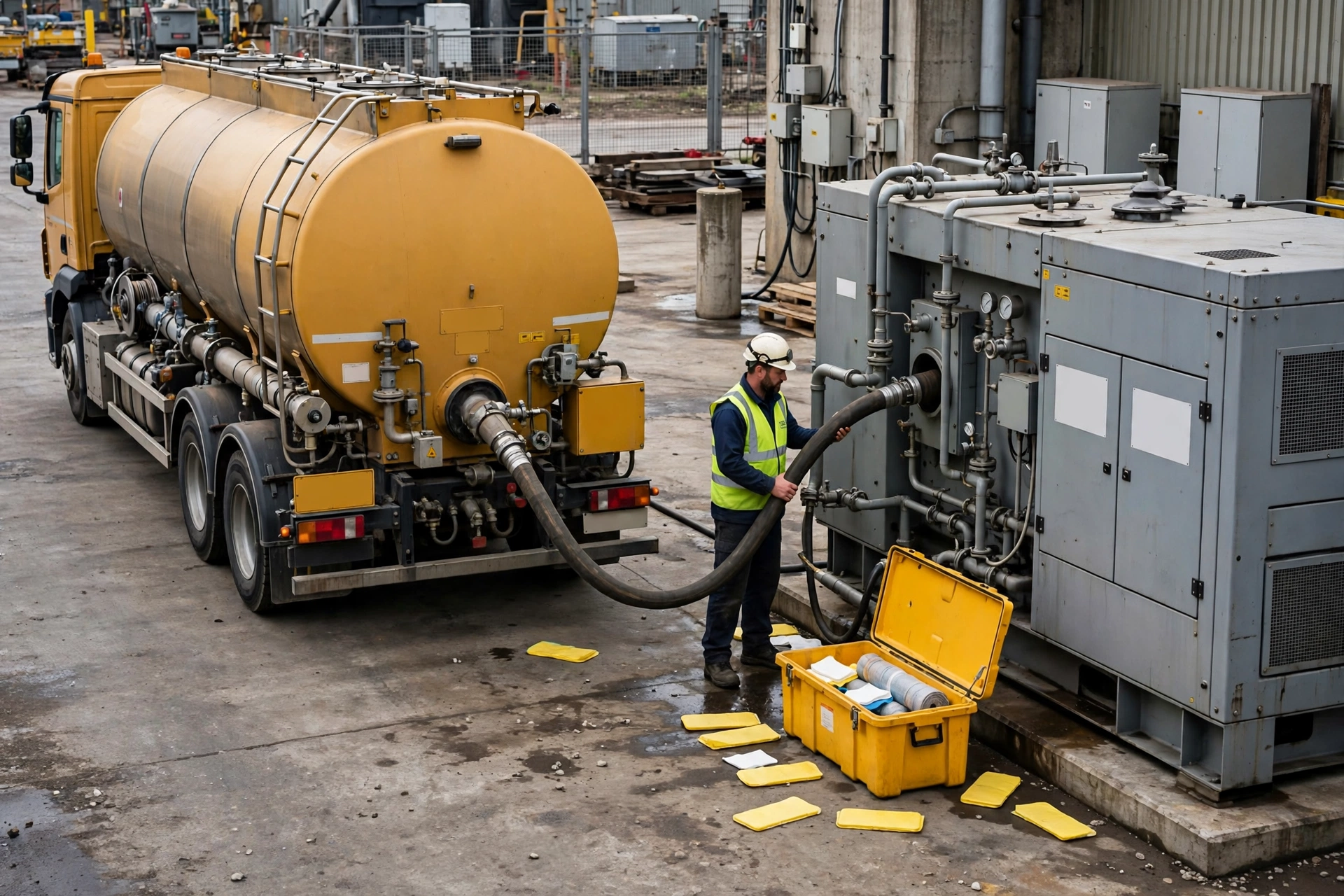
Overfill is the most common spill on a generator site, and the most preventable. It happens when a tanker delivers faster than the tank vents, when the gauge is wrong, or when nobody is watching the fill. The countermeasures are a high-level alarm set at 90% of capacity, an automatic shut-off valve on the fill line, and a rule that nobody leaves a delivery unattended. A bund catches the overfill. An alarm prevents it.
Corrosion and seam failure
Steel tanks corrode from the outside in where water sits against them, and from the inside out where water collects at the bottom of the fuel. A tank that has stood for ten years without an internal inspection is a tank with an unknown wall thickness. The countermeasures are a bund, a tank inspection every five years, and a water drain at the lowest point of the tank, drained monthly. Diesel fuel ageing accelerates the problem: water in the fuel breeds microbes, microbes produce acids, and acids eat steel.
Hoses and fittings
The last metre of fuel line on most sets is flexible rubber hose, and it is the component least often inspected. A weeping fuel hose next to a hot turbocharger is a fire risk before it is a spill risk, and a failed hose at a bulk tank can empty the tank in minutes. The countermeasures are a bund, a hose replacement interval of five years, and double clamps on every barbed fitting.
Rainwater filling the bund
An open bund collects rain. A bund that is half full of rainwater is a bund that is half useless. In a tropical climate, 100 mm of rain falling into a 10 m² bund adds 1,000 litres of water — enough to take a 2,200-litre bund for a 2,000-litre tank below its legal capacity. The countermeasures are a roof over the bund, a manual drain valve that is opened only after the water has been inspected and found clean, and a level alarm in the bund itself. For what happens when water reaches the set itself, see our guide to flood damage.
Theft and tampering
A tank without a bund is a tank that can be drained quietly. Siphoning from an unbunded bulk tank leaves no trace until the gauge is read. A bund does not stop theft, but a bunded tank with a locked fill cap, a level gauge that is read daily, and a fuel ledger makes theft visible within a day. The fuel theft problem at remote sites is a metering problem as much as a security problem.
Sizing and Building a Bund That Works
A bund that is the right size, built from the right material, and kept empty of rainwater is a simple structure. Most bund failures are not design failures. They are maintenance failures.
Sizing for the set you actually own
The bund is sized to the tank, not to the generator. A 500 kVA set with a 645-litre sub-base tank needs a 710-litre bund. A 2,000 kVA containerised set burning 353 L/h at full prime load needs a bulk tank of at least 20,000 litres for 48 hours of runtime, and a bund of 22,000 litres. The fuel consumption and tank sizing calculation comes first; the bund follows the tank. Order the bund with the set, and the factory builds it into the base frame. Order it afterwards, and the site builds it from concrete at three times the price.
Materials: concrete, steel, GRP, integral
A concrete bund is the default for bulk tanks: durable, repairable, and easy to inspect. The floor and walls must be sealed with an oil-resistant coating, and every joint and pipe penetration must be sealed. A steel bund is lighter and faster to install, but it corrodes in the same way the tank does and needs the same inspection. A GRP bund does not corrode and suits aggressive environments, but it is brittle under impact and hard to repair on site. An integrally bunded tank is the cleanest option below 2,000 litres: the factory builds the second skin, fits the leak alarm, and ships the unit as one piece. Whatever the material, the bund must be impermeable, must have no drain, and must be strong enough to hold a full tank of fuel without deforming.
Keeping the bund empty and working
A bund full of rainwater, leaves and old spill kits is a bund that will overflow at the first real failure. The operating rule is simple: inspect the bund monthly, pump out rainwater after checking it is clean, and keep a spill kit beside it. A bund level alarm costs less than £200 and tells the site when the bund is filling — from rain or from a leak — before it matters. The alarm belongs in the generator controller or the building management system, not on a wall where nobody looks.
Frequently Asked Questions
Does a diesel generator fuel tank need a bund?
In most cases, yes. In England any business storing more than 200 litres of oil needs secondary containment, and in the United States any facility over 1,320 gallons of aboveground storage needs an SPCC plan with containment. Below those thresholds a bund is still the cheapest way to avoid a cleanup bill that is typically ten to twenty times the cost of the bund.
How big should a bund be for a diesel generator fuel tank?
The bund must hold 110% of the largest tank inside it, or 25% of the total capacity of all tanks inside it, whichever is greater. A 645-litre sub-base tank needs a 710-litre bund, and a 10,000-litre bulk tank needs an 11,000-litre bund. The calculation must allow for the volume displaced by the tank itself and by anything else standing inside the bund.
What is secondary containment for a diesel fuel tank?
Secondary containment is a second barrier around the fuel tank that catches fuel when the tank, a hose or a fitting fails. It can be an integrally bunded tank, a concrete or masonry wall around the tank, or a prefabricated steel or GRP enclosure. A double-skinned tank alone does not count as secondary containment under the English regulations unless the space between the skins is monitored.
How to stop diesel leaking from a generator fuel tank?
Inspect the tank base and seams every five years, drain water from the bottom of the tank monthly, replace flexible fuel hoses every five years, fit a high-level alarm on the fill line, and keep the tank inside a bund. Most leaks are found by inspection, not by alarms — a monthly walk around the tank with a torch catches more failures than any sensor.
What happens if diesel spills from a generator?
Diesel seeps into soil and groundwater, and one litre can contaminate up to one million litres of water. A spill typically means excavating contaminated soil at £150–£300 per tonne for disposal, groundwater monitoring, a fine from the environmental regulator, and the generator out of service while the tank is replaced. In England, fines in the Crown Court are unlimited.
Specification Checklist: Before the Fuel Delivery Arrives
1. Is the tank bunded, and to what capacity? Ask for the bund capacity in litres, and check it against the 110% rule for the largest tank. A quotation that says “bunded” without a number is not an answer.
2. Does the bund have a drain? It must not. A bund with a drain is a tank with a hole in it. Rainwater is removed by pump after inspection, never by a permanently open valve.
3. Is the interstitial space monitored? On an integrally bunded tank, the leak alarm between the skins is the only warning of a primary tank failure. Confirm it is fitted and connected.
4. Is there a high-level alarm on the fill line? Set it at 90% of tank capacity, and make sure deliveries are never left unattended.
5. When was the tank last inspected internally? Five years is the usual interval for steel tanks. Ask for the inspection record, not a verbal assurance.
6. Where does a spill go? Walk the route from the tank to the nearest drain, watercourse and site boundary. If the answer is “into the ground”, the bund is missing or undersized.
A bund is not a piece of environmental paperwork. It is a steel or concrete box that turns a £65,000 cleanup into a £200 pump-out. The fuel tank is the cheapest part of a generator installation to protect and the most expensive to leave unprotected. Specify the bund in the generator order, size it to the 110% rule, and inspect it monthly. The generator will never thank you for it. The site owner will, the first time a hose fails at two in the morning.
For a bunded base tank, a bulk fuel installation, or a generator specified with secondary containment from the factory, contact PAVO — the team can size the tank and the bund to the set, the runtime and the site regulations before the order is placed.