

What Size Generator Does an Industrial Bakery Need? | PAVO
Bread dough is alive. From the moment the yeast meets the flour, the clock is running, and a power cut does not pause it — it spoils it.
What size generator does an industrial bakery need? A mid-size plant baking 5,000 loaves a day needs 200–250 kVA; a large tunnel-oven line needs 500–800 kVA; an electric-oven plant needs 1,000–1,500 kVA. Size from peak demand — mixers, proofers, oven fans and blast freezers — not from daily energy use.
Contents
- Why a Bakery Has No Pause Button
- The Bakery Process, Load by Load
- How Big a Generator Does an Industrial Bakery Need?
- What Happens When the Power Fails Mid-Shift
- How Long Can an Industrial Bakery Run on a Generator?
- Standby, Prime or Continuous — and Where the Set Sits
- Frequently Asked Questions
- Specification Checklist: Ten Lines Before the Deposit
Why a Bakery Has No Pause Button
Bread is the most widely eaten manufactured food on earth, and more than three quarters of it in the UK is made on an industrial scale. British bread baking alone consumes about 2 TWh of energy a year and produces 570,000 tonnes of CO2, according to a thermal-energy study published in Applied Thermal Engineering. Behind those figures sit large commercial bakeries running tunnel ovens the size of commuter trains, and every one of them depends on electricity arriving on time, every shift, without exception.
A bakery is not a warehouse with a few lights. It is a living production line. Dough is mixed, divided, proofed and baked on a schedule measured in minutes, and each stage depends on the one before it finishing on time. The yeast in the dough does not know the grid has failed. It keeps fermenting. The proofing cabinet keeps warming. The oven keeps cooling. A break anywhere in that chain does not delay the batch. It downgrades it, or destroys it.
That is what makes the generator question different for a bakery than for most factory loads. The set is not protecting a building. It is protecting a perishable, fermenting product that is already on the production line, already rising, already in the oven. The dough cannot wait for the grid to come back, and it cannot be stored while the bakery decides what to do. A plant that loses power for two hours in the middle of a morning bake has not lost two hours of production. It has lost the morning’s dough, the afternoon’s orders, and the supermarket delivery slot that cannot be re-booked.
The economics sharpen the point. A bakery can lose an entire production cycle in two to four hours, including ingredient costs, labour, unfulfilled orders and reputational damage. After just two hours without power, up to 70% of proofing dough and high-moisture pastries may be unsalvageable. A small bakery owner in the United States reported losing over $900 in product and at least $500 in sales from a single outage, with losses heading into the thousands if the outage ran into the next day. A Reno bakery hit by a three-day winter outage put its total loss — spoiled ingredients, lost revenue and equipment damage — at more than $35,000.
This article sizes the generator for an industrial bakery from the process loads upward: what each stage draws, what size set each plant throughput needs, how long the fuel lasts, which rating fits a bakery that bakes six days a week, and what a power failure actually costs when it arrives mid-shift.
The dough clock
The first clock is the dough itself. Yeast is a living microorganism, and it works on its own timetable. Most baking strains perform best at temperatures near 105 °F (40.5 °C) and humidity around 85%, according to product developers at Lesaffre and Corbion. In a high-speed operation using a straight dough, bulk fermentation can be finished in as little as one hour. In an artisan process it can run 18 to 72 hours. Either way, the baker cannot tell the yeast to stop because the proofer broke down.
A shaped loaf proofs in 45–90 minutes at 24–27 °C, 30–60 minutes at 27–29 °C, and 1.5–3 hours at 20 °C. In a fridge at 4 °C it proofs slowly over 8–48 hours. That spread is the whole problem. When the power fails, the proofer stops holding 35–38 °C and 80–85% humidity, and the dough keeps rising at whatever temperature the room settles at. In a warm bakery in summer, that means over-proofing within the hour: the gluten stretches past what it can hold, the structure collapses in the oven, and the loaf bakes flat with a sour, boozy smell. Over-fermentation breaks down the gluten structure, leaving a stickier, slack dough and an overly acidic flavour. Slightly over-proofed dough can be knocked back, reshaped and proofed again. Badly over-proofed dough cannot be saved — it bakes as flatbread or it is thrown away.
The industry window is short. Proofing dough has a critical window of 1–3 hours without power. Laminated dough — croissants, puff pastry, Danish — has 1.5–2 hours before the butter separates and the layers are lost. Finished pastries have 2–4 hours. A walk-in cooler holds for 4–12 hours if the doors stay shut. A walk-in freezer holds for 24–48 hours. The dough is always the first thing to die, and it dies fastest.
The oven clock
The second clock is the oven. Half of the energy consumed inside an industrial bakery is in the oven, and the specific energy to bake a kilogram of bread runs from 0.5 to 7.3 MJ/kg depending on the oven, the product and the bake. Industrial bread baking as a whole uses 450–750 kWh per tonne of baked product. Those are thermal figures — most large ovens burn gas — but the electrical load that keeps the oven running is real, and it is the load the generator must carry.
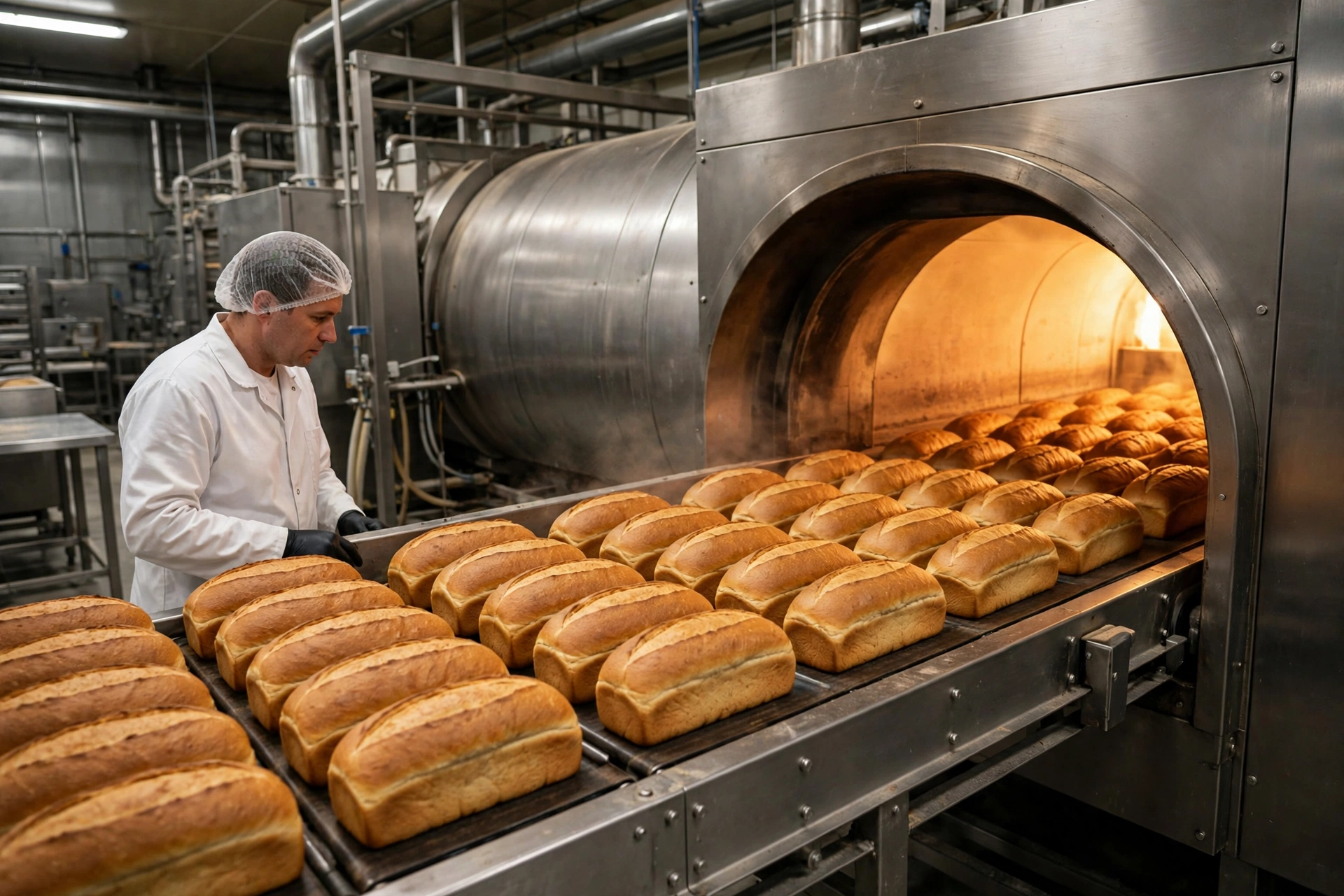
A gas-fired tunnel oven still needs electricity for its burners, its circulation fans, its conveyor drive and its controls. A small gas tunnel oven burns 50,000–200,000 BTU per hour and draws 5–20 kW of electricity. A large JYB-series gas tunnel oven producing 1,000 kg of bread an hour draws 21 kW of electricity and burns 60 kg of gas an hour; the 1,250 kg/h model draws 25 kW. The heat is gas. The movement is electric. When the power fails, the conveyor stops, the fans stop, and the bread inside the tunnel stops moving — in an oven still sitting at 190–260 °C.
That is why Pepperidge Farm fitted uninterruptible power supplies to its high-volume cracker ovens. If the power goes out, there could be 250 feet of product in that oven that will burn — a loss, and a fire hazard. A well-insulated oven’s thermal mass retains baking temperature for over an hour after a power failure, which can save the batch inside, but it also takes hours to reheat from cold, slowing recovery. The oven clock runs both ways: the batch inside is at risk within the hour, and a cold oven costs hours of production to bring back.
The Bakery Process, Load by Load
An industrial bakery has six electrical stages. Four of them are continuous loads. Two of them — mixing and oven starting — are peak loads that decide the generator size. The thermal energy is far larger than the electrical energy, but the generator does not carry the heat load. It carries the motors, fans and controls that move the dough through the heat.
Spiral mixers and dividers
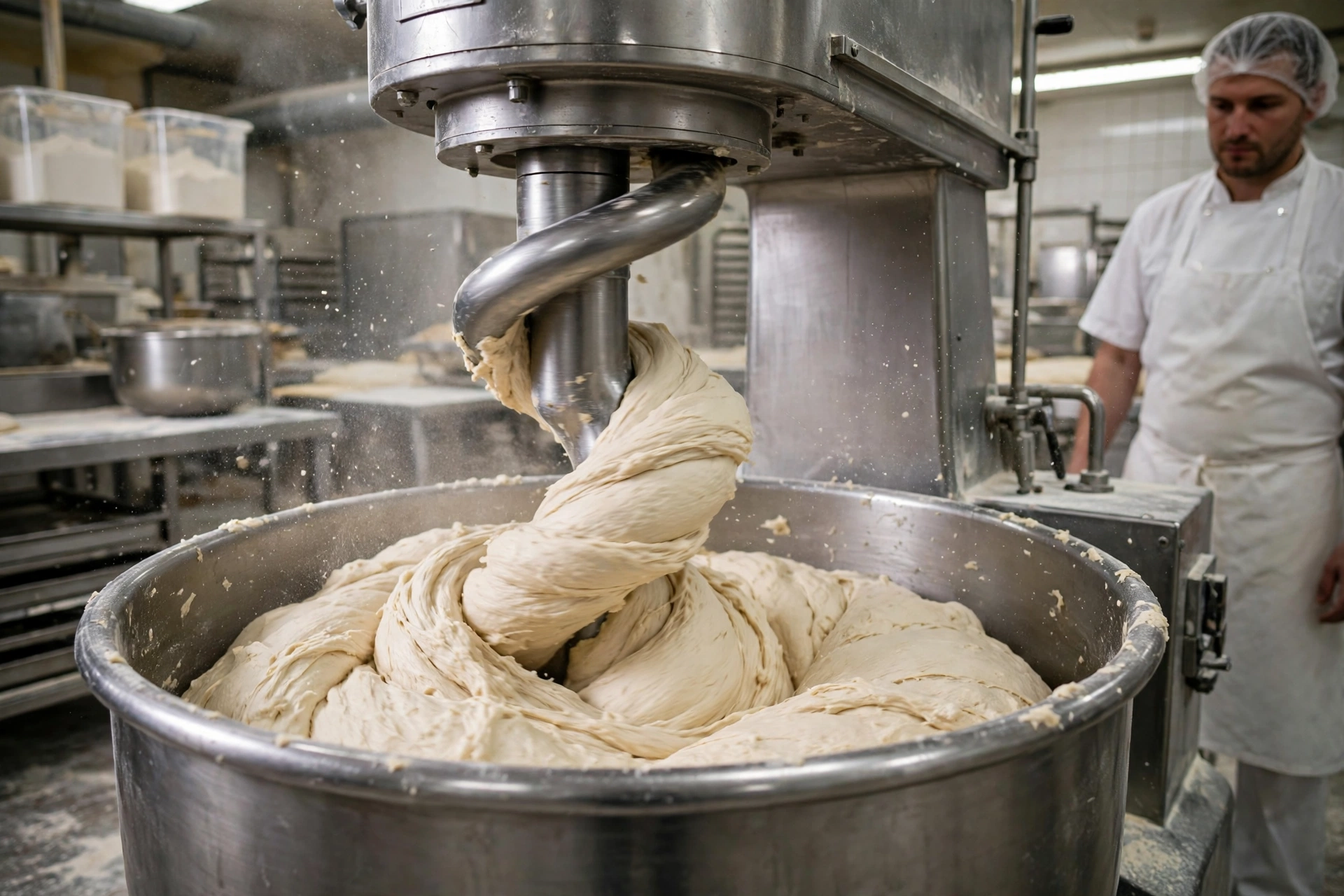
Mixing is the first electrical load and the first peak. A spiral mixer is a heavy, high-torque machine: a slow, powerful spiral arm kneads the dough while the bowl rotates. A 120 kg dough-capacity mixer draws 7–9.5 kW — the Univex SL120RB, a 180-quart floor model with a 120 kg dough capacity, is rated at 9.5 kW (an 8 kW spiral motor, a 0.75 kW bowl motor and a 0.75 kW head motor) and sells for $62,664. A HOMAT HM-120A of the same 120 kg capacity draws 7 kW. A Tronp TP-125KG, taking 125 kg of flour and 220 kg of dough, draws 16.5 kW. A plant running two 120 kg mixers in rotation therefore carries 14–19 kW of mixing load, and both mixers start in sequence at the beginning of the shift — the starting surge is what the generator feels, not the running load. Mixer motors start direct-on-line in most plants, so the surge runs 5–7 times running current for a few seconds. That is the subject covered in the section on motor starting below.
After mixing comes dividing and moulding. A volumetric divider and a long-moulder together draw 8–12 kW, and they run in step with the mixers. They are small loads individually, but they run at the same time as the mixers, the proofer fans and the oven fans — and it is the simultaneous peak that sizes the set, not any single machine.
Proofers and retarders
Proofing is a low-power, high-consequence load. A proofer cabinet holds dough at 35–38 °C and 80–85% humidity using heaters, steam injectors and circulation fans. The electrical draw is modest — 8–15 kW for a cabinet holding several hundred loaves — but the consequence of losing it is total. The proofer is the one load where the generator is not protecting a machine. It is protecting the dough.
A retarder works the other way: it holds shaped dough at 2–4 °C overnight so it proofs slowly and bakes on schedule. Retarders are refrigeration loads, 5–10 kW each, and they run all night. A bakery that retards dough for the morning bake has refrigeration running when nobody is in the building — which is why the generator and the automatic transfer switch matter at 3 a.m. as much as at 3 p.m. If the grid fails overnight and the retarder warms, the morning’s dough over-proofs before the first baker arrives.
Tunnel and rack ovens
The oven is the largest single load in the bakery, and the most misunderstood. In a gas-fired plant, the oven’s electrical draw is 15–30 kW for a tunnel oven of 500–1,250 kg/h output — fans, conveyor, burners and controls. In an electric-oven plant, the oven is the whole load: a small electric tunnel oven draws 5–20 kW, and a full electric deck or tunnel line for a large plant draws 200–600 kW. The difference between a gas-oven plant and an electric-oven plant is the difference between a 250 kVA set and a 1,500 kVA set. That is why the first question in any bakery sizing exercise is not how many loaves, but what heats the oven.
Rack ovens sit in between. A double-rack oven bakes 80–160 loaves a batch and draws 15–30 kW electric plus gas, or 30–60 kW fully electric. A plant with six rack ovens carries 90–180 kW of oven load before anything else is switched on. White bread bakes at about 191 °C for 20–25 minutes; a denser whole-wheat loaf needs 204 °C for 30–35 minutes. The oven runs at those temperatures for 10–16 hours a day, six days a week, and it does not forgive a cold start: a tunnel oven reheats in 45–90 minutes from cold, and a cold oven means the first hour of the shift produces nothing.
Blast freezing and cold storage
The cold side of the bakery is the second-largest electrical load, and the one that runs longest. A blast freezer drops par-baked bread or frozen dough from 30 °C to −18 °C in 60–90 minutes, and a single blast-freezer room draws 30–60 kW while it runs. A frozen-dough plant — one that ships par-baked loaves to supermarkets for in-store finishing — can have two or three blast freezers running in rotation, plus a cold store at −22 °C drawing 15–25 kW continuously.
The cold chain has its own clock. A full walk-in freezer holds temperature for about 48 hours without power; a half-full one for about 24 hours. A walk-in cooler holds for 4–12 hours. Food-safety rules say refrigerated food above 40 °F (4.4 °C) for more than 4 hours must be discarded. For a bakery, the cold store holds flour improvers, yeast, butter, eggs and finished frozen dough — tens of thousands of dollars of stock that cannot be re-made in a day. The general cold-storage design is covered in the companion article on food processing plants; the point here is that the freezer compressors are large motor loads with heavy starting surges, and they start at the worst possible moment — when the generator has just taken over and every other load is starting too.
Packaging, air and utilities
The rest of the plant is a long tail of smaller loads that add up. A flow-wrapper or bagging line draws 5–10 kW. A slicer draws 3–5 kW. Compressed air for pneumatic dividers, depositors and packaging runs 11–22 kW for a 15–30 kW compressor, and it cycles all shift. Water treatment and pumping draw 3–7 kW. Lighting and HVAC for a 2,000–5,000 m² plant draw 20–40 kW. None of these is large alone. Together they add 50–90 kW to the running load — roughly a third of the plant total — and they are the loads most often forgotten in a sizing exercise, then discovered on the first real outage when the generator trips on overload.
| Load | Typical draw | Runs when | Starting surge |
|---|---|---|---|
| Spiral mixers (2 × 120 kg) | 14–19 kW | Batch, all shift | 5–7×, direct-on-line |
| Divider and moulder | 8–12 kW | With mixers | 4–6× |
| Proofer cabinets | 8–15 kW | Continuous | Low |
| Retarders | 5–10 kW each | Overnight | 5–6× compressor |
| Gas tunnel oven (1,000 kg/h) | 21 kW electric | Continuous | Low |
| Electric tunnel / deck ovens | 200–600 kW | Continuous | Low |
| Blast freezer | 30–60 kW | Batch rotation | 5–7× compressor |
| Cold store | 15–25 kW | Continuous | 5–6× compressor |
| Packaging and slicing | 8–15 kW | With production | Low |
| Compressed air | 11–22 kW | Cycling | 5–7× |
| Lighting and HVAC | 20–40 kW | Continuous | Low |
How Big a Generator Does an Industrial Bakery Need?
Size from the peak, not the average. A bakery’s average electrical draw is a misleading number, because the plant does not run at its average. It runs at its peak — mixers, proofers, oven fans, blast freezer and compressed air all on at once — for most of the shift. The generator sizing guide gives the full method; the table below gives the answer for a bakery by output.
| Plant size | Daily output | Running load | Generator (gas oven) | Generator (electric oven) |
|---|---|---|---|---|
| Small artisan / central bakery | 500–1,000 loaves | 30–50 kW | 50–75 kVA | 100–150 kVA |
| Mid-size plant | 5,000 loaves | 120–180 kW | 200–250 kVA | 400–500 kVA |
| Large tunnel-oven line | 20,000 loaves | 300–450 kW | 500–800 kVA | 1,000–1,500 kVA |
| Frozen-dough / par-baked plant | 30,000 loaves | 400–600 kW | 600–800 kVA | 1,200–2,000 kVA |
The gas-oven column is the common case: most large bakeries burn gas for heat and use electricity only for movement, fans and controls. The electric-oven column is the trap. A buyer who sizes from the gas-oven column and then installs electric ovens ends up with a set at half the size it needs. Check the oven fuel before anything else.
Sizing table by plant size
A small artisan bakery or central production kitchen — 500–1,000 loaves a day — runs one 120 kg spiral mixer, one proofer, one or two rack ovens and a cold room. The running load is 30–50 kW, and a 50–75 kVA standby set covers it with headroom for the mixer and compressor starts. This is the size most often bought as a first set, and it is the size most often outgrown: a bakery that adds a second rack oven and a blast freezer within two years needs 100–150 kVA, and the 75 kVA set becomes a trade-in.
A mid-size plant — 5,000 loaves a day, two shifts, a tunnel oven or four to six rack ovens — runs 120–180 kW. The set for it is 200–250 kVA standby with a gas oven, or 400–500 kVA with electric ovens. The worked example below is this plant.
A large tunnel-oven line — 20,000 loaves a day, continuous production, a 1,000–1,250 kg/h tunnel oven — runs 300–450 kW of electrical load with a gas oven. The set is 500–800 kVA. With electric ovens the same plant needs 1,000–1,500 kVA, and at that size the buyer should be talking about two sets in parallel rather than one large one — the same growth logic covered in the article on standby and prime ratings.
A frozen-dough or par-baked plant is the heaviest case per loaf. The blast freezers and the cold store run alongside the ovens, so the electrical load is 400–600 kW even with a gas oven. The set is 600–800 kVA, and the cold side never switches off — which means the set runs at 70–80% load for most of the shift, and the buyer should be looking at a prime rating, not a standby rating.
Worked example — 5,000 loaves a day
Take a mid-size plant in the Philippines baking 5,000 loaves a day for supermarkets: two 120 kg spiral mixers, a divider and moulder, two proofer cabinets, one 1,000 kg/h gas tunnel oven, one blast freezer, a cold store, a flow-wrapper, a 15 kW air compressor and lighting and HVAC for a 2,500 m² plant. The load list reads:
| Equipment | Running kW | Notes |
|---|---|---|
| Spiral mixers (2 × 9.5 kW) | 19 | Start in sequence, 5–7× surge |
| Divider and moulder | 10 | With mixers |
| Proofer cabinets (2) | 12 | Continuous |
| Gas tunnel oven, 1,000 kg/h | 21 | Fans, conveyor, burners |
| Blast freezer | 45 | Batch rotation, 5–7× start |
| Cold store | 20 | Continuous |
| Flow-wrapper and slicer | 10 | With production |
| Air compressor, 15 kW | 15 | Cycling |
| Lighting and HVAC | 25 | Continuous |
| Total running | 177 kW |
177 kW ÷ 0.8 power factor = 221 kVA. Add 25% for motor starting on the mixers, blast freezer and compressor, and the target is 275 kVA — a 300 kVA standby set, or a 250 kVA prime set run at 70–80% load. The plant’s flour comes from the mill down the road, and the sizing logic is the same one used for flour mills: size from the motors, not from the daily energy bill. At 75% load a 300 kVA set burns about 45–50 L/h of diesel. A 24-hour outage needs about 1,100 litres. A 72-hour outage needs about 3,300 litres. Those numbers are in the fuel table below.
The common mistake is to size from the electricity bill. A plant using 450–750 kWh per tonne of bread and baking 5 tonnes a day uses 2,250–3,750 kWh a day — an average of 140–230 kW over a 16-hour day. That average looks like a 200 kVA set. But the peak is 177 kW of running load plus starting surges, and the set must carry the peak, not the average. Size from the load list. Always.
Electric ovens change everything
The one decision that doubles the generator is the oven fuel. A gas tunnel oven producing 1,000 kg/h draws 21 kW of electricity. An electric tunnel oven producing the same 1,000 kg/h draws 250–350 kW — ten to fifteen times as much. The gas is doing the heating in the first case; the electricity is doing the heating in the second.
For a bakery with electric ovens, the sizing rule changes. The oven load is resistive, not motor — no starting surge, but a flat, continuous draw that never drops. A 500 kg/h electric line needs 150–200 kW of oven power alone. A 1,250 kg/h electric line needs 350–500 kW. Add mixers, proofers, freezers and air, and the plant is at 500–700 kW — a 800–1,000 kVA set at minimum, and the buyer should price the set against the cost of converting the oven to gas, because the generator for an electric-oven plant costs more than the oven conversion in most cases.
There is a second trap with electric ovens: load shedding does not work. A gas-oven plant can shed the blast freezer for an hour and keep baking. An electric-oven plant cannot shed the oven — it is the production line. If the set is undersized, the choice is between tripping the whole plant and not baking at all. Size the set for the full oven load, with 20–25% headroom for growth, or do not buy the set.
What Happens When the Power Fails Mid-Shift
The outage does not arrive on a schedule. It arrives at 3 a.m. in the middle of a night bake, or at 7 a.m. when the morning dough is proofing and the first delivery truck is already at the gate. The damage depends on what was in the plant when the grid failed, and on how fast the generator took over. Three real cases show the range.
Case 1 — Entenmann’s, Bay Shore, New York, 2003
The Northeast blackout of August 2003 hit Entenmann’s giant bakery-goods plant on Fifth Avenue in Bay Shore, Long Island, at the height of production. The plant did not lose a shift. It kept running, because it had spent more than $16 million installing four generators capable of producing 5.1 MW — enough electricity to power about 5,000 homes. The generators were not a contingency. They were part of the plant’s operating model, and the blackout was the day they paid for themselves.
The lesson is scale. A plant that bakes for a whole region cannot afford a generator sized for the office and the lights. It needs a generator sized for the production line, and it needs it installed, tested and fuelled before the outage, not after. Entenmann’s is the extreme end of the range — 5.1 MW is a small power station — but the logic is the same at 250 kVA: the set must carry the line, not the building.
Case 2 — Pepperidge Farm cracker ovens, Norwalk, Connecticut
Pepperidge Farm took a different approach to the same problem. Its high-volume cracker ovens carry 250 feet of product inside the oven at any moment. If the power goes out, that product burns — a loss, and a fire hazard. The company’s answer was to fit uninterruptible power supplies to the ovens themselves, so the oven keeps moving its product out even if the rest of the plant stops.
The lesson is that the oven is not one load. It is two: the heat, which a well-insulated oven holds for over an hour, and the movement — the conveyor, the fans, the controls — which stops the moment the power fails. A generator sized only for the heat misses the point. The conveyor must keep moving, or the product inside the oven is lost even if the temperature holds. That is why the automatic transfer switch matters as much as the set: the transfer must happen in seconds, before the conveyor stops and the product starts to burn.
Case 3 — A Reno bakery, three days without power
A bakery in Reno, Nevada, lost power for three days in a winter storm. Not just the ovens — the refrigeration, the point-of-sale system, even the security cameras. The owner put the total loss at more than $35,000: spoiled ingredients, lost revenue and equipment damage. The bakery was a ten-year labour of love, and three days without power crippled it.
The lesson is duration. A generator that runs for 8 hours is not a generator for a three-day outage. The fuel calculation in the next section shows what 24 and 72 hours actually need, and the answer is a bulk tank, not a sub-base tank. A bakery that bakes six days a week and loses three of them has lost half a week’s revenue — and the supermarket contracts that go with it. The set must be sized for the outage that actually happens, not the outage the buyer hopes for.
Case 4 — A Lagos bakery, and the jerry can
The fourth case is the smallest, and the most common. A commercial bakery in Lagos, Nigeria, filmed during a power cut, shows the reality for thousands of bakeries in markets where the grid fails daily: trays of unbaked dough rolls on the tables, a handwritten sign reading “50 loaves today”, an oven control panel showing 220 °C and a 15-minute timer — and then darkness. Production stops while orders wait. A worker refuels an outdoor generator with a red jerry can, and the bakery starts again.
The lesson is that a generator is not a luxury for these bakeries. It is the production line. The bakery runs on the generator as often as it runs on the grid, which means the set needs a prime rating, not a standby rating, and it needs a fuel supply that does not depend on a man with a jerry can. Diesel fuel ageing in a tank that sits half-empty in tropical heat is a real failure mode, and it is covered in the companion article. The Lagos bakery is the reason the prime rating exists.
How Long Can an Industrial Bakery Run on a Generator?
The answer is a fuel calculation, not a guess. A generator’s runtime is the tank divided by the burn rate, and the burn rate depends on the load. The table below uses the Cummins C500D5 as the reference set — 500 kVA standby / 455 kVA prime, burning 93.2 L/h at full prime load, 69.9 L/h at 75% and 49.0 L/h at 50% — and scales down for smaller sets.
Fuel use by set size
| Generator | Load | Burn rate | 8 hours | 24 hours | 72 hours |
|---|---|---|---|---|---|
| 75 kVA standby | 60 kW | ~14 L/h | 112 L | 336 L | 1,008 L |
| 150 kVA standby | 120 kW | ~27 L/h | 216 L | 648 L | 1,944 L |
| 250 kVA standby | 200 kW | ~45 L/h | 360 L | 1,080 L | 3,240 L |
| 300 kVA standby | 240 kW | ~55 L/h | 440 L | 1,320 L | 3,960 L |
| 500 kVA prime (C500D5) | 340 kW (75%) | 69.9 L/h | 559 L | 1,678 L | 5,033 L |
| 500 kVA prime (C500D5) | 455 kW (100%) | 93.2 L/h | 746 L | 2,237 L | 6,710 L |
The burn rates for the smaller sets are typical figures for modern turbocharged diesel sets at 75–80% load; the C500D5 figures are from the Cummins datasheet. The pattern is the same at every size: fuel use is roughly linear with load, so a set running at half load burns roughly half the fuel. That matters for a bakery, because the plant’s load drops overnight — the ovens go off, the mixers stop, and only the retarders, the cold store and the lights keep running. A set that burns 55 L/h during the bake may burn 20 L/h overnight.
Tank sizing for 8, 24 and 72 hours
A sub-base tank — the tank built into the generator’s own base frame — typically holds 8–24 hours of fuel at full load, often closer to eight. That is fine for a site where the grid comes back the same evening. It is not fine for a bakery facing a storm outage, a remote site, or a plant whose business dies when the power does. The worked example above needs 1,100 litres for 24 hours and 3,300 litres for 72 hours at 250–300 kVA. A sub-base tank cannot hold that. The plant needs a day tank plus a bulk tank, with a transfer pump and a level alarm — and the transfer pump is the part that fails most often, as the fuel-system article shows.
Three rules for bakery fuel. First, size the tank for 72 hours if the bakery supplies supermarkets, because a supermarket contract does not pause for a fuel delivery. Second, keep the bulk tank above half full at all times — diesel in a half-empty tank in a warm bakery breeds water and microbes, and diesel fuel ageing kills more standby sets than any mechanical fault. Third, test the transfer pump every month under load. A transfer pump that has been dead for months is only discovered when the day tank runs dry in the middle of an outage, with a full bulk tank fifty metres away.
Standby, Prime or Continuous — and Where the Set Sits
The rating is the decision that decides the set’s life. A standby set is built to run for the duration of an outage, typically 200–500 hours a year, and it is not built to run at full load for days on end. A prime set is built to run as the main power source, at 70–80% load, for unlimited hours. A continuous set is built to run at full load, non-stop. The full comparison is in the article on standby and prime ratings; the bakery version is short.
Which rating fits a bakery
A bakery in a city with a reliable grid — one or two outages a year, each under 8 hours — needs a standby set. The set waits, starts in seconds, carries the plant through the outage, and goes back to sleep. A 250 kVA standby set is the right answer for the mid-size plant in the worked example.
A bakery in a market where the grid fails weekly, or a bakery that runs its set every day because the grid cannot carry the load, needs a prime set. The Lagos bakery in the case above is a prime-set bakery. So is any bakery in a region with daily load shedding. A prime set costs more, but a standby set run as a prime set dies early — the warranty will not cover it, and the engine will not forgive it.
A bakery that runs its set as the only power source — an off-grid plant, or a plant on an island — needs a continuous set, sized so the load sits at about 70% of the rating. That is a small minority of bakeries, but they exist, and they are the ones that most need the maintenance schedule in the companion article, because a continuous set is a production machine, not a backup.
Placement, heat and flour dust
A bakery is a hot, dusty, humid building, and the generator room must be designed for it. The set needs ventilation sized for the heat it rejects — the companion article on generator-room ventilation gives the numbers — and it needs clean combustion air, not air full of flour dust. Flour dust is a combustible dust: it settles on hot surfaces, it clogs air filters, and in the right concentration it can ignite. The set should sit in its own room or enclosure, with its air intake away from the mixing and flour-handling areas, and the air filters should be checked monthly, not annually.
Heat is the second placement problem. A bakery already runs at 30–35 °C near the ovens. A generator in the same room adds its own rejected heat, and a set that is fine at 25 °C derates at 40 °C. In a tropical bakery, the set should sit outside in a silent canopy, or in a ventilated room with its own louvres, not in the corner of the bakehouse. The silent-canopy option also solves the noise problem: a bakery in a residential area cannot run an open set at 3 a.m. without complaints, and a canopy that cuts the noise to 65–70 dB(A) at 7 metres is the difference between a neighbour and a noise complaint.
The set also needs a remote monitoring connection. A bakery bakes at night, when nobody is watching the generator. A Deep Sea controller with a modem tells the owner the set started, the load it is carrying and the fuel left in the tank — from another country, if that is where the owner is. The companion article on remote monitoring gives the setup. For a bakery, it is not a luxury. It is how the owner knows at 3 a.m. that the set started, and that the dough is safe.
Frequently Asked Questions
What size generator does an industrial bakery need?
A mid-size plant baking 5,000 loaves a day needs 200–250 kVA with a gas oven, or 400–500 kVA with electric ovens. A large tunnel-oven line needs 500–800 kVA with gas, or 1,000–1,500 kVA electric. A small artisan bakery needs 50–75 kVA. Size from the peak load list — mixers, proofers, oven fans and blast freezers — not from the electricity bill, and add 20–25% headroom for growth.
Do industrial bakeries need a backup generator?
Yes, if the bakery sells to supermarkets or wholesalers, or if the grid fails more than once a year. Proofing dough is unsalvageable after 1–3 hours without power, and a bakery can lose an entire production cycle in two to four hours. A generator is the only backup that keeps the ovens, proofers and cold store running together; a UPS covers only the controls. The only bakeries that do not need one are those with no wholesale contracts and a grid that never fails.
How long can an industrial bakery run on a generator?
As long as the fuel lasts. A 250 kVA set at 200 kW burns about 45 L/h, so 1,000 litres gives about 22 hours and 3,300 litres gives about 72 hours. A 500 kVA prime set at 75% load burns 69.9 L/h, so 5,000 litres gives about 71 hours. Size the tank for 72 hours if the bakery supplies supermarkets, and keep the bulk tank above half full to avoid fuel ageing.
What happens to an industrial bakery during a power outage?
The dough over-proofs within 1–3 hours and collapses in the oven. Laminated dough loses its butter layers in 1.5–2 hours. The tunnel-oven conveyor stops with product inside at 190–260 °C, and the batch burns. The cold store warms past 4 °C within 4–12 hours and the stock must be discarded. The plant loses the day’s production, the delivery slot and the supermarket contract. A generator with an automatic transfer switch prevents all of it, if it starts in seconds.
Can a diesel generator power an industrial bakery?
Yes. A diesel set powers every load in a bakery — mixers, proofers, ovens, blast freezers, packaging and air — provided it is sized from the peak load list and the oven fuel is known. The one limit is scale: a plant baking 20,000 loaves a day on electric ovens needs 1,000–1,500 kVA, and at that size two sets in parallel are usually better than one. A gas-oven plant of the same output needs 500–800 kVA, which is a single standard set.
Specification Checklist: Ten Lines Before the Deposit
- Oven fuel confirmed in writing — gas or electric, because it doubles or halves the set size.
- Load list by machine — every mixer, proofer, oven, freezer, compressor and pump, with running kW and starting surge.
- Rating matched to the grid — standby for one or two outages a year, prime for weekly failures or daily use.
- Tank sized for 72 hours — bulk tank plus day tank, with a transfer pump tested monthly.
- Automatic transfer switch with a 10-second start — the dough clock does not wait for a manual start.
- Ventilation sized for the room — the set rejects heat, and a bakery is already hot.
- Flour-dust separation — the set’s air intake away from mixing and flour handling, filters checked monthly.
- Noise limit in writing — silent canopy if the bakery runs at night near housing.
- Remote monitoring fitted — Deep Sea controller with modem, so the night bake is watched.
- FAT report and load-bank test before payment — the set tested at full load in the factory, with the report in hand before the balance is paid.
A bakery that buys on those ten lines gets a set that carries the plant through the outage. A bakery that buys on price alone gets a set that trips on the first mixer start. The numbers in this article are a starting point, and the right set is the one sized for the bakery’s own ovens, proofers and freezers. For a sizing calculation on the plant’s actual load list — contact PAVO.