

What Size Generator Does a Grain Silo Need? | PAVO
A grain silo does not spoil the day the power fails. It spoils in the days after, while the fans sit still, the moisture migrates upward and a hot spot the size of a football grows in the middle of ten thousand tonnes of wheat.
What size generator does a grain silo need? A 1,000-tonne store needs 30–60 kVA, a 5,000-tonne terminal needs 100–200 kVA, and a 10,000-tonne terminal needs 200–300 kVA — the aeration fans, the bucket elevator and the dryer fans are the load; the dryer heat is propane or gas, not electric.
Contents
- What a Grain Silo Actually Draws: The Load in Numbers
- What Size Generator Does a Grain Silo Need?
- What Happens in the First Hours of an Outage
- Three Sites, Three Outages
- The Grain That Cannot Heat: Hot Spots, Moisture and the Spoilage Clock
- How Long Can a Grain Silo Run on a Generator?
- Frequently Asked Questions
- Specification Checklist: Before You Order the Set
What a Grain Silo Actually Draws: The Load in Numbers
A grain silo is a quiet electrical load with a loud failure mode. On a normal day, a 10,000-tonne wheat store draws less power than a small workshop: a few aeration fans, a monitoring system, a weighbridge and an office. On a harvest day, the same site draws ten times as much, because the receiving line — bucket elevator, conveyors, cleaner and dust system — all runs at once. The generator has to be sized for the harvest day, not the quiet day, and most buyers size it for the quiet day.
The scale of the industry sets the stakes. World cereal production runs to about 2.8 billion tonnes a year, and almost all of it passes through a silo, a bin or a flat store before it is eaten or milled. The Food and Agriculture Organization puts the annual spoilage of harvested grain at more than 20%, most of it from insects and mould in storage. In industrialised countries, producers accept about 1% loss in harvesting and 2% in storage as normal, and the commercial rule is stricter still: an acceptable loss rate is 0.75–1% after nine to ten months in store. The difference between 1% and 20% is storage management, and storage management is mostly electricity: fans, sensors, conveyors and dryers. A silo that loses power during harvest or during a hot spell does not lose a shift. It loses a percentage of the crop, and a percentage of 10,000 tonnes is a number that ends a season.
Aeration fans: small motors, long hours
Aeration is the silo’s life-support system, and it runs on surprisingly little power. Aeration pushes small volumes of outside air through the grain to cool it and even out temperature and moisture — it is not drying, which removes moisture to a safe level for storage. The University of Georgia Extension recommends 1/10 to 1/20 cubic feet per minute per bushel (CFM/bu) for upright storage and 1/5 to 1/10 CFM/bu for flat storage, and warns against lower rates unless the moisture content is below 12%. Oklahoma State University puts the working range at 0.05 to 1 CFM/bu, and notes that a light system at 0.1 CFM/bu needs about 120 hours of continuous running to cool clean grain — five days of fan time for one cooling cycle.
The fan power follows the grain depth and the airflow rate, and it rises fast. The Georgia tables give wheat stored at 15 feet depth, at 1/10 CFM/bu, as 0.04 horsepower per 1,000 bushels against 1.25 inches of water static pressure. The worked example in the same publication is a 5,000-bushel wheat bin at 15 feet and 1/10 CFM/bu: the fan needs 0.2 horsepower — less than a quarter of a horsepower — moving 500 CFM. Scale that up and a 10,000-tonne wheat silo, about 367,000 bushels, needs roughly 15 horsepower — about 11 kW — of aeration fan at 0.1 CFM/bu. Oklahoma State adds the warning that matters for sizing: doubling the airflow rate or the grain depth causes about a four-fold increase in power, and above 0.5 CFM/bu at 20 feet of depth the requirement exceeds 1 horsepower per 1,000 bushels. A large terminal that wants fast cooling therefore does not run one big fan. It runs several 20–25 horsepower fans, one per silo, and the generator must carry all of them if the cooling cycle is running when the grid fails.
The target the fans are chasing is a grain temperature of 50 °F (10 °C), which the Georgia publication calls generally satisfactory, particularly if the grain is to be moved the following summer. Below 15 °C and below 13–14% moisture, wheat, corn, rice and soybeans will store for 6–12 months. At 16% moisture and 25 °C, mould and insect activity start within weeks. The fans do not need much power. They need to run, night after night, whenever the air is cooler than the grain.
The bucket elevator and the receiving line
Receiving is the silo’s peak load, and it is a motor-starting problem. The bucket elevator lifts grain from the intake pit to the top of the silo, and manufacturer catalogues put the motor at 1.1–30 kW on feed and grain elevators, rising to 132 kW on the largest grain elevators. The catalogue numbers are concrete: a 20–40 t/h elevator at 10 m lift takes 1.5–3 kW; a 60–80 t/h elevator at 15 m takes 5.5–7.5 kW; a 100–120 t/h elevator at 20 m takes 11–15 kW; and a 280–420 t/h elevator lifting to 70 m takes up to 132 kW. A second manufacturer’s table gives a TH400 elevator at 24–94 t/h and up to 50 m lift as 15–30 kW, and the NE series at 30–400 t/h as 7.5–75 kW.
The elevator is only the first motor in the line. Behind it stand the receiving conveyor, the distributor that sends grain to the right silo, the cleaner, the dust extraction system and the load-out conveyor — each 5–30 kW, each starting under load. A 100 t/h intake line typically draws 40–70 kW of running load while trucks are tipping, and the starting surge when the elevator and two conveyors start together is two to three times the running load for a few seconds. That is the same step-load problem that trips UPS systems on generator power, and the motor starting method — direct-on-line, star-delta or soft starter — decides how large the voltage dip is. A set sized for the running load alone will dip, and the variable-speed drives on the distributor and the dust system are the first to trip.
The dryer is a thermal load, not an electrical load
Grain drying is the silo’s largest energy consumer and its smallest electrical load — the same split that decides generator sizing in a plywood plant. The heat that removes water from grain comes from a propane, natural-gas or biomass burner, not from the generator. The generator carries the dryer’s fans, drives and controls only, and those are large enough to matter. The Ontario Ministry of Agriculture figures put the energy to dry one tonne of corn from 25% to 15% moisture at 860,000 kJ of heat — 34 litres of propane — plus about 5 kWh of electricity to run the dryer fan. A continuous cross-flow dryer is the most common type and the least efficient; a mixed-flow dryer is about 30% more efficient. The dryer fan needs 225 litres per second of airflow for every tonne per hour of dryer capacity. A 30 t/h dryer therefore needs a fan moving 6,750 L/s, and its electrical draw is typically 45–75 kW — fans, burner fan, discharge and controls together.
The scale of the drying bill explains why the dryer cannot be treated as a minor load. Ontario grows 8.5 million tonnes of corn a year, and drying it from an average 25% moisture to 15% uses almost 300 million litres of propane and produces nearly 450,000 tonnes of CO2. A smaller, in-store drying study measured 54 kWh of fan electricity and 43.9 hours of fan time to dry one tonne of grain from 22% to 12.6% moisture. The heat is the expensive part. The electricity is the part the generator must supply, and a dryer that stops mid-batch leaves wet grain sitting in a hot column, which is the subject of the next section.
Monitoring, fumigation and the office
The smallest loads in a silo are the ones that protect the largest value. A temperature-cable system — the three-dimensional grid of probes that finds hot spots before they spread — draws a few hundred watts. The monitoring computer, the weighbridge, the office and the yard lighting together draw 5–15 kW. Fumigation, where it is used, needs the silo sealed and the fans off, so it draws nothing during the treatment itself — but the fans must run before fumigation to even the temperature, and after it to ventilate. These are small loads, but they are the loads that must never be shed: a silo that cannot monitor its grain is a silo that cannot tell a hot spot from a safe store, and the first sign of trouble is then the smell at the load-out, when the damage is already done.
The table below gives typical electrical running loads for the equipment a generator must actually carry. These are running loads; starting surge is a separate problem, covered in the sizing section.
| Equipment | Typical running load | Notes |
|---|---|---|
| Aeration fan, 1,000 t silo | 1.5–4 kW | 0.1 CFM/bu, 15 ft depth |
| Aeration fans, 10,000 t terminal | 11–30 kW | Several 20–25 hp fans, one per silo |
| Bucket elevator, 100 t/h | 11–15 kW | 20 m lift; up to 132 kW at 400 t/h |
| Receiving conveyor and distributor | 7.5–15 kW | Starts under load |
| Grain cleaner | 5–15 kW | Screens and aspirator |
| Dust extraction system | 5–15 kW | Continuous while receiving |
| Dryer fans and controls, 30 t/h | 45–75 kW | Heat is propane or gas, not electric |
| Load-out conveyor | 5–11 kW | Intermittent |
| Temperature monitoring and controls | 0.5–2 kW | Never shed |
| Weighbridge, office, lighting | 5–15 kW | Steady base load |
A 10,000-tonne terminal in receiving mode draws roughly 100–180 kW of critical electrical load while trucks are tipping and the dryer is running, with peaks when the elevator, the conveyors and a dryer fan start together. The load profile is close to that of flour mills and rice mills, which draw their grain from stores like this one — but a silo adds the aeration fans and the receiving surge on top, and the grain inside is worth more than the machinery around it.
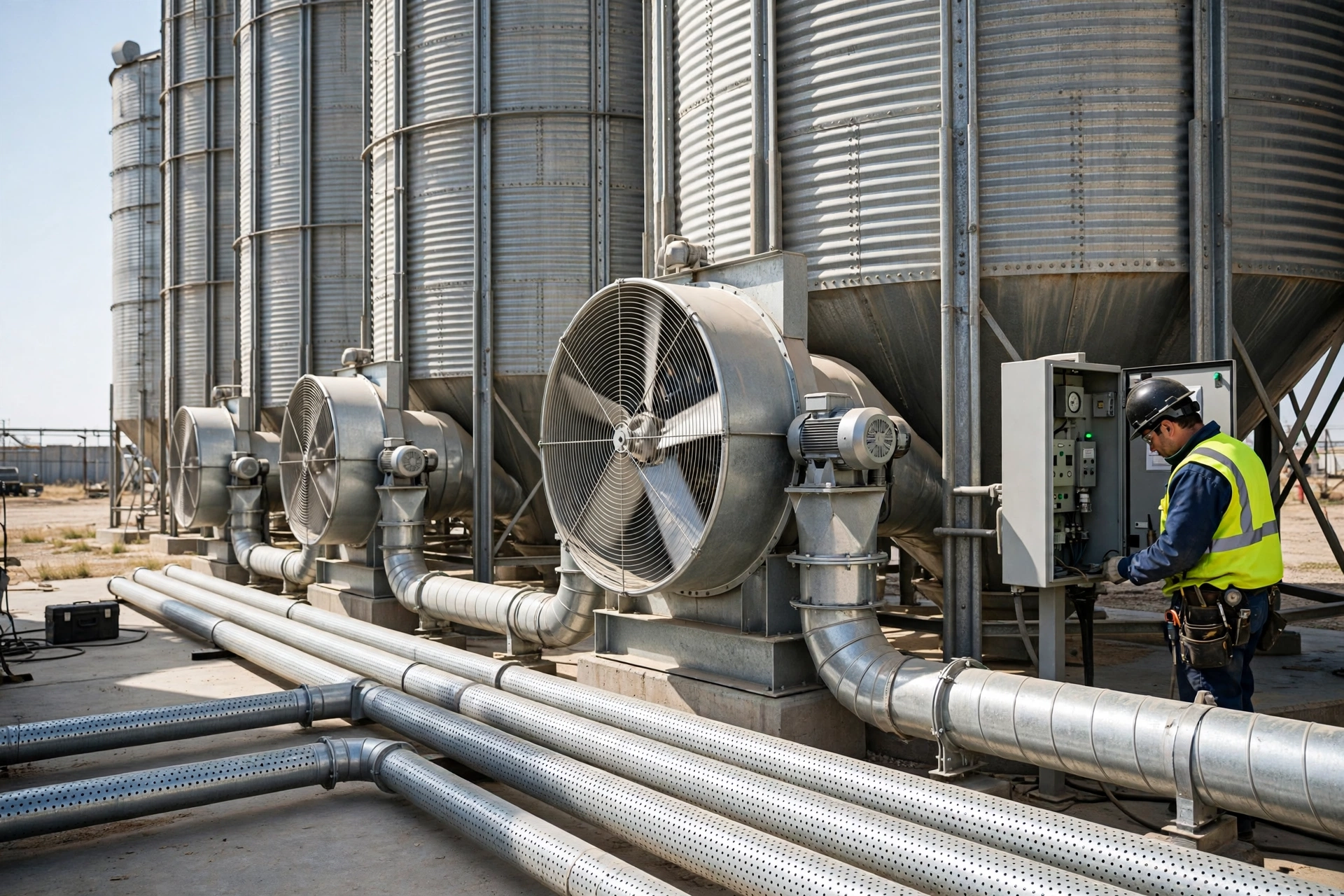
What Size Generator Does a Grain Silo Need?
The answer starts with a load list, not a catalogue page. Walk the site, write down every motor with its running kilowatts and its starting method, and add the loads that run together. Then apply three rules that catch most sizing mistakes in this industry.
First, separate the dryer heat from the electrical load. Drying a tonne of corn from 25% to 15% moisture takes 860,000 kJ of heat — 34 litres of propane — and only about 5 kWh of electricity. The generator carries the dryer fans at 45–75 kW for a 30 t/h dryer, not the megawatts of heat in the burner. A buyer who sizes the generator for the thermal rating buys a set five times too large and then runs it at 20% load, where wet stacking starts. The same applies to the boiler or the hot-air generator, which needs only its fans, pumps and controls — typically 10–20 kW — from the generator.
Second, size for the receiving peak, not the storage average. A silo’s average load understates the peak by a factor of five or more, because the receiving line runs only during harvest and intake, and it runs everything at once. When the bucket elevator starts under a full boot, the receiving conveyor is loaded and a dryer fan starts, the generator sees a step load of 50–100 kW in under a second. A set sized to the quiet-day average will dip voltage, and the variable-speed drives on the distributor are the first to trip on undervoltage. The correct figure is the coincident peak, plus a 20–25% margin for the next motor starting. The generator sizing guide gives the full method; the bands below are the shortcut for a first budget.
Third, decide the rating before the kVA. A grain terminal in a region with an unreliable grid that runs on generator power for several hours a week during harvest is on prime duty, not standby duty. ISO 8528-1 allows a standby-rated set 200 hours a year; a terminal that loses the grid for 40 hours a month passes that limit in five months. The standby and prime ratings decide whether the manufacturer will stand behind the set at that duty, and a prime rating is typically 10–15% lower in kVA than the standby rating of the same frame.
| Facility type | Storage | Typical critical load | Generator size |
|---|---|---|---|
| On-farm bins | 100–500 t | 5–15 kW | 10–30 kVA |
| Small commercial store | 1,000–3,000 t | 20–50 kW | 30–60 kVA |
| Mid-size terminal | 5,000–10,000 t | 80–180 kW | 100–250 kVA |
| Large terminal, dryer running | 20,000–50,000 t | 200–400 kW | 250–500 kVA |
| Full operation, 100 t/h intake + 30 t/h dryer | 10,000 t | ~180 kW | 250–300 kVA |
A worked sizing example: 10,000 tonnes in Kansas
Take a 10,000-tonne wheat terminal in Kansas, receiving at 100 t/h during harvest and drying at 30 t/h. The load list reads: two aeration fans 11 kW, bucket elevator 15 kW, receiving conveyor and distributor 12 kW, grain cleaner 10 kW, dust extraction 11 kW, dryer fans and controls 60 kW, load-out conveyor 7.5 kW, temperature monitoring and controls 1.5 kW, weighbridge, office and lighting 10 kW. Running load with the intake line and the dryer up together: 11 + 15 + 12 + 10 + 11 + 60 + 7.5 + 1.5 + 10 = 138 kW. That is the coincident load, not the nameplate total — and it is the load for full harvest operation, dryer included.
At 0.8 power factor, 138 kW is 173 kVA. Add a 20% margin for the next conveyor starting and for the next silo’s fan, and the requirement is 207 kVA. The correct order for full harvest operation is a 250 kVA prime-rated set. Most terminals do not order that. They order the storage-only set: aeration, monitoring, lighting and the load-out conveyor, with the receiving line and the dryer shed — about 40 kW, or 50 kVA, plus a 20% margin, which is a 60 kVA prime-rated set. A 100 kVA standby set, the figure a catalogue quote would most likely offer, covers the storage load with room to spare and fails on the first harvest day the grid drops during intake. The same arithmetic scales down: an on-farm store with a 5 kW coincident load needs a 10–30 kVA set, not the 5 kVA unit that looks adequate on a nameplate list.
What Happens in the First Hours of an Outage
The first ten seconds decide nothing. The first ten days decide the crop. The automatic transfer switch senses the loss, starts the set and transfers the load — typically 10 seconds from grid failure to generator power on a well-maintained system. What happens in those ten seconds matters less for a silo than for a press line: no machine is mid-cycle in the same way. What matters is what stops running for hours and days after, because grain spoilage is a slow failure with a fast price.
Aeration stops, and the moisture starts to move
The first casualty is the aeration fan, and the damage it causes is invisible for days. Warm grain respires: it gives off heat and moisture, and warm, moist air rises through the grain mass. When it reaches the cooler top layer, the air cools, loses its water-holding capacity, and the moisture condenses on the grain. That is moisture migration, and it is the mechanism that turns a sound store into a spoiled one. The Georgia publication is blunt about it: the moisture accumulation in the top layers of grain produces spoilage, and moving the air downward cools the upper layers first and reduces the possibility of moisture migration.
Aeration is the only defence, and it works slowly. At 0.1 CFM/bu, a cooling cycle takes about 120 hours — five days of continuous fan time. A silo that loses its fans for three days in a hot spell does not lose three days of cooling. It loses the cooling cycle, and the moisture that migrated in those three days does not migrate back when the fans restart. It stays in the top layer, where mould starts. A terminal that runs its aeration fans on the sheddable load — the logic being that the fans are small — has made the same mistake as the plywood mill that put its dryer fans on the sheddable load: the small load is the load that protects the large value.
The dryer stalls mid-batch
The second casualty is the dryer, and it is the most expensive one in the short term. A continuous-flow dryer at 30 t/h holds several tonnes of grain inside it at any moment — in the drying column, in the cooling section and in the discharge. When the fans stop, the air stops moving, and the grain nearest the burner keeps heating while the rest cools. The burner itself is a thermal machine: on a gas or propane burner it stops when the gas valve closes, but on a biomass or solid-fuel burner it keeps firing for minutes on its own inertia. The grain in the hottest section over-dries and cracks; the grain in the cold section stays wet. Both are downgraded.
The dryer cannot simply be restarted. The column must be emptied, the over-dried grain pulled, the moisture profile re-established, and the burner brought back to temperature — 30–60 minutes on a large dryer, and the batch that was in the column is lost. A terminal that loses the grid twice a week during harvest loses a full day a month to dryer restarts alone, and the grain that goes back through the dryer a second time costs fuel twice: 34 litres of propane per tonne, every time it is dried.
Receiving stops, and the trucks queue
The third casualty is the receiving line, and it is the one that costs money the same day. During harvest, trucks arrive every 10–15 minutes, and a 100 t/h intake line clears a truck in about 20 minutes. When the elevator and conveyors stop, the intake pit fills, the trucks queue on the yard and then on the road, and the harvest crews in the field keep cutting. A terminal that cannot receive grain during a four-hour outage does not lose four hours of intake. It loses the trucks that went to another terminal, the demurrage on the trucks that waited, and the field crews that stood idle. At harvest peak, a four-hour outage on a 100 t/h line is 400 tonnes of grain that arrived and could not be taken in — and in a wet harvest, that grain is sitting in trailers at 20–25% moisture, heating up while it waits.
Monitoring goes blind
The fourth casualty is the one nobody notices until it is too late. When the monitoring system loses power, the temperature cables stop reporting, and the hot spot that was growing at 0.5 °C a day grows without anyone watching. A hot spot starts small — a pocket of grain a metre across, a few degrees warmer than the grain around it — and spreads, because the heat it gives off drives moisture into the grain around it, which respires faster and gives off more heat. The FAO guidance on grain storage is that a three-dimensional grid of measuring points enables the early identification of hot spots, and that the cables must be fixed to the ground so the loaded grain does not move them. A silo that cannot monitor its grain is a silo that cannot tell a hot spot from a safe store, and the first sign of trouble is the smell at the load-out, when the damage is already done. The monitoring load is 0.5–2 kW. It belongs on the essential circuit with the fans, never on the sheddable load.
Three Sites, Three Outages
The numbers above are not theory. They are the shape of three real outage patterns that repeat across the grain belt, from Kansas to the Black Sea to Punjab.
Case 1 — Kansas, USA: the hot spot that grew for four days
A 5,000-tonne wheat store in western Kansas holds hard red winter wheat at 13% moisture in two flat-bottom steel silos, each with a 7.5 kW aeration fan. The store runs a 60 kVA standby set that covers the office, the lights and the weighbridge — not the fans. In July, a storm took the grid out for four days during a heat wave, with daytime temperatures above 38 °C. The fans stopped. The wheat in the top layer of each silo, which had been cooled to 12 °C in the spring, warmed to 28 °C in four days, and the moisture that migrated upward condensed on the top 30 cm of grain.
When the grid returned, the temperature cables showed a hot spot at 42 °C in the centre of one silo. The store ran the fans for 120 hours to pull the temperature down, but the damage was done: 180 tonnes of wheat in the top layer had gone musty and was downgraded from milling wheat to feed wheat, a loss of about US$9,000 at the price spread, plus US$1,800 in extra fan electricity and 6 hours of labour to turn the grain and re-check the cables. The store now runs a 100 kVA prime-rated set with the aeration fans and the monitoring system on the essential circuit, and the fans run on a temperature-based controller that starts them the moment the grain rises above 15 °C — with or without the grid.
Case 2 — Odesa, Ukraine: the terminal that could not receive
A grain terminal near Odesa handles 200,000 tonnes a year through eight silos and a 200 t/h receiving line: a 30 kW bucket elevator, two conveyors, a cleaner and a dust system, drawing about 70 kW while trucks are tipping. The terminal had a 150 kVA standby set that covered the office and the yard lighting. During the 2024 harvest, the grid failed for six hours at the peak of the wheat intake, with 40 trucks already on the yard and more arriving every 15 minutes.
The intake pit filled in 20 minutes. The trucks queued for three hours, then began leaving for a competing terminal 60 km away. The terminal lost 800 tonnes of intake that day — grain it never got back — and paid US$2,400 in truck demurrage. The wheat that waited in trailers at 22% moisture had to be dried a second time when it finally arrived, at 34 litres of propane per tonne. The terminal now runs a 500 kVA prime-rated set with the full receiving line on the essential circuit, and the intake pit has a 30-minute buffer: a second pit that holds one more truckload while the set takes the load.
Case 3 — Punjab, India: the dryer that cooked the paddy
A rice silo complex in Punjab runs a 30 t/h continuous-flow dryer on paddy at 22% moisture, drying to 13% for storage. The dryer fans draw 60 kW; the burner is propane. The complex had a generator, but the dryer fans were wired to the sheddable load — the logic being that the dryer was a thermal machine and the burner would keep it hot. When the grid failed for 45 minutes during a drying run, the fans stopped, the burner kept firing for 4 minutes on its own inertia, and the paddy in the hottest section of the column over-dried to 9% and cracked. 12 tonnes of paddy was downgraded from head rice to broken rice, a loss of about US$1,500, and the dryer lost 50 minutes emptying the column and re-establishing the temperature profile.
The fix cost less than the loss: the dryer fans and the burner controls were moved to the essential circuit, and the set was upsized from 200 kVA to 300 kVA to carry them. The complex also added a rule that has since become standard practice there: no dryer run starts unless the generator is fuelled, tested and on automatic start. A dryer that cannot finish its batch is a dryer that should not have started it.
The Grain That Cannot Heat: Hot Spots, Moisture and the Spoilage Clock
Grain spoilage is a clock, and the clock runs on temperature and moisture. Everything in this section is about reading that clock, because a silo manager who can read it knows whether an outage costs a day or a season.
Moisture migration in numbers
Safe storage is a narrow window. Wheat stores safely below 13–14% moisture and below 15 °C for six to twelve months. At 16% moisture and 25 °C, mould and insect activity start within weeks. The FAO figures put the loss of grain quantity by respiration alone at 0.5–3%, depending on temperature and moisture, and more than 80% of post-harvest losses are caused by weevils — insects that breed fastest in warm, moist grain. A hot spot is the point where all three drivers meet: warm grain, moist grain and insects, each feeding the next.
Moisture migration is the mechanism. Warm grain at the bottom of a silo respires, giving off heat and water vapour. The warm, moist air rises through the grain mass and hits the cooler top layer, where it cools and drops its moisture. The top layer, which was at 13% moisture when it was loaded, can reach 17–18% moisture in a matter of days if the fans are not running — and at 17% moisture, mould starts in days, not weeks. The Georgia publication’s advice is to reverse the airflow: moving the air downward cools the upper layers first and reduces the possibility of moisture migration. A silo that aerates upward in summer and downward in winter is managing the moisture, not just the temperature.
The hot spot, hour by hour
A hot spot starts as a pocket of grain a metre across, 2–3 °C warmer than the grain around it. The cause is usually a small patch of higher-moisture grain — a wet load that was not blended, a leak in the roof, or fines that settled in one place and hold moisture. The pocket respires faster than the grain around it, giving off heat and moisture. The moisture moves into the grain around the pocket, which then respires faster too. The pocket grows. At 30 °C, insect activity doubles. At 40 °C, the grain starts to cake. At 50 °C, the grain is spoiled and the pocket has grown to several tonnes.
The temperature cables are the only way to see it coming. A three-dimensional grid of probes, read daily, shows a hot spot as a single sensor rising 0.5–1 °C a day while its neighbours stay flat. The countermeasure is aeration: run the fans, pull the temperature down, and turn the grain if the spot does not respond. A silo that reads its cables daily catches a hot spot at 25 °C and loses nothing. A silo that reads them weekly catches it at 40 °C and loses the pocket. A silo that cannot read them at all — because the monitoring system has no power — catches it at the load-out, and loses the silo.
Dust: the explosion the generator must not cause
A grain silo is also a dust-explosion hazard, and the generator installation must respect it. Grain dust, flour, starch and most feed ingredients are combustible dusts, and the inside of silos, bins, bucket elevators, conveyors, mills and dust filters is normally a dust hazardous area. Under IEC 60079-10-2, the silo interior, the elevator legs and the inside of any dust duct are Zone 20 — an explosive dust cloud present continuously or for long periods. Fill points, discharge boots and bagging stations are Zone 21, where clouds form occasionally in normal operation. The area outside the silo, around vents, flanges and inspection hatches where dust layers settle, is Zone 22.
The numbers behind the zones are severe. Grain dust typically runs a Kst of 70–150 bar·m/s and a maximum explosion pressure of 8–9 bar, with a minimum ignition energy of 30–100 mJ — a spark from a bearing, a hot surface or a static discharge is enough. About 70% of grain silo explosions are triggered by mechanical sparks from bucket elevators or faulty bearings, and 60% of silo explosion incidents involve neglected housekeeping: dust layers thicker than 0.8 mm are explosive. The history is written in death tolls: Westwego, Louisiana in 1977, 36 dead; Blaye, France in 1997, 11 dead; the Imperial Sugar refinery in Port Wentworth, Georgia in 2008, 14 dead — a sugar dust event, but the same mechanism, a primary explosion in a conveyor that shook settled dust off every beam and ledge and fed a secondary explosion an order of magnitude more violent.
The generator’s part in this is placement and protection. The set must not sit inside a Zone 21 or Zone 22 area, and its exhaust and its radiator discharge must not blow hot air or sparks toward a dust source. Electrical equipment in the zones must be ATEX Category 1D, 2D or 3D to match Zones 20, 21 and 22, and in the United States the framework is NFPA 61 for agricultural and food processing facilities, now consolidated into NFPA 660 in 2025, with a dust hazard analysis required. The dust extraction system is the safety load that makes the rest of it work: it keeps the dust out of the air, and it must be on the essential circuit. A generator that cannot carry the dust system is a generator that cannot safely restart the plant — the same rule that applies in a plywood mill, a flour mill and a feed mill.
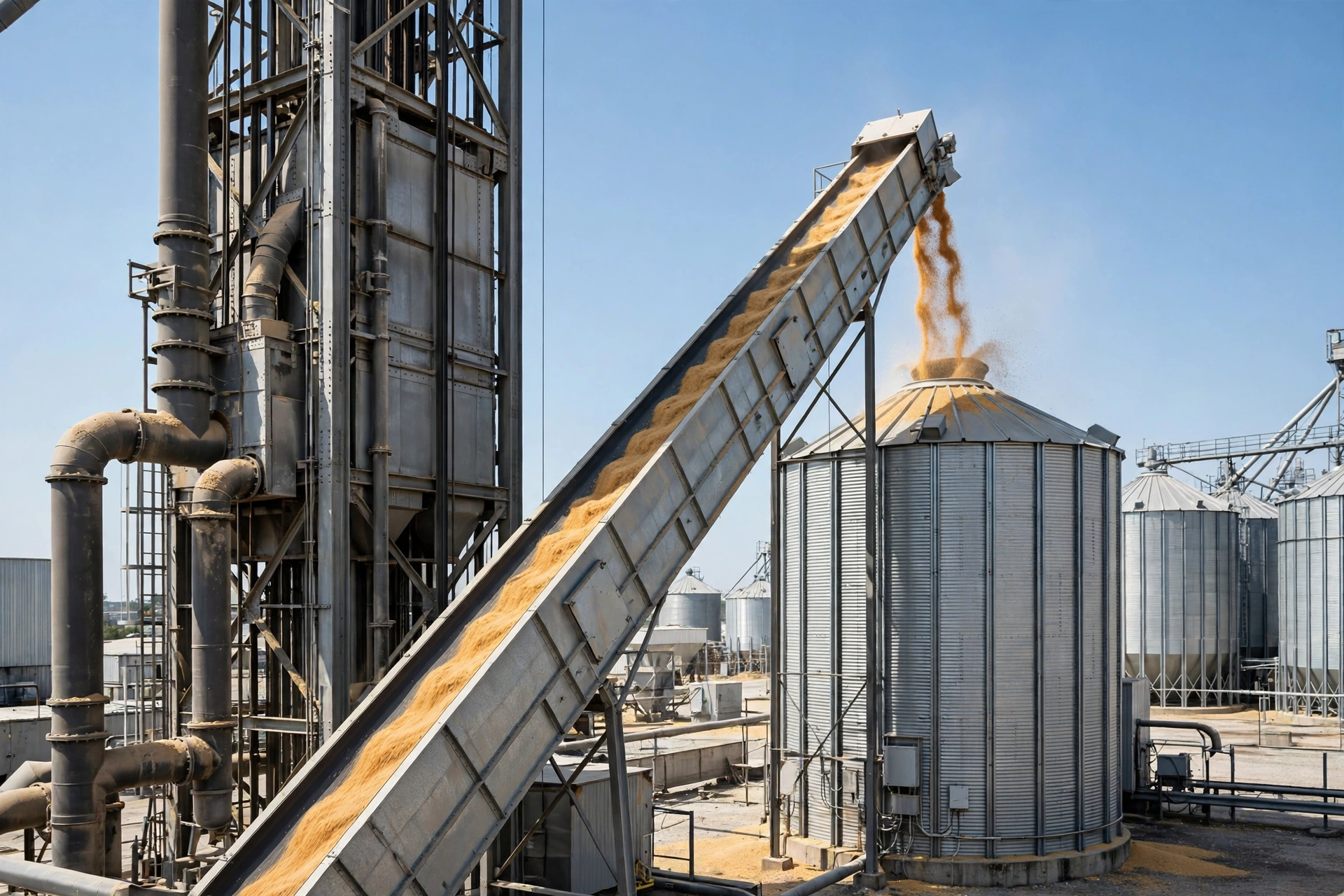
How Long Can a Grain Silo Run on a Generator?
The answer is a fuel calculation, not a guess. A grain terminal that runs on generator power through a harvest outage burns fuel at industrial rates, and the tank that looks generous on paper runs dry in the middle of the second day.
A diesel set burns roughly 0.26 litres per kWh at full load. The Cummins C500D5 datasheet — 500 kVA standby / 455 kVA prime — lists 93.2 L/h at full prime load, 69.9 L/h at 75% load and 49.0 L/h at 50% load. The table below applies that consumption rate to the set sizes a grain silo actually orders, at the 75% load a well-sized set runs at.
| Set size | Load at 75% | Fuel use | 8 hours | 24 hours | 72 hours |
|---|---|---|---|---|---|
| 60 kVA prime | 36 kW | ~9.4 L/h | ~75 L | ~225 L | ~675 L |
| 150 kVA prime | 90 kW | ~23 L/h | ~185 L | ~560 L | ~1,680 L |
| 250 kVA prime | 150 kW | ~39 L/h | ~310 L | ~940 L | ~2,810 L |
| 500 kVA prime | 273 kW | 69.9 L/h | ~560 L | ~1,680 L | ~5,030 L |
| 800 kVA prime | 480 kW | ~125 L/h | ~1,000 L | ~3,000 L | ~9,000 L |
A mid-size terminal on a 250 kVA set burns about 310 litres in an 8-hour shift. A standard 1,000-litre day tank lasts about three shifts. A 5,000-litre bulk tank lasts about 16 shifts — roughly a week of single-shift running, or five days at two shifts a day. A terminal that wants 72 hours of autonomy on a 250 kVA set needs roughly 2,800 litres of stored fuel. The fuel must also be fresh: diesel in a standby tank absorbs water, grows microbes and goes stale, and diesel fuel ageing is the most common reason a set that starts perfectly on its weekly test fails on the day it matters. A terminal in a hot, humid climate should polish its fuel every 6 months and test it every 3 months — and the fuel supplier should be on a contract that delivers within 24 hours, because a 72-hour tank is useless if the refill takes a week.
The operating cost is straightforward. At a delivered diesel price of US$1.00–1.20 per litre in most of Southeast Asia, Africa and South America, a 250 kVA set at 75% load costs about US$39–47 an hour in fuel. A 10-hour outage costs US$390–470 in fuel — against US$9,000 in downgraded wheat from a single hot spot, or US$2,400 in truck demurrage from a single missed intake day. The generator is not the expensive option. The outage is.
Fuel storage that survives the outage
Three rules govern the fuel installation. First, the day tank must be sized for the longest single outage the terminal expects, plus a margin — 8 hours of fuel in the day tank is the minimum for a terminal that runs two shifts, and the transfer pump that fills it from the bulk tank must be on the essential circuit, not the sheddable load. Second, the bulk tank must be bunded: a 110% secondary containment bund is the standard in most jurisdictions, and a spill from a 5,000-litre tank without a bund is an environmental incident, not a housekeeping problem. Third, the fuel must be tested. Water in the tank bottom feeds microbes, microbes make sludge, sludge blocks filters, and a blocked filter at 3 a.m. during a storm outage is the most common cause of a set stopping mid-outage. A maintenance schedule that includes a monthly fuel-water check and a quarterly fuel sample costs almost nothing and catches the failure before it happens.
Frequently Asked Questions
What size generator does a grain silo need?
An on-farm store at 100–500 tonnes needs 10–30 kVA, a small commercial store at 1,000–3,000 tonnes needs 30–60 kVA, a mid-size terminal at 5,000–10,000 tonnes needs 100–250 kVA, and a large terminal at 20,000–50,000 tonnes with a dryer running needs 250–500 kVA. The aeration fans, the bucket elevator and the dryer fans are the loads that decide the size; the dryer heat is propane or gas, not electric.
Do grain silos need a backup generator?
Yes, if the store holds grain through a hot season or receives grain during harvest and the grid fails more than a few times a year. A single four-day outage in a heat wave can grow a hot spot that downgrades 180 tonnes of wheat, and a single missed intake day costs US$2,400 in truck demurrage. The generator also carries the dust extraction system, which is a life-safety load that must never be shed.
How long can a grain silo run on a generator?
As long as the fuel lasts. A 250 kVA set at 75% load burns about 39 L/h, so a 1,000-litre day tank gives roughly 25 hours and a 5,000-litre bulk tank gives about five days at two shifts a day. The practical limit is the fuel contract, not the engine: a prime-rated set can run indefinitely at variable load if it is fuelled, serviced and load-banked.
What happens to a grain silo during a power outage?
The aeration fans stop and moisture migrates to the top layer of grain, the dryer stalls mid-batch and the grain in the column over-dries or stays wet, the receiving line stops and trucks queue or leave for another terminal, and the temperature monitoring goes blind so a hot spot grows unseen. A 10,000-tonne terminal typically loses US$2,000–9,000 per outage in downgraded grain, demurrage and re-drying, plus the restart time.
Can a diesel generator power a grain silo?
Yes. A grain silo is a standard industrial motor load: aeration fans, bucket elevators, conveyors, dryer fans and dust extraction, all three-phase, all within the capability of a prime-rated diesel set from 10 kVA for an on-farm store to 500 kVA for a large terminal. The set must be sized for the receiving peak and the motor starting surge, the dust extraction must be on the essential circuit, and the set must be placed outside the ATEX dust zones.
Specification Checklist: Before You Order the Set
- Load list first. Walk the site and record every motor with running kW and starting method. Size for the receiving peak, not the storage average, and add 20–25% margin.
- Separate dryer heat from electric. Dryer heat is propane, gas or biomass. The generator carries fans, drives and controls only — do not size for the thermal rating.
- Choose the rating. More than 200 hours a year on generator power means prime duty under ISO 8528-1. A standby-rated set run as prime loses its warranty and its engine.
- Put the aeration fans, the monitoring system and the dust extraction on the essential circuit. The receiving line and the dryer can be shed in storage mode, but never the fans, the cables and the extraction system.
- Fit a 30-minute intake buffer. A second intake pit holds one more truckload while the set takes the load, so a transfer gap does not stop receiving. Size the fuel for 72 hours. A 250 kVA set needs about 2,800 litres for three days at 75% load. Bund the bulk tank at 110% and polish the fuel every 6 months.
- Plan the motor starts. Elevator, conveyors and dryer fans on soft starters or star-delta cut the starting surge by half or more and let a smaller set carry the same terminal. The motor starting method is the cheapest kVA on the site.
- Place the set outside the dust zones. The silo interior and the elevator legs are Zone 20, the fill points are Zone 21, and the vents are Zone 22. The generator, its exhaust and its radiator discharge must not sit inside a zone or blow toward a dust source.
- Contract the fuel and the service. A fuel supplier that delivers within 24 hours, a service visit every 250 hours or 6 months, and a monthly load-bank run at 80% load keep the set ready — and with remote monitoring, the terminal manager can watch the set from another country and catch a low-fuel or high-temperature alarm before it becomes a stop.
- Test the whole system, not the set. A monthly test that transfers the real load — fans, elevator and dryer — proves the automatic transfer switch, the set and the load shedding all work together. A set that has never carried the receiving line is a set that has never been tested.
A grain silo buys a generator for one reason: the grain cannot wait for the grid. Size the set for the receiving peak, the aeration fans and the dust system, rate it for the hours it will actually run, and fuel it for the outage that lasts three days, not three hours. For a load list and a prime-rated set sized to the terminal’s real coincident load, contact PAVO — the PAVO team sizes generator sets for grain silos, terminals and storage facilities across Southeast Asia, Africa and South America, and will quote the set, the transfer switch and the fuel system as one package.