

What Size Generator Does a Corrugated Plant Need? | PAVO
In a corrugated packaging plant, the grid does not fail at a convenient hour. It fails in the middle of a production run, with board in the double facer and a truck waiting at the dock.
What size generator does a corrugated packaging plant need? A sheet plant that only converts board typically needs a 250–400 kVA set, an integrated plant with its own corrugator needs 500–1,000 kVA, and a large integrated plant with two corrugators needs 1,000–2,000 kVA. The corrugator’s steam boiler and motor starts, not the running load, usually decide the size.
- What a Corrugated Packaging Plant Actually Loads
- The Double-Facer Window: Why the First Minutes Decide the Board
- Sizing by Plant Size
- Three Plants That Lost Power — and What It Cost
- Fuel Autonomy: How Long a Corrugated Plant Can Run on a Generator
- Power Quality, Paper Dust and Placement
- Frequently Asked Questions
- Specification Checklist
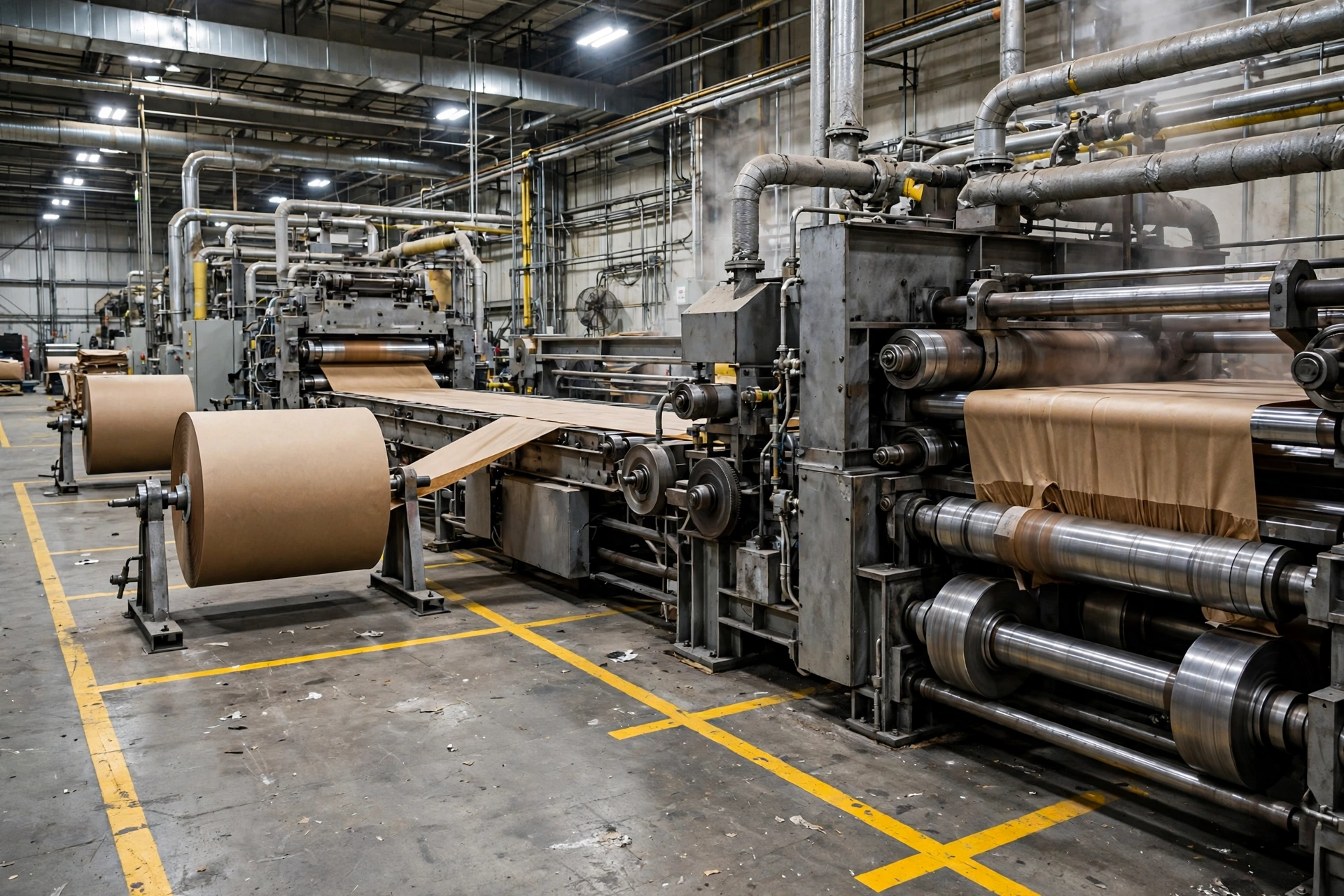
What a Corrugated Packaging Plant Actually Loads
A corrugated packaging plant’s electrical load looks nothing like a warehouse’s. There is no single big machine that dominates the bill. Instead the load is a stack of medium-sized machines and one large heating plant, and the heating plant is the part that cannot stop. The world produced about 152 million tonnes of corrugated boxes in 2024, worth $271.9 billion, and Europe alone made 49 billion square metres of board across 537 plants — so the load profile below is not a corner case. It is the daily reality of an industry that runs on thin margins and tight delivery windows.
The load is also unusual in a way that matters for generator sizing: most of it is motors and steam, not electronics. The corrugator is a line of driven rolls, vacuum fans and pumps. The converting floor is servo-driven print and cutting machines. The boiler is a gas or oil burner with its own fans and pumps. That mix is forgiving on a generator in one respect — there is little sensitive electronics to protect — and demanding in another: the load is dominated by motor starts and a steam plant that cannot be allowed to cool. A voltage dip that a computer would ride through without noticing can stall a corrugator web, break a paper reel and leave a hundred metres of board jammed in the dry end. The paper that feeds the corrugator comes from paper mills, and the same outage that stops a corrugator stops a paper machine — the two plants share the same problem at different points in the same supply chain.
The corrugator wet end
The wet end is where paper becomes board, and it is the heart of the plant’s load. A modern corrugator is a line 100 metres or more long that takes paper reels and produces finished board at 100–400 m/min, depending on the line. The largest lines run at web widths of 1,400–2,800 mm. A complete high-speed line from BHS or Fosber represents an investment of ₹15–60 crore — roughly $1.7–$7 million — and the generator that backs it up has to be sized for a machine that costs more than the building it sits in.
The wet end’s electrical load is a collection of driven rolls and fans rather than one big motor. A single-facer unit — the section that forms the flute and glues it to the first liner — draws 50 kW on a small 1,400 mm semi-automatic machine, and the drives scale up from there. A full 3-ply line at 1,800 mm width carries about 150 kW of installed electrical power and draws roughly 80 kW at full production speed. The main corrugating-roll drive is a 22 kW frequency-controlled motor, the suction fan is 11 kW, and the glue pump, bridge adsorption fan and reel-stand lifts add a further 10–15 kW between them. None of these is large on its own. Together, with the preheaters, the web tension controls and the steam condensate system, the wet end draws 80–200 kW depending on the width and speed of the line.
The wet end is also where the plant’s product is most exposed. A corrugator running at 300 m/min produces 5 metres of board every second. If the power fails at full speed, the web stops, the paper in the single facer cools on the roll, and the starch glue that was mid-bond sets wrong. The board that was in the machine at the moment of the failure is waste, and the line needs 30–60 minutes to warm up, re-thread and get back to saleable board even after the power returns. The loss is not the electricity. It is the board, the paper and the order.
The dry end and the steam boiler
The dry end is where the board is finished, and it is where the steam plant lives. After the single facer, the board passes through the double facer — a run of steam-heated hot plates, typically 185 psig at 370°F (about 1.28 MPa at 188°C) on older American lines, or 1.0–1.1 MPa saturated steam at around 180°C on modern European and Asian lines — where the second liner is bonded and the starch is gelatinised and dried. The double facer is the thermal heart of the line, and it is the section that cannot be allowed to cool with board inside it.
The steam for the whole line comes from a boiler, and the boiler is the largest single electrical load in many plants — not because of the burner, but because of everything around it. A 3-ply line at 1,800 mm width needs 1,500–2,000 kg/h of steam at 0.8–1.1 MPa, which means a boiler of roughly 4,000 kg/h capacity to cover the corrugator plus the glue kitchen and the building heat. The boiler’s own electrical load is modest — feed pumps, combustion-air fan, fuel pump and controls draw 15–40 kW between them — but the boiler is a thermal load, and a thermal load has a memory. A boiler that trips on a power failure needs 20–40 minutes to come back to pressure, and a corrugator that restarts before the steam is back produces board that delaminates on the customer’s shelf. The generator has to carry the boiler’s auxiliaries from the first second, or the whole restart waits for the boiler.
The dry end’s electrical load is smaller but no less critical. The slitter-scorer that cuts the board to width, the cut-off knife that cuts it to length, and the stacker that piles it for the converting floor draw 20–40 kW between them. These are servo and inverter-driven machines, and they are the machines that decide whether the board that leaves the corrugator is the right size. A slitter that loses power mid-cut leaves a board width that is wrong by the length of the cut, and a stacker that stops mid-lift drops a pile of board on the floor.
Converting: flexo folder-gluers and die cutters
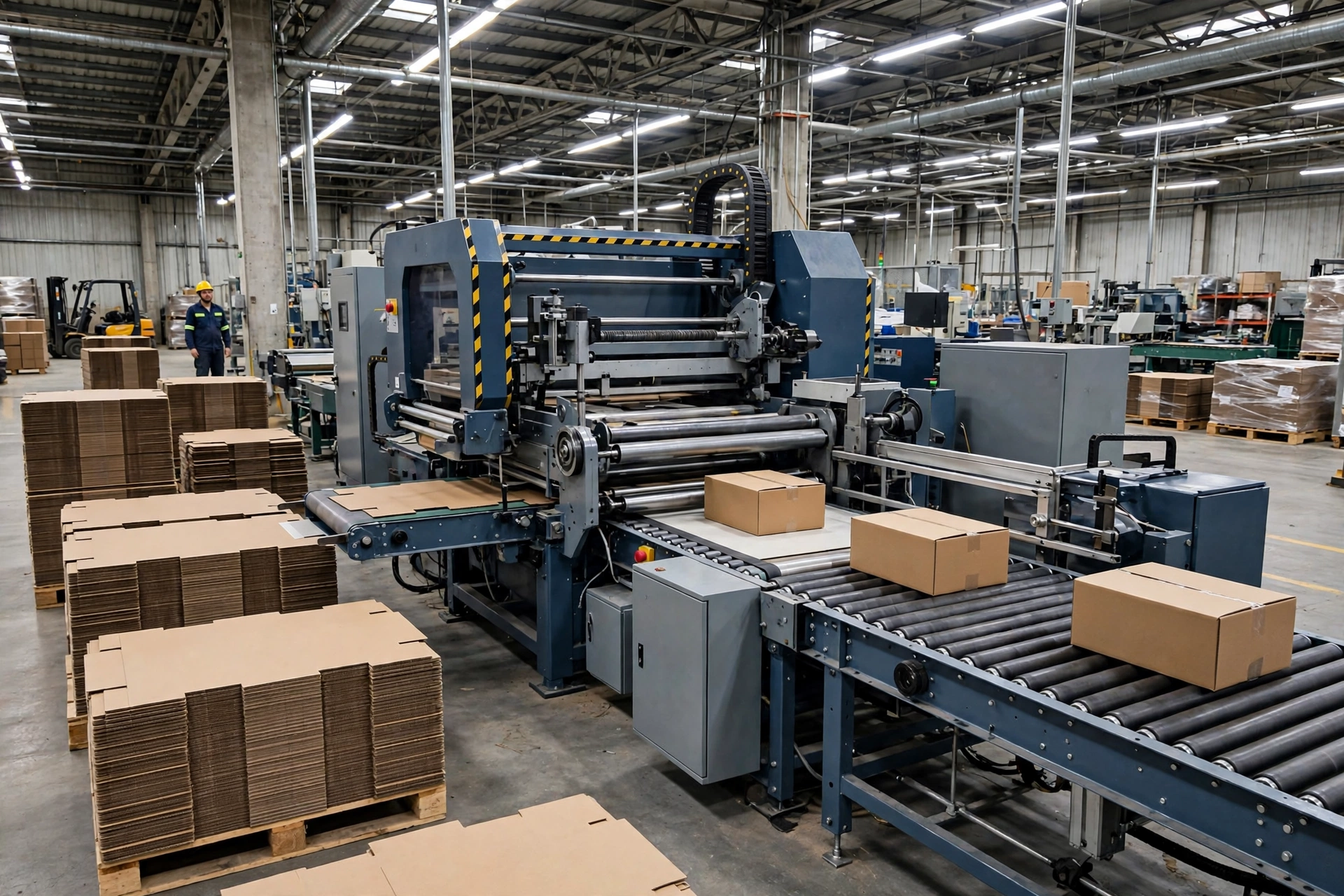
Converting is where board becomes boxes, and it is where most of the plant’s machines live. A flexo folder-gluer (FFG) prints, slots, die-cuts, folds and glues a flat box blank in a single pass, and a modern servo FFG running at 600 sheets/min draws 85–110 kW. A smaller 4-colour flexo printer slotter die cutter draws 45–75 kW, and a basic 1,400 × 2,800 mm printer slotter draws 30–40 kW. A folder gluer on its own needs 12 kW, and a rotary die-cutting unit needs 15–45 kW depending on the size and speed. A converting floor with two FFGs, a die cutter and a stitcher draws 150–300 kW at full production, and every one of those machines is a servo-driven line that stops the instant the power stops.
The converting floor is also where the plant’s money is most exposed. A mid-size corrugated box plant running 15–20 SKUs per shift loses $800–$2,400 per hour of unplanned downtime, according to 2026 operational benchmarks reported by PMMI, the Association for Packaging and Processing Technologies. That figure is the lost production alone. It does not count the board that was in the machines when the power failed, the ink that dried on the printing plates, or the order that shipped late and cost the customer a retail promotion. A flexo line that stops mid-run leaves ink drying on the anilox rolls and the printing plates, and a plate that has dried ink on it has to be washed and re-mounted before the line can run again — 30–60 minutes of work that no generator can shorten. The register and ink questions are the same ones printing plants deal with on every job, and the same generator rules apply.
Compressed air, dust extraction and the rest
The load that surprises first-time buyers is not on the production floor at all. It is in the plant room. A corrugated plant runs on compressed air, and compressed air is electric. Vacuum feeders on the flexo lines, air knives, pneumatic clamps and the glue kitchen’s air-operated valves all run on air at 0.5–0.7 MPa (5–7 bar). A mid-size plant’s screw compressor draws 22–37 kW, and a larger plant’s compressor draws 55–75 kW. A flexo line with power but no compressed air is as idle as a line with no power at all, so the compressor has to be on the essential bus with the machines it serves.
Dust extraction is the second utility load, and it is the one with a safety dimension. Corrugated plants generate paper dust at the slitter, the trim chopper and the die cutters, and the extraction fans that keep that dust out of the air draw 15–30 kW. The load is not comfort. Paper dust is combustible, and a plant that loses its extraction while the machines are still running is accumulating the fuel for a dust fire. The fans have to run whenever the machines run, and on a generator they have to start with the machines, not after them.
The rest of the plant is small by comparison but still matters. The glue kitchen — starch, borax, caustic and water mixed and held at temperature — draws 5–15 kW. The paper reel handling, the automatic reel stands and the warehousing conveyors draw 10–25 kW. The offices, the laboratory and the quality-control instruments draw 5–10 kW. Together the utilities add 80–150 kW to a mid-size plant’s essential load, and they are the loads most often forgotten when a plant owner sizes a generator by adding up the nameplates on the production floor.
The Double-Facer Window: Why the First Minutes Decide the Board
A corrugator is a live thermal process, and that is what makes a power cut in a corrugated packaging plant different from a power cut anywhere else. When the power fails in a warehouse, the lights go out and the work stops. When the power fails in a corrugator during a run, the board does not stop being half-made. The starch is part gelatinised, the liners are part bonded, and the board keeps changing while nobody can do anything about it.
The numbers are unforgiving. A double facer holds the board between steam-heated hot plates and a pressure belt for 20–60 seconds, depending on the speed and the grade. The starch adhesive needs to reach its gelatinisation temperature — roughly 60–70°C in the glue line, driven by hot plates at 170–180°C — and then dry. If the power fails while board is in the double facer, the heating stops but the board stays in the hot plates. The board that was in the machine at the moment of the failure is scorched, delaminated or warped, and there is no way to save it. The only question is how much board is in the machine, and at 300 m/min the answer is a lot of board.
What starch gelatinisation actually is
Starch adhesive is a suspension of dry starch in water, mixed with a little borax and caustic soda in the glue kitchen. It has no strength at all until it is heated. When the glue line reaches its gelatinisation temperature, the starch granules swell, burst and form a gel that bonds the flute tips to the liner. After the starch gelatinises, the heat dries the bond and the board leaves the double facer as a rigid sheet. The whole sequence — penetration, gelatinisation, drying — has to happen in the right order and at the right temperature. If the starch gelatinises before it has penetrated the paper fibres, the bond fails and the liner peels off. If it never reaches temperature, the bond never forms at all.
That sequence is why the double facer is so sensitive to a power cut. The hot plates are heated by saturated steam at 1.0–1.1 MPa, and the steam flow stops the instant the boiler’s feed pumps and fans lose power. The plates themselves hold heat for a few minutes — they are cast iron, and a cast-iron plate at 180°C does not cool in seconds — but the pressure belt stops, the board stops moving, and the board that is sitting on the plates keeps absorbing heat in one place. The result is a section of board that is over-dried on one side, scorched on the other, and warped beyond use. The corrugator’s own control system will dump the board and purge the line on restart, but the board that was in the double facer is already lost.
What happens to the board in the hot plates
The damage window is measured in minutes, and the plant has no control over it once the power is gone. The board in the double facer is typically 15–30 metres long, depending on the length of the hot-plate section. At a production speed of 300 m/min, that is 3–6 seconds of production — but it is 15–30 metres of board that has to be cut out and scrapped, plus the board in the single facer, the bridge and the wet end that was mid-bond when the line stopped. A typical stop at full speed wastes 50–100 metres of board before the line is purged and re-threaded, and a full re-thread and warm-up takes 30–60 minutes even with an experienced crew.
The waste is not only board. A stop mid-run leaves starch glue drying on the corrugating rolls, the glue rolls and the applicator. The glue that was on the rolls when the power failed sets hard, and the rolls have to be cleaned before the line can run again. A single-facer roll that has dried starch on it produces board with a weak bond until it is cleaned, and a roll that is cleaned badly produces board with crushed flutes. The restart is not a matter of pressing a button. It is a matter of cleaning, re-threading, warming up and running 100–200 metres of board to waste before the first saleable sheet comes off the stacker.
| Double-facer stage | Temperature | Time in stage | What happens if power fails here |
|---|---|---|---|
| Preheat rolls | 150–170°C | 10–20 seconds | Paper cools slowly, web survives, line can be re-threaded |
| Single facer bond | 170–180°C | 5–10 seconds | Starch sets mid-bond, flute tips unglued, board delaminates |
| Double facer hot plates | 170–180°C | 20–60 seconds | Board scorches and warps on the plates, 15–30 m scrapped |
| Cooling and cutting | 25–40°C | 10–20 seconds | Board stops mid-cut, slitter leaves a wrong-width section |
The restart that costs more than the stop
The restart is where the money goes. A corrugator that has stopped at full speed does not restart at full speed. The line has to be warmed up, the steam has to come back to pressure, the glue has to be re-applied, and the board has to be run to waste until the bond strength is back to specification. A typical restart takes 30–60 minutes and wastes 100–200 metres of board, and that is for a clean stop with an experienced crew and a generator that started on time. A stop that also took out the boiler, the compressed air and the dust extraction takes longer, because each of those systems has its own restart sequence and its own warm-up time.
The cost of a restart is easy to count and hard to accept. A mid-size plant running 15–20 SKUs per shift loses $800–$2,400 per hour of unplanned downtime, and a two-hour outage with a one-hour restart costs the plant $2,400–$7,200 in lost production alone. The board waste adds $200–$500 in paper and starch. The late order adds a penalty, a lost promotion or a lost customer, and none of those appear on the generator’s price tag. The generator is not bought to keep the lights on. It is bought to keep the board moving, and the board moves only if the generator starts in seconds and carries the whole line, not just the lights.
Sizing by Plant Size
Sizing a generator for a corrugated packaging plant starts with a decision that has nothing to do with kilowatts. It starts with deciding what the generator has to keep running. A plant that sizes its generator for the lights and the offices will discover, on the first outage, that the corrugator stopped, the boiler tripped and the board in the double facer is waste. A plant that sizes its generator for the whole production line will discover, on the first outage, that the line kept running and the order shipped on time. The difference between those two outcomes is the difference between a generator that was sized for the building and a generator that was sized for the business.
The table below gives the sizing bands that work in practice. The running load is the load the plant draws at full production. The recommended set is the standby rating that covers that load with the motor starts and the boiler’s auxiliaries included, and with the 10% overload rule kept in reserve for the corrugator’s starting surge. The full method for adding up a plant’s loads is covered in the generator sizing guide, and the motor starting rules for the corrugator’s drives are the same rules that govern any large motor start. The bands are for a plant running at 50 Hz, 400 V, which is the standard for most of the world outside North America.
| Plant type | Typical output | Running load | Recommended standby set |
|---|---|---|---|
| Sheet plant (converting only) | 5,000–15,000 boxes/day | 120–250 kW | 250–400 kVA |
| Integrated plant, one corrugator | 30–80 t board/day | 300–600 kW | 500–1,000 kVA |
| Integrated plant, two corrugators | 80–150 t board/day | 600–1,200 kW | 1,000–2,000 kVA |
| Large integrated plant, 2,500 mm line | 150–250 t board/day | 1,200–2,000 kW | 2,000–3,000 kVA |
Sheet plants
A sheet plant buys board from a corrugator and converts it into boxes. It has no wet end, no boiler and no steam, and that makes it the simplest plant to size. The load is the converting floor — one or two flexo folder-gluers, a die cutter, a stitcher and a folder gluer — plus compressed air, dust extraction and the warehouse. A typical sheet plant running one FFG at 600 sheets/min draws 85–110 kW on the FFG, 30–40 kW on the printer slotter, 15–30 kW on the die cutter and 22–37 kW on the compressor, for a total running load of 120–250 kW. A 250–400 kVA standby set covers that load with room for the motor starts, and a 312 kVA set is the size most sheet plants actually buy — a Weichai-powered silent set at that rating is a common export configuration, and it leaves the plant with a set that can run the whole floor, not just the lights.
The sheet plant’s sizing mistake is usually the opposite of the integrated plant’s. A sheet plant that sizes its generator for the FFG alone forgets the compressor, and a flexo line with power but no compressed air is as idle as a line with no power at all. The compressor has to be on the essential bus, and it has to be started before the FFG, because the FFG’s vacuum feeders need air before the first sheet can be fed. A sheet plant that sizes its generator for the whole floor, compressor included, restarts in minutes. A sheet plant that sizes it for the machines alone restarts in hours.
Integrated corrugator plants
An integrated plant makes its own board and converts it, and the corrugator is the load that decides the set. A single corrugator at 1,800 mm width draws 80 kW at full production speed on the line itself, and the boiler’s auxiliaries, the glue kitchen, the slitter, the cut-off knife and the stacker add a further 60–100 kW. The converting floor adds 150–300 kW on top of that, and the utilities add 80–150 kW. A plant running 30–80 tonnes of board a day — the range a BHS SMART line is built for — draws 300–600 kW at full production, and a 500–1,000 kVA standby set covers it.
The corrugator’s starting surge is the number that decides the size. A corrugator does not start all at once. The main drive, the suction fan, the glue pump and the bridge fans start in sequence, and each one draws 5–7 times its running current for the first few seconds. A 22 kW corrugating-roll drive draws 110–150 kVA on start, and a 55 kW induced-draft fan on the boiler draws 275–385 kVA on start if it is started direct-on-line. A set that is sized for the running load alone will stall on the first motor start, and the corrugator will never get to speed. The set has to be sized for the starting sequence, not the running load, and the starting sequence has to be written down and tested — not assumed.
Large integrated plants
A large integrated plant with a 2,500 mm line running at 300–400 m/min is a different machine altogether. The corrugator alone draws 200–400 kW, the boiler needs 4,000–6,000 kg/h of steam, and the converting floor runs three or four FFGs at 85–110 kW each. A plant of this size draws 1,200–2,000 kW at full production, and a 2,000–3,000 kVA standby set is the size that covers it. At this size the set is usually a containerised unit or a pair of paralleled sets, and the plant’s electrical design has to include load shedding — a controlled sequence that starts the corrugator and the boiler first, and brings the converting floor up in stages as the load allows.
The honest limit has to be stated. A plant that draws 2,000 kW at full production cannot be backed up by a single small set, and a plant that tries will discover the limit on the first outage. The generator is sized for the essential load — the corrugator, the boiler, the compressed air and one converting line — not for the whole plant at full production. The rest of the plant is shed, and it is shed by design, not by accident. A plant that writes its load-shedding sequence into the generator’s control system restarts in a controlled order. A plant that does not writes its load-shedding sequence into the outage itself, and the outage is not a good place to make that decision.
Three Plants That Lost Power — and What It Cost
The sizing bands above are not theory. They are what three plants learned the expensive way, and each one learned a different lesson. The first learned that a generator sized for the lights does not save the board. The second learned that a boiler that is not on the essential bus takes the whole restart with it. The third learned that a generator that is never tested is a generator that does not start.
A sheet plant outside Chennai
A sheet plant outside Chennai runs two flexo folder-gluers and a rotary die cutter, converting board bought from a corrugator forty kilometres away. The plant’s grid supply is unreliable in the summer, when the local distribution network is loaded to its limit, and the plant had a 250 kVA set that was sized, on paper, for the whole floor. The set was bought for the lights and the offices, and the FFGs were added to the essential bus later, without anyone re-checking the load.
The outage came on a Tuesday afternoon, in the middle of a run of 12,000 printed boxes for a consumer-goods customer with a promotion starting on Friday. The grid failed, the set started, and the FFGs came up — but the compressor did not, because it had never been put on the essential bus. The FFGs had power and no air. The vacuum feeders could not feed a sheet, the pneumatic clamps could not clamp, and the lines stood idle while the generator ran at 30% load and the order slipped by a day. The plant lost $1,600 in production, using the PMMI benchmark of $800–$2,400 per hour for a mid-size plant, and it lost the promotion slot — the customer moved the order to a competitor for the next quarter. The fix cost nothing: the compressor was moved onto the essential bus, the load was re-checked, and the set was re-rated from 250 kVA to 312 kVA to cover the compressor’s starting surge. The plant has not lost an order to a power cut since.
An integrated plant in Guangdong
An integrated plant in Guangdong runs a 2,200 mm corrugator at 250 m/min and two flexo lines, producing about 60 tonnes of board a day for the electronics and consumer-goods factories of the Pearl River Delta. The plant had a 750 kVA set that covered the corrugator, the converting floor and the utilities — on paper. The boiler was not on the essential bus. It was on the mains, because the boiler’s burner and fans were wired to the plant’s main switchboard and nobody had moved them when the generator was installed.
The outage came at 2 a.m., in the middle of a night shift. The grid failed, the set started, and the corrugator came up — but the boiler was dead, and without steam the double facer had no heat. The line ran for four minutes on the residual heat in the hot plates, then the board started to delaminate and the operator stopped the line. The boiler needed 35 minutes to come back to pressure, and the corrugator needed a further 40 minutes to warm up, re-thread and run board to waste before the first saleable sheet came off the stacker. The plant lost two hours of production and 180 metres of board, and the night shift finished two hours late. The fix was a rewiring job and a new load-shedding sequence: the boiler’s feed pumps, combustion-air fan and fuel pump were moved onto the essential bus, and the generator’s controller was programmed to start the boiler first and the corrugator second. The plant’s next outage, three months later, cost it twenty minutes — the time it took the line to come back to temperature.
A box plant in Lagos
A box plant in Lagos runs a single flexo line and a die cutter, converting board for the food and beverage companies of south-west Nigeria. The plant’s grid supply fails several times a week, and the plant’s 400 kVA set is the plant’s real power supply for much of the year — it runs on prime duty, not standby, and it is the machine the plant’s production depends on. The set was bought second-hand, and it had never been load-tested since it was installed.
The outage that mattered came during a run of 20,000 boxes for a brewery, with a truck waiting at the dock. The grid failed, the set started, and the FFG came up — and then the set stalled. The fuel filters were blocked, the injectors were fouled, and the set had been running at 30–40% load for months, which had glazed the cylinder bores and left the engine unable to take a step load. The plant lost the run, the truck left empty, and the brewery moved the order to a competitor. The set was rebuilt — filters, injectors, a load-bank test at 100% load for four hours — and the plant’s maintenance schedule was rewritten to include a monthly load-bank test, a fuel-polishing cycle and remote monitoring of the set’s running hours, fuel level and alarms. The plant’s generator now runs 2,000 hours a year on prime duty, and it is tested under load every month. The plant has not lost a run to a generator failure since.
Fuel Autonomy: How Long a Corrugated Plant Can Run on a Generator
Fuel is the part of the sizing exercise that most plant owners get wrong, because they size the tank for the set and not for the outage. A 500 kVA set with a 1,000-litre day tank runs for about 14 hours at 75% load — and then it stops, whether the grid is back or not. A plant that needs 72 hours of autonomy needs a bulk tank, a transfer pump and a fuel delivery contract, and it needs them before the outage, not during it.
The table below uses the published datasheet figures for a Cummins C500D5 — 500 kVA standby / 455 kVA prime, burning 93.2 L/h at full prime load, 69.9 L/h at 75% and 49.0 L/h at 50% — and the standard rule of thumb of roughly 0.21 litres per kWh at 75% load for the other sizes. The 72-hour column is the number that decides the tank.
| Set size | 50% load (L/h) | 75% load (L/h) | 100% prime (L/h) | 24 h at 75% (L) | 72 h at 75% (L) |
|---|---|---|---|---|---|
| 250 kVA | 26 | 39 | 52 | 936 | 2,808 |
| 400 kVA | 42 | 63 | 84 | 1,512 | 4,536 |
| 500 kVA | 49 | 70 | 93 | 1,680 | 5,040 |
| 750 kVA | 74 | 105 | 140 | 2,520 | 7,560 |
| 1,000 kVA | 98 | 140 | 186 | 3,360 | 10,080 |
| 1,500 kVA | 147 | 210 | 280 | 5,040 | 15,120 |
Fuel use by set size
The numbers scale in a straight line, and that is the point. A sheet plant on a 312 kVA set burns about 50 L/h at 75% load, which is 1,200 litres a day. An integrated plant on a 750 kVA set burns about 105 L/h, which is 2,520 litres a day. A large integrated plant on a 1,500 kVA set burns about 210 L/h, which is 5,040 litres a day — a road tanker every three days, not a jerry can. The plant that sizes its tank for a day and then faces a three-day outage discovers the error at the worst possible moment, when the fuel supplier is also without power and the roads are closed.
The cost is easy to count. Diesel at $1.00–$1.20 per litre in most markets means a 750 kVA set costs $105–$126 per hour to run at 75% load, or $2,520–$3,024 per day. A 72-hour outage on that set costs $7,560–$9,072 in fuel alone. That is the price of keeping the plant running, and it is a small price next to the cost of not running — a mid-size plant loses $800–$2,400 per hour of downtime, which is $57,600–$172,800 over 72 hours. The fuel bill is not the problem. The problem is running out of fuel on the second day of a three-day outage, and the solution is a tank that is sized for the outage, not for the set.
The 72-hour question
Seventy-two hours is the autonomy figure that most plant owners settle on, and it is the right figure for most plants. A grid outage that lasts 72 hours is rare but not unheard of — a storm, a substation fire, a transformer failure — and a plant that can run for 72 hours can ride out almost any outage that does not also close the roads. A plant that can run for 24 hours can ride out a normal outage and nothing more. The difference between the two is a bulk tank, and a bulk tank is cheap next to the set that feeds from it.
The 72-hour tank for a 750 kVA set is 7,560 litres, which is a 10,000-litre bulk tank with room for the fuel to expand and for the transfer pump to work. The 72-hour tank for a 1,500 kVA set is 15,120 litres, which is a 20,000-litre bulk tank. Both tanks need a bund — a secondary containment that holds 110% of the tank’s volume — and both need a fuel-polishing cycle, because diesel fuel ageing turns stored diesel into water, microbes and sludge, and a generator that is fed bad fuel is a generator that does not start. The fuel in the tank is not a consumable. It is the plant’s insurance, and it has to be maintained like insurance.
What the boiler does to the maths
The boiler changes the fuel maths in a way that surprises first-time buyers. A corrugator’s boiler burns gas or oil to make steam, and the steam is what makes the board. A plant that runs its corrugator on a generator but lets its boiler go cold has a generator that is running and a corrugator that is not producing board. The boiler’s fuel — gas or oil — has to be sized alongside the generator’s diesel, and the boiler’s fuel supply has to be as reliable as the generator’s.
A gas-fired boiler needs a gas supply that does not depend on the grid, and a gas supply that is interrupted by the same outage that took out the grid is a gas supply that does not help. A plant on a piped gas supply should check whether the gas network stays pressurised during a power cut — in most networks it does, because the compressors have their own backup, but the plant should confirm it in writing. A plant on LPG or fuel oil needs a bulk tank of its own, sized for the same 72 hours as the generator’s diesel, and the same fuel-polishing and water-management discipline applies. The corrugator’s steam is the plant’s product, and the steam’s fuel is part of the plant’s autonomy, not an afterthought.
Power Quality, Paper Dust and Placement
A corrugated packaging plant is a forgiving load for a generator in one respect and a demanding one in another. The load is mostly motors and heaters, which tolerate a generator’s voltage and frequency variations without complaint. The plant’s controls, its servo drives and its printing register are not forgiving at all, and the plant’s paper dust is a fire risk that a generator’s exhaust can ignite. The set has to be placed, wired and protected with all three in mind.
Harmonics from the drives
The corrugator and the converting floor are full of variable-frequency drives, and variable-frequency drives are non-linear loads. A VFD draws current in pulses, not in a sine wave, and those pulses distort the voltage waveform that the generator produces. The distortion is measured as total harmonic distortion (THD), and a generator that is feeding a floor full of VFDs will see a THD of 15–25% if the alternator is not sized for it — enough to overheat the alternator’s windings, trip the protection and, in the worst case, damage the drives themselves.
The fix is an alternator that is oversized for the load. A generator that is feeding a VFD-heavy load needs an alternator rated at 2–2.5 times the kVA of the drives it feeds, and the alternator’s subtransient reactance has to be low enough to hold the voltage waveform within limits. A 750 kVA set feeding a converting floor with 300 kW of VFD load needs an alternator in the 750–1,000 kVA class, not a 500 kVA alternator that happens to be bolted to a 750 kVA engine. The alternator is the part of the set that the harmonics attack, and it is the part that has to be specified for the load, not for the engine.
The servo drives on the flexo lines are the most sensitive load in the plant. A flexo folder-gluer’s register — the alignment of the print on the box — is held by servo motors that read an encoder thousands of times a second, and a voltage dip or a frequency excursion can reset a servo drive and lose the register. A line that loses its register mid-run produces boxes that are printed out of alignment, and a run of 5,000 boxes printed out of register is 5,000 boxes of waste. A UPS on the servo drives’ control circuits, fed from the generator, is the standard answer, and it is a small load — 5–10 kVA — that protects a large one.
Paper dust and fire risk
Paper dust is the corrugated plant’s fire risk, and it is a risk that a generator can make worse. The slitter, the trim chopper and the die cutters all generate fine paper dust, and the dust extraction system keeps it out of the air — but only while it is running. A plant that loses its extraction while the machines are still running accumulates dust on the beams, the cable trays and the top of the machines, and a layer of paper dust 0.8 mm thick is enough to propagate a flame. The dust extraction fans have to be on the essential bus, and they have to start with the machines, not after them.
The generator’s own exhaust is the second half of the risk. A diesel generator’s exhaust leaves the engine at 400–500°C, and a stack that is routed past a dust-laden roof space or a paper store is a fire waiting for a spark. The exhaust has to be routed outside the building, with a rain cap and a drain, and the stack has to be kept clear of paper, board and dust. The generator room itself has to be separated from the production floor by a fire-rated wall, and the fuel tank has to be bunded and separated from the set. A generator that is placed to save on cable length and ends up next to the paper store is a generator that has traded a small saving for a large risk.
Where the set goes
The set’s placement is decided by four things: the cable run to the switchboard, the air it needs to breathe, the noise it makes, and the dust it has to live with. A generator needs 6–8 cubic metres of air per second for every 1,000 kVA of rating, split between combustion air and cooling air, and a set that is starved of air derates itself — a 750 kVA set in a room with too little ventilation will deliver 600 kVA on a hot day and trip on high coolant temperature on a hotter one. The room needs louvres sized for the airflow, and the louvres need to be on the opposite wall from the exhaust, so that the air flows across the set and not around it.
Noise is the second placement question. A silent-canopy set at 75 dB(A) at 7 metres is quiet enough for a plant in an industrial estate, but a plant next to houses or a school needs a set that is quieter, or a set that is further away, or a set that is inside a purpose-built room. The noise falls by 6 dB every time the distance doubles, so a set at 75 dB(A) at 7 metres is 69 dB(A) at 14 metres and 63 dB(A) at 28 metres — and the plant that measures the noise at the boundary, not at the set, is the plant that does not get a complaint.
Dust is the third placement question. A generator’s air filter clogs with paper dust faster than it clogs with road dust, and a set that is placed downwind of the trim chopper will need its filters changed twice as often as a set that is placed upwind. The set should be placed where the air is cleanest, and the filters should be checked weekly, not monthly. A set that is starved of air because its filters are clogged with paper dust derates itself in exactly the same way as a set in a room with too little ventilation, and the fix is the same in both cases: more air, and cleaner air.
Frequently Asked Questions
What size generator does a corrugated packaging plant need?
A sheet plant that only converts board typically needs a 250–400 kVA set, an integrated plant with one corrugator needs 500–1,000 kVA, and a large integrated plant with two corrugators needs 1,000–2,000 kVA. The corrugator’s steam boiler and the motor starting surge decide the size, not the running load. Size the set for the starting sequence, and test it under load before the first real outage.
Do corrugated packaging plants need a backup generator?
Yes, if the plant runs a corrugator or a flexo line and the grid is unreliable. A mid-size plant loses $800–$2,400 per hour of unplanned downtime, and a stop at full speed wastes 50–100 metres of board and costs 30–60 minutes to restart. A plant that ships to retailers on a promotion calendar cannot afford to miss a delivery window because the grid failed.
How long can a corrugated packaging plant run on a generator?
As long as the fuel lasts. A 750 kVA set burns about 105 litres per hour at 75% load, so a 10,000-litre bulk tank gives about 72 hours of running. The practical limit is fuel delivery, not the set — a set that is maintained and load-tested will run for weeks if the fuel keeps coming. Size the tank for 72 hours and keep a delivery contract in place.
What happens to a corrugator during a power outage?
The line stops, the steam stops, and the board in the double facer is lost. The board that was in the hot plates scorches and warps, the starch in the single facer sets mid-bond, and the line needs 30–60 minutes to warm up, re-thread and run board to waste before the first saleable sheet comes off the stacker. A generator that starts in seconds and carries the boiler as well as the line keeps the board moving and the restart down to minutes.
Can a diesel generator power a corrugated packaging plant?
Yes. A corrugated plant is a motor and heating load, and a diesel generator is built for exactly that. The set has to be sized for the corrugator’s starting surge and the boiler’s auxiliaries, the alternator has to be oversized for the VFD harmonics, and the fuel tank has to be sized for the outage. A plant that sizes the set for the whole production floor, tests it under load and maintains it monthly will run through an outage without losing a run.
Specification Checklist
- Size the set from the starting sequence, not the running load — the corrugator’s 22 kW main drive and the boiler’s induced-draft fan draw 5–7 times running current on start.
- Rate the set on the right duty: the standby and prime ratings on the nameplate decide how many hours a year it can run — a set that runs on prime duty in Lagos is a different machine from a set that runs on standby in Chennai.
- Put the corrugator, the steam boiler, the compressed air and the dust extraction on the essential bus — a line with power but no air and no steam is a line that is not producing board.
- Fit an automatic transfer switch rated for the full set output, with a 10-second transfer time or better, and test it monthly under load.
- Size the fuel tank for 72 hours at 75% load — 7,560 litres for a 750 kVA set, 15,120 litres for a 1,500 kVA set — and bund it to 110% of the tank’s volume.
- Pair the generator with a UPS on the servo drives’ control circuits and the plant’s MES servers, so a voltage dip does not lose the flexo register or corrupt the production database.
- Check the alternator is oversized 2–2.5 times the VFD load it feeds, and confirm the THD stays below 15% under full converting load.
- Bond the generator’s neutral to the plant’s earthing system, fit RCD protection on the temporary supplies, and test the earth at every new set position if the set is moved.
- Keep a spare set of fuel filters, air filters and a spare AVR on the shelf, and a load bank on the maintenance schedule — test the set at 100% load for four hours at least once a year.
- Keep a fuel delivery contract and a fuel-polishing cycle in place, and test the fuel for water and microbes every six months — diesel that sits in a tank for a year is diesel that will not start a set.
Talk to PAVO about a generator sized for your plant’s corrugator, converting lines and steam boiler — a set that keeps the board moving through the outage, not just the lights on. To size a set for your plant, contact PAVO with your board output, line width and speed, and your longest outage in the last two years.