

What Size Generator Does a Tyre Plant Need? | PAVO
A tyre plant does not stop politely when the grid fails. It stops mid-cure, mid-batch and mid-press — and every tyre in the line at that moment is scrap.
What size generator does a tyre plant need? A plant making 5,000 passenger tyres a day typically needs a 1,500–2,500 kVA set for its essential board — curing presses, one Banbury line, steam and cooling — while a 20,000-tyre-a-day plant needs 4,000–6,000 kVA or parallel sets. The curing presses, not the total connected load, decide the figure.
Contents
- The Four Loads That Decide the Size
- Sizing Bands: What a Tyre Plant Needs by Daily Output
- The Curing Window: What Ten Seconds Costs
- Starting the Big Motors Without Tripping the Set
- Fuel Autonomy and the Steam Problem
- Placement in a Hot, Dusty, Steam-Filled Plant
- Frequently Asked Questions
- Specification Checklist: Seven Lines Before the Deposit
The Four Loads That Decide the Size
A tyre plant is a poor candidate for the usual sizing shortcut of adding up nameplates and applying a diversity factor. The loads are lumpy, sequential and interdependent. Mixing draws a third to a half of the factory’s power in bursts of two minutes. Curing draws modest electricity but depends entirely on steam. Tyre building runs steady and light. Utilities — compressed air, cooling water, chilled water — draw little individually and stop everything collectively when they fail.
The generator never carries the whole plant. It carries the essential board: the loads that keep curing alive, keep the Banbury line fed, and keep the plant safe to restart. The first sizing decision is therefore not a number. It is a list, agreed with the plant’s process engineers, of what stays on and what is shed. Most tyre plants are tier-one suppliers to automotive plants, and the delivery contract behind the sizing decision usually carries penalties for missed shipments. That contract, not the electrical drawings, sets the cost of an outage.
Banbury Mixing: The Largest Single Motor in the Building
Mixing is where the power goes. An energy audit of tyre manufacturing published in the International Journal of Mechanical Engineering and Technology found that mixing accounts for 35–55% of the total power consumption of the factory. The machine behind that figure is the internal mixer — the Banbury. HF Mixing Group’s published technical data shows the scale: a BM120N with a 116-litre chamber carries a 600 kW motor; a BM305N with a 269-litre chamber carries 1,500 kW; a GK420N with a 420-litre chamber carries 2,300 kW; and a BM700N with a 720-litre chamber carries 3,000 kW. Batch weights run from about 100 kg on the small frames to 621 kg on the largest.
The batch is short and violent. A non-protective compound batch of 160 kg takes about 130 seconds at 145–150°C and consumes 13–14 kWh; a protective compound batch takes 90 seconds at 100–105°C and consumes 6.5–7 kWh. The motor load is not flat across those two minutes. It peaks when the ram drops and the rotors bite into cold rubber, then falls as the compound softens. A generator sized on the average mixing load will trip on the peak. The correct figure for the essential board is the peak draw of one mixer line running its normal batch cycle, plus the mill and conveyor loads downstream of it.
One mixer line is usually enough for the essential board. A plant with two or three Banbury lines runs one of them on generator power and accepts a lower compound output until the grid returns. The compound stock between mixing and building — typically four to eight hours of sheeted rubber — is the buffer that makes this trade possible.
Curing Presses and Steam: Small Electricity, Total Dependence
Curing is the stage that decides the generator size in a different way. A single hydraulic curing press draws only 10–30 kW of electricity for its hydraulics and controls. A hall of 100 presses therefore draws 1,000–3,000 kW — but the presses themselves are not the problem. The problem is heat. Vulcanisation runs at 140–180°C and 15–30 bar, with the curing bag at about 200°C, and a passenger-car tyre needs 10–25 minutes in the mould. A European patent on optimised curing (EP1237713B1) records the prior-art cycle at 14–25 minutes and 2,100 kcal/kg, improved to 10–19 minutes and 1,500 kcal/kg by better temperature control — a reminder that the cure is a thermal process with a fixed energy budget, not an electrical one.
The steam that supplies that heat almost always comes from a gas-fired boiler, not from electricity. That is good news for the generator: it powers the boiler’s feed pumps, fans and controls — typically 100–300 kW for a plant boiler — rather than the boiler’s thermal output. It is also the trap. If the boiler is electric, or if the plant’s steam comes from an electric superheater, the generator cannot carry it, and the curing hall is dead regardless of the set’s size. The boiler’s fuel is the first question on any tyre-plant sizing visit, before the kVA figure is discussed at all.
Tyre Building and Extrusion: Steady, Light, and Easy to Shed
Tyre building — the drums, the ply winders, the bead setters — runs steady and light. A building line draws 50–150 kW depending on size and speed, and an extruder motor runs 75–200 kW. Calenders, the machines that coat fabric and steel cord with rubber, sit in the same band. None of these loads is large next to a Banbury, and none of them is time-critical in the way curing is. A green tyre waiting on a building drum loses nothing in an hour without power. A green tyre in a curing press loses everything in ten minutes.
That difference is why the essential board for a tyre plant usually carries building and extrusion at reduced capacity — one or two lines, not the whole floor — and spends its capacity on curing and mixing instead. The building floor restarts in minutes once power returns. The curing hall does not.
Utilities, Air and Cooling: Small Loads That Stop Everything
Compressed air at 6–8 bar drives the Banbury ram, the press clamping cylinders and the tyre-handling actuators. Cooling water carries heat out of the mixers, the extruders and the moulds. Chilled water holds the moulds at their set temperature between cycles. Lighting, controls and the plant’s SCADA system draw a few tens of kilowatts. None of these loads appears in the headline sizing table. All of them must be on the essential board, because without air the presses cannot open, without cooling water the mixers cannot run, and without controls the generator itself cannot be monitored. Budget 150–400 kW for utilities on a mid-size plant, and treat them as non-sheddable.
Sizing Bands: What a Tyre Plant Needs by Daily Output
Daily output is the most honest sizing input a tyre plant can give, because it scales with the number of presses and mixer lines. The table below assumes a passenger-car and light-truck plant, a gas-fired steam boiler, and an essential board carrying curing, one Banbury line, two building lines and all utilities. Truck and off-road tyre plants run heavier presses and longer cycles, so their figures sit at the top of each band or one band higher.
| Daily output (passenger tyres) | Essential load | Generator size | Typical configuration |
|---|---|---|---|
| 1,000–2,000 | 400–700 kW | 800–1,250 kVA | Single set, standby rated |
| 2,000–5,000 | 900–1,400 kW | 1,500–2,000 kVA | Single set, or 2 × 1,000 kVA |
| 5,000–10,000 | 1,400–2,200 kW | 2,000–3,000 kVA | 2 × 1,250–1,500 kVA in parallel |
| 10,000–20,000 | 2,500–4,000 kW | 3,500–5,000 kVA | 2 × 2,000–2,500 kVA in parallel |
| 20,000–40,000 | 4,000–7,000 kW | 5,000–9,000 kVA | 3 × 2,500–3,750 kVA in parallel |
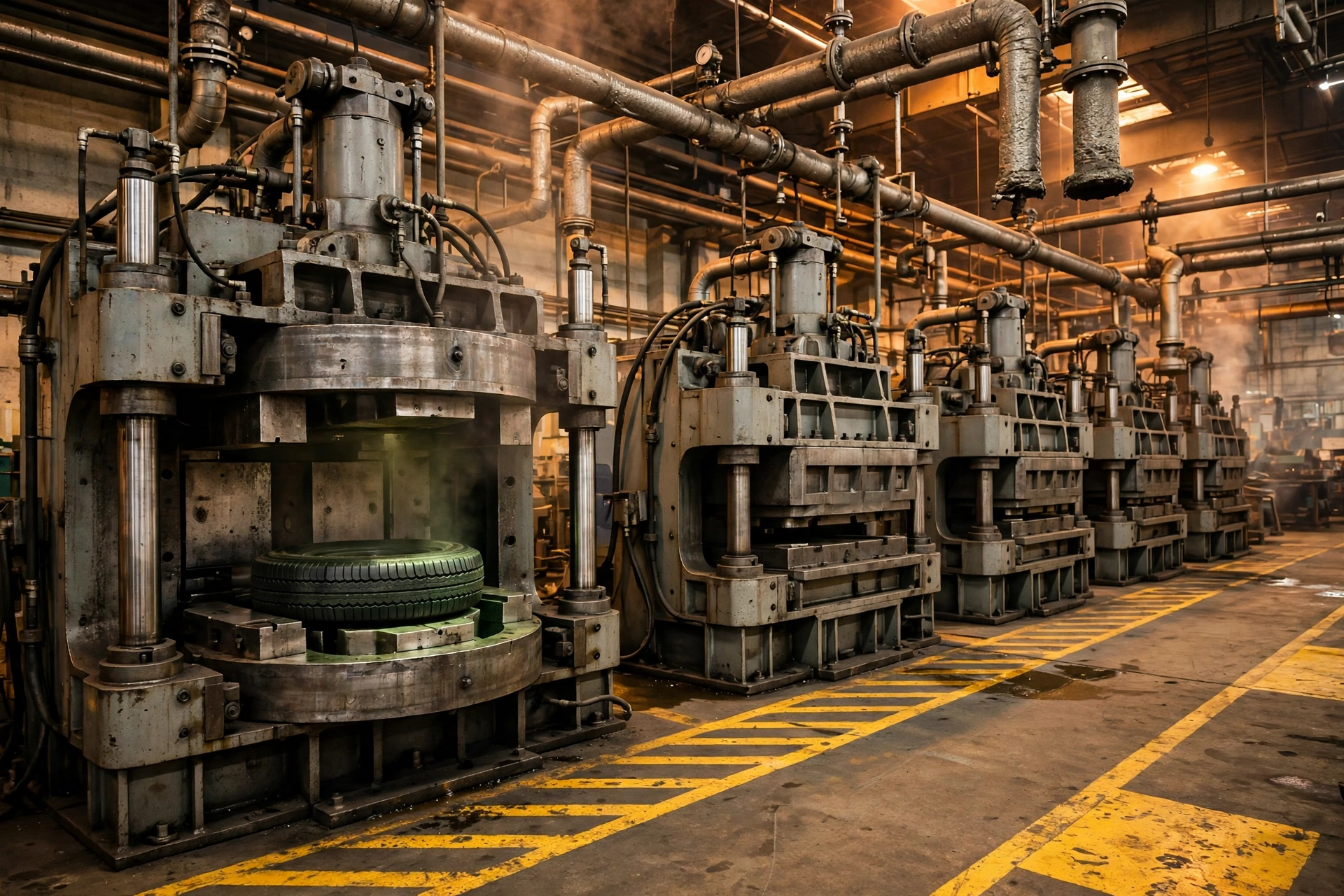
A worked example shows how the arithmetic runs. Take a plant making 5,000 tyres a day on two shifts, with 60 curing presses, one BM305N Banbury line and a gas-fired boiler. The essential board: curing hydraulics and controls 60 × 15 kW = 900 kW at a 60% diversity factor gives 540 kW; one Banbury line at peak 1,500 kW motor, running at an average 55% of peak across the batch cycle, gives 825 kW; two building lines 200 kW; utilities and boiler auxiliaries 250 kW. Total running load: 1,815 kW. At 0.8 power factor that is 2,269 kVA, before any starting transient. Add a 10–25% reserve margin for motor starting and load growth, and the set lands at 2,500–2,800 kVA — two 1,250 kVA sets in parallel, or one 2,500 kVA set with a soft starter on the Banbury.
The rating matters as much as the figure. A set that runs eight hours a day, five days a week, on a plant with an unreliable grid is on prime duty, not standby. Under ISO 8528-1, standby (ESP) allows 200 hours a year; a plant that loses the grid for 300 hours a year has already exceeded it. The standby and prime power ratings decide whether the manufacturer will stand behind the set at the plant’s real annual hours, and the price difference — roughly 10–15% more per kVA for prime — is small against a rebuild. The full generator sizing guide covers the load-list method in detail; the figures above are the tyre-plant application of it.
The Curing Window: What Ten Seconds Costs
A curing press does not forgive an interruption. Once steam pressure falls or the mould temperature drops below the cure window, the cross-linking reaction stalls. The tyre cannot be re-cured — reheating a partially cured tyre produces blisters, weak bonds and a reject. The press must be opened, the tyre scrapped, the mould cleaned and a new green tyre loaded. That cycle costs 20–40 minutes of press time per affected tyre, on top of the material.
The arithmetic of a short outage is brutal because the presses are synchronised by the clock, not by the grid. A hall of 100 presses running 15-minute cycles turns over about 400 tyres an hour. A ten-minute outage catches roughly 65 tyres mid-cure. At a factory-gate value of $40–60 per passenger tyre, that is $2,600–3,900 of material — before the restart labour, the lost press capacity, and the compound that sat cooling in the feed lines. A two-hour outage at a 10,000-tyre-a-day plant costs 800–900 tyres of lost production, or $32,000–54,000 at factory-gate prices, plus the restart. The generator’s job is not to save the electricity bill. It is to keep those 65 tyres in the mould from becoming scrap.
Case 1: Michelin Waterville — When the Grid Does Not Fail, It Sags
Michelin’s tyre plant at Waterville, Nova Scotia, illustrates the failure mode that a generator alone does not solve. The plant did not suffer blackouts. It suffered recurring voltage sags — brief dips that lasted a fraction of a second and were long enough to drop out the curing-press controls and the Banbury drives. Each sag stopped the line, scrapped the tyres in the presses, and forced a restart. CBC reported the pattern, and Michelin’s Canadian president told the provincial regulator that incoming power quality had fallen below the range specified in provincial regulations. The regulator approved a capital project of roughly $31 million for a dynamic voltage restorer — equipment that injects voltage during a disturbance to hold the plant’s supply within tolerance.
The lesson for generator sizing is direct. A standby set with a ten-second start time protects against a blackout. It does nothing for a 200-millisecond sag, because the presses have already tripped before the set cranks. Plants on weak rural grids need both: a fast ride-through device — a UPS or a dynamic voltage restorer — for the sags, and a generator for the outages. Specifying the generator without asking about sag frequency is specifying half a solution.
Case 2: Substation Fire in France — Two and a Half Days Without Mixing
A French tyre factory recorded in the ARIA industrial-accident database shows the other end of the scale. At about 5:00 a.m., during the lock-out of a 20 kV cell for maintenance, a fire broke out in the plant’s electrical substation near a 63 kV transformer. The internal contingency plan was initiated at 06:02, and the plant’s own emergency services extinguished the fire at about 6:40 a.m. Twelve 20 kV cells were destroyed, one of the four 63/20 kV transformers was destroyed by overcurrent, and the equipment in the neighbouring room was severely damaged.
The mould-making and mixing workshops were shut down for 2.5 days. No generator on the site could have replaced a destroyed substation — the fault was inside the plant’s own distribution, not on the grid. The case still belongs in a generator article, because it shows the limit of the argument. Backup power protects the process against loss of supply. It does not protect against loss of the switchboard the generator connects to. Plants that treat the generator as their only resilience measure, without a second feed route or a spare transformer, have a single point of failure one room away from the set.
Case 3: Goodyear Fayetteville — The Hydraulics That Feed Twenty Presses
Goodyear’s plant at Fayetteville, North Carolina, shows how curing capacity concentrates into a small number of shared systems. The plant’s tyre curing presses run from central hydraulic units, each supplying four to five presses. When the plant needed more capacity in 2014, it brought four stored hydraulic units back into service — enough for up to 20 additional presses — rather than buying new ones, because without those presses tyres backed up on the production line. Curing is the final step before testing, so a press that cannot run is a tyre that cannot ship.
The generator implication is that the hydraulic power pack is a single point of failure for four or five presses at once. Its motor is typically 55–110 kW, and it starts under load when the accumulators are empty. Losing one hydraulic unit to a tripped breaker costs five presses; losing the unit’s motor starter to a voltage dip costs the same. The essential board should carry the hydraulic units on their own circuit with their own protection, and the restart sequence should bring them up before the presses they serve.
Starting the Big Motors Without Tripping the Set
The largest risk in a tyre-plant generator installation is not the running load. It is the first ten seconds after the automatic transfer switch closes, when every motor that was running tries to restart at once. A Banbury motor started direct-on-line draws six to seven times its running current for two to three seconds. A 1,500 kW mixer motor therefore presents a transient of roughly 9,000–10,500 kVA to a set that may be rated at 2,500 kVA. The set will not carry it. It will dip, the under-voltage protection will trip, and the plant will be dark again — this time by its own hand.
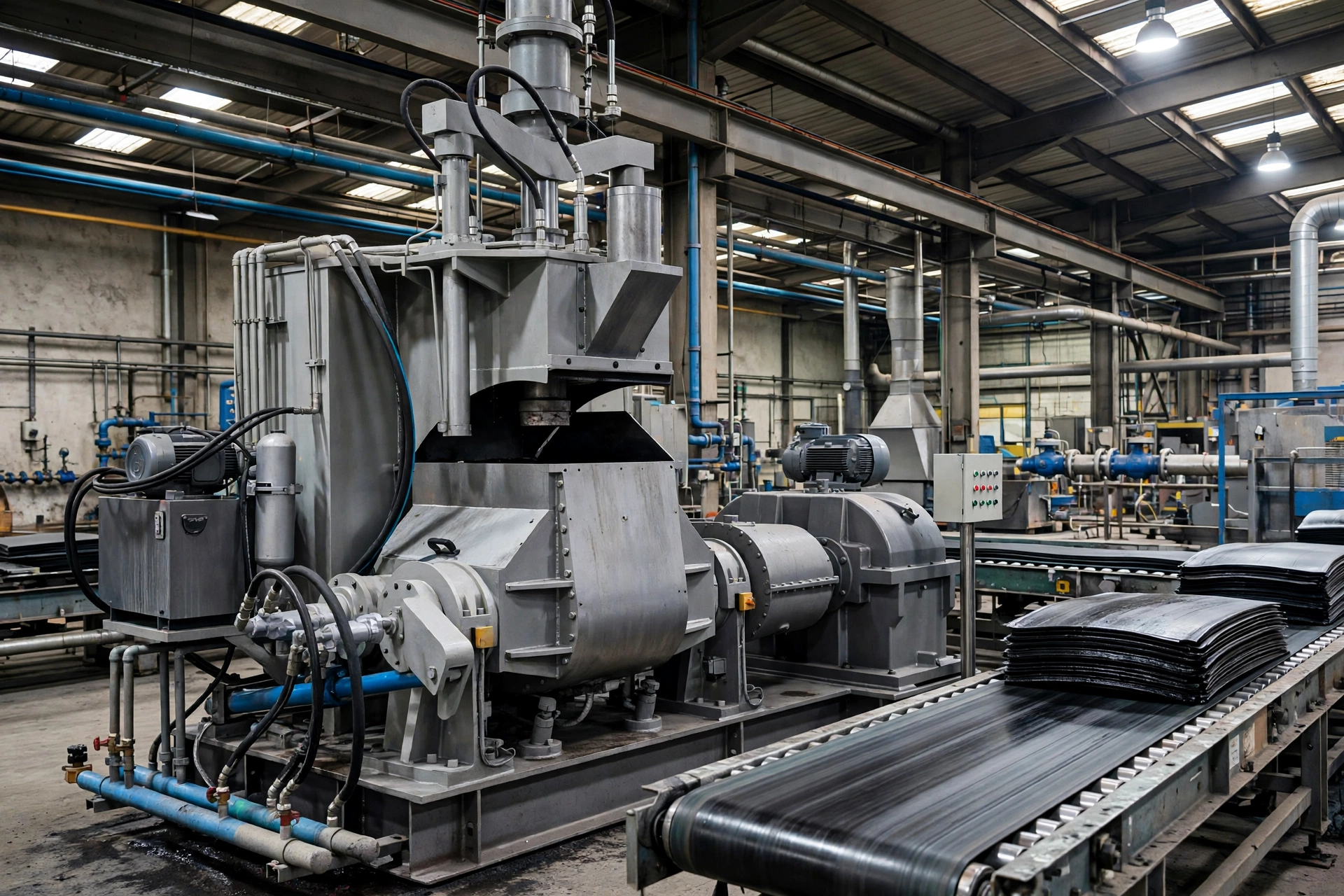
Banbury Direct-on-Line: The 1,500 kW Problem
The fix is never to start a Banbury direct-on-line from a generator. A soft starter limits the inrush to three to four times running current; a variable-frequency drive limits it to 1.5 times and adds the ability to ramp the rotors up to speed over 30–60 seconds. Either device cuts the transient to something a 2,500 kVA set can absorb. The cost — $15,000–40,000 for a soft starter on a 1,500 kW motor, more for a VFD — is small against the cost of the next frame size up in generator, and it pays again every time the plant transfers to generator power.
The same logic applies to the mill motors downstream of the mixer and to the large extruder drives. Most generator sizing errors are made on motor starting, and the tyre plant is the worst case for it: the largest motors in the building are also the ones the process needs first.
Press Hydraulics: Small Motors, Simultaneous Starts
The hydraulic power packs are individually small — 55–110 kW each — but they start together, because the press operators restart the hall as a group. Five units starting at once present 275–550 kW of motor load with a combined inrush of 1,650–3,850 kVA. The fix is sequencing, not size: start one hydraulic unit, wait for its accumulators to charge, then start the next. A programmable restart sequence in the plant’s PLC costs nothing in hardware and saves a frame size in generator.
Staged Restart Sequence: The Order That Works
A workable restart sequence for a tyre plant on generator power runs in this order. First, cooling water pumps and compressed-air compressors — without them nothing else can run. Second, the boiler auxiliaries, so steam pressure starts recovering. Third, one hydraulic unit and its presses, then the remaining units one at a time. Fourth, one Banbury line, ramped up on its soft starter or VFD. Fifth, the building lines. Each step is confirmed by current measurement before the next begins, and the whole sequence takes 8–15 minutes from transfer to full essential-board load. Plants that skip the sequence and close the main breaker on everything at once learn the lesson in the form of a tripped set and a second, longer outage.
Fuel Autonomy and the Steam Problem
A tyre plant that runs on generator power for 24 hours needs fuel in quantities that surprise first-time buyers. The Cummins C500D5 — 500 kVA standby / 455 kVA prime — burns 93.2 L/h at full prime load. Scale that linearly and the numbers are stark.
| Generator size | Fuel at full load | 24-hour autonomy | 72-hour autonomy |
|---|---|---|---|
| 500 kVA | 93 L/h | 2,230 L | 6,700 L |
| 1,250 kVA | 230 L/h | 5,500 L | 16,600 L |
| 2,000 kVA | 370 L/h | 8,900 L | 26,600 L |
| 2,500 kVA | 460 L/h | 11,000 L | 33,100 L |
| 3,750 kVA | 690 L/h | 16,600 L | 49,700 L |
A 2,500 kVA set at 75% load burns roughly 350 L/h, so a 24-hour outage needs about 8,400 litres and a 72-hour outage needs about 25,000 litres. The set’s own sub-base tank — typically 645–1,000 litres on a 500 kVA frame, more on larger frames — covers six to eight hours. Everything beyond that needs a bulk tank and a delivery contract. The fuel must also be usable: diesel fuel ageing in a standby tank is a real failure mode, with water and microbial growth clogging filters exactly when the set is needed most. A polishing and testing schedule belongs in the same contract as the fuel delivery.
Why Steam Boilers Set the Real Limit
The fuel table above answers the wrong question if the boiler is ignored. A gas-fired boiler keeps producing steam on generator power as long as its feed pumps, fans and controls have electricity — 100–300 kW for a plant boiler. The gas supply is the constraint, and a plant on a piped gas supply has no fuel problem at all for the boiler. An oil-fired boiler needs its own fuel store and its own delivery plan, sized alongside the generator’s diesel. An electric boiler is the failure case: a 1 MW electric boiler is a load the generator cannot carry, and the curing hall is dead regardless of the set’s size. The boiler’s fuel is the first question on any tyre-plant sizing visit, and the answer decides whether the generator project is a 2,500 kVA set or a boiler conversion as well.
Placement in a Hot, Dusty, Steam-Filled Plant
A generator room inside a tyre plant is a hostile environment, and the set’s life depends on where it sits and how it breathes. The three threats are heat, dust and steam, and each one takes a measurable slice off the set’s output or life.
Heat: The Curing Hall Runs at 35–45°C
A curing hall runs hot. Ambient temperature near the presses sits at 35–45°C for most of the shift, and a generator room sharing the same roof space sees the same air. The alternator loses about 3% of output per 10°C above 40°C, and the engine derates above its rated ambient as well. A 2,500 kVA set in a 45°C room is effectively a 2,350 kVA set before it starts. The remedy is separation: put the set in its own ventilated room or outside in a silent canopy, with its own air path, and size the generator room ventilation for the set’s rejected heat — roughly 8–10% of the set’s kW output as heat into the room — rather than for the hall’s comfort.
Rubber Dust and Carbon Black: Conductive, Abrasive, Everywhere
Carbon black is the defining dust of a tyre plant. It is fine, it is black, and it is electrically conductive. It coats air filters, clogs radiator fins, and settles on alternator windings and control boards, where it absorbs moisture and creates tracking paths. A set in a tyre plant needs its air filters inspected monthly rather than quarterly, its radiator blown out on the same schedule, and its alternator windings checked for contamination at each annual service. An open set inside the compounding hall will not survive this environment. A silent canopy with filtered intake air, or a dedicated room with positive-pressure filtered ventilation, is the minimum.
Steam and Corrosion: The Slow Failure
Steam leaks are a fact of life in a curing hall, and the humidity they create corrodes exhaust systems, control cabinets and battery terminals. A set that sits idle for months between outages corrodes fastest, because nothing dries it out. The diesel generator maintenance schedule for a tyre plant should include a monthly loaded run — not a no-load idle — specifically to bring the set up to temperature and drive moisture out of the windings and the exhaust. Battery terminals get a corrosion-inhibiting coating, and the control cabinet gets a heater. These are small items, and they are the difference between a set that starts in ten seconds and a set that starts after an electrician has cleaned its terminals.
Frequently Asked Questions
What size generator does a tyre plant need?
A plant making 5,000 passenger tyres a day typically needs 1,500–2,500 kVA for its essential board — curing presses, one Banbury line, steam and cooling. A 20,000-tyre-a-day plant needs 4,000–6,000 kVA or parallel sets. The figure comes from the curing and mixing loads, not from the plant’s total connected load, so a proper load list is worth more than a rule of thumb.
Do tyre plants need a backup generator?
Yes, wherever the grid is unreliable or the plant ships to just-in-time automotive customers. A ten-minute outage scraps every tyre in the curing presses — about 65 tyres in a 100-press hall — and a two-hour outage at a 10,000-tyre-a-day plant costs 800–900 tyres of lost production. The generator pays for itself against one long outage, not against the electricity bill.
How long can a tyre plant run on a generator?
As long as the fuel lasts. A 2,500 kVA set at 75% load burns about 350 L/h, so a 24-hour run needs roughly 8,400 litres and a 72-hour run needs about 25,000 litres. The real limit is usually the steam boiler: a gas-fired boiler runs indefinitely on generator power, while an electric boiler cannot be carried at all.
What happens to a tyre plant during a power outage?
Curing stops first and costs most. Every tyre in a press when the steam drops is scrapped, the presses need 20–40 minutes each to clean and reload, and the Banbury line stops mid-batch. Building and extrusion simply wait. A plant with a generator and a staged restart sequence is back at full essential-board load in 8–15 minutes; a plant without one loses the shift.
Can a diesel generator power a tyre plant?
Yes, for the essential board — curing, one mixing line, building at reduced capacity, steam auxiliaries and utilities. No generator powers a whole tyre plant at full production: the total connected load of a large plant runs to 10–20 MW, and the correct design is a sized essential board with load shedding, not a set the size of the plant.
Specification Checklist: Seven Lines Before the Deposit
1. Which loads are on the essential board, in writing? Curing presses, one Banbury line, building lines, boiler auxiliaries, compressed air, cooling water. If the list is not written down, the sizing is a guess.
2. What fuel does the steam boiler burn? Gas-fired is ideal for generator backup. Oil-fired needs its own fuel store. Electric cannot be carried — find out before the order, not after.
3. How does the Banbury start? Soft starter or VFD is required for generator operation. A direct-on-line start on a 1,500 kW mixer motor will trip a 2,500 kVA set.
4. Which rating is quoted — ESP, PRP or COP? A plant that loses the grid for more than 200 hours a year needs prime, not standby. The letters must appear on the datasheet and the contract.
5. What is the staged restart sequence? Cooling water, air, boiler, hydraulics one at a time, then one Banbury, then building. If the supplier has no sequence, the set will trip on its first real transfer.
6. How many hours of fuel are on site? The sub-base tank covers six to eight hours. A 24-hour autonomy target needs a bulk tank and a delivery contract, plus a fuel polishing schedule.
7. Where does the set breathe? A curing hall at 35–45°C with carbon-black dust needs a filtered, ventilated room or a silent canopy — not an open set on the compounding floor.
A tyre plant buys a generator for the same reason it buys a curing press: to keep a thermal process alive through the interruptions that would otherwise scrap its product. The set is sized by the cure, not by the catalogue. Get the essential board right, start the big motors in sequence, keep the steam alive, and the plant survives the outage with its presses full and its delivery schedule intact. Before requesting a price, send the supplier four lines: daily output in tyres, the number of curing presses and the Banbury frame size, the boiler fuel, and the site’s annual outage hours. Any manufacturer that knows its business — PAVO included, with a range of 9 to 3750 kVA in open, silent and containerised configurations, powered by Cummins, Weichai, Yuchai and Shanghai Diesel — will price the correct set from those four lines.
For a sized quotation on a tyre-plant set, contact PAVO with the plant’s daily output, press count and boiler fuel, and the correct rating will be quoted against the essential board rather than the catalogue.