

Can a Diesel Generator Be Saved After a Flood? | PAVO
Flood water does not ask what a generator cost. It rises to the same line on a 20 kVA portable and a 2,000 kVA containerised set — and the difference between a saved machine and scrap is usually decided in the first hours, before anyone touches the start button.
Can a diesel generator be saved after a flood? In most cases, yes — if the set was not running when the water arrived and nobody tries to start it while it is still wet. Fresh water below the alternator usually means a clean, dry and test; salt water above the windings usually means a rewind or a replacement.
Contents:
- What the Water Line Tells You
- Fresh Water, Salt Water and Mud: Three Different Damages
- The First 24 Hours: What to Do and What Never to Do
- Drying the Alternator: Megger Readings That Decide
- Engine, Fuel and Oil After Water Ingestion
- Three Flood Cases: Saved, Rebuilt, Written Off
- Frequently Asked Questions
- Repair or Replace: The Decision Checklist
What the Water Line Tells You
The first measurement after a flood is not electrical. It is a tape measure. The height of the water line on the canopy or the skid decides almost everything that follows, because each component sits at a different height and each one fails in a different way.
A standby set in a basement is the most common flood casualty. Basements collect water, and generator rooms are often placed in basements because the weight, the noise and the exhaust routing are easier there. Tropical Storm Allison in 2001 flooded the basements of the Texas Medical Center in Houston; backup generators sat under water and the hospitals lost power during the storm they were built to survive. Eleven years later, Hurricane Sandy flooded the basement generator plant at NYU Langone in New York, and the hospital evacuated more than 300 patients down dark stairwells. Both sites had generators. Both had them in the wrong place for the water that arrived.
Below the skid: a wash and a check
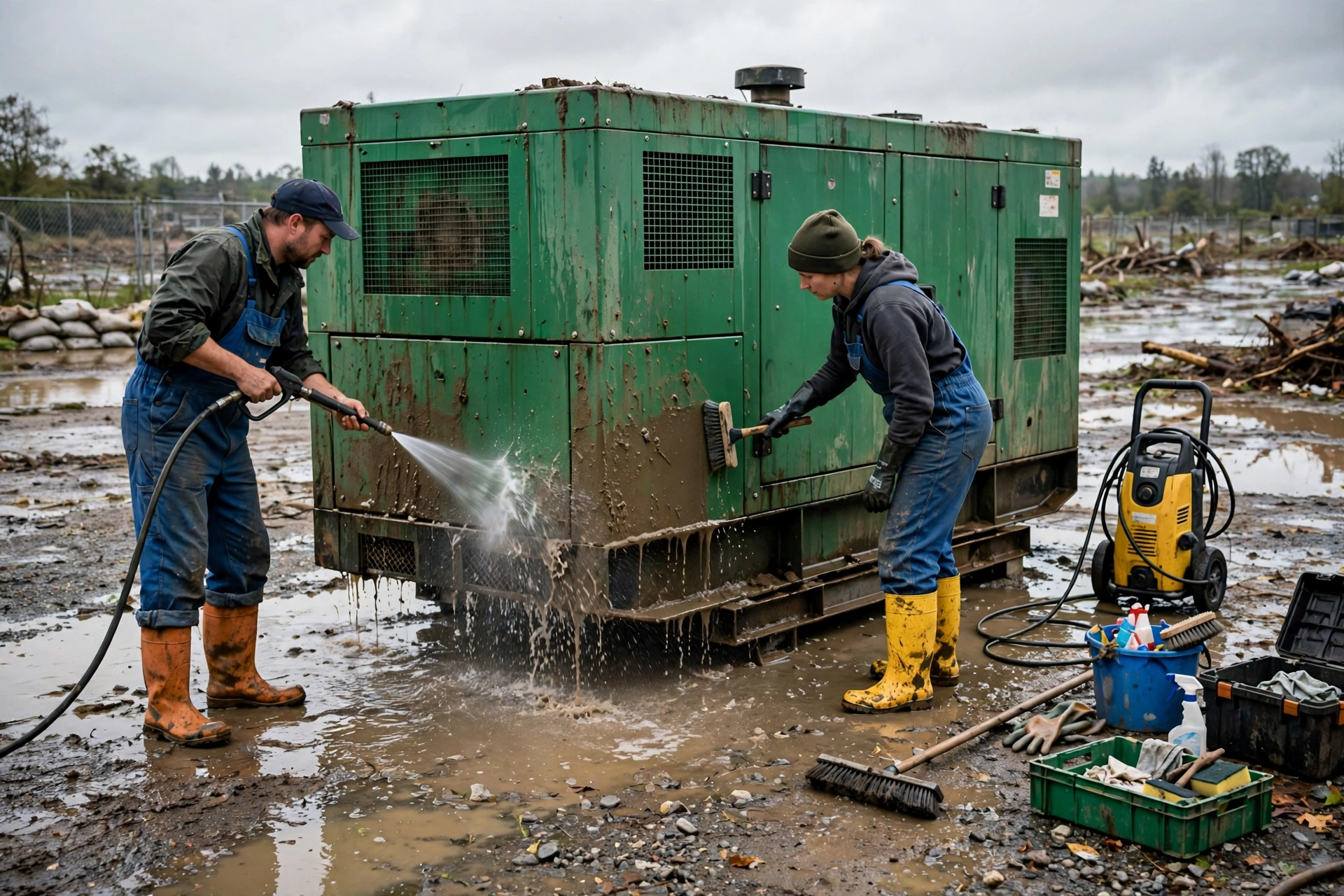
Water that reaches the base frame but stays below the engine sump and the alternator is the best outcome a flood can offer. The damage is mostly external: silt on the frame, water in the bund, a soaked battery box, corrosion starting on unpainted steel. The fix is a wash-down with fresh water, a dry-out, new filters, and an insulation test before the set is returned to service. A set in this condition is usually back on line in a day, and the bill is mostly labour.
The check that matters here is the battery. Batteries sit low, and a flooded battery box means terminals under water. A 12 V or 24 V starting battery that has been submerged should be load-tested before it is trusted again. A battery that cranks slowly after a flood is not a minor inconvenience; it is the reason the set fails to start at the next outage, when the water is long gone and nobody connects the two events.
At the alternator: the decision line
Water that reaches the alternator windings changes the job completely. The alternator is the most expensive single component after the engine, and it is the least tolerant of water. Windings are copper wire coated in enamel and varnish, packed tight, with air gaps that trap water for days. Once water is inside the stator, the question is no longer whether the set runs. It is whether the insulation still holds voltage without breaking down to earth.
This is the level at which a flood stops being a cleaning job and becomes an engineering decision. The set must be dried and megger-tested before any attempt to start it. If the insulation resistance recovers, the set lives. If it does not, the alternator needs a rewind or a replacement stator, and the cost of that work decides whether the repair is worth doing at all.
Above the engine: usually a rebuild or a replacement
Water above the engine — over the air filter, the turbocharger, the top of the cylinder head — means water has entered every system at once: intake, exhaust, fuel, oil, cooling and control. An engine that was running when the water arrived is worse still, because a running engine sucks water through the intake and into the cylinders, where water does not compress. The result is a bent connecting rod, a cracked piston or a broken crankshaft, and the damage is visible only when the head comes off.
A set submerged to this depth is rarely written off on the spot. It is written off after the strip-down, when the workshop prices a rewind, a rebuild, a controller, a radiator and a fuel system against the price of a new set. The water line tells the owner where that conversation is heading before the first spanner is lifted.
| Water level | What is usually damaged | Typical outcome |
|---|---|---|
| Below the skid | Frame, battery box, bund | Wash, dry, test — back in service in a day |
| Up to the alternator | Windings, bearings, control wiring | Dry and megger test — rewind if insulation fails |
| Over the engine | Cylinders, turbo, fuel, oil, controller | Strip-down — rebuild or replace decision |
| Full submersion, running | Engine internals, alternator, electronics | Usually a write-off on sets under 500 kVA |
Fresh Water, Salt Water and Mud: Three Different Damages
Flood water is not one substance. Fresh water, salt water and muddy water attack a generator in three different ways, and the treatment for one can make another worse. The first question after the water line is always what kind of water it was.
Fresh water: mostly a drying problem
Fresh water — rain, river water, a burst main — is the most forgiving flood. It conducts electricity poorly, it carries little dissolved salt, and it does not start aggressive corrosion on its own. The damage it causes is mostly about time: water sitting in windings, bearings and fuel tanks while the owner waits for the site to dry.
The risk with fresh water is complacency. A set that looks dry on the outside can still hold water inside the alternator for a week, and a set that starts and runs after a fresh-water flood can fail three months later when a bearing that was never dried properly seizes, or when insulation that was never tested breaks down under load. Fresh water forgives a fast response and punishes a slow one. Drying is the whole job, and the megger reading is the proof that it worked.
Salt water: corrosion that keeps working after the flood
Salt water is a different problem entirely. Seawater conducts electricity roughly a hundred times better than fresh water — about 5 S/m against about 0.05 S/m — which means it turns every wet connection into a short circuit and every pair of dissimilar metals into a battery. Corrosion in salt water does not stop when the water drains away. Salt crystals left behind in windings, terminals and bearings absorb moisture from humid air and keep corroding for months.
The numbers from coastal service make the point. A resort owner in Barbados installed a standard open set without an intake-filter upgrade in salt air; within 18 months the engine had lost 25% of its power, and replacement piston rings cost $4,000. That was salt air, not submersion. A set actually submerged in seawater faces the same chemistry at full strength, inside the machine rather than on its surface. Copper windings turn green, steel shafts pit, aluminium housings powder, and electronic boards fail weeks after the flood, when the owner believes the set is fixed.
Salt water also changes the drying rule. A salt-water set must be flushed with fresh water before it is dried, because drying salt water in place leaves the salt behind. A set that is dried without flushing is a set that will corrode from the inside for the rest of its life. Any workshop that quotes a salt-water recovery without a fresh-water flush in the procedure should be asked to add one, in writing.
Mud and silt: the abrasive that hides in bearings
Muddy flood water carries a third kind of damage: grit. Silt is fine enough to pass seals and coarse enough to grind. It settles in bearing housings, in the air filter, in the radiator core, in the fuel tank and in every low point of the exhaust. A set that has been in muddy water needs every filter changed, the radiator core washed from the inside, the fuel tank drained and cleaned, and the bearings inspected — not just the outside washed.
Mud also hides the water line. A set that looks as though the water reached the skid may have silt packed to the alternator, and the only way to know is to open the covers. The cleaning time for a muddy set is roughly double that of a clean-water set of the same size, and the cost of skipping the cleaning shows up as a failed bearing or a blocked radiator at the next full-load run.
The First 24 Hours: What to Do and What Never to Do
The first day after a flood decides more than the first week of repair work. Three actions in the first 24 hours protect the set; one action in the first hour can destroy it.
Never start a wet generator
The single most important rule in flood recovery is also the simplest: do not start a generator that has been under water. Every major manufacturer states it in the same words. Generac’s manual for its Guardian range puts it plainly — if the generator has been submerged in water, it must not be started and operated, and an authorised dealer must thoroughly clean and dry it first.
Starting a wet set does two kinds of damage at once. Electrically, water in the windings and the control panel creates paths for current that the insulation was never designed to carry, and the first start can burn out a stator that drying alone would have saved. Mechanically, water in the cylinders cannot compress, so the starter motor drives the piston into a solid column of water and bends the connecting rod. A set that could have been saved by drying becomes a set that needs an engine rebuild, and the difference is one turn of the key.
The rule applies even when the set looks dry. Water hides in windings, in the bottom of the fuel tank, in the air filter housing and in the exhaust. If the water line reached the alternator or the engine, the set is wet until a megger test and an oil sample prove otherwise.
Isolate, drain, document
Once the decision not to start is made, the first 24 hours have a clear sequence. Isolate the set electrically — open the breaker, disconnect the battery, tag the automatic transfer switch so nobody starts the set remotely during the outage that usually follows a flood. A set that starts itself on a remote command while a technician is working on wet windings is a safety incident, not a recovery.
Drain what can be drained: the sump, the fuel tank, the coolant, the air filter housing. Water in oil turns the oil milky within hours, and water in diesel sinks to the bottom of the tank, where it feeds microbes and corrodes the tank from the inside. Photograph the water line on the canopy before anything is washed, and keep a sample of the flood water if the site is insured. Insurers ask for the water line, the water type and the duration of submersion; a photograph taken on day one is worth more than a reconstruction on day thirty.
The 72-hour corrosion clock
Corrosion does not wait for the workshop. On bare steel, rust starts within hours of exposure to air after a flood, and on salt-water sets the clock runs faster. Bearings are the most urgent item: water washes the grease out of a bearing and leaves the steel surfaces in contact, and a bearing that sits wet for three days can be ruined even if the rest of the set is saved.
The practical rule is that a flooded set should be in a workshop, or at least stripped, washed and oiled, within 72 hours. After that, the recovery cost rises steeply, because every additional day adds corrosion to the parts list. A set that is dried in three days and a set that is dried in three weeks are not the same repair, even when the water line was identical.
Drying the Alternator: Megger Readings That Decide
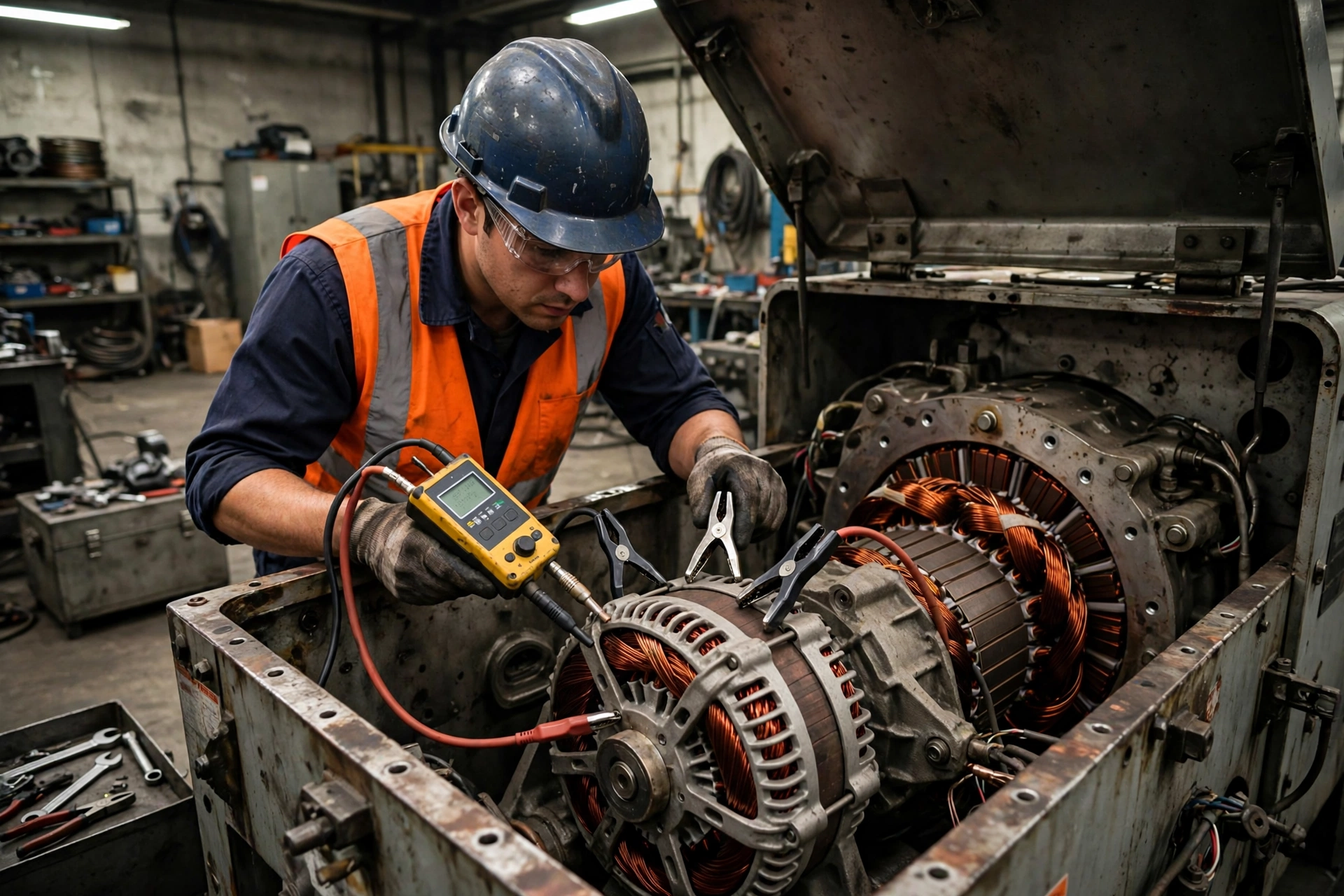
The alternator is where flood recovery is won or lost, and the tool that decides it is a small grey box that costs less than a tank of diesel: the insulation resistance tester, universally called a megger after the brand that invented it.
What the megger is actually measuring
An insulation resistance test pushes a high DC voltage — usually 500 or 1,000 volts on a low-voltage alternator — into the winding and measures how much current leaks through the insulation to earth. Dry, healthy insulation leaks almost nothing. Wet insulation leaks freely. The reading, in megohms, is the most honest number in flood recovery, because it cannot be argued with and it cannot be faked by a set that looks clean.
The test takes about a minute per phase. It is done with the set isolated and the AVR disconnected, because the test voltage will damage electronic components. Any technician who megger-tests a set with the AVR still connected has not done the test properly, and the reading should not be trusted.
Reading the numbers: the three buckets
After a flood, almost every reading falls into one of three buckets. The first is near zero — fractions of a megohm, or a dead short. That is not moisture. That is damage: a winding that has been cut, crushed or carbon-tracked. No amount of drying fixes it. The machine needs a rewind or a replacement stator.
The second bucket is a tenth of a megohm up to about one. That is the damp machine, and it is the most common result after a flood. Nine times out of ten, it is moisture, not damage. The fix is heat and time: space heaters if the set has them, or warm dry air pushed through the windings, then a retest. IEEE 43 gives a useful floor for the decision — a minimum insulation resistance of roughly the rated voltage in kV plus 1 MΩ — so a 400 V machine should read at least about 1.4 MΩ before it is energised. The working rule on most sites is simpler and stricter: below about 1 MΩ, stop. Do not energise. Do not “just try it.”
The third bucket is 5 MΩ and up. That is a healthy machine. Start it — but remember that insulation resistance roughly halves for every 10°C the winding warms up, so a reading taken on a cold winding always looks better than the same winding hot. A cold reading of 5 MΩ that falls to 2 MΩ at operating temperature is normal. A cold reading of 1.2 MΩ that falls below 1 MΩ hot is not.
| Megger reading (400 V machine) | What it means | Action |
|---|---|---|
| Near zero / dead short | Winding damage | Rewind or replace stator |
| 0.1–1 MΩ | Damp windings | Dry with heat, retest until above 1 MΩ |
| 1–5 MΩ | Drying, but not proven | Continue drying, retest hot and cold |
| 5 MΩ and above | Healthy insulation | Start under load, retest after first run |
How drying works in practice
Drying a flooded alternator is slow work, and the time it takes surprises owners who expect a day. A 250 kVA stator holds litres of water in its windings, and the water leaves only as vapour, carried out by warm dry air. Space heaters fitted to the set are the best tool if they survived the flood; a portable heater and a fan pushing 40–50°C air through the alternator is the usual substitute. The target is a steady rise in the megger reading over days, not hours.
A realistic drying time for a 200–500 kVA set is three to seven days of continuous warm air, with a megger reading taken every 12 hours. A set that reaches 5 MΩ in two days was less wet than it looked. A set that is still below 1 MΩ after a week of drying has either trapped water in a low point or insulation damage that drying will not fix. At that point the rewind quote, not the heater, is the next step.
Engine, Fuel and Oil After Water Ingestion
While the alternator dries, the engine needs its own strip-down. Water in an engine is not a single problem. It is five problems in five systems, and each one has to be cleared before the set turns over.
Water above the pistons: hydrolock
If water entered through the air intake or the exhaust, it sits above the pistons. Water does not compress, so the first crank drives the piston into a solid column and something has to give — usually the connecting rod. The check is simple and must be done before the starter is touched: remove the injectors, bar the engine over by hand, and watch for water coming out of the injector holes. If water comes out, keep barring until it stops. If the engine will not bar over by hand, stop. A seized engine that is forced with the starter becomes a broken engine.
An engine that hydrolocked while running is a different matter. The damage is already done, and the strip-down will find it: a bent rod, a cracked piston crown, a scored liner. The repair cost for a hydrolocked engine on a 500 kVA set typically runs $6,000–$15,000 in parts and labour, and on a set that also needs an alternator rewind, that figure is usually what tips the decision toward replacement.
Oil and fuel: drain everything, twice
Water in the sump emulsifies the oil into a milky liquid that no longer lubricates. The fix is to drain the sump, change the oil filter, refill with fresh oil, run the engine briefly once it is cleared to start, and then drain and change the oil again. The second change catches the water that the first change missed, sitting in the oil cooler and the galleries. An oil sample taken after the second change should show no water at all. If it still shows water, there is a leak the flood exposed — a cracked cooler, a failed seal — and it needs finding before the set goes back to work.
Fuel is the same story with a longer tail. Water in the tank sinks to the bottom, where it feeds the microbes that cause diesel fuel ageing and clog filters with black slime. A flooded tank should be drained completely, the bottom of the tank inspected and cleaned, the fuel filters changed, and the fuel polished or replaced. Fuel that looks clear in a sample jar can still carry enough water to shut the set down under load, and the failure will arrive at the worst possible moment — during the next outage, when the set is carrying the building.
Air intake, turbocharger and exhaust
The air filter is the first casualty of any flood and the cheapest to fix. A paper filter element that has been wet is finished; it must be replaced, not dried and reused. The turbocharger needs its shaft checked for free rotation and its oil feed checked for water contamination, because a turbo that ingested grit will fail at full speed, not at idle. The exhaust system needs draining — water sits in the silencer and the low points of the pipe, and the first start after a flood can push a slug of water back into the cylinders through an open exhaust valve.
Three Flood Cases: Saved, Rebuilt, Written Off
Flood recovery is decided case by case, and the pattern is consistent enough to describe. Three real-shaped cases from recent flood seasons show the range.
Case 1: Lagos hospital basement — 500 kVA, fresh water, saved
A private hospital outside Lagos runs a 500 kVA Cummins set, a C500D5 on a QSZ13-G5 engine, as its standby supply. The set sits in a basement plant room with a single drain that blocked during a night of heavy rain. Water rose to 600 mm — above the skid, below the alternator terminal box, and into the battery box and the bottom of the control panel.
The facilities manager did the one thing that saved the set: he did not start it. He isolated the breaker, disconnected the batteries, photographed the water line and called the service contractor the same morning. The contractor drained the sump and the fuel tank, removed the control panel for drying, washed the frame with fresh water and put space heaters on the alternator for four days. Megger readings started at 0.4 MΩ, rose to 1.8 MΩ on day two and reached 7 MΩ on day four. The set was load-tested at 75% load for two hours, then returned to service.
Total cost: about $3,800, including the call-out, the drying, new filters, a new battery pair and the load bank test. Downtime: nine days. The set has run its monthly tests without a fault since, and the hospital has since fitted a high-level alarm in the plant room and a second drain. The flood cost the hospital a week. A single start attempt on the wet set would have cost it an alternator.
Case 2: Coastal resort, Cox’s Bazar — 250 kVA, salt surge, written off
A beach resort in Cox’s Bazar, Bangladesh, runs a 250 kVA silent set behind the main building, 200 metres from the shoreline. A cyclone storm surge pushed seawater across the site to a depth of 900 mm, submerging the set to the top of the canopy. The set was not running. It sat in salt water for eleven hours before the water receded, and it sat for a further six days before a technician reached the site, because the roads were closed.
By the time the covers came off, the damage was visible without instruments: green corrosion on every copper terminal, white powder on the aluminium control housing, rust on the alternator shaft, and salt crystals in the stator vents. The megger reading was 0.05 MΩ — effectively a short. The engine barred over by hand, but the oil was emulsified and the fuel tank held a layer of seawater under the diesel. The controller board was dead, the battery charger was dead, and the AVR was corroded beyond cleaning.
The workshop priced the recovery: alternator rewind $9,500, engine strip and rebuild $7,000, controller and AVR $3,200, radiator and fuel system $1,800, labour $4,500 — a total of about $26,000, against a replacement set at $31,000 with a full warranty. The resort replaced the set and raised the new one on a 1.2-metre plinth, with the fuel tank on a separate raised bund. The old set was sold for parts. The decision was not close, and the six-day delay was part of why: salt water left standing in a machine for a week does damage that a same-day flush would have limited.
Case 3: Dhaka construction site — 110 kVA trailer set in mud, saved
A construction contractor in Dhaka runs a 110 kVA trailer-mounted set that moves between sites. During the monsoon the set was parked on low ground, and flood water carrying heavy silt rose to the axle line — about 500 mm — and stayed for two days. The water was muddy rather than salty, and the set was off.
The recovery took longer than a clean-water job and cost more in labour than in parts. Every filter was changed, the radiator core was washed from the inside with low-pressure water, the fuel tank was drained and the bottom wiped clean of silt, and the alternator was dried for five days before the megger reading cleared 5 MΩ. The bearings were the surprise: silt had passed the seals on the alternator drive-end bearing, and the bearing was replaced as a precaution for $180 rather than risking a seizure at full load.
Total cost: about $2,400, most of it labour and drying time. Downtime: eight days. The set has since been parked on a raised gravel pad with the trailer jacked up, and the site manager’s rule is simple: if the forecast says heavy rain, the set moves to high ground before the rain, not after it.
Frequently Asked Questions
Can a diesel generator be saved after a flood?
In most cases, yes — if the set was not running when the water arrived and nobody tries to start it while it is still wet. Fresh water below the alternator usually means a clean, dry and test. Salt water above the windings, or a set that was started wet, usually means a rewind or a replacement. The water line, the water type and a megger reading decide the outcome.
What to do if your generator gets wet in a flood?
Do not start it. Isolate the breaker, disconnect the battery, and photograph the water line before anything is washed. Drain the oil and the fuel, remove the air filter, and call a service contractor to megger-test the alternator. A set that is dried properly and tested before starting can usually be saved; a set that is started wet often cannot.
Can salt water damage a diesel generator beyond repair?
Salt water can, and often does. Seawater conducts electricity about a hundred times better than fresh water, and the salt left behind keeps corroding windings, terminals and bearings for months after the flood. A salt-water set must be flushed with fresh water before drying. If the megger reading stays near zero after a week of drying, the alternator needs a rewind, and the repair is usually only worth doing on sets above 500 kVA.
How to dry out a flooded diesel generator?
Drain the oil, fuel and coolant first, then dry the alternator with space heaters or warm dry air at 40–50°C, with a megger reading every 12 hours. A 200–500 kVA set typically needs three to seven days of continuous drying to reach 5 MΩ. Do not use a high-pressure washer inside the alternator, and do not rush the drying — a set that reads 1 MΩ cold can fall below 1 MΩ when hot.
How much does it cost to repair a flooded diesel generator?
A clean fresh-water recovery on a mid-range set typically costs $2,000–$5,000, mostly labour, drying and filters. An alternator rewind adds $8,000–$20,000 depending on size, and a controller and AVR replacement adds $1,500–$4,000. If the total repair passes 50–60% of the price of a new set with a warranty, replacement is usually the better decision.
Repair or Replace: The Decision Checklist
A flooded set should not be repaired on optimism. It should be repaired on numbers. Price the spare parts first — filters, bearings, sensors and a controller are the items that turn a drying job into a rebuild — then work through the checklist below, in order.
1. What was the water line? Below the skid, repair. At the alternator, test before deciding. Above the engine, price a rebuild against a replacement before spending anything.
2. What kind of water? Fresh water favours repair. Salt water adds a rewind to the bill and a corrosion risk that outlasts the repair. Muddy water doubles the cleaning time and adds a bearing inspection.
3. What does the megger say? Below 1 MΩ after a week of drying, the alternator is the decision. Near zero, it is a rewind or a new stator, and the quote for that work is the number that matters.
4. Was the set running when the water arrived? A running set that ingested water may have a bent connecting rod. Bar the engine over by hand with the injectors out before any other decision is made.
5. What does the repair cost against a new set? Add the rewind, the rebuild, the controller, the fuel system and the labour, then compare with a new set of the same standby rating. If the repair passes 50–60% of the replacement price, buy the new set and keep the warranty.
6. How long was the set wet? A set dried within 72 hours is a different repair from a set that sat wet for a week. Salt water left standing for a week does damage that a same-day flush would have limited, and the bill reflects it.
7. Can the site be protected next time? A raised plinth, a high-level alarm, a second drain and a generator room above the flood line cost less than one recovery. A set that floods twice is not unlucky. It is installed in the wrong place.
Flood damage is not a single failure. It is a sequence — water, then corrosion, then a start attempt on a wet machine — and the sequence can be broken at any point. The cheapest point is the first one: do not start a wet generator, and get it dry within three days. Everything after that is priced in thousands.
A buyer who has already lost a set to a flood, or who is specifying a set for a site that floods, should ask the supplier three questions before the next order: what is the flood history of the site, what height the set will sit at, and what the plinth and drainage will cost. Any manufacturer that knows its business — PAVO included, with a range of 9 to 3750 kVA in open, silent and containerised configurations, powered by Cummins, Weichai, Yuchai and Shanghai Diesel — will price the protection from those three answers. A supplier that prices from kVA alone is not doing the buyer a favour.
For a site assessment, a recovery quote or a replacement set raised above the flood line, contact PAVO — the team can price the set, the plinth and the drainage together, before the next storm arrives.